ETL Speaker Series: Hemant Taneja, General Catalyst
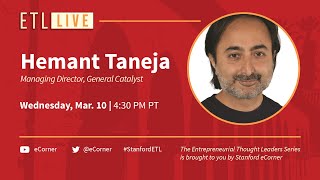
This content was created by GHION.AI . This content was uploaded by GHION.AI . This is a YouTube video from Stanford's Entrepreneurial Thought Leaders (ETL) Speaker Series titled "ETL Speaker Series: Hemant Taneja, General Catalyst," recorded March 11, 2021. Host Tom Byers interviews Hemant Taneja (Managing Director at General Catalyst, author, and part-time Stanford instructor). The session covers the evolution of venture capital, entrepreneurship advice for students and founders, healthcare innovation (the Livongo story and the Livongo–Teladoc merger, the "health assurance" thesis), responsible AI and ethics (accountability, transparency, explainability; the 2019 HBR piece on moving beyond "move fast and break things"), DEI and equity concerns, SPACs and an alternative SALE structure, and practical Q&A about regulation, business models, and founder–VC relationships.
Chapters
away with mine. Hi, I'm Tom Byers, and I'd like to welcome everybody to the Entrepreneurial Thought Leader Seminar Series here at Stanford University. It's presented by SDVP, which is the entrepreneurship center that I'm associated with, and all your other guests, hosts this winter. And it's also put on by BASES, the Business Association for Stanford Entrepreneurship Students. So we're really glad to have that partnership continuing between STVP and BASES. Today, I'm really delighted. I mean, genuinely delighted that I get to spend this time with Haman and a few other people online. But every time I get a chance to talk with him, I learn something new, and I go away being super inspired. So fasten your seatbelts, folks. Hey, Matt. Tanaja. Excuse me. Tanaja. I'm so nervous, I can't even say your name. You can call me anything you want. Call me Tim the rest of this session. He's the managing director at General Catalyst and has been an early investor in— get this— these leading companies: Digit, Grammarly, Gusto, Livongo, Mindstrong, Samsara, Snap, and Stripe. He also is an author, and I recommend all of his publications. One of them in 2018 we're going to talk a little bit about today is called Unscaled, and it was regarding the need for accountability and transparency and explainability in AI technologies. Then there's a piece that is heavily influencing me as we work on this ethics and entrepreneurship project. And this is the piece that the Harvard Business Review article in 2019 called "The Era of Move Fast and Break Things Is Over." So we'll talk a little bit about that today. But in addition to this, let me just talk about what he does in his spare time besides writing books and being a world-class venture capitalist. He's co-founder of the Advanced Energy Economy, an organization focused on transforming energy policy in America. He's the founding board member of the Khan Lab School, nonprofit K-12 school dedicated to classroom innovation. And he sits on the board of fellows right here at Stanford University in their school, in the School of Medicine. He also, and this really makes me happy to share, that he teaches a terrific computer science course, not this year because his partner's on sabbatical, but next year. So for the Stanford students listening, get ready for this if you have room in your schedule next year. It's called Artificial Intelligence Entrepreneurship and Society in the 21st Century and Beyond. So welcome, Aymond. How you doing?
Thanks for having me, Tom.
Well, you— and I noticed that already on the Q&A, some folks noticed something that I didn't mention— 5 degrees from MIT. Okay, smarty pants, what were they in? I'm testing you. Do you remember what you got 5 degrees in?
Yeah, well, it was computer science and electrical engineering, mathematics, biology, operations research, which was a master's, and the master's in computer science.
Okay, I think in a history of 20 years of doing ETL, which is, you know, 24 speakers a year or so, That means 500 speakers. You might have more degrees than anybody we've ever had.
Tom, it's not a marker of intellect. It's a marker of ADHD, which is why I'm a venture capitalist.
Why did you get all the degrees? You just enjoyed school so much?
You know, honestly, my favorite thing to do in undergrad— and I know this sounds a little geeky— was looking at the course catalog and just seeing all the things that were available. And, you know, MIT, like Stanford, is a very interdisciplinary place. And I just, for the first few years, took all the classes that I thought were interesting, and then started deciding what am I going to graduate in towards the end of my journey there. And then there were a few departments that I could have finished, so I, you know, sort of loaded up and tried to finish whatever I could. So it was, it was not planned. It was more curiosity-driven.
Well, then I'm sort of perplexed. You got out in 1999, and around the time of the infamous dot-com period in technology. Why did you want to become a venture capitalist? Why did you become a venture capitalist?
Yeah, it's sort of interesting. I was actually, uh, in a doctoral program, and my goal was to be a professor. And, uh, I mean, you remember this well, in the late '90s, it was this unbelievable time where on campus all these faculty and students were starting to build businesses with the arrival of the internet, and it just felt like it was a moment in time I wanted to be a part of. And, you know, took a couple of my grad school friends who were some of my best friends, and we decided, hey, let's go build a business.
And really it was to be part of that moment.
I used to joke my life's a bit of a greedy algorithm, This is the most interesting thing going on right now, so I'm just going to go participate in it. And, uh, we just jumped ship. So one day I was an academic, and the next day I was trying to figure out what does it mean to actually start a company. It was—
so you made your way to becoming a venture capitalist shortly thereafter?
Yeah, so that's right. So I did, I did, I built a business for about, uh, 3.5, 4 years, was terrible at it. Learned how difficult it is, which frankly helped me get empathy for what it means to be an entrepreneur, and that's always stuck with me because I struggled so much. And, you know, we sold that business, which was in the mobile infrastructure arena, and at that point General Catalyst was just starting, and they invited me in to be an entrepreneur-in-residence. So I actually sort of said, hey, I had my 4-year gig, made lots of mistakes, I want to do it again, and I'll go sit with this new firm and try to be an entrepreneur in residence. So I actually never really thought I was going to be a VC. It just somehow, you know, serendipitously happened.
Yeah, and you have been since then, including coming out west 10 years ago to start the GC office, which is right downtown, everybody, right on University Avenue. Um, but when's the last time you're in the office?
Boy, uh, last May.
Yeah.
And then our CHRO found out I'm not supposed to do that, so I have not, have not gone there since.
Yeah, well, it's a cool old home. And so folks, when you come to visit again someday, uh, or live here, you should check it out down on University Avenue, right downtown. But what, how has the industry changed over 20 years, you know, from the time you joined to now? I'm talking about the venture capital industry.
I think a lot about that.
It has, it has materially changed. So when I think about when I got in the business, um, all of our effort was on how software can fundamentally bring efficiency to our life, right? What's better software for doctors? What's better software for teachers, supply chain managers, or consumers on the internet? And you fast forward today we're actually redesigning all the core pillars of society, right? We're actually building new healthcare services, we're building new insurance companies, we're building new schools, uh, all, you know, digitally powered. So what does that mean? Um, that means we've gone from efficiency to efficacy in terms of the value proposition of the companies, uh, that we're building. The second thing is we've gone from being a technology vendor to, uh, actually redesigning these core services in society. So if technology was 1% of the budget that we were serving for these markets 20 years ago, we're going after the entire 100% of the budget. What does that mean? Well, a billion-dollar win used to be amazing in the early 2000s, and, and now you're actually seeing $100 billion companies being built. So everything has changed in terms of, um, the size and scope of the ideas, and therefore the responsibility that we have in how we manifest those ideas.
Well, I'm looking forward to diving deeper into that. Is there one story of one of your portfolio companies or companies you've had a hand in investing in or being on their board and nurturing them that illustrate that? Is that— would that Stripe be that, for example?
Yeah, look, I mean, I think the, the one I would give you is actually— maybe because I'm spending so much time in healthcare right now— it would be Livongo. Right. We're, we're, we're building— Livongo is now part of Teladoc, um, and we can go into that story later, but we're actually building a service that helps 32 million consumers in the United States that have diabetes and other comorbidities. We essentially help them manage their health conditions and live normally. That's— that is different from giving them an app that they could use to collect data and, and then go see their doctor and get care, right? So the— it's sort of a fundamentally different mindset of how we approach the problems now.
Yeah, well, I want to talk about Livongo if we don't, you know, come back to that because it was a heck of a story over the last year and you had a ringside seat from my understanding and still involved in the company. Anyway, we'll come back. But you know what, I'm going to get ahead of what is very typical when we have a venture capitalist in this series, over the years, and that is, what about students who are considering a career in it? And, you know, do you— can you give some advice to that?
Yeah, look, um, it's a, it's a really interesting way to spend time. And you can think about this, first of all, sort of why do it, right? You can think about it as it's, uh, it's a career for going and doing financial transactions and deals. Or you can think about it as it's a great vehicle for creating impact in the world, in society that you care about, and sort of focusing on enabling entrepreneurs that are working on those kinds of problems. So like, is this sort of a serendipitous, you know, you're selling money, not to sound crass, or is this sort of a vehicle for intentionally going and creating change in the world? So I would just say, given the evolution of our role as a technology diaspora, and we're trying to do in this digital transformation. Intentionality matters, so go in it for the right reason, I suppose, is my first comment. The second is it is a very competitive industry because so much of— and you see this in the stock market today, technology stocks are highly overvalued and everything else is highly undervalued, generally speaking. It's because, um, so much value is accruing to technology-led businesses. And so a lot of capital is coming in, which means capital gets further commoditized. So you have to think about what are you going to develop as your core skills so the entrepreneurs want to work with you. And I generally believe having gone and done real work building companies gives you empathy for the problem. And off entrepreneurship. And so I think that's one piece of advice. And the second, again, is become an expert at something. So if you are going to get into it, get into it with a point of view. And, you know, I can say this from my personal experience, it took me a long time to figure out how to do this, uh, and I failed a lot. And so you do need to have patience and perseverance, uh, if you are going to get into this. That's a very important trait, because you can't really learn— there's a lot to learn to get this right.
Well, thanks for sharing your thoughts on that. Let's go back to, uh, Livongo, because it's one of the sectors you've been investing in. In fact, in typical Heymont style, you wrote a book called Unhealthcare: A Manifesto for Health Assurance. So first of all, I want to know what you mean by health assurance. That's a cool term, but I love that. But then would you tell the story of Livongo and Teladoc, please?
Yeah, so I'll take this in reverse order because Livongo led to the creation of the health assurance thesis. So, um, uh, there's a phenomenal entrepreneur from Chicago, Glenn Tillman, and he— this, this is 2012. I'm just going to tell you a little story of how the company came about. He, um, He was gonna retire from his previous company, which was a public company, and essentially invest out of his family office. So I invited him to the Valley, and then I set up 8, I think it was 8 or 9 speed dating meetings with a bunch of technology founders doing healthcare in my office in Palo Alto. And at the end of the day, we went to dinner, and Glenn in his typical very polite Midwesterner style said, Hemon, terrific founders, but I gotta tell you, none of these companies are gonna work. And I actually said, exactly right. And the reason is because these companies are technology first in their culture, and they actually don't understand that healthcare is not a free market and don't have empathy for the problem as well, because these are folks that have really not been in the healthcare space. And my— the reason I did that is I was basically making the pitch to him, don't retire, let's team up, because we can culturally build something that's going to be at the intersection of technology and healthcare, a true partnership. And that is what it's going to take if we want to transform the healthcare space. And then we drew up on a whiteboard what segment we're going to go after. We decided on diabetes because it was personal, uh, to him. His son had diabetes and and others. And so he has sort of seen the pain firsthand. And we, from first principles, decided the goal there is going to be twofold. We want to transform the consumer experience. Because if you think about the life of a diabetic, it used to be you're checking your blood glucose every day, you're writing, uh, uh, the data points, you're constantly thinking about it in the background, and then you go see your PCP 4 times a year with that data to see how you're doing. Well, By the way, the reality is if you were okay that day to go see your PCP, you were probably doing that well that day. In the middle of those two visits, you might have gone to the ER because of some seizure because it's a real-time, uh, it needs to be real-time managed as opposed to being checked on 4 times a year. So we decided, how about we give consumers an experience where they can disengage from the disease, not think about it all the time, and if something was trending wrong we will be monitoring in the cloud and we'll call them so they can have their peace of mind. So that was first, which is transforming the consumer experience. The second was we did an actuarial analysis, and in diabetes, uh, consumers with diabetes and other conditions cost the healthcare system about $350 billion. And we said we're going to take $100 billion out of, uh, this market by keeping people healthier, by assuring their health. So our healthcare thesis essentially was about How do we transform the consumer experience to make it more preemptive, but with a real commitment to shrinking the size of this market, which is very anti-capitalistic, right? When you mentioned Stripe earlier, Stripe's mission is to increase the GDP of the internet. The mission in our healthcare work is to actually reduce the GDP of healthcare because this is a drain on society and want to reduce the cost so folks have resources for other things. So that's how we started building company, and honestly, Taking that point of view and putting the consumer in the middle, we built something that grew as fast as any of the other businesses. We, we started in 2013, we, uh, ended up going public in 2019, and then last year we decided to combine Livongo with Teladoc in an $18.5 billion merger. The reason being we wanted to take the two winning platforms, put them together, and build a modern virtual health system that could truly transform as a platform, as opposed to these two companies competing and killing each other. So that's the brief story of Livongo.
Well, it's going to be fun to track Teladoc because that is the, the public company, correct?
Absolutely.
And it certainly seems it has unlimited potential and will be one of those companies you were talking about earlier.
Absolutely.
Long time.
They've been a long runway ahead of them.
Yeah, wow. Well, then let's, let's shift here before we— and we'll get to questions at the top of the hour, everybody. So get them going on anytime you want. And we'll leave plenty of time for that. But I'd like to talk about the themes of your course that I mentioned that you're teaching, Artificial Intelligence, Entrepreneurships, and Society. I remember when you were thinking about doing that. And I came by and we talked about, well, where would be a good place for it? And it turns out, I think CS is a great department. And who's your partner teaching that?
Surya Ganguly.
Yeah, yeah. And, and I've just heard amazing things. Uh, when will you do it again? In the fall?
Probably in the fall. Yeah.
All right, awesome, awesome then. But that, that seems to be a, of an investment thesis though of your firm. So, and you know, you wrote the book In Scale. We, you touched on earlier, but anything you want to share, um, about AI technologies?
Yeah, so I think the observation that we started to make in the early part of last decade was, boy, we're going from those companies that are building software to make stakeholders more efficient to building new health systems and new education systems and new neobanks and whatnot. And why was that happening? And the reason that was happening was because by having platforms like Facebook, Amazon Web Services, iPhone, we had essentially started to have a way to organize content, community, commerce, now care online. And the act of doing that essentially became these closed-loop product development exercises, because you could rent all aspects of scale that you needed. You could rent computing, you can rent manufacturing, distribution, consumer access. And so it all became about mass personalization. So if in, in the 20th century we had scaled all of our systems—corporations, banks, power plants, hospitals—we were now starting to go from that mass production and mass scaling to mass personalization. So, you know, managing your diabetes or teaching you in a personalized way on Khan Academy or giving you your own kind of a financial management, uh, service online. So that's the trend that started to happen. Why was that possible? It was because we could have an implicit understanding, uh, of the consumer and their needs and have these product development loops. Well, guess what? That is, you know, you went from a— if you remember, big data to machine learning to AI over the last 15 years, you started building this deep intelligence around people. And the thing we started observing is, well, those product development tactics were okay when you were building games and you were trying to influence people's engagement in games. But when you start doing that around healthcare, somebody's health, you can't, to your point earlier, move fast and break things. If you're teaching somebody, you can't just experiment with different features to see will they learn better or not. It's actually, it's somebody's educational journey. You can't play with that. And so how do you do that responsibly? That is what we started thinking about in the context of AI. I think AI is not a thing by itself to go invest in a lot of companies, and just like mobile isn't a thing. But using— how you use AI and how are you accountable, transparent, and explainable in your approaches became a core focus for us. Because that's what it was going to take to build responsible companies. And that is what led us to writing that book and sort of putting our frameworks out there around it.
Well, you certainly inspired me. As you well know, I've told you this a few times now. In our work at the center, the STVP Center that puts on this series, to rethink what we mean when we say entrepreneurship and innovation. And we have, you know, this center puts on this series, it also is the home of Steve Blank and all his Lean Startup courses and movement. And to a person across our 24 faculty, full-time and part-time faculty, agree with you. You know, and whether we stand up new courses that are specifically about ethics and entrepreneurship, or about responsible tech. It's embedded now in every other course, including this one. I mean, this is a course, as you know, but it happens to be provided free. So it's really great to have you because you're in a way, you're sort of a godparent to it all with that piece you did in 2019, "The Era of Move Fast and Break Things Is Over." We all know that to be the theme of Facebook in its first 10 or so years. Did anybody at Facebook call you about that title?
No, no, listen, um, it's not like they don't see it. Yeah, the, the thing that's interesting is, you know, Facebook is a very profound company. It organized society and community online. Um, it, it's the unintended consequences is they did not know what they were getting into. And, and by the way, this happened to us 150 years ago. Like, if we were staring at the first internal combustion engine today, and somebody told us, hey, this is going to transform society, but it's going to cause climate change, how would we have used that differently? Yeah, it's the same thing with the use of AI in trying to garner people's attention and building products to facilitate that. It led to, you know, there's lots now been said about that, I don't need to go into it, but that was just an unintended consequence. And so to me Learning from that to say, how do you build companies now when the scalability of these companies is very fast? Because you've got Moore's Law and Metcalfe's Law working behind these companies. You can go touch hundreds of millions of people within a couple of years. Well, you better understand the unintended consequences or they become untenable very, very fast. To me, that's the big learning there, as opposed to thinking that, you know, there were bad intentions. None of these founders, you know, that we meet start with those bad intentions. You just, you, you, you, you, You lead into it by a series of decisions that you make along the way.
Well, as you saw last year, you know, we— you were so kind to also come to a conference we put together with University of St. Thomas and Duke University, and you saw that, uh, educators, uh, are— have, uh, gotten the message, and it's being emphasized. Not just— I'm not just blowing Stanford's horn, but it's really across MIT and all our peers, all the full spectrum of colleges are now emphasizing there's a entrepreneurship and innovation are very powerful tools. I know you agree on that. You know, you've dedicated your life to that, you know, to combine with these technology paradigm shifts. But the only kind we're doing is principled, you know, ethics-based, values-based, responsible, technology, innovation, all that. And it's— they've become a little bit of buzzwords, but that's okay. At least it's in the conversation. So in the piece for Harvard Business Review, you said there are 8 questions that folks should ask. And I think you were speaking even to your VC community, you know, with that very directly, saying these are the kind of questions— more or less saying, look, this is what we're asking. Can you pick a couple of those 8? Because I do encourage everybody to go read that HBR piece. It's free on their site. So— but what are those 2? Well, how about this one? You wrote it probably 3 years ago. Which 2 seem even more important today?
You know, I can say you can bucket those questions into 2 things— mindset and mechanisms. And the mindset of the stakeholders that are working on the company, and that includes the founders, the product development team, the investors, everybody. Are they thinking enough about the systemic change they're about to go create? Do they really understand all the stakeholders that are involved, that they touch? And not sort of immediately, but second order and third order effects of as well of their business. So that just brings intentionality to the whole body of work. And one example of a mechanism is, are you looking for the unintended consequences that might be emerging from your innovation? So this goes back to what I have called algorithmic canaries. Are you measuring the second and third-order effects of your products on society? Because every time the, the challenge is around how do you make the right short-term decisions for your business that are fundamentally aligned with the long-term interests of society. So I think having that bigger picture and having that kind of a product development mindset probably are two important ones that you have to think about.
Yeah, well, there was also one of those 8 that, you know, in 2018 you had probably no idea just how important it was going to become now, because it was important then, it just got a lot more attention, and that is DEI.
Absolutely.
You know, those statistics in 2018 were pretty horrible, and so I encourage everybody to go have a look at that. But I, I was— you're really ahead of the game on that too, calling out the industry.
It's a great point because one of the unintended consequences always is around equity. And, um, are you, um really building for society as a whole, or are you empowering some stakeholders and leaving others behind? Listen, that happened with the internet, right? If you think about how our rural education and healthcare have suffered, digitization benefited the urban areas more than rural. You know, that— I mean, this is something that we have to worry about with biology. I'm sort of using this notion of the biological divide. Well, if CRISPR can help us become NBA players or NBA candidates for our kids, is it going to be an affordability issue? And does it cause equity issues? So just constantly thinking about, are we taking care of all the stakeholders with these innovations, is a responsibility we can no longer ignore as the technology diaspora.
Well, let's get to Q&A. How about that? Well, I just— you can see the Q&A window like I can, and I'm just scrolling down, and I noticed we have enough questions. So can you hang around for, I don't know, another 2 or 3 hours?
Whatever you like, Tom.
Yeah, we could, we could do that. All right, so let's, uh, let's give— let's trust the upvoting system. We got one here at the top. How about taking that one? And we should read it here. That— what— I'm happy to read it to everybody so everybody can hear. In healthcare ventures like Livongo and other sectors that have significant gatekeeping, licensing requirements, regulation, stuff like that, how do you approach introducing novel business models, yeah, such as a customer-first model that may not easily be accepted in that existing system?
It is such a great, uh, question. And, um, the, the business models that are in these industries have a lot to do with, um, you know, where they end up. So advertising is a misaligned business model, right? Who pays and who benefits are two different stakeholders. Healthcare is even worse. Who pays, who benefits, who decides are different stakeholders often. So one of the things, um, we have always thought about a lot is where are those leverage points in the system where there's alignment of those stakeholders. So when we started Livongo, for example, we went to the self-insured employers because they were taking their own risk, and we could go to them and say, here is the clinical ROI, here's the improvement in lifestyle of your employees, and here's the financial savings. So if you make that decision, you benefit across the board, uh, in, uh, in, uh, and using the service. And so I think the key is to find these leverage points where there is alignment for, even if it's a small sliver of the overall market, demonstrate success. And if you have shown economic as well as in this case, clinical benefits, others will follow. And it's exactly what happened there. And that has become a little bit of a playbook in this industry. Cause I meet lots of companies out there, Livongo for X, where X is a persona. If Livongo was serving for diabetics. And I think just that leverage point identification is really, really important.
Thank you. Let's do— we'll take a look here. We got one upvoted here. Let's go, when and why should a startup receive VC funding? Yeah, let's get to basics. What do you think is the most misunderstood— what do you think is most misunderstood regarding how the public and early-stage entrepreneur— whoop, it's jumping around here— entrepreneurs perceive the role and relationship VCs have in their investments? I like that. I'd love to hear your philosophies about that.
Yeah, look, I mean, I can tell you when I raised capital for my own company, I was 23 years old and it was very intimidating because here's these folks that show up and they've got millions of dollars and, you know, that number was just daunting to even think about. And you start to immediately think about this subservient relationship to them. And that's clearly not the model that leads to success. I think the thing I've learned over the years is the relationship, and I'm speaking about early stage, of an early stage investor with their founders truly has to be a partnership where they're not investing with a mindset of judging, they're investing with the mindset of building. When a company is really raw, it's actually not about governance, right? What— you can have board meetings, but what governance is there to do? Because there's problems everywhere. Everything has to be figured out in the early days. So the mindset has to be, what are the key decisions that need to be made? How do we help you make them? How do we help eliminate failure modes? So it really needs to be a builder's mindset early on and And if I'm starting a company, if I'm, you know, somebody in the audience doing that, I would really be screening for that. I would really be looking for exactly how you would work with the capital investor. And if you're not gonna get that, then you want somebody passive. So you can decouple capital from advice and go seek advisors in the market that maybe can help you build a business. So it's gotta be one of those, as opposed to necessarily adding too much governance stacks in the early days.
Well, sort of keeping on this venture thing, we— I see we've got one pretty— and you— why don't you take that? Why don't you say— do you see the top one there?
How do you differentiate your venture capital from, from others? Do you have any thoughts on the future of venture capital and any trends it might be gravitating towards? Yeah, it's a good question. Um, the secret in our business is Everybody's selling money, which is the ultimate commodity, right? So I think the differentiation does have to go back to this, this idea of are you coming in to be a long-term partner and a company builder or not? Our framing for how we're different is we very much have a maker's mentality. We very much have this mindset of, hey, let's help you build enduring businesses. Our mission is actually to invest in powerful, positive change that endures. And the general view is, let's not look for exit strategies, let's look for endurance strategies. You know, we want to partner with folks that want their companies to be their life's work, and we wanna be on that journey. That means we wanna be a capital provider all the way from beginning to help businesses endure through the public markets, we wanna provide governance through the different phases. Again, from being just sort of co-creators and builders in the beginning to what does it take to run a public company with good governance and sort of toggle that with the right phasing, and it's all about that lifecycle relationship. So that's how we think about this. I would say there are a few great firms that have that kind of a mindset towards building enduring companies in the Valley, we're not alone. And it comes from also being intentional about capital we have aggregated, which is from long-term investors. They want us to do that. So every stakeholder is aligned from the standpoint of building enduring companies.
Thanks for that. We have more. Here's one. You need to believe that technology will become more regulated. You seem to believe. I want to try my glasses. Believe that technology is going to become more regulated. Do you think this will lead to lower VC returns in general? What are the other areas that have high potential, think internet '90s, early 2000s that we've been talking about, but are not as regulated?
Yeah, look, the role of technology companies is changing. I'm going to keep going back to this, from building free market efficiency software to actually building core services. A lot of them are regulated. Stripe isn't a regulated business, right? It's a very regulated business, but they're obviously building a phenomenal platform for commerce and financial technology and financial products. That's arguably the best private company out there today. And Livongo was regulated. It was taking care of people's lives. Robinhood is regulated. So I actually think most innovation in this phase, as we're reorganizing societies at the intersection of technology, capital, and policy, and sort of great systemic thinkers that have deep regard for the spirit of why the policies were what they were, and help evolve that towards these new consumer experiences, where some of the biggest ideas lie, because those markets markets are very big. So we're actually not afraid of going into regulated markets. You know, we're building, you know, we're involved in a phenomenal defense contractor, highly regulated space. They're doing amazing things. You know, I mean, industry after industry, I think we have figured out how to build businesses at that intersection.
How about a little bit of a right turn, or, you know, 90-degree turn? One of the things in the news nowadays are SPACs. Yeah. And they sort of just burst onto the scene. So I'm picking this question because I teach a course starting in 2 or 3 weeks with Trevor Loy on entrepreneurial finance. It's a full course for the quarter. What do I need to know about SPACs? Yeah. Well, first of all— How do you feel about them?
Yeah, Tom, you probably don't know this, but I raised a public vehicle as well. And it's actually a different kind of a security and we call it SALE, which stands for Stakeholder Aligned Initial Listing. So here's a model around SPACs. Model around SPACs is you go to public market investors as somebody who's raising a SPAC, You essentially convince them you've got a thesis, you're gonna go find a private company and bring it to the public markets, and you will take a, what I call a broker's fee for getting that deal done. And that's obviously dilutive to the company. And for public market investors, it's a great way to get early access to good public companies. That'd be the idea. Okay. Good public companies have many choices and they can go public on their own as well anyways. So what happens generally is because in my opinion, you know, there's an economic impact on the startups, generally companies that aren't as public ready are the ones that are choosing to go the SPAC route. And accessing public markets. So if you look at how many SPACs have been raised, it is an incredible amount of money that has gone into those vehicles. And I'm pretty sure there aren't that many very good companies that are gonna choose that route. So one thing is I think there's an adverse selection problem that SPACs have to deal with. So imagine taking something out at the peak of the market today and you get your 20% promote as the SPAC enabler, but the market collapses, you still got paid, but the investors actually lost money. There's a very likely chance that could happen to a lot of companies. So the security we created, the sale, actually does away with the promote. The idea is to not get paid anything upfront and take all your fee structure almost like a carried interest in terms of how public markets, in terms of how your stock appreciates in the public market from there. So that's a more aligned structure for everybody. And so we're trying to encourage the market to think about it that way. And in that case, if you can actually bring great operating expertise to these companies, perhaps the really good companies would also choose to go public that way. And that's an experiment, experimental journey we're on. But I definitely can tell you it's, the volume of SPAC activity is crazy right now, it's mind-boggling.
[Speaker] Well, I'm gonna give you the opportunity to sort of sort through these and see if there's one you'd like to answer because we've got a lot of them and we're coming up on the end of our time together. So let's, wanna make sure you're happy.
Yeah, so here's a question. Um, how should a founder who would spend a lot of time on a problem deal with the rational advice from a hands-on VC in the early stages when it's contradicting the founder's gut? I think this, this is the— it's a great— I, I chose that question because it's, uh, it gets to the heart of the problem of, hey, we're coming to help you build But I think the key point is we're not coming here to run your company. And so one of the things that I always talk about when I meet founders in terms of our own approach, the approach is to be adaptive. And if our time is not useful, we won't apply it. If our time is useful, we want— we have all the time in the world to be helpful. And I think as a good founder, you ultimately have to listen to your own gut. As many patterns as we have seen, all great companies have their unique trajectories. And so, you know, I think you have to listen to your venture capitalist's advice, assuming they're well-informed and they're self-aware to only give advice when they're well-informed. I should caveat by saying that. But in the end, you have to make the call. I'm actually very afraid if if a founder changes their opinion because of something I said, and I wanna make sure it's for the right reasons. So in the end, you have to trust your own judgment after listening with first principles.
Thanks. How about this one? What advice would you give to minority and international students currently in college?
Yeah, it's a great question. I think twofold. One is, I do believe, and maybe I'm an optimist, but I think many firms are taking this issue very seriously around creating a more equitable environment for entrepreneurship. So that's one, which is, you know, Start to understand where teams and cultures are developing and spend time there. And you can, you can see early signs of how these teams are evolving in different firms. The other thing I would say is the opportunity is very global now. And if you are gonna think about starting a business, think back to where you're from. This is about the international part of the comment. Because there are great ideas to execute and the ability to execute everywhere now. I think the pandemic was an accelerant, but more importantly, you know, as everything is going digital, you know, all countries, societies are getting more sophisticated about using technology. So the number of ideas is just phenomenal. So, you know, you will have great empathy for problems back there. And think about applying that empathy towards solving them as opposed to necessarily, you know, thinking about what might be interesting and hot in the valley. That'd be my sort of other piece of advice there.
Well, since you are a part-time professor, which I hope someday you are a full-time professor and we're lucky enough to have your talent at Stanford when you hang up your your VC hat. But is there something that you wanted to share today that we didn't get to, either with my questions or the student questions? Because I got one more for you. I'm going to take advantage of that in a moment, but I just wanted to double-check.
Yeah, look, I, I, I said 3, 4, 4 years ago, 5 years ago, that we're in this 30-year cycle. Okay, and but it's 30 or 40, I don't know, but the duration is long and that applies to, you know, probably the rest of my career and it applies to a huge part of everybody's career that's listening as well. We're in this phenomenal time and I really do think we're all going to look back as the builders and innovators, which is a huge part of the community at Stanford and And I feel like our legacy is part of the society that exists on the other side of the cycle.
This digital transformation is once in 100 years. And so we should all feel very fortunate that we are actually living in such a fertile time in terms of what can be done with our skills, I would say. As innovators, entrepreneurs, investors in technology. And we should also feel there's a great amount of responsibility. And I think that comes, you know, folks that are at Stanford, the fact that there's so much being taught around responsible innovation, just learning from that and bringing that to bear at all levels in these companies. If we're going in prepared with that mindset, then those engineering decisions that manifest sometimes themselves at scale will be the right ones and will build these products that are good for society.
It's truly global. I want to combine that. My question for you, you just answered, which is, if you've got one piece of advice for students, these opportunities are global like never before. I mean, it's the best of times, worst of times, right? We've got these existential crises going on. And all these shocks last year, everywhere you turned, has provided a reminder to us. In our wall, you would normally be at Stanford over in NVIDIA auditorium, and right outside is where our center is, the STVP puts all this stuff on. You've been by there and there's a big motto on the wall The bigger the problem, the bigger the opportunity. And so we have that, great. Now we have this, just this awakening in all these different dimensions by this generation of students. I'm saying this is not just the Stanford students. Yesterday I was teaching students in the UAE, and then last week I was teaching students in Saudi Arabia. And it's just remarkable how flat the world really is, you know, to borrow that old term. It really is flat. And it just got flatter, you know, over the last year, but that was coming anyway. As you said, it was an accelerant. But I really like the optimism I hear about folks wanting to go solve these existential crises, but with entrepreneurship and innovation as the wind in their back. As long as it's principled and responsible, all the stuff you taught me. You are my spiritual guru on that project. I don't know if you know that. You are anointed. We just went ahead and just anointed you with even that, and without asking you, you are a special advisor to our project on ethical entrepreneurship. So thanks for spending this time with us. Any last words you want to share?
Look, I'll just say one last statement which perhaps summarizes all this, which is, um, I think we all have to realize this this period of innovation, there's a false choice between impact and returns. It used to be you can invest in impact, you can invest for a financial return. I don't think that's gonna be the case for this next phase. I think the best businesses and the most impactful innovation is gonna be at the intersection of impact and return. And so, you know, might as well go at those big problems, Tom, as you're describing. I think that's where the opportunity lies. That's what the world needs.
Well, this is wrapping up a whole winter series, and we're going to be back in the spring, that being about 3— if I can do the math— about 4 weeks from now on April 7th. We'll be back for 8 lectures this spring. Now, it just so happens you know the person that's going to be our kickoff speaker on April 7th at 4:30 Pacific time, and that's, uh, Offman. Real quick, why did you folks get so excited about Color?
Boy, that's an amazing team. And when you think about actually the word health assurance, the phrase came to my mind in a Color board meeting because we were literally talking about if you can get everybody sequenced, we can create the 401(k) equivalent of their health. Because we would know exactly how to be preemptive about their health and assuring their health. And I think Color's got this tremendous opportunity to be that kind of a platform for, uh, um, uh, for the industry.
They're doing great. My special guest at that session, if you— and we'll go watch Authym and talk all about it. Absolutely. In 4 weeks. All right, everybody, so this is a wrap. Thank you so much for attending today. And for all those You have been tending him for a while. Thanks, uh, thanks for being part of this. And thank you, my mom.
Glad to do this.
More from GHION.AI


O processo de reconhecer limites, mesmo quando a vida parece exigir sempre mais.





Depois de tantas histórias, aprendizados e pausas necessárias, o @interior_iza está de volta



