ETL Speaker Series: Irma Olguin, Jr. (Bitwise Industries) and Morgan Simon (Candide Group)
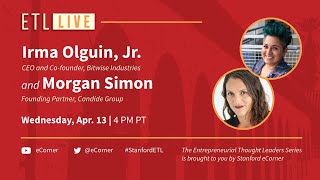
This content was created by GHION.AI . This content was uploaded by GHION.AI . This is a YouTube video titled "ETL Speaker Series: Irma Olguin, Jr. (Bitwise Industries) and Morgan Simon (Candide Group)" created on April 14, 2022. It features a discussion led by Chuck Easley with Irma Olguin, Jr., co-founder of Bitwise Industries, and Morgan Simon, founding partner of Candide Group. The conversation covers topics such as the founding and growth of Bitwise Industries, impact investing, and systemic change in capital deployment. The discussion also touches on the challenges and strategies of building tech economies in underestimated cities and the role of impact investing in social change.
Chapters
Good afternoon, I'm Chuck Easley and I'd like to welcome you to the Entrepreneurial Thought Leaders series presented by stbp, the Entrepreneurship center and Stanford School of Engineering and Bases, the Business association of Stanford Entrepreneurial students. Today I'm delighted to welcome Irma Algon Jr and Morgan Simon to ETL. In 2013, Irma Oglen Jr co founded Bitwise Industries to create a diverse tech workforce in Fresno, California and leverage a bottom up approach as the economic driver to reinvigorate the city. In 2019, Bitwise Industries secured one of the largest Series A rounds of funding ever for a female Latinx led company. Bitwise Industries now operates with the goal of building tech economies in underestimated cities across the United States. Morgan Simon has close to two decades of experience making finance a tool for social justice. In that time, she has influenced over $150 billion and is regularly sought out as an expert on impact investing. Her book, Real Impact the New Economics of Social Change has been featured everywhere from Harvard Business School to the United Nations. She's a founding partner of Candide Group, which works with families, foundations, athletes and cultural influencers who want their money working for justice. Welcome, Irma and Morgan.
Thanks so much for having us.
Hey, thanks for being here. So Irma, let's start by digging into your entrepreneurial journey with Bitwise. And before we get to the point where you connected with Morgan to kick things off, could you explain to our audience what Bitwise Industries does for those who aren't familiar with the company?
Yeah, I'd love to. Just a super fast thumbnail overview of who we are and why we do the things that we do. We're headquartered in Fresno, California which is the breadbasket of the world. We produce between 20 and 30% of the world's food, which has created a system where you have a very few number of wealthy landowners and a very large number of farm laborers and packing house workers and those who sort of labor to produce that food. That's created this massive disparity between the folks who get to do certain things and the folks who have to do labor based jobs. That's my story and the story of my co founder. We are both descendants of Mexican immigrants. We wanted to figure out how we could change that story. We both landed in the technology industry completely by accident. Looking at it from different angles, I ended up becoming an entrepreneur and engineer, he became an intellectual property attorney, he became. And as we met as adults, we both returned to our hometown believing that we could do something about the reality of this place we started sharing how we both sort of accidentally ended in an industry that changed our lives. And then the next question of course became, well, can you do something about that so that those things don't happen by accident, but you can create systems out of what was serendipity in our lives? And so that ultimately became that sharing of frustration, became what Bitwise Industries is today, whose goal was to infuse high tech, high growth jobs into an area where you don't expect to find them. And then in doing that, how do you invite folks who are sort of underestimated, who don't expect to participate in the tech economy, how do you invite those folks into that new system in their hometown, Started that about nine years ago, have experienced some really wonderful growth since then. But honestly wouldn't be at this new place that we're at today in 10 cities across the country were it not for running into Morgan, honestly. And if it weren't for the advice and the learnings that we gathered from Morgan and others like her in the space, we would have really stopped at sort of a ceiling that is sort of imposed on you when you're from an underestimated city. And so Morgan helped us crack through that and hope we get to talk a lot about that here today.
Awesome. Such an inspiring story. I'm curious if you can talk a little bit more about the initial experiences and observations that led you to founding Bitwise and how did you find the confidence that you could contribute? Unique solution?
I think it's less about confidence and it's a little bit more about just solving the problem that's directly in front of you. Like I said before, myself and Jake Soberall landed in the technology industry and the industry radically changed our existence. It sort of was this hard left turn, completely unexpected, where suddenly you're paying all of your bills in the same month and you're tipping the pizza delivery guy and you're taking your kids out for ice cream cones. And those are not things that you grew up expecting to be able to do. And so when you sort of look at that system of how you ended up there, you say, okay, here are the specific moments in time that I can point to where something was standing in my way. And via serendipity or divine intervention or call it what you like, that was that barrier was removed for me only, right? And Jake and I living that, that story out sort of in separate siloed lives. But the pattern was the same. We both landed in technology education that would change our lives. We both ended up In a first job that enabled us to tip the pizza delivery guy, right? We both were in inspiring environments where we found our community and found our sort of people that could inspire us to get to the next thing. And when you look at that and you say, okay, that's what happened to me, that's what happened to Jake, you see that those things were not happening in our hometown. Can you recreate now that experience for other people? Where they find technology education, where they get that first job, where they find their community in an inspiring building in their hometown. Those three things became what we do today. But it was really just putting one foot in front of the other. It was a very small 1200 square foot coworking space at $39 a month. Right? Like that was the first pass. And then we were running classes nights and weekends for our friends and family. And then, you know, that sort of snowballed into the, you know, 10,000 students trained and the million square feet across the country and the quarter of a billion dollars in wages that are earned by our apprenticeships. Apprentices today like to go from day one to where we are now, which is nearly year nine. There were lots of fits and starts along the way, but you're never thinking about how do I dominate the world. You're just thinking about how do I affect this friend or this neighbor in a way that's meaningful in their lives. And you're just solving one problem at a time.
Nice. And you know, a lot of what we teach in our classes here is around the lean startup method and pivoting to find that product market fit. Was there a particular early inflection point that stands out when you knew things were really working?
You know, there are a couple, actually, there were a few times. So we had really struggled to go from that 12,000 square feet or 1200, excuse me, square feet, to our first 50,000 square foot building. And in that journey, classes were selling out. And we were holding events that were full and folks were excited and it was vibrant, but it didn't really, we weren't really sure if it was working until we looked across the parking lot one day at a sold out event and we said, you know, four years ago these cars wouldn't have been in this parking lot. And they were all like better, more reliable cars with four tires and no donuts, right? They all had paint jobs that were respectable and none of them were backfiring and leaving the parking lot. And we looked at that parking lot, we said, we need to actually take a step back and study what's happening here because these folks are getting jobs and they're earning 401ks, they're buying better cars, they're buying homes for the first time. And not in the ones and twos. But at that point it was in the dozens and the 50s and nearing 100 folks. And we had to take a step back and say, this is objective proof that what we are saying we can do is being done right here in Fresno, California. And that once you really evaluate what that looks like from a GDP or an economic level, we were really moving the needle. And that's when we began to ask ourselves if expanding made sense.
You started in Fresno, but now operate in more than 10 cities around the country. Can you talk about how you scaled what first convinced you that it was time to replicate your approach in other places?
Yeah, well, I mean, just as I was describing before, Fresno is a very challenged place. The Central Valley is a challenged place. Four of the ten poorest zip codes in California are in my county. Right. So if you can make this work and diversify the technology industry and get folks into these high growth, high wage jobs that are changing their lives, if you can do that in Fresno, the question became, can you do that in other places that are like Fresno? What we term underestimated cities? That was that moment we said, okay, well the model probably works, but are we any good at executing on that model in a new place? We chose a couple of cities inside of Fresno, or, excuse me, inside of California to expand to, thinking that if this is going to port, right, if we can move this model to other places, let's choose something where we feel it's a win. It could win places that are similar to Fresno. So that turned out to be Bakersfield and Merced, which are both inside the Central Valley and then West Oakland in the Bay Area. Believing that these underestimated places had people in that spot who could create meaningful impact in the technology industry if only they had the shot. And so that was our first sort of foray. We raised that Series A that you were just talking about is what financed that growth, which was actually in large part due to the council and the leadership that we gained from Morgan here and then from there, it was just sort of off to the races. Once the Series A was successful and we found that we could expand, then we had to ask ourselves, what is a reasonable appetite for what's next? And for us, we know that we're producing almost certainly the most diverse technology workforce anywhere in the country. We have the largest tech apprenticeship in the country, and that's just doing our work in California. So what if we were to begin to expand eastward across the country? And as you noted a couple of weeks ago, we announced that we'll be in 10 cities in the United States with operations fully up and going this year in each of those places. And more folks changing their lives through the technology economy.
Amazing. And I do a lot of work on entrepreneurship internationally and a lot of folks coming to Silicon Valley to look to replicate what's happened here. But we often caution them that things need to be tailored. Did you have to customize or match to the unique circumstances in each of the communities that you entered?
Absolutely. I mean, the folks that we are focused on and the folks that we most want to serve have real life challenges. Right. The thing that we say a lot is that entering into the technology industry has very little to do with whether or not you were great at math in the fifth grade. That's really not what it's about. It's really about do you have the space in your life where you can focus on gaining a new skill and invest in your own future, which a lot of folks who are coming from generational poverty or generational disenfranchisement simply don't have. They simply don't have the space in their lives. What does that look like in Fresno? That means that transportation is an issue. That means that childcare is an issue. That means that cash in your pocket is an issue. Now that's in Fresno, where we have this massive sprawl and lots of ag acres. Just a lot of distance, literally physical distance to travel, to get from where you live to where your technology education might take place. That's not going to be the same thing in Buffalo, New York. It's not going to be about sprawl. It's probably going to be about things like folks who are working nights and weekends.
Right.
And having technology education that meets them where they are and flexible schedules and probably childcare there too. And so yes, tailoring our wraparound services is really, really critical to being successful in another place. And it's paying attention to those non technical barriers to entry that we think we are exceptional at. That's actually the thing that we understand best. We didn't invent a new way to teach JavaScript. Right. As they say, we just focus on the things that prevent people from learning it. And that really is the difference between what bitwise does and what others, so to speak, competitors might do.
Nice. So in a moment, I want to bring Morgan into the conversation and Talk about, explore a little bit her experience as an impact investor and what that's provided. But before we do that, I wanted to dig in a little bit more on what your funding process looked like. Your, your cap table includes both impact investors and traditional high growth tech investors, and you've now raised almost $80 million. What have you learned along the way about pitching and even vetting investors?
Listen, candidly, we were really bad at it at the beginning. Like, we just didn't. We didn't know what we were doing and didn't understand that there was a system to raising money, like an actual system that you could learn how to be good at. Right. In the same way that some folks get good at taking tests and some folks get good at building houses. There's a system to each of those things. And the system of raising money is its own world, has its own language, it has its own requirements and etiquette. And honestly, as I was saying before, Morgan led the way in helping us understand one, that there's a system, then two, how to act inside of that system. When can you demand things, when can you not demand things, when should you be asking for more, et cetera. And we learned through that process that the way that we were telling our story was very, very human centric and is important to a certain kind of investor. And then there's a completely different story to tell, equally as true, but just a different lens on it that a different investor with their own goals wants to hear and needs to hear. And so learning to tailor the things that we were talking about, all based on the same level of reality, but still sort of speaking to what they were trying to accomplish with their dollars and, or the dollars they're charged with managing. That was a game changer for us. And so we learned how to do that and be very specific to the folks that we were approaching. That was part of it. And the other part of it that I think Morgan helped us see was there's like a level of, and I don't want to be too free with this word, but like abuse that you don't have to take. And it feels weird because you're the person coming from this unorthodox background who's asking for money essentially, but you don't have to necessarily take what it is they're dishing back to you in every case, and learning when you should take it and when you shouldn't was a really big sort of cultural shift for Jake and myself as we were raising that Series A, so that first institutional capital was all about like sort of learning the landscape. And if it were not for Morgan and then our lead investors who end up coming in on the Series A, who Morgan introduced us to, we wouldn't be at this moment where we've raised over $100 million in venture capital to.
Expand across the country.
And we're about to embark on what we think will be a very successful Series C to do even more expansion and to invest in these folks in ways where they're changing. They will be the future. They will change the digital infrastructure of this company or, excuse me, of this country. And it all began back in the day with sort of showing up with our passport to a country for which we did not know the language and had Morgan alongside us saying like, this is how you ask for tea and coffee in this new land. And that made all the difference in the world.
Such important lessons. It's clear, both anecdotally and from empirical research that resource availability really dramatically impacts the personal decisions that people make around employment and around entrepreneurship. It requires a certain amount of resources to take advantage of opportunities. So before we turn things over to Morgan for a while, I'd like to ask about. I'm really curious to learn more on the paid apprenticeship programs. What role do those programs in particular play in terms of building tech careers and entrepreneurial opportunities?
Yeah, this is actually my favorite thing, because the key to diversifying the technology industry in our eyes and as we have evidence now to prove, has everything to do with not creating a choice between investing in your own future and taking an hourly rate job at your local packing house or warehouse or retail job. Right. Like if you can remove that decision point from somebody who's experienced poverty or a lack of resources, and instead you can pay them to learn now, they can make space in their lives to latch onto a new skill, practice it enough to prove that they know what they're doing, and then get that first, second and third job where they're moving up that sort of social mobility ladder. And that is absolutely game changing, which it shouldn't feel like rocket science, but it sort of looks like it is to other people, when really the most basic thing that we're doing is paying people to learn. That's it. Producing the most diverse technology workforce anywhere in the country. And the only change that we made was paying people to learn. If they can make the space in their lives to do that, you're going to see really, really wildly different outcomes in the technology industry and the technology economy that will literally change the future that we're all signing up to live in.
Let's move to Morgan's side of this equation. Morgan, you've been an impact investor for around two decades. You often speak about impact investing and wrote a book titled Real the New Economics of Social Change. Before we get into your relationship with Bitwise and Irma specifically, can you talk more broadly about what impact investing means to you and how you define it?
Sure. It's always the million dollar question in the sector. And I guess I would say. That investing generally is really about legacy. Right. It's the idea of what are the values that we show up with every day, how we want to be seen in our communities, how we want to be seen for our children and our grandchildren, and that normally, if you just put your money into the traditional economy or with an advisor and are not really paying attention to where your money is spending the night, it's usually off doing all sorts of terrible things. Right. It can be, you know, locking people in prison and destroying the environment. And basically things that you probably wouldn't be very proud to tell your grandchildren, look, I made this wealth for you by destroying someone else's family. That's not really, I think the legacy most of us want to leave. And impact investing to me is the opportunity to really build a much more positive legacy. To say that I use the wealth, whether I generated it or inherited it, and I made sure that I created opportunities for others and that I created a bright path and that I contributed actively more than I extracted from community. That's how I think about impact investing.
Amazing. How do you think about the growth or the business fundamentals of the ventures that you evaluate? So just kind of digging down a little bit further, do you have a particular framework for evaluating how an organization's business strategy will either support or hamper its social impact strategy?
Sure. And just to provide a little bit of context, so the last nine years now, I'm founding partner of Candide Group alongside an Air Ben Ami. So as you mentioned before, working with families, foundations, athletes and influencers who want their money, working for justice. And in that capacity, we focus on private assets. So both companies and funds. And we've supported just over 100 different companies and funds with over 170 million. So that's kind of the range of experience that we bring to the table. And a lot of what we think about is systems change within any sector or geography. Right. It's really what Irma was saying, the difference between two Teslas in the lot versus 500 Honda Civics. The idea that you could have wealth that's much more broadly distributed and create much more happiness for more people as kind of a basic value. Rather than saying how do we make it just slightly less miserable to be poor or how do we make it 30 years instead of 20 that we all die of climate change. Right. We really need to look at long term systemic solutions and whatever we do, so that's what we try to prioritize. I'll note that also of our investments the last four years, over 75% have been in women and people of color. And that's not because of any particular goal, but it's that essentially one of our values is simply that people closest to their communities are going to know best how to solve community problems. And that, you know, the Silicon Valley kind of tradition of having less than 10% that goes to women and people of color. If I have that stat correct, you basically would have to kind of go out of your way, right. To over index towards white men given in places like the barrier in New York, it's over 60% people of color and certainly at least 50% women. Right. So I don't think we even view diversity as some like weird go out of your way goal. But it's simply if you're showing up and supporting communities is something that's going to happen naturally and that that's just kind of one of the elements on the road to more structural change. And then the final thing that I would say in terms of that integration of business model and impact, we think a lot about the value of non extraction, which is basically that I want to add more value than I extract in any transaction that I do. So for instance, there might be something, a fintech company that's trying to be an alternative to a payday lender that is providing a slightly better service than the really extractive alternative. But that doesn't mean that it's fair. Right. And even if you took that from a would I want my child to use something like this or would I say, oh, it's just good enough for those people. Right. So we really try to apply that non extractive test whenever we can to the work that we do.
Awesome. Such great points. So I'm curious what attracted you to bitwise and how did you evaluate that team and opportunity in particular? So sure.
So I think as I mentioned, that structural change element is just so embedded in what they're doing and how do we really think about broadening opportunity and not just saying even within tech, there are going to be the factory workers of tech who are just Kind of. I mean, I'm not a coder, but I would say relatively mindlessly coding, while most of the value that's being created is kind of going to the top brass within tech companies and sort of the trend towards outsourcing. So there's sort of these armies of workers where it could, you could wind up in a world where that's not that much different than a typical Walmart worker. But I think one of the things about Bitwise is that they're really saying technology is a space with so many different entrance points that you certainly could be a coder and have a well paying job where you get to go home at night. You could decide to be a tech entrepreneur who's going to build something on their own. You could decide to work within a very conventional company that could be doing any sort of service in the real world. But just add that tech component, which is one of the areas where Bitwise graduates have been very active as well and part of what's often enabled them to stay in Fresno or stay in their communities rather than needing to move to tech hubs. And that being one of the objectives as well. So that really holistic and structural change element of how we engage with tech in a way that better spreads wealth, that is something that I see is really integral to Bitwise's not only mission but way of working. And that that's what some of Irma was talking about. And it's about removing the impediments. That means you have to be aware of them. You have to have that lived experience and have that within your team to really bring that to the table. And then the other piece from an investment perspective, which I would say in general is often a pattern and it's both a positive and a negative that's often been found with entrepreneurs of color who do a lot more with a lot less. And that Irma and Jake had made an unbelievable amount of progress for how little money they'd raised at the time. And it meant that they had just shown a remarkable capacity to get things done. They already had a really well established presence in Fresno, had done a lot on the real estate side. This was a train that was moving and if you were lucky, you got to get on it. So I think from that perspective was also very excited about the trajectory of the company and they've been really consistently executing. And as I really appreciate Irma, what you said that who's got time for confidence? If you're trying to just get stuff done, that's kind of caking that Real humility. But beyond that, just the idea of let's get to work, you know that that's really what needs to be first and foremost within these companies.
Yeah. Focus on solving the problem. I wonder, you were mentioning a little bit about the stage that the company was at when you met Irma. I wonder what questions were you asking yourself as you considered funding Bitwise?
Good question. I think one of the things that's common with people who are out there to change the world is that they're doing something different. Right. And that means that your pattern recognition can get a little bit thrown off. And one of the things that is really unique about Bitwise is that they had cracked this model of saying to build a tech ecosystem, you can't just have an incubator, you can't just have a co working space, you can't just have training. You got to do all of it together. So other people might have started three different companies to do those tasks. And it felt sometimes like I was underwriting three different companies, which was a pain in the butt, thank you very much, Irma. But it meant ultimately that we had to understand how those pieces came together and how they were really mutually beneficial and that particularly given this emphasis on underestimated cities, you needed to have the union of those factors for the whole thing to work. But it meant that as an investor, you had to kind of be willing to wade into those different qualities of mud. Right. To kind to see how it all came together to build this beautiful castle.
So many investors bring knowledge and support mechanisms as well as just sheer capital. I'm sure as an impact investor, you bring a unique set of skills and perspectives to a portfolio company. Can you talk more about how you see your role in relation to Bitwise? What were some of the things that you brought to the table?
Sure.
So I think I would say that as Candide Group, generally in our practice, we try to be really honest about what we know and what we don't know. And that as investors, sometimes part of investor ITIs can sometimes be thinking you're smart about everything. Right. Because your job is to try to get really smart about different sectors really quickly. And we try to do that more through really having an expert network. Right. That it's not that I need to know everything, but I need to be a phone call away from the right person who does know it. And from that perspective, it also means only trying to insert myself in the business of companies where I know I'm actually going to be helpful and staying the heck away from the Parts that, you know, like. Actually, I think Jake and Irva would probably say their greatest experience with me is them calling for advice on something and me saying, you shouldn't be asking me that. I don't know anything about that. And they're like, no, no, we want your opinion. So I think obviously, as entrepreneurs, you always have to make choices about voices you want in your ear because there are so many potential voices on your cap table and knowing strategically when to call whom. So I think what's interesting is that you might get a different perspective if you ask the entrepreneur or the investor what value they think they're adding. But certainly navigating fundraising processes, as Irma has alluded to, in probably overemphasizing my role, but in terms of just being able to wade through that soup, I think has been valuable and is something that we do with a number of entrepreneurs. And then also I tend to find on the impact side, they say sometimes that the job of an impact investor is twice as hard because I pay just as much attention to financial outcomes. To be clear, I am held just as accountable for the financial outcomes of my work as any other registered investment advisor. That's what I am. I have the same compliance program. I have the same stuff that you have to do. But on top of that, I care deeply about the impact and spend a lot of time working on frameworks around that, on making sure I have a community understanding of what impact can be and what's important to people. And I think sometimes for entrepreneurs who can get kind of pulled in different directions, or sometimes a feeling of, I gotta present the financial side, that's what's most important. Having someone who just consistently is asking the questions of, oh, well, what are the outcomes that we're seeing? And where are you seeing the opportunity to deepen? And are there spaces where maybe some grant money would be able to complement what you're doing can be really helpful and hopefully kind of relaxing to know that investors are on your side that way. So to give another example of that, there's a company called Maven that we've supported where they basically sell hair through black hairstylists. And that typically when women go to a hairstylist, they would need to buy the hair separately for braids or other hairstyles, bring it back to the stylists, and that stylists tend to be very low income. Right. So the average black hairstylist in the south is making $17,000 a. So if you wanted an intervention to be able to support those women targeting stylists is a great way to go. And essentially by selling the hair directly to clients, then they're able to capture a lot more of that income. You know, it can be an additional $300 or whatnot a week. So when Covid started, all these hairstylists were out of work overnight, right. And already on, you know, bringing on the edge of poverty. And the entrepreneur called me and said, what do I do to help these women? We, you know, we have all their bank information, right? They're, they're buying from us. We can deposit in their accounts immediately. But, you know, is there some way that I could do some sort of emergency fund for them? We were able, through one of our clients, to contribute the first hundred K towards a stylist emergency fund. And we challenged kindly all the other investors, plus did some crowdfunding as well, that turned into over a million dollars in direct payments to stylists during COVID And that's the sort of initiative where having an impact investor on your cap table can be really helpful, right? To be able to really think holistically about how you're supporting your broader community, you know, whether that's your customers or clients or however that's defined and know that you're going to have partnership in that. So I think that's some of the value that we try to provide is not only kind of the philosophical and intellectual support on impact, but then when the rubber hits the road, how to really make that happen.
Amazing. Amazing. In our prep conversation the other week, you noted that just like in the Silicon Valley venture capital business as a whole, impact investing also has its highly ethical firms and some less trustworthy actors. Can you talk more about that? What are some red flags, for instance, that impact driven founders look for when they're building relationships with investors?
I'm trying to not say things that are really trite without saying things that are too specific. But I guess I would say that in general, the good news is that there's a lot of capital and that that has really been shifting certainly over the two decades that I've been in this business, and certainly even over the last couple of years. And the idea that you can be who you want to be and do what you want to do and not feel like you have to shape shift in order to fit specific investor needs versus saying okay, if this is not the right fit, I just get to keep moving that that creates opportunities to make sure that people don't waste your time, that people don't ask for a ton of information because they really just kind of want to get to know the market segment but have no particular interest in funding you or may kind of get pretty far down the line to back out or some of the things that can happen or be looking for valuations kind of on the presumption that the entrepreneur might not know better. So there's certainly, I think, ways that we see within whether impact investment or investment market. And I can't even see what Irma said, but I bet it's good. I bet it's good that essentially there's always the spaces for good and bad actors. And that that to me, in a, in a very kind of Pollyanna way I would say is almost progress because it's part of really becoming a bigger market where then entrepreneurs get to be more choosy. And that really is a good thing versus the feeling of impact. Capital is so scarce, I guess I got to do whatever they're telling me. I feel like that dynamic really is shifting. And particularly when you see entrepreneurs like Irma who have just flown in terms of what they've been able to do in the world.
I think that was Morgan's. How do I say this nicely Face quick reminder to the students and audience members. If you have questions, feel free to post those in the Q and A. We're going to get to those soon. And you can also upvote questions that you particularly want to see asked and answered. You're both very focused on systemic change. And before we go to the student questions, let's finish with this big question. What major systemic changes would you both like to see in terms of how capital is deployed in the country or in the world? And where do you see the biggest opportunities to deploy capital in ways that help all communities to thrive?
I'm happy to take it.
You first. That's a big topic.
Yeah, I mean we think a lot about this. Right. I know it's. Which is different than if you were mostly thinking about how to grow and succeed your company. Right. One of the things that we think a lot about and have been designing structures to try to address is this question of who gets to allocate capital. Because you have historic inequity in the US and globally that has tended to concentrate wealth into certain communities and extract it from others. And that means that even in the context of impact investment, you often then have white investors like me who come from, you know, I come from pretty middle class community, but that come from relatively privileged communities getting to make decisions for others. Right. And to put it as crass as possibly as possible, impact Investing can't just be rich people deciding what social change should look like, right? But if they are the asset owners, if they are the board members for foundations or endowments, that's who gets to decide where ultimately capital is allocated. So we've been really looking at, and not just us, but many others in the, in the ecosystem, how do you really broaden not just access to capital, but access to decision making over capital? So for instance, we have a fund called Olamina, which is a $40 million fund that's invested in US community development, that has a community advisory board that is all women of color activists who on a rotating basis sit on the investment committee. And that means that they are voting on where this capital is being allocated. Similarly, we're in the process of launching a climate justice funding that will similarly have a community advisory board structure to make sure that people who are directly impacted the consequences of environmental racism and climate change are getting to decide where the capital goes and get diligent support from our teams, which is also, our team is also a highly multiracial team. But the idea that you can bring together different skill sets and that you need to value lived experience and impact knowledge just as much as you value financial experience, right? So it's not just traditional finance people saying, oh, I think I'll become a social investor, right? Let me, let me try that on and see if I can learn something about communities, right? Like that's a lifetime of experience that people may or may not have to bring to the table. And that's okay, right. I think it's important to validate that we can all still have a role in this, but knowing what it is, right? And then how do we use the power that we have to create space, spaces for others? So that's where as Candide Group, we've been trying to kind of build this linkage between some of our investors, which some high net worth families and some foundations who might be really thinking from a reparations framework and are saying, maybe I'm not the one who should be deciding this wealth that I inherited here by the grace of God go I. Maybe I'm not the one who should be deciding what impact priorities for the world are. Let me go ahead and turn over governance to others. And then we kind of jump in to answer the question, well, how do you do that in a strategy structured, thoughtful way. So that's one of the, I kind of, in a good way would say trends that I'm seeing in impact investment innovation thinking about not just beneficiaries of capital but allocators of capital as well. Irma, that probably give you ample time to think since I went on and on.
I mean the only thing you can say is what you said. That's the only right answer. I think the other maybe small element that I'll add is that one of the hard parts about the moneyed versus the non moneyed is that the question of who deserves money now becomes is a thing we have to actually talk about. And that's a complicated thing and no two people are going to think exactly alike on that topic. Which is why we are fortunate to have the Morgan Simons of the world who are spending their time and their nights awake trying to figure out how to spend solve this in a way that more people will agree to if not all right.
Yeah, this reminds me of Jennifer Eberhardt. Professor Jennifer Eberhardt here at Stanford in the Spark center has done some really great research funded by Illumina Capital on asset allocators biases against African American investors. And the statistics that you had quoted earlier Morgan, on the lack of diversity in founders are even more amplified when you get to the level of the VCs and investors and asset allocators in the country. So really important points there. Let's go to some of the student questions and encourage others in the audience to ask questions and upvote them under the Q and A section. But the first one here looks like mainly directed to Irma, but perhaps both of you have thoughts on it. The question is if you were to start another company today in a different industry or problem space, what would you do and why? And I'm picturing that this is from a young aspiring impact oriented entrepreneur or trying to think through or get some advice around what areas to go out and try to problem solve on.
Yeah, that's actually really hard to imagine doing something other than what I'm doing now. Someday I'll have to think about that, but I haven't given it too much thought and the reason for that is because the thing that I chose to do was something that was deeply, deeply important to me. Right. Like even when it was going to be super hard, I was not going to abandon the problem itself and the solutions that might be put in place.
Right.
Like very different. I think that if I had decided to, you know, I got my first start in the technology industry doing writing code, like if I had decided to build Instagram filters or, or some other software as a service that was kitschy and in vogue, that's the sort of thing that is Easy to abandon when it's hard. But when you're thinking about a problem space as deeply human as how do I affect the lives of my friends and neighbors and the people who grew up the way that I did, that's not easy to pull away from even when it sucks. That's why imagining a new thing to do would be probably in that same, like, set of things, like, how do I eliminate suffering for the people that I know and love? I think the. The only thing that I would change. I have so much more experience now with hard things, right. And know, walking all the way into spaces that I know nothing about and feeling comfortable there. And as Morgan said, like, knowing who to ask the question at the right time and the right moment to take their advice. And like, those things are very hard to pick up until you have to do them over and over again. So I think that I would still do a hard thing, but I have that much more experience now to draw from. So if anything, I think the level of difficulty would go way up. Even though one might argue that the things that we're doing today are pretty damn hard as they are. But that's how I would change it if I were to do something else. I just. I just can't see myself investing myself this fully and something that feels less important.
And I would take like a very short stab at that question because I think the other thing that people forget about investors, you know, I'm a small business owner, right? Like I run a, you know, 11ish. There's some contractors in there, person registered investment advisor. And we built that from two people to where we are now. And, you know, we gotta meet payroll and do all this stuff, right? And I guess what I think about sometimes is that I view social change as four lanes, right? It's the economy, it's politics, it's media and culture. And that part of Candide Group that's a bit unique is that we kind of straddle those lanes at different times. And I could see at some point saying, all right, I've kind of done a lot in that economy lane. Are there other lanes to play a little bit more in? And are there learnings that, that you can take from one lane to another? Because what is it when. When you have a hammer, everything looks like a nail that. And someone had put in the question, maybe we can, they say, feed two birds with one scone. So we try to not use too many military analogies. You know, what are the most effective ways to solve social environmental problems? And was had the question of for profit businesses, nonprofit or government. Okay, all of it, right. Is the kind of boring answer. But the, but the point is really what is the right tool for the right thing, right. So I think about nonprofits being either like super emergency type aid or advocacy, right. Of like change the system. But there's a lot in the middle there that basically is preventing business from just helping people, right. That like, if you just had a good living wage, you wouldn't need so many food banks. Right. Like, could you, could you really kind of put the emphasis on not requiring so much charity in the world? And then there's some things that can only be solved through policy. So for instance, you know, we won't invest typically when we're looking at the Global south in things that are about providing water because we don't think that's something that the private market is going to do a really good job of allocating, particularly for poor communities. Right. So I think it's more, and I think maybe to tie both of our experiences together, right. Like Irma is working on a very specific problem and she's got multiple options, right. Within for profit business, sometimes Bitwise also uses government support for that. Sometimes it's using grant support or grant partners. Figure out what's the right lane for each actor in the context of a problem. And that's something that I talk about a lot in the book as well of kind of how do you pick the right sector to solve a problem?
Great. So another question that was, I think referring back to some of the topics that we were going over earlier on. Can you talk a bit more about ways to prevent brain drain in communities?
That's all you.
I'm happy to go for that one, although I think you probably have an interesting lens on it as well. But listen, I mean, the reason that folks leave is because they believe that their highest and best life is going to be like, lived somewhere else, right. That the opportunity that they are after or the life that they want to live and picture for themselves is somewhere else. That's, that's the very basics of it. And so to prevent brain drain and exporting all of your best talent to other places, you've got to address what is actually missing for these folks. And sometimes that's access to opportunity, sometimes it's high growth, high wage jobs that could also be the housing market is all messed up and so they can't find, buy a house if they, they want to live in with their kids, right. Et cetera. And so for us, the benefit to focusing on underestimated cities. The way that we do is that 90% of the folks that we train who earn technical employment stay in their hometowns because that's where they want to be. And so we're not changing their desire set, we're changing whether their desires are met in their hometown. And that really is how cities, local government and other, you know, for profit and nonprofit entities in that space can really respond to Brain drain is by figuring out what's missing. Is it that educational opportunity? Is it the first job? Is it the 10th job? Right. Because if there aren't enough positions for CEOs in your hometown, but that's what you think you're going to do, you're going to go somewhere else. And so it's very specific to a locale. But for us it comes down to if you don't talk to the people, you're not going to know what they're necessarily.
And I just dropped in here a book that just came out from a Jorah Carter who's been a major mentor to me for decades. There was a good five year period where I was sleeping on her couch for real anytime I was in New York. And I think her title is really informative, right? That you don't have to move out of your neighborhood to live in a better one. And just all of her efforts to say, hey, I'm from the South Bronx. And as I've gotten my confidence, college education, I want to do things. What if I actually want to be in the South Bronx? And her experience sometimes of even getting protested when she had opened a coffee shop. And a coffee shop typically being the sign of gentrification and that a lot of local residents just really couldn't adapt to the idea that she was from there. Right. And that, you know, they're like, go back to where you came from. And she's like, wait, no, I'm a black woman from the South Bronx and I've opened a coffee shop for. And I want to make sure that the dollars stay with us rather than young people feeling like they got to move further south in Manhattan in order to get access to a nice place to hang out. So it's interesting in this question of how do you really create opportunity locally? And I see that something that obviously bitwise is working on. And then others like Majora across the country.
There's a couple of operational kind of tactical questions that are here being directed to Irma. But, but Morgan, please feel free to chime in as well. Cause you may have seen other examples of this One is, how do you build partnerships when you go into a new community? What sorts of local leaders, organizations tend to be most helpful in scaling this kind of community based tech or entrepreneurship development?
In some ways, Morgan's answer is gonna be more informative than mine. Cause mine's very specific to building a tech economy in a new place. But just to sort of address how we go about doing that, we know that there is a certain amount of sort of kissing the ring that you do when you go into a new space. And so you do that, whether that is with the local elected political officials, if it's the money class in that place, I mean, in Most underestimated cities, 50 or fewer families control the majority of the wealth of that place. So yeah, you want to go and get to know those folks, but I think it's really important and especially in the work that we do, we put a lot of time and effort to get to know sort of the unsung heroes, right? Who's the president of the local community college, but also too, who's the teacher that's been there for the last 15 years, who's been trying to modernize curriculum and isn't having a lot of success in that system? Who's the freelancer who is trying to get a co working space off the ground in his garage? Like, who are those people who are actually doing the super hard work where we can come in and be wind at their backs? Right? So yes, of course you spend time with the folks who have the money, where the wealth is concentrated. And of course you get to get to know the local electeds. But in every place we go, there are people who are trying to make something work if only they could just get a little nudge, right? A little, a little lift. And we try to be a partner to those people first before anything else because we're not trying to come into a place with our elbows out taking over and being the knight on a horse to save the day. It's really about collecting those efforts and putting them all to good use in the format of trying to get folks high growth, high wage jobs in their hometown. We're not trying to step on folks who are already doing that work. We're actually trying to be the wind at their backs.
Awesome answer. What I wanted to add is I actually think I, I think it's a really relevant question for investors and that people tend to forget that to their own peril. Right. And that often when you're an investor, you do the site visit where you basically very reasonably get Shown what people think you want to see. Right. And it might be very limited amount of time, or it might even be in a country that you're not familiar with, in a language you don't know. Right. And how do you actually know what's going on in a community? And I find that typically for me personally, what's been the most successful pathway there? I'm a very active dancer. I have a whole artistic life and mostly street dance. And that means that, for instance, when we were diligencing a clean energy company in Kigali in Rwanda, the first thing I did is I reached out on Instagram to who were the B boys in Kigali, Sent them some dance videos and said, hey, I'm coming to your town. I'm an American dancer. Can we hang out? And they were like, absolutely. Took me all around town. And after we'd had kind of a weekend of dancing together and building trust, then going to their homes and saying, hey, actually, how much are you paying for electricity? And kind of explaining, oh, this is actually why I'm in the country. And give me your perspective. Right. And it's a completely unbiased one. And that can often counterbalance for me what I might be hearing from an entrepreneur. So it might not be the type of thing that you would think of. Oh, make sure to carve out time in your day for that, for everyone. It's going to be something different in terms of what helps you connect within a community, really on a person to person level. And I don't mean that instrumentally. Right. It's obviously something I get a lot of joy from, that I would do regardless. It just so happens that I've learned that it also supports my work. Another couple small examples of that. I live in Oakland in the Lake Merritt neighborhood, which has a lot of unhoused communities. And during COVID knowing less people were volunteering and I felt pretty safe health wise, started doing a weekly route providing lunches to, like 60 different unhoused folks. And that meant I really got to know people, because you're seeing the same people every week. And when we started to look at some potential solutions, entrepreneurs who were working on building, like reinforced tuff sheds, the first thing that I got to do was to walk down the block to the unhoused camp and say, hey, look at this design. What do you think? And actually, in that particular case, they were like, no way in hell. Don't invest in that company. We're like, okay, cool, we got it right. But if I didn't have that Accumulated relationship, it wouldn't matter. And I obviously didn't go start doing that for that reason. Right. But the more, I guess it's to say if you're actually engaged within your community, then you will have a better sense of what community needs are. Or like I said before, the best investor is not the smartest person on everything. They know who to call and ask. And that means I need to have my expert on artificial intelligence and crypto in the same way that I have my experts on the lived experiences of how.
Right.
So how do you kind of maintain that broad network? It's by letting yourself be a holistic person even as you're continuing in your career.
Right. And that community orientation in general. Let me ask one sort of broader version of one of the audience questions here to kind of be the final question and wrap up. Which is based on something that an impact investor friend of mine from grad school, Justin Kohla, said when he came into my class, which was that he tended to look for entrepreneurs and companies to invest in where the social impact was kind of baked into the business model of the company. Whereas as the company does better, the social impact is amplified and as the social impact is amplified, the company is going to do better. So that those two things are intention, because we know especially the early stages of starting new ventures, there is often that search and a lot of pivoting that's going on. And especially if you have a mix of investor types involved or a mix of advisors, you're going to get pulled and tugged in different directions. So I wonder if either of you from your experiences have thoughts on this or examples or anecdotes.
Of companies that are achieving that or how that tension gets managed.
Yeah, yeah. How that tension gets managed, if that's a criteria in your mind or if it can work in the other way, where the business is oriented around one thing and then the proceeds get used for social impact.
I think typically with impact investing, we're really looking for that to be integrated. I mean, I think otherwise we just consider, consider that to be a business that is doing charity. I actually, I teach social enterprise in the Middlebury Graduate School and we actually do like a great debate of like something like Tom Shoes, is that a social enterprise or not? And typically students have come on the side of, no, that is a business that has a really strong philanthropic arm. Right. But that doesn't make it a social enterprise, which I would define as always having the impact bacon. So I think some of my puzzledness and literally listening was like, well, of course, like that's the only thing that we would do because otherwise, I guess maybe knowing this might be the last question. This is kind of a funny one to end on, but Warren Buffett famously or infamously was asked in front of a business school audience, do you think it's better to make a bunch of money and then give it away, or is it better to do something social from the start? And he said, well, that's like saving sex for old age, and that's not a good idea. So that is my final bit of advice.
Irma, do you have thoughts on this one? Or points when you had to pivot where this might have come up?
You can't top that. It's like saving sexual needs. Yeah, it's always going to be what.
Morgan said, except that I didn't come up with it, so that's why it's less impressive. Yeah.
Still a brilliant quote and an important point. Well, thank you so much to Ermine and Morgan for fascinating discussion. And to our audience, thank you for tuning in to this session of the Entrepreneurial Thought Leaders series. Next week we'll be joined by Free Will co founders and co CEOs Jennifer Shah Spradling and Patrick Schmidt. You can find that event and other future events in this ETL series on our Stanford E Corner YouTube channel. And you'll find even more videos, podcasts and articles about entrepreneurship and innovation at Stanford Ecosystem Corner. That's Ecorner Stanford Edu. As always, thank you for tuning in to etl.
More from GHION.AI


O processo de reconhecer limites, mesmo quando a vida parece exigir sempre mais.





Depois de tantas histórias, aprendizados e pausas necessárias, o @interior_iza está de volta



