ETL Speaker Series: Jannick Malling, Public.com
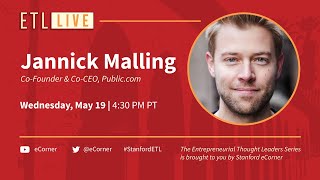
Jannick Malling, co-founder and co-CEO of Public.com, talks about building a fintech company, why Public.com stopped accepting payment for order flow, and the co-CEO structure. He discusses company principles, content moderation, and his approach to angel investing.
Chapters
Hey. Hey. Hey. We're live here on YouTube and I'm Toby Corey and I'd like to welcome you to Entrepreneurial Thought Leaders series presented by stvp, the entrepreneurship center in Stanford School of Engineering and Bases, the Business association of Stanford entrepreneurial students. Today we are delighted to welcome Yannick Malling to ETL. Jannik Malling is the co founder and co CEO of Public.com an investing social network where members can own fractional shares of stocks and ETFs. They can follow popular creators, share ideas within a community of investors. Now, prior to Public, Mahling was co founder and CEO of Tradable, a company that reinvented the online trading platform through a unified API platform that allowed developers to build financial apps connecting to a global network of brokerages. He was on the founding team and served as head of product at CFH Group and he began his career at Saxo bank, the original online trading service in Europe. He's got tons of experience in this space. Janik has been named a Global Shaper by the World Economic Forum and he was selected as a leader of tomorrow by the Saint Galleon Symposium, the world's leading initiative for intergenerational debates on economic, political and social developments. Jannik, what haven't you done? And welcome to etl.
Hey, thanks, Toby. Yeah, it's really awesome to be here. Honestly, I'm looking very much forward to this.
Well, you've got an extraordinary career and I. And your story is just so epic and I know all the students are incredibly excited to hear your journey. So let's get right into it. So let's talk a little bit about career and building public. But what's really interesting about your business is that it's both a social media app and it's a brokerage service. And you've been able to combine that into really interesting user experience. But let's start on the brokerage side of things. Now, I imagine one of the central challenges of building something like Public is the degree to which you need to think about regulation and not just customers and revenue. Right. So can you talk a little bit about some of the bigger kind of systemic hurdles you had to jump through as you built public trading service?
Yeah, absolutely. So you're right. Public is a fully regulated broker dealer nationwide in the US And I think one of the best ways to kind of summarize it is this whole notion that a lot of people have preached. A lot of people have sort of been taught directly or indirectly through the areas of the content of move fast and break Things that's sort of been a Silicon Valley mantra for many years. And I think more than anything really what operating a highly regulated industry means is that you cannot just always follow those sort of standard startups rules, if you will, because at the end of the day, you know, you're dealing with people's money. It's, it's, it's a fairly sort of highly, highly regulated industry. And I think in a different way than people might expect from something like an Uber or an Airbnb that also had some regulatory challenges. And so what that ultimately means is everything can't always happen as, as quickly as you want it to be. There is, there is another very important stakeholder and off the table in most of the decisions that you make. And it's not the usual just you know, you have sort of your customers or your VCs, your employees, but there's also a regulator that I think especially these are becoming increasingly important for the industry overall. I think that being said. And so that's probably the number one thing, right. I think the interesting thing about regulation is it does present a high barrier of entry. And I think that's why for many years that you didn't want to also see maybe a lot of startups up until sort of the rise of fintech, maybe call it half a decade to a decade ago, but finance was one of the last large industries to really sort of be disrupted, for lack of a better word, by various forms of technology startups. And I think as a result of that, consumers expectations may also be a little bit lower because most sort of, because technology hasn't been around the finance industry as deeply as it's integrated into today for several decades. And so that's maybe one of the few sort of positives that you're able to actually create. It's a longer draw, it's more regulated, but you can create some really magical experiences in and around money once you sort of push for that.
Yeah, that's an interesting point. I spent some time both at SolarCity and Tesla and I know working with Elon Musk, especially on the solar side, massive regulation, you're dealing with utilities and huge amounts of friction. But being able to unlock that, there's a tremendous amount of value for those that have the vision and the experience and you've done an amazing job in that area. So I think as kind of starting off with that first question, but can you talk about your background and what gave you both the interest and the courage to take on such a huge challenge of creating something as Ambitious as public because there's nothing out there like it, right?
Yeah. I mean, arguably, like, like you said, I actually have been around this industry for a long time. I sort of say I've been in fintech maybe 10 years before. It was really cold fintech. So personally, I grew up in Copenhagen in Denmark and took a very early interest in design and sort of did some early web development as well. But I leaned more to the, the Photoshop and I mean, God, this was like when Macromedia Flash was all the rage. So that was actually what I started designing in that, in Photoshop. But then early on in my career got into this company called Saxo bank, which is very well known in kind of Europe, a little bit less so in the US because they never really operated that much here. But got to join there early. I think I was like employee number 300 or something. And that was, that was a real rugged ship. Like we, I think after being there for. So I joined there when I was 17 years old, so it was a kind of interesting position. And I think they only took me in because I knew how to code a little bit and could design and whatnot. And so I was able to carve out a nice kind of interesting role for myself in that company. But inside, I think 12, 18 months or something, we were over 1,000 employees. And so that was a really interesting scaling experience that was also very global because it was around Europe and Asia for the most part. And that's really how I kind of came into the industry. So it was not this thing that I grew up necessarily always wanting to get into it. I kind of stumbled into it a little bit. But then after that I think that's where maybe I caught the bug around the financial system. And just like it's such a vast thing and it's really one of the areas where you can truly be a lifelong learner because it's just such a massive system. And even now, 15 years later, I'm still learning stuff every day, even around how markets really work, how they should operate, etc. And so did that. Then a bunch of us actually left start another company that was actually in 07. So that was right before the financial crisis. We decided to start a financial technology company, which obviously was an interesting timing and we actually ended up building something entirely different than what we set out to build. But in the wake of the financial crisis, we're able to build sort of a B2B marketplace business, facilitating liquidity over API between the big banks in London and small and medium sized Financial institutions around Europe and the Middle East. And so that was something where I really got a very deep understanding of how the markets actually kind of operated, even among the big banks and whatnot. And that was also where I sort of really started with the head of product role, obviously building out and more, I'll say, being responsible for building out a much more sophisticated tech platform in around the financial markets. And so ultimately that company was quite 2016. That's when I moved to the US. I was living in London at the time. And then a year, 18 months later, I kind of began to start what is now public.
Yeah, so two follow up questions to that. One that's really blatantly obvious is that you have this unique ability to really see where problems are. Is that something that you developed over time? Was that something early in career and combining that with this intellectual curiosity about design. So did you go to school? I know Stanford's got an amazing design and D school to take up Photoshop and get learning. So those two aspects like recognizing where real problems existed and, and then, you know, kind of design and prototyping, where'd that come from?
Yeah, I would say I got my design degree on YouTube.com okay. Basically just, you know, doing, honestly in the beginning of just doing tutorials, I was really fascinated with a bunch of graphic design, which is how most designers work. And this was pre mobile. Right. And so then, you know, with Micromedia Flash as well. And then I think I remember, I remember actually, I think it was Evan Spiegel said this in a quote of like you sort of. I was, I was too young to really catch the dot com wave. Right. I was probably 12, 13 years old when that happened. So I was a little bit too young. But that was actually around the time that I started doing some design and development for the web. And then after 2001 and the bust, I remember feeling a little bit like, oh, you know, sort of you kind of missed the window from a generational perspective. But then with the emergence of mobile, I remember just feeling incredibly fortunate because you could see early on that that was going to be something different entirely. And what I think was interesting about mobile is that design suddenly had to become more human and there was the potential to. I mean, the Internet in those early days was still a lot of early adopters and whatnot. Right. And I think just when you started to realize that everybody was going to rock around with a computer in their pocket and you started to think a little bit differently about how you can solve problems, which I think in Many ways, Public is a direct manifestation of. Because we always talked about the problem that we're solving being much more psychological one than anything else. Of like most people historically feeling like the stock market has not really been for them. That's sort of where the irony of the name public comes in. Because it turns out the stock market was actually designed for the public. That's why they're called the public markets. But you know, when you can start to use technology to really solve even like psychological problems, I think that's very fascinating because I think the early technology boom saw it being a little bit more solving some business model issues and like, you know, being able to disrupt a bunch of stuff around, how you distribute products, how you sort of make money on things, etc. And I feel I really see Public as a company that's solving a much more sort of human problem, which is much more to do with how people actually feel. And the UX and the app is obviously. And the community itself within Public is a massive puzzle.
Yeah, yeah, interesting. Well, to that end, I know there's a lot of bias here in Silicon Valley from venture capital firms that want the CEO or that other core co founder to be highly, highly technical. And I really find it fascinating that you're not a hardcore engineer by study or training. You study finance, you study management, you study economics, and your career focus really on the product side of things rather than the engineering side. But for those students out there coming from a similar background, can you speak a little bit about the sorts of skills and advantage someone like yourself can bring to a tech startup? That magic?
Yeah. Again, I think that this sort of what you're referencing there was maybe also a little bit of a generational thing at a time where engineering talent was really, really scarce. And so in order to actually build a startup from the ground up, you can really take on a bunch of cost upfront. And so it becomes very handy when one of the two co founders can actually just throw together the prototype. Right. I think we now live at a time with the rise of like no code tools and even with things like, you know, envision that frankly has been a product that you could use to put together an MVP as a designer and go out of the real world and test it with people and get a lot of the answers that you're kind of looking for at that stage. And so I definitely think it's shifting. I will say I do think that it's always incredibly handy to have an act for understanding architecture. And so I'm not someone who obviously write codes. I never wrote a single line of code at this company, but I have always been involved in the architectural decisions because if you can understand, those are the ones that might either open up avenues for you down the line to quickly execute upon, or vice versa. You can block yourself out of stuff because you're moving in the wrong direction, basically. The ability to synchronize your product roadmap and product vision with the architecture of your systems, I think is actually really important, because that's ultimately what allows you to move fast and not break things. And that's something which is, in our industry, obviously, has been pretty. Pretty important. And that, I think, has been very paramount to any sort of success we've had today.
Yeah. Yeah.
Awesome.
Very fascinating. One of the things I'm curious to know, I know many, many EZL speakers talk about the massive pivots and the journey of their startup, but I'm curious to know, from your original vision, is it exactly how you had envisioned it, or did you take some twists and turns and pivots along the way? And could you speak a little bit about that initial idea to where you are today?
Yeah, I don't. So there was a couple of things. I think largely the problem that we wanted to solve remained the same, but the way you go about solving it tends to have different faces to it. Right. Also, you start to, you know, it's always nice to dream big at the. At the outset, but then, you know, you really got to sit down and map stuff out. And then it's like, okay, you got to scope a lot of things out of the MVP and things of that nature. But the original thesis was always about creating, you know, making the markets more approachable, not just making them more accessible. And those are two words that sound similar, but are actually wildly different. And so part of making the markets more approachable had more to do with, like, breaking down that psychological barrier of people feeling like the markets were not for them. And that that is a problem that had less to do with, like, commissions and fees and more to do with, like, what is the experience in and around the market. So a lot of people historically have been intimidated by. By it. We did a lot of user research upfront where a lot of people were like, yeah, stock market's not really, for me right now. I think one of my late 30s I might start. And that's in the markets, which is all about compounding. At the end of the day, that's exactly the problem. And so we kind of realized that there was this Misconception around what the stock market really was. I think also stemming from the fact that the culture around it has always been sort of a very defined culture. You think about stock trading, your mind goes to Wolf of Wall street memes. It's a very sort of white male dominated activity. It's a little bit, you know, the communities that have all exist around have always been very short term focused. And I think we wanted to create something very different from that, which was more about real investing culture and actually making people solid long term investors and truly building their financial literacy as well as growing their portfolios over time. And I do remember though that we actually started with that thesis. And so that's how the whole social thesis came into play of like, how can you build a community that educates itself? And I think in some of the beta versions we had the social features, but we didn't have the ability to own fractional share share. And that was like a big unlock for us. I remember where, you know, I think we, we saw a lot that people really liked the promise of what we had built with the social features and whatnot. But they weren't that useful for them because you were looking at people that maybe owned Amazon stock and you were sitting yourself there and like couldn't even afford a single of Amazon because it was trading at 1500 bucks per share at the time. And so I remember we sort of had to make the little tough decision to go way back and be like, okay, we're not just going to actually put this out, we're solving half the problem now. But we've got to do some really deep, innovative work in and around how you actually transact in stocks to solve that. And at this time, fractional shares was not a thing that really existed as sort of, you couldn't go into a brokerage and just buy real time fractional shares. And so we kind of have to invent that up from the ground up. And I think that took another six to nine months or something. And that required a lot of principles, thinking and a lot of really rethinking how things were done. But I think where we ended up was excited with the sense of like, once you put those two concepts together, it became the great unlock and the whole sort of flywheel within the app and whatnot started really kicking into gear in a very different way.
Yeah, yeah, that's interesting. Well, to that end, we're talking about customers and feedback and consumer behavior and being able to get insights into that. But I know that you recently welcomed your 1 millionth user, so congratulations on that. But so now you have a lot of consumer behavior to analyze. So can you talk a little bit about your philosophy and strategy in terms of like how you observe customer behavior and allowing that to impact your product roadmap? I guess like with most product roadmaps you have requests for way more features than you have engineers and how to prioritize that. Are there any particular clear examples of customer behaviors that are driving product innovation at public and how does that process work there?
Yeah, definitely. I think there's a general thing and honestly this has come in very handy during quarantine of when you're building community led products where the community is sort of at the center and actually a massive, if not the biggest part of the value proposition that you offer. There's a lot of challenges with that. I will say we always say internally like everyone can build social features, but it's freaking hard to build community. It's two very different things. But when you are building community products there are some advantages, right? So for instance, you don't just see the data kind of quantitatively, but immediately when you put new things out into the app, even sometimes the smallest updates, right, People pick up on them and you can see them conversing around them within the community and you sort of see how they're adopting them in a very different way because everything is kind of very transparent and and the user see how other people are adopting those as well. And so that adds a very interesting layer, I think, to sort of the product feedback loop that single player apps or kind of like non community led products really don't have. And I think it's often the emotional kind of drivers that help you understand really how people feel and about your product and how they use your product. And I think especially in the finance world, historically there's been, we sort of have studied for most of my life like there's always been the tendency to like operate under the assumption that everybody's completely rational. And that's just not true. In fact, the opposite is true. Most people are just human beings with that are very emotionally kind of driven. And so I think once you realize that and accept that, then you can start to really use that as a strength in sort of building community. Which then leads to sort of this super interesting kind of product feedback flow where you know, you get a lot of it from the users directly as you would in any other company, but you see how people are talking amongst each other within the community around kind of new features that you put out. I Think that's been very handy at a time like quarantine, where you can't go down in the coffee shop and do over the shoulder kind of looking. It's kind of like the digital way of doing over the shoulder kind of look testing and whatnot. And obviously that's been something that many startups in the past now 15 months have been unable to do.
Yeah, yeah, very cool. So let's shift gears a little bit. At stbp, we're incredibly passionate about exploring how entrepreneurs can build values and ethics and principles into their ventures. It's a super hot topic. It's brought up every quarter during my classes. But at Public, you've created a list of 10 principles to guide your team. Can you give us a few examples of your company principles and talk about why and how you created this list of principles and the value that's creating for your employees and your stakeholders and ultimately your brand?
Yeah, definitely. So, I mean, we are, me and my, we're huge believers in principles. I think we see them a little bit differently than others maybe in that we actually see them more as tools than values. Right. And I think it's easy to dismiss these things as sort of like motivational posters that hang around the office, but we've really approached them as tools. And so we've created the system called Public principles, which is really a. You can kind of see it as a little bit like rules of engagement of like how the company wants people to act. And I think what's very interesting is that, I mean, I think we actually, this is one of the first thing we did when company, we were like, hey, I think both being sort of second time founders here, we sort of had, you know, been through some things of like just, I think for the first time we just jumped both into product, the two of us, and then only later for the journey, you realize building a product is 1/10 of building a company and there's many other things that kind of go into it. And so we really wanted to get it right from the outset this time. And so really it was just this notion of, hey, building a company. At the end of the day, it's the product of making millions of decisions. The more consistency you can have between those decisions, I think will correlate to how successful you are. And so really. But you don't want to make all the decisions yourself. Nothing. Like you cannot make millions of decisions over even a decade. Right. It's just not going to happen. So the principles were designed to give people sort of a framework for how to make those decisions and how to operate within the company. And so an example, principle one is honesty kills bullshit. Sorry for excuse my French, but that's. And like, that's a principle that really comes up every day. And it's been something that when you're growing a company really quickly, I mean, to give you an idea, I think we were like 20 people lockdown hit, now we're over 100. So we've definitely had some interesting scaling challenges as well. But I think by and large the principles have actually helped us get through that in many ways. And so when you're sort of meeting someone that you never met before and like, being really honest with people can be kind of difficult. Like, it's not necessarily something that comes easy to most people. And so really these principles serve to give people the toolkit, to just be honest. Right. So the way people will say things like, hey, quick, principle one, I think X, Y and Z. And in that moment it's a little bit like, you know that I'm not trying to be a jerk right now. I'm actually not trying to sort of like, I'm just trying to act in the way the company wants me to act, which at this moment means just being honest about something. A lot of the principles go hand in hand. Principle two is feedback comes from a place of care. So I think, you know, those two principles, for instance, is an interesting duo and a very powerful one, I would add. And now that also just serves to keep in mind what feedback actually is, because a lot of people, I think the definition is suggestions for improvement. But a lot of people just take a vague translation to that and use it as an excuse to kind of say anything, I think. And so as you go down the list, there are more and more principles that really are tools that you can drop in conversation and slack in meetings, et cetera. That sort of helps other people on the receiving end as well really understand where you're coming from when you're saying those things. And it's a living document, it's in its third version already. And so we actually have a quarterly review of these things and try to sort of keep it up to speed as the company grows and evolves.
Yeah, it sounds like you guys are going to live by this. A follow up question to that. I've seen a lot of companies that have two sets of principles. One set of principles for 90% of the company and another set of principles for the rock stars. Have you had a situation where you've had, you know, an A player that violated a principle and you had to let that person go.
We have not. But I think, I think to your point, the reason people end up there, because I've seen it as well, and I think the reason people end up there is because they have this idea that the principles have to be timeless and set in stone. And once you accept that that's just not the case and that you can actually version them and update them, then they become much. Then they sort of become more universally applicable for the entire company at any point in time and they basically just scale better with the company. And so I think that's been a reason why that has been one reason why that haven't happened. We take it very seriously, literally on employees. First day we sit down, both my co CEO and I, and we spend an hour just running through every principles, talking through them anecdotally, how we think about them, why we put them in there, et cetera. And I also think that ensures that people approach them from the outset in a consistent manner.
Yeah, well, I think you've done a great job. So we take the principles and let's pivot to another really important business decision that you make. Because lots of times an economic model will drive either lack of transparency or bad behavior at the end of the day. So we had Robinhood co founder CEO Vlada etl back here in February and right after the GameStop situation blew up and at that time a rather very obscure mechanism called payment for order flow suddenly jumped into national headlines. Right, but around that time you released a statement saying that public was ending payment for order flow. So that was a big decision on your part and obviously there's probably a significant amount of revenue implications to that. But can you explain that decision in light of these company principles we just talked about?
Yeah, definitely. So to maybe give a quick primer, Payment for order flow, or PFA for short, is a practice by which brokerages get compensated from routing customers orders to be filled by third party market makers instead of at an exchange, which is, I think most people, when they think about stock market, they would just assume that your order goes to the exchange. Right, the stock exchange. And in the vast majority of the retail investing world that's actually not the case. Now then in February, to your point, we decided to actually end payment for order flow and remove the sort of receiving payment overflow from Margaret from our business model. And then we rolled out a feature called tipping, which is basically sort of an optional way that people can leave a tip on a trade to public that offsets the Cost of clearing instead, I think at the end of the day. So first of all, the reason we made the decision had more to do with what kind of company we really want to build. Oftentimes companies over time become very beholden to their business model more than anything over time, especially as they sort of get closer to actually ipoing themselves, et cetera. And we were kind of looking at this like if, you know, if you are relying on payment for order flow to be your main kind of revenue stream, we think you end up building something that might have misaligned incentives with your customers. At least the way we think about building this kind of company. Right. We really, we don't just care about access, we actually care about making people better investors. We really want to ensure that they grow their portfolios as well as their financial literacy. And I think payment of Oracle didn't really sit well with that kind of model because at the end of the day, you will make more if your users trade more. And just to have users trade more is not always correlated in quite a. Often the opposite, in fact, with actually growing people's portfolios and their accounts, because most people that day trade historically lose money. It also goes to things like we don't offer products like margin trading and options trading. And those are sort of incredibly lucrative if you have payment for order flow as a business model. And so I think for us it just came down to looking at the incentives between us and our customers. And we want it to be entirely beholden to our customers, not to third party market makers. And that ultimately is what drove that decision.
Yeah, well, I applaud that effort because I know also been a former CEO, the pressure you get from your board and driving growth of the company. To make a decision like that takes a lot of courage and will and I think really, really speaks to you as being a principal leader in your team. And I just really applaud the courage that you guys, because that's a big step.
It was. I will say though that it all depends on how you look at it because I think we look at this company as what kind of revenue profile do we want to build? We would like to build something where we have a little bit more diversification of revenue rather than being reliant on, like I said, options trading, margin trading, and ultimately just have that all sort of hit this one, revenue leverage. And then I think we were early enough in our lifetime that we weren't beholden to it in the same way as many other folks are. And so I think for us it truly was the sort of Venn diagram overlapping between do we believe it's the right thing to do? Yes, it works better with our mission and our roadmap and everything that we're trying to accomplish. But we actually think long term it's going to be a better business decision for us as well. If you sort of a B test the two parallel realities of us just continuing with Pfaff versus what we're going to do now, we truly believe that's going to lead to a much stronger business overall. And so it's at the end of the day, like with the markets, by the way, quite often all a matter of your perspective as far as time. Are you looking at things a little bit more short term, medium term, or just like very long term?
Right, yeah.
And I think this was just a decision where we are in a position to think really long term about this stuff, whereas obviously incumbents and many others are necessarily not in that position.
Yeah, well, I also, I know we're not going to dive into that in this talk, but that does speak a lot to how thoughtful you were and looking at your cap table and especially in your board of directors, because I've been on a lot of boards and quite the opposite is true, where they just want revenue and growth and I don't have that long term view. So everything from the service that you built and the revenue that you generate and to have that kind of long term view just says a lot that you picked your investors really wisely and folks that are in it for the long haul. So I really commend you on that now because you're a social media company as well as a brokerage firm. I'm sure you guys spend a lot of time thinking about content moderation. We've seen that in spades, especially with the last political cycle here in the United States. But at a high level, like how do you approach enforcing or encouraging standards of behavior that work for your community in a way that you envision it?
Yeah. So before I sort of get into some of the, some of the technical stuff, I think the, one of the most interesting things that we've done with Public, I think is by way of merging at brokerage, where when you run a brokerage, you open a brokerage account, we actually need to verify your identity. Right. That's like standard kyc, know your customer. And so by merging that with a social platform, we actually have arrived at what might now be the most verified social network in the history of social networks, in that every single member is actually verified. So in order to participate in the community, we need to have verified your identity. And that's been such an interesting social experiment in and of itself. Toby, because I think it's like historically the Internet has always like been mostly centered around anonymity, right in the early days and now later with the crypto movement or whatnot. And we've sort of made a 180 on that and been like, well, we're going to operate a social network where nobody's anonymous, we there. And so therefore there are no bots, there are no sort of like everyone is a real person. And that just means that the behavior on the app is incredibly within the community is very, very different than what you sort of see from other social networks historically. And I've had the privilege to talk to some of the leaders of those kind of big social companies and I think they've been also pretty fascinated with it because it's something that they're not in a position to do, obviously. Right? Historically it's only people with the blue check mark that has their identity pre verified and those tend to not really cause the issue when you're talking about content moderation on those platforms. And so just by having that mechanism in place, we've dramatically lifted the bar as far as the quality of the community, which has been also very important just because it's very like when you're having a community around finance and investing, you know, it really is a quality over quantity game as far as the user generated content that exists on the app. And like we always say that the community is really our way to sort of educate people at scale because it's a community that educates itself. And so rather than us, you know, trying to run a publishing house and running education company on top of that, we think it's much more powerful if you have a diverse community to also have diversity of thought within, you know, the things that you kind of like how people approach investing, etc. And so I think at the most foundational level that's been, that's been super fascinating to see because it just raises the baseline quality on the conversations and the civility in the community. It makes it much more humane. We even saw around the Gamestop incident, right? Like there was a lot of people coming in from a certain forum on Reddit that where everybody actually are anonymous. But when those users kind of trickle into public, they, we've seen them very much conforming their behavior to the culture that already exists in the community. And I think that's a very kind of Human thing. I know that Steve the Bread founder talks about this as well, but like, you know, you will act differently at a dinner with your in laws than you do with sort of when you're hanging out with your friends, right? And I think the same is sort of true for communities. You sort of tend to pick up on the vibe in that community and then conform your behavior to that a little bit. And so when we see, especially in those days where a lot of Wall street best people came in on Reddit, they might have a cartoon for a profile picture, a username with a bunch of swear words in there on public, have a real profile picture with their dog or their significant other, they have a real name. And the bio might have some diamond and rocket emojis, but it's still presenting a much more human side of themselves, which again, just like adds to the culture of the community and reinforces what it's really about. So in addition to that, we obviously have a bunch of tactical things, right? There's actually a lot of interesting things that you can do. Like there are many ways you can scale content moderation, especially when you're maybe sort of within the written format and you don't have that much like live content happening. Live content is credibly tough to kind of scale content moderation for, but for a lot of the written stuff, you can sort of set up bots that crawl stuff. We have a lot of things that sort of run things through models in real time and alert our community members and things of that nature when there are things that they might want to kind of look into. And so, long story short, there's actually a lot of ways that you can scale that, mostly with code as well now, and not just with actually people, but obviously we also do have a community and a customer service team that is relatively, to our size, a relatively large group.
Yeah, very cool. Well, we got a bunch of questions queuing up from our students that are anxious to jump into the fray here. So let me start with our first one. And the question is, what do you say to people who blame retail investors or the behavior of micro investors for the volatility of the public market? I know you touched a little bit upon that, but what's your overall take on that?
Oh, man, that's an interesting question. I'll try to give a short answer. We could talk about that for hours, frankly. So. So I think if by micro investors you're referring to people that invest with fractional shares, they tend to be a smaller part of the market, obviously because you're not actually even buying full shares. A lot of the volatility from the retail side of it tends to actually come from margin trading, which is the ability to basically take a loan to sort of boost your trades. And so again, the larger the trades amounts are, the more it adds to the volatility in the market. Then there's options trading that even more so actually adds to the volatility of the market. And again, both of those practices are not something that we've engaged in also for the reasons that we don't. Volatility by definition equals risk. And so we think that a lot of the deliberation, a lot of those tools have definitely put the market into a place where they are much more volatile. I don't think it's the only factor playing in, if I'm being honest, but I definitely think it's, it is an accelerant to some degree. But I think the micro investors have maybe less to do with that than actually some of the retail investors that do have margin, that do have options trading. And I think the sort of fractional share investors at relatively much less in comparison to the volatility.
Okay, very cool. Let's see. I noticed that public has co CEOs and can you talk about how that arrangement came about and why it works for the two of you? Because that's, that's not atypical.
Sure, yeah, definitely. So I mean look, the funny thing is again we took a very first principles approach to this I think of like, you know, historically we get that there's like one CEO and that's how most kind of companies work, especially stateside. I think in Europe you've seen a little bit more the co CEO thing historically play out. But at the end of the day we are operating, like I said, in a space where a lot of the decisions like can't just be not checking things with the regulators or even with our internal compliance teams, etc. And so if you think like we turn around like what is actually the benefit of having one CEO? The benefit tends to be that like, okay, if you want to have a more dictator style kind of leadership culture within your company, then you can move really fast, etc. That's never anything that we really strive to actually do because you just can't really have that. Right. I can't go in and completely just overrule my chief compliance. That's not how this industry kind of works. And so a lot of it is really just dialog. And then when you look at what the benefit of being co CEOs and that structure actually means. It means a lot of different things. So for instance, where a lot of companies sort of that scale very quickly end up struggling is when they have to hire the first kind of C levels. I think we've brought on a COO and a CFO recently, but we have not brought on a Chief Growth officer or CMO because that's sort of what life my co focuses on. We have not brought on a few product officers because that's what I kind of focus on. And so I think you're able to scale the company in a little bit of a different way versus sort of, you get to that point where you waste, you know, you have your product market fit, you raise that round and then boom, you're going to add 5C levels in the span of 7, 6 months. That's really tough. Culturally, everybody's coming with their own kind of leadership styles that like that. That's a really different problem to navigate. And I think we've been able to at least cut that problem in half and basically phase it out a little bit more. Right. There might be a day where I end up hiring a Chief Product officer to sort of replace myself for the role that I play within product, but I'm able to put that off a little bit more, which then allows me to focus my energy and ensuring that our CFO and our CEO are probably not just onboarded, but probably integrated into the company as well. And so I think there are actually some distinct advantages also being able to share that like CEO responsibility. It's a massive one. Right? Let's be honest. And so I think it often puts CEOs at the place where they're like, oh, all I have time for is fly around. Maybe not in the last 15 months, but like historically, CEOs, like, they fly around for conferences and speaking gigs and you know, they do basically just fundraising and press and whatnot. And if that's all you do, you quickly become a little bit distant from the company and. And then actually you put yourself, it might adversely affect yourself as far as your ability to sort of have temperature on your customers and your company and your core people in the business, et cetera. And so again, I think sort of sharing the CEO workload helps us stay more connected to what's actually going on in the company, which I think at this point in the company's life is incredibly beneficial overall.
Yeah. Yeah. Well, it's interesting you say that, and I think what ends up happening, you just happen to make it formal But I know with my company that I started in 95, me and my co founder, although he had the CEO and chairman of the board title, I had the president, chief operating officer title. We literally were CO CEOs. We met regularly. Everything you talked about, we operated that way. And I think a lot of early stage companies operate the same way, although they may not have the title nomenclature like you've told us.
Exactly. And I think it also helps like when we come out, me and life, my co CEO, when we come out, we make a decision implicitly. Everyone in the company knows that we talked about this. This is very thought through, this is not a rushed thing and this is something we both agree on. And again, that is a dynamic that you can't necessarily have as a sort of sole CEO.
Yeah, I think that's super, super smart. Let's see, another question has come in. Beyond your work at public, you're also an active angel investor. Can you talk about the sorts of early stage ventures that you get really excited about?
Yeah, definitely. So I mean I think actually there's a lot of different kind of sort of takes on this and I think angel investing is really helpful because it helps you just understand how the world works a lot better if you're a founder and all you ever do is kind of raise capital. It really is very, very good to be on the other side of the table for once and actually really understand you put yourself quite literally in the shoes of an investor. And I think we're living in a time where a lot more people are angel investing. With the rise of things like SPVs and AngelList and other kind of things, a lot more people are able to participate in investing in the private markets. The things I look for have a wide degree of variety. Obviously there are many things around fintech that come my way, but I do focus a lot of other things. Well, I used to be a gamer, so I think the gaming industry generally is quite interesting. I think the esports industry is quite interesting. And I'm probably also just a sucker for anything that's really great product design, if I'm being honest and that call it an occupational hazard. And then I'm also quite passionate about, as cheesy as it might sound, but things that do help progress the world and make a little bit of a better place. Right. So there are some things around climate change I think are interesting, especially back in Europe. There's a bunch of stuff in and around that and I think, yeah, so it's a very wide degree of things and at the end of the day, like most people, you look at the people, especially at the angel stage, because there's not many other data points to really consider. Like maybe there's a product. Right, to my point. But. But that's really your main data point at that early stage of the industry.
Yeah, you sound like a couple other great rock stars. Most recently had Howie Lu from Airtable on, and he's fanatical about product design and look and feel. You know, I spent some time working with Elon Maniacal about look and feel and product design. So I think for all those wannabe entrepreneurs out there spending the time getting that product right, it's just a lot of hard work. And that I think, I think you're right. That's one of the most important things to look forward to, evaluating new opportunities.
100% I actually think, and maybe this is a little bit contrary to what most people talk about, but a lot of people say that, like, oh, designs now in the marketage, you can hire designers everywhere, etc. Etc. That there may be some truth to that, obviously, but most products that I open on my phone or on the web are still not magical products. And so there is still a massive advantage in really putting the time and energy and work into building something truly magical. Now, to do that, you really need to go the extra mile, truly. Right. Like, not just the extra 20%, but you really need to sometimes obsess about things that you're like, wait, but Reid Hoffman once said that like, if you're not bearish by your first version, you're too late. And like, I think that was a quote for a different time, if I'm being honest. I think, I think now you really, you will never regret, you know, putting time into truly obsessing over, you know, the first mile of your product. Like, which Skabielski talks a lot about. Right. But also just like the general kind of flywheels within the product, how the product really works, how it sort of how it, how it delivers kind of this like, magical value. And I think that's. That, that's really the, that's the sort of, that's the first thing you think about when you come with something new and it's the ultimate kind of test. Well, and so it kind of starts and ends with that.
Yeah, I think you're right because you only, you know, that market entry, that first glimpse that lasts forever.
Right.
You only have one shot to do that and you create a massive impression no matter what. And I think the term. I don't like the word mvp, Minimum viable product. I like the term more map. Minimum awesome product. Right. So I think there has been a significant shift over the last several years around that concept.
So that's interesting. I'll remember that. I think certainly we actually call it. Yeah, we have various degrees of that. So, like, MVPs are only something that we demo internally for the team. We never obviously put those out. Ours is like minimal. I think it's marketable kind of product. It's like, hey, what do we. With our brand that we care a lot about, with our ethos? What do we feel good about putting out the market right out in the hands of our customers? And that power is obviously way higher than just rolling out an mvp. Yeah.
Yeah, it is. So time for me one or two more questions. This next one is kind of similar to the first question. You got some folks kind of pushing on all sides of your business and your brand. And the question is, do you worry that building beautiful and easy investing apps can and in of itself serve to mask the seriousness of investing? Will the social features on public.com serve to heighten the irrational exuberance and madness of crowds so famously associated with markets?
Yeah, I mean, it's a good question. I think it's something that we've. So that is the thing that we obsessed about in the beginning, right? It's like, how do we. I think all the communities that have ever existed around this stuff have probably been in that camp of like, playing more off of like, FOMO and like, getting people to kind of make irrational decisions. And I think the hardest thing that we did is really focusing on building a community where that's not the case. Now. The way we did that, though, was also, like, we did not go out to all the stock trading communities and like, again, conventional knowledge tells you, like, find your cheapest, lowest hanging fruit users that care most about this. We did the opposite of that. We went to female leadership communities, we went to creative communities that never heard about, like, sort of everybody knows the stock market, but they had no idea how everything would that kind of work. And that was a big gamble, frankly, because it could have been like, oh, shit, they just don't care about this. But the opposite happened. And then I think that really helped create this culture within the community, which is much more about building your financial literacy. It's much more. About 90% of people on public actually make their first investment on public. Right. And so it's something where you really just. You're on a journey with people that in many place are a little bit in the same place as you. Obviously we have a number of creators on the app that tend to be much more kind of knowledgeable and really more experts within certain kind of companies or sectors or themes or whatever. But there's a lot of power in building community where people have a shared kind of interest in something. And we always say we want the community to be collaborative, not competitive. That's kind of one of our core principles there. And so at every turn I think we've just optimized for how do we not make this sort of like we actually don't talk about ourselves as a trading app even. We see us as much more as an investing thing because it's not about speculation. I think over 90% of our communities are long term investors. And so that's I think been probably the biggest thing of like, yeah, in the beginning when we started, I'm sure that a lot of people didn't think that we could really pull that off because it's like, nah, social and something with the stock market is all ever going to be speculation and stuff. And I think, you know, we've, we've proved that the opposite can actually happen as well, where people just participate in the community in order to, in order to learn from others, in order to learn together with others. Many times you learn something much better when you're trying to explain it to another person. So it's really just trying to create conversations and dialogue around all these kinds of concepts to, to make people better investors in the end.
Yeah. Well, look, Yannick, this was a really fascinating discussion. I love what you've built. I think you've tackled, you've done something just really out of the box. That's what great entrepreneurs do. That's what investors look for. People that have extraordinary vision, break the norm, break the rules and find an opportunity to create extraordinary value. And I think you've done a really great job, you and your team and what a great ETL speaker that you've been. And to our audience, thank you for joining the Entrepreneurial Thought Leadership series. Next week we'll be joined by Nicole Diaz. She's the global head of Integrity and compliance of Legal at SNAP Inc. You can find that event and other future events in this ETL series on our Stanford E Corner YouTube channel. You'll find even more of our videos, podcasts, articles, a lot of entrepreneurship and the innovations at Stanford Ecorner. That's Ecorner Stanford Edu. And as always, thank you for tuning in to etl. Have a great day.
More from GHION.AI


O processo de reconhecer limites, mesmo quando a vida parece exigir sempre mais.





Depois de tantas histórias, aprendizados e pausas necessárias, o @interior_iza está de volta



