ETL Speaker Series: Jeff Seibert, Digits
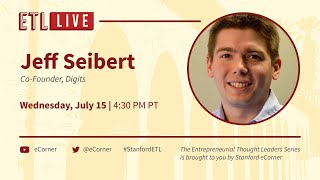
This content was created by GHION.AI . This content was uploaded by GHION.AI . This is a YouTube video titled "ETL Speaker Series: Jeff Seibert, Digits" created on July 16, 2020. It features a discussion between Tina Selig and Jeff Seibert as part of the Stanford Technology Ventures Program's Entrepreneurial Thought Leaders series. The conversation covers Jeff's entrepreneurial journey, his new venture Digits, and insights into running a fully remote company. They discuss the challenges and strategies of remote work, team dynamics, and the evolution of online collaboration tools.
Chapters
Hello, everyone. I'm Tina Selig and I'd like to welcome you to our Entrepreneurial Thought Leaders series Revisited, presented to you by the Stanford Technology Ventures Program, which is the entrepreneurship center at Stanford School of Engineering. Today, I am totally delighted to welcome Jeff seibert back to ETL. I met Jeff back in 2007 when he was a Mayfield Fellow, and as you will see, he is a natural born entrepreneur. Jeff has started and sold several companies and is an active angel investor. His new venture is called Digits, which he co founded in 2018. And after selling his prior company to Twitter, he served as Twitter's head of consumer product.
Right.
Wasn't that true, Jeff?
Yep.
He graduated from Stanford 2008 with a degree in computer science, and he returns today to discuss what he's learned over the last few years. Now, I want to invite everyone who's watching to post questions in the YouTube chat. We are going to be collecting them during the discussion and Jeff is looking forward to answering them. So welcome, Jeff.
Thank you, Tina. It is an absolute honor to be back at etl. I'm so excited.
Well, you know what, it's really fun. I looked back through our records and you've been a visitor a couple of times to ETL before. One time as part of a panel in 2010, and then again, you gave an amazing talk on acquisitions. In fact, for anyone who's interested in learning about how to sell a company, that is a must watch tutorial. But I want to go back to the visit that you had 10 years ago in 2010. It was with a panel of young entrepreneurs. You were still really quite a puppy. And I think this clip is wonderful because it talks about why are you motivated to start companies. So let's play this first clip.
And I think to go into sort of my personal motivations for like, why would I go out and do this? I'm very interested in building products and in building something that people find useful and really helps them. And so Kimber and I started meeting and talking and having these brainstorming sessions, like, what problems could there be? And more specifically, what product could we build that someone would really fall in love with and find that it helped them on a day to day basis. And then the other aspect was I wanted to do a vast variety of things. I had done a number of internships where I was just coding, where I was just an engineer. And it was great. I enjoyed it. But you're stuck sort of in that one role and you have to code all day, eight hours a day. Or 10 hours a day or whatever it is. And I wanted to expand beyond that and I wanted to do some of the business side things and be in meetings and talk with customers. And I wanted to participate in the design of the product as well. And so sort of tying those together, having a product, I wanted to basically be able to influence all the different aspects of putting a product together that would help people.
Well, Jeff, I think that is still true. So since then, you have started and sold several companies and maybe you could tell us a little bit about what you are doing right now, your new venture, Digits.
Yeah, Tina, it's so fun that you found that clip. And I remember being on that panel. I can't believe it's been 10 years and it's still so fun to see who else was on that panel and what they're up to today. It's accurate. I love building product, I love building software. And more particularly just like crafting something that I believe could save someone a massive amount of time. And that's sort of been the theme over the three main companies I've started now. And so with Digits, we started this two years ago in 2018, and it really came out of our prior experience at Crashlytics. So we had been building this mobile crash performance tool and that went well. But when we thought about the business side, like, how was it and what was really challenging, and back in 2011, a lot was challenging. When you started a new company, payroll getting set up was a nightmare and we had to work with adp and it just, it really was not a pleasant experience. And fortunately, now Josh Reeves, a friend of ours, has gone and started Gusto. They've done great. Accepting money was challenging. And now, of course, Stripe has done just a brilliant job in that space. And we started looking at these things and we're like, whatever happened to accounting? It really hasn't changed. And so you start a company today and you don't have a choice. You have to hire a bookkeeper because you need your books. And so you hire an external bookkeeper. They set up QuickBooks for you. And from that moment, you really lose all visibility into your business because you even I, as the founder, if I have a question, I have no choice but to email them. And the response is always the same. They're external, they work with maybe 20 other clients. They work for you a day and a half a month. And it's like, oh, great question. Let me take a few days to update your books and I'll get back to you. And so, sure enough, no matter what question's on your mind, it results in an email three, four days later with either an Excel sheet or a PDF that tries to answer your question. And that to me was just crazy. And so in 2018, my co founder Wayne and I were like, what if, like why on the product side do we have Google Analytics and AB testing tools and Crashlytics, these real time performance dashboards, you can log in and see in an instant what's happening. And on the finance side, I'm waiting four days for a PDF or weeks after the month close for my full books. And so that was the premise. It's like, how can we build instant real time visibility for finance for business owners and, and their finance teams to really understand what's going on?
Interesting. I wonder if you would do a product for personal people, individuals as opposed to companies. Has that been something that's come up?
It's funny, we've had a lot of asks for it and we're really focused on the business side right now. But I could definitely see down the road doing something there. There's been efforts to space. Yeah, Consumer product. I could see tackling that later on.
So this is all very interesting, but the thing I'm most interested in talking to you about today is something that you were ahead of the game on, independent of the product. It's about how you organize the company. And you, I remember you talking about it two years ago. You launched this company completely virtual. Everybody is working remotely, everyone's working from home. And I'd love for you to tell us a little bit about this because I think we're going to get quite an education. The timing couldn't be better. So why did you decide to start remotely and how does that actually work?
Yeah, and this was a really hard decision that I'd say was really non obvious in 2018. And so the context was I was leaving Twitter. I'd been head of consumer product at Twitter and I had seen there the challenges in building large product engineering orgs in San Francisco. You're dealing with tremendous competition for great talent. And because of that, you naturally want to hire great people where they are. And so you're motivated to set up these remote offices. And so for Twitter, we had offices in Boston and New York and Seattle and Boulder and London and so on and so on. Right. And when you have that dynamic, it starts adding a lot of friction. You feel the necessity to travel between offices to visit them. You're really consciously aligning work for different teams in different offices to try to make sure, they feel involved in the core product, but that the work also suits the skill sets of that office. It basically it created a lot of overhead. And so when Wayne and I were starting digits, we realized that this was a long term mission. This was not going to be a quick flip of a company. Building a whole finance stack is very challenging. And so we wanted to set the company up for long term success. And we knew we couldn't hire the size and caliber of team we wanted all in San Francisco. So we would have people who worked for digits elsewhere. And so then it became do we go down this remote office path, which we'd seen quite well, or do we try something new? And I had a feeling that there was huge advantages to being fully remote in terms of putting everyone on the same level playing field. You didn't have this sort of second class citizen character that came out with having these distant offices. And so it was an experiment, I'd say honestly, even a number of our own investors in digits were originally quite skeptical and it's just been magical in how it's played out. Honestly now I wouldn't consider any other approach. And, and the majority of our team has told me they would not go back to an office in the rest of their career. Like they view this as a far superior way of working.
Amazing. So let's get a little logistics. How many people are they and where are they located?
Yeah, so right now we're 20 people. It is primarily a product engineering team and we're spread out all across the country. So we're in seven states right now, about 50, 50 on both coasts. We have made a number of decisions and so there's different degrees to going fully remote. One of the big things we decided to do is be remote but synchronous. So we're not just, oh, people around the world working whenever. We have agreed as a company to basically work central time. And so there's a bit of a skew, east coast, west coast, based on people's hours and when they eat dinner. But the vast majority of the team is all online at the same time during the core of the day. And that makes so many things easier because you can have direct conversations, you can work with each other face to face even though you're on screens. It makes it a lot easier.
So let's talk about the details. I know you've really thought about the logistics here of how people collaborate. How much time are people doing heads down work, how much time are they collaborating? Do you have to set an appointment to talk to someone, is someone interruptible? What does this look like?
Great question. So we had this advantage that we were designing the company from scratch to be remote, right? And so we could really optimize every process in order to make that effective. And so we've done a few things that I think are quite different from other companies. So we run a really tight cadence. We do weekly sprints and so we kick off the whole team every Monday. Everyone sets goals for the week together. We do Wednesday check ins, basically checking in on the status of projects. And then we do Friday show and tell, which is my favorite time of the whole week. And literally every group shows off what they built. And it could be a product thing, it could be some very deep technical logging solution or data manipulation. On the product side it'll be wireframes, on the marketing side it'll be blog content. It's sort of all across the company. And so that keeps everyone in close contact because you're basically seeing everyone every 48 hours. Then we decided, okay, every project, how do we go tackle it? And then the danger with sort of working from home or from a co working space is it's very easy to just be isolated and to sort of rabbit hole down in something. Like I'm stuck on a bug or I'm trying to figure out a problem and all of a sudden hours go by, no one knows what you're working on, communication breaks down, et cetera. And so we decided from the early days to set up sort of a buddy system is what we call it. And so every project is basically tackled by at least two people, usually two to three people. And what that means is you always have someone you're working with during the day on this project. On the engineering side it's pair programming. On the product side it's collaborative whiteboarding and wireframing. On the marketing side it's co editing blog posts. And so we found that this scales actually quite naturally across the team. And the easy critique is like, oh wait, you're having two people do each job. Isn't that inefficient? And we found the opposite. So projects get done way faster with way higher quality because you have the thoughts and ideas of two people all at once. On the engineering side, your code review is built in because you're pair programming with someone and so you're not waiting for someone to review your pull request hours or days later. And so it creates a great rapid fire progress there. And it makes it more fun because now you are talking with someone, whether it be on Video or audio or just screen sharing during the day and it feels like you're sitting right next to them. And so that's honestly been super successful for us and I think makes the whole work from home thing more collaborative to a degree than if you were all in offices and sort of running between meetings.
Super interesting. Now, how often do these teams switch up?
Yeah, quite frequently. This is another thing that we've done that's different. And I think traditionally product organizations and organizations are structured as teams with managers and the teams are pretty static and then the projects sort of change over time and we've taken the opposite approach. So at digits, and we did this prior at Crashlytics and up to a team of about 85. So it scales quite well. We change the teams every two to three weeks as projects emerge. And so what this does is it prevents ossification. You don't have someone emerge as sort of the de facto leader of this team and everyone just sort of naturally else falls into a subservient role. You don't have someone decide, oh, they're the control person over this part of the product and they get to make all the decisions. Like things ebb and flow across the team. You get to work with a much wider range of people over the course of the quarter. And it's more fun because it builds more trust and you build more relationships. And so what we do is we scope things in what we call horizons. So a horizon is roughly a month long and that's the duration that teams will be roughly stable for. And then we do these series of weekly sprints. And then as those projects wind down, we'll break apart that team, form a couple of new teams and take on new projects and go from there. And so it's a really. It keeps it interesting and fun every week.
So how do you deal with people who have different working styles? I mean, I'm going to guess some people are much more introverted and heads down. Some people are much more gregarious and want to talk all the time. I mean, how does that work out?
Yeah, great question. It definitely varies by personality and varies across the team. And so you'll see we don't mandate any specific work pattern. So you're assigned the team who you're working with, but it's up to you to coordinate. Like, oh, do we want to sit on video? Or maybe we just do some screen sharing for an hour and a line and then go off and work on our own and then come back and realign. It's totally up to the different groups and personalities. And it's varied widely. We've had one pair last year decided they were going to do pair programming so aggressively they set a timer and switch drivers every 10 minutes on the timer. Wow, that's changing who is actively writing code. Every 10 minutes, you're on average five minutes away from writing code. You have to pay attention. It's exhausting, but it's a really fun sort of high intensity way to get something built. Other teams would much prefer to sort of build on their own and then check in a few times a day to make sure they're aligned and working in the same direction.
So do you find that there are some natural partners that evolve? Like these two people always, or this team is a dream team and they always want to work together and you kind of have to force them apart or I mean, because I can imagine, like, hey, Jeff, you know, I want to work with you all the time.
That definitely happens. And so it does take some coordination. And I intentionally will let them work together for a while, then break them up for a few weeks and have them work with other folks and then maybe come back together later. So it's definitely. It takes some management thought and just sort of understanding the different personalities, understanding the different skill sets. But the advantage is you can really tackle almost any project because as teams become free, I can hand pick who based on their skill set is best to tackle the next thing coming down the pipeline. And so it really allows an almost optimal sort of allocation of skill as we take on different projects.
Can you ever be part of two teams?
You can't really. There's been a couple times where I've had to ask a favor of an engineer to just like help another team out for part of a week. And of course it's not ideal because then you're losing contact with the team you're supposed to be on. You're stretched thin. So I'd say very minimally, you really want to be in your own team with one or two other people and sort of heads down, focused on what you're doing.
So does this mean that everyone is just online staring at a computer all day long? I mean, do people get up? I mean, like.
I mean, I think.
About in a typical company, you get up, you'd go to a meeting, you'd go to lunch. You know, this way you're all connected. So how does that feel being just sort of, you know, literally growing tentacles into the computer all day long?
Yeah, so it does take some adaptation, I'd say. When Someone joins in the first two to three weeks, they're sort of figuring out their routine and schedule. It's very flexible. So people grab lunch when they want to. If they need to go pick up their kids or get them dinner or whatever, they go do that. It's not meant to be. Like you have to be here all the time. That would be crazy. It's just high communication. So you mentioned team. Oh, I'm dropping off for an hour to go take a bike ride or go walk or go pick up my kids or whatever it is. And that's fine. And people are like, great, all right, we'll reconnect in an hour. And you're back. The key thing, and I think this is important to articulate, is meetings aren't really a thing. So we have the three all hands, Monday, Wednesday, Friday. And the goal is for the rest of the day, the calendar to be clear. And the only way that works is because you're synchronous with your buddy system. Right? So within your group, you're working together live or on audio or however you prefer. And then between groups, it's intentionally asynchronous. So say we're working on a big new area of the product and you want feedback from a broader set of folks. Then the way you do that is you don't schedule a meeting. You put together a doc, a Google Doc in our case, and it has your spec and technical thoughts and design sketches and so on, and you'll send that out for comment and the rest of the team can comment on it over the next few hours or over the next morning or whatever, and then you get input. And so that's where you keep the degree of meetings to an absolute minimum. The only disruption to that is of course, external stuff. So we do have to schedule calls with customers in some cases, we have to schedule interviews in some cases. But the vast majority of the time you're basically just in flow, working with your team and sending out sort of asynchronous ask for input from others.
So that's super interesting. We have a question, we have a bunch of questions coming in. So the first one I'm going to ask is a really interesting one, like working all day. So is all day. An eight hour day is a ten hour day. The person who wrote it said, listen, software companies in India and China work 12 hours from 9am to 9pm, six days a week. What do you think about what is a day and how many days a week?
Yeah, great question. And this is always so dangerous for Startups because there's infinite things to do and so it's too easy to just work far too much. We're very conscious about this and the weekly cadence helps a lot because everything ends at show and tell On Friday, there's no work. Over the weekends, there'd be nothing to do. We're going to kick off new projects on Monday morning. And so that's very healthy for the team and ensures everyone sort of takes a break and gets a breather during the week. It is definitely more fluid. I'd say it's a startup lifestyle. We probably average about 10 hours a day, but it'll vary based on if we're racing towards a new milestone or whatever it is. I would say it's, again, flexible for the individual. And so it skews like we have a bunch of folks on our east coast team who just like getting up early and being online in the morning to work with east coast folks. And so they've fallen into that pattern. Definitely. A few of these coast folks all drop off for dinner to spend time with their kids and family, and then late at night, after their kids are asleep, they'll pop back on. But there's no expectation that it's more just sort of what works for you. And I'd say it averages eight to ten hours a day.
Interesting. So there's another question from a listener who's saying, again, a question about how teams get formed. Can people request to work with certain people? Is there any sort of. Do they have a choice on what team they want to be on?
Yeah, the way I frame it is, by all means, let me know if you have preferences on types of projects, people to work with and so on. And I never promised to respect them, but I'll take that into consideration. And it's funny, it's happened far less than I would have expected. And so when we were starting the company and using this approach, I sort of imagined people would become quite opinionated on who they work with and what they work on. And I've seen the opposite, actually. People love the variety and love working on new challenges with new people. And so, yeah, that hasn't been a huge thing for us, I'd say. We also, in our interview processes, do actively select for a growth mindset, for a learning mindset. And so we select for people who really want to try new things and grow their sets of experience. And we also select for people who are very sort of supportive and like to help mentor other members on the team and so on. So it's been A very collaborative culture that we've built. There's no competition, which is important. So you're not pitting two teams against each other or two employees against each other. There's no promotion bar of like, oh, you contributed this and not that. It's more I judge our success on like, are you helping the whole team be successful in shipping great product? And if you're being a collaborative contributor to that, awesome.
So I'm super fascinated by how this works and this selection process is really interesting. Can you. I'm going to guess that you're just as thoughtful about how you interpe interview people and how you select them. Can you talk a little bit about that process? Because you have to find people who are certainly going to be a really good match for this type of environment.
Definitely, definitely. And it does self select and remote work. Definitely self selects. And so I spoke with an engineer probably six months ago and who was super excited about digits, really strong engineer. But it came down to the point in the conversation where he was like, honestly, I prefer a culture where I can grab beers after work at 5pm every day. And I'm like, that's not a thing. Like how would that work? We're not with you. And so it definitely selects for people who enjoy the freedom and flexibility of working remotely. For interview process, we've spent a lot of energy trying to making it as unbiased as possible. And so we start with a generic phone screen, just gauging background and interest in the role. It then immediately goes to a work sample. So a take home assignment. If it's engineering, it's technical. If it's product, it's strategy and design aspects. On the marketing side, it's copywriting and like strategic positioning. So it's customized to each role and that is graded totally blind by the team. So each of our work samples has a rubric. We don't identify the individual who submitted it whatsoever. And so they're graded blind. And then based on how that is done, then they're brought in for zoom interviews and we spend about half the time on sort of work, sort of work style and tactical things. So like engineering, it'll be some more technical questions and talking about what they've built and what went well and what didn't and so on. And then we spend about half the time doing top grading. And so this is an interview format where it's a really thorough exploration of their career history, how they viewed their performance, how they believe their manager viewed their performance. And then we're able to do Rough checking after the fact and validate their expectations, matched their manager's expectations or what they thought their manager thought of them. And through that, you get a very complete picture of the person. And then it comes down to what you're selecting for. And so selecting for growth, mindset, selecting for collaboration, selecting for customer focus. Like, do you want to build something just because it's cool? Or do you really care about helping people? And we want people who want to actually ship to production. Like, I want to deliver the results of my work, not just work on it in an. On an island.
So you said you really try to be very unbiased. Have you found that the system has allowed you to come up with a very more diverse workforce than you would have had if you were doing it differently?
100% and concretely, far more diverse than the Crashlytics team. We were able to build in Boston because we were only hiring in Boston, in Kendall Square, Cambridge, and the talent pool there is obviously just constrained by the local demographics. And so this has been a dramatic improved process. And obviously you're never finished on the diversity front like, you want to keep pressing, but I'm really happy with where we've come to so far, and I think we're set up well to keep building that.
Great. Now I want to. There's a question that was asked, and it sort of builds on the question that you discussed about, you know, having beers after work. Do people have lunch together? Is there a social time together? Is there? You know, that's one of the things that happens in a workplace is that people have unstructured time to catch up and learn about each other and build that relationship. So, you know, do people ever spend time, you know, even having a virtual beer together?
Yeah. Really great question. So we've experimented on a whole bunch of different dimensions with this. So we tried starting our meetings early so that people could just join 5, 10 minutes early and chat beforehand. That was. That worked briefly, but then it's too easy to just revert to the calendar invite time. We. We have had great success with basecamp, ironically. So we have basecamp every day, prompt you at 5pm what did you get done today? And it's a quick update for the team so everyone can sort of see what's happening. But then every Monday morning, it also prompts, what did you do this weekend? And people fill it up with photos of family and pets and so on and fun stories and anecdotes. And so that's a really great way to connect. And then we are very Passionate about pairwise, one on one sort of team, fully matrix one on ones. And it's easy when the team is very small. Now at 20, it takes a little bit more thought, but the goal is for everyone to have an unstructured one on one with everyone else at the company over time. Right. Over the course of weeks and months. And so those have been very effective at just casual conversation. What we do do intensely for this is quarterly on sites. And so historically we have flown the whole team somewhere in the country. We get a series of Airbnbs, we get everyone together for a week. And so every three months you get to see everyone for a week. And it's fantastic to build relationships. Obviously the current situation has made that challenging and so we have done remote hack weeks, but it's all non work stuff. We work on fun projects, do a lot of team building activities, do a lot of casual time, sort of assign small group projects. So you have casual time with different folks on the team. Trying to be really intentional about that.
Yeah, interesting. I was going to ask you about your off sites and of course can't do them now, so you must be building up a need for that when we are finally released.
Yes, everyone is so sad and so anxious to get back together and see everyone because they are just a total blast. And we've spent, we typically spend about half the time doing work and strategy. We spend half the time on fun activities, big sort of family dinners together and just fun experiences. And it's been great to sort of tour the country. And so we've I think, been to six or seven cities now, places that most of us had never been before. We pick sort of smaller cities that people wouldn't normally travel to. And it's just such a great way to experience new things together. So we are missing that. And so I would say we just did a remote hack week a few weeks ago and it was cool to do things that you can't do in person. So for example, if we're in rural North Carolina, which we were last year, you don't have a ton of customers there, so you can't really do a customer panel. And so a few weeks ago we did some zoom chats with customers and got the whole team to meet them and ask questions and so on. And so we're trying to migrate based on what's possible.
So you talked about sort of scaling and there's a question from one of the listeners asking about how does this scale? I mean, could you at some point have folks in Asia and Europe Participate or do you have to be limited to, you know, the United States, which is, you know, sort of similar time zones? I mean, how are you thinking about that? And also how does it scale? You know, you're now 20 people. What about 200 or 2000? How does this work? How are you thinking about that?
These are, these are all great questions. And I was really concerned about this at the start. I'm like, okay, this is working now, but will it really continue to work? And I spoke with Kevin Cluj, who's the SVP of engineering for Elastic. And so he personally grew their engineering team from 11 people to 500 across 34 countries. And he told me he would never do it any other way. And the things that you think are going to be hard, communication and balancing work and so on, turn out to not be hard. The things that you would never expect turn out to be impossible. And so, for example, one of those is just compensation. How do you level equity and salary bands across the world is very challenging. But yeah, I don't see any structural limitations to scaling this. And there's companies like Envision, GitLab, Buffer that have thousands of employees that are fully remote. And so I think there's clear precedent and that it'll continue to scale and we will go ahead. Sorry.
No, no, no. I was going to say there was another question about what are the unexpected, unexpected challenges that have. You've had a lot of unexpected surprises, positive surprises. What have been the unexpected challenges?
The biggest one for us has been whiteboarding, which sounds really silly.
Wasn't that one of your businesses in Creo? Wasn't that a whiteboard company?
My first company in 2007 was yes. And you cannot imagine how many times in the past two years I've been like, why isn't backboard still a product? But anyway, different topic. So I knew at the beginning that scaling engineering was doable. Product was really tough because you're used to debating different approaches, different priorities, different designs for concepts on a whiteboard right there, all in person. And it was such a problem that my co founder and I ended up flying back and forth. He's in la, I'm up in the Bay Area and we were flying back and forth every other week just to get enough time in person to do product. And that's not sustainable. About a year ago we found a tool called Pixel Board and it is a peer to peer whiteboarding app for iPad and you can connect and you can do live drawing together and it's just seamless. But there's One key realization, because the drawing actually isn't it. And if you think back to, like, working at a whiteboard with someone else, you don't spend most of your time drawing, Right. You draw something and then you spend most of your time sort of sitting back and thinking about it and, like, gesturing. And so what Pixel Board did really well is they have a gesture tool that you can circle stuff and draw an arrow and be like, oh, maybe we should put this over here, or cross that one out. And it just fades away after a few seconds.
Oh, interesting.
And so it solved remote gesturing. And I think that was our biggest unforeseen issue, is it's not the work that's hard. It's the strategy and debate around the work that you really want to feel connected to and be able to see what people are talking about.
So it's called Pixel Board.
It's called Pixel Board. Caveat. It's quite buggy, but I believe there's many tools like it in development and it's getting better as well. So I'm excited for the space.
You bet. Everybody's working. It's amazing, the number. Each week there's someone tells me a new product that is going to help us collaborate remotely. So there is some questions about your business model. Do you have customers? Are they paying? What's the business model here?
Yeah, great question. And this has been one of the impacts of the pandemic. So we've spent two years building this. It's a remarkably complex project because in order to accurately model a company's finances, you really do need a true ledger implementation. You need to be able to fully model the transactions. And so we've spent two years, heads down, building that. And originally we were set to launch a rather broad sort of business finance SaaS product. And when the pandemic hit this spring, we realized that it had really focused the market. Right. You saw instantly every small business care about cash flow, Runway and expenses. How do I make sure I'm not going to go bankrupt? And so we decided, you know what, we can come to that later. Let's do something to help now. And so we pared back all the functionality, focused it only on expenses, and we launched that for free because we felt it would be unfair to launch a paid expense management tool in the middle of a pandemic. That felt bad. And so that's gone fantastically well. We've had thousands of signups. It's sort of everything we can do to get them into the product as quickly as possible. So we're still working through the wait list and we've just been overjoyed by the response and sort of people understand the mission we're on and want to give tons of ideas and feedback. And so the product is definitely still in its early stages. But because we've had two years of work on these foundations, we're now really set up to start delivering features. And so we did the launch this spring. We're coming up on two more major launches this year that we're very excited about and then we'll see on revenue model. It will in time be a paid product, but that's not important right now. Our goal is really to be able to help every business weather these times.
So are you, do you have investors?
Yes. So yeah, we've raised two rounds of funding totaling 30 million. So we're very pleased to be well backed by Benchmark and Google Ventures. We also have the support of over 70 angel investors which has been just fantastic.
We're all going to run to write checks to you.
We are in good shape now. I'd say we are very fortunate that we have almost a decade of Runway, which allows us to take a very long term mindset. And so we're really building the product for the long term to help businesses. We think there's tremendous opportunity because a lot of this finance software hasn't really changed in 30 years. It was written in the early 90s and still has a lot of that same mindset and feature set. And so we think there's a huge opportunity to reinvent the back office of businesses.
One of the listeners asks, how do you figure out who you're going to let invest in you? Now obviously you've got a whole bunch of angel investors, but these large VC firms, how did you decide which ones that you wanted to go with and how did you evaluate them as members of your team?
Yeah, it's a really great question. When it comes to investors, for myself and my co founder Wayne, it really comes down to the individual and the relationship and how you feel collaborating with them. I think a lot of people have written about an investor as sort of like getting married and it's sort of true. They'll be with you on this multi year journey. And it has its ups and downs, it's high intensity, high pressure. And so we focused primarily on the individual, more so than the firm or anything else. And in both cases we couldn't be happier. So Peter Fenton was our series A investor. He was actually my assigned Mayfield mentor back in 2007. And so I've Been looking for an opportunity to work with him since then, and so happy to be doing it now. Our other board member, Jessica Varilli from Google Ventures, is also a Mayfield Fellow my same year from 2007. And so I've known her that same amount of time. And so we've really focused on surrounding the company with great supporters who we knew we could work really well with and we knew were committed to our mission, like they understood. And so Jessica in particular, she saw from her experience in Twitter corporate development, all these startups and all the challenges they faced sort of at their end game right when they were looking to be acquired. And so she really understands what business owners are looking for. And that perspective has been great.
So it's really interesting that you're mentioning all these people who you've known for a long time, who invested in you. What should someone do if they are new to the Valley or new to this world and want to get plugged in and are looking for investment? I mean, people knew you and clearly they would be excited about the product, but they also are probably pretty excited about you given your track record of innovation. So how does someone break into that world?
Yeah, so I faced this. So in 2010, I moved to Boston and knew nobody. And I had been out west, like had a great friend group and ecosystem out here. Moved to Boston after selling incredible and Backboard the document collaboration product to Box and Box had me start their Boston office and so moved out east and knew nobody. And it was a real challenge. But the approach I took was to basically meet as many people as I could as quickly as possible. And in those days that took the form of just going to any startup event under the sun. And so I went to like Ruby on Rails meetups and tech things and startup pitch things for mobile and they were all like anything startup tech related. And it got to the point where I was going to two or three events a week and just trying to meet as many people as possible. And it worked basically by after a year of doing that, I started to have a sense of like, who was well connected in the space and who was working on what and who knew which type of people. And so that was super, super helpful and sort of formed the basis of my network in Boston. Obviously today it's harder to go to.
That's really tricky.
Yeah, a little tricky. But I would do a lot of webinars like this, reach out to people. There's still a lot of support groups and incubators that are active. And so I do think it Comes down to building your network, whether that's on GitHub or on Medium or wherever it may be and trying to meet people, because it is, I think in many senses it still comes down to who you know in order to surround yourself with support and get help.
Yes. And you know, it's. That's a big job. Right. Just like it's a big job hiring people. It's a big job finding investors. It's a big job building your network. This is all part of the job, right?
Exactly.
Is all the finding the right people to be on your team.
And one thing I'd say is. So I spent four years at Twitter and during that time I still met with investors probably one to two times a month. And I wasn't raising money. I didn't even have a company. I was happy at Twitter. The reason was to keep building those relationships. And so no matter what you're doing, no matter if you're starting something or not, I'd highly encourage a really conscious effort to just sort of diligently build your network. Because you never know. Right. Like I met Gloria over 10 years ago and she happens to be a great customer of digits. And it's like you never know how things connect going forward.
Exactly. It is a small world.
Yes.
So I want to go back to talking about working remotely. I'm curious, can all companies do this? What would be the limitations? You happen to be a very software focused business that people have had a lot of experience working remotely in different industries. What can't be done this way and what can. That might be surprising.
Yeah, it's a great question. And it is fortunate honestly to just be doing pure software. That does make things easier. But I'd say even other shape of businesses, even hardware businesses, you can do a lot remotely. And so first, to answer your question, the tougher ones are if you're building hardware, it is difficult to have to share a physical prototype virtually. And so that is tough. If you're doing biotech, the equipment is super expensive, the chemicals are super expensive and dangerous. You're not going to put those in a home office. And so there are limitations where you do still need an office. But I would say even those businesses can do a lot remotely and are. And so my wife's a biotech engineer. She still now works mostly at home and goes into the lab a few days a week. And that same with most of their team. I'm an investor in an aerospace company, they're building a plane and they are mostly working remotely and then going in to work on the actual hardware when they need to, and spending a lot of time doing simulation. And so it depends and I think you can be conscious about the business, but it truly is the sweet spot is pure software or pure digital services. Those, I think can go fully remotely almost immediately.
So do you see the evolution of online collaboration tools really exploding? I mean, we are in this very unique time where the world has turned upside down and we've all been forced to embrace this new online world. Where do you see the tools evolving and where should they evolve?
Well, it's fascinating to see the different platform shifts and they've been mostly technical. So you had the rise of the Internet in the late 90s, then you had Web 2.0 in 2005, you had the iPhone and the app ecosystem in 2009. And people have been waiting for like, what is next? What's the next platform shift? And it's turned out not to be a platform shift. Mobile is still mobile, it's a work style shift. And it's driving all of these enterprise companies with very old processes and tools to change overnight. And so I think you already mentioned it. I'm seeing a just massive number of pitches for collaboration tools, video sharing tools. Zoom will inspire thousands of companies and that's fantastic. I think the amount of innovation we'll see in this space over the next 18 months is just going to blow our mind. And when you ask in 18 months, like, how was remote collaboration back in 2020? It'll be like, oh, those were the dark ages. That was terrible.
Yeah, it's going to be super interesting to see when we look back, like, oh my gosh, you were on Zoom all day, you know, how did you do that? So speaking of Zoom, you know, I'm spending a lot of time on Zoom, teaching classes and figuring out how to make that work. So different than a classroom setting. A lot of people are super frustrated with teaching online or online learning. You know, looking from the student and the teacher's perspective. What do you know from your experience that might be able to make online education work even better?
Yeah, that's a really great question. One of the things that comes to mind is the sort of the cadence, the pace. If you do a 90 minute lecture on Zoom, even the most interested audience is going to get bored and distracted over time just because it isn't as engaging. You don't feel as present, even though you want to be. And so I think it'll change the format of instruction. I think you need to like, very quickly switch modes. So like maybe it's a few minutes of talking and teaching about something and then you split into breakup groups and do an exercise and then you turn off video and do an audio only brainstorming and then you turn off everything and just do a slideshow and it's in silence for a few minutes. I think by changing those modes it keeps sort of the mental acuity and you keep getting, you'll bring people back in every few minutes if they've sort of like gotten distracted or tuned out briefly. I think it's the long period. To me it's almost more like a TED talk format. Right. Like keeping things very short and concise and moving on to a new thing and then maybe circling back if you need to, rather than doing the whole long topic all at once.
Yeah. The way I think about it is I often think I'm teaching like Sesame street. Keep changing things up every few minutes. Have to keep, you know, keep, keep doing something different. So given the fact that this is all a brave new world and a lot of new tools, do you, one of the people who's listening asked, do you prefer new college grads, seasoned people? Do you have a preference for people who haven't already been indoctrinated in other work approaches? Or is everyone comfortable sort of getting up to speed on this new way of working?
That's a great question. And I'd say our perspective has shifted a bit. So before this, for the past two years our mindset has actually been to tend towards more senior, more experienced people who have sort of seen industry, know how to work, used to how things are going and they're ready for something new. They want more flexibility and schedule. They want more flexibility on where they can live instead of being in San Francisco or Boston or New York. And so that's been our bias because I felt it's potentially unfair if you take someone brand new out of school. You get so much from the in person work environment in meeting friends and building your network that to deprive them of that may not be ideal early in your career. Now, of course, because everyone's in this environment, I do think actually people who are more used to being online, talking with friends over social media, gaming for example, is a great way of collaborating remotely. I think they do might have an advantage in terms of being comfortable with this environment in a world where everyone's working at home most of the time. And so now we feel less strongly and we're seeing great people sort of all across the spectrum.
Very interesting. Yeah. I mean the world has really changed, which obviously opens up the door for many more people being interested in this type of work. So where do you see digits in five years, 10 years? You know, you've built several companies and flipped them, sold them. Is this another company that you're going to get to a certain size and then flip them? Flip it?
Probably not. We've seen that movie, so it's interesting. So with Crashlytics, we were acquired by Twitter 14 months in and at that point we had no interest in being acquired. We weren't looking for it. The product was going fantastically. But Twitter came and presented us an opportunity that was very hard to refuse. And for the product was a natural fit. They wanted to make it free, they wanted every developer to use it, they wanted to put their brand behind it, etc. For the finance world, it's very different. I'd say this has a far larger market potential than a developer tool. There's far more to build than a developer tool that did one thing. And so we see this as a long term mission to really start reinventing every stage of the back office for businesses based upon this premise of finance should be real time, not days or weeks later. And so because of that, I do not expect to sell the company. I think we have a tremendous amount to build and I would really love to see digits become an instrumental part of companies both large and small on how they pay, how they receive money, how they view their business, how they model their business, how they plan their business. There's so many different use cases that I think the foundational platform can support. And so, yeah, we're super excited, particularly for the next few months, we're working on some really cool things and so it'll be fun to just keep marching forward in this space.
Well, it's so exciting. I really, it's so fun to look back at that video we started with. I mean, that's what I remember. That's when I met you, you look like that and you were this very precocious young man with big dreams. And of course you're showing that you really have realized them. I'm curious if in our last minutes together, if you look back to when you first started, whether you were a student or back 10 years ago when you were just a brand new founder of your first company, what things do you wish you knew then that you now know?
Really good question. A couple sort of key lessons. One is balance your team, be really self aware of what you're good at and weak at, and then intentionally find people who are Sort of the exact flip of you so that you can really trust them. And so I think what works so well between my co founder Wayne and I is we overlap on product in the middle. And then he trusts me completely with product and engineering and I trust him completely with product marketing. Sales, like how do we pitch it and how do we drive growth and distribution. And so that's really freeing. It allows us to really focus on our sides of the business and sort of not worry or fight about things that aren't important. Like we need to get our stuff done really, really well. So that's one, two would be the importance of distribution. And this is more software related potentially. But it is a complete lie that if you build something people will come and use it. There's just too much going on in the world, too much distraction, too many great products. And so to stand out, I think you have to fundamentally architect your distribution story into your product. And we did that with Crashlytics. It was very intentional. We set out with can we make a developer tool that goes viral? Which is a concept that no one had really ever thought of before. And the premise holds here. If we can make an accounting tool that enables viral social workflows within the company back office, that will be extremely powerful. And so I think you need to engineer that into the concept of the entire business and that's how you can drive growth and distribution of your idea. And the first time around I certainly did not appreciate that. And we were very quickly sort of capped on the reach of our product. Product.
Super interesting. Those are very tactical things that you can do that you go, okay, next time around I'm going to do something really different. Well, Jeff, this has been absolutely fabulous. I promise we will not wait another 10 years to get you back. I can't wait to see how this all evolves. And honestly, I'm hoping someday we're going to have a consumer product because I'm going to be a digits customer too.
That's fantastic. Well Tina, thank you. This has been so.
Thank you. So really, really appreciate it.
More from GHION.AI


O processo de reconhecer limites, mesmo quando a vida parece exigir sempre mais.





Depois de tantas histórias, aprendizados e pausas necessárias, o @interior_iza está de volta



