ETL Speaker Series: Jenny Lay-Flurrie, Microsoft
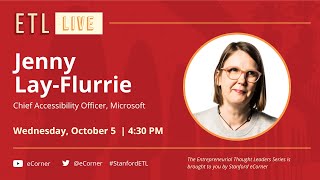
Jenny Lay-Flurrie, Microsoft's Chief Accessibility Officer who is deaf, discusses her leadership journey and how accessibility innovations drive change across the company. She explores inclusive design and the challenges of transforming large organizations from within.
Chapters
Welcome YouTube and the Stanford Communities to the Stanford Entrepreneurial Thought Leaders 2022 season. It is so great to have you back. I am Ravi Balani, a lecturer in the Management Science and Engineering Department at Stanford and a Director at Alchemist and Accelerator for Enterprise Startups, and I'd like to welcome you to the new year of the Entrepreneurial Thought Leaders Series presented by stvp, the Stanford Technology Ventures Program, which is now the Stanford Engineering Entrepreneurship center or Seek and Bases the Business association of Stanford Entrepreneurial Students. Before I introduce our speaker today, first off, let me say that today's ETL is the brainchild of MSME Lecturer Bruce Kahn. Bruce has long been advocating for the department to shed more light on the intersection of disability and entrepreneurship. And so while I'm here facilitating this Fireside Chat, don't confuse the megaphone for the muscle. This has really been the work, the result of Bruce's hard work that he's been championing for a while. And I would say that Bruce and myself could not be more pleased to kick off the 20222023 ETL series than to have Jenny Leif Lurie as our kickoff keynote Fireside Chat. Jenny Leif Lurie is Microsoft's Chief Accessibility Officer. And as Microsoft's Chief Accessibility Officer, Jenny is leading the company's efforts to drive great products, services and websites that empower people and organizations to achieve more 1 in 7 people 1 in 7 people in the world Over a billion people have a disability, and for 70% of those people, the disability is not apparent. That means even in our Stanford class, if our Stanford class mirrors the world's statistics, there's over 75 students in this class that have a disability and and you may not even know about it. Jenny's team is at the forefront of creating positive experiences that apply technology to make a difference in the world and the lives of individuals, from how Microsoft hires and supports people with disabilities and employment to innovative technology that aims to revolutionize what's possible for people with disabilities. Jenny hails from Birmingham, England, famed for Ozzy Osbourne. She has a sister who is congenitally deaf and a child on the autism spectrum. Jenny had hearing loss as a result of childhood measles that worsened with multiple ear infections and is now clinically deaf. In fact, on the deafness spectrum, Jenny is classified as profound and severely deaf, meaning that she can't hear what we're saying, although her articulateness may fool you and we might talk about this, how she has the ability to cloak her deafness. She studied classical music at the University of Sheffield and also received an MBA from the University of Bradford. Jenny's worked at Microsoft for 17 years, rising up from being a support manager all the way to a chief executive role now at Microsoft as Microsoft's Chief Accessibility Officer. And so with all that said, please welcome Jenny to etl. Jenny, welcome.
Hi there. It's lovely to be with you.
Well Jenny, you know what I we define entrepreneurship at Stanford as pursuing opportunity without regard for resources controlled or said another way, it's about transcending beyond your limits. And so I would be remiss if I didn't kick off by asking about how you navigated your journey into leadership because I think especially I think many people may have felt self limited when they would look at the prospect of becoming a chief executive role in a tech company, especially given that your formal training was in music. You were profoundly deaf and many people would have self limited themselves, but you didn't. And so I was wondering if we could kick off, if you could talk about your journey in navigating toward leadership in the tech industry and especially what were the key lessons that you learned in creating your path in leadership despite these things that others might have seen, might have perceived as disadvantages.
So my journey to what I do today, not the normal route, but every route is valid. I went to mainstream school. I went on to study classical music. I then realized coming out of college and university in the UK that I needed to earn a wage. I applied to a bunch of jobs. I got one working at the Daily Mirror on the IT help desk, having really candidly not used a computer. There wasn't a lot of computing in my music degree. In fact, I had an electronic typewriter to write my dissertation which was all of 5,000 words. It was more about performance music than writing stuff. But I did have a partner in me. I mean that nerd started very early in life and I did love my ZX81 and I loved coding as a kid and all that kind of stuff. Well, that came into into fruition when I started at the Daily Mirror, which was really about problem solving, fixing journalist issues with whatever tech they were using back in the dark ages in the sort of, my gosh, late 90s, went on from there to work in bigger groups, go through the IT boom and bust era which was super fun, startups all over the place. You were a millionaire one day and then you were bankrupt the next. And then eventually landed at Microsoft initially to work on Hotmail. Very quickly got into a whole bunch of other stuff, whether it was Online advertising support. And my peers were supporting Windows and Office and great things and the launch of Xbox and seeing three CEOs in my tenure here. But really, all the time, what I was learning was, one, the discipline of IT and this industry of computing, which is incredible, the sort of limitless potential that there is with computing. Two, I was learning how to get stuff done in that environment and how to go from helping people with problems to strategically identifying them and being ahead of that, how to manage people, how to work with people, how to collaborate with people and partners. And yes, eventually falling into the discipline of accessibility and being the CAO that I am today, which I've been in this role for seven years. Do I see limits on what I can do? No. I was brought up with two teachers as parents, and my parents both said to me, you're the only person that can stop you is you. And they were right. Yes, I'm deaf. I wouldn't describe myself exactly as you put it in the intro, but I.
Oh, please correct me.
Declining deafness from a young age. I don't hear speech today, but my voice is fantastic. I'm super modest about it. I use a sign language interpreter. I use captioning. And bluntly, I think actually my deafness, while it's not been easy at times, and I think having disability in the society, in a society that candidly doesn't empower you, but it's ultimately become a very big strength and expertise for me and has, you know, I've leaned into that over the years, and I do think that disability can be that expertise and strength. We very proactively here hire people with disabilities because of that. We're the folks that can help to create great things and tools that are going to empower people everywhere, whether it's our own employees or customers around the world. Because as you said, disability is everywhere. And if you're not in my call gang today, you will be at some point in your life. I'm pretty damn sure of it. So, yes, it is about opening doors to possibility, and that's really the core of what we do here.
Thank you. And please correct me on the introduction if there's anything that was. It was not intended to. It wasn't intended to be misspoken, but I would love to double click on this relationship that you've developed with disabilities or without anything that may have confronted you as in life, because, you know, I think it's highly relatable, this idea that we all have inadequacies when we're going into new forums Especially people that are trying to do something differently. And I'm curious about if that relationship has shifted or changed because there's different narratives about how to approach perceived inadequacies. And I understand that you had, in your career early on, developed compensatory superpowers where you could cloak your deafness and hide your deafness if you wanted to. You had exceptional lip syncing skills that you had honed as a little girl. But then eventually you decided that you wanted to stop cloaking it or stop pretending not to be deaf. And in fact, you've now leaned into it more. And I think that's something that's in parallels many issues that our students have with feeling inadequate, going into certain situations. So can I invite you to speak more about your relationship to your deafness? How did you originally approach it? When did you decide to stop cloaking it? When was that moment? And how did that shift things for you as a leader?
Okay, well, let me maybe take a step back. I'm deaf. I am very proud leader. I do not feel that my deafness or my other disabilities. I have a leg that works sometimes and not others due to a blood condition. I have a mental health condition that I live with. I don't see any of those as inadequacies. I don't see any of those as negatives. They are part of my human, and I was empowered to think that way as a kid. I grew up with my sister who had mild, moderate loss hearing loss, and I had my dad, who kind of had some loss. He would ironically, always hear dinner, but never hear chores or dishes. And I have an uncle who was deaf and used hearing aids. My sister used hearing aids. I had hearing aids. It was never, ever, ever in my lifetime by my family described as anything that was disadvantageous to us. And I think that was a very important culture that I was part of. So I never saw my deafness as a negative. I never saw it as an inadequacy. And I would encourage anyone, whether you're dealing with a disability or anything else, you are worthy, you are human, you are awesome. You may have a disability which is, again, just part of that human and genetically, or whether you acquire it most disability comes later in life. These things come your way, and they're not always easy to handle or to figure out. And the journey can be a little bit arduous as you go through, but you learn from it. And so I think that the grounding that I was taught as a very young child, I think was very important to me. And it's still something that I remember today. I will say that I also don't believe I have superpowers. I actually believe that I have learned to use. I use certain skills, and I lean on them a lot. So I do lip read. But again, lip reading can only get you 30 to 40%. It doesn't get you the full context of a room. I have hearing aids. I don't use them as much now because my hearing has gone down, but I do use them to try and keep my speech going and to hear my children. And, you know, I found that the combination of captioning, some degree of speech therapy training, and that's a personal choice. I could be just fine signing and never using my voice. And I empower anyone who sign is first language. You're beautiful and magical. Do not feel that you need to follow my path in any way, shape or form. And candidly, I want to follow your path because it's easier for me to sign than it is to voice now, because I don't hear what I'm saying. And I learn how to watch body language consume the context of a room to be curious, to make sure that all voices have an opportunity to speak, whether they are oral or not oral. I think if there's any ability that I've learned through my disabilities actually to be more inclusive, that. So, no, I think it's important to frame disability. It is part of the human experience. And I also feel very, very lucky, blessed and very privileged to be working in a company that thinks that way, too. And I'm fully supported. I don't have to think about, do I have an interpreter for my next meeting? It's covered by the company. If there's captioning and I'm going to. That's already done by the. Everything I go to is captioned. You know, there's certain things that I don't have to spend a lot, and that's a very privileged position. And maybe going back to what I said, society today doesn't just include those things. You have to ask for them. And then people say, well, I don't know, what is that? Then they ask you, well, how do I go about doing it? Oh, we can't do that in the time your society can be hard. So I think it's, you know, I have to always remember that, you know, actually when I leave the building and I go to a red, I go to a restaurant or I am far more deaf than when I'm at home or when I'm at work, because society doesn't provide what it should to be fully inclusive.
And so let's dovetail then into your role as CEO and how Microsoft might be helping redefine accessibility. Can you speak to the innovations that you're most excited about or the most significant ones that you're seeing as part of your role at Microsoft, and if there are any broader implications for those innovations for the rest of society?
Well, innovation's everywhere. So, I mean, I get really excited by the toys and goodness that's coming out today and the privilege of being in this position. I said this to a new member who joined my team last week is you get to sit in the hub. So we have what's called a hub and spoke model. So I have me and my team of amazing individuals, all of them geniuses and experts in their own rights. Many of them have far bigger profiles on social and other forums than I do. They work with every other part of the company, whether that is gaming, Windows, cloud and AI, whatever it may be. And they get to work with them on making sure that we don't just meet the basics, but we open paradigms. Because our holistic set of goals are to drive and make an impact on the disability divide. We want to impact that social inequity that exists in employment and education to help power people with disabilities. In fact, that's why most of my team just happen to be because they're the expert people with disabilities who have lived, experience or knowledge of. They are the experts. So I get to play across the company and go from division to division and see what they're up to and help disperse some of that. And I will say there's some really great things and trends that I'm seeing as we go forward. I think hardware is an incredible area for us. I think we've got an amazing leader in our chief Product officer, who's Panos Panay, who leads over Surface and Windows. We've got the adaptive controller that led a lot, which was the first controller for gaming, the Xbox adaptive controller, which was designed with a whole gang of amazing individuals with disabilities, mostly vets in the beginning, giving their expertise to really scope a controller. Well, that was a few years ago, but that led a legacy of amazing things coming out of that group, whether it's putting accessibility vehemently up there. In fact, if you're on Windows 11, it's right in the bottom corner. It's right there. It pops up and you can have captions embedded into the operating system online and offline. Instantly on that is just ground changing for Deaf, hard of hearing, but you've also got adaptive hardware coming through with the mouse and the hub, which we announced a little bit earlier in the year. And just think about your mouse and being able to with limited mobility, whether it's arthritis, cerebral palsy, or you want to flick your mouse from quickly being left handed to right handed because your partner is lefty and you're a righty. We've now got a mouse coming out that just simply with 3D printed and we're putting those CAD files online so people can 3D print that on, adapt it. You can just flick off that engine and put the tail on that you want, that works for you. And I think that whole space is all about making sure that we design seamlessly operating systems and hardware to flow together, meet the needs of people, no matter where they are and what they're at. And so the mouse is fun, it's beautiful, it's cool, it's affordable, which matters, but also it adapts to you. You can change it. So if your hand works well in the morning and you don't need the adaptive tail, don't put it on. But if during the course of the day you get muscle fatigue, chuck it on. And that's how technology should grow. So I get really excited about that. I also get really excited about AI. I think AI is the untapped potential that's going to lead the future in so many ways. There's so much there that I can talk about ad nauseam. But I would say that I'm excited about the collaborations happening here. I think we all know that artificial intelligence is based on data. It's based on a lot of data, billions of data points that then give you the ability to have machine learning and intelligence coming out of it. It's got to be ethically done, it's got to be thoughtful, it's got to be inclusive. It's also got to include data that's come from people with disabilities in that mask, because if it doesn't, you don't have an end result that's going to actually empower the full diversity of human. So this week we just announced a great collaboration which we've been working on for some time with four other tech companies, small ones, Apple, Google, Amazon, Meta small ones, to work with the University of Illinois with the right security, privacy, gather that data working on impacted voice, so speech recognition, so that we can accelerate and advance quickly the technology that's available to people who need that. The fact that you've got five huge companies working together to accelerate A technology area to really lean into AI potential that gets me up in the morning.
I'm going to ask one more or two more questions, then I'm going to open it up for student questions. Jenny, if you look at the Q and A tab, if there's any questions that really pop out at you when we go to that, you have prerogative and we can jump into those. But one of the things I want to ask about is you've been accredited with creating real change within Microsoft's culture. It's hard as an entrepreneur to create changes, period. But creating change within an organization, which is a large corporate like Microsoft, is even that much harder. Do you have any advice on how to be an entrepreneur from within an organization? Are there unintuitive insights you've learned on how to affect change from within?
Yeah, I mean, I've learned a lot and I think, but to be clear, I'm still learning. So, you know, you've learned a lot. But that one, I'm sure there's a couple of books written on that, maybe there's a college course on it, but.
People are still trying to figure it out.
You know, I will say that some of what I've learned if I go back about 10 years ago and I was chair of the disability employee group then. So that was really how I slid into this gig from Hotmail. How do you go from Hotmail to. It was by. I went to meet people who were deaf like me and then I meant to met people who were blind. And then I find there's a mobility group and an autism group and ADD and mental health and. And then I was like, oh, we should all work together. So I built the, the ERG with the help of many people and that's kind of rule number one. It's never one person, no one person can change a culture. It's got to be a gang of incredible, impassioned individuals. And so I know leadership is important and we put a lot of onus on it, but I'll tell you, I don't do anything without that gang. And that's probably one of my most proudest moments is being a part of that ERG and having a part in forming it here at the company. But 10 years ago I was sat there meeting with the then president of Cloud and AI, who is now the CEO Satya Nadella. And it was my first meeting with him and I'd asked him to be sponsor and I was horribly nervous and I'd made this amazing 45 minute presentation deck and I'D labored for hours on it. And I sat down and he looked at me and he said, no, let's not look at that. Can you just tell me what's going on? And I said, no, no, no. I've spent days on these slides. You have no idea. But it ended up being one of the best meetings of my life. And the advice he gave me at the end is, jenny, you've got to go and get after Hearts and Minds. Hearts and Minds. I was wallowing in this afterwards, and I wasn't in this role. I was still pushing rocks uphill, but I took it to heart because I think there is a responsibility, opportunity when that comes to accessibility. But I think there is with any kind of leadership, particularly at the time this was under Resourced. It didn't have a lot of prioritization in the company at the time. And I felt like we were pushing constantly, but. But I started building collateral. I started working with people to turn this into something that would pull people in, in an empowering way, that would help them to learn, that would educate, that would also gather their expertise and insight. That would start the flywheel. That then accelerated in 2014, when Saki became CEO, in 2015, when I was fortunate enough to move into this role, along with a host of other amazing people, when we pivoted this from just a technical discipline into thinking about accessibility as a cultural enterprise, as an ecosystem, as a maturity model, as something that you have to inch forward and be strategic and prioritizing, clear and simple in what you go after and how you go after it. And every year I sit back and I run my annual assessment and I go, well, they're doing really well, but we got to go focus on procurement. We got to go figure out how to empower our sellers or how to talk about disability in Country X. And we come with a slim set of profiles and goals like you do with any other business. And then you get after that and you manage and you measure and you move methodically forward. I think if there's One difference with MySpace, it's never forgetting the ground you walk on. We're trying to. We're trying to empower people around the world. We're trying to change social, demographic, social inequity that's existed for decades, if not centuries. And it's human and it's real and it's not always fun, but it's really important. And there's people at the heart of it. And so, yeah, we run it like a business, but at the core, it's all about hearts and minds and it's all about humans.
That's great. I'm going to turn it now to the student questions. And Jenny, if there's a question, if you click on the Q and A that jumps out at you, you have prerogative. Otherwise there's a lot of them. Okay, there are so but there but you can rank them by most upvotes. So I'm going to go in meritocratic order because we won't have time to get through all of them. So I'll ask the first one and if you see any that jump leaps out at you, you have prerogative to decide which questions we answer. But the first question is how do product managers at Microsoft develop products or solutions through the lens of inclusion and adaptivity and adaptability? Is there any methodology, guideline, et cetera, anything official from a company guideline perspective?
Yeah. I mean the goodness with accessibility is while in some ways I would say that it's a constant learning environment and we're constantly busting open and challenging paradigms on the other end there's an enormous amount of wealth of expertise, wisdom, policies, processes that are really important as foundations to lean on. So yes, Microsoft does have a Microsoft Accessibility standard which is an amalgamation of regulations around the world that help inform that foundation. That's not the goal with what we do, but it is the bare minimum and so engineers, given that whether it's a developer or someone who's writing websites or code in any form hardware as well, I would also say that secondly, every employee at Microsoft has to take mandatory training on accessibility. So I've had 170 plus thousand employees that have taken training that's really important. That helps me again with that foundational basics of getting people to the point where they understand the importance of designing with and for but also they understand etiquette, they understand language and how important it is to include people and some of the easy ways that you can exclude and how to navigate and avoid that. Because again, everyone comes to an environment with different varying levels of understanding of nature, nurture with disability, with any part of the lived experience. I think the other part in learning how to design and go beyond that is leaning into the principles of designing for human and there's lots of words you can band around here. Inclusive design, it's probably the best well known but there is a lot of rigor here that goes into designing and busting open those doors. It's not just love. Let's see if this works. It actually is a whole process. So that Mouse, which started as a hackathon project. We have a lot of hacks here. We just finished that a couple of weeks ago and we had some amazing hack projects come up. The adaptive controller came from the hack. The actual Windows captioning came from a hack. It starts at small beginnings, but then it gets picked up by a team. They work with people all across the spectrum of disability to gather insights, to understand what would be best about that feature, what would not be good, to gather that holistic understanding that informs that design process right at the beginning all the way through, and keeps us grounded to whether it's the right thing to do or the wrong thing to do. And so that rigor and process is actually very important as well for us as you kind of go beyond and start building technologies. Otherwise you risk producing technologies that are not useful to anyone. And sadly, in this industry, there are a lot of them that haven't gone through that level of rigor. So, yes, there are. There's a lot of materials. As your short answer to your question.
That's great. The next two questions are most upvoted. I'm going to choose. I'll ask this one. How do solutions for seen and unseen disabilities differ? How can companies or individuals ensure that they are addressing unseen disabilities in addition to seen ones?
Well, I should again just pause a minute on the spectrum of disability. So, you know, there's lots of different ways to categorize. It's important to be thoughtful that there is a range in every part of the spectrum. So when talking about deafness, you have people that have mild loss, like my dad, you have people with mild, moderate loss, like my sister. There's moving beyond that. There's people who are born where first language is sign language. And so there's a massive spectrum within every parameter. And a lot of that can be visual or non visual. Deafness is one, which really can be both. But you've also got blindness, you've got mobility, you've got voice and speech. You've also got mental health and neurodiversity, which is the umbrella term for dyslexia, dyspraxia, autism, ADD, and much more. In every part of this, it can be apparent or non apparent. In fact, over 70% of disability is non apparent. And I will say that those guidelines that I mentioned earlier cover both. But do they cover everything? No. And we have to remember that we're learning a lot about some areas of disability right now, like mental health, which skyrocketed through the pandemic. Our understanding grew neurodiversity similar during the pandemic, a lot of those conditions came much more to the fore. I think they were probably still there before the pandemic, but they came to the fore in terms of I need assistance or support far more so. The same principles apply, whether it's apparent or non apparent. It's making sure that you at least embed the foundational items. But then you include, if you're doing usability testing, if you're doing design forums, that you include the full diversity of human in those forums to inform your process. And you don't just take one voice. That means multiple voices, because again, the spectrum is broad. So thinking inclusively, particularly around disability, means that you pull in that expertise across the spectrum to inform your process.
The next question is, how do you incentivize organizations to invest more heavily in accessibility?
I tell them to.
Okay, let me play devil's advocate because I think some people would say, jenny, this is great, and I wish I could, but I have limited resources as an organization and disabilities are a minority ultimately of the state of my customers. And so I need to prioritize my resources for the mainstream. I'm playing devil's advocate. How would you respond to a CEO that responds with that or an organization that acts with that motivation?
Well, first I'd have to control my eyebrows because they give away my thoughts. But it's not a minority. One in the CDC actually has it at 26% of the population in the states has a disability. I don't think we can call that a minority. And if you're not purposefully including people with disabilities, you are actively intentionally excluding. And those are your customers, your peers, your employees, again, whether you know it or not. And I think that's one of the key things I have a lot of comments I've had in the years is we don't have anyone in our company that has a disability. And again, I have to watch my eyebrows and my giggles because I'm like, that you know of. And that's because you haven't created a psychologically safe environment for somebody to come in and tell them who they are. Inclusive of their human, inclusive of their disability. When I hired this team several years ago, first hired with a blank slate, which is a gift that you very rarely get in a career. I knew coming in that I had 50% disability. A year later, I knew it was over 90%. Why is that? Because the 40% in the meantime felt safe enough to tell me or their manager that they had a disability and how their manager could Help best support their environment. That disability could have been a mental health condition, could have been autism, could have been dyslexia, whatever it may be, didn't disclose it previously. Now, that's what's happening in most environments. But I'll tell you now, they're your customers. And I'll give you one quick example of that. I went to a restaurant recently on the many travels. It was an environment, it was very open because we are still in a pandemic, and it was outdoors. But I asked if they wanted to verbally give me the menu. And I said, well, do you mind if I have a written copy? And they turned to the person with me and said, would you mind telling her what I say? And, you know, writing it down for me because I can't be bothered with that. And my colleague very kindly said, she's as she said she's deaf and she just needs a little bit of. She needs a written copy. I said, well, this maybe isn't the restaurant for you. And we walked out. What we also did was cancel the event that we had the day following at that same restaurant. They lost my business, they lost a bigger business as a result. We spend money, a lot of it. And so I would. Any person who says to me that, why should I? I'm like, if you're not already, you're excluding people, you're losing money, you're incurring risk, and you're creating societal damage, move on.
Can I ask one question on that? On language and what we as a society should do regarding language and how we dialogue about disabilities? Because I think it speaks to this idea of creating more comfort for people to come forth with disabilities. There does seem to be a tension in society about how we should approach communications. On the one hand, there's a desire for a lot more sensitivity. And we're hearing that, you know, in a variety of ways where different subgroups want more sensitivity call to them as well as even in the mainstream. You know, there are artists like Beyonce and Lizzo that misappropriated words that were obviously very insulting and then they retracted lyrics. Then there's another current which is talking about, really about the need is more human humanizing the whole experience. That the whole point is not to draw upon people's differences, but to really the. The common human thread across all of humanity. Can you speak to what. How we as a society should be approaching language and disabilities?
I'm so first is to quote, I'm not an expert on disability language. There are some amazing folks out there that I would very quickly point you to Emily Ladou wrote an amazing book on disability. Judy Heumann, of course, has written an amazing book on the history of disability. Alice Wong has just published recently an amazing book that I was pouring all over on my way back from New York just a week ago. So there are some incredible advocates out there that I would say are the right people to learn from. And if you haven't read Emily's book, seriously, grab a cup of tea and a biscuit and read it. It is the resource. It's where I point people. But, you know, there's a couple of things here. One is, with any language, in any community, language evolves and changes over time. The phrase, my gosh, handicapped used to be. What was the term for actually what we're in this month, which is National Disability Employment Awareness Month or endeam, that used to have the word handicap in there, but terrible word, not relevant today. And there were several words that were used in Beyonce and Lizzo's frames that also terrible words and should not be used. And I was really thrilled to see, while they shouldn't have been included in the first place, the advocacy community jump on that, educate on that. And a very quick response in return because ultimately, we've all got to learn. Language does change today. The pendulum is a little swingy. And so first, remember that disability is personal. Everyone has the ability to frame what is personal to them about disability. In fact, if people want to talk about my disability, ask, let me do that, because it's mine. Let me talk about my deafness and my journey with it. Because it's very personal to talk about somebody else's medical condition. So know that the best first thing to do is to ask, how do you, like, are you deaf? Are you? And for me, I'm like, I'm deaf. I'm definitely not impaired. Unless I've had two glasses of wine, I'm deaf. But know that it's person first. Some like, so people with disabilities, person with hearing loss, and then there's identity first. Autistic, deaf, blind. Identity first is kind of where I land. But you'll see me use people with disabilities and disabled interchangeably as well. But if someone says, hey, Jen, I prefer this, that's what I'm going to go with. So ask, be curious. Remember, it's personal. And there are days where it's like, I really respect the questions, just stick with deaf. And no, I'm not going to go into my personal journey of how I got here. If you see a person with a wheelchair. It's honestly rude to touch their wheelchair. It is rude to ask them how they became and use a wheelchair. And it's terrible in all disability to say to someone, I'm so sorry for your deafness. I'm not sorry. I like it. You guys live in your horrible, loud world. I prefer mine. Now there are days.
More from GHION.AI


O processo de reconhecer limites, mesmo quando a vida parece exigir sempre mais.





Depois de tantas histórias, aprendizados e pausas necessárias, o @interior_iza está de volta



