ETL Speaker Series: John Felts
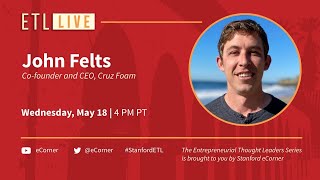
This content was created by GHION.AI . This content was uploaded by GHION.AI . This is a YouTube video titled "ETL Speaker Series: John Felts" from May 19, 2022, featuring a talk by John Felts, co-founder and CEO of Cruise Foam, as part of the Entrepreneurial Thought Leaders series at Stanford. The session, hosted by Toby Corey, covers John's journey in entrepreneurship, the development of eco-friendly foam alternatives, and the challenges of raising capital. The discussion includes insights into the environmental mission of Cruise Foam, the technical and market challenges faced, and the strategic pivots made to address plastic pollution.
Chapters
Speaker.
Hello Stanford community students around the world and all those interested in phenomenal entrepreneurship. I'm Toby Corey and I'd like to welcome you to Entrepreneurial Thought Leaders series. It's presented by STVP and that's the Entrepreneurship center in Stanford School of Engineering and Basis, the Business association of Stanford entrepreneurial students. Today I'm not only delighted, I'm super excited to welcome an amazingly talented entrepreneur who's tackling some of our biggest challenges. John felt the etl. Let me tell you a little bit about John. John is the co founder and CEO of Cruise Foam and Cruise Foam produces a bio benign foam and eco friendly EPS and EPE that's expanded polystyrene, expanded polyethylene alternative solutions that power key industry leaders to be a catalyst for a cleaner environment. John holds a BS in Chemical Engineering from UC Santa Barbara and an Ms. In Materials Engineering from the University of Washington. He co founded Cruise foam in 2017 with the mission of saving our oceans and helping end the global epidemic of plastic pollution. Before I welcome John, he's got a couple of slides which will give you a good overview and then we're going to jump in and do a live fireside chat to dive more deeply into. So John, welcome to etl. Tell us about Cruise Foam.
No. Awesome, thanks Toby. Great intro and really, really excited to be part of the conversation and have this opportunity. So excited for everybody joining and look forward to engaging with your questions and yeah, good primer Toby. Let me pull these slides up and I can give a quick overview kind of what Cruise Foam's about, what we're doing and really the exciting work that chat about today and what we're on a pathway to really achieve. So let me bring this up to the whole screen. All right, so I don't think anybody's on this call is probably unaware of the huge issue we have around plastic pollution. And really the problem has become so enormous. I think it's pretty apparent that every single one of us now has microplastics inside our bodies. So there's no more denying it. It's literally on our doorsteps, it's in our systems. And one of the craziest things I think is a stat that isn't said a lot. And it's something that really resonates with me. It was actually in 2020, nature came out with an article that said essentially human made materials now outweigh the entire Earth's biomass. That's trees, that's plants, that's that's animals, and just plastic alone is Greater than all land animals and marine creatures combined in mass. Trying to wrap your head around that is a little scary. And it's really what drives the work and the mission behind cruise foam. And what we're really looking to achieve with our technology. And that is a rethinking and re approach of materials. Really designing materials to be truly circular. And that's not just looking at the end of life. That definitely needs to be improved. But I think what's really not grasped or really thought of at the forefront is how we start at the beginning, how we design materials, how we source the raw inputs to really create that entire circular system with green manufacturing and clean capture of high value waste. In the end of life with us, what we've been able to do is take one of the most abundant biopolymers, Chitin, and really combine it with diverse byproduct wastes to create materials. But really what's differentiating for our technology is we've done it in a way that can drop in interface and really lower the barriers and friction to entry by working with existing plastic manufacturers. And really what we're excited about now is we see this huge need, this huge shift and our first really technology and product we're looking to tackle is Styrofoam expanded polystyrene protective packaging. It's mind boggling how much is still used by just single companies. And this is the type of material that breaks into a microplastic. There is no cleaning it up. So we have to figure out how to address the problem at the beginning. So excited for the chat. I'll stop there and shall have plenty of time to talk about the whole journey and everything along the way. So excited to for the conversation.
Toby, that's fantastic. I mean there's so much to unpack there. So let's break this down to slowest common denominator. I know one of the things that students are always really curious about is how this kind of journey gets started. So let's go back a little bit of time here and start with your decision first to study chemical engineering as an undergrad. And did you go into that field with the idea that you wanted to be an inventor or an entrepreneur? Other motivations like let's start there and then we'll start to break this down.
Yeah, it's an interesting start period and it really kind of does start at when I went to get my chemical engineering degree. And I'll cover that in a second. What I mean but when I went into school I knew I was very technically Scientific minded. I knew I wanted to be an engineer. I didn't know what type of engineer. I struggled between mechanical, electrical and chemical. And at the time when I was at UC Santa Barbara, I think they ramped it up. But the materials department wasn't really its own standalone thing. So it's kind of a merger with chemical engineering. And I was really attracted materials. And so the natural closest fit was chemistry and chemical engineering. And when I got involved in that, I got really exposed to academia and the thought patterns that go into learning a practice or a discipline like chemical engineering. Really, really robust. But a lot of it I found, at least in my experience, was geared towards PhD, geared towards research aspect. And that's not really what drove me as a person and what I wanted to achieve. I don't know if I would call it entrepreneurial at the time, but it was definitely I wanted to create something. And so when I was going through school, ironically enough, looking back at it now, it was probably just my naivety or youngness, but I wanted to become a petroleum engineer. It's really funny to think. And the real driver was, hey, there's a lot of innovation in that space. They're always creating. It pays well, and it's kind of what chemical engineers do. And that was the track I was on. And about halfway through my schooling, I had a pretty significant life event. My mother got sick. She's okay. But it really shifted my viewpoint on life. And honestly, it was a moment where she was someone that I really admired. She started at a company of the American Red Cross, at the very bottom, working as a thrift store, and became a regional coo. And. And it was just really this trajectory that I really emulated and really wanted to model that path as much as I could. And seeing what happened to her, she had to quit her job. Entire life changed. And it just was this realization of how short life is. And that is when I dived into the ocean. I literally started surfing almost every day, twice a day. And it really just shifted my perspective on life and really aligned with the cliche life is short, but really do what you are passionate about. And that for me was. It was this resonation I had with the ocean and this draw that really shifted. I. I see what's happening in plastics. I see what's happening when I'm in the ocean every day. When you're in Santa Barbara, I don't know how many people have been there, but there's oil rigs off of the coast. I used to literally have to go home after surfing and use a knife to scrape the tar off of the bottom of my feet because they would be caked and black tar that was floating on top of the surface. And it was just that moment where I realized this is what I want to dedicate my life to, is making change in the space around Ocean and Ocean Tech. And that was the seed. That's where it started. Yeah.
Well, then there's two other pieces that fell into place for you. One was you spent eight years at Tetra Tech. And so talk to us a little bit about like what that was, like what you learned there. And then after that you decided to go get your master's degree in material science up at uw. So what did the eight years and then the graduate degree set you up for? The master's degree?
No, 100%. What was interesting was I never wanted or had the idea of going to graduate school. You know, I wanted to go into industry. I wanted to apply in real life applications and scenarios. And when I graduated in 2008, I don't know how many people are familiar, but it was arguably the worst possible time to graduate in the last two decades, barring maybe, you know, Covid. But I would, I would argue maybe worse, but I can, I can commiserate. And I had a lot of pull to go get a good job. Petroleum. It was available, but it wasn't in my ethos, it wasn't in my drive anymore. And I got a job at Tetra Tech. Not quite what a chemical engineer would hope to get paid out of out of college, but it aligned with what I wanted to do. And really what I think I learned most through that experience is a. It was a job where it was involving a lot of out of the office on field running teams. And it was cleaning up old remediation or old environmental waste and remediating basically land or soil, wetlands, groundwater. I worked and contracted for the Navy, the Air Force, the epa. And it was large projects, three, four months long on site, and then coming back and doing the reporting and writing. And I think what it really gave me perspective is how industries of that scale operate in a way that is so different from what you see in academic environments. The expectations, the timelines, the engagement. And I think what really was one of the things that changed and prepared me well for what I do now is, you know, you're exposed to some, I would call them heavy hitters back then, but people with big titles and, you know, you're kind of cautious being a young student coming out of school. How do I engage. How do I communicate? And one of the things I can't remember if it's. I feel like it's something someone told me during that job was at the end of the day, people are people. You know, it may be a title, but everybody, you know, is at the core as a human being. And, you know, you're gonna get the outliers that are crazy and whatnot, but at most point, you can relate to people in ways that are just, you know, being a human being, interactions on a very, very simple level. And I think that's where I built a lot of my relationship building was through that job. Putting myself in really uncomfortable positions, having to go into areas in Las Vegas and some sketchy spots, and working in remote areas in the desert. Really kind of developed this approach to how I saw what I could apply my learnings, my real expertise that I was growing and really transition it to what I wanted to put my trajectory of my life on. And that was really this environmental mission, if you want to call it. And about eight years in, it was honestly my wife. She said, you can do more than this. Go, go, go apply yourself. And thank God she said that. And that's when I took the jump, went back to school. I was 30 at the time. It was pretty funny going to a master's program and clearly being the oldest person in the room. But it was. It was definitely a moment where I knew exactly what I was going there to do. The time at Tetracheck really allowed me to kind of gain that confidence in that, you know, career trajectory I wanted to take. And for me, that's why a lot of times I would advocate a lot for people to spend time in industry between undergrad and graduate. I know it's not always possible, depending on the situation, but I think it can be very, very advantageous to take that time and really learn what options are out there and who you are as a person. Because until you put yourself in those uncomfortable situations, it's always going to be kind of a guessing game. And going through University of Washington master's program, it was a great opportunity. Naturally, me and my wife love Seattle, but the bigger, obviously coalescing event was meeting Marco and. And ironically enough, we bonded over surfing. You know, he was a professor at the time, and like I said, people are people. And he's this kind of. Was this lofty professor in the materials department up there, and he was turning away all these PhD students because nobody knew. But he was on his way down to Santa Cruz and he, you know, he couldn't commit. But everybody was like, why is it Marco taking anybody? And it was funny because I just went in there and sat down and we, I don't know if we talked about school. I think we immediately just started talking about me being from Santa Barbara and surfing. And it was an immediate connection on a personal level. And I think when you have that skill set or you know, try to mature and, you know, improve that in yourself, it can really benefit you in so many different ways. And for me it's really about network. And for startups there's almost nothing more important in my opinion, when you look at what can really push things forward in different ways. Meeting Toby, good example.
But yeah, life takes crazy twists and turns.
So.
Let'S dive in this a little bit more. So tell me how you know this is a two part question, like where this initial idea came from. I know, like, it was like, hey, we're going to take shrimp shells and we're going to turn them and get rid of all these foam boards in the ocean and solve that big problem. And then you made a really extraordinary pivot. So one like where the idea of surf courses, shrimp shells come from. And then what was the inflection point of the pivot that turned out to be incredibly strategic? Move those two pieces.
Yeah, this will be a good one. Okay. So we, we had the idea for surf or for, for kind of this idea. This, this really business was based around surfboards. And how that came about is like I said, me and Marco kind of connected around the idea of surfing. More love of the ocean. But it was through the, you know, the medium of surfing. And when I went up to University of Washington, I got exposed to his research group and what he was doing. And specifically he was sort of on his way out as a technical lead of another startup. It's called Kaitotech Medical. And at the time what they were doing was making, and they still are, they're actually commercial, but they make micro needle bandages that can replace the need for stitches during ER visits. Less intrusive, cheaper. And at the time they were looking at doing the micro needles with chitin because chitin as a biopolymer has really fantastic microbial properties. It's really well suited for that identification. Long story short, fda, they eventually went to stainless steel. But I got originally exposed to material in Marco and kind of this idea around material development by working with him on that specific thesis project based on that company. And when we sat down, kind of at the end of it, we started what am I Going to do what's kind of the idea for next steps in career. And that's when he brought up the fact that he's going down to Santa Cruz and there's an opportunity to look at what could be done with this material. And specifically in the other aspects of his research lab, he was using Chitin a lot for bioplastics, but for thin films, it was thin films. Looking at very high end army DARPA research type of applications, niche, nothing of scale. But he saw the potential. And my background in chemical engineering actually did some work in foams during my bachelor's and we saw this opportunity where when we landscaped the kind of transition and novel early days technology around bioplastics, nobody was really looking at foams. I think at the time tempur pack was just getting legs. I think Ecovative was maybe getting something underneath them, but we didn't see anybody addressing it well. And when we looked at Chitin and the material properties, the mechanical strength to weight ratio is so fantastic, we're like, why not? Why couldn't this be a foam? And that's where we thought surfboards are almost always made out of polystyrene or polyurethane plastic foam trash. For all intents and purposes, we're riding around on that in the ocean. This just seems like it makes absolutely no sense. And so that's where the idea kicked on. We're like, let's make surfboards out of this. And we tried for a year and the stories I have behind that are intense and I'll share a couple. But I think what really benefited us choosing that was a. It was really what we were passionate about and it really lended a lot to what the core mission was, was around ocean focus, changing the, you know, what we're doing to our oceans. But I think also having that high, lofty target really allowed us to pivot later on. And I'll touch on that. And that's specifically because styrofoam or surfboard foam is so high mechanically strong, the requirements behind it and performance are probably the highest foam out there. You know, there probably isn't anything higher. With guys surfing down 100 foot waves, it has to stay intact, it has to perform. And so when we kind of really tried to develop it, the real issue for us became scale. How do we scale this properly, keeping that performance and really matching what the industry needs. And probably the best story is we near the end, before we pivoted, we were at a point where I think there was three of us total One guy we got from Cabrillo College, he's actually working for us now. Again, it's great when you see people come back, but he's super hands on. We had him build us steel surfboard molds out of sheet metal. He welded them together, we put them in our parking lot behind our closet facility. We're literally working in 200 square feet at the time. And we had to mix the foam originally in five gallon buckets in series, dump them into this steel case mold and heat it over barbecue. And this is how we originally tried to make our surfboard phone. And so you think about that starting point and people look at startups and think they happen like that. It takes time and it starts always with the most outrageous approaches and ideas because you don't know no one's done it. And we tried, we kept trying it for a little while and what we saw was people loved it. People really wanted what we were trying to make. The scale was going to be really difficult and the market was just tiny. And at the end of the day, you basically need a team, a market and product. And for us it was really this moment where we saw if we don't change what we're doing, we're going to be done. And we had a really honest sit down session. I think Toby was actually part of it. And it was me and my original co founder. And we said, what's the core mission behind what we're doing and how are we going to realistically achieve that? And we boil it down and it was simply that we had to have a catalytic moment to change the amount of plastic impact we're having on our oceans. And the technology to do that is going to need to be something that can really displace one of the biggest defenders in that space. And that is single use materials like packaging. And when we looked at that landscape and the need around that industry, it was absolutely enormous. Not only because consumers were there, brands were starting to make really, really big ESG goals and regulations were starting to really gain legs. And this was in 2018, I believe, 2018. And at this time when we noticed this, we're like, okay, well we don't know anything about this industry. You know, packaging. We're surfers, we kind of get it enough. But we didn't know anything about packaging. Besides, that's what we saw our technology being a really, really strong fit for. And we went through this program called the National Science Foundation I Corps. It has nodes in the, you know, around the US where you go through a week long program. And the goal is to help you really define your business model. And the goal. And by doing this, you have to go do in person. I don't know if it's still in person with COVID but the idea then was in person over a hundred interviews to fully define your business model. I flew to Australia to do some of these interviews because realistically you have to find conferences and going through this arduous process, I'm not going to lie, it is extremely daunting. Really, really tough. They really, really challenge you. But it's good, it's what's needed because it really helps you kind of be honest with what you're trying to build. And coming out of that, that's where we pivoted really, really hard. Really, really aligned with single use plastic packaging and specifically protective foam packaging. But that's just the beginning. You know, we had to really figure out in that gargantuan world of packaging what was that entry point. And you know that, that, that's a whole nother story.
Yeah. So in addition to all the insane both pivot formula development, the other extraordinary innovation that I, I don't have any other company that's tried this or doing this, which is to actually use existing manufacturing which is designed for petroleum based materials. And did that idea start early on because that's what gives you your scale instead of having massive capex buying your own manufacturing equipment and just you've got companies that want millions of units a year, tens of million units a year. So first, where did that idea kind of come up in the ethos? And two, just talk to us a little bit how hard it is to not only produce a formula but then to actually have it run on existing extrusion machines out there.
Yeah, it is by far the most differentiated factor of our technology. And it's been definitely the core of our approach from the beginning. I think a lot of this was very beneficial to have Marco as part of the core team, one of the co founders, understanding materials, what goes into the manufacturing, the development. And also not that my industry experience was directly related to that technology, but I understood how businesses cost structure, how kind of it needed to be worked. And when you looked at manufacturing specifically, what we really identified at the beginning, and we identified it through surfboards, honestly, it's the same principles existed really to make a product or material, you know, a final finished item. It's the material cost at a very high level and the manufacturing cost. There's obviously things that go in there, but those are usually the two biggest Inputs. When you looked at surfboards, our original idea was, well, if we can get a material cost that meets that surfboard as it currently costs as a material size, now that's one step. But we can't have to, you know, laminate a billion little squares together like certain people were trying to do with surfboards. We couldn't, you know, have these exotic, you know, like wood boards are a good example. They're, they're too exotic. That's why they cost extreme amounts of money. And so we were trying to emulate a mold, pour it into a mold, blow it up, follow the exact same way they make surfboards today. And the idea being is if we can meet the material cost and scale to meet the manufacturing cost with the same drop in style, there would be a natural coming together of cost parity. And that's really what we translated when we went to packaging and we saw, okay, we're going to no longer work with a liquid material like we were looking to do with surfboards. How do we take this and make it into something that'll scale into the industries around how plastic packaging is made? And really, when you boil it down and really understand all starts, the foundation starts from pellets. Almost every large scale manufacturing technique has an input step. Where pellets go in extrusion is what we do. Now you think of injection molding, you know, most adhesives, coatings, all of these things are either liquid or pellets that are basically melted in the liquid form. And that's really where we saw if we can take our material, turn it into a pellet, and then understand how that can then be transferred into those larger environments. That's the only way this impact is really going to be achieved. And we knew that when we went through the I core, we went through nsf when we looked at current other foam materials and kind of just plastics in general. Good example is ecovate of mushroom foam. I think it's a fantastic technology, you know, taking mycelium bacteria, growing it into different novel materials, but the sheer time in which it takes to create a final product, we saw even then, I was like, that's not going to work. And lo and behold, three, four years later, they're now making bacon. And there's a reason, because the scalability behind trying to tackle packaging with that approach was just unachievable. And that's really where, from our viewpoint, we knew it was going to be difficult. It was going to be extremely tough. Because one of the biggest things with biomaterials is the Processability, the variability and inputs, the different environmental ambient conditions, the different logistics of where you might get it from sourcing wise all come into play because it's not a standardized material that's been sitting under the earth for millions of years, that's very, very homogenized and everybody knows how to work with it. What we've really been having to do is build it from the ground up in a way where knowing what we need to achieve, how do we do that with this lower friction of adoption for our partners and industry. And we saw extrusion as the best first tackling point to achieve that because it's the highest volume output and it's usually, usually one of the simpler ones to achieve from a pellet format. And what we've been able to take is chitin combining with other byproduct waste. We have the ability to create a proprietary pellet that has thermoplastic properties. And why that's so key is because most of these larger industries or manufacturing partners out there, their large machines have a single input. So you need a homogenized single material and not any, I don't know of any other bio based material company that's been able to achieve what we have. Taking that from the raw grade and dropping it in with large partners. And we're at the stage now where it's really just about putting all the pieces together. We've seen it work, we validated it and it's going to be exciting because I think what we've seen is a real excitement around this possibility. And in the last six months, the overwhelming amount of interest we've had from starting with brands that's really been transitioning to manufacturers really speaks to these guys. Want to switch? Nobody's like, I love polluting the planet. It's just that if it doesn't meet a the performance, but more importantly the scale and cost structure, especially in packaging and kind of just plastic materials in general, it's never going to be adopted at scale. And that's kind of what we really, really have been working our hardest at, is to have that be an option for these guys and have this be a realized impact that can be really, really changed.
Yeah, that's amazing. And such an extraordinarily hard problem to solve. Want to remind students, get your questions in the Q and A so we can upvote them in about 10, 15 minutes we're going to tackle those. So get them in there. Upvote the ones you like. You know, as you were talking, it really reminded me of this is a very Tesla esque story because Tesla's got a. It looks like a car, it's a cool car, it's great looking car, but literally had to completely innovate everything underneath that. I know your phone like looks like cool like EPS phone, but like it is an entirely so much magic that goes into that. And I think that to me is like the right way to think about like the extraordinary work, the extraordinary innovation that's happening over there. And with that, we all know, like one of the hardest things of being an entrepreneur and a CEO is raising money. Take us through that journey because I know how hard you've worked to get here. And then that culminating in most recently getting direct investments from Ashton Kutcher, Leonardo DiCaprio, having him join the advisory board. That whole trajectory is just, it's fascinating. Students always like, how do I raise money? You know, how does that whole thing come together? You're an engineer, like, how'd you raise money for this thing?
Yeah, it's really honestly the most challenging part, especially at the early days. And I think it ties back into what I think I was lucky when I spent my time at Touch and Tech. You know, you build these soft skills in a way that allows you to relate to people in ways that really transcend the work environment. Let's say it's on a more personal level. And for me, I think that served me well. But it was incredibly hard at the beginning. A, you don't know where to start. Do I go try to. You just don't. You have no idea. And luckily I think the networks and the support systems are building in this space. But definitely here in Santa Cruz, it was limited, let's say. And I think I was lucky because Marco had some experience, but he wasn't the one raising money for his former company. And so at the time I came out of uc, me and Marco were like, okay, this seems like a good idea. I think we won the grad Islam from the UC and got like a couple thousand dollars. Like, great, this will pay me for a month and you take the risk. And I think there's that moment where a lot of people ask me, how did you make that choice? How did you jump off that cliff and go and really commit? And I think it's not black and white. I think the best answer I've always arrived to that I like to give is I believe most people have a handful of opportunities that come across them that offer a huge reward, huge opportunity, but also enormous risk. And a, you got to be in a Place where you identify that you have your mindset to realize that that's happening in front of you. But you also have to be in a time in your life to accept it, because it may happen, but something extraordinary can happen in your life or really terrible and it just isn't the timing for you. But if those two things come together, that's the best answer. And that's really what I relied on was I've always felt I wanted to create something and really put myself out there. And it was a moment in my life where I had the support of my wife. I moved here to Santa Cruz, my sister lives here. It felt like this is worth doing. And going out and raising money is a daunting effort. When you're an engineer, you don't have any idea what it means. I had to teach myself from the ground up what cap tables are, what valuations are safes, convertible notes, equity, the whole, the whole range. I had no idea before I started this business. And the amount of accelerated learning that you do is incredible. I would honestly say the last five years doing, starting this company and running this business has, I've learned hand over fist more than I did at both my degrees and my former job. And it's just because you have to go full in and if you don't, you're not going to succeed. And that's same with fundraising money. At the beginning you get a little bit of capital in different ways. Some can be, you know, pitch events, some can be grants if you can apply for them. Usually it's a little bit early if you're just starting to get a grant. We went and raised a little bit of capital from friends and family, so we're able to raise, I think it was 80k from friends and family would allowed us to just get out of the school, which I'll recommend. I think Stanford maybe is a little bit more palatable, but get out of the school because it gives you the idea, the ability to get your own ip. You can light, you can start really developing a technology on your terms in a little bit more ways. But that's another story. I think once you kind of get that initial capital through friends grants, pitching, it's really about how you start telling the story and telling it in a way that really resonates with the market. But obviously angels, that's probably the early stage it's going to be and then eventually VCs and venture capital. And for me being the CEO, I think what's the key is it's really on you. You really have to have the perseverance and really the drive. And that vision has to be so laser focused and telling that story and really bringing that to the forefront in the conversations you have. And if it's not, then it's never going to succeed. If you don't have that sheer perseverance and will, you're gonna, you're gonna want to quit. It's true. And when I tried to go raise our first round, let's call it, I came out of an accelerator and this was in 2000, I think it was late 2018. They were like, go raise $2 million. I was like, great, let's do it. And I was in Santa Cruz. I was driving to San Francisco, I would say three to four times a week, spending all day. I probably did over 150 investor venture fund interviews. I ended up raising $225,000. And the amount of no's I heard, the amount of basically blown off meetings I had is incredibly disheartening and it's incredibly challenging. But I think what really propelled me was the support that we had and it was the early network and people I was able to connect with. One was clearly my co founder, Marco. We had some good team members. I believe I had connected with Toby by then. He was one of the first people we were able to connect with here in Santa Cruz. Thank God. And it's really, those are the people when you can rely on and get real. Just kind of advice, just, just human connection on a real level that can really help you keep that drive real, really keep it fresh and going. Because sometimes it's really important to revisit the mission, why it started, why you're doing what you're doing. And something I don't tell a lot of people, but it's something that's important is the first two years I was delivering pizzas at night because literally how I'm not paying myself and the, the, the, the, the, the, the humility and, and, and, and, and looking back at that is just crazy because I also had a daughter near the same time period. And you think, I can't do this, I have to, I have to stop. But when you have everybody around you propelling you and pushing you forward, it just, that's what's needed. Otherwise if you're alone, it's going to be so incredibly difficult. And I think with that vision, that drive, it really allowed me to really apply myself and really put myself out there in high risk, kind of uncomfortable scenarios. And in doing that, one of the things that really Kind of changed was this moment in time where I was able to connect, build my network enough. And guess what? Got connected to an incredible ocean technology system and ecosystem around entrepreneurial investing funding. And it took me three and a half years to get to that point. And it was a gargantuan struggle up into that point. There's probably two or three times where we had less than $1,000 in the bank and I didn't know what I was going to do. We had a pitch competition the next week and we had to win. And Marco actually did that one. And thank you, Marco, because we literally had no cash and that was $20,000. That let us go for another three months. And that's really what it takes. And I'm sure so many entrepreneurs and so many startups will have that, a very, very similar story. And you get to a point where things start really making sense. You start having conversations with the right people. You start really having this moment where you don't feel like you're talking to a wall, you're not talking to a venture capital that's just interested in what you're doing. And you get to a point where you can identify that pretty quickly. And I'm at a point now where raising capital is by no means easy, but it's definitely. You learn who's serious, how they're really going to engage in a way that's not only going to add value to them, but value to you, and then really position your story in a way that paints that picture of execution in a way that only you, your team, your product in the market is so timed and ready for this that you're the ones to do it. And that's really. That happens over a long period. And I think one of the best things to sum it up when I found to tell the story along that trajectory is the three prongs that I touched on before. It's product, team, and market. And this is my own personal experience. But I found at the beginning, your products probably could be an idea. For all intents and purposes at that point, your team, you know, is more or less just you and the market. You probably don't even know what your market is. I mean, we try to do surfboards. We didn't know where the market was at the beginning. So at the beginning, for me, the most important thing is team. They have to buy into you. They have to buy into you. You are the person that's going to change this industry. Your passion, your vision, your drive is unlike anybody else who's trying to tackle this problem. That's the first key. If you can do that, you'll get some raise, you'll raise early capital. After that you need to paint the picture of the market. You better know what your market is, the whole landscape, how it's shifting, how your technology is the right fit, the timing, everything that defines the market and that product market fit around the technology you're building. And then the point that we're at right now is product. I think once you get to the A, your product better be kick ass, it better be going into the market, it better be ready to scale and really start getting some real commercial opportunities behind it. And that's when you have this kind of complete picture, team market product that allows you to really go and run with the startup.
Yeah, that's fascinating. I was with you in some of those meetings. A lot of the no's we did actually get that great yes from that Australian firm they run for a wine combinator contest and we're over at some dump office space. So it was the journey is awesome and your resiliency is, is absolutely incredible. The company would not be where it's at without your incredible leadership. So lots more to talk about here. Some questions that have come into Q and A student, feel free to post them. I'm going to grab the first one that got the most votes. John, how does the price of cruise foam compare with Styrofoam? What if anything may refrain companies from switching to a bio sustainable plastic alternative and purchasing your product?
Yeah, cost is obviously one of the bigger things, especially when you look at packaging and materials. And so as I touched on before, it's really materials and manufacturing. Right now our material cost is nearly on parity with EPS and that's pretty incredible. And really what we see, the thing that needs to catch up is the manufacturing. And that's really what we developed with the ability to drop in the current manufacturers and scale with their existing infrastructure. And so right now I'd say when you Compare us to EPS we're probably about 2 and a half, 3x is expensive depending on the, you know, the quality of eps because I won't get into weeds but you can have 1 pound EPS which is really crappy stuff and then 3 pound EPS which is really strong, really tough, different cost structures, but roughly 2 and a half to 3x. But really what happens with that accelerated manufacturing? The material gets only better and the manufacturing really, really starts to drop down. And we see cost parity being achievable with eps. I would say no later than the middle of next year. What's really interesting for the entry point for our market around electronics and appliances is with the regulations around Styrofoam and plastic. These global suppliers are looking to switch not only to sustainable materials, but if they can't get sustainable materials, they're going to other plastic foams. And the most widely one is polyethylene. What's interesting about this is polyethylene a lot of times is 2 and a half to 3x. The cost of expanded polystyrene interestingly enough, offers none of the sustainability benefits and kind of matches the performance. And that's where there's this really strong market opportunity for our technology to displace eps, but do it in a way where we don't really need to match cost parity with them, we need to beat or match cost parity with what they're trying to replace it on their side to polyethylene. And so that's where there's this strong opportunity to get in the market, get the scale, drop the cost parity. And that's really where the doors open for a much wider application set for different EPs working on small electronics or other e commerce applications that have less of that ability to switch or go to polyethylene. And when you look at why some companies might not use it, I think the biggest thing right now is probably the cost. Honestly you're going to have some companies that just don't have the ability in their businesses or structure to make that kind of quick moving switch for us, we can identify that pretty quickly. And we work with people that are really trying to be thought leaders in this space. Pioneers and those are the whirlpools of the world. The other thing might be if there's certain aesthetics that somebody wants, there might be something that we just can't necessarily achieve yet. And that's fine because we can't boil the ocean with every single product application that comes with development. That's what MVPs are for. You always start with something minimal viable product and expand. And then finally I think what was the last time I had one other one I was trying to think of, oh, this is changing. But one of the big things right now is end of life. A lot of people still rely on recycling right now. I think people have become pretty aware how broken that system is and how much need there is for other people solutions and capturing waste and the value behind waste. And that's one of the things right now our first product is compostable. You know, industrial Compostable. We're getting our at home certified compostable certification. It can go through recycling stream. You won't capture anything, it won't damage it. But the point is we want to see how we can make a product that can be tunable, starting with compostable and then potentially also recyclable. So that's one other gating item. Right now some people are like, oh, we can only use recyclables. And we're like, that's kind of shortsighted, but fine. We got plenty of other opportunities. So. Yeah.
Yeah. Great color. Another key question. Many students out there are either currently pursuing an entrepreneurial path, have ideas, have a product they've built. As you've pointed out, raising money is really, really hard. So this student says, hey, John, what are the biggest adjustments you made to pitch along the way of fundraising to make it successful at the end?
I think, you know, what I could probably say is the best advice I got. And I'm not sure. I don't know if you gave this to me, Toby. It could have been someone else. But it was the very early days of pitching. And it's very, very common. When you're starting to pitch, this is what you do. You focus on the technology. I learned very early when someone told me, and it really changed my conversations and pitching. Nobody cares about your technology. That sounds really harsh, but it's probably the best advice I got because really, when you start understanding that, they want to understand, it's at the beginning. It's also where I am now. They care a little bit more about the technology because obviously the commercialization and whatnot. But most of these guys in raising capital, they're businessmen, they want to make money. And so to understand that, they need to understand at the very early days what your mission is, your vision, your story, and how that's realized into a global, really impactful, large business having huge revenue. Naturally, you always kind of paint this ridiculous picture at the beginning, but I think it's really taking the viewpoint of telling your story more through the lens of the impact, the scale, the business, really how it becomes this entity of capturing high value and not so much about your nuanced, really cool, specific technology that, you know, two people in the world understand what you're talking about. And I think it's, how do you distill that in a way where not don't ignore the technology, but really frame it in a way to highlight the business and how that's going to be super successful? And I think if you can Tell the story with that kind of strategy. That's really where I saw a lot of resonation and kind of changing of excitement around what I was telling them. Yeah.
And I think watching you go through that, it really was just an extraordinary evolution. I think more importantly, it's like. And you hit on it. It's like it has to come together like a successful Hollywood motion picture where the stories like really exciting the character that's describing it. And I can connect with it emotionally. And I think like, and at that and through the venture journey, it's similar to that. We're like, is this guy really passionate? Does he really understand what's going on? Am I resonating with him? Am I resonating with the story? Am I resonating with these characters? More pro, like, what is the problem that he's solving? Like being able to tell that in your story and that you have the ability and unique capabilities to solve that. And it's a really large problem. So like it's been awesome for those students out there. John's an absolute pro at that. So maybe he'll just do it.
Thanks for bringing back for a pitch class.
So, all right. This one's pretty cool too because I think what. And this sort of ties into the trajectory of cruise foam. So it's one. John, you started with surfboards, then you moved to protective foam packaging. Kind of looking at the horizon. What other applications are you exploring for further growth? You know, bedding, furniture, building materials. Like what does that, what does that envelope look like?
Yeah, no, that's a great question. I'll try to make it short. But the idea here is we really want to build a company that's continually, continually innovating in biomaterial technologies around the idea of catalyzing these global supply chains from petroleum based materials, non renewable materials, to renewable circular, really bio based solutions that solve and really answer this call around plastic waste. And for us, as I said, the pellet's the kind of foundation to achieve that. But when we look at what's in front of us and what's capable, starting with just foam, you nailed a couple on the head. Packaging and protective single use plastics and whatnot is probably where we see the biggest impact and need. But construction, huge, huge market. I mean, clearly we've innovated some of our stuff and engineered it to be, you know, not last forever, but that's in soil. There's definitely ways to develop our foam in ways to last. You know, the requirements of construction. Cushioning is a big one. Surfboards you know, why not? But what's really interesting, when you look at these markets, some of them are growing exponentially. Construction and foam is twice the market of packaging. It's about 40 billion, 50 billion. And that's only going to keep going when you look at third world countries and all these things going into areas where populations are really just starting to pop. And so that's one huge avenue that we see just in the foam space. We could build this company just on foam if we wanted to. But our vision is bigger than that. We really see this capability of taking our core technology and looking across the spectrum of materials, really focusing on the higher need ones, the ones that would really result in the best impact for the environment in our oceans. But we've tested injection molding, we've tested different adhesives, we've tested coatings, we've tested a lot of different early stage technologies with our different biomaterials. And it's really that platform that we want to build as a company that allows us to really be the leader in this space. Allowing large industries, markets starting with packaging, construction, automotive, electronics in general, to really make and have the capabilities to transition from their standard petroleum based plastics to our different biomaterial sets. And that's really done with this idea of global sourcing, regional production, licensing and distribution. And that's really the only way that it can be done on a global scale to really transcend the entire supply chain around materials. And that's the longer term vision. It's going to take a lot of work. But the first step and really model to replicate in different applications is what we're doing with foam.
Yeah, that's awesome. Sounds like sky's the limit. All right, we have time for one more question. And this one ties back to a little bit what we talked about, just the journey on fundraising. And there's the technical side, like the right product, the right market, understand the right costing, structure, manufacturing, all of that. Then there's like the mental side of it and that is as important, if not more important. So the question is, hey, John, during those tough times, like when Cruise only had a thousand dollars in the bank, how did you stay focused rather than freak out, spend all your time concocting exit strategies and alternative career paths? And I know like working with you going back four years, like we never talked about an exit strategy, there's never like career plans. But how did you keep that all together, man?
That's a really good question. I think, you know, the core of it's definitely support. I think you know, either it's a good co founder, it's family, it's friends, finding that network of support a lot of times outside of the business, I think is going to be really what you need. For me personally, I think a lot of it came down to, as I said, you know, this is something that I really, really saw as a unique opportunity in my life. And if I wasn't going to go till my wits end and see this to the absolute last breath, then I wouldn't have done it from the beginning. And I think that's kind of something you really have to be honest with yourself before you even start a journey like this is are you willing to take this to the very, very end of its life, be good or bad? And that if you're working on exit strategies before that point, you've answered that question. And I think when my biggest struggles was the nights where we're baking stuff over a steel barbecue or something, I've just worked eight hours delivering pizzas, I come home, my six month year old daughter's screaming her head off and I'm just exhausted. And really it's having outlets that allow you to really clear your mind and really allow you to reconnect with that core, you know, personal spirit, vision, you know, drive that, that helped you and really put you on this path to begin with. And that for me was the ocean. And so I don't get back to the ocean as much as I'd love to. But in the early days it was critical. You know, you, you have certain mediums and you have certain, you know, energies. I think that if you can identify those and tap into those, they really allow you to regenerate yourself in a way to keep driving. Because at the end of the day, if as a CEO, you're feeling, you're, you're, you're, you can't bring your best, it's going to be really hard for your team to want to do that. And I think that's where it starts at the top. And having good support, having good, you know, outlets to regenerate and really step away, I think is key. And that's why, you know, co founder or founder burnout is a real thing. And, and, and having that separation even at the early days can be really daunting as you know, how do I step away? If I step away from a day, it's all going to crumble. It's not. And a lot of times that's going to be way more beneficial for you and your team and the company till.
The end Yeah, I think you said it best. I think it's like if you're willing to not, basically it's like the point of no return and literally being able to go into the black hole and be okay with that, wherever that that's going to lead you. And that conviction is absolutely vital. And the reason that I think the connection on it is that you're so passionate about your mission. And you know, I've been teaching here for 11 years and if you don't have that passion, the going's going to get tough. There's going to be a million reasons to quit. And if you really deep down inside of your soul, don't believe, want to put everything behind that mission, then you're really not cut out to be an entrepreneur. So I don't think you could have said it any better. As I said, I've been teaching here for 11 years. This is one of the most epic stories, one of the most great talks that you've given. We really appreciate your time.
Thank you.
And to our audience, thank you for tuning into this session of Entrepreneurial Thought Leaders series. Next week we'll be joined by director and co founder of Stanford Byers center for Biodesign, Josh Makeover for our last ETL talk of the quarter. You can find that event and other Future Events in ETL series on our Stanford E Corner YouTube channel. You'll find even more of our videos, podcasts and articles about entrepreneurship and innovation at Stanford E Corner. That's E Corner, that's Stanford Edu. John, thank you for an absolutely fascinating, amazing inspiring talk and best of luck to you and our team going forward.
No thanks, Toby. It was obviously a pleasure and thanks for joining. Hopefully I gave you some tidbits and some things to take away, so it was a pleasure.
More from GHION.AI


O processo de reconhecer limites, mesmo quando a vida parece exigir sempre mais.





Depois de tantas histórias, aprendizados e pausas necessárias, o @interior_iza está de volta



