ETL Speaker Series: Jorge Rios, Bridgefy
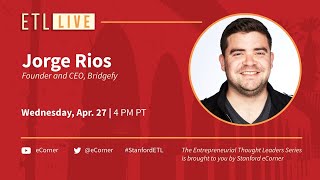
This content was created by GHION.AI . This content was uploaded by GHION.AI . This is a YouTube video titled "ETL Speaker Series: Jorge Rios, Bridgefy" created on April 28, 2022. It features a seminar from the Entrepreneurial Thought Leaders series at Stanford, hosted by Ravi Belani, with guest speaker Jorge Rios, Founder and CEO of Bridgefy. The discussion covers the development and impact of Bridgefy, a mobile messaging app that operates without internet, its use in crisis situations like protests and natural disasters, and the ethical considerations and challenges faced by the company.
Chapters
Welcome YouTube and Stanford Communities to this week's Entrepreneurial Thought Leaders Seminar. I am the ETL series, as you know, is presented by stvp, the Entrepreneurship center in Stanford School of Engineering and basis, the Business association of Stanford Entrepreneurial Students. I am Ravi Bhalani, a lecturer in the Management Science and Engineering Department at Stanford and the Director of Alchemist and Accelerator for Enterprise Startups. Today we are thrilled to welcome Jorge Rios to etl. Jorge Rios is the Founder and CEO of Bridgify. Bridgify's technology helps millions of people use mobile apps without an Internet connection through Bluetooth based mesh networks for mobile. According to Forbes, after Signal, Bridgify was the most popular Apple downloaded in Ukraine by Ukrainian civilians during the Ukrainian crisis, Bridgify has become the leading app in protest movements and for civilians and war stricken zones like Myanmar, Myanmar and Hong Kong and almost every area where peer to peer messaging without Internet infrastructure or government control is desired. Bridgify has been growing exponentially. They've grown almost 3x over the past year alone. Jorge Rios grew up in Monterrey, Mexico and began his career in the public sector helping local teenagers develop, fund and launch entrepreneurial projects through local city government. His first company was an online food ordering platform in Mexico and he founded Bridgify when he observed the need for Mexico City inhabitants to have a more reliable communication infrastructure in the aftermath of earthquakes. Since Bridgify was founded, its patented technology has helped more than 8 million people share information without an Internet connection in contexts such as Internet shutdowns, natural disasters, rural communities, underserved schools and large events. Bridgify has received the United Nations WSA Award and has been featured as a Pro magazine top 100 startup as one of the 25 most innovative companies, according to TechCrunch. Prior to becoming an entrepreneur, Jorge Rios taught politics, economics and international topics at the University of Monterey and he has served on the board of Startup Bus and advises multiple startups and entrepreneurs and was also named one of MIT's top 35 innovators in 2020. So with that being said, please welcome Jorge. Jorge, Big welcome from both the Stanford and YouTube communities.
Hi everyone, thank you for having me.
So Jorge, what I'd like to begin is just by explaining what Bridgify is. In February, Bridgify hit a tipping point and and became one of the leading apps in Ukraine. Can you use that as a window to explain exactly what Bridgify is, where it's used and can you give some use cases of how people have been using Bridgify in Ukraine, of course.
Bridgeify is a mobile messaging app that works without the Internet. Instead of using data, we use Bluetooth low energy to connect devices in situations and places in which it was previously impossible for the Internet to reach. And so this has proven to be useful, like you said, Ravi, in protests, natural disasters at very large events, at schools, et cetera. Because we know that the majority of smartphone owners do not own, do not have access to an Internet connection. And so we found that it was an immense market, it was an immense need, and that not only people were having a bad time when they lost access to the Internet, but also companies that make apps lose out on revenue, lose out on engagement when people don't have access to a connection. And so we thought, hey, let's build another alternative to the Internet that works in the situation places where the Internet does not.
Okay, so I want to dig into that because I want to talk about the origin story of Bridgify. And let me first set some context because I think that there are two narratives on how great startups get founded. There is an ends based narrative where you have a founder that is a visionary and they have some keen insight into the future that nobody understands. And entrepreneurship is about currying the resources to achieve that vision. But there's another narrative which is really where, which is more of a process based narrative where entrepreneurship is more of a muse that seduces a founder down a path. But then by going through the journey, you pivot, you change, you use design thinking, which is, I think, the wisdom of the design thinking school, to unlock insights that you would have never have known before. And you end up pursuing something that might have been a deeper calling than you even realized from the beginning. And I know everything is sort of a combination of the two, but which of the two did Bridgify fall in? And can you talk about the origin story of how Bridgify was created?
Definitely the second one. We were first time founders. We are, I guess, technically first time founders in the States at least. And so I was elected to represent Mexico in a hackathon, it's called Startup Bus, in which teams from several parts of the United States, several parts of Canada, and several parts of Mexico, they meet in a specific city. And that year it was Austin, Texas. And so I was elected to represent Mexico, but I had no knowledge of technology. I had just worked on a startup Notice of quotes for the past three months only. And so, yeah, that's where Bridgeway was born, out of necessity, like you said we started thinking of something that people actually needed. Not only a convenience, not only is like a novelty, but something would actually impact people's lives, including our own. And so, yeah, we, we met on the bus and we thought, let's build a messaging app that works without any Internet connection whatsoever. Because in Mexico City there were earthquakes every. Almost every two or three weeks. And so we thought this would be cool. And then we can also take it to concerts, we can take it to stadiums, et cetera. And so, yeah, we got second place in that contest. And so we thought, this is really cool. A lot of people identified with the idea and the then vision, which was very small compared to today's vision. And so, yeah, we decided to turn it into a company. Yeah, you were going to say, oh, sorry.
So I want to. I want to keep going down this thread because I just want people, I want the founders and the students to all understand this. So the impetus for this thing that has now become this influential tool to really influence the world started with you had this vision of people using it after the Mexico City earthquakes, maybe in concerts. People in concerts would text each other. And now can you give some examples of some of the more touching ways that you're seeing people use the app in Ukraine or how you're actually seeing it being used?
Yeah, definitely. Since we launched it back in 2015, we've seen major usage spikes in very, very delicate situations, such as the Mexico city earthquake in 2017, and there were a couple of hurricanes in the States that hit the United States in the same year. So that's when we got our very first big spike. And then throughout the years, we were also used in Hong Kong and the protests in India, Myanmar, Thailand, and then more recently in Ukraine. And people were using it to communicate during these situations because they knew that they were going to be surrounded by tens, if not hundreds of thousands of people. And you know what happens when that large amounts of devices are trying to connect to the same network. It gets saturated, so it becomes unusable. And so people started using it because there was no alternative. Bridge Fi was the only app that worked during those situations. But then as the years went by, it started evolving into, we choose to use Bridge 5 because it keeps us out of the eye, out of the public eye, because if you send a message, like a Bluetooth message to somebody that is within 330ft from you using Bridgefright, then it doesn't go through a server. We never have our content go through service, at least with the version that we have right now. And so people started identifying it as an extra layer of privacy and anonymity. We started learning from our users that, you know what, Richway is no longer a natural disaster and events app. It is now turning into an app that people have identified as a tool for protests. And so that's when we started paying attention to stuff like security, anonymity and privacy, because it had evolved into that. And so now we have this huge responsibility of paying more attention to security, paying more attention to how the app is being used by people that don't know English or Spanish, which is the only. Which are the only two languages that we support right now. And so just how do we make that better? How do we reach more people? How do we make it easier to use and how do we make it more attractive to use by those that want to and need to stay safe and anonymous?
Yes. And so I just, I want to underscore this point because the initial vision was, you know, people at concerts are going to use it to message about how great a song is, you know, at a concert with each other. And now what are the messages that people are using that you're seeing even in the real time crises, what are they using the app for? Just so people understand the gravity of this.
Yeah, they're using it to mobilize. They're using it to. If you lose sight of a loved one or a friend or whatever, they. Then they also use that to find each other. And so, yeah, a lot of organization and a lot of filling in the holes that the Internet leaves where you lose sight of your family or you lose sight of somebody that you were working with or something like that. And so this is when the technology has been the most valuable in those situations in which you cannot afford to be disconnected from the world.
And it's literally life or death now, if you get disconnected from bridgeify, either you're not going to know where your loved ones are in Ukraine, or it'll also prevent how the messaging is happening for the people that are resisting the occupation. So it's become a critical life or death messaging tool effectively.
Yes.
So can you walk me. So can you walk us through the moments? Because I think there's a few examples of pivoting towards something which is such a grand calling as what's happened with Bridgify. Can you share any insights that you've learned about how to unlock these pivots or these moments as a founder to find where. I don't like to use the word the universe, but the spirit of entrepreneurship ends up pointing you and saying, hori, you're not going to build a concert messaging app. You're actually going to be a critical messaging tool for war torn and protest driven movements. Can you give us a little bit more color in terms how that happened and any advice for future founders on that?
Yeah, definitely. So it wasn't a decision that we made. We didn't plan for it to be used the way that it's being used today. And so like I said, our users were telling us through downloads, through messages, on social media, through a lot of email that they needed this for a different use case, they needed this for a different situation than we had originally envisioned. So we still, people still use it for events, a few thousand people use it at Coachella, people still use it at schools. Nevertheless, the main, main usage right now is situations in which there is censorship, in which there is a political problem going on. And so, yeah, I mean, we kind of had to pivot. We didn't choose a pivot. And so we built the app and then we realized that it was being used for these other things. And then at the same time we were building out the BridgeWisedK, which is basically software that other companies can integrate into their own mobile apps and make their apps work without the Internet. So imagine one day being able to use Twitter or Facebook messenger or a Red Cross app when you don't have access to data. And so we started building that in a different way. We started building that with security, with privacy, with anonymity in mind, because we had been led to this pivot. It wasn't a decision. It wasn't like one day a light bulb turned on in my head and we said, okay, you know what, we should pursue protest and we should market to countries where there's going to be a political conflict. It was basically what happened. It was basically what our users told us that they wanted.
And when was there a moment when you realized that this was the new direction of Bridge of Fire and when did you know that it would become this phenomenon? Was there a moment when you realized this was actually going to become fairly significant?
I don't want to say that this is the direction that we're going to keep going on. We basically are focusing right now on licensing the technology to any app that wants it. However, our own app is taking this direction. So it's very interesting because we have this responsibility and we have to keep preparing for that. And I guess the moment when we realized, wow, this is actually happening, this is actually getting big and interesting was back in 20. Well, 2017 was very, very emotional for us because all my team is Mexican. And so a lot of people lost their lives in the Mexico City earthqu and so just the messages that we got from people saying, thank you for building this. I literally found my mom thanks to this app. We have downloaded it like one or two days before, by coincidence, there was this person that had downloaded it literally that same day before the earthquake. And so that's when it really hit us, like, okay, this is important. Not necessarily to the point where we were like, okay, millions of people are using it already. That was a little bit later, but definitely that was one of the first ones. And then when it's started getting even more Serious was in 2019 when it started just going viral in Hong Kong. We had 350,000 downloads, which to us was a huge amount. It was double what we already had had. And so we got 350,000 downloads in like two days. And we started getting in the news. We were on Forbes, Wall Street Journal and whatnot. So that's when we started getting a lot of good opinions, but also bad ones because they said, you're supporting the protesters, which we were not. We just had the app on the App Store. We don't support or not support anybody. We are a tool. And so we also got a lot of flack because of our security was not great back then. So it had a lot of vulnerabilities and we let our users know, but they were still there. And so throughout the years, we started focusing on fixing those holes and improving our security and to the point where we are about to hire a security team to work in house.
And so I find this fascinating because you built this with this intention of helping out people that were within the Mexico City earthquakes or even concert goers. Now you're in the throes of these, probably the deepest global crises, and you are significantly influencing those with your technology. One of the themes for Stanford this year is exploring ethics and entrepreneurship. And I imagine that you are now in the middle of some pretty interesting ethical situations. Can you, if that's true, can you share any experiences that have happened to you as a founder that have posed ethical dilemmas or situations that have. Where you feel like you've been confronted by different entities that have a vested interest in trying to understand what you're doing?
Where do I begin? Definitely. So we actually were. We got a very, very large amount of messages in 2020 because we got around 3 million downloads in Myanmar because of the protests and a lot of people reached out to us saying that we should shut it off, that we should remove the app from the app stores because it was fueling this protest, which was completely not true. The protest was going to happen regardless. And so that was one. It wasn't an ethical dilemma because we weren't going to take it down, of course, but it was something that made us paused and made us think, okay, are we doing the right thing? What if this gets into the hands of drug dealers? What if this gets into the hands of the wrong people? Like, we have no control over who uses our app, like any other app does. You don't know what the content is that they're sharing. And so this is constantly on our minds. Like, how do we, how do we avoid becoming a social media platform that is evil? How do we avoid becoming a source of. Yeah, of evil? Like, how do we avoid pressure being used for things that we don't agree with, you know, that are not ethical? And so as a founder, you really have to stick to your guns. You're going to get a lot of noise from the outside, from both a little devil and the little angel on your shoulders, but you really, really have to stick to your guns. And most importantly, I think as a founder, you have to ask for opinions and you have to talk to people that already have already been in those dilemmas and you're going to get conflicting opinions as well. But it will help you come to a decision. And at the end of the day, what helps you sleep at night, even if it's a little bit, is having done what you think is right. And I know it sounds a little bit cliche, but if you don't run your business in a way that you think is right, it's not going to be a, it's not going to be worth getting up in the morning to go, to go and do and have.
Do you formalize for yourself principles to navigate making these decisions. When people are trying to tell you what you should be doing in these war torn countries or not doing, are there principles that you have to navigate those? And what principles have you developed? And if there is any situation that came to you that was a difficult situation that you could share and how you had to navigate that using those principles, it's welcomed.
Yeah, definitely. So it's very basic. It's basically don't do evil, like Google used to say, but it's don't lie, don't steal. You know, like those are, those are crucial for a company and you see a lot of companies doing it on a daily basis. But we're very aware of how that can impact us in the future. And for example, I think I know which example you're talking about. A few years ago, like five or six years ago, we were fundraising, and two funds in the same round that we were raising offered us money. But then they offered us money in a way that we weren't comfortable with. Like, they offered us money, and then they say, okay, we're going to invest in you, but then you have to return this much money. And so we were uncomfortable with that. And then I spoke to my advisors, I spoke to my family, I spoke to a few friends that I trusted in, and everybody said, you can't take this money. And I said, my company's going to die. We weren't considering it. But if they make you an offer, you as a founder, as a CEO of a company, you have to seriously consider both options of taking it or not taking it. And so it was money that we were going to be very uncomfortable with. It was not the partner that we wanted. And so at the end of the day, we didn't take it, even though it would have completely changed our company. But that basically set the pace for the following years where we, whenever we sat down with a customer, with an investor, with a potential advisor that we didn't really trust, and it gave us this feeling of, like, something that you can't really measure. But you know what? I don't like the vibe of this person. Gives me the wrong impression of this and this and that. You have to follow your gut because at the end of the day, like, you have all these opinions, all this gamma of opinions, but it has to. You have to run things the way that you. You want to run them.
And if I can, can I ask about the ethical issues around. Do you. You view the technology as a technology, and so do you view. Do you view it as a just a tool agnostically, or do you think that you also have an obligation to ethically constrain how the tool is used? Does it matter who uses Bridgify to you, obviously, like in the news right now, Twitter with Elon Musk's bid to acquire Twitter, everybody's asking, will Twitter now allow Donald Trump on the platform? And Twitter, which has been a messaging bus. Yeah. Has made this ethical decision to not allow certain behaviors on their platform. How do you navigate similar ethically controversial situations like that?
The thing with Bridge, right. And this is going to get a little bit specific and particular to our technology, is that we don't have access to any content. And so there is no way for us to police anything. We are going to roll out a version of Richey that will let you report users and we might be able to take a look at if that user has been reported multiple times. But really the price that you pay for extreme privacy and security and anonymity is that it can be used by anybody and you have no like Signal, for example, is considered one of the safest messaging apps in the world. And so you don't know who's using it. Like probably I'm sure that bad actors are using it as well as good actors. And I'm sure that Bridgewise has also been used by people that we wish weren't using it. But really there's not much you can do. You just need to keep it as safe as possible and just work on encryption and whatnot. But there's really not a lot that we can do. So to answer your question, we consider ourselves a tool to help humanity in general, whether it's five students in one classroom in rural Mexico or 800,000 people in Ukraine. But yeah, I mean, it's a tricky question.
No, it's. That's why we're asking. So, so, so. And I appreciate you having the conversation around that, but it sounds like. So you went through this one pivot where there's this opportunity that emerged which was around really using Bridge of I in these situations and areas that you couldn't have predicted before. It sounds like you're also hinting at that there's like another pivot that seems to have emerged as well where not only is it useful in war torn areas, but that actually there's other use cases that are now on the horizon that you guys are thinking about supporting. Can you explain how that now has emerged or what is that?
Yeah, definitely. So the Bridgeway app, we're never going to decide what is being used for, but the Bridgeway SDK, the technology that we license. That's what you mean, right?
Yeah. Or I guess what's on the horizon now? It sounds like, it sounds like we were saying what unlocked before was that people were just using it for messaging when they didn't have Internet infrastructure. Then there was this realization that it's actually even with Internet infrastructure, it's a better security and privacy from other sources. So suddenly then this is again sort of the entrepreneurial news unlocking this other unforeseen opportunity. I was wondering if there was something along with that and how you discovered that.
Yeah, definitely. So the Bridgeway app Started off as a proof of concept because we always wanted to get into the B2B side of the company and make the Ubers and Twitters of the world work without the Internet. But then the app started growing up and so it stopped being a proof of concept and now it's a one of our two verticals. And so right now our goal for the next few months is to make people use Bridge Fight more. So we want people to use Bridge Fight not only when they don't have access to the Internet, not only when there's a protest or an event or when they're at school, but also throughout the whole day. So we are going to release a version of the Bridge by app that will contain Internet and non Internet capabilities so that you will be able to use Bridge by 24, 7 and then should you lose access to the Internet, you're good. You don't need to switch apps like you need to do with let's say WhatsApp, Signal or Telegram. If they stop working, you need to switch to Bridge Fi. But what we want is for people to just fall in love with Bridge Fi, make it as safe as we can. Add all the cool features that all the other apps have and so not necessarily replace the other apps, but be a better alternative. Be an alternative that people can use all day regardless of whether they have access to the Internet or not. And we feel this is going to be huge in regions like Latin America, like Africa, Southeast Asia.
Okay. And what I found fascinating is how you have these cascading insights that unlock to building up this product that you could never have a priori predicted. It just became this thing that you wouldn't have predicted before in advance.
Yeah, absolutely. Especially like all the safety features that we're going to roll out like disappearing messages and having to put in a special password in order to open the Bridge by app, just to open it self destructing messages like you can set a timer, a security QR code, you know, like all those things including the Signal protocol which we're adding. We're the only company in the world that has made the Signal protocol work without the Internet. And so Bridgeway is going to be as safe as Signal, except that it's also going to work without data. So we feel that that's a compelling offer that we're making to users and hopefully that will make other companies say, hey, this is really cool. More than 8 million people are using Bridge because it works with the Internet. I Uber should adopt this technology or WhatsApp or Twitter or Tinder. What have you should also want to make an effort to service those markets that have a smartphone, but they don't have access to data.
And so you're saying before that it's a tool, but it also sounds like with this next evolution you view it as more than that, as like a platform that everybody gets plugged into. Do you view it as a product or a platform? And how would you make the distinction?
So the Bridgeway, they're both products, except that the Bridgeway SDK is an infrastructure play. So we want to build this global network where you can go to, let's say San Francisco and automatically get information or send information out to anybody in the city. Thanks to Bridgewide, working on smartphones, on smart cars, on smart street lights, on microwaves, everything that we can get our technology onto, we will. And we're already working on that because we are convinced that that's what's needed right now. Like for example, in developing regions, 4G is still not universal and it's been around for years. And so 5G is not even on the horizon for the vast majority of the world population. And just bringing an alternative that works today. Like all you need is your phone. All you need is to turn Bluetooth on and you can plug into a huge 800,000 person network around you. Then we feel that's really valuable for protests and events, but also schools and also in the gaming sector and international travel, tourism, rural regions. We feel that all these people, these communities need this technology. And the Toko infrastructure is not catching up. It's expensive, it's slow to roll out, and if you don't have 4G today, there is a very slim chance that you will have 5G in the near future. But we're ready for that.
So it's so fascinating to me how this thread of this journey has taken you from this initial application of Bridgify. Now you're even thinking horizontally to all these different applications. And it sounds like it's getting bigger and it's like a sequel. It's getting bigger and better with every movement. But how is the journey and everything' exploding now? But can you talk about the journey up until this point? Were there challenges? As a founder, we oftentimes live in this TechCrunch world where everything seems like it's up and to the right and it's easy to build these apps. Can I invite you to share on the low points of getting to this point here?
Absolutely, yeah. Like one of our investors, Biz Stone says.
Is the co founder of Twitter. Everybody Just in case you didn't know. But.
Yeah, yeah, sorry, yeah. Bizton, one of the co founders of Twitter, I think he published it on his book and he said that an overnight success takes 10 years to make. And so I completely agree with that because we did go through a lot of stuff up until, I would say 2019, the Alchemist accelerator, the best B2B accelerator in the world, dare I say, adopted us before that. We went through like five very, very rough years in which nobody wanted to invest in us. And maybe that's our fault because we've never been great at fundraising, where our specialty is building product. And so at the very beginning when we started Bridge Fi, a lot of people wouldn't even take meetings with us, with us, because they said, we don't understand the product, we don't understand technology, we're not in the market. We've never invested in a Mexican company, even though we were not a Mexican company. And we went through a lot of stuff. Like we. When we first moved to San Francisco, we were invited by the person that invented the startup bus, Eliot Bazzani, who's also on our board today. And he invited us to come to San Francisco and we worked. He had this hostel slash co working space that was like a three story building. And so he said, you can come to San Francisco and stay here for three months, although we stayed for six. You can come to San Francisco and stay for three months. You just have to work, help us with hostile stuff. You need to help clean, you need to help build bunk beds, you need to help with the coworking space, whatnot, in order for us to stay in San Francisco for free. But we didn't have any money, so we constantly went to Uber events. I remember we went to a Nest event before they got bought out. We went to a lot of Twitter events and just, just to have dinner because we didn't have, we didn't have money to buy food and just. And so one of our, one of our challenges every day was, okay, whose turn is it to find dinner and say, okay, it's my turn? I found this event that is four blocks away. They're going to give out pizza and beer if you stay and watch this pitch night or whatever. And so we used to go to those events and just eat as much as we could because we couldn't afford to buy three meals a day sometimes. Some days, and I apologize to my former hostel maids, we used to have to steal breakfast. You know, take a couple eggs here, take a little bit of milk. From there. And so this basically, that's how Bridgewise started. And that's what we are today. We don't steal food anymore. I don't think my team steals wood anymore. But we evolved in a very scrappy minded way. Don't waste money when you don't need to. We have achieved way, way more than any of our competitors with a fraction of what they've raised. Because we don't go around buying cars, we don't go around renting huge offices in San Francisco. We pay for what we need. And our goal is to build product and to help people. That's not to spend money. And so throughout the years, we went through a lot of crisis, a lot of recessions, a lot of team rotations. This one time in 2015, we were literally like two weeks away from telling our team we ran out of money, you guys should start looking for work. And so we got selected to participate in this Twitter contest called Twitter Hatch. And the price was $25,000, which is what we needed to last for three more months. And that would have given us time to fundraise. Second and third prizes were not enough for even two more weeks. And so one of my co founders says, you have to go and you have to win. And I said, okay, that's great advice. Thank you for that. And so we went and we won. And that ended up being the only year that they held that contest was basically like, it's not that I believe or don't believe in fate, but whenever we have been about to throw in the towel, something has happened that has revived us again. 2018. Both of my co founders left in December 2018. Three weeks later, Alchemist said. You were accepted into the Alchemist program. We went on to raise $1.5 million. It's just been a hell of a ride.
Yes, yes, yes. I mean, that's an understatement. It sounds like. And it's so people oftentimes say you just have to be present to win as an entrepreneur. So so much of it is being there when the wave takes you. Almost like surfing when the wave takes you and you have to go through all these challenges to be there. But I'm curious, Jorge, because you're going through all even these experiences now where you're in unchartered territory. When you came to San Francisco, that also felt like it was unchartered territory. How have you received or have you been able to receive mentorship through the entrepreneurial journey? Has your experience as an entrepreneur from Mexico building a global company out of Silicon Valley has that. Do you think that is unique to other entrepreneurial journeys and can you share about what that experience has been like and how you have navigated that?
Yeah, no. It's all been uncharted territory. It's all been a constant learning process throughout the years, albeit way, way more drastically at the very beginning. And we are definitely not the first Mexican, we're definitely not the first company that is made of 100% Mexicans that has been successful or not successful in Silicon Valley by a long shot. However, we think that we are unique in that we've impacted such a huge amount of people in such a small amount of time with technology that we build in a co working space in a hostel without any money in our pockets. And so it's definitely been.
A lot.
Of pushbacks from Silicon Valley that we managed to survive. Like I said, a lot of funds wouldn't even take a meeting with us when they learned that we were in ex Ivy Leagues or that we didn't even have green cards back then that we weren't living in the Bay Area. And that's what we're trying to fundraise for. So we can't afford to live in the Bay Area. So it's been a lot of stuff that I know that not every single company has gone through. We haven't been the only ones. But it has definitely been a unique, not unique, but a very special journey so far.
Yes. And founders, I'm going to open it up for questions in five minutes I'm going to ask one or two more questions. So again you can start posting questions if you have for Jorge, but Jorge then given all of that, do you have any advice for founders that are coming from underrepresented areas in the United States? Anything that you would have done differently now, knowing what you know now?
Well, you actually people who are coming from outside the States have an advantage nowadays because you can easily raise money without even physically being in the United States. All you need to do is be a Delaware C corp. Or let me rephrase, all you need to be is an American company, not necessarily Delaware, but yeah, like for example one company that I'm advising right now from Ecuador, they were very worried that they needed to take a loan out from the bank in order to come to to California and be able to stay here for a week to be able to take meetings and fundraise. And I said who? Which fund has asked you for an in person meeting? And they said well no, none but I mean we have to go Meet them. And I say, no, you don't. That you can raise money. We're actually, we try fundraising right now and we haven't been in California in a while. And so that's an advantage that you have. You don't need to be in the States before you raise money. And another one is that you probably understand problems that people in California do not. You probably have life experiences that have nothing to do with a day to day of somebody in California. And so you can bring a different viewpoint to the table. You can identify these problems, like lack of access to the Internet. Like for example, at the very beginning we used to pitch bridge fight and people would say, but I always have access to the Internet. Yeah, but Latin America and Africa and all these types of. But all you have to do is turn WI fi on like the antenna and then you have access to the Internet or if not, you have your data plan. And it was so challenging to convince people that that was not a reality. It is not, it is not a universal privilege to have access to the Internet. And so this is an example of how people coming from outside of the United States, you have that advantage. You have that advantage and you don't need to be in the States today. Which I think is the biggest difference from when we started back in 2014. Like we had to be in California. They had to see you, they had to see if they liked you. And now you can raise two or three million dollars on a zoom call.
That's fantastic. And any. You know, I think everybody's becoming more of a global citizen and it's partly because of technologies like yours. The geopolitical lines are blurring and everybody has a vested interest in everything now around the world. Can you speak to how the entrepreneurial ecosystem has changed in Latin America or just globally? And if there's opportunities or things that have shifted even since when you started bridging by.
Yeah, definitely. So the very few funds in Latin America that were active eight, nine years ago are finally starting to see the benefits of having taken those risks. And that in turn lets other funds acknowledge that Mexico and Latin America have a lot to. You are seeing a lot of success stories in Mexico and Argentina or Brazil that were not there before. So it was unproven territory, uncharted territory for us, because back then the majority of the investors that we spoke to had never heard of any Mexican company being successful in California. I'm not saying they weren't, but nobody knew of them. They weren't famous like any Brazilian company, any Argentinian company Chilean company. And so now Latin America has evolved and grown to the point where there are many, many more funds, there are many, many more angel investors, which we did not find back in the day. And they know that the resources are there, that the talent is there. Latin America has ridiculous developer talent, ridiculous developer talent. And a lot of cities are business hubs where universities focus on businesses, programs as well. And so you have what it takes to make it. You just, if you want American money, you need to be an American company, but you don't need to have any Americans on your team. And so, yeah, it's basically that. And then fintech has taken over because there are hundreds of millions of poor people in Latin America and if you bring just a fraction of them to the digitized world, then you're going to make it, which is something that, for example, nubank has done fantastically. And so, yeah, a lot of, a lot of markets that you have access to that others don't.
Yeah, it's just, it's so ripe. I think right now. There's so much happening. It's so exciting. We're gonna, I'm gonna turn it over now to the student driven questions. Students, feel free to post questions if you have them for Jorge. I can't say your names or show your pictures just because of Stanford policy. So that's FYI. Why? I wish I could just give you direct access to Jorge, but the first question is, do large Internet providers and cell phone companies, AT&T Verizon, view the technology of Bridgify, particularly the SDK, as a threat to the services they offer? Do you see Bridgify as a disruptive technology in these industries?
I don't think they see it as a threat. At least we haven't heard that from conversations that we've had. With a few of those, it's basically more of a plus for them. Imagine if you could take an iPhone out of the box and it's an AT&T iPhone, just to name a brand, it's an AT&T iPhone. And right out of the box you can start using apps that are already on your iPhone. Imagine how powerful that could be to hundreds of millions of people. And you know that. You know what, only AT and T phones have this technology, whereas the other carriers don't. So this could be a plus for them. In addition to us being able to cover the gaps that in this same example that the AT&T network would leave on top of, like a third option would be that we, we also reduce server load for we will reduce server load for these kinds of companies. So that if Ravi and I, if you and I, Ravi are at a stadium and I want to send you a payment or I want to send you my location or what have you, instead of consuming resources by making my message go through a server, I can just send it straight to you. And that is a, maybe a fraction of a sense. But ask any huge company what their Amazon Web Services bill is every month and it's stratospheric and so that's another plus. So I don't think they're ever going to see us as a threat because we are there when their service doesn't work. So we're an add on. And then the second part of the.
Question is do you view it as a disruptive technology? So you know, the classic disruptive technologies, they appear sort of. I know, but the implication behind that question I think is is that the classic disruptive technologies appear innocent and they're going after sort of a low end market which in many ways Bridge defy is. It's almost like a cruder version of doing messaging when you don't have Internet connectivity effective but, but, but a simpler method. And then over time as these SDKs evolve and everything else evolves, it starts to usurp the incumbent. And so I think the hidden question here is do you think in the future as you grow exponentially, when people think about Bridgify five years from now, are they going to think about it as a network like an AT&T or a Verizon back in the old days? Five years from now, is it going to be the new next generation network or what is the vision for what Bridgify becomes?
I don't think we're going to replace traditional cell phone and Internet networks. It's just they're just different animals than Bridge fight. But we are going to see a change in the way that people communicate because we see people demanding to their app makers like Uber and the Twitters and the Whatsapps we hope to get to the point where they're demanding that they also work without the Internet because the other apps are. And once we partner up with either an Apple or a Google and are on every single iPhone or, and, or every single Android, then we will see this universal, like this global network that is unavoidable. Ridgeway is very similar to Bitcoin, I think to crypto in general because it's something that it's almost impossible to stop. And I don't mean that in a bad way. I mean that we don't break any laws, you don't need to jailbreak your phone. It's almost impossible to stop. And it's for the people. And so we create independent, decentralized networks that people can use that they can't today. And that's not fair, you know, like, it's not fair that I can't participate in the local, local economy or local society or like my life has to be in danger because I can't afford the airplane or because your infrastructure is not enough, it's not robust enough. You didn't want to invest enough in this rural town in Mexico and now there was a flood and everybody's screwed. So basically we want to, we want to do that. We want to democratize communications to a point that it's unavoidable for apps to include the bridge technology and participate in this network because everybody else is going to be okay.
And if you were going to become the next network, you probably wouldn't say it publicly right now to everybody.
No, we are going to become, we are going to become the next network. Okay, yes. We're not going to replace the Internet. We're not going to replace the Internet ever. That would be ridiculous for me to say. But we are going to be an alternative for when the Internet is not available.
It becomes the next manifestation. Okay, fantastic. There's a bunch of questions, so I'm just going to keep going through as many as we can. Hi Jorge, thanks for the talk. And gang, upvote the questions if you want to prioritize yours. So if you're even listening passively, you can upvote the ones that you really want. This next question is. Thanks for the talk, Jorge. How have you gone about building a technical product with limited resources? How did you focus between getting something on the market fast and building more long term quality?
That's a great question. We actually built it ourselves. I used to have two co founders and then when we raised a little bit of money we hired four more engineers. So we've always been a product heavy company and so we've always focused on building product, always focus on building product then because we didn't know if rich I was going to be able to exist because so many other companies had tried to build it and failed because the technologies weren't ready. Bluetooth was not ready. Operating systems iOS and Android were not ready. And I think there's, there was also a lack of understanding of the basic problem or the fundamentals of the, of the, of the problem. And so we were at the right place at the right time. And we are going to be, we are the first ones where we're definitely not going to be the last ones, I think. And so yeah, we first focus on the, on the product. Once we like, oh, wow, this actually, we were actually able to build a disc and actually exists now, then we started focusing on growing.
Okay, next question. Jorge, can you talk more about your background, including your education and your experience teaching at the University of Monterrey? How did your academic and teaching interests lead to the creation of your companies?
How did they know I was a teacher? So I am a business major and I have an mba which is, has not been of any use whatsoever. I mean, you don't need, you don't need an MBA to start your own company. Maybe it helps you if you go to Stanford, if you go like a really, really top school. But I would say like the majority of the people that I know that have MBAs regret doing it. You know, like it's better if you invest your youth in finding out what you love, finding out what you like to work on and then going hard on that. And yeah, teaching really, really shaped me as a person because you. I used to teach at a really, really low. Yeah, like underprivileged schools. And so you see how important it was. At the same time, I taught at a local public school in Mexico that's very, very underprivileged. And then I also taught at one of the best high schools in Mexico. And so you could see the differences, you see the contrast and you, it helped you appreciate. Maybe in the future didn't realize it then, but in the future it helped me appreciate how if those kids had had the same computers or they had had the same access to a WI FI network, how on par would they have been with the other school? And that basically reflects the south of the hemisphere, Latin America, Africa, et cetera, how that compares to Europe, how that compares to the United States in that if we all had the same resources, there wouldn't be developing and developed countries. And that's what we're trying to fix in a way.
Thank you, Jorge. Next question. How do you balance. This might be similar, but how do you balance. To a previous question, but how do you balance the research and development aspect of a startup with the need to keep a tight balance sheet when you're.
New in the field, they're not mutually exclusive. We've always done both. We've always focused on product. I would say that only the past, maybe year we focus on growing, but before that we Were always working on product, product, product and building something people needed. And the 8 million people that have downloaded Bridge by it has been completely organic. That is something that I should have said earlier. We have not put a single cent into marketing and that's because we, we built something that people wanted, which is something that, that is my biggest ask out of potential entrepreneurs on this meeting. Find out if people want what you're building. That is the first thing you have to do. Talk to people, run a poll, build a very basic version and give it up for free. Find out if people want it because if they don't want it, it doesn't matter if you build. If you raise $12 million, doesn't matter. You have the best co founder. It does not matter. People will not use it. They don't care how much you raised. They don school. You went to find out if people want it and then you got it made. You just need to build it. You just need to hire. You just need to hire and you just need to fundraise all the easy parts.
I'm going to actually exercise my prerogative and jump to one of the questions which is it sounds like you've had some stressful moments as a founder. Do you have any tricks for managing stress and staying optimistic?
Yes. That is actually something. Yeah. One of my very few regrets is since I started Ridgeway is not taking care of myself physically and in my mental health as well. I just put it off for later, put it, put it off for later until I got to a point where I was like, oh man, now I have to start taking a blood pressure pill. I have to start taking cholesterol pill. I have to start taking pills for my because I developed like really bad stomach aches because I got super stressed and I wish I had taken care of them before they became huge problems. And that's also something that I really, really recommend. Take care of yourself. Like, you don't have to kill yourself to build a company. That is a myth. That is something that a lot of people, especially in California, want you to believe because it's in their best interest. You do not need to kill yourself. You don't need to sacrifice your family or yourself or your social life for your company. There is such thing as work life balance. And so I eat well. I eat better than I did a few years ago. I meditate a lot. And I also have learned how to let go. Like, you know, like if it's 7pm that's the end of your workday unless there's an Emergency. You are allowed to turn your phone off. You're allowed to spend time with your family, and you have to for the sake of your company.
Thank you, Jorge. Thank you. Thank you. Thank you for sharing that. Next question. What type of entrepreneurial education did you receive throughout your life before beginning your startup journey? Was there any type of programs, courses you can think back to that made a big impact in shaping the entrepreneur that you are today?
Before Bridge Fight? Yes. I founded my first company in Mexico. It lasted three months and we went through an accelerator program. I learned how to pitch and I learned how to. I learned what a business model was, I learned what a startup was. We felt that's a story for another day. But it was pure luck and coincidence that I got into the startup world. But yeah, other than that, I've had to learn it as I go. I read a lot of books, talk to a lot of people, and just pay attention to what others are doing. Not necessarily in your space, but like people who have already gotten to the point where you want to be, just learn from them. And I think that's the best quality you can have as a founder. Like realize that you do not know everything, realize when you are wrong, and be able to learn.
And are there any specific books that you would tell your former self to read sooner? Any books that you want to recommend to the next generation of founders?
Yeah, I wish I read the Lean Startup earlier, Crossing the Chasm as well. And I would say what would have also really helped me in the very beginning is one of the pitching books. What was it never split the middle that the Alchemist gives us?
Pitch anything, probably.
Pitch anything. Oh yeah. Pitch anything. And never split the middle. Never split a difference. Sorry, Never split the difference. Never split a difference and bridge anything. Like those are really helpful not only for fundraising, but also talking to your team and your wife.
That's great. Okay, next question. Bridge of his mission to connect people of the world, regardless of wealth, privilege or circumstance. Reminds me a lot of cryptocurrencies. Bridgify and crypto have the same concerns you discussed as having good actors and bad actors, but find the ethical nature and having the platform available for everyone, free of censorship. Is that something you've thought about?
Yes, absolutely. We actually mentioned it. I think like 10 minutes ago that I see BridgeFi as a crypto. It's decentralized. We want to make it as democratized as possible. One day we might make it open source to a certain degree. And so it is something that the world needs that is going to take a while for us to get to critical mass, maybe one or two more years. But we know that the world needs it and the world wants it. Very similar to crypto. And so yeah, we feel that we are very, very similar.
Next question is, how do you envision the future technological landscape of off network mobile communications? Are there any emerging such as mobile mesh networks, Starlink, etc. Which would out complete Bluetooth given the limited range?
So that's a very good question. We are not limited to Bluetooth. We built the technology on Bluetooth because it was what worked back in the day, back in 2014, 2015 it was what was available. Now we have Wi Fi aware we have all these other protocols that are, that work with IoT as well. So we're not limited to Bluetooth. We don't want to be outgrown by anybody else. And so what I see happening in the next five years is that, well, we already know that more and more people are going to have a smartphone and they're going to want to participate in the digital world, but the infrastructure is not going to be enough. And so that's where we come in. That's where Elon Musk comes in, that's where Bridgewide comes in to fill in those gaps that the current telco infrastructure has left and still has. And so I think that that's where we're going to get to and hopefully 4G will finish, will continue to grow. 5G I'm not really concerned about. But yeah, that's how we see the next five years.
I'm going to ask you a question, just diving into that moment that we had before about reading these books and about how these books are, are good for people, interacting with people. So I'd love to just get into the nuts and bolts of being an effective leader. Can you share what you've learned about building a team and leader, slash founder of a startup, what have you learned about building a team? Any advice that you'd want to share to the next generation?
Yeah, make very, very sure. Be very sure that you are partnering up with the right people. Some people might seem like great co founders at the very beginning, but you might learn later that they weren't that great or the other way around. Maybe some of the people that weren't like the shiniest stars in your team end up being the person that you trust the most or the most important aspect of your development team, for example. And so it really comes down to what we said at the very beginning, Ravi, that you have to trust your Gut, you have to trust your feelings. And like I said, it sounds kind of romantic, kind of cliche, but you have to because you don't know what's going to happen in the future and there's no book and there's no questions that you can ask somebody that will tell you what this person is going to be like in five years. So if you can spend six months sleeping in the same hostel room with somebody and you don't get into a fist fight, then that might be a good, a good signal. But yeah, choose very, very wisely, especially before you start giving out equity, for example. Make sure that those people are going to be worth that in the future.
There is quite a strong pattern matching with co founders that manage to live together and then start their companies in the same space. Partly just because you are forced to create all these norms and values and deal with conflicts just because of physically living together, that you learn a lot about each other. So that's great. So again, trust your instincts. If you have a bad and your gut is really in your body, Jorge, that's how you feel it. If you know somebody's good or bad, you can feel it in your body. It's not something rational, it's just that that Spidey sense that you have. Okay, yeah, there's a question that came up just based on that, which was diving into that more. What are the specific values that you would look for then in a potential co founder or even an employee? What are you looking for, Jorge? Or what would you say?
I would say like number one is honesty. Like that's basically it. Because honesty encompasses everything from telling you if you're messing up, telling you if they think that you're doing something wrong, telling you where they think things should head towards, but also like being honest in the way that you're not going to say, yes, I'm in front of my computer and I'm working on this and you're out at the beach. You know, like everything is encompassed around that. And also I would say that a lot of people are. We've met, I've been very, very smart, very resourceful, but they weren't really hard workers. And so you want to get a co founder that is honest that you like as a person, like you can go grab a beer with and you're not going to be like, oh man, how much longer till I get out of here? But also that are like hard workers that want it as much as you, that are as hungry and as ambitious as you are, then you will in all likelihood, make a good match.
Can you know all those things, Jorge, just with your gut, or are those things that you only understand after some experience?
I think you have to make do with what you have. If you have no experience, then you have to trust your gut. And then if you have already seven, eight years of experience, then you have to trust your gut. But you also have to look for the signals and the red flags that you already learned from. You were going to say something.
By experience, I meant by actually working with that person. So I'm wondering, as a hack for you, would you extend somebody to be a co founder just based on a gut instinct or would you want to work with them for a little period of time and establish if they're honest, if they're hardworking, all these things first, would you recommend that before formalizing an offer with somebody?
Absolutely, absolutely. Yeah, definitely. If you can afford it, time wise and resource wise, then definitely get to know a person as much as you can before you get into that marriage with them.
And then as a co founder, any guidance on should you put yourself on vesting schedules at the beginning with your co founders?
Absolutely. Okay. Absolutely. Vesting schedules on your friends.
Okay.
Yeah, yeah. A vesting schedule for those who don't know, it's basically you don't get your stock right now, you will get it little by little throughout, let's say, the next four years. So if you leave the company, you don't leave with 33% of the company. So that's vesting. That's a vesting schedule. They are your friends. You need to put one on yourself as well. Your investors will demand that you have one. And so they are very good. Highly. Recommendations.
Terrific. We have one more minute. Jorge, any other pieces of advice that you want to give for the next generation of founders that you wish you had received when you were starting out or thinking about starting out? And I guess the classic question that we oftentimes ask, and I should ask right now is what do you wish you knew when you were 20 years old, which is the average age of the Stanford students that are here?
When I was 20 years old, I wish I knew that I could do anything. Yeah. Because I thought like, oh man, well, I'm Mexican and I'm going to this university and I have these friends and I've only taken these courses. Yes. I have to work on something related to that. But the world is full of opportunity and you just have to, you just.
Have to want it.
And not only take it, but you have to want it. You know. And that's, I guess, my biggest piece of advice. And again, I am very cliche. But if you're not in love with something, don't work on it. You're going to be miserable. And it's not about the money. Money is important. Yes. But if you are in love with something, you're going to be working on it, even if you run out of money, which is extremely important in a startup, in a founder's life. So, yeah, work on something that keeps you up at night.
Well, thank you. Thank you, thank you. Thank you, Jorge, for sharing so honestly and generously. Thank you for the discussion. Thank you, everybody, for tuning in to the Entrepreneurial Thought Leaders seminar. So that's this week's etl. Next week, we'll be joined by Sequoia Capital partner Alfred Lin. You can find that event and other future events in the ETL series on the Stanford E Corner YouTube channel. And you'll find even more videos, podcasts and articles about entrepreneurship and innovation at Stanford Ecorner. That's Ecorner, Stanford Eduardo. And as always, thank you for tuning in to etl.
More from GHION.AI


O processo de reconhecer limites, mesmo quando a vida parece exigir sempre mais.





Depois de tantas histórias, aprendizados e pausas necessárias, o @interior_iza está de volta



