ETL Speaker Series: Joseph Tsai, Alibaba Group
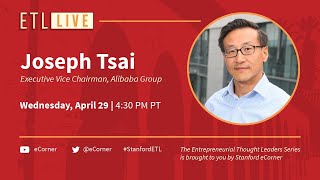
This content was created by GHION.AI . This content was uploaded by GHION.AI . This is a YouTube video titled "ETL Speaker Series: Joseph Tsai, Alibaba Group" from April 30, 2020. It features a conversation between Tom Byers and Joseph Tsai, co-founder and executive vice chairman of Alibaba Group. They discuss Tsai's journey from law to business, his role in Alibaba's growth, his investment in sports teams like the Brooklyn Nets, and his views on entrepreneurship and leadership. The conversation also touches on the impact of the COVID-19 pandemic and Tsai's philanthropic efforts.
Chapters
Good afternoon, everybody in this hemisphere or this part of the world, but good morning, Joe. In Hong Kong and in that part of the world, I'm Tom Byers and I'd like to welcome you to the Entrepreneurial Thought Leaders seminar series presented by stvp, which is the entrepreneurship center in the School of Engineering and Basis, the Business association of Stanford entrepreneurial students. We're so excited today to welcome Joe Tsai to etl. He's the co founder and the executive vice chairman still of the Alibaba Group, a global Internet technology company. Needs no introduction, but it's based in China with a portfolio that includes about everything under the sun. E commerce, cloud computing, digital media, entertainment. He joined Jack Ma and the others to incorporate the company in 1999, just over 20 years ago, and he served in a variety of capacities, leadership capacities, over the years. He's now responsible for the company's strategic acquisitions and investments as the vice executive Vice chairman. I hope I got that right, Joe. And serves on its board of directors, obviously. He's a graduate of Yale College and holds a law degree from Yale Law School in addition to his role at Alibaba. I'm just as excited that he's an owner of the NBA's Brooklyn Nets and the WNBA's New York Liberty and has invested in several other sports and sports media companies. You can see all that up on Wikipedia. I had two dreams in life was to be a college professor and own a sports team, so I got one of them done. But it's great to hang out with somebody who actually got to do that. So we're gonna. We get to talk about both of those things. Welcome and good morning once again.
Good afternoon, Tom. I'm really glad to be here. And I guess for one afternoon I can be a college professor and speak to the students.
Well, absolutely. And come back anytime. We'll always give you this platform. Okay, so let's go. You and I talked about this beforehand and agreed that it'd be fun to do about three different sorts of parts of this or pastures, as they call it, at Harvard Business School. Let's do that. So let's go way back. You're born in Taiwan, went to school at Yale, like I said. But what attracted you back to China initially?
Well, Tom, I was working in New York as a lawyer. I started out my career in the law. I come from a family of lawyers. My grandfather was a lawyer, my father was a lawyer. And of course, you mentioned Yale Law School. And I really wanted to get away from the law and get into business. So my first exposure when I left the law practice was to get into private equity. And I worked for a small firm in New York. Just by fluke, I got an opportunity to interview with a firm called Investor ab. It's a Swedish company. It's backed up by the Wallenberg family, and they were making investments globally and starting a new area of investment in medical technology, information technology, et cetera. And I was intrigued by the opportunity. Someone I had worked for before in Hong Kong introduced me to the opportunity. So that's how I made my way back to Hong Kong. And then four years into my job there, I met Jack Ma.
And how did that happen?
Well, a mutual friend introduced us. And so the circumstances are interesting because there's a friend of mine. His name is Jerry. Jerry Wu, Not Jerry Yang. It's another Jerry. And at the time, Jerry had his own technology company. He tried to merge the business into Alibaba. And I asked Jerry, why do you want to sell your business? You don't even know what this Alibaba.com is about. And you do? You know, I barely know Jack. So what's up? And he said, well, it's because Alibaba has a name.com in it, and if I can merge my company into Jazz company, maybe he'll take it public after six months and we'll do really well. So that was his motivation for introducing me to Jack. He said, you go to Hangzhou, Joe. Check him out. See what you think of Jack. So I went to Hangzhou. This was in May of 1999. And I met him in China. It was sort of the beginning of the Internet at the time. I remember, I think Yahoo went public in 95. Ebay came around 96. So China was a few years behind. And back then, only 10 million Internet users in China. Right now, we're over 900 million Internet users in China. Mobile Internet users. So everything happened very quickly. After my first visit, I was just fascinated with not the business plan. The plan itself was kind of ordinary, But I was fascinated with the person with Jack.
Was he a school teacher?
Yeah. No. He had already founded Alibaba. So I stepped into his apartment. There were something like 15 people there. I saw 15 pairs of shoes in front of the apartment before I went in, and I met everyone, and then I had to use the washroom. So I went to the bathroom and saw 15 pairs of toothbrushes. So people were living in that apartment, cramped in there, sleeping on the floor. And I thought, wow, this is like the real entrepreneurial spirit. And I fell in love with the company. Back then. It wasn't really much of a company, very small operation, but it was great.
So when I read that there were 18 co founders, was that the shoes?
Yeah, absolutely, it was a shoe. They were smelly shoes, too. I think one of the most important things to learn about Alibaba is the ethos, the people behind it. And obviously Jack is the main character. And Jack is a very inclusive person. In fact, when I met him first, we hadn't even formed the company. We hadn't incorporated yet. So it was just a collection of people. And because of my legal background, I said to Jack, look, I'll help you incorporate, but who are the shareholders back then? This was in 1999. He faxed me a list. I'm sure a lot of the students here haven't even used the fax before. And there were 18 names on that list. And I said, jack, I'm talking about the founders of the business. I know you're the main founder. There may be a couple other people, but why 18 people? He said, well, these are all my students. In fact, most of the founders are about 10 years younger than Jack and me. I'm the same age as Jack. And they were students of his in Zhejiang University where he was a lecturer in English and international trade. And he said, they started this business with me. I want to include all of them. And in fact, he gave away quite a bit of equity to all the original founders. So we had a group of 18 people. Wow.
But now I want to ask you about your mindset or your state of mind at that time. So you went to Yale. I understand you played. Speaking of sports, which we'll get to, you played lacrosse. I think you even played football, if I got that right.
High school.
High school. Okay. Right. So. And then, you know, you seem like the dream investment banker. You, you know, you go to there Yale to get a law degree, you become a investment banker doing really well in Hong Kong. Did people think you were crazy when you came back and said, I'm going to join this thing called Alibaba.com as a co founder?
Definitely when I talk to people about Alibaba, I mean, nobody back then in 1999 appreciated the power of the Internet. And people said, who is this Jack guy? Why do you want to join? And for me, I had transitioned from being a lawyer to private equity person, an investment person on the private equity side, which allowed me to make business decisions. As a lawyer, you're an advisor, but you never get to make decisions. But when you're investing, you're pulling the trigger. You have to make a case for it. So that was a good experience for me. But after investing for four or five years, I was sitting on boards investing companies, I talked to management, but you can never get through to the operational level. And I really wanted to understand how a business operates, how decisions are made day to day, how do you deal with people, how do you hire, retain, fire people, all those decisions, if you're just sitting at the board level as a venture capitalist, you never see the real picture. And I was fascinated, and I also was interested in seeing how that gets done in the China context.
What was the culture like in China then for entrepreneurship?
Well, I think it was back then, still is today, very, I would say entrepreneurial in that people are always coming up with new ideas. The potential size of the China market, I think breeds this kind of entrepreneurialism because you can always, I think in business school you teach about looking at a business plan. The first question you ask is, how large is the market? So in China, every sector, every market is very, very large. So you can kind of dream, right? But the big difference between Alibaba and today's startups, especially the ones that you see in the Bay Area, is that Alibaba never started with the Yale, Harvard, Stanford, MIT graduates. We didn't have the top college grads, I would say we didn't have the elite or elitism in our organization. It was a group of very ordinary people that got together, that pulled together a vision and also a very defined mission of what we wanted to accomplish. So I think that was very important. I think with a very clear mission, ordinary people can do extraordinary things.
Well, that's a really important takeaway that you just mentioned, and I'd like to dive a little deeper. So Alibaba and to just keep it moving here over the last 20 years has been incredibly successful by any measure. So what was it that helped the company scale so well? Was it a culture internally, or was it a set of strategic frameworks and decisions, models that you used for such rapid growth? What do you think when you think about the whole 20 years?
Yeah, sure. One of the most important things to scaling a business early is to retain a lot of flexibility and delegate responsibility to the frontline managers. And I still remember in the early days of Alibaba, people always say, well, you know, you have different groups doing different things and they're all, they're all sort of run in different directions. Synergy, you need to have, you need to bring everybody together to generate synergy because you could have two engineering teams developing the same software, the same applications. But when you're a startup, you have to maintain that kind of flexibility and allow people to run as fast as they can. And I think that's the secret to scaling a business early. But then later on you need to have more coordination as the company gets bigger. You can generate synergies, you can find room for synergies. I would also maybe almost sort of bring a sort of you as a numerical sort of milestones. When you have like 200 people. I think the company has the potential of scaling up very, very fast and flexibility is more important. But when you get to about 2,000 people in your company, then you need to have management, you need to have a framework for making decisions and look for areas of synergies.
Is there a particular story you remember over those 20 years? A moment of truth. And obviously we're going to end up talking about what life is like now with the pandemic. But looking back, was there a risk, whether it was a major decision or risky decision? Do you remember one where you'd like you could share with us story?
Sure. And you know, this is sort of the story of how, as you probably know, we have a very big cloud computing business. We're the largest cloud computing business in China. Very much like AWS here in the United States. We have about 45% market share in cloud computing. And the origin of that business about over 10 years ago, it was in 2009, was that we had a big debate among the engineers. On the one side was our cto, on the other side were a very large group of fervent engineers. In fact, our CTO didn't have his own troops support in that particular debate. And the debate was about whether we should develop proprietary technology to scale our business from a data standpoint. So our CTO was advocating proprietary and then there's a group of open source engineers that wanted to use Hadoop and develop on top of Hadoop. It was the early days of distributed computing and eventually the person that settled the debate knew nothing about technology. It's Jack. I still remember the meeting. We were sitting there for three hours debating and I couldn't understand what was going on because I just have a legal training. I didn't learn how to code or anything. So I was listening to this and then finally Jack kind of closed his eyes. He said, let's stop, I've got the answer. So people kind of. And he was sort of sitting at the other end of the table. And people kind of looked at him and said, jack, how? I mean, we're having this religious debate on technology path. And for you, who doesn't understand any technology, you know, to come in and make a decision for everyone, you know, people were kind of looking at him kind of with a lot of skepticism. So he said, well, the decision is we're going to do both. We are going to commit ourselves, commit resources to develop our proprietary technology. I don't know if it'll work, but we're also going to keep our open source effort in case we fail, we do both. There's no reason to actually split or pick a path right now at this juncture of the fork. When you look back, it's a very smart business decision. Fortunately, we had enough capital so we could afford a dual path development. But the lesson learned here is that when you're in the Internet business, when things can scale up very fast, your biggest mistake could be opportunity cost. You choose not to do something and you lose the opportunity to pursue a very different path. So when you look at the history of Alibaba, there's a lot of instances where we would do sort of almost two opposing things and it didn't make any logical sense, but it's because we were hedging our bets and again, sufficiently capitalized to make those hedges. And then once something develops to a point where we feel that that's the winner, that's the winning horse, we can back, we put all of our resources into it. And that's what happened to our proprietary distributed system. It was a system that's basically my layman's understanding of it, is it's an operating system that can make like 10,000 computers think and work like one single computer. Doesn't matter where these computers are located. They could be located in 10 different locations and they work as one powerful computer. And that's the operating system we developed. It's called APP Sarah. And that system today forms the core basis of our cloud computing business.
Wow. Well, thank you for that story that resonates well. Most of our students in this course are from the School of Engineering and I'm sure they really enjoyed that. So can we move on that second pastor or second part? It's related though. It's an easy segue. I want to ask you, what's the difference to you between entrepreneurship and leadership? Because this series is about. It's called Entrepreneurial Thought Leaders because we have strong beliefs about the relationship between the two. But philosophically, do you. What do you see as the Relationship between the two concepts?
Well, I think entrepreneurs, the good entrepreneurs develop into good leaders because invariably if your idea works, the way I think about entrepreneurs is you, you're very creative, you have come up with very good ideas and then you execute it and then you scale. But once you scale, you have a lot of people. You need to bring team members onto your on board to help you realize the vision. And then people management becomes very, very important. So being a good leader is all about how do you get other people to do something that you to do? Right. Think about this. How does, how do we, in this current pandemic situation, how do we get everyone to practice social distancing to. But you know, sometimes you can't use force. You have to use a combination of logic, persuasion and just good sense of leadership. And so I think good entrepreneurs develop into good leaders and we've seen a lot of examples like that in Silicon Valley.
Well, I do want to talk about the current pandemic, but before we do, can we talk a little sports? Because what's interesting about you is obviously that you're truly a global citizen. I mean with all your life connections personally, professionally in North America as well as China, in Asia, there's that. But then there's this decision you made to, to start owning and investing in sports teams which, you know, the one that's probably gotten the most attention for you is the Brooklyn Nets, including the center, the Barclays center right in Brooklyn, as well as the WNBA team. So what possessed you to start investing and owning sports teams?
I've always been an athlete. I love sports. When I was growing up in Taiwan, I get up at three in the morning to watch little league baseball. And then when I went to the States, my parents sent me away to boarding school when I was 13. The one way for me kind of integrate myself into the community with someone who is from Taiwan, culturally very different. And also I didn't speak much English at the time, so I very much felt that I needed to be one of the guys. Right. By the way, I went to a school that's an all boys boarding school, so you can imagine. So sports is the only sort of way for me to make people feel like I'm part of the community. So I actively participated. I tried out for the baseball team, got cut. I tried out for the swimming team, I got cut. But then I ended up trying American football. I'm not a very big guy. 5 9. At the time I was, you know, maybe around 150, 160, but you know I could run. I used to be very fast. And I ended up playing middle linebacker on our high school football team. And I also, since I got cut from baseball as a spring sport, I picked up lacrosse and then ended up, you know, playing lacrosse in high school and went on to play in college. So. So my whole life, sports is very important part of it. I was never good enough to play basketball at the competitive level, but there's been lots of pickup games and things like that. And when the Nets, the opportunity to buy the Nets came up, I was originally very skeptical because it's a big undertaking. It's a big, you know, there's a lot of capital investment. But the more I looked into it, I thought the idea of a professional sports league, especially the NBA, is a very interesting sort of economic proposition. You can imagine there are 30 teams in the league, but all 30 owners share the wealth, the league level wealth, equally. So what is league level wealth? It is revenue that the league generates from being shown on tv like ESPN NBA basketball. You get to keep your local revenues, which is your tickets. So that depends on your own ability. But in a way, there's also that backstop of league level economics that all owners share equally. So I thought to myself, that's actually a pretty good system. It doesn't matter if you are in first place or 30th place, you get the same split of the league level revenues. And the other very interesting thing about the NBA I think is true in most professional sports leagues is per the collective bargaining agreement, there's a very thoughtful way of sharing the economics between ownership and the players. And today, you know, the players have become more and more important. They're, they're stars. They're literally mega stars. Very, very powerful. So you can't treat your players as employees anymore. They're your partners in the business.
They're really good business people as well.
Yes, they're very good business people. They're smart. They wouldn't get to this kind of stardom if they weren't smart. And they're also represented by very, very good business people. So you really need to treat, approach this relationship as a partnership. And if you read the collective bargaining agreement, which is like a 800 page thick tome, there's very detailed provisions on how you share revenue and things like that. So that really attracted me because I analyzed the economics of the league. But the emotional part is it's the Brooklyn Nets. It's New York City. I grew up, you know, actually not being a Nets fan. I actually watched because my high School was in Jersey, near Philly. I was a Sixers fan, and I was a big Dr. J fan. The Sixers had Maurice Cheeks, Bobby Jones, Caldwell Jones, those guys. And you know, you know what I'm talking about. But the kids here don't, because they're too young. But the. But the chance opportunity to own an NBA team, there are only 30 of them and an NBA team in New York City. It's an opportunity of a lifetime. If you have the resources to do it, why not?
And so this is what's so interesting is what skills and behaviors or certainly knowledge transferred from your years at Alibaba to what you're doing in addition to that now with owning the Nets and the other ones.
Yeah, that's a really interesting question. And I've been thinking about this. What are the skill sets? I think that the skill sets of. Well, you know, we're an Internet business in Alibaba. So you're developing software, you're launching a product that hopefully hundreds of millions of users will use. And then when you come into the sports business, it's all about personal relationships and it's all about making deals, you know, media deals, sponsorship deals, and things like that. And so I think that's a very different kind of. I would say at Alibaba, we're kind of a direct to consumer business. Whereas when you come into a sports business, a lot of the activities are actually business to business. Right. And so you have to really shift your mindset. I think the same principles of leadership and managing people carry over. You have to make sure that your employees not only show up because there's a paycheck, they show up to work because they love the culture of the company. They understand very clearly what ownership is about. And you have to very clearly communicate those values to your employees. And either they agree with you or they don't. For those that don't, they sort of slowly drop off, but then you'll end up with a very good core group of passionate people that spy into the whole vision.
So I saw yesterday, and we were just chatting about it before we went on that Dr. Fauci, the Dr. Fauci has said it's going to be tough to. For the sports teams to operate. I think you said some sports may have to skip this year. So in our transition to talking about COVID what do you think about that and how is the NBA making that decision collectively?
So one of the beauties of being, you know, we're one individual team, but we're also part of the league so I'm kind of under a gag order of what I really think of what the NBA should do. But everybody is still trying to figure things out with the hope that maybe we can reopen the season, the current season, because they're, you know, think about this. If you look at the Los Angeles Lakers or the Milwaukee Bucks, they're in first place when the season got suspended. There's a chance for them to go for the championship. Of course they want to play. The players want to play, the ownership want to play. Right. And then there's other teams that are, you know, if you're in 28th place, maybe this season isn't that important. So there is a difference in opinion among the owners as well. But I think what Adam Silver, the commissioner, is very focused on is, number one, making sure that all the players and everybody associated with the NBA are safe if we do open. And the safety question is really has to be rely. You have to rely on data. I don't think. I think Adam has said, look, we're not looking at a date. Setting a target date doesn't make any sense. Let's look at the data. I think one of the most important thing to Dr. Fauci's point is you have to have enough tests to be able. One of the most sort of pernicious things about the COVID 19 is you could be asymptomatic and be infectious, so you can infect other people while you look perfectly healthy. That's a big problem. And without tests to identify those that are contagious, and then we try to isolate them without a test to do that, it's very difficult to restart and keep everybody safe and healthy.
And tracing is going to be important too. As we were chatting about. In fact, you know something about tracing right now. Can you show your bracelet?
Sure, of course. So I came back to Hong Kong. You know, I was in the States, in Southern California. I came back to Hong Kong on Monday. The rule in Hong Kong is anybody visiting from a foreign country will have to quarantine themselves for 14 days. So I am right now literally under quarantine. I'm sitting in my study, and here's my bracelet. I have to wear this 247 because they're worried that you are going to leave your house, and they want to have the ability to trace you. So the bracelet is connected to my cell phone by Bluetooth. And if I literally, if I step out of the house, someone from the health department will call me. They don't get around. So this is the level of diligence that you really have to apply to really contain the virus. And fortunately, you know, when I got to the Hong Kong airport, they make me take a COVID test. I tested negative, as most people do. But once, you know, the test is over, you are quarantined in your home for 14 days.
Wow. Well, I'd like to just finish this before we go to. And do some of that. We've got some great questions, by the way, from the students. Would you say a word about your optimism now or your hope? I mean, if you imagine yourself back as a junior or senior at Yale and sitting in some sort of class like this, but it's 2020 and a few black swans have flown in, or whatever, whatever way you want to. In whatever adjective you want to use. Unprecedented. This is. This is a. This is truly a special time. What. How do you maintain hope? How do you look to the future?
If you look at history, there's been a lot of pandemics. There's been war. There's been lots of bad things that happened to the world. But the nature of the human race is that people come back, people bounce back. And I think it's inherent in human beings that they want to. They always look up rather than look down. And I would just say that it's human nature. Even though right now the mood is very, very grim and, you know, to the current situation, I think I really feel for the young people, the students. My daughter is among the audience here. She's a junior at Stanford, and also I have a son who's a senior in high school. He doesn't get to have his graduation. You have. And you have, you know, athletic teams that their seasons are canceled. Everybody is disappointed. But I think at some point, just to the COVID 19 situation, someone is going to develop a vaccine that will be able to immunize people. And we're on to the next scene. So at some point, things will recover, both medically and also economically, things will recover, and human ingenuity is such that new business models will emerge. I think right now, what's happened is very, very destructive. Traditional businesses are being destroyed. There's a permanent destruction of wealth in the economy, but that creates opportunities for new business models to emerge. So as students, I would say, actually, you know, you've lost your. You know, maybe you could say, I lost half a year. I lost my semester. But from a wealth standpoint, you know, you haven't started yet. So that's the good thing. So, you know, with the skill sets that you guys have learned that you guys have picked up in school and Stanford is the best of them. There's just so many opportunities out there with new business models that you can explore. The other thing I wanted to say is when I talked to my parents and grandparents, they lived through war. My parents grew up in Shanghai. They had to escape mainland China because the communists came in. So they went to Taiwan. And it was a time when I still remember my mom, you know, at the same time as the civil war in China and the communist revolution in China. It was. What happened was at the end of the war with Japan, Japan had occupied big parts of China and there were bombings. So my mom was telling me stories about how they were. They had to go hide in shelters because Japanese bombers came in and tried to bomb the city. So those stories was the last generation. I totally fortunate that in my generation we didn't have these wars. But now the next generation, my kids generation, you guys sitting here in the audience, you know, you would be remembered as kind of the coronavirus generation that lived through a very, very serious pandemic. And it is almost like war. But the thing is, to my optimism point after war, there's always recovery because human beings are by nature optimistic and they always look up rather than look down.
Wow, that's fantastic. Very inspirational. Maybe we should just use that as our commencement speech at Stanford instead and just rebroadcast this. That was that good, Joe. Okay, I've got a couple some questions here. Some have been voted up. Here's one at the top of the. With a lot of votes, it says you mentioned the importance of defining a vision and mission for a startup. While it's important to dream big, how can teams ensure lofty mission statements? It's jumping around here. Hold on a second. Lofty mentioned. Let me start with that again. While it's important to dream big, how can teams ensure lofty mission statements don't become just hollow promises? And I love this somebody, that person says wework's mission was to elevate the world's consciousness, for example.
Yeah. So there are companies that have. There are companies that have great missions because the founders have been thoughtful thought through it. And there's companies that are totally bs and I wouldn't say which ones. If you look at Alibaba's mission, our mission is to make it easy to do business anywhere. That's actually a very practical sort of commercial mission, if you will. That's because when we were first founded, we created a marketplace for small businesses to trade with each other to Buy and sell. It's a marketplace model. And. But that mission was true 20 years ago. It's still true today. We still do a lot of things, whether it's consistent with the mission of helping small businesses, helping them make everything easy to connect with each other. So that underlying that mission statement is we already baked in our business model because it's a marketplace. There's. And in every business line, not just in commerce, but let's say in media, there are producers of content and there are consumers of content. So how do you put the two together, shorten the distance between them, get rid of the middleman, and make it easy for them to do business together? So it applies in the media business. It's applied to newspapers, cloud computing, whatever you want. I think you could fit a lot of businesses under that mission, and we keep extending that mission. We want to make it easy. That's the core thing.
All right, well, so let's go back to careers, though, from that, we're jumping all over the place because this one got voted up pretty high as well. And it says your transition from law to business was not without difficulty. What is your advice for people wanting to make a strategic pivot in their career right now? Do you need to have solid plans in place before making that career jump, or is there an element of risk taking involved and not much planning at all?
So what I've learned in life is if you try to plan everything out, you cannot plan your career. If you run a business, you gotta have a business plan. But it's hard to plan your own career because you are going to come across opportunities that you never expect would come by. And you have to have the sense, the judgment and the optimism to seize on those opportunities, which means you have to take some risks. So when I went into Alibaba, for me, I thought the risk reward situation is actually asymmetrical in the sense that I have very little downside risk, but I have a lot of upside potential. Why is there very little downside risk? Because I have a degree from Yale Law School. If everything failed, maybe I could still go back and be a lawyer. For all of you guys sitting here in the audience watching this video, you're in the world's best institution. You are majoring computer science or symbolic systems or whatever it is, you're the smartest kids in the world and equipped with a very good education, you have protected your downside. So let's look at the upside. The risk reward is asymmetrical for people in this audience. Unfortunately, not everyone has that asymmetrical situation. And a lot of people, because they have to put their food on the table, you know, support the family, they cannot afford to quit a job with a steady income. But you guys are very, very fortunate.
True. And that is great advice. Here's another one. And it's a good one. Maybe to start our last bend or coming around the last lap here. This is pretty simple. You've accomplished so much in life as we've gone over the last hour. What else do you want to accomplish either in Alibaba personally or beyond? What about your future?
You know, the funny thing is I hadn't thought about this until, let's say, two months ago when, you know, we all had to stay home. And, you know, I've had time to think, but guess what? These two months, even though the circumstances that created the stay at home situation was a bad circumstance, but I've had a really great time just spending time with my family, with my wife and kids, and I realized that it's great. It's been a terrific experience just being with them and being able to sit down at home, have dinner every night. So what I like to do going forward is to sort of rebalance my life a little bit and try to see my kids more. And also, you know, obviously here with not just the Brooklyn Nets, but also we own the New York Liberty. I own an indoor lacrosse team called the San Diego Seals in San Diego, spending more time really digging into the business of sports. And because I'm fanatical about sports, but the business side is fascinating as well, so I like to spend more time there.
Well, it's been a thrill to get a chance to chat with you. I just realized you're the third MBA owner that we've had in our classrooms at Stanford, specifically the entrepreneurship classrooms. Steve Ballmer came and talked in this series a few years ago when he was at Microsoft before he bought the Class Clippers. And of course, Joe Lacob, locally here from the warriors, has helped us a good bit in talking about his leap from venture capital to owning the Warriors. And of course, any of us around here that are Golden State warriors fans, we're still sad to see Kevin Grant go to that team that you happen to love so much. But we all love New York. And by the way, I also need to give you a very big shout out for what you and your wife did four weeks ago for that city.
Thank you.
If folks go Google what they did, they sent two big jumbo jets of PPE mask ventilators. This is back I think probably the first weekend of April. Right. Right when things were beginning to. It gets super scary in New York City. And even speaking of shout outs, I think you got a shout out from Governor Cuomo in one of his press conferences. But what an act of love and connection. That's when we're reminded that despite sometimes when China and the United States are a little off center, we're all one world. I enjoy teaching students from Stanford. I enjoy delegations from Stanford. I can't wait. They come back, business delegations that we get to talk to because we really are one world. And you, you are a bridge builder and you're a very kind person to do that for New York City.
Thank you, Tom. Thank you for the shout out. It's something that my wife and I feel very strongly about. And New York City is one of the hardest hit cities. And, you know, we were talking to doctors and hospitals and just our friends who live in New York, and we just felt that we were uniquely positioned to help because access to the PPE from Chinese manufacturers is actually something that not everybody has. And through the Alibaba relationship and through. I want to thank Jack Ma as well. Through him personally, he was helping to source the supplies, and we were able to bring the shipments in. It was done not without a lot of sort of red tape. I mean, they were on both sides. It took a lot of effort to export the stuff out of China, but also import them because everything with medical supplies will have to be FDA approved. But we did it, and we're very glad to have the opportunity to help.
Well, obviously helped a great deal. And, you know, it's only been four weeks since then. That's what's a little weird time is.
Seemed like a year ago.
Yeah, it sure does. Okay, so as we hit the final minute here, once again, our gratitude to you, Joe, and all your team that helped put this together. I can't wait to welcome you in person to campus sometime to teach in our classes. And I see that you told me that's the professor behind you on the wall. So that painting.
Yes, It's a Taiwanese artist named Cho Yao Cai. He paints portraits. And I think that painting's name is called.
All right, well, you were a professor today for sure. Okay, well, I want to invite the audience to tune in next week because if you like Joe today, you're going to like Andy as well. I don't know if you've ever seen Andy Karsner, Joe speak. He's at X and better known as their space cowboy. He's a senior strategist for their moonshot factory and an amazing advocate for climate change over the last 20 years. I think world, him and you as well. So we will draw this to a close right on time. And I will wish everybody a very safe weekend. It's hard to believe May 1st is the day after tomorrow. It's here as well. But we'd love to see you for our last four ETLs of the whole school year starting next week. So with that, we'll go to a close. Thanks, Joe.
Thank you, Tom. It's a pleasure. Thank you.
More from GHION.AI


O processo de reconhecer limites, mesmo quando a vida parece exigir sempre mais.





Depois de tantas histórias, aprendizados e pausas necessárias, o @interior_iza está de volta



