ETL Speaker Series: Josh Makower, Stanford Byers Center for Biodesign
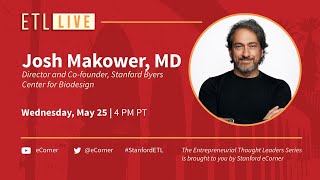
This content was created by GHION.AI . This content was uploaded by GHION.AI . This is a YouTube video titled "ETL Speaker Series: Josh Makower, Stanford Byers Center for Biodesign" from May 26, 2022. It features a talk by Josh Makower, a professor at Stanford University, discussing his work in health technology innovation and the biodesign process. The session is part of the Entrepreneurial Thought Leader Seminar series, hosted by Ravi Belani. The talk covers Makower's career, the biodesign methodology, and its application in medical innovation, as well as the challenges and future directions for biodesign, including global health equity and policy initiatives.
Chapters
Welcome YouTube and Stanford Communities to the final session of the Entrepreneurial Thought Leader Seminar in our academic year. It is terrific to have you. I am Ravi Balani, a lecturer in the Management Science and Engineering department at Stanford and the Director of Alchemist and Accelerator for Enterprise Startups. And I'd like to welcome you to the Entrepreneurial Thought Leader Seminar which is presented by stvp, the Entrepreneurship center in Stanford School of Engineering and basis, the Business association of Stanford Entrepreneurial students. Today we are honored and thrilled to welcome Josh Machauer to ETL to close out the Academic. Professor of Medicine Bioengineering at the Stanford University School of Medicine and Engineering and is the Director and co founder of the Stanford Bayer center for Biodesign. He also serves as a special partner for new Enterprise Associates NEA's healthcare team supporting their med tech and health tech. Additionally, Josh is also the founder and Executive Chairman.
Of explore event. So I just go guys, oh this is innovation.
We're having hiccups. So I apologize gang. This is obviously something that I need to take a lesson from good design thinking and iterate towards victory on this. But I apologize, my Internet connection seems to be unstable so I'm going to quickly give Josh's intro, which is that in case people missed it, Josh is also the founder and Executive Chairman of Explora Med, which is a medical device incubator that has created 10 companies over the past 20 years. Josh holds over 300 patents and patent applications for various medical devices. Josh's academic training began with a bachelor's degree in Engineering and Mechanical Engineering at mit. Josh went on to get an MD from nyu, but rather than practicing clinical medicine, he focused on the intersections of healthcare and business. Getting an MBA from Columbia Business School, spending six years at Pfizer in strategic innovation, and founding over nine ventures prior to the roles of that we've already discussed. So without further ado, please welcome Josh to etl. And Josh is going to be giving us a talk, so I will not be interrupting with my poor Internet connectivity on biodesign innovation and also biodesign policy. And then we'll open it up for Q and A. I turn it over to you.
Absolutely. Thank you so much and thanks for the opportunity to talk about this. This is basically my life's work, so I am passionate about it and it's a real pleasure which is health technology innovation. So. And it's, you know, although this looks like a hodgepodge of activities with all the organizations that I've been attached to over the years and then the companies that Founded that the middle layer, and then the other things that I've done at the bottom. There's actually one central theme that ties all of this together, and I'm going to try to tie it together for you, because one of my real passions is to inspire others to follow a similar path and make an impact on the world. And it all sort of starts here, which is what medical innovation looked like, or what we thought it looked like. When I was coming up, sitting in your seats and learning about medicine and innovations that were created, and most of these were created with a chance discovery, just like a phenomenalistic kind of moment where we noticed that the petri dish looks different, or someone's hand showed up on a film that was near an X ray. And this is sort of like the history of medical innovation was very episodic and empirical and certainly nothing that could ever be planned. I mean, the idea of inventors going off into distant locations and working out of the garage with some sort of crazy invention coming out the other side is basically how people thought about innovation. And that was sort of the approach that I think most people had going back, let's say, even in the 80s. But I had this one opportunity that sort of happened to me. And when I graduated from Columbia, speakers said they believe in luck. Luck is where opportunity meets preparedness. That really inspired me to understand, like, yes, we are all constantly being exposed to these opportunities, but are we prepared to go ahead and take advantage of them and actually utilize that opportunity? And this is one of these moments in my life that transformed my entire career from that moment on. And this is a guy named Hank McKinnell. He was the VP of strategic planning and then later became the CEO of Pfizer. I got some good advice from somebody when I was in, you know, at Arthur D. Little sort of interning there. And they said, you know what? You should. If you want a job in any of these companies, don't go look at, you know, the job postings. Write to the senior most person who you can get their address for and tell them exactly what you want to do, and they're going to get this. Of course, they're not the right person. They're the CEO or whatever, but they're going to forward it to the person who might have an interest. And guess what? When they get their letter forwarded by the CEO saying, hey, take a look at this. This is of interest. They don't just, like, throw it in the trash bin. They actually look at it and maybe they even say, feel like, gee, the CEO Sent this to me. I got to like respond. So this. Then they actually reach out and they actually do something about it. It was the best advice I ever get. And I give the same to you. Find their email, go write for the senior person. So that's one piece of advice for you all and how to get the best job you can. Anyway, Hank reaches out and so I wrote to him, never expecting that he would actually, actually be the one to contact me. And he did. And he said, come on here, let me talk to you. And so I was an engineer at that point. Background I had engineering degree. I was, had got completed by medical training and looking to do something in innovation in creating new technologies, but I didn't know what that looked like. And the idea of coming to Pfizer, which had a device business and a pharmaceutical business, where I thought like the potential was infinite, would be a great place. Anyway, he calls me in and long story short, he gave me a job and most of it was related to doing all searches, things associated with business development. But he had a special project which was outside of that that he said, if you have time, I'd like you to do this. And the ask was, we buy all these small companies and they, they, they get bought by Pfizer and then very quickly after the acquisition, they stop innovating, they stop being successful with their innovation. Why? I want you to go figure this thing out. And then I want, you know, I want you to figure out, is there something we can do about it? So what was awesome about that was I had a free license to go talk to all the founders of these companies and understand what their process was and actually like, you know, what did they go through to understand, you know, how they came about their innovations. And then also a free license to go talk to the existing teams that were now inside of Fires. Usually these teams have turned over. Maybe a few people were the same, but it was a different team now. And they were doing other processes and look at what the differences were. And so these are the companies that, you know, catheter company, implants company, drug delivery company, surgical company. And I talked to this founding teams and also the, and in the ones that were inside of Pfizer.
And.
And there was one key difference between these two groups. The group that was the teams that were startups were trying to solve a problem and they didn't have any technologies in mind. They found the technologies they needed to solve the problem. And then once they became like a balloon catheter company and they were purchased by Pfizer, what happened then? They were a balloon company and then they were looking for places to put balloons. So it was a completely reverse process. And so I said, look, that's a key difference. Maybe this idea of this incremental stuff is what's leading to such less success and performance. Maybe it's because they aren't actually focused on the customer needs and they're just starting with, like, I have a solution. Where can I find an application for it? And maybe that's what their problem is. Maybe that's why it's so incremental. So I propose this back to Hank, and I laid out sort of what this process would look like when they're startups that we really aren't doing inside of the company. We aren't saying we want to innovate here and then go in and just find out what the problems are, find out what the needs are. We're not doing that. So maybe if we did it, we would, we would solve it. So I brought that back and said, okay, that's great, prove that that's true. And so he gave me some funding and I actually created a group called the Strategic Innovation Group at Pfizer back in, back in 89. And we started on this process to see if this, you know, being rigorous and adherent to the process that you see here with it, define your strategic goal and then go in without any biases and find needs and then use those needs to create, hone them down to a set of criteria that would be successful. And then invent after you've already got this whole specification created independent of a solution, then if you invent to that spec, maybe you'd be more successful. So that was the proposition, and it was actually very successful. We produced a number of products that wound up getting into the divisions of Pfizer. And it was great, except that Pfizer was still a very big company and it was a very frustrating place to work. And so even though we had solved that problem, there were lots of other problems of big companies not innovating that had nothing to do with this step, but was other stuff. So I became a little frustrated. And so I left in 95 and I created this incubator called ExploreMed. And the idea was, I want to do exactly what I was doing in Pfizer. I want to use this process, this, you know, innovation process, but this time unbounded by the limitations of a. Of a small, you know, a large company, I want to do it with, with a full market availability to all the options and the funding that I could get as long as the ideas stood up and were good enough. And so I'm going to tell you a few stories about the companies that we created briefly, just to show how we use the methodology that I just shared to create these. And so in this, as I've mentioned before, there's more than these companies, but these are just good representative examples. And I'm going to be fairly brief about it, but this is a. Clarence. This was the first company to produce a technology called balloon sinuplasty. And it was rooted in this need for treatment for chronic sinusitis. And at the time that I got interested in this, I actually was a chronic sinusitis sufferer. And I had been to many ents and they had told me, here's another drug, here's another antibiotic, et cetera. And I got very frustrated with this because I was like, can't you just fix it? What is going on here? And they said, well, you're not bad enough for surgery. And I never really knew what that meant until I finally had time to actually go in and watch the surgery. And it was a bloody mess. Even the minimally invasive surgery, the there, it's. It's very bloody. And so I. But what they're trying to do is open up the passageway. That's what they're trying to do. But the tools that they were using were traditional surgical tools. They were cutting tissue and bone away. And so by observing this and realizing what the goal is, which is to create drainage, that's the real goal. But you want to create the drainage without destroying the very important mucosa lining of the. Of the sinuses. That is the need. The need is to create drainage without disrupting the mucosa, which is the surface on top of the bones. Don't take the bones out, leave the bones in place, open the passageway. Brainstorming, etc. Come up with this idea. Why don't we take a page from the technologies of bony angioplasty and just dilate the bones? Can the bones be moved? Answer was yes, very successful company. And now JJ's ENT division. Similar type of situation for neotrop. Benign prostatic mercury hypertrophy. A very common condition, affects most males over the age of 50, and it results in enlargement of this gland. So when you get older, that gland that sits between your bladder and your urethra as a male enlarges, compresses the urethra, and you get all these symptoms like you can't get through a golf game. Or you can't make it through a movie without going to the bathroom a couple of times. And there are lots of treatments for this. Some of them are awful. Once again, bloody nerve damage, all sorts of things like that. So that is traumatic. Observing this need, you think, well, why don't they come up with something better? There are lots of drugs. The drugs didn't work that well. The mechanical therapies all involved destroying the prostate, which of course, as soon as you do that, you cause nerve damage, you cause muscular damage, you cause all these other side effects, bleeding, et cetera.
It's bad.
Again, using the process. What's the need? Spec people want to have a procedure that they can see immediate results and they can basically pee right away. And it's good, that lasts, you know, forever or long period of time. Minimal trauma and no damage to the nerves, no impotence, no incons, et cetera. Fast forward invention to the SPEC process. This idea. Neotract urolift, a way of sort of just, you know, pulling the opening the urethra. Not destroying the prostate at all, just moving it out of the way. Just pinch it and move it out of the way. Cross creating the opening, less trauma, less bleeding. Fast done in the office and taking off and will probably be the leading treatment for mechanical therapy for bph. I'm not going to go through these others, but just say each of these companies, Moximed for osteoarthritis, Willow first wearable breast pump for women that allows them to pump anywhere. All were created with the exact same methodology. Even this one, my latest company that we just got commercial this year, it's a treatment for cellulite of common condition that affects 85% of women. Exact same thing. Just focusing on what the need is that need unlocks. When you just understand the need first and don't tie yourself to a technology. Don't go say, where can I apply a laser? Or where can I apply, you know, a balloon? Find out what the need, what the patient needs, what the physician needs, what the payer needs, what, et cetera first, and then invent from that. Then you can create these, these opportunities to really change healthcare that solve all these problems. And so, you know, we've, we've been very successful. We've had a number of successful exits and touched a lot of lives and made a big difference. And we will continue to do so. That I continue to practice this innovation because I think as a professor here, I owe it to my students to continue to continue to be current. But a lot of change for me, when I met Paul Yock and we got a chance to start working together to create Biodesign back in 2001, the idea was can we take this process, this methodology now and transition it into an academic environment? Can we make it actually something that other people can use to propel their careers? And the mission was to really train the next generation leaders in innovation and healthcare innovation, health, tech innovation. Can we install this inside of Stanford and really prove that we can actually train others to do the same things that we've done in our careers? Of course, Paul is very successful innovator in his own right and world renowned for his inventions. And so we teamed up and created a bio Design back in 2001. And the idea was innovation is a disciplined process that you can teach, you can learn it, you can practice it and you can get really good at it if you just keep on focusing on adhering to the process, trusting the process of this need findings, need statement to need specification two, onwards onto invention and then screening, etc. That, that's going to lead you on your path. And that's, that's exactly what it is that we call it the biodesign process now. And this is it, exactly what I've been talking about. Very rigorous, looks simple, it's a lot harder than you think, but anyone can do it, anyone can do it. And that's really the power of it, is that. And we and now show you that we've proven that that's true, we can teach this. And if you dedicate yourself to the process, you can learn it. And truthfully, that need is the DNA. The need is if you get the need right, if you characterize it right and you only accept a solution that meets it, then you will be successful. And we've really been training innovators for the last 20 years in this methodology. We have a few graduate classes here, trading faculty as well, we have fellows, we have graduate students. Anyone for the business school who's listening? There's a great innovation course which is a foundational course on this and many companies and innovators have come out of that and so it's quite a vast program now we also do grants. I mean we have some translational partnerships, we teach executives. It's a big deal lot going on here at Biodesign over the last 20 years and it just continues to grow. And the reason why it grows is because a we first of all have this sort of reach. These are the folks that we touch here just at Stanford. But as you mentioned, as you See those global faculty, those global faculty are here training to set up bio design organizations across the world. And they go off and do this and these executives are training, they're installing bio design as a core process inside of their organizations to identify the next generation product and stuff like that. So, so just our students alone, just our fellows alone have created about 65 different entities. Some public companies here, some significant acquisitions, some failures too. Comes with the process, comes with the territory, but really exciting. And what's most exciting is today our latest data is that we have touched the just the students projects. Not mine, not Paul's, just the students. Our fellows have touched 7.6 million lives with the technologies that they have produced through the companies that they invented here at Stanford while they were here. We're not even counting the things that they invented after or the companies that they started after. This is just stuff that was created here which is pretty incredible for a purely educational program. And so the economic impact of biodesign is really, has really been amazing and I'm really proud of it and I'm honored to be here, you know, stepping into Paul's views as the Director now after 20 years of working on this together. It's really exciting. And of course, as I mentioned, the global impact is significant as well. And we have different ways that we reach the globe. Not only through our trainees who come here and get trained or organizations that we partnered and affiliate with, but we have a textbook that is really sort of the, has everything in it, case studies. It's a very thick textbook, something to read at night if you have trouble sleeping or a much more easily accessible online student guide that was created by our amazing Lynn Dunend. And it's just a beautiful, very accessible, you know, very modern resource that you can use. And it's available across the world and has been accessed across the world. So here we are, a new beginning. 2001. I was asked to come back and lead the program and I was very fortunate to have this opportunity. And really biodesign is fortunate to have had the support of the individuals who you see here present University Dean of the Engineering Medical Schools, Brooke Byers, who has given us a fantastic gift to allow us to survive and very appreciative to Brooks insight and guidance. And of course Paul, who's my friend, co founder and still working with me today here at biodesign. And as I come in as the new director, these are the things that, that I find first of all, while we have accomplished amazing things and come so far, as I look into the future, even with the amazing gifts that we've received so far, we are not sustainable yet. So we need to figure out a way to figure out how to put ourselves into a better position so that biodesign can be available to the future. And we haven't done that yet. So that's one of my goals, is to try to bring people forward who can help be our sponsors and help us create the future of innovation for our children's children. And I want to see that happen. So that's important to me. So that's, that's going to be a top goal for me. The other one is to create the capacity for growth because we're, we're growing, there's more things to do, the world is even more complex and there's even more clinical needs that we need to solve. And really installing the, the scalability and capacity of the team to do that. And so I've been working on that. We're making progress. Of course, funding is going to be a part of that as well. And then the other reality is, of course, the landscape is changing around us. There's a lot changing. How do we evolve biodesign to meet the challenges of innovators of the future? Like, what is next for biodesign? Have we peaked? Is this it? Or is there a future that can be useful to make biodesign useful for these next generation of innovators that are to come? And so first part of that is making sure we solidify the team. And so you can see we've sort of organized with an executive team. These are the folks on the team, some amazing people here. It's always, always about the people. And I'm just so honored and just so privileged to work with this great team and as we will look to form, by design and bring it into the future. So part one, solidify the team. Then I created a board. We have now a board together. And this is a diverse group of people with different backgrounds, but everyone with a perspective that can help us for the future. This is our board. Very proud of this group and we will continue to grow this board as we think about how do we tackle the problems of the future. But very honored and appreciative from this board. So then we got the team together and we said, okay, what are the challenges? How shall we, who are we as an organization? What do we want to be? You know, what is our purpose and our purpose that we aligned on is that we are really all about advancing health outcomes and health equity. Like fundamentally, those are our deliverables that is what we want. We want access for people to get access to our innovations who want to improve outcomes. But the way we're going to do it is we're going to do it through education. We're going to teach people how to do it. We're going to help them translate their ideas into businesses that are going to make an impact. And the new piece here is we're going to now create a program around policy. Because as we look back and we talked about what the challenges of our innovators are, and of course I've experienced this myself as an innovator, there's a lot of adverse policies, there's a lot of things that don't make sense. Why can't you get paid for something that really save lives or even lowers the cost of healthcare? Why can't that happen? And why does it take so long? And why does the patent office. Not the patent office per se. But why are these force. Why are there forces that are trying to basically weakened patents? And what is this about the regulatory system that can be so difficult at times, even though things have improved so much? Can we do better? Can we facilitate innovation and make it more accessible and less expensive, like I said, for us and our children, et cetera. Then as you see here, who are we? What do we care about? And these are the words that characterize what we care about in our organization that we believe are important. And of course, no surprise. Innovation, collaboration, empathy, which is a big part of our. Even just the way we find these needs is sort of this empathic kind of experience where we sit with our customers and we see the problems they're having. Integrity, obviously the quality of the work that we do, the ethical way we approach it and that we want to create these leaders. And also we want to be diverse. We want to get all the voices in the room, all the perspective, all the people from different backgrounds to work together so that we can find the best solution for everybody. And so the future, three things. Number one, we're going to de. Differentiate from Medtech or digital into all life sciences. Why is this important? Because it's going that way where everything's converging. Here you see a invention actually created by a Stanford professor. By the way, it's a device, obviously you can put it in your hand. It's a digital device because it connects to the Internet. It's actually a digital service because it's actually performing service. It's a PCR in your hand. So it's like a PCR test. So It's a molecular diagnostic in your hand and it's sold, could be sold in Walgreens, it could be a consumer health product. So all these things all combined and I wouldn't be surprised if there's AI there as well. The point is, you can't just be unifocal on a particular technology anymore. We want to provide the framework for our innovators of the future to have all of these life sciences available to them at their fingertips as they're inventing. And that means creating collaborations with, with corporations, with VCs, with other leaders on campus and across the world to make sure that we get the framework right so that our inventors of the future understand all these tools and know how to invent with them. So that's number one. Number two is we're going to refocus our global efforts really to be focused on the mission we want to make a difference on health equity. And like we said, health equity access is important to us. It's a part of the care we want to deliver. And so that means really thinking about how do we use the by design process to not only improve the health care of these areas of the world that need it. And that could even be here in the United States, by the way. That could be, you know, there's a lot of poverty here in the United States that we just sort of overlook. And so how do we address that? How do we address those inequities and try to get, you know, elevate everyone and have them all benefit from the innovations that we're talking about rather than just a small percentage. And the great news is we've, we've, over the years we had a chance to experiment with this with a program in India which has been amazingly successful. And then the team there has done an amazing job all starting with the process. And then as you see in the circle, the innovations that sort of came out and the relationships that came out of that first circle and then all of the bigger infrastructure, the bigger companies that, and the funding that came in to support this creating a whole ecosystem from where there was none and that lifts, get, creates jobs, improves the quality of health and they're actually producing solutions that are benefiting that population. So can we do more of this now that we have a framework on a model? Can we train the trainers and get parts of the world in, you know, help innovation for health tech to actually drive all of these changes and economic well being. So that's, that's, that's the second major major new thrust. So we're going to show some of that in the coming years. But this is a long term initiative that we're starting and I hope that there will be after several years, several of these things that come out of it. And lastly, I'm going to talk about this policy initiative which is truly as big opportunity as the Biodesign Innovation program itself. What we're really talking about here is training the next generation of policymakers in health technology. And so key to that is we are going to be, in just one week, we will be recruiting for the first Innovation Policy Fellowship here at Stanford Biodesign. These folks have an opportunity over the next several months to apply. We're going to be making decisions in September, October and picking the first class of fellows. This will be as fundamental as our, as our core fellowship that we have today and we recruit those in the same sequence. We've actually sent those announcements out as well. For anyone interested in being a Fellow here, check out our website on either policy or the innovation. We'd love to, love to have you. It's a great program and as you can see, our graduates have really made a difference. These folks are going to make a difference too. They're going to go first year with us working on policy research and engaging with policymakers and producing important published results. And then their second year they're going to spend in D.C. working in the White House, working as a staffer, as a paid staffer in Congress or maybe the FDA or maybe cms. That's where we want to help them understand the challenges of developing health technologies and the complex environment in which they are sitting alongside the fellows that are actually going through it for the first time, but being met by the mentors, the startup community, the corporate partners that we have that come in and the experts in regulatory and reimbursement and payers and all those that ecosystem that we built around by design, all these policy folks are going to get exposed to that and then they're going to go and spend time in Washington and then we hope we'll be taking leadership careers in the government and that with that insight we hope that the policies that they will create will actually facilitate innovation. That's the theory. The same time we're also going to create a graduate course which will be available to the business, engineering and medical schools and any graduate students on campus to be able to learn about policy and all the fundamentals. So that'll be also be, we're also going to put that in place. And so it's really going to be research Education and then engagement. We're going to, we're going to try to engage directly with the research insights that we've gained to also try to help on a, on a, on an as needed basis. But our real goal is to train these policymakers and really make them a great resource to.
The world.
We're trained, trained folks across the world to do this one case study just to give you an example of what this looks like. We had an opportunity and I started here in August. We quickly identified this Medicare coverage of innovative technologies need. There are products get approved and they languish for years before they can actually be paid for by insurance. If you've ever tried to get access to one of these as a patient, you know how difficult that is. This is an idea that was proposed that could accelerate that payment and actually have the payment begin immediately after approval. And during that time they could collect whatever other evidence that payers and CMS might need. And it's a really great idea, but unfortunately it was actually canceled. But there's a lot of energy and momentum behind this because this could really advance innovation and it can actually spur investment. So we did a study that proved that. First of all, it validated that yes, it's about four and a half years of delay before something of a real breakthrough nature can actually get covered, which is way too long, especially for a CMS population. And secondly, we showed that if you could address this and shorten it in a guaranteed way, you'd bring investors in, you'd bring enthusiastic engineers in. And that's what we want to solve these big problems. We don't want to discourage them, we want to incentivize them. So if we can shorten just addressing this phase and getting things paid for faster, we could actually spur innovation. We could solve some of these big problems. Right. So we proposed that we partnered with Duke Margolis and also CMS on a webinar that we put together engagement. And now we're in an active conversation with the stakeholders about this issue. And we really think we can, can through this process bring some change that would be beneficial to our innovators. And so in very much a way where we're sort of, we've already demoed that we can through these processes, get ourselves into the conversation. And hopefully it's not me, it's the fellows, it's the students. That's who we want to put in the front to be able to get these experiences and build these relationships. So as I said, these are our three main new theory. No new new Thrusts of course, the main one in addition to this is keep the core, continue to enhance the core. Good stuff that we are doing and will continue to do. And you know, our real goal is to, you know, support what innovators need for the future because our goal is to really train the people, you know, train the folks that are actually going to go out there and really, and really change the world. So yeah, so that's, that's where we are. That's, that's what I'm doing. It's an honor to have an opportunity to share that, that vision and, and story with all of you and I'm, you know, I'm just happy to, happy to be here and I'm happy to take your, your questions if you have any.
Terrific. Thank you, Josh. I'm going to jump in here if my Internet goes out. Toby may be jumping into my stead. We've got some questions. So I'm just going to go through the questions based on upvotes from the first question is can you tell us more about the experiment you ran in India and your key learnings from there?
Absolutely. Well, we taught ourselves that we could do was challenging and there were a number of new wrinkles that we encountered that were quite difficult there. You know, I think that one of the key things is clearly everyone needs to be there. The innovation has to happen there. It has to be with the available resources that are there. And that means also addressing infrastructure and finding the right places from which to base the innovation. Also funds flow. I think that early on it was very difficult to find the resources. We were able to route donated support for biodesign to this. That really wasn't, it was sort of generalized. And so it was an experiment at that time to do it at the scale that I want to do it. Going forward we're going to need direct support because it's a scaling issue. And I think we learned that lesson. But on the positive side we just made a tremendous difference. I just made the case for the economic impact that we've had. But we've produced inventions that are saving babies lives, helping them be resuscitated, identifying hearing loss in a very inexpensive way that can be really fast and available at places where people gather with their babies. A lot of maternal stuff actually ways to splint a knee with really just cardboard, but very inexpensively, very portably but important fundamental needs and finding ways to do it in a low cost environment. So there have been a lot of learnings and I say the proof of concept is there. We have proven it can work. And now we're ready to try to scale it and do it here in the United States and underrepresented under resource parts of the world and here in the US as well as overseas.
Terrific. Thanks, Josh. I'm going to exercise my prerogative because we have a bunch of equally uploaded questions and I want to go into this issue of ethics. There's a question on how does the ethics of the design factor how does the ethics of the design factor into the projects you choose to bring to life? And maybe that also played in the India.
Yeah, no, absolutely. I think, you know, ethics is integral into, as you saw in our, in our values. And trying to find the way to bring the greatest good to the greatest number I think is thematically something that we do care about. And there are lots of ethical issues that get presented when you are an innovator in medicine. What's the fair profit? How do you navigate conflict of interest? These types of things are very, very common and we think a lot about them and we have a perspective on all of them and on those two in particular. We believe that you need to have a fair profit. Investors need to get a return, otherwise they're not going to put the money in. Where's the money going to come from? We can't get it from just grants, so we need real businesses. So the act of actually creating a business to solve a medical problem is actually completely consistent with ethics because it's sustainable. To create something that is unsustainable is not ethical because it's just going to peter out and a great idea, a great solution will not survive. So fundamental to the training that we provide is how do you make this a business? How do you get this to be self sustaining and return to the investors so that they come back and put more money in for the next innovation, the next one. So that's how we think of it. And I think grappling with that idea and the juxtaposition of profit and then also health outcomes is something that we deal with every day and we believe it's necessary. It's necessary to actually have a sustainable business that investors can get a return on and then they will continue to invest in health care.
Can you go deeper into maybe an ethical dilemma that you might have faced where there was a conflict between the two? I understand the idea of aligning business outcomes with ethical impact, but what happens when the two are at odds? So let's say when the economic return for the investors would lead to funding something that would actually Save less lives but be more profitable versus for example, the examples you brought up in India where the economic impact might have paled compared to the human impact. So can you, is there, is there a dilemma that you face that you can share? And what I'm more interested in is how you navigate the decision of actually coming to a position.
Yeah, no, it is a common issue. We find a lot of these. And I'll give you a great example. Pediatrics, very small population, thank God. Most children, children are not very sick. They don't necessarily need a lot of healthcare. You know, they're for the most part pretty well. But there are a few that get very sick. It's a very small market. And so how do you inspire innovators to go into that field? You know, when there's not a lot of VCs, there are, there just isn't a lot of money. There's not actually a lot of money to be made, not a lot of money to be invested, not a lot of money to be made. How do you do that? I think what you do is you find ways of creating the incentives. I think we are all incented by our desire to improve people's health. And we have a robust pediatric program led by James Wall here, who's a pediatric surgeon. And they have cobbled together funding sources and they come from a variety of places. Some of them are actually VCs and others are more, let's say not for profit oriented, but they care about kids and they want to make kids health better. And the innovators that are chasing after this are excited by the idea that they can make a real difference in kids lives. And so it happens, you can find the right people who have that few. It isn't all about building billion dollar businesses. These are never going to be billion dollar businesses. But you match the entrepreneur to the opportunity and then you try to find the funding sources that are willing to put the money behind it. And that's how you get there. And so yes, a struggle, but overcomeable by just finding the right pieces to put together.
And how do you define success then? Is your success based on an economic impact measure or is it more of a humanitarian impact?
As you can see, I'm big into the number of the people whose lives we've touched, right. And we've touched them in all different ways. Some of them are foundational, like a major impact on the quality of life. Others, some of those are just a diagnostic, you know, ruling out the disease, ruling out something. So in that number it's a Very diverse number. And for me personally, you know, as an innovator myself, I am often asked about this, like, you haven't been successful, why are you still doing this? And for me it's about making a difference. I love doing stuff that has never been done before. I love solving a problem that hasn't been solved yet. And I think that inspires all of us. And when you do solve it.
And.
You meet that person or you get to hear a loved one or family member that's, that's had their live improved because of something that you made, that you invented, that you had a role in bringing to market. It's better than any other return on investment. For me, I live for it.
I completely understand. That dovetails nicely into another question. So one of the other students was asking globally, what are two to three health challenges where innovators can make the most headway in the next decade?
Well, as we think globally, we just have to really think about this health equity issue. I mean, we have had a lot of health innovations that have come to the smallest percentage of people on the planet, planet. And there's a lot of people who don't have access and that, you know, the reasons for that are multiple. Some of them are structural and systemic and, and they need, that's, that issue needs to be addressed. But the innovations themselves I think weren't. They were created with the idea that all these resources would be there, all this training would be there, you know, all these support, you know, sort of, you know, first world types of environments that really aren't accessible even in the first world, across the first, all of the first world. That's where the opportunity is. The opportunity is narrow. That's why we're investing ourselves in this mission driven global effort because we believe that we've already shown that it can be that we can come up with innovations that are affordable and that can result in outstanding outcomes if we just pay attention to the details of what are the needs of those environments. And they probably could serve the rest of the world well too. They aren't just for those environments, probably also resulting in less cost. I think the big opportunity for all of us as innovators is to really put our arms around health equity and think about how do we, how do we get access to the millions of people that don't have access to the best healthcare and how do we make that more affordable and more available?
Terrific, thank you. Next question is, I imagine the biodesign process doesn't always lead to success or a solution. Are there any through lines in terms of the teams or projects that tend to struggle when using the process.
Hmm, interesting. I will say I've had many failures myself. I didn't put them in the beginning decade. They're not that fun to talk about. But I have failed and everybody fails. I mean if you, if you're not failing, you're not trying hard enough. So you gotta go now. The reasons for failure didn't have anything to do with the process not working. It's just that at some point there are always pieces of the project that are unknown and those unknown things, you know, once you do the study and you. And it's known, sometimes it's an answer that you wish wasn't there. But it's data and science. Right? So. So yes, I think that, that it is not foolproof. The method is only really good to identify the potential pathway. It isn't like you're always a success, because that isn't true even in my own experience with it. But you're going to increase your probability of success with it. That's the reason to use the rigorous process that we teach is at least you'll eliminate all those problems that most people make that don't follow it and you get those out of the way and those can be retired early. The through line in terms of success, however, is the team people, like I mentioned before, they are the difference maker. And so even when the idea doesn't work or you finally get that result and you realize that it doesn't pan out, if the team is good, you can pivot and get to the right answer. So I really believe in teams. Picking the right people for these projects is key because I'm just been so amazed by the leaders of the companies that had a great opportunity to create and see how they have pivoted around the problems that they've had. And they come in all sorts of ways. Some of them can have nothing to do with the idea itself, but it's the regulatory process or trying to get the thing paid for, it's trying to raise money in a bad environment or whatever it is. There's so many ways to fail. But if you have a group of people who are mission driven and looking under every rock to try to make sure that they have a chance for success, that is the through line for success ultimately.
And are there ways that you can predict if a team is going to be distinctive, a priority? You said already some mission driven. Any other unintuitive insights? When people are thinking about assembling teams of things that they should be checking for to make sure that they're set up.
Yeah, I'm sure you deal with this in your work too, Ravi. All the time trying to figure out who's going to be able to navigate it. I think. The best leaders are learners and listeners, not knowers. They take in as many inputs as they can and they surround themselves with as many advisors with diverse and different perspectives as they can to get the benefit of all the perspectives. And they don't just boldly know where to go without and sort of fight against advice. That's in my experience, at least in this field anyway. Maybe it works in, you know, in, you know, other fields that you sort of just blaze on and don't pay attention to anybody else and think of an ipod and just make it even though no one asked for it. That certainly is a good example of one that worked. But I think that at least in the healthcare field, surrounding yourself with great advisors and being humble, being realizing you don't have all the answers and I, I mean, it's a necessity. So when I see that willingness to not always be right and really looking for the right answer from collecting it from all different viewpoints, I always feel like that's a person that's going to be successful because they can get outside of their own head and really consider what others are thinking and navigate to that. Making their own decisions ultimately, of course, and then confidently defending them. Of course, you know, having that still leadership, but also taking the opportunity to listen before they act.
That's terrific. I'm going to end it on that. So thank you. Thank you. Thank you, Josh. Especially with all my technical difficulties. Thank you for so generously sharing today and to our audience. Thank you for tuning in to this session of the final session of the Entrepreneur Thought Leaders series. This is the last ETL of the academic year. We're going to be taking a short break this summer and hope to see you back here on Wednesday, October 5th, as we kick off the next season of ETL ETL with the Chief Accessibility Officer of Microsoft, Jenny Leigh Fleury. As always, you can find that event and other future events in this ETL series on our Stanford E Corner YouTube channel. And you'll find even more of the videos, podcasts and articles about entrepreneurship and innovation at Stanford ecorner. That's Ecorner Stanford Edu. And as always, thank you for tuning in to etl.
More from GHION.AI


O processo de reconhecer limites, mesmo quando a vida parece exigir sempre mais.





Depois de tantas histórias, aprendizados e pausas necessárias, o @interior_iza está de volta



