ETL Speaker Series: Karabo Morule, Capital Art
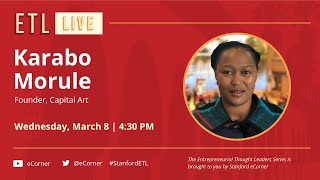
This content was created by GHION.AI . This content was uploaded by GHION.AI . This is a YouTube video titled "ETL Speaker Series: Karabo Morule, Capital Art" from March 9, 2023, featuring a discussion between Vimbai Kajesse and Karabo Morule. The conversation is part of the Entrepreneurial Thought Leaders series and covers Karabo's career in finance and art, her role as CEO of Capital Art, and her insights on African art, financial inclusion, and the importance of provenance. The discussion also touches on the historical context of apartheid in South Africa and its impact on art valuation and representation.
Chapters
Welcome to the Entrepreneurial Thought Leaders series presented by stvp, the Stanford Engineering Entrepreneurship center and Basis, the Business association of Stanford Entrepreneurial Students. I'm Vimbai Kajesse. I'm a creative story extractor, a tech media representation activist, and when I'm not hopping around the world, being an adjunct lecturer in MS.E272 for the spring quarter literally keeps me grounded. Now today I'm thrilled to be joined by my friend and fellow African, Carabo Morale. Carabo is the founder and CEO of Capital Art, the first art collection management service for modern and contemporary African art collectors. She's also a non executive director at Time Bank, South Africa's first cloud based banking system. But that's not all. She's an actuary by profession and how auspicious that we get to spend time with her on International Women's Day. Because Carabo is a celebrated woman woman in her country. She is South Africa's second black female actuary. In addition, she's an angel investor, a patron of the Arts since 2012 and she was selected by the World economic forum in 2018 to be a young global leader. And this is how I know her. So privileged with her extensive background in investment banking at J.P. morgan and financial and financial services at Old Mutual Ltd. She's now focused on arts, technology, financial inclusion, startups that focus on value, addition to the continent, responsible investing and leadership. So let's dive into Carabo's fascinating career and learn more about her insights and vision for the future of African art and finance. Welcome Karabo. Happy International Women's Day. Just a quick check in, it's late where you are, where are you calling us from?
Thank you so much Bimbai and it's really great to be here. Thanks for the invitation and indeed Happy International Women's Day. It's great to be on the same panel as you, a woman who I celebrate as well. So thank you very much. Yes, it's just after 2:30. Based in Johannesburg, South Africa. 2:30 in the morning. But I am super energized for this conversation.
Oh, we are so lucky to have you and we hope to make good use of your time. Well, okay, let's get started. This week. The theme that we've been exploring around your interview is how to have an inclusive mindset. And we discussed the importance of having awareness. This is in terms of how the world works, how our own biases work, being sensitive to different intersectionalities, that's something that we talked quite a bit. Recognizing our own privileges and being mindful of our blind spots. This is all to prime us to see opportunities that others don't. Now, you are somebody that sits at the intersection of some very unique expertise. We're talking about art, black and African technology, personal finance and insurance. Can you share with us how you came to be at this very interesting GPS coordinate?
Yeah, I'm trying to figure out how to sum up, like 41 years of existence. But, yeah, I think, you know, it's. It's firstly really so great that your class is engaging on these topics because I think this is what really is important to make us better citizens of the world. Right. And I guess I'm lucky it's in a way to have had this exposure from different cultures from a young age, and perhaps I think that also built the skills to appreciate nuance, but also to foster curiosity around the world about the world around us without being overwhelmed by the diversity. And I think also fostering resilience. And I know I'm not unique in that at all. You know, a few friends of us, with a few friends, we've actually had a very similar upbringing. And we kind of talk about this a little bit, you know, you know, from time to time about how we grew up in these suburbs, formerly known as townships, which were these constructs created by apartheid, attended schools of relative privilege, with most of them being kind of Anglican oriented with a very British culture, and then developing this sort of figurative language to exist in that world, but also to thrive in those spaces, but being still very tethered to our history and culture. And I think it gives one the opportunity to be able to see obviously the differences in resourcing between these two cultures, but also to appreciate the opportunity that they present. Yes, yeah. And I went into insurance. Yeah. Because I was a qualified actuary and I had worked and been working in investment banking, and I'd never worked in a traditional insurance setting. So I thought it might be good for my life CV to explore that and do that. And I guess I also just acknowledge how lucky I am to have done so, because I also think I wouldn't have had the corporate success that I did if I wasn't actually working in oil and gas. So it helped a bit that I went to go work at an insurance company and. Yeah, and I think, you know, I was, you know, the first business unit that I joined was what became personal finance. It used to be called Retail Affluent after the name of the segment that it was focusing on from a customer segmentation perspective. And I did that first stint and I was there as a strategy marketing executive and kind of not really maybe engaging in really the personal finance aspect. It was more to understand it from a marketing perspective and managing a marketing team. But in the second stint when I was the managing director, and I guess when you're now leading that business, you take into consideration and take into heart quite a bit more in terms of being a custodian for that business unit. And I was very fortunate because in that interim period, I worked for the employee benefits business and I was in charge of a business unit called Member Solutions, and that was responsible for basically taking the retail proposition to the members of the retirement funds that we administered. And in that, actually, one of the people who I was managing, you know, the person in my team said, you know, you really should go and see what these financial wellbeing courses are about and financial education courses are about. And I went. And I think, yeah, you know, you're somebody who isn't actually, you've been working in banking and you feel like you know a lot about finance, then you start to really understand personal finances. And that was a seminal moment in actually kind of, I think, achieving, you know, quite a good measure of financial, you know, independence or just more grounding in how I thought about personal finances. And that stood me so well for my journey around entrepreneurship, but also just, I think, being able to realize that you're not really beholden to kind of any particular job as well. I think that that also is quite freeing and it enables you to also take greater risks in being in a corporate career. I really appreciated that, for sure.
Yeah.
And then the tech side is interesting. I attended the Harvard Advanced management program in 2019, and there was a course called the 21st Century Operations Manager. And I mean, obviously I've been a very big advocate of tech before that. I think, being a millennial, we generally are. But that course, I think, really solidified in me that I wanted to go work in tech. I think tech is a great enabler for the future. I really just thought I really need to go immerse myself in tech. And. And that's something which I then decided kind of in 2019, is something that I wanted to make sure was a really strong focus of the kind of skills that I wanted to develop over time. And so having those. That diversity of experiences, I think certainly helps to see gaps in connections where maybe others don't. I think it also reinforces the statistic around, you know, the diverse, most diverse companies are the ones that thrive. Sure. And this might also be a plug for mature founders as well. You know.
I wanted to go back to some of the terminology that you mentioned. You talked about townships and apartheid, and of course, I mentioned that you were one of the first black female South African actuaries. And for those who don't understand the context of that significance, can you just quickly explain South Africa's history and what apartheid meant and what this inclusion and diversity, why it's such a big deal in the art world?
So, yeah, you know, the history of apartheid was really about kind of social exclusion, economic disposition, and really being very. The kind of government being very deliberate about what are the types of professions that people of certain races could access, what are the types of services that people of certain races could access. And just being very deliberate about excluding, you know, what was 95% of the population and leveraging the resources, the economic resources of the whole of the country to really benefit a very small minority.
So who was the government? Because you might not understand that even though this is an African country. Yeah, I'm from southern Africa. We weren't necessarily under black majority rule.
Agree. It was a kind of a white nationalist government, you know, Africana based, you know, and really focused on, you know, you know, really making sure that that was kind of the dominant culture that was operating in all spheres of work and in the government as well. Yeah. And so really focused on also then taking, you know, I refer to townships. Basically what occurred was also segregation around land. Land disposition occurred in 1913. But, you know, as the apartheid rules kind of increased, it really focused on trying to make it seem like the people who were born of this land and had lived in South Africa for. For centuries literally were not existent. And actually that was something that occurred across the continent as well. And actually maybe we'll get a chance to talk about, like, the way in which art was also weaponized in that way. Yeah, but, yeah, yeah, I mean, it's quite.
It's quite a fascinating journey that you have lived through from where you've come from to be where you are now. So when somebody like you, coming from your background and coming from the backgrounds that we have given the histories of southern Africa, I'm from Zimbabwe. We've had a similar history. When somebody like you is very intentional about solving for inclusion and representation, I see them as an activist. So to me, you are an activist. And capital art, the platform that you have founded, is your form of activism. Can you elaborate whether you see yourself as that or not?
Yes, I certainly do. And it's funny because it didn't start that way. The business was conceptualized after a discussion with an art advisor. And we then worked on this concept for about a year and also during that time launched an mvp. And the primary idea actually was just around to bring digitalization and fintech thinking into collection management in South Africa. So like many entrepreneurs, it really was just kind of like seeing an opportunity. But in that research and ideation phase, some of the insights that were of interest was that there's interest in African art which had really grown over the last couple of years. So, you know, the Deloitte and Art tactic report for 2021 reported that the African art market grew by 51% between 2015 and 2020. And in fact reports showed that the African art market had grown by 22% between 2015 and 2018. So that also just highlights the immense growth that occurred, you know, 2019 and 2020. Another data point, which was kind of one of the things around the thesis for the business and the opportunity was just the growth in the high net number of high net worth individuals that would grow in the years to come. And in particular across the African continent. And then also the fact that on African continent individuals were investing less than the global average in collectibles, which is where kind of the category of asset classes that art falls into. And that was also then set against the fact that the African art market was only making up 1% of the global art market. And I thought that that was like really strange. I thought it was just such a strange number. And then you start to understand the dynamics around it and you get to get a sense of why and yeah.
Hey, is it categorized differently considering that African art has always been part of the global narrative and part of the collective of international art?
Why is it Exactly. And the 1%, yeah, really is around auction sales. And so you're so right that actually there's a lot of people who are collecting art. And certainly African art has always been there in the global narrative, but there's not many people who are then accessing kind of the financial institutions that are available in terms of realizing that wealth. And you certainly see that that's kind of been actually, I think the narrative. And that's kind of the insight that I, I had around why this was kind of important is kind of bringing that financial ecosystem to have more people think about art in that way.
Wow, thank you. That's amazing. Part of what capital art does in terms of bringing people into the financial ecosystem as you've talked about, is really ventilating this concept of provenance. Can you describe what Provenance means and why a deeper understanding of it helps us appreciate an object's historical and cultural significance. Given the way that African art has previously been procured.
That's a really great question. So provenance is just the history of ownership of an art piece from when it was created up until today or whenever that time is when you assess what the provenance is. And you know. Yeah, so kind of going back to also kind of thinking about the activism of Keppel Art is, you know, after the. I had a co founder at the beginning of the business and she left kind of like I say, after a year of us kind of working together. And it just happened after that period. I had a conversation with Bongi Duomo, a famed artist and activist herself, a cultural worker and a collector herself and an art advisor. And we had this walk through the Constitutional Court in South Africa in Johannesburg, and they actually have an art gallery associated with it. And she was also involved in the formation of that. And she was kind of highlighting for me how our parents were collecting art, but maybe they didn't see it that way. And so really kind of the services and act of inclusion in trying to get collectors of art, especially from areas outside of the major art markets, to perform collection management, to manage their art portfolios more efficiently and also just to try and get more people to see art as an asset class. So that activism is really kind of twofold. It's around the financial inclusion for those who are collecting art and might not be collecting art and should be or might be collecting art and don't realize that they are. And then trying to make the art market more fair for artists who may have been marginalized by the ecosystem. And it's interesting because, yes, there was a panel in Davos on financial inclusion in May last year, which I was very fortunate to be on. And the governor of the Central bank of France kind of balked and almost fell off his chair when I spoke about financial inclusion for middle income people. And I think it's. And I'm really still resolute around that. You know, I think people often think about financial inclusion as being for the bottom of the pyramid. And it's actually really important to talk about it through the pyramid. So for me it would make me happiest if, you know, there's a collector of African art or any art form which is underrepresented from an underrepresented geography where they take an item, maybe to an auction house for auction, and because of the information that they've kept on a platform like Capital Art, they are able to present information like the invoice, the details of the provenance, the certificate of authenticity, contextual information about the artist, the artwork, because they've been. And because. Because they've been collect, getting collection reports from Capital Arts as well, they can appreciate, you know, what's the updated estimated value for that artwork, and that can empower them to know what the value for the floor is for selling that artwork and to arm the auctioneer with the best information to market that artwork as well at an auction. And I think in many instances, the process of a collector exiting their investment doesn't actually play out like that because the artist is unknown to the auction house, and so the value of the paying for the artwork is not maximized. And in that way that I think the talk about provenance is actually so important, and the history of the historical significance of artworks is so important, because sometimes that's actually kind of really, at the moment, known by a collector, and sometimes it's not known outside of that because of this history of the economic disposition that occurred. And in the history of South Africa, you see it very patently. There's lots of people who couldn't get gallery representation. And that often was kind of the avenue where they could then get exposure to many more art markets, which would assist with supporting the increased valuations for that artwork. Wow.
I mean, just so many things that I want to pull out of there. But the first thing that you talked about was our parents have been collected collecting art and didn't realize it. And possibly, possibly we have been, too. And I love this sort of expanded notion of how we need to. To think about maybe some of the artifacts that we have as art, like the sculptures that we get on the side of the road. How do we. You know, there's so much in terms of inclusion that needs to incorporate these vendors who sell us these goods, which we then bring and exhibit in the San Francisco Atlanta airport. I'm thinking of Sona sculptures. How do they benefit along this value chain every time the work gets sold?
Absolutely. And I think that's exactly kind of the big point about this is you often see. You'll see kind of beautiful artworks that people will say are kind of maybe marketed as African art. And it's like masks from, like, somewhere in Gabon. And, like, you'll just see the title says artists Unknown, you know, and this thing sells for $2 million. And it's sad because then that artist, whoever created that, doesn't get the benefit of the fact that people now know the signal of the quality of their work and can attribute that same value to other artworks by the same artist and by the same creator. And I think that's the sad part is, yes, you know, the artist unknown kind of, you know, label, it enables a lot of people to say kind of it's a once or four, not. Not necessarily see the breadth of a creator's kind of work and their portfolio and then similarly attribute these kind of, you know, high price points that they achieve to other artworks that they have. It just means that it's kind of like an outlier just for the benefit of whoever happened to have that artwork. Yeah.
You know, when I was doing this research, you touched upon this artist unknown, and one of the stereotypes that I heard in a podcast is that.
Folks.
Who would procure, or nations that would procure African art would justify the looting by saying Africans don't have history, that this became a certain stereotype. So my question to you is like, are there any other historical biases and stereotypes of African art and do they impact its valuation and appreciation to compare to other global artists?
Yeah, that's a really, really good question and a really great insight. So, you know, this past kind of month in February, it was, you know, a big art fair that occurred in South Africa. It's the Cape Town Art Fair. It's one of the two big art weeks, the other being the Joburg Art Fair, which occurs later in the year. And actually I attended that, and there was a discussion around kind of the lack of arts education in the current curriculum of many schools in South Africa, and also just the closing down and the lack of public funds or government investment and support for a number of the art centers and art institutions. So we actually have a very big challenge in South Africa not having grown a local collector base. And the same can be said for many countries kind of across continents and around the world. And actually, that was also something that was the hallmark of apartheid in terms of closing down these art centers and actually restricting the amount of art education that occurred in black communities. And that does then play out into how people see art and whether they see art as an asset class or not, you know, and how art is then passed down from generation to generation, and whether the story is about this artwork and what gives it value is also transitioned from generation to generation or not. And I, you know, I think we don't then value this as a society, and then we don't make sure that we take care of it in passing it on. And I think another stereotype, the one that you Touched on, very importantly is this issue of what is appreciated as being various forms of art and what isn't. So the Bongitlomo collection, I think contains tapestry and it contains these wood sculptures that are painted and often those have been overlooked very much like you say, you know, you'll see kind of artists who've been creating stuff and you drive past them in the road and actually you kind of just see it just as that and people kind of then categorize it as craft and not necessarily see it as art. And there has that been that kind of. Yes. Long standing challenge in the valuation and appreciation of African art and art forms from other regions. And you know, it's been up to, for example, China to say ceramics are important to us and part of our history and heritage and that's a form of art. And for the Middle east to similarly say calligraphy and beautiful geographic geometric patterns and ceramic tiles are our forms of art. So that's really important for us. And I think in Africa it's exactly the same. You know, the Wangi Dloma collection contains. Yeah. These beautiful tapestries. And actually the, you know, the naming of it is really important. And the one artist who was making these tapestries, she put her name on it and that is this act of defiance of saying, I'm not going to allow for this artwork to just be relegated to kind of the artist unknown category.
Yes. And Anonymous or uncle. Agreed. That is, I love these acts of activism and rebellion which basically underp. You know, the importance of inclusion. And I see here as you're talking about provenance, for example, and the passing down of value through generations, that there is a preservation of the narrative which we previously were not included in, even though our art has always been a part of the global conversation.
Absolutely, absolutely. Absolutely. Oh, wow. Wow.
I mean, there's just so much to. To unpack. I mean, I have some words for the, the, the, the French person you were on the panel with. Yeah. About that. Have they given back salute? Benin Bronx? What is it?
Yeah. Oh, gosh. Yeah, this is. Yeah. One of the big topical debates has been occurring around art restitution. And yeah, I think it's kind of sad because a lot of the times these kind of are, you know, items which actually are of very significant cultural value. You know, yes, these were seen as art was spoils by some colonialists, but actually they've been very important cultural symbols for the communities from which they were taken. You know, for example, like the Benin bronzes in relation to Nigeria, the great Zimbabwe birds in relation to bird from Zimbabwe. Yes, yes, exactly.
That's an ongoing. My goodness.
Exactly. Yeah. And it's so interesting because. Yes. In some cases, that's not necessarily seen as art by the communities that they've been taken from. And it's kind of. Yeah, it's. There's maybe then kind of a, you know, an ongoing fetishization around some of the things that people have found on the African continent. That said, I think it's great that more people kind of are taking charge and taking ownership for the narrative around Africa and African art. And actually, I think also, you know, I know there's this topic around, you know, who gets to call themselves as African. And I think anybody, you know, people do use it often as a shorthand for Africa and the African diaspora. And I think it's one of those things where. Yes. If you're from the continent, I think just immerse yourself and include yourself in the definition if you have currently situation. Exactly. Yeah. Wherever you're situated, it doesn't matter. I think include yourself, for sure, in that conversation. And, you know, there's. Like I said, it's great when we have these exhibitions, like, you know, the exhibition of the Boy Ni Lomo collection. And also there's an exhibition at Zeitz Moka, the Museum of Contemporary African Art in Cape Town called When We See Us, which is a play on the movie titled When They See Us. And it's great about how to. It was a great exhibition just showing the artworks by kind of black people and about how we see ourselves. And it's great because obviously, yes, you know, the one thing which always I'm fascinated by is sometimes you will, you know, be in certain circles or you kind of read newspapers and you'll see a picture of Africa which is portrayed. And many people, when they arrive on the continent, they are kind of pleasantly surprised. I think there's a TikTok going around about this lady who. She was expecting to see mud huts, and she was very surprised when she saw these beautiful, beautiful malls in Nairobi, you know, and. Yeah, I think black. Black figuration is a very big theme in the African art world at the moment now. But it's great when it's showing the full diversity of the experience rather than kind of the monotone way of kind of looking down on Africa and seeing it as just a place for aid kind of and that type of thing. I think it's great to show that diversity. And I think this is why people sometimes find it very strange if there's kind of, you know, somebody Starting a startup where they're trying to kind of of create inclusion for middle income people who are collecting art because it's not seen as kind of the thing to do. They just find it very strange because.
They want to relegate you to always having that poverty mindset as opposed to growing middle or upper class. I also just wanted to give a plug to the moad, the Museum of African Diaspora here in San Francisco, on which I sit on the board that is also doing the same thing. And so I love the idea that these museums and these institutions are now talking to each other about how to represent black and African art across the diaspora and redefining what it means to be African and what it means to exist in our different skin tones, with our hair types and yes, definitely what we consider art. I love that, I love that, I love that, I love that. I think we're about to move on to the question and answer portion. Is there anything else you want to add, Carabo, before we go on to our questions?
I'm fine with going on to the questions, but yeah, I think it's an interesting kind of point around where to from here. And I know we've spoken before about kind of the ways in which to empower and celebrate artists and collectors who have previously been left out of the art ecosystem. And I think that's kind of what the platform is really there to do. You know, it's been an interesting road as a, as a startup going through the ebbs and flows of that, but the platform, I think it's been great to kind of listen to what users have been giving me feedback about and I'm really iterating in that way. So now the platform, for example, has a free account. It enables aspiring collectors to sign up and you know, they also gave feedback around, you know, people would sign up and you can save up to three artworks for free. And they were like, you know, you know, but I don't know what to collect. And so a new feature that was launched towards the back end of last year was kind of having featured collections and also showing basically the artists that are being collected by a variety of different art collectors and trying to get a variety around that as well. And because I was also inspired by, I was on an art talk at Art Joburg and one of the other collectors who was on the panel was talking about how she collected an artwork, which is basically 500 rand, which is I think the equivalent of like $50 type thing or $25. And it's also just showing the breadth of kind of collecting, because I think a lot of people do have preconceived notions of what is collecting and what is art. And it's great to kind of dispel those notions by showing what people who are patrons are collecting and showing the diversity of that, the fact that they're not all collecting these kind of super expensive pieces of art. They're also collecting the things which. And trying to kind of support emerging artists early on in their careers as well. Yeah.
Wonderful, Wonderful. Thank you onto our Q and A. Just want to recap before we go onto our Q and A. Thank you for just kind of giving us a historical context and the importance of. Of why what you're doing is so important and so. And so groundbreaking. Even though we are. We come from black African nations, but we are, as our generation emerges and is educated globally, we are the firsts that a lot of people don't realize. And thank you for really explaining the importance of provenance and the history of ownership and how we value a different narrative and pass that on to different generations. And so definitely a platform to empower and celebrate some of the great artifacts and artists that we have on the continent, globally. And I just love this pursuit to change the narrative, to demand for the artifacts to come back and to really take stock of what we lost in value, because we're talking about millions for some of these masks that look like you could have just bought them off the road, they have so much significance, etc. Etc. All right, so onto our Q and A. Somebody's asking what inspired you to pursue a career that combines both finance and art? And how do you. How did you initially get interested in modern and contemporary African art?
That's a great question. So I guess my background has been in finance, and I've been a collector since 2012. And so I guess, you know, I've been. I lived in the UK for a period of time between 2006 and 2009 and then moved back to South Africa. So I've been probably surrounded by modern and contemporary African art in all the kind of spheres that I went into, because I kind of. From around 2011 or so, I started attending the local art fairs that are here. So that's probably how it came to be. But, you know, there's an element of it where it's also about trying to get people to see art as an asset class. And then when you start thinking about that, that's also the part which I thought was, you know, gets a bit exciting because then it's just about helping people to understand the extent to which they're investing in art relative to everything else. You know, when we talk about holistic financial planning, that's really important is to kind of look at everything that's in your wealth and then understand what's where and whether you need to rebalance that. And that's kind of coming from my background in terms of, you know, what I studied and natural science and around asset management. So. And then obviously you start then thinking about insurance and how important understanding updated values for art is in the context of insurance. So that's kind of how it came to be in a way. Yeah, Just combining two passions, I guess. Wonderful.
And just going off of what you talked about, you know, seeing art as an, as an asset class. How do, what are the different investment options available to invest in the art market? And does investing in African art, how does that compare in terms of, of potential profitability and market volatility?
It's a very interesting question because actually there's a whole bunch of collectors who really hate having the conversation about art and value. So it's always fascinating, but it is, you know, there's different ways in which people can invest in art. So obviously there's the physical art and that's what most people are familiar with is kind of, you know, the stuff that you put on your walls and around you, that, that looks so beautiful and owning that. But there's also fractional investing in art art and there's some new platforms that are focused on. That one was launched last year that is focused on African art as well, specifically. So that's an interesting way of, you know, sort of. Yes, it really does then look like an investment. And like I say there's some people who just abhor that notion. But I think it's really great for people who, you know, maybe want to know that they own like a little small piece of this really well known art artist, you know, rather than thinking of spending a small amount on an artist who is lesser known type thing. So I think that's also kind of giving the breadth of it. And then there's people who are investing in art in so many different ways. When you think about producing art. You know, actually one of the things that occurred was I provided some funding for an artist to create a film that was going to be submitted to the Berlin Biennale, for example. So there's ways in investing in art in that way. There's people who are investing in it through art fairs. Like I mentioned, art galleries starting, art galleries starting out, different platforms and being an art advisors and assisting with storage and valuation. So, you know, the art economy is actually really, really big and maybe we, yeah, we don't always appreciate it. The insurance side, the lending side. I think it's quite fascinating actually. So lots of different ways for people to access. And I love that this is a.
Segue into the next question because you talked about it. People are used to appreciating art and investing it in the sort of physical sense. But this question is, what is your opinion on the debate between artists and those who build generative AI like stable diffusion, Specifically whether and how credit should be given to artists whose works might be used in data sets consumed by these models.
Models. I think we have space for all the types of creativity that are out there. I think most people are more kind of mindful of the fact that they don't want kind of to be duped into thinking it's one thing and then it's something else. So I think as long as it's really marked that, yes, you know, this is this type of art form, it's different to something else. I think people just want that transparency so that they can make up their own mind as to, yeah, you know, is this really kind of a painting or was it generated by AI? But actually it's just about an expression of creativity. So that's why I think it's, we should be more inclusive and more welcoming of these new forms of type of art and not be dismissive in saying it's not art because it's also an expression of creativity. So I think, you know, I'm all for it and I think it's just about the transparency that people want. It's the same as kind of, you know, know, the conversation around ChatGPT, writing essays for people. People just want to know if it's written by AI or if it's written by you yourself. That's really what people really want to know.
But I think there's, there's something to be said about giving credit to the inspiration, the, the, the original creator of the inspiration that is used as an input. And as one of the, you know, in the previous class before we were talking about, you know, inclusive mindset, we talked about collaboration and giving credit. And so as you mentioned, that transparency of giving credit to say, hey, you know, these are one of the inputs, they came from here, et cetera, et cetera. And as a way to be more inclusive because the idea, great ideas, are a culmination of so many others. Right?
Absolutely, yes. You know, there's the very famous example of kind of our 2010 World cup and the attribution of. Of that song, you know, to incorrect attribution of that song, you know, the Waka Waka song. So, yes, I think.
Yes, let's remind people.
Exactly, exactly.
They attributed it to Shakira. Meanwhile.
Agreed.
Meanwhile.
I have a friend who, you know, he was from Gabon, and when the song came out, he's like, no, we used to, like, sing this stuff. Army ranks in the army runs because, you know, there's kind of. Yeah, you know, country duty for a lot of people. And they said, yeah, this is kind of the song that we sing in the morning coming from the barracks.
Exactly.
I find it fascinating.
Just credit. Do you know what I'm saying? Credit the. The inspiration. All right, going on to the next question. I like this question. How has your quantitative training in actuarial science aided you in building a company in a more creative space?
Space that's, yeah, really interesting because. And like I say, I know I. I appreciate that. I. I love the art aspect of the business, but actually, as you kind of probably have heard, I kind of lean into the finance aspect of it also quite a bit. And I try to balance the two because I do appreciate that, yes, there's the financial value, but the cultural value is also incredibly significant and priceless and fact. So that's kind of the way I do it. And I think it's so fascinating because I obviously get invited to quite a number of talks within actuarial society and a number of actuarial communities and speaking about this, and I think people are so similarly fascinated. But I always say, I think actuaries are actually very creative people. I think people who are in mathematics and engineering, I know this audience is kind of engineering. And yeah, I think there's actually lots of creative people in that field. And this is why it was so important for people to change the acronym from STEM to STEAM to include the arts in it, because it's really about confusion, fusing those expressions of creativity in the work that we do. So, yeah, in terms of kind of the art, I do it because I guess I've always been interested in art and love it. And I'm very happy to spend lots of time at art fairs and in art galleries. I'm very happy to do that. But there's an element of the service at its core about also kind of the finance aspect of it, and that's where kind of the actuarial brain is kind of ticking there.
Yeah. Do you have a creative outlet, an Artistic creative outlet.
I don't think I do, but. Well, actually I've been, I've been flexing my writing muscle because I have to write a blog article to get, I had to get write blogs to get paid ranked on Google. Right?
So I saw them, I saw your blogs exactly.
These are kind of the found founder. Founder hacks.
I love it. She's a, she's a, she's a writer at. As a woman of color. So next question. As a woman of color, what are some challenges you faced in your journey and what advice would you give to young women of color in entrepreneurship?
That's a really great question. I think it's the story that is there kind of, you know, throughout because yeah, it's, you know, we're kind of in South Africa actually. They used to always say kind of, you know, black women face double approach depression, you know, depression because of the gender and because of race as well. But I think it's, it's been great to have been surrounded by so many incredible women role models who were maybe doing very different things. But it's always still very encouraging getting sponsorship from both men and women as well. You know, I guess this is the thing that one also has to realize is, you know, when you have power, it's about lending that power to people who. And including them. And I guess that's also the theme around talking about inclusion. And I think I've benefited greatly from, you know, white men and black men who, you know, far more senior positions who gave me a chance and allowed me to thrive in those circumstances. So that I think has helped a lot. And I think it's something that I'm quite mindful about in terms of lending that power to other people as well. So, you know, you know, when I became MD for you know, big business units, one of the top two contributors to all mutual limited by profit. It was also around making sure I lent that power to also underrepresented groups in whatever way I could. And I think all of us have that duty to do that. You know, when you get into position of powers to find ways of inclusion as much as you can. And I think it's an entrepreneurship space. I've also benefited so greatly from people who just connected me with other people and connected, connected me with different spaces and great, gave me great opportunities. And I think it's, you know, I try to make sure I take those opportunities wherever I can because I think you never know when it might lead to something else as well. So I think being open to the opportunities that are out there certainly helps a lot.
I like that you receive and then you give back. I have a. I have a question that kind of follows on this. In the class that I can at co teach in the spring MSNE 272 we had a speaker VC from Kenya and he introduced us to the concept of a black tax or discount that black and African founders face when they're raising money. Now, does a similar phenomenon exist in the art world? Maybe as a woman tax, black tax as well. And if so, how does it manage manifest?
Is that in relation to the startups.
Or to the artworks in relation to how they are maybe valued or. Yeah, let's go with the artists.
Artists. It's interesting in South Africa certainly you see it. I mean I attended an auction in November last year and it was dark to see artists who are contemporaries where you know, one is doing an artwork which is paint on wood. Another one is also doing another one which is paint on wood. And the one, the guide price for that artwork was six times the amount of the other artist. And the difference between the two is the former was white and the latter was black. And in South Africa you have this history of that that people who were contemporaries often their art was not as highly regarded and maybe some of it does result. It's a consequence of these valuation dynamics that we spoke about earlier. But. But I just think yes, you know, that is something which is quite sad that still occurring and people haven't rerated. So maybe there's an opportunity around kind of the fact that you should see this RE rating and there should be a middle ground and more valid kind of comparison of these two artists because they really are contemporaries in terms of the quality of the work that they're doing. And sometimes they kind of are doing very similar work and it's quite stock that, you know, the evaluations are not the same. But that's all changing I think. You know, I actually was just reading a report from OTC where it was talking about these, you know, they call them the ultra contemporary artists, which are artists born after 1975 and that art market has been really growing and kind of exploding in terms of valuations as well and what they've been able to achieve in the secondary market just because there's so many artists in that category who then just don't get gallery representation. So the artwork tends to go straight to auction. And so that's actually quite encouraging to see. But that's also underscoring why it's so important to try and make sure. That there's kind of local collector bases, you know, in all these places where there's art which is being generated so that. That just can support the pricing that occurs and you don't have these kind of big spikes and. And then crashes thereafter. Because crashes do happen in the artwork art world as well. Well, yeah. Wow. Okay.
We're running out of time, and I just wanted to get your, you know, to wrap things up. What is your favorite or most impactful art collecting story, given the work that you've done? Like, what comes to mind that has encouraged you?
I think, you know, I referenced it so much, but I think it's because. Because it's really such a groundbreaking collection and that is the Bungidlomu collection and what it has achieved. Because remember, like, this is basically an art foundation which had this benefactor who is a lawyer and businessman, basically commissioned Bungidlomo to acquire artworks and just make his collection more diverse and institutionalized. That collection, because it's actually in an art center that associated with the University of Pretoria, but actually allowed the collection to be named in her name because she's the one who chose all the artworks. It's just that he provided the money for her to buy all these artworks. But it's quite phenomenal in the context of challenging these notions about, you know, what is art, who are the artists who collect, who is of value. And that's one of the things which just inspires me so much. And I know there's lots of people who are doing, you know, similar types of work around collecting, but it's. It's just encouraging because I think it's now, you know, creating such eminence around a collection which is named after a black woman. So, you know, maybe because I'm also a black woman, I just find it really inspiring. And that's been one of the most impactful stories for me. And it challenges me in terms of how I think about my collecting journey, what I want to achieve. What will the Karabu Murule collection look like in 50 years time? So.
So for sure, what will the Caraba Murure collection look like in 50 years? Now with that, we finish up and we wrap things up. Thank you, Caraba, for such a fascinating discussion and to our audience, thank you for tuning in to our last and final speaker of the Winter Entrepreneurial Thought Leader series. Even though this was my first, our spring series will kick off April 12, where we'll be joined by Deblier, the CEO of Ancestry.com and you can see our spring speaker schedule on our Stanford E Corner YouTube channel, and you can find even more of our videos and podcasts and articles about entrepreneurship and innovation at Stanford E Center. That's Ecorner Stanford Edu. And as always, thank you for tuning in to ETL.
More from GHION.AI


O processo de reconhecer limites, mesmo quando a vida parece exigir sempre mais.





Depois de tantas histórias, aprendizados e pausas necessárias, o @interior_iza está de volta



