ETL Speaker Series: Kristen Fortney, BioAge Labs
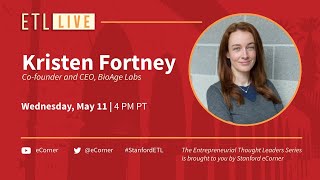
This content was created by GHION.AI . This content was uploaded by GHION.AI . This is a YouTube video titled "ETL Speaker Series: Kristen Fortney, BioAge Labs" featuring a talk from May 12, 2022, with Toby Corey hosting Kristen Fortney, the co-founder and CEO of BioAge Labs. The discussion covers BioAge Labs' work on developing treatments to extend healthy lifespan by targeting the molecular causes of aging, the company's strategies, and Kristen's journey from academia to entrepreneurship.
Chapters
All right, we're live. Good afternoon, I'm Toby Corey and I'd like to welcome all the Stanford students, all the students around the world, all the enlightened folks to entrepreneurial ETL series presented by stvp, the entrepreneurship center in Stanford School of Engineering and Bases, that's the business association of Stanford entrepreneurial students. Today I'm incredibly delighted to welcome Kristin Fortnay to ETL. Kristin is the co founder and CEO of BioAge Labs. This is a clinical stage biotechnology company developing a pipeline of treatments to extend healthy lifespan by targeting the molecular causes of aging. Doesn't sound too technical, right? The company uses its discovery platform, which combines quantitative analysis of proprietary longitudinal human samples with detailed health records tracking individuals over a lifespan to map out the key molecular pathways that impact healthy human aging. By targeting these pathways with a large and diverse Portfolio of Drugs, BioAge aims to treat and even prevent diseases of aging entirely new ways. Her talk's going to be really fascinating. Kristen's scientific background is in biology and bioinformatics. She received her PhD in Medical Biophysics from the University of Toronto, followed by a postdoctoral training at Stanford University where she has a fellow of the Ellison Medical Foundation, American Federation for Aging Research. Kristin, welcome to today's ETL show.
Thanks so much, Toby, for that introduction.
It's really wonderful to be here.
Yeah, we're so happy. I know there's like an immense amount of info to get through, so I think what would be really helpful, I know you put a slide deck together, but if you could give the students just a brief summary of like both the problem space and talk a little bit about what bioage is trying to solve, that will set up a really good context for us to get into a little bit of a fireside chat.
Yeah, for sure.
So happy to pull up that deck. Let me know if you can see it now.
There it is.
And full screen. So you gave a great introduction to what we're focused on. And really we believe that by targeting aging biology itself, we can find important new treatments for key diseases of aging. And that's really our focus at bioagency, where we are today. You said this basically right, but what we are is we're a platform driven clinical stage biotech company advancing a diverse and growing portfolio of therapies that treat disease by targeting molecular mechanisms of aging, which is really a new way to.
Go after disease and I think a really important one.
Some key differentiators of bioage. And we'll go into more detail on this probably during our conversation, but we have this powerful human first discovery platform.
I really believe that you need to.
Understand human aging to treat human aging. And we've invested heavily in research in that area. Today we have a clinical stage portfolio of three programs in human testing and growing. This is also a really important year for the company because we have two clinical readouts, both a phase 2 trial of an immune aging drug and a phase 1b trial of a muscle aging drug. But we'll see the data by the end of this year.
That's fantastic. Sounds like you guys are off to a really great start. I think you've raised a total of 127 million.
That's right, 130 million so far.
The clinic is an expensive place.
Fantastic.
This is just a brief slide on why we focused on aging. And really, aging is one of the biggest challenges for human health. If you look at the United States today, the two biggest killers are heart disease and cancer. These are completely different diseases in terms of their symptoms and their progression, but they're really driven by the same underlying.
Factor, which is your age.
They're primarily diseases of older people, not younger ones. The promise of aging science is that by understanding aging biology, we'll be able to intervene in entirely new ways and eventually even prolong what we call the health span, the amount of time that you are healthy. If you look at the US today, the average lifespan is around 80 years, but the average health span is only around 60 years. That's when you get your first chronic disease of aging. Then you have this very long, expensive period where these diseases just keep on adding up. The promise of these therapies is that we might be able to shorten that gap, shrink that gap, so that we're living healthier longer. The way that we approach this at bio age is by. I like to characterize it as copying what already works. There already are all these humans out there who are living really long, really successfully. On the right, there is an extreme example. Robert Marchand, who won a competitive cycling award at the age of 105, is in the Guinness book of world Records. There's all these people who live not only long, but extremely healthy. Their brains still work, their muscles still work. At bioage, we want to know what's.
Different about those people.
At the molecular level, we've invested in really deeply mapping human aging across a wide range of different ages, different populations. This is just showing here in one.
Of the biobank cohorts that we work.
With the age at which people die. As you know, some people die when they're 70, but others make it as long as 100. We're trying to figure out what the difference is that we can target those differences and really learn from this exceptional biology of people who live longer and live better. The way that we're tackling this is really collecting data over a lifetime. So we've partnered with some really special biobanks. The way that I think about it.
Sort of big picture is that because.
Humans, because all of us age on the scale of decades, we really need molecular data that span decades to understand aging. And we're able to do this by basically running a 50 year experiment back in time because there's some very special biobanks that started collecting blood samples from healthy people as long as 50 years ago. Then those same individuals were followed up for the entire rest of their lives with longitudinal sample collection, with mass electronic health records, tracking not only how long these people lived, but what diseases they got as they aged. And also health span variables like their walking speed, their grip strength, their cognitive function. What we're able to do is leverage modern technologies today by taking these old preserved samples that have been in deep freeze for decades and interrogating them with modern omics technologies like the proteome, the transcriptome and the metabolome that really just making a big list of all the molecules in each sample, using technologies that.
Weren'T available just a few years ago.
And then using machine learning to ask a bunch of questions of the data like which molecular pathways are changing with age, but even more importantly, which predict the future. What's different about the biology of the pathways of those 50 year olds who go on to live 90 plus in great health from those of us who don't? This is where our hypotheses come from. Now, once you've found a pathway to target, and once you've found a drug.
To hit that pathway, what do you do with it in the clinic?
This is a really important question. What does a clinical trial for aging even look like? The broad philosophy at Bioage is that, well, we're going to make bets on targets and on mechanisms that we think long term have the potential to help a broadly aging population. But there has to be a really efficient path first through the clinic. Our first clinical trial will never be for aging.
It'll be for an acute disease that's.
Really well defined, that will let us create value rapidly, that will de risk our program and humans. There's a clear regulatory path at the fda, a clear payer story at the end of it. But we can expand afterwards to a really ambitious Broad aging indication with high prevalence, huge market potential and high unmet need. Just to give you a brief example of one of our currently live programs that has a trial reading out this year. BGE 105 is a drug we're developing for muscle aging. On the left there you can see some data for how we first got excited about this target from our human cohorts. We found that middle aged people with higher apelin levels were not only living longer, but had better muscle health then when it intervened in multiple muscle aging models in old mice. We found that a drug that upregulated apelin could basically protect muscles from atrophying in the short term acute scenario. This is basically you take a really old mouse and you cast its limb for a few weeks and that leads to severe muscle atrophy. But as you can see in the data here, the mice on drug are really substantially protected from atrophy. And we're really excited by that. Then we went immediately into a phase 1b clinical trial where we're looking at some healthier elderly volunteers at bed rest. We have some people who'll be sitting in bed for a week when you're old. That's enough to cause some changes in some muscle atrophy biomarkers. We'll be able to see if our drug helps that. Then after that we can move immediately into phase 2 trials in important acute indications driven by muscle atrophy. That's one of our three programs so far. Our overall goal here is one of my favorite quotes, but our aim should be to help our patients die young as late as possible by Tenley Albright. And yeah, that's Bioage.
Thanks, that's a fascinating overview. One thing that reminded me of when you're going through your presentation is a similar philosophy to Peter Thiel's startup book. And I think what you've done is really focused on a small niche, a specific problem, kind of a trojan horse that can then grow into a big blue ocean, occupy that space. Is that. Was that where you started or did that just develop over time? Try to understand the problems that you're and your strategy to penetrate the market?
Well, yeah, I guess, you know, my philosophy there is that a startup should only do one impossible thing at a time.
Right.
And so we're going after agents and that's new.
That's hard. Right.
Like that's our big thing and we want to sort of de risk every step along the way as much as possible. Right. So we're also not going to also revolutionize the fda. You Know, in our first.
In our first go.
Yeah, yeah, yeah, yeah, yeah. I like the strategy a lot. All right, well, for those that were here last week and heard Alfred Lin talk, he made a really cool comment about either one of two things happen. Either you follow in your parents footsteps or you go in 180° different direction. And I know you went 180° different direction. Your folks aren't scientists, but how did you get interested in science, particularly human biology, especially given that your folks and family were down that career path?
Yeah, sure.
No, that's a great question.
I mean.
My answer might be science fiction. I read an awful lot of science fiction back when I was in high school. And that's when I became, I guess, interested in a lot of, well, also in aging biology.
Right. Like there was.
I became aware of specific advances in aging biology as a high school student where, and this is true today, there's a growing list of interventions, whether they're genetic interventions or therapeutics that can make a mouse live longer and live healthier longer. The vision of that translating to humans has always been very exciting for me. I actually didn't start off in biology. My undergraduate degree was in math and physics. I love math and physics.
But I was always sort of keeping.
Tabs on the aging field and decided for my PhD that I wanted to get into it directly myself and really sort of bring my sort of more numerical skills to do bioinformatics and machine learning in that area.
Yeah, that's fascinating. A lot of entrepreneurs have similar stories where there was something early on in their life that just they really connected with, got really passionate about and they.
Ended up getting a note.
My microphone doesn't work so well. I'm going to try unplugging here.
Tell me.
There you are.
Did that work? Yeah. All right.
Yeah, that works great. Yeah, fantastic. Yeah. I was just remarking that it's interesting that the reoccurring theme. All successful entrepreneurs start out with an interesting backdrop story what got them where they wanted to go. And I think that everything from Ethan's story of Impossible meets and where you are with science fiction and leading into that and finding your passion, I think related to that. I made some remarks at the top of the show where You've earned your PhD from the University of Toronto and then you moved to the Bay Area for your Stanford postdoc. But was entrepreneurship in your field of vision at that point or do you have other career paths in mind? Like how did that, how did that vector surface itself?
Yeah, that's, that's A really good question too. I was always, you know, very motivated by the idea of developing therapies that humans took. Right. And, and I guess I'd originally connected that in my mind to doing academic research and then, you know, realizing that wasn't really the kind of thing that happened in academia while I was a PhD student. I think starting a company was not really in my mind. It wasn't on the list of like, sort of possible career options for me. It was still a rare thing in Toronto. I think it's, you know, this is close to a decade ago now, so I think that's maybe less so today, but the Bay Area is still a special place. So I, I came after my PhD to Stanford, my postdoc, in part to get a crack at some really awesome genomes of humans who live to be older than 110. Amazing project. And, and then, yeah, I made friends with founders. I, you know, knew a lot of it, became one of those know, possible things to do. And honestly, like after my postdoc, if there'd been a really amazing company working on aging, I might have joined up. But the sort of particular idea of what I wanted to do and starting a company became was the natural sort of next step, you know.
Yeah, yeah. I think students love to just understand the breadcrumbs of where you got to that idea and how you got to that point in time. So as a follow on to that, were there any courses or mentors or other factors that helped pave the path from doing science to becoming an entrepreneur that influencing major. Influencing events that occurred during that time?
Yeah, for sure. So I actually did take the Ignite program while I was at Stanford, which supposed to be a crash course for PhDs, you know, more scientifically trained types to get, you know, really exposed to all this sort of startup stuff. And, and I found that a useful experience. But also just honestly having founders who ed friends. Right. Instead of hearing directly one on one their stories and the process, like that's the most valuable thing. And there's such an enrichment of those around Stanford and the whole community.
Yeah, that's fascinating. Wanted to remind the students, get your questions posted in the Q and A. That gives the other students a chance to upvote those. There's one epic question there. Let's see if somebody can top that by. So don't wait till the end on that. Let's shift gears a little bit because obviously you understand the science, the product side of it, and I think the customer side well, but that's a small slice to being a CEO and a co founder of a company. So as you entered like the worlds of CEO and having to raise money and hiring and building a company, what was that like? How did you acquire the expertise and the insights to deal with more the EQ and the fundraising and the stuff outside the science and the product and the market?
Sure, yeah. I mean fundraising is weird, right? Like there's no, I would say very good book on, you know, how to go out and raise a venture round. And honestly it like changes year to year as a function of the market and as a function of what's, you know, what's, what's interesting. Right. So, so you really do have to. So for me, I guess as a postdoc with my first sort of seed pitch deck, I initially bounced it off friends, I initially bounced it off angel investors that those friends connected me to who were not in my area at all. So I could get some like, very, very like clear feedback without having any sort of risk. Right. And then, and so I started off with basically zero network. Right. In terms of actual investors. But once you start to meet a few, that, that sort of community is very welcome. Connected.
Yeah, yeah.
And then how about the hiring side? That's you know, also something incredibly important and falls outside of sort of the, the science view of things. And how did you know and learn and put a management team together and a staff and a team and recruit and retain really great talent. How did, how did that occur for you?
Yeah, hiring is incredibly important. It's so important. There's a whole bunch of things I know today that I didn't know when I got started. And one of those is honestly just how many people will be sort of interested in what you are building. Right. Like, I think there are a lot of very smart, accomplished people out there who are excited by new things and who are willing to help. So I've become a much bigger fan. Like I'm a huge fan of the cold email. Just sort of reaching out, just. And whoever you think is interesting, you'll get a fairly high return rate on that. I'm just being very sort of ambitious with your hiring plans. So there's network, but don't limit yourself to that at all. Right. Try to figure out who you think is the best at X and reach out directly to them and to their network. That's, I think paid off for us many times.
Yeah.
I don't know anything about clinical development. Right. Or drug discovery.
Right? Yeah, yeah, yeah.
And did you utilize mentors as well through this process? Obviously at a board and investors. But what kind of role did mentors play in helping you figure all this out?
Yeah, definitely. I mean, like, there's mentors who have gone, like, there's sort of mentors who's like, sort of seen it all.
That's wonderful.
And there might be angel investors who've been involved with, you know, hundreds of companies in some cases. Right. And there's also mentors who are like one or two years ahead of you. And those are both, I would say, incredibly useful in different ways because having had your sort of direct experience, but like, you know, just a little bit in the future, being able to peer into the future one year is incredibly valuable. So I think that both types are really important to get on your side.
Yeah, yeah, yeah.
It sounds like you've utilized them very well. All right, let's dig in a little bit more here. So first, how did you decide which potential therapies and interventions to work on given probably an unlimited array of options? How did you boil that down to this single focus?
Yeah, this is sort of connected to what I mentioned earlier. Right. So we really want to reduce risk at every step. So there's no magic bullet for aging. We know that from all the animal work that we've done, you know, that the field has done over the past few decades.
But there are probably several different, double.
Dozen different pathways that are important that can work. And the way that we've approached this in bioage is that. So again, you see a whole bunch of different signals emerging from our human data and which targets they prosecute on first. And we're really doing it in order of like the most de risk to the most novel. So we specifically chose to start with those targets that had existing chemical matter so we wouldn't have to build a drug from scratch. And that let us get really a rapid start on advancing our first therapies into the clinic as well as just the pre clinical testing. Right. We need to have a sort of tool to move forward. We didn't want to build everything ourselves from scratch. So it's really sort of assessing the ones that have the most knowledge around them already.
Yeah, yeah.
One of the things that really intrigued me was the. Your comment about going back 50 years of time and getting those, those data sets and blood samples. But my guess, however, is that that in and of itself is like boiling the ocean. So there's a lot of noise. And how are you able to sort of extract the signal through the noise? And how does that magic work?
Yeah, sure. So there's A lot of you can make a big list of things that predict that are correlated with longevity, correlated with health span. And then the question is, what are the actual big levers? What are the causal things? And so there's a number of different techniques you can do, like in silico on your computer, things like Mendelian randomization, which asks the question, like, if there's a genetic variation, then does that actually cause a difference in the trait? Which works sometimes, but not always. And honestly, whenever you're doing the computational analysis, I think of that as just giving you like kind of a prioritized list. Right. And then you really need to do the in vivo experiment. You really need to actually modulate the target in a living animal to make sure that, one, it's important for aging, and two, because again, remember, for each of these drugs, we're going first to an acute disease, and it's really important that the drug not only be relevant for aging, but also have a big enough effect in an acute disease model to justify clinical development. Right. So we've also invested a lot on that side. And we have our own aging mouse colony, about 5,000 animals, sort of a really extensive battery of tests. So it's really important, I think, to have those two components together.
Yeah, that's fascinating. Okay, so biotech's one of those fields where you spend a lot of time and money working on something before anything obviously can be tested for real people. I'm curious. You know, half of my career was in software development, and that's pretty standard. You work on these sprints, they're usually two weeks in length. They do a build, you test it and you see the progress. You've added new features, you fix some bugs or what have you. And these are other businesses have fairly larger cycles. But I'm just wondering obviously, like, how do you deal with such a long development timeline both in terms of like patience and resiliency? And then how do you sort of measure that progress without kind of clear, kind of builds in software or in renewable energy? You see the number of systems that you're building and how do you manage that?
Funny you mentioned patients, because I think of myself as a very impatient person. And it's true. No, it would be lovely, right, if virus pack had iteration cycles like software. But all these things take a lot of time.
So while it takes a long time.
To get to revenue. Right. Which is sort of. I guess you're right. If you're a startup that really matters your time to revenue to actually be able to sell the Drug for humans. There are like really, really big de risking milestones along the way, right. Like is there a target, is there a drug that hits the target that has all the right characteristics to be advanced? Does it actually work in the animal model? You know, like there's. So there's. Every year there's like a lot of like I would say really important de risking information that you learn. And then, and then the big one of course is your first few clinical trials. And we just put, you know, last year was the first year that we put one of our drugs into a human, right? And amazing, like really exciting milestone for us. And this year we have these two data readouts, right? So it's the first time that's kind of the ultimate test. And the scary thing too in biotech, right, Is that you can do sort of, unlike in software, you can do everything right. And you can still be surprised in the clinic because humans are very different from mice, right. So you can sort of de risk.
As much as you like.
But the upside, of course is that the, the rewards are tremendous. Right. So, so biotech is very, I would say high risk, high reward, like immensely, you know, high reward if a therapy can actually improve patients lives.
Yeah.
So looking at your entrepreneurial journey, what would you say would be the biggest surprise in a positive way? And also the exact opposite of that, the biggest surprise in a negative way from starting to where you are today.
Sure. The biggest surprise in a positive way.
I guess coming into the entrepreneurial world.
The biotech world, as an academic, I think I had everything backwards in a way. I thought that what the scientists did, which was finding the target to work on, that was the hard part. Then you just. Pharma and clinical development, these sort of machines, these cranks that you turn to build a drug, to run a trial. And I guess I have the very opposite view today where probably corrected too much in the other direction where it's like, oh, targets, those are, you know, those are easy.
Yeah.
So that's, that's one example where I was sort of, I guess something could call that surprise in a negative way where I just had really the wrong idea. It related to that too. I guess I thought that the best science brands were in academia, you know, and that like people who went into, you know, pharma, those are different species and that's really not true. Like there's amazingly brilliant people in pharma in drug discovery and clinical development. Like really creative, really amazing people and being able to work with them, I think has been really exciting. Yeah.
Yeah, yeah.
I'm also curious too. Within your industry, what does your corporate culture and values look like and how do you manage that?
Corporate culture and values? We are very science centered, discovery oriented. So I think that's an important part of our culture is really just creativity giving everybody room to grow. Because again, I started as a postdoc, my co founder also started as an academic. And we really want everybody to be able to, no matter where they're coming from, be able to sort of grow into their roles at bioage.
And like, honestly, especially in an early.
Stage startup, like, there is no one more valuable than the really sort of brilliant generalist who sort of wants to throw themselves into whatever's needed because there's always going to be something different. You know, on a weekly basis, on a monthly basis. We're at 60 people today. And that's like still true to a large extent. Really. Right. There's just so many different things going on. Of course you need decision making structures too. Those are really important. I'm a big fan of, I think it's called like the disagree and commit. Right. So I like a culture where you have a meeting and everyone gets to put in input because everyone has really good ideas and you want people to feel comfortable to sort of disagree and to sort of say, I think that's a terrible idea. But then, then you make a decision and after that everyone needs to align around it. Right. That's the, the most efficient way to move forward. Yeah.
That's awesome.
Yeah.
I want to remind the students, don't forget post in the Q and A. I see some popping in here so you can get upvoted. I'm sure that you interested in bio aging or your boss or uncles or parents or grandparents. So keep those questions coming. All right. A little bit more tactical. How much do you need to be already thinking about how your interventions will fit into the broader health care system, specifically like insurance and hospitals and all the other downstream infrastructure.
Definitely. Yeah. So again, we try to make that easier by going first after diseases where that's already been mapped out. So we're not inventing the disease. It's not a new one. Right. So we know there's like a clear payer strategy. This is really important from a regulatory risk like will the FDA even accept these clinical trial endpoints? Are they meaningful and will the payers pay for it at the end of the day? So these are really critically important. That's an important part of de risking your program. I will say though. But. Right. Like we do have this Longer term vision that these therapies are not just going to treat an acute disease, but they might be a drug for frailty or a drug for immune dysfunction, maybe used prophylactically. Like a great example today is something like a statin. It's prescribed as though it were an aging drug. Right. Like if you're over 40, you have a couple of risk biomarkers. Your doctor will prescribe a statin and they weren't first approved that way. They were first approved for familial hypercholesterolemia, like a narrow orphan disease. And the label was widened over time. So this is a path that's been trotted before in terms of start with a very narrow indication, broaden over time, do a big one. And the question for us looking to the future is like, can we accelerate that? Right. We believe there are going to be these therapies that fundamentally move the needle on aging and how do we actually get them to the largest population that could benefit as rapidly as possible? So that's more, I would say that's a harder question. Right. But we are doing some work on that now to really realize the full value of these therapies and help the most patients.
Yeah.
And I think too for the non science, non bio folks out there, just as consumers, we look at that and go, I mean, just a regulatory massive black hole. No one understands it, but how do you navigate through all those regulatory issues involved in doing something like so incredibly, incredibly radical?
Sure, yeah, that's. I mean, we're still figuring it out. Right. I mean, honestly, you know, it's pretty complex too. Even for like a standard disease, you.
Have to have a lot of interactions.
To get your therapy approved, to get your endpoints acknowledged. And then beyond that, like, so there are, I mean, there is precedent. Right. Like there are new indications like all the time. And the FDA can be very open minded about those. But you have to sort of initiate discussions now and start working groups and start convening, you know, groups of experts who, like for example, frailty. Right. Like that's not a clinical indication today. But I would love it if, you know, you could have a clinical trial where you have a bunch of older people with impaired muscle function, maybe they don't walk so well. Right. And we could get FDA to agree that, you know, if they walk better or some other functional measures improve, then we'll approve this therapy for this indication. And so there is a path forward there, but it's a longer one.
Yeah, yeah, I think too, I know going back through my entrepreneurial journey. And I know for me, really focusing on first principles and developing frameworks really helped me make really good decisions outside of, you know, whether I was a software engineer or kind of product manager. But as a CEO and co founder, my guess is that you're dealing with lots of sorts of decisions you have to make in building a company from very different decisions and that don't have to do with doing research. So did you have to develop new principles or frameworks and how do you make decisions and the stuff that kind of fell outside of the out of the science category.
Sure. I mean, I don't think we're necessarily.
Building new frameworks, but we are sewing.
Together ones from a lot of different disciplines. Right. Whether it's like doing good data science and then doing good experimental biology and target nomination to doing a good clinical trial design. The one I would say hardest piece that we have to do, which maybe I think it's both a challenge and an opportunity. Because often in biotech you're like, we are a company that works on disease X. Maybe it's Alzheimer's, maybe it's some cancers. And so you know what your drug is being developed for. And for us, we find a target. We know it's important for aging and that means it's important for actually a number of different diseases. Right. So it's actually this is an area where we have to actually pick the first disease that has the highest chance of success in the shortest amount of time for the least amount of money. So it's like a fun constrained problem to solve. So that's one of the more unique challenges we solve. But the rest are really, I would say, common to a lot of biotech.
Yeah, yeah.
Well, I think looking at the great trajectory of bioage and I think, I think I noticed on your last press release bringing on board a chief medical officer, you obviously have had great success in hiring and retaining really great people. What's been your secret? What other advice could you give students on how to master that challenge?
I think everybody is really excited. I mean, I think it's really important that everybody you hire be really excited about the mission. And we have an ambitious mission, so that helps. I think that we're able to attract a lot of, a lot of really great talent because they're excited about what we're doing, they're excited about the autonomy they have to sort of help execute on that mission.
Yeah, yeah.
Well, it sounds like you have a big job and a lot of weight on your shoulders. This is such a big vision and A long term vision with potentially incredibly profound impacts on health, bio, aging and society. But I'm wondering what do you do to compress when you got to take your work hat off, how do you unwind and how do you find time to recharge your batteries?
So I probably recharge in a few different ways. Like everybody, I still read a lot of science fiction. That's how I fall asleep at night. The most effective way to decompress is that I have two little kids actually I have a 2 year old and a 5 year old. And when you are playing with a 2 year old and a 5 Year old, you can't think of anything else. It's not even an option. So I recommend spending some time.
Yeah, yeah, yeah.
That's fantastic.
They won't let you, you know.
Right, right. Do you have any other hobbies or you work in some travel or is it just walk or meditation or yoga or any of those, those types of activities. Probably tough. As a young mom.
I jog. Travel is usually really around sort of work related events. But that's okay. Like you can always tack on a day or two to be a tourist. Right.
So that's fun.
Yeah, yeah, yeah.
That's great. So here's sort of a horizon trajectory question for all those aspiring entrepreneurs out there who may want to innovate and the highly technical biotech space. What are the areas you think that are ripe for exploration in this field?
Well, I'm biased, but I actually think there should be more aging companies. You might have guessed my answer there. You know, like today there are so many different oncology companies. Right. Like there's just, it's such a crowded space and aging is a new science. There are going to be a lot of different mechanisms that work. And honestly we need more companies in this space. Like I know basically everybody else in the space because that's how small the field is. It's brand new. Right. It basically didn't exist a few years ago. There was nothing clinical stage a few years ago. And even today all the companies that I know, like we're not competitive because there's so many targets. There's all this opportunity. So I'm a really big believer in that. There's also of course all these different really exciting modalities. Right. So I think there's new ways to build drugs that are really exciting. I personally am biased towards sort of platform approaches. Like if you're in the clinic, we discussed this earlier with a drug like that's, that's really risky and it's just like a binary risk. Right. It either works in a person or it does end.
The company sort of lives or dies by that.
And if you're a platform company, then you can have a portfolio of best. And our approach at BioAge is to have a computational platform to yield multiple targets, to advance multiple therapies that way. But there's also like different types of platform, like ones that are using like crisp. Like maybe it's a way of making drugs. Right. Like it's a way of using ML to build drugs de novo or it's a way to use, you know, CRISPR or antibodies. Right. But I'm really excited by this sort of newer generation of platform approaches to therapeutics.
Yeah, well, I think, I'm not sure I'm going to give her credit anyways, Tina Selig, because I heard her say it. Maybe she stole it from somebody else. But kind of our favorite question here at ETL, which is if you could go back to your 20 year old self, that's not that far for you. But if you go back to your 20 year old self and tell yourself one thing, what would that, what would you tell yourself?
Oh, that's a good one. Yeah. I mean, honestly, just to start everything earlier. Right. Like, I don't think I, you know, I think you can be really successful as an entrepreneur. I think there's like brilliant people that are starting things that, and you don't really need a postdoc, you don't really need a PhD the world. Like if you, again, if you cold email someone who's written an awesome paper that you'd like to work with them on, people are remarkably responsive to that. So just that there's sort of like a bigger world I guess that I was aware of at that age in a more accessible world.
Yeah, that's awesome. One question I'm curious about is, I know in other industries one of the challenges with hiring really talented people, they're also incredibly creative and have lots of ideas. And sometimes focus becomes a problem for large companies. And in my experience, both working at Tesla and other companies, usually the problem's not the quantity or even quality of ideas, it's really knowing what not to say no to. And that kind of discipline where a lot of CEOs just don't have that natural talent or ability. But I'm wondering, is that a factor in your business or is it just like, hey, we got a clinical trial, it's pretty, you know, dot the I's, cross a T sort of standard or are there differing points of view other ideas that come in and potentially present some challenges around how to keep things focused and, you know, really focus on the things that really move the needle. And how do you evaluate that?
Yeah, no, that's a really great question. And certainly there are a lot of, you know, you do need to brainstorm and there are a lot of different directions that things can go in. And personally, and I also agree with you that there are some people who are brilliant at brainstorming and having like wonderful ideas, but not like picking and focusing. Right. So I actually like to have those skills in different people. You know, you've got your brainstormer and that's sort of where the idea generation comes. And then you, you bring in your sort of crew of cutters, sort of like focus in on the most practical one and that sort of, you know, you can have, I think, a team that is very complimentary that way. And you need really both sides of that.
Yeah, fantastic. All right, we got a whole bunch of really cool questions, so we're going to. I'm going to run up the Q and A box here. This first one I'm actually is very philosophical for you and I'm really curious to know as well. It comes under the alias of Twilight Thoughts question mark. So here's the question. When you can live forever, what do you live for?
Is it really any different? You know, I mean, like the thought experiment, I guess, is like, what if, you know, you could take a pill every day that would make you super healthy and, you know, everything works and you know, like super fun. You're a 20, perfectly functioning 20 year old for that day. Right? And the question is when? When do you stop taking that pill and why? Right, Yeah. I think, you know, in the United States, right, I think the average age, the average life expectancy is close to double, you know, in the last century with all the sort of changes that were made and I, you know, and now it feels natural, you know, to live, but it, it used to be like actually a lot shorter than that. Right. So I don't know. Personally, I think there's lots that I would do, go back and do some physics. There's so many things, right. So.
Yeah, yeah, I think you're right. And I think too, it boils down to kind of a mindset question in that our neuroplasticity, our brain stops growing at about 16 years old and neuroplasticity usually starts to hit a peak at about 25. But we're all born with this natural innate ability to create and it's extraordinary. And over time, as you can conform to society, then neuroplasticity erodes and you get into these just habits. And I think then the quality of life just begins to erode for those that are young at heart and I think are always pushing the boundary, have a growth mindset. There's unlimited horizons to tackle and opportunities to explore and new talents and skills to develop. And if that's your mindset, then I think there's a lot to live for. And if you're going through the drudgery of life and you know, the same sort of cycle, then you're probably going to get a different answer. So that's a really cool question. All right, something a little bit more tactical. When you pitch to investors, what are some of the most powerful data points or stories slash frameworks that seem to really convince investors because they're obviously betting on the future? Not sure. Lots of investors, especially as you get out of a seed round, there's some metrics like, hey, they're looking at product market fit, they can touch and feel your product. They look at how many customers are in your beta and maybe there's some revenue in there, but this is a really different story. So my guess is you probably had some no's. Raising money is a really humbling experience. I have had way more no's and yeses in my career. But what's that like from a pitching and a storytelling standpoint of how to get that investor to see your vision and understand this opportunity?
Yeah, for sure. So it's a combination of a few things and like you said, like one of them is sort of what is the what, what's the vision if everything works right?
And there you can point at, you.
Know, point at statistics of, you know, all these things that work in animal models, for example, and what that would mean for a human. And then there's sort of like the actual sort of practicality, you know, component, right, where you have a therapy and you have, you know, at least this first indication where also it's going to work. And that in itself is a valuable market. And that in itself has this like wonderful animal data and this great drug and a clear plan to move forward, right? So it's like these are, you know, therapeutics for acute diseases with high unmet need. And everything else, in a way is all upside, right? So I think it's really important to work with investors who have your broader vision, right? Because, like, because we could be a company really just working on these first diseases, but we want to Do a whole lot more than that. But that's an important component. Right. Because you have to sort of show what the sort of how you're reducing risk at every point. Yeah. As well as the overall potential.
Yeah, yeah.
And where do you think? We talked about kind of what the overall industry trends might be, but where do you specifically see bioage in 10 years? What does that look like?
I'd like us to have a couple approved therapies. Right. And ideally they're approved for a specific disease. And at the same time we have some information on whether they're really going to impact aging. And we're trying to get a head start on this in our clinical trials in the sense that even though our trials are for an acute disease, we.
Are measuring biomarkers of age.
These are all diseases in older patients. We're doing full proteomics at the beginning and the end just to integrate it back with our cohort data and ask are we changing biomarkers of aging to start to learn if they have this broader potential? In 10 years, I'd like us to have a couple of therapies that have passed the finish line for that first indication and where we also have conviction that they have potential beyond that from human data in our trials.
Yeah.
Great job. This goes back to one of the first comments that you made in your love of science fiction. So students asking, what are your top three recommendations for sci fi books to read?
That's a great question. Greg Egham is probably one of my favorites. So Diaspora is a really good book. So is axiomatic for that matter. That's to Greg Egans. I'm currently reading Brian Stableford, who I also recommend More of an Oddball, but there's a. Yeah, some very, very good science fiction novels there. I actually can't remember the title of the one I'm reading right now. David Sindel. I like that. That's three good authors at least.
Yeah, got it. And then what made you decide to come to Stanford for your postdoc? And how much of that decision do you think played into you taking the. An entrepreneurial path?
Yeah, that's a really good question. So the why. So aging is a really small, weird field even today. Right. So just to give you an example, I did my PhD at the University of Toronto. I graduated to 2012 and that's Canada's largest research university, but it actually had zero labs focused on aging. So I was doing aging projects, but in a cancer informatics lab. And there's really only a few labs, not even at every university that work on aging and Stanford is one of them. So I worked with Stuart Kim at Stanford who'd done some really great sort of computational papers and specifically he had these DNA from these humans who live to be older than 110 and wanted to crack at that data. I've always believed that some of the low hanging fruit really is to learn from the humans who are already aging. Well. These are living examples that we can do it safely, we can do it while preserving function. So if we can learn what's different about those people, then we can target that. That's. That theme is continued at Bioh. That's a great question. I don't know that I would have thought to start bioage if I hadn't been in the Bay Area.
You know, there's a good chance I wouldn't have.
Yeah, yeah.
It's definitely a very fruitful environment for entrepreneurship where you've got all the pieces there and you know, it takes that mindset. You start to move in that mindset, right?
Yeah. Like there's a piece of sort of like making it on your mouth of sort of like reasonable career moves. Like that's one piece. But the second is also just I would say, you know, investors willing to be, you know, to bet on these kinds of ideas too. Right. Like, like the kinds of investors that you have in, you know, Europe or somewhere, like Toronto versus or even other parts of the United States are very different. Yeah.
Yeah.
Okay, next question. How much drug modeling do you simulate using software? And at what stage of the process are you doing the simulation? The second part of the question is do you close the feedback loop by using the FDA trial data results or something else?
Oh, so we're not doing drug simulation.
In our data sets, our data is.
All about finding targets, biological targets. And then we're using drugs that are, you know, that are designed specifically to hit those targets. So that's not sort of computational.
Yeah, this is a great one too. Which pertains to funding. Given that biotech seems, actually seems. It's very complex. Were you able to test your assumptions about your product in any way before you got funding?
Test. Well, only in animal models, right? Like humans.
Yeah, yeah.
But basically it was just the animal models that either was pretty binary, the investors could understand that felt there was that that data was good enough to make investment on.
Well, yeah, I mean the way that we look at it is that we're doing our target discovery in human populations and, and that should be de. Risking. Right. Because we want to ultimately Take these to humans. Like there's a lot of other companies even focused on particular therapeutic areas where it's all in animals. Right. And it's sort of like it's target first discovered in animals, works great in mice and like fingers crossed in humans. And we know that these are targets relevant for aging from our human data sets. And then we have, you know, also that it works in the animals. Right. And it's sort of those two things together that.
Yeah, yeah.
And then, you know, congratulations on the last big round you raised. Where do you see those investments being made to get you to what stage of the company?
Sure. So those are, you know, the bulk of that is going to be spent, you know, if we were a tech company, that would be spent on headcount. Right. But you know, as a biotech company, that's almost all going to clinical trials. Clinical trials are very expensive. So it's really to give sort of like, you know, three different, like well powered clinical shots, you know, while keeping the discovery engine running, you know. But that's honestly much more capital efficient than having to run a clinical trial. So it's really going to get us to, you know, proof points for three programs. Yeah, three, three and a half programs.
Yeah, got it. And then how much might you own therapies, therapies that relate to end of life or palliative care? That's the first part of the question. Then basically how much do you need to think about the ethics around when to continue and when to stop an aging related therapy? Or is it that a line of thinking better left to a doctor healthcare system?
I'm not sure I understood the first.
Part of the question.
What was that?
Yeah, so I think it was basically like how much might you own therapies that relate to end of life or palliative care? So do you see that vectoring in or is it more on the front side of that?
Yeah, sure, sure, that makes sense. I mean it's actually a lot harder.
To go in and make a significant.
Difference when someone is very, very ill. So in most cases we're going earlier than that. So for example, the two first indications for our immunogen drug, we actually are going after patients with hospitalized with COVID older patients hospitalized with COVID You know, so that's there's they're sick but they still can make a full recovery. And for our muscle aging drug, we're looking at patients who are suffering acute muscle atrophy in hospital. So again, sort of transfer for full recovery.
Yeah, yeah, I think too, I'm curious to know, are there, what type, what is the, what are the operational KPIs look like? Do you use OKRs or what are the, you know, what does your dashboard look like? And you manage it weekly or bi weekly or monthly or quarterly? What do the operational metrics look like?
Yeah, that differs a lot by team for us. So I would say the clinical team is very, very heavily operational. Cause that's really like you have this really complicated plan of execute. Right. So that's sort of very KPI driven. Research is less so it is more around sort of a certain number of targets assessed, you know, diligence really. Right. You know, internally with internal resource, in vitro, in vivo by quarter.
Yeah, yeah.
And then did you go early on with bringing an in house patent group or do you still utilize an outside patent group? We still believe that's a critical.
Yeah, yeah, yeah, yeah.
Fantastic. Okay, another question here. To what end are you motivated by effective altruism?
That's an interesting question. I don't, you know, formally identify as that, even though I guess I am very aligned. So yeah, I mean, you know, yeah, I tend to not eat meat for the same reason. But this is all really giving like more healthy years to people. Right. Like that's, I think, the real promise of aging science. Like people have estimated that if you could cure all cancer so that cancer didn't exist anymore, that would extend average lifespan by four years only, you know, which is a number that amazes people. Right. It's because if you're at the age at which you get cancer, you're also very highly likely to get, you know, heart disease or Alzheimer's, etc. And those are so, so it's four years and it's not four healthy years. Right. Because you're old and you have all these other comorbidities piling on top of you. And in contrast, if we could extend, you know, so these therapies, again the first to be used to treat acute disease. But eventually I'd like to infuse preventatively, just sort of delay the onset of disease the same way that we see in these long lived human populations.
And if what we've done in mice.
Over and over again extended that period of healthy life by close to two decades in human equivalent years. And that would be tremendous from that perspective.
Yeah, that's great. And the second part of that question is. And have you read the Fable of the Dragon Tyrant by Nick Bostrom?
Yes, I have.
That's great.
Yeah.
Are there any other books that you'd Recommend just general topic stuff that you think helped you with understanding entrepreneurship and what that journey would look like or business books or.
Yeah, sure. I mean, I guess I like the biotech specific books. So there's this billion dollar molecules, there's a story about the origin of engine, there's a story. Story about the origin of Genentech and they're really great. Like it's, you know, sort of in the trenches. There's, there's really always good times and hard times and lots of decisions. There's also the founder of alum John Raginor had a really great piece about his company in either Nature or Nature Biotech that just came out a few days ago that I would highly recommend. Just, it's, it's, you know, a very novel modality and investors love them. Sometimes they were like the hottest thing ever, then they completely abandoned them other years and it's, it's just, it's just a really inspiring story and it, you know, went on to become a really groundbreaking company. So that's, you know, I would recommend that there's, I wish there were more of those, really. Frankly, you know, there aren't that many biotech ones, but the ones that are out there are actually very good. Yeah.
Yeah.
Well, look, we're out of time, but I just want to say thank you so much for your time and your insights. I think, you know, for most of us it's, you know, a really big black box, big black hole. And I think you've really brought, you know, an incredible amount of light and a little bit better understanding of these types of businesses. And certainly your business strategy, I think is really incredibly fascinating with just extraordinary positive implications for humanity. So let's applaud all your hard work and the work that you do. So thanks again for an amazing discussion and to our audience, thank you for tuning in to this session of entrepreneurial Thought Leader series. Next week we're going to be joined by Cruise Foam co founder and CEO John Felt. You can find out how he's looking to accelerate the adoption of sustainable material. And you can find that event and other future events in this ETL series on our Stanford E Corner YouTube channel. And you'll find more of our videos, podcasts and articles about entrepreneurship and innovation at Stanford E Corner. That's Ecorner, Stanford Edu. And as always, thank you so much for tuning into E.
More from GHION.AI


O processo de reconhecer limites, mesmo quando a vida parece exigir sempre mais.





Depois de tantas histórias, aprendizados e pausas necessárias, o @interior_iza está de volta



