ETL Speaker Series: Lisa Dyson, Air Protein
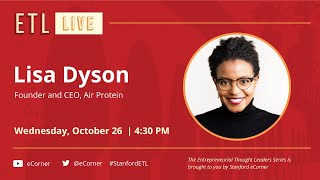
This content was created by GHION.AI . This content was uploaded by GHION.AI . This is a YouTube video titled "ETL Speaker Series: Lisa Dyson, Air Protein" from October 27, 2022. It features a talk by Dr. Lisa Dyson, founder and CEO of Air Protein, hosted by Tom Byers at Stanford University. The discussion covers Air Protein's innovative approach to producing protein from air, the challenges of scaling sustainable food production, and the importance of entrepreneurship in addressing climate change. The event is part of the Entrepreneurial Thought Leaders seminar series, co-sponsored by Stanford's entrepreneurship center and the Business Association of Stanford Entrepreneurial Students.
Chapters
Okay, welcome everybody to the ETL live version with a studio audience, but also, as you recall, we're on the Internet simultaneously. My name is Tom Byers and I'm your host. I'm faculty here at Management Science and Engineering along with Robbie Belani, your usual host. I have the honor of substituting today. I'm also faculty director of the entrepreneurship center here in the School of Engineering called stvp and so very proud of that. But all of us at STVP are proud to be co sponsoring the Entrepreneurial Thought Leaders seminar series this year and have been for a long, long time with basis the Business association of Stanford Entrepreneurial Studies or students. I should have that right. After all these years. I'm tongue tied because I am delighted. And just let's get ahead of this because I've been looking forward to this moment for a long time. I get to say Lisa Dyson's here. So here I go. I'm going to say a word, but then we're going to watch a video and get into this. Let me just tell our audiences around the world about Lisa for a second. Dr. Lisa Dyson is a founder and CEO of Air Protein, which won the World Economic Forum. Technology pioneer company. That is a huge honor, as you're going to see in the video here in a moment or maybe you read before coming today, it is reinventing how food is produced. This is going to be really cool to get to talk to her about it. Let me tell you a little bit more about her, though. She's also the founder and chair of coverdi, a biotechnology company working with corporations that make the circular economy a reality. We'll end up chatting about that, I hope. And let's talk about her background, though. She has a PhD on such an easy subject, theoretical physics, string theory. I'm sure you just read this for fun. How many people are majoring in physics in here? All right, there you go. Well, I honor you and I salute her as well, because it was my most difficult subject when I was a student at Berkeley many, many years ago. So she got a PhD in that from MIT. She was a Fulbright Scholar at the University of London, where she received an Ms. In physics. And before that, we always like to celebrate even people's undergraduate education because that's like many of you in the room. She has degrees in mathematics and physics from Brandeis University, but this is not her first time at Stanford in official capacity. You were here as a scholar in Leonard Susskind's physics lab a few years ago as well, as well as our alma mater, Berkeley. So it's really cool to welcome you back to campus and just listen to some of these accolades. Inc. Magazine's top 100 female founders, United Nations Global Citizens Award, Fast Company's 100 most creative people. Yeah, there was a good reason why we were clapping to welcome her. And thank you for that. So, Lisa, welcome my friend.
So wonderful to be here.
Thank you.
Thanks for having me.
Well, it was terrific to have one of our Mayfield fellows last summer, Jessica, who's here, intern at Air Protein. And that's when I first became familiar with the company, when we did our site visit with her. But we're going to try the impossible here. We're going to play a little video here that it's just two minutes long, but I think it'll give you a real jolt.
For some, the sky's the limit. For us, it's a starting point because below the clouds, there's a world crying out for change. A change to using less land, less water, to transforming industries that have become leading causes of climate change. At Air Protein, we focused on meat. But to fix it, we couldn't just fix the process. We had to create an entirely new one. So we made meat from air, introducing Metameat, a new food category pioneered by Air Protein. Using novel technology inspired by NASA, we convert elements in the air around us into protein using cultures, then turn those proteins into any meat imaginable. It's where cutting edge science meets old ambition to reinvent the way we eat. Because we're not in the business of baby steps, we're here to take leaps. Leaps that let us transform the future of sustainable food with solutions we never thought possible. Leaps that deliver us to a world where meat is delicious and nutritious and making it is carbon negative, massively scalable, and uses exponentially less land and water used today. And leaps that reimagine our relationship with the environment to ensure that it's something worth passing on to those who come after us. And if you join us on this relentless pursuit for more, changing the world will soon feel as natural as taking a breath.
Watch that over and over.
Okay.
I mean, it doesn't get much more purposeful or big and bold than that. So it's so cool we get to have a chance to chat with you. We've prepared some questions for her, and we'll do that for a little while. And after that, it will open it up to everybody else in the room for the rest of the time. Fair enough. Usual style here. Okay, so let's. We put Together about three categories of questions. So the first one, let's just jump right off of that. What makes this technology distinct? And why are you so motivated to bring this to fruition?
So, again, it's so wonderful to be back here at Stanford, and it's so wonderful to be here with you all today, just to start with the why. And I'll talk about food in a way that we probably don't hear people talking about a lot. And I'll say that the technology that we use right now to make a steak can take up to two years, and it has the greenhouse gas footprint of a car. And that technology, as I'm calling it, of course, is a cow. And so it's hugely inefficient. It's the same way that my grandparents made food. And that might sound fine, but when my grandparents were kids, there was 1.6 billion people on the planet. And now there's about 8 billion people on the planet. And by 2050, there's going to be about 10 billion. And so right now, the food industry is one of the largest greenhouse gas emitters and it contributes to massive amounts of deforestation. So there's a lot of issues as we get more people, where are we going to get more land from to grow and, you know, for. For cattle grazing, to grow crops, to feed the cows and all the other forms of meat as well. And how are we going to do this without breaking the planet? So that's really the why, why we're focused on protein, because protein is a critical part of our diets. We're going to need to increase protein content or protein production for more people on the planet. At air protein, we focus on doing it in a way that from cradle to gate is carbon negative and that doesn't require any arable land, no agricultural inputs whatsoever. If you allow me to go back to another invention that we're kind of following as well is, you know, back in 1898, the newly inaugurated president of the Royal Academy for the association of the Advancements of Sciences gave a talk about why the 19th century farmer was struggling. And it was because there wasn't a lot of natural sources of fertilizer. And so he issued a charge for innovators for scientists during his inaugural talk to create innovations to actually pull nitrogen out of the air to make nitrogen fertilizer. And that, of course, happened. And it's so impactful. It's estimated that 50% of human tissue has nitrogen from this process that was created, the Haber Bosch process, ultimately was created to solve that problem, and Haber won a Nobel Prize for that. And so that was to pull nitrogen out of the air so that we can grow crops and do that more quickly. And now we have this huge issue where we're running out of land. And. And with this population explosion, as it were, running out of land, and we have all these greenhouse gas emissions, so why not just pull food out of the air directly?
Wow. Well, I'm thinking about this room we've had in previous ETLs, previous years. The founder and I just was having a deja vu of beyond meat. And we had the founder of Impossible Foods in this series. How do you. How do you position what's going on with their protein, with them?
Yeah, we stand on the shoulders of giants. A lot of innovators have come before us, and we're excited about the transition that we believe is happening and will happen to create things that are more sustainable for all of our future generations. And so what's different about us is that we're innovating kind of at the core. We're innovating at the. At the ingredient level. So we're creating proteins from a new source made from cultures, natural cultures. Think of yogurt and cheese. These are also made from cultures. The fermentation industry is an industry that's been around ever since we realized that beer tastes good. And so our process is a type of fermentation. A new type of fermentation is called air fermentation, because we use, you know, you need oxygen, you need carbon dioxide, you need a nitrogen source. We use fixed nitrogen. And then you add energy and water, essentially, and you end up being able to create with these cultures the nutrients that we need for a balanced diet.
Well, we could spend the entire time talking about the technology because we're here at the School of Engineering, of course. But I'm interested about the relationship with Coverti, which is you started that with a fellow named John Reed at MIT back, what, 14 years ago, something like that. So what's Caverdi have to do with air protein just in terms of the journey?
Air protein is a spin out of Coverti. And so we're leveraging. You know, first of all, we're leveraging work done by NASA during the space program back in the 60s and 70s, where they were thinking about how do you put make food for astronauts on long space journeys? And you have to figure out how to do it in a way that's super efficient, that's fast, and uses minimal space. And then Coverti has leveraged that to build a suite of technologies, and Air Protein is the protein version of that. And so we're spun out of Converty to build this company.
And I was reading Converty originally was thinking about jet fuel, right?
That's right.
And then you. And your journey has led you to this. How did that happen?
So we started in, I'll call it Cleantech version one. And that was when there was a lot of excitement about creating biofuels. And we wanted to do it. And, you know, we want to figure out how we can be a part of the solution as well. And so the day that we, you know, we were in our garage phase Initially, myself and Dr. John Reed and the people that were on the team at that time. And for us, that meant going to a lab that we rented from a couple that had an NIH grant that had some extra benches. And so we'd go there and we'd work on can we make jet fuel, in this case from CO2. And happily, the day that we ultimately got some funding and the day that we created components of jet fuel was super exciting. But the price of fuel dropped. It crashed, in fact. And so the excitement about biofuels pretty much crashed with it. And so we had to pivot at that point. We had to figure out, what else can we do with this, with these concepts?
Yeah, I remember that moment because I was involved in a company that was making biofuels out of grease, but in a really small refinery, one you could put in your parking lot, you know, and take your grease and then make your diesel and use that with your fleet. But 2008 happened exactly 2009. So it was difficult. So we're here at Stanford where we're all celebrating the new school of sustainability. So I want to get to that because it's in our minds right now with it. You know, new school doesn't come along very often. What's it been, 80, 80 years? Something like. And it's. It must have felt gratifying to you because you've committed your life to this issue of climate and sustainability. What do you have? There's a lot of excitement here. There's an accelerator with 40 members in it already. 40 teams. What do you say to them? Because you've been at this game now for a while post, we're not in 2009, we're in 20. What's your advice to them? Because you're sort of out the chute. But now they're thinking, you know, how do they redefine processes and rethink this the way we do? Almost anything on this planet in order to avoid, you know, the catastrophe we're worried about.
Yeah, your ideas, your innovation is required. That's the main thing that I have to say because again, we're going to be at 20, we're going to get 10 billion people by 2050. And the amount of plastic waste that's in the ocean, the size of a continent, the amount of greenhouse gases we're emitting, forests that are being removed, water issues, topsoil issues, there's so many issues that are out there that needs great minds to come and solve them. So that's the main thing. And then figure out what role you want to play essentially in it. And to be an entrepreneur is not for the faint of heart. We happen to be in a moment where there is strong interest, for instance in climate and by, you know, companies are making net zero claims and they're looking for solutions. So we happen to be in that moment, grab that moment and like come up with solutions and work with those companies to figure out how to solve some of these problems. You know, there's, with plastic there's, you know, regulations that single use plastics are being banned in many different geographies and so companies have to do something about that and so grab that opportunity and come up with some solutions. So that's what I'd say. We don't know how things are going to change over time, but you can start a company, you can have an idea, you can join a company, you can join corporate America, you can join an ngo, there's policymaker. There's so many different ways in which you can get involved.
The co host, the regular host of this series this quarter and the leader of the course itself is a fellow named Ravi Balani. And he has a great way of talking about his, of his love of the word resilience. And I think if you're going to go into this space, you better be very resilient. So here you are. You could be, you could be, I could be talking to you right now as a professor here. I mean, you know, you've gone down the path of getting into a tenure track position in the physics department. I'm sure that was an option for you. You are here or some other peer school, but you've decided to be a founding CEO. I mean yes, you were the entrepreneur with the other one, but now you've been at Air Protein since the get go and it's a different situation than being in the lab generating and creating knowledge. I mean you now are responsible for a whole lot of stuff. So how's that been that this becoming a founding CEO, so what I'll say.
And by the way, Coverti is still doing its thing and kind of have developed a platform technology as a result of all the pivots it had to make early on.
Do you have any operating role there?
Just on the board.
Just on the board, yeah. Not the Steve Jobs doing Apple. And I'm on the board.
So, you know, my dad actually was an entrepreneur and so I got to see the highs and lows of entrepreneurship growing up. And what I loved is just he would have ideas and just seeing him, you know, the wheels turning and him bringing people together to, you know, bring those ideas to fruition. And I love that, you know, that's something for me, like every. So I'm very much, you know, not averse to risk. I'm very much not averse to things not working. You know, if I believe in something, you know, I'll work really hard to try to make it happen and, you know, really focus on that. So I think that was important for me to see his example at some point. He was president of a chain of 55 hair salons. So, you know, he had, he saw the ups and downs of his journey and I saw that with him. And so that was, that was kind of critical for me.
I'd say, well, it's fascinating. We don't normally meet people who could go really, really deep in some scientific field and be a star there, which you undoubtedly would have been if you kept to that, to diving in and saying, okay, what does it mean to be a leader as a. Not a laboratory leader, but, you know, a leader of a company?
Yeah, well, I didn't intend on leading a company.
Yeah. So when did it happen? When did that little.
Yeah, it was more by life.
Pivot.
Yeah, it was, it was like we had a vision and we needed leadership and so I stepped in to do it. But I am definitely the entrepreneur of the group. I am definitely the risk taker, the one who can kind of grab the vision and run with it, no matter what challenges are in the way. But yeah, and so building a company, there's so many different things that as all of you have heard from others, that you've talked to probably some of your friends, but there's so many aspects of building a company, but the important thing is the people that you surround yourself with. Getting a great group of people and creating a culture, actually that's going to be one that's going to persist through challenges, through pivots. Innovative, creative, and where there's a lot of trust.
Well, I met some of them when we visited Jessica in her internship. And you've raised a great deal of money as a seed round or a series a round from GB and other reputable firms. Though I want to kind of get. We're just amongst friends here. It's just you and me. We just got about 200 friends here.
Okay, what.
What brings you joy in this job? We're always asking, like, what's your worst nightmare? But let's flip it today. What brings you such joy to want to do this pace?
So I was at a part of this group called Unreasonable Group, which is really phenomenal. Love it. And one of the mentors there, a founder, successful, successful entrepreneur who sold his company and all that, came back to mentor those of us who are building companies. And after talking to him for a while, he said, lisa, it seems like you have a burden on your shoulder that you have to inspire your people. And he said, your people need to inspire you. And that little shift in thinking was so important for me because I began to shift and look at the amazing people we have on the team and all the amazing things that they're doing. And my people are the ones that is. They're not my people, but the people that I'm privileged to get to work with are the ones that inspire me on a daily basis.
Wow. Right. Well, I'm watching the time here. And again, folks, we're going to go to questions here shortly. Can we go to third pasture or third dimension we were chatting about at the team and hope it's okay with you and that is the notion of pivoting, scaling. I threw in a pivoting in your role, but this is pivoting in strategy. And we touched on it early on. From jet fuel to here, your job is to scale this thing. This is not a small business, I mean, anymore. That's not the intention. Especially when you took on venture capital. It is now. But you were driven by more than that. You wanted to scale because you want to put a dent in the universe. As you talked about this problem that's brewing. So what can you talk about a time when a pivot was necessary in order to seek the scale that you wanted that was particularly challenging.
I think it's that first one. Is that jet fuel one that was probably. And there's been many stints. But the benefit of that, the benefit of saying, okay, the market is no longer ripe for investing in a new innovation in this area, what else can we do? With this technology. And then we started working on palm oil. Actually when we were working on that, we were hitting, you know, some good milestones. And in the midst of that project, working with a corporation, the price of palm oil dropped by two thirds. So we pivoted again. But in the process we ended up building more of a platform and we realized that there's so many different things that we can make with this technology. And you know, Coverti works with corporations to help them, kind of does R and D development projects. What's the molecule that you want? What's the material that you want? Can we make it in a way that's carbon negative and cradle the gate? Can we make it in a way that doesn't require any arable land? So that's what Converty does. And you know, air protein, we split out air protein to focus on this food issue because it's its own thing. And we're building, you know, we have the B2B opportunities, but we also have B2C consumer brand and that's a whole different skill set.
I see. What is your business model for?
We want to tell consumers our story directly. We want to connect directly with consumers on, on, you know, new way of producing the nutrients that they enjoy. And so we're building up both a B2C brand as well as happily because there's this strong understanding that climate is an issue and all these net zero promises that companies are making, they're looking for companies that can help them with their scope. 3 emissions and that's essentially the emissions associated with materials in their supply chain. And we happen to be a company that can make ingredients and inputs in a way that lowers your scope for your emissions is that in fact it's carbon negative from cradle to gate. So that's a huge opportunity. We're excited about this moment where there is an interest in that and there's a, you know, we're devoted, we've devoted our lives to this and we're happy now that corporations are seeking that.
Well, as you can tell, I'm a fan, but every company has risk. What's the white hot risk right now or the red hot, you know, that's burning a little bit that needs attention in the coming year or two.
Yeah, the main thing for us is scaling. That's the main thing, larger and larger facilities. We're working on our first facility, our first demonstration unit. Now as you come online very soon, we're at the tail end of that process and then it's just going to the next scale, going to the next scale. And so with each scale up, there's time essentially that it takes to both scale up the facility and also to get it optimized at that, at that level. And so that's the huge thing.
And get the right people who can scale.
Absolutely right. It's all about team. It's all about people, in the end, execution have that.
So I don't know if you told anybody that you were going to go to an ETL and meet somebody that makes protein food out of air. Did you do that? Because when I told people what I was doing today, they just looked at me like, are you what? You know, yeah, she makes protein food out of air. So it's. It's real. It's real. And so before we open up, I've got one more. We've been emphasizing several themes in this seminar series. The seminar series has been around for 20 years, up until about three, four years ago. We talked about, you know, finding product market fit. We found. We talked about how to raise money with minimizing dilution, all the kinds of challenges and dilemmas that CEOs like yourself face and your teams. But we pivoted and we started emphasizing the discussions around ethical dilemmas and how they manifest themselves. So is there a time where your values were such that you had a big challenge to solve a particular dilemma? A typical. In any given week, you got a several dilemmas in any given month, period of the company. But is there one where you could share with us? Because we're emphasizing that ethical dilemmas are going to be there no matter what. It's how you handle it. When it comes to mind.
What I'll say about that is when we started Air Protein, we wanted to be really intentional about the culture that we wanted to create. We got together and we passed through what are the values that we want people that are in this company to have? The people that we hire, people that we keep. And one of the core values is protect people on the planet that emerge from many conversations about what we value and that that reveals itself in many ways. The planet side is pretty obvious. People join Air Protein because they're trying to have a positive impact on the planet. And then on the people side, you know, it's everything from our employees to our partners for our customers and beyond. And how do you protect people on the planet? Like, how do you do that? And one area that comes to mind is just safety, Creating a safe operating environment, creating psychological safety. And for us, it was important for us to define that as a core value. So that when we got people in the company, that's something that they ascribe to. And also it's something that would be a measure. We measure kind of our decisions against that. And what I'll say there is building a safety culture in an operating manufacturing environment is critical, is really important. And one thing that we've started saying is safety is priceless. Because one of the ways which companies, if you look at some of these large companies that have had issues, some of it is around cost cuts, like kind of making a choice based on profitability, based on what's the least cost, et cetera. We of course, are for profit, so we focus on profit as well. But what's above that? It all else is protecting our people. Protecting people. So that's kind of one important thing. What I'll comment there is, and it kind of links up to people. Inspiring me as well is there's been a couple of instances where there's been a work team around us that haven't been implementing practicing safety processes. And one project manager on our team went and reported that to their bosses. And in our team meetings where we talk about safety as kind of, that's one of the four parts of the meeting, his comment was I had to say something because just as a human, they're not on our team. We can't affect their work. But I can try to have an impact as a human. And in that moment, he inspired me.
Wow. All right. That's fantastic. Well, I suggest we move on to questions. We have a student here. Let me see if there's any inside the room here first. That'll bring the microphone. He is heading back to the back. You see somebody? All right here. Oh, we got two. Excellent. All right. Hi, I'm Jay. So I'd assume that the average consumer walking around in the grocery store probably doesn't care as much about the environment as someone like you or I do. So how do you convince them to buy an air protein product over, like, their normal burger or steak? Like, is air protein? Does it taste better? Is it cheaper? What's the main draw?
Yeah, I think there's. There's a couple of answers. One is it has to be great. It has to taste great. Like, there's no way to. One of the reasons why we're working on what we're working on is because we don't want there to be a compromise. We want, you know, I'll make choices based on the environment, but the person, my husband loves me, so he is my measure. You know, he has to like it in order for us to actually, we believe, be successful for people like him to like it. So taste is number one. And then secondly, it's about building a brand. Building a brand that stands for something. You know, more and more consumers today want to buy from companies that stand for something and they may not know the details. You're right. You know, but, you know, that's what we're going to do, is build a brand and talk directly to consumers about what they're supporting as they support this brand.
Fantastic. Do we have one back there? Move around the room. How about right here?
Hello. Thank you so much for coming. I wanted to ask more about the circular economy and what that means. What now?
Can you speak up a little bit? Okay, sorry.
Hi, I wanted to ask about the circular economy. The circular economy, yeah. So it is. And I'll actually give the example of the NASA example of when you go to space in a spaceship, you don't. There's no food company, I won't name names here, but there's no food company along the way, no grocery store. So you have to make your food there. And so you have to. And we're a carbon based life form and we get our carbon through our food. So that is the same thing as saying recycling carbon. As an example, you have to figure out how to recycle carbon. And on Earth, carbon is recycled via plants and trees. And so there's a circularity, as it were, just naturally in our ecology, in our ecosystems. And so circular economy is applying that to how we manufacture, how we make goods. It's recycling plastic, for instance. It's just how do we recycle and reuse in nature? One organism's waste is another organism's fuel. That's what it is in nature. So how do we do that more and how we manufacture.
Also? We are taking questions on Zoom and I'll come back to you in a minute about that. We got one over here though.
Hi, thank you so much for your talk. My name is Christine and I'm actually a physics major here and I'm interested in both research and entrepreneurship. So I was going to ask them, how do you think having that background in theoretical physics, which is like highly technical, impacted your experience as a founder. And I'm also curious what that mindset transition was like from research, which is very conservative and cautious and detail oriented to the startup space, which favors a lot more boldness and risk taking and kind of grand idea.
That was so well done. That was what I was trying to do earlier. How about Next week you come up here. That was perfect, that transition.
So for me, the transition happened at the Boston Consulting Group, where after getting my PhD, I was thrust into a room with executives from a large company, helping them plan their international expansion strategy. What I realized is that the scientific method can be applied to many things, almost anything. So you gather your data, you do your research, start with your hypothesis, of course, you do your research, hypothesis, data analysis, conclusion, and you keep the cycle going. That was a really good moment for me to really experience how I can help these executives from these global organizations solve business problems that I had never studied. And so that was a good transition. And the other thing was the whole 80, 20 rule, that's definitely not what a physicist focuses on. 8020 is getting 80% of the answer, doing 20% of the work and just diving deep and getting as far as you can quickly and then coming and forming your hypothesis or editing your hypothesis as a result of that. So I think that was DCG served as that great transition for me to get to what you're talking about and ultimately launching businesses.
We have somebody right here.
Hi, I'm Lara, I'm a freshman. You had mentioned the Haber Bosch process. And whilst it was an incredible invention, I know that there were lots of consequences like euphorication, biodiversity loss, issues with the atmosphere. So I think my question was, with this being such a world changing technology, are there any unintended consequences that you're either researching or taking into consideration, perhaps more specifically on the atmosphere, if this is really scaled up in the future? Yeah, that's a great question.
That's a great question.
Yeah, lots of good questions.
One I wish I had asked.
Yeah, and it's important. I mean, what we're dealing with really is we're addressing what's happening because it's not because of Haber Bosch, it's because people kept popular, you know, kept having children, but, but the Haber boss enabled them to be fed, essentially. And so that's important. Again, this goes back to our core value as a company, protect people on the planet. And that's just something. That's why we made that a value. So that if there's an there, if there are unintended consequences, we're alerted to that early on. People in the team, they have the ability to raise their hand and they have the, the obligation to raise their hand and say, we need to think about doing this differently.
I want to introduce you to two faculty members that are teaching a class which I highly recommend to everybody, whether you're Undergrad OR grad. It's engineering 148 for undergrads. Sign up for 248. Engineering 248 as a grad. It's Jack Fuchs and Scott Sandel. You may know Scott Sandel's name because he runs New Enterprise Associates. He's a managing partner. But that's the whole course is that the discussion of what's the difference between values and principles? How do you take your personal principles to use in an organization, therefore the organization's values and ethics. And then there's of course the SoHo societal ethics type of thing. So there's all these layers but they go through this all in a case based method, role playing. And it's been spectacularly successful the last four years. And that's, that's just the sea change for us in entrepreneurship education is to put that in now and that these kinds of, these kinds of questions never came up 10 years ago and maybe they should have. You know, when we had the, that generation of entrepreneurs coming through this series was just, it really is good to see.
Yeah. And just to pick up on that. So yeah, I mean, and again that's, that's within an organization. It's the culture that you create and you want to create a culture where integrity is an integral part of that culture. And then on the, on the question about this process. So plants pull carbon out of the air as well and this is a way of doing it faster. And the question that we're trying to ask is how do we do what plants are doing and what animals are essentially doing through with plants as kind of the first step? But how do we do it in a way where we don't have to clear all this land? How do we do it in this way way we're not emitting more greenhouse gases. So, so we're actually just really trying to address problems with this.
Well, let's go out online to the Internet, find out what they would like to ask.
Andy, question over here we have about.
100 students also tuning in on zoom.
So this is the most upvoted question.
Curious to understand your production costs versus the standard meat production costs. How competitive is air protein meat when.
It comes to the average consumer choice at the point of sale? How do you scale the business with such production limitations?
If there is the unit economics question.
Yes, that's an important one. And it's one of the reasons why we're excited about air protein is because we did the techno economic assessment, we did it with third parties and we believe that at scale we will be lower cost than the alternatives. And so that's why we're excited about it. And one of the, the process requires a few things in a following kind of these, these trends that we're seeing. And one of the trends is power generation becoming more and more renewable. We use a lot of power. That's kind of a key input for us and we focus on renewable power and that's becoming more abundant and lower and lower cost, and that's important. So we're, as we scale and renewable power scales and become, becomes cheaper, our process also becomes cheap. So that's something that we're piggybacking.
All right, good. Do you have another one in here? But right here is the microphone right on the aisle there. Thanks. And then we'll come back and do another zoom after this.
Hi, my name is Ava and I was just wondering, generally for your outlook on the potential market for air protein, are you mostly interested in individual consumers in the country? Are you interested in maybe making broader changes in terms of like industries like the restaurant industry, or are you looking on like a global scale, maybe targeting areas of food where food is really scarce or food deserts within the country? How do you see kind of transitioning air protein maybe from just something that's sold in grocery storage is something that can solve larger issues in the world? Good question. And our vision is really as big as what you're summarizing there. We're starting in the US that's where we are locally. Here we're almost at, we're at the tail end of our grass process or independent grass certification and our facility coming online. So we're starting here. But our vision is much bigger than this. I mean, to the point about areas. This is a place, this is a technology where you can produce food locally. You can produce food using minimal kind of inputs and resources. Water, energy and elements of the air are key inputs that can allow you to produce nutrients. And so that can be deployed in places where there's food security issues today, where there's supply chain disruptions today or tomorrow. So that's important. We want to scale a technology that can enable us to provide low cost nutrition to anyone.
How about another from Zoom?
It seems that one of the challenges in food distribution is logistics. How can air protein overcome that challenge and can it be produced locally?
Well, I answered that a little bit at first and so I'll say that to build on that so we can produce locally. We don't rely on any agriculture. So right now, if you're producing food, your Inputs are coming from far away in many cases and there may be issues associated with seasonality as well as with climate change. We're seeing more droughts, we're seeing the yield be affected by all that. So we don't have any of those constraints, any of those barriers. Our inputs are very simple essentially and they can be sourced locally. So that part of the equation is immensely simplified by this process. And then, you know, once we, you know, start creating products, we have to deal with any other challenges associated with getting food out to consumers. But the locality of this, the ability to make it local, is a huge benefit.
Well, I think we covered everything our team wanted to hear and these were really great questions I would like to wrap up by asking you. Imagine yourself, 20 years old, Brandeis, sitting in a room like this, listening to someone like you. What do you hope that they heard from you today?
I think the most important thing is that change is required. How we got into the mess we're in, the processes and the systems that got us here will not get us out of. So we need new ways of producing, we need new ways of doing things. And so we need innovators. We need innovators and inventions and we need people to work on those inventions. We need people to support, you know, sustainable alternatives. So I think the main message is the time is now. We need to change and we need all of you to be a part of that.
Well, this was so fabulous. I'm going to, when we publish this later and you know, do some editing and so on and then we put it out to the world. I'm going to send it over to the new dean of this door school. I have his email and urge him to have a look. I think Arun would really, really like it. And it's so it's not only thank you for being here on the behalf of the school of engineering and frankly, you know, the entire university, but specifically what a perfect time given what's going on here. So everyone, how about once again give it up for Lisa Dyson. Just a quick note if I may. Thanks for being here everybody. Of course, tuning in the session for the folks out in Zoom Land next week, the CEO and founder of hey Jane, Kiki Fraben and co founder and chief Medical Officer of Plume, Dr. Jerika Kirkley will be joining us virtually. So the watch party will be here but a little different format than today. You know, you can find this event and Future events on ETL and our Stanford E Corner and YouTube channel. So as always, thank you for tuning in and have a good evening.
More from GHION.AI


O processo de reconhecer limites, mesmo quando a vida parece exigir sempre mais.





Depois de tantas histórias, aprendizados e pausas necessárias, o @interior_iza está de volta



