ETL Speaker Series: Maëlle Gavet, Techstars
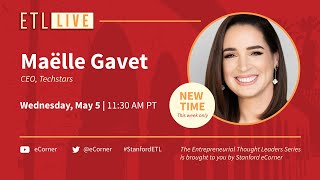
This content was created by GHION.AI . This content was uploaded by GHION.AI . This is a YouTube video titled "ETL Speaker Series: Maëlle Gavet, Techstars" from May 6, 2021. It features a discussion between Toby Corey and Maëlle Gavet, CEO of Techstars, as part of the Entrepreneurial Thought Leader series at Stanford. They discuss Maëlle's career, her book "Trampled by Unicorns," the role of technology in society, and her vision for Techstars. The conversation also covers topics like leadership, empathy in business, and the impact of global experiences.
Chapters
All right, we're live on YouTube. Hey everybody, I'm Toby Corey and I'd like to welcome you to Entrepreneurial Thought Leader series presented by stvp, which is the entrepreneurship center in Stanford School of Engineering and Basis, the business association of Stanford entrepreneurial students. Today I am super, super stoked to welcome Mael Gavat to etl. Mael is the CEO of techstars and the author of a really, really intriguing great read called Trampled by Big Tech's Empathy Problem and How to fix it. Wiley2020. Now she founded her first business at 16 and then went on to start two other companies. She's been a senior executive at numerous very large tech companies around the world, including Ozone, the Priceline and Compass. Gavet has appeared on Fortune's 40 under 40 list and Time magazine's list of 25 top female techpreneurs. And she's been named a young global leader by the World Economic Forum. And not only one of the most creative people in business by Fast Company, she's also one of the most competitive people on the planet. So, Maya, let me welcome you, welcome to ETL472.
Hi there. Very happy to be here. Yeah.
Have you had any tequila yet or are you going to wait till later today?
A little later today I have a tequila launch party. A friend of mine is launching a new brand of tequila and I'm very excited.
I'm incredibly jealous. Anyway, but before we get into techstars in your own career, I want to talk about this really incredible book that you just published which is called Trampled by Unicorns. And it's very critical of the impact the biggest tech companies are having on our society. We're all seeing it in every corner of planet earth here. But you also are leading a major tech accelerator, so you're obviously not anti technology. But can you start off by talking about what most excites you about tech driven entrepreneurship in terms of technology's ability to improve the lives and create opportunity?
Sure. So I'm going to start by saying not only I'm not anti technology, I'm actually very, very pro technology. I do really think that technology can and should make the world a better place. What I argued in the book actually was that tech is never all good nor all bad. And I see it more as a mixed bag of good, bad and ugly. And precisely because it is or can be such a mixed bag, I believe that tech entrepreneurs and leaders in general have a responsibility to focus on the good and what they can do to improve people's lives. And what is magical about technology is that it scales and tech can solve problem that other approaches in the past, other industries cannot solve. And so when you look at things, I don't know, like climate change for example, regulation is not going to be enough. We are going to need technical solution. My point in general is that it shouldn't be an either or, it should be an end. So we need regulation and I'm sure we will be talking about it in the next few minutes, but we also need the technical solutions. And so when I talk about entrepreneurs at techstars or outside of techstars, what I talk to them about is you have a choice. You can do good, you can do bad, you can do very ugly. Stop pretending that you don't have a choice and certainly stop pretending that to make money you always have to be on the side of the bad and the ugly because you can do a lot of good and build a really awesome business.
Yeah, so it's just a quick follow up on that. Do you think that the kind of current tech climate is just a legacy of something 20 to 30 years old and you see it a new awakening? What kind of reaction have you been getting to your book? It was really an incredible piece of work that I think opened a lot of eyes.
So what has been interesting is that I could compare it to the very first article that I wrote. It must have been now, seven, eight years ago. That was for Wired, and at the time the senior editor of Wired asked me to write an article about a conversation we had at a lunch table around data regulation. At the time I was already arguing that self regulation wasn't going to work, that tech companies were aggregating more and more data, and that that was going to be a problem problem for individuals, problem for society, problem for democracy, and that we really needed to get ahead of that and start regulating. So what's interesting is that when I published that article in Wired at the time, I got a bunch of phone calls and emails from my peers at other companies being like, are you crazy? Like you're going to kill your career if you continue to be as vocal about it. And my reaction was it too important. My career matters for sure, but my life as a human being and the society in which my family, my friends and the people I know evolve are significantly more important. And by the way, I think we can combine the two again. We can have a great career and have great values. And so I now compare that to the reaction I got when Trampled by Unicorns came out And I was getting ready for the worst. I had basically told my family, maybe I'll go, I'm based in New York. And I was like, maybe I'll go back to France, because especially Americans are going to label me like a socialist and basically kick me out of the country. And my peers at tech companies are going to refuse talking to me after they read that. And I got the exact opposite reaction, which really surprised me and to this day makes me really happy, which was people saying, yeah, yeah, we definitely need to talk about how we can build a more human focused, more empathetic tech ecosystem because we're not making the positive changes, we're not having the positive impact that we thought we would have, and we got something wrong.
And at least with your book, we're starting not just to talk about the problem, we're also starting to talk about the solutions. And so the reception was overwhelmingly positive. And so I'm still in New York and I'm still talking to my friends in tech.
Well, honestly, I so applaud you on so many levels. One, just having the courage to speak truth and to help illuminate and open up eyes to better opportunities. I think you're a bastion for altruism and it reminded me of what you're doing here on the tech side of what I think Jacinda Arden was able to put together in New Zealand, which was the world's first well being budget, which, yes, GDP is really important, economic initiatives are really important, but we can also walk and chew gum. And I look at these companies, Patagonia is one of my favorite that can actually like employees love working there. Investors have been handsomely rewarded and they're a full B corp. And to this day they've contributed over $90 million off their balance sheet to contribute to environmental activism at the grassroots level. So I just think the writing's fantastic. You also give very detailed solutions to these problems and I just applaud all your work. So on the other side of things, your book also diagnoses a lot of problems with the big tech. But when you stand back from all the individual challenges you've explored in the book, are there one or two problems that you see as particularly like, really deep and really troubling?
Yes, there are a few, I would say, at a macro level, because as you pointed out, I do speak about a lot of individual challenges and individual problems that exist throughout the tech industry. But if we take a step back and really talk about a macro level thing, I would say there are two that for me are Deeply ingrained challenges that I'm hoping we're going to make progresses on. But I don't know if we are as much as I think we should. The first one is this deeply ingrained belief, especially in Silicon Valley, that governments are useless and that self regulation is the only way to go. And I find the idea incredibly dangerous one because self regulation has never worked for any industry ever. And the almost hubris that goes with that, this ego that goes with oh, we're different, we're going to be able to self regulate ourselves. And this idea that democratically elected governments are something that we should be ignoring feels to me incredibly short sighted in particular because if you look, I have a humanities background, I studied history and philosophy and these kind of things. If you look at what has made Western societies so successful, my view, my interpretation is that it's been this really good balance we've been able to find, especially I would say over the last hundred years, between entrepreneurial capitalism and democratically elected governments that were pushing a certain vision of society and a certain vision of life and implementing guardrails and, and this balance, which by the way wasn't always easy to keep, but that, that balance that we have been able to maintain in different ways in Europe versus North America, but still is what has allowed us to create such prosperous societies, in my opinion. And I think we find ourselves in a place right now where a lot of tech companies have been arguing for a really long time, though they're starting to change a little bit. Their I've been arguing for a really long time that they can self regulate and that governments are just making so many mistakes, which I find particularly ironic when you look at the number of massively destructive mistakes these same tech companies have been making. And so there's almost like an idea of there are two different set of rules for tech companies which should be allowed to iterate and make mistakes and learn from their mistakes, and another set of rules for government that should get it right from the get go and shouldn't be allowed to iterate. And if you allow me, there is another problem I think which is actually touching on what I've just described, which is this deeply ingrained belief. I don't even know if it's a belief because I'm not sure it has been expressed in a way that people understand that this is how we operate in tech, is this idea that we can test our way out of problems. So this famous AB testing approach that most tech companies operate with, where you have a problem and you test two solutions and you look at which one gets the best response and then you move into the next one. And so you ab test every decision that you make, which in theory is amazing. It looks like we don't have to use a lot of brain juice, let's just test stuff. The issue is that it basically implies that we're going to make a lot of mistakes until we get to the solution. And more importantly, assume that it's absolutely okay to use human beings as guinea pigs. The tech industry is the only industry that runs tests on billions of people without any control. And we as tech leaders not only are comfortable with that, we are actually proud of it. We're like, look at how many tests we are running in parallel to make sure that we get to the same to the right idea. And so to me, like these are two very deeply ingrained issue around self regulation and this idea that it's okay to test, to use human being to a B test everything. We would probably be in a very different position right now if we had earlier on had conversation about whether these two beliefs are the right one.
Yeah. So thinking about what you're outlining to me, what it sounds like is that society in general just gets stuck in dogma and just thinking on a very single track kind of mode. We're seeing it certainly here in the United States. Politics is so broken, it's so divisive because everything starts with what divides. Everyone gets in their camp. And I think on the entrepreneurial side, we've had this one format, so to speak, of like, hey, go build enterprise value, show incredible growth, a great business model. And then all we really care about is discounted cash flow and some multiple off that. But I think as you sort of look at the next generation of entrepreneurs and think about the societal implications of technology, entrepreneurship, what sort of advice and guidance and sort of what can you share with us about how to think differently, how to think more creatively. You can actually walk and chew gum, you can create great companies, you know, while at the same time we can actually give back to and take care of some of society's biggest challenges.
Yeah. So I think you need to start by thinking in terms of and rather than.
Or.
And I think that's what you've just mentioned, which is rather than be like it has to be this side of the solution or this side of the solution, thinking more in terms of and and this applies actually to this conversation around can a company be both a force for economic and social good? Not economic or social good. There's a study that I like very much it's starting to get a little outdated unfortunately, but it's still in my opinion very relevant. It was conducted by a man called Raj Sisodia and he worked in particular with the CEO and founder of Whole Foods. And he looked at companies that he considered as them as conscious company. And the way he described consciousness has a lot to do with what you're talking about, which is what is their stated purpose, what is their. The generosity of compensation was there for the employee, the quality of customer service, but also investment in communities, impact on the environment. So basically the social good, the social part of good. And he demonstrated, and again as I said, a little outdated because it's. He looked at data from 96 to 2011 and I wish we could have a much more recent study on this, but he demonstrated that over this 15, 15 years these companies considered as the most conscious, based on what I just described, outperform. And these were all public companies. These companies outperformed the S&P 500 index by a factor of 10.
Wow.
I want to start by saying stop thinking in terms of you have to choose between being a successful company and being a socially good company. I think there has been too many myths, especially in tech, especially when we look at some of the companies that made the headlines in the media. There's this false choice of the only way you can be number one in tech, the only way you can build billions, billion dollar companies is by ignoring your social impact and just focusing on growing at all cost. And so start by changing your mindset and look at the data and convince yourself that actually being good for the world and being good for the communities around you is actually good for, for business.
Yeah, yeah, I think, and I think too, but just by highlighting that you. It's not a single track solution where it's just about building enterprise value. There's more that can be done. So tell us a little bit about your career to where, from where you were to where you are today is quite extraordinary. So you started some companies, you've been advising companies. Now your techstars. Walk us through that journey because my students, our students are incredibly intrigued about, you know, how you got from point A to point B and what that journey looked like and you know, additional advice that you could share. It's really fascinating.
I'm not sure about extraordinary, but I appreciate it. I will take any compliment. That's, that's one advice I can give to anyone is just take the compliments as they come. You usually don't receive anywhere near enough Anyway, so just pick them. So look, in terms of career, I started as an entrepreneur. I built my first business when I was 16. And frankly, there was no big mission. It was just I needed the money. I was a little nerdy and awkward and I wanted to buy some cool clothes and shoes. And my parents was what you would call your typical low middle class parents. So we didn't have a lot of money for all these things. And I just built a business because I wanted to be able to have the latest shoes and a lot of clothes. And it gave me a taste of entrepreneurship. It gave me a taste of what it means when you actually change things and people around you. And I liked it so much that then I went on to building a second and a third business. I also very quickly realized that I was really not equipped to build big businesses.
It's going to come.
It'S going to.
Come out as very different than what you probably have heard in Silicon Valley where like you're supposed to drop out of high school or university and like go and build the next $10 billion company. My experience was that it kind of helps when you know how to build a business case. It kind of helps when you know how to read a P and L and a balance sheet. It kind of like there's a ton.
Of things that you can actually learn.
In school that will make you a better business person. And so I didn't want to go back to school. No patience for that. And so I did the second best thing. I joined a consulting company. So I joined bcg, spent six years, loved it, then decided that I loved it a lot.
But I still wanted to go back.
And build a company. But something else, something else appeared on my radar. I ended up joining.
A company called.
Ozone, which at the time was a small e commerce company and is now one of the largest e commerce company in the world.
It's based out of Russia.
I was their CEO for a few years. So I became an executive for Haier. And I did that, as you mentioned earlier, I did that for Ozone. Then at the Priceline Group, which owns OpenTable, Kayak, Priceline, Booking.com, et cetera. Then I did that at Compass, which just went through ipo.
So that was the third phase of my career.
Then I decided to take some time off to write the book we were talking about, which was something I really cared a lot about. And then in January, I joined techstars as the CEO.
Yeah, that's fantastic. So one of the things that students love, especially here at Stanford, is learning about Mistakes, because that's where some of the world's greatest life lessons can be found is. Obviously most people want to talk about all the great rosy stuff that happened, but there's a lot of potential first time founders and entrepreneurs out there. Could you share with any of them both a combination of mistakes and advice that you give them of kind of lessons learned the hard way and what wisdom you can impart?
Yes. How much time do we have? I got a few, I would say the most impactful mistakes, meaning the one that really, really made it hard at some point to be sure that I would be successful, were always people related mistakes. Anything from when I was very young, my second business, I was 23 at the time. So I, for example, I decided that I needed to because I had very little time and I should be focusing only on my senior team because the junior team didn't matter. Guess what? When your junior team goes on strike because they hate the way you treat them, you can't run your business anymore. So like thinking about your team globally and thinking about the fact that even the most junior employees actually do bring value to the table, and that may not be the value that you see immediately because you do not interact with them all the time, I find to be a very common mistake, one that I definitely made in the past, but one that I see very regularly. This idea that somehow people are disposable and that the more junior they tend to be, the more disposable they are. I've seen that over and over again with a lot of founders and I think it's a terrible mistake because again, like you're only as good as your team is good. And then the second mistake, again very people related because at the end of the day everything is about people, is also one that I made which is to believe that to build a great company you have to have a great product.
And that your focus should be on the product rather than the people.
Who build the product.
So it's back to the people thing and it sounds kind of obvious, but the reality is most founders, especially the one with technical backgrounds, have a natural bias towards, and especially in tech, have a natural bias towards I need to build the best product possible. So they will get very passionate about how to build the best algorithm or how to do a proper build a proper UI ux. And they will not spend that much time talking about how do you recruit the people to build this product, how do you engage these people so that they really want to build this great product, how do you make sure that you coach them, mentor them, develop them, how do you make sure that you exit them also in a proper way when they don't meet expectations? And so you, you tend to see first time founders, especially in tech, very focused on the product rather than the team in the way they allocate their time. And in my view, that's a huge mistake. Look at your time, look at how you spend it. You should be spending as much time, if not more on the people who build the product rather than on the product itself.
Yeah. So let's finish up on this final question and then we've got a whole bunch of questions that are queuing up and we'll turn it over to the students and we'll start, I'll let you start, start taking and answering some of their questions. But I think what your body work demonstrates to me and any sane person is one, you have an incredible growth mindset. I think number two is that you've just been an incredible producer and your work product speaks for itself. And then three, I just think having courage, conviction and an incredible sense of altruism. But in order to get to where you're at, there's no way you did that without having really strong leadership skills. And we're talking to hundreds and hundreds of students out there, like what advice would you give them about how to build leadership skills and how did you go about doing that and what advice would you share about that? Because that's a really important point that a lot of traditional venture capital firms kind of gloss over. Right?
Yeah. There is no. I wish there was a silver bullet and like you do that and then that's it. I think you have to be an eternal learner and work with people and be very open about your strengths and also your weaknesses and stuff that you don't know how to do. But if I had to, if I had to try to summarize it, I would say in no specific order, study, study. Servant. Servant leadership. I think there's a ton of literature out there that talks about how you can be a servant leader and how you can actually work for your team rather than having your team work for you. You learn to use the word. Thanks a lot. Try to use it more than you feel comfortable with because that will pay you back very much. So build your network. No one ever succeeds alone. Anybody who makes you believe that somehow they were this kind of genius that managed to make it all by themselves is either lying to you or incredibly self centered and to the point that they're blind to the world around us. Like, no one succeeds alone. So build your network, have friends around you, take care of your family, make sure that you pay forward and you give first. That's how you build a network that will help you be the leader that you want to be. And then the last one, that one I'm going to tie back to my book is I used to say be empathetic and then people started misinterpreting it as like, be weak. I'm not advocating you to be weak in any manner or form. So I would say be ruthlessly empathetic. And what I mean by that is being empathetic is about trying to understand the impact of your decisions on people around you, on communities around you. It doesn't mean that you shouldn't be making hard decisions. It just means that you need to see around the corner, you need to be, to have a, hopefully a 360 degree view on what is it that you're doing so that you can take into account really the full impact. And so be empathetic, but be ruthlessly.
So, yeah, that's really, really great advice. All right, let's turn it over to. We're never going to get through all these questions. You've busted our cue here, which is no surprise. But let me start out with one that I often get asked from a number of college students, especially at Stanford, about career decision, right? And like, do I start my own company? Do I go work in a consulting company? Do I do this, do I do that? So the question basically is in tune with that. How has your early career as a consultant helped your current work at an accelerator? And would you recommend consulting as an initial line of work leading to a career in tech entrepreneurship?
It depends. Which is usually the answer. I hate when anybody answer my question by saying it depends. But it really depends because every individual is different. To me, it was invaluable. I consider BCG to be my, my first business family. I consider, I consider BCG as the team that helped me think through difficult problems. They taught me how to ask questions and then they taught me about how to formulate my thought in a structured way and how to start with what we call the pyramid principle, where you basically start with your hypothesis and then you manage your whole process of validating your hypothesis through that. And I don't have the time, unfortunately, to explain it, but this is something that people who are not, who haven't gone through consulting don't fully understand. And it's probably one of the most powerful thinking framework that I had the pleasure to use.
Or the pleasure to be taught.
So for me it was incredibly helpful. At the same time, I will tell you in the spirit of transparency that when I left BCG after six years, it was a massive culture shock to go back to the real world, as I call it. For example, six years at BCG had convinced me that once you put a Gantt chart in front of people, of.
Course they're going to execute and of course things are just going to happen.
It doesn't work that way at all. And so I think you got to be careful, which is why I wouldn't advise everyone to go to enjoying a consulting company. I had spent many years being an entrepreneur before. The six years I spent at BCG were incredibly useful for me to structure my thought and things through problem. And then it took me a good 6 to 12 months to go back to the real world and a lot of support and mentorship from people around me that actually who actually helped me go back on track. So I don't think it's like a.
Pure black and white answer.
Yeah, okay. I think what also intrigues a lot of our students is you have just a tremendous amount of just kind of global and international experience and perspective. And one of the questions that came in was what are the biggest cultural differences between work workplace in Russia and the US and how do you adjust your approach leading companies in different countries? So I would just say both obviously spent some time within the Russia tech ecosystem and how does that contrast that to the U.S. and kind of on a global level, are there lots of differences and how do you parse that?
So funny enough, if you go into most tech companies in Silicon Valley and you look at their engineering team, there's a very high chance that in the top three nationalities represented, you will find Russia. So I don't know if there is as much. If you look at pure tech teams, I don't know if there's as much difference as many people think because the American teams are actually very Russian in many aspects, then look, they're different. Every country has some very specific cultural traits. And so that's back to my empathy thing, which is approach every, every culture, every person actually as their own island. Approach them as an interesting universe made out of like their education, their personal experience, the way they were wired when.
They were born, how their brain was.
Wired and how they process information and process the motion and process everything that that's happening around. And then try to think about how what you do will impact them and how they will process what you are doing. Saying in front of them. And so I want to avoid the cliche of like, the Americans are that way and the Russians are that way and the French are that way and more. Go back to work on your empathy. Work on understanding how people are funding. Every single person around you is pretty different from you in many, many aspects, and try to include that into your thinking much more than, hey, this is how the Russians are and this is how the Americans are. Does that make sense?
Yeah. Yeah. I think that's incredibly insightful. So one of the students wants to wade into a hot topic here. So I'll discuss the need of ethical oversight boards in the business world. Looking at Facebook's often controversial oversight board, which made an interesting ruling today, what does she think is done right or wrong there? And is Facebook's oversight board effective and should it be implemented elsewhere?
All right, thanks for the question.
All right, let me.
And that got upvoted, of course.
All right, so let me try to answer that in the most, in the clearest way possible without being too controversial. I think fundamentally, in a company where the decision power, the real decision power, like the way the voting rights are being allocated, when that decision power is extremely concentrated, I think it is very. It's an illusion to believe that some kind of board, consultative board, has any kind of real power. So I would start with that, and.
I'm sure you will be able to.
Read between the lines. The second thing I would say is nevertheless, having instances made of, and I talk about this in the book, having instances that gather people from different backgrounds, people with technical background, people with philosophical background, people with historic, basically humanities background, etc. So diversity is something that I would encourage actually more and more companies to do, by the way, not just tech companies, because I do think that from that diversity of thoughts come challenging questions and challenging thoughts which are way too often ignored by the leadership of these different companies. I'm going to give them the benefit of the doubt often because just they are not. They don't have this thought being given to them. So I think having this kind of board or organization is actually useful. Now, I'm under no illusion that for that to be actually helpful and really helpful, the leadership then needs to take this into account and do something about it. And so in this particular situation, I will refer you to my point number one, which is this felt a pretty truthless institution, in my opinion.
Yeah, I think, and I agree because I often, you know, Apple and Steve Jobs, you know, very interesting background, he was obviously an incredible creator, but I know that when he first started that company, their whole mission was all about thinking differently. In order to do that, like companies that were building microcomputers back in the 70s would hire two types of people. Either you can like write firmware and solder chips on a PCB board, or you can write software code. He went out and looked at the humanities, he studied calligraphy, he hired artists and musicians. And I couldn't agree with you more. It's bringing that diversity in to thinking differently and broader, where you're going to get the best ideas and the best opportunity for interaction and collaboration. So I think you're super spot on there. This is a really good question here and I'm curious to know your answer on that. So you attribute the general data protection regulation to the shift in startup leaders policies regarding empathy in Europe? Since Americans are far more neoliberal, where does she expect to see change, if at all in the American entrepreneur's mindset? Is public policy the only manner to strong arm tech giants towards empathetic policies?
This is a very smart question and clearly someone who read the book very much because usually the feedback I'm getting is the moment where there's two chapters in the book about regulation and it's like hardcore regulation chapters. And usually when I talk to people it's very clear that they read the book with the exception of these two chapters and then like they move into the next thing. So a couple of elements of answer. The first one is as you read the book, you know I am not advocating for full on top down, let's regulate technology out of existence kind of approach. I'm advocating for balance. I believe that again in society where we have democratically elected government, the key here being democratically elected. When we have democratically elected governments, they have a role to play in terms of giving guardrails and protecting the values we care about. In American society, security is a value that matters a lot more than privacy. It would take us much more than 30 seconds to talk about this. But if you study history you will see that over and over again. While if you look at Europe again for historical reasons that we won't have time to explore European society value privacy way over security, again there are nuances, but et cetera. And that is reflected in the type of governments we elect. And it is reflected as a result of that in the type of policy that these different governments implement. But I do think that in general government have an absolutely critical role to play in making sure that the values that we as a human society, which is different in the US and in Europe that these values are being implemented and protected and strengthened. And so I do think that in the US the government, as the population is getting more and more aware of problem with privacy and usage of data, the government in the US is starting to feel the pressure from the people on the ground, from us, basically, and they're starting to get more conscious of it. So that's one. And I understand that. I'm pretty sure a lot of you are looking, listening to that and saying, God, she's naive. So let me talk about the second part of the answer, because I'm under no illusion. It's not because suddenly the American people just woke up to the fact that Facebook and Google are misusing their data, that suddenly the government is going to start regulating them. There's another aspect, which is dominance over the tech space. And understanding that because Europe took the lead when it comes to regulation, for historical and cultural reasons that I mentioned earlier, we are now in a place where, ironically, a lot of American tech companies are following European legislation when they build their products, including when they build products that are then given to the American people. Now we're talking about a conversation that is much more at the geopolitical level and economical level of like, who is actually defining the principles and standards of the big tech giants of the world. And I doubt very much that the US Is going to be comfortable having Europe deciding what are the standards that are going to apply to tech companies. And so the significantly more cynical answer to your question is, I am very happy that Europe took the lead and pushed much more stringent regulation around data privacy. GDPR was in no way a perfect legislation, but it had the merit to exist and to start pushing some really important topic. By the way, it was very much copied by California, and that's awesome. Please copy. But I do expect that over time, things may be changing and that the American government may actually feel the need to be much more in the driving seat. So I expect changes to come mainly from that. That and obviously your strong voice when you go and vote, make sure that you elect leaders who care about the topics that we're discussing right now.
Yeah, I think that last point is incredibly, incredibly important. So since we're on the swing of kind of international talk, another question that's come in. What do you think are the most valuable skills and experiences that you've developed from working globally?
I think working globally in a way forced me to develop empathy, because the first time I worked outside of my home country, France, I came with this idea that the people in front of me without really never thinking about it. I expected that the people in front of me would be exactly the same and they were not. And so in a way, my international experience was like a forcing mechanism to accept the fact that I had. Every time I was talking to someone, I had to take into account that they were, as I mentioned earlier, they were an island in themselves. And I needed to, if I wanted to work with Russian people, with Indian people, with Chinese people, I had to stop, really listen to what they were saying, really try to understand where they were coming from, really work on understanding the cultural and historical context to actually be able to work with them. And I've done that so many times because I lived in so many countries that it kind of forced me to develop empathy because otherwise there was no way I would have been able to work in all these countries. So for me, that was the biggest learning from all of that. Definitely not one I was expecting to learn when I started, but one that was just given to me.
Yeah, yeah. We got time for one final question and I'm going to ask this one. It's going to be about techstars. Before I do that, I think the most important thing that you communicated on today's ETL lecture series was the fact of, I just think knowing that the book that you wrote could have led to a no career at all. And I just want to applaud your conviction and your courage and really speaking from your heart and your conscience to do what's right. Because I think doing right will always prevail. Even knowing that it could have been incredibly detrimental. And I think by challenging the status quo and painting, sharing new ideas and a new vision for the future, I just think is so important and perhaps the most valuable lesson that you've imparted on our students today. But with that, I know you've only been there, I don't know, maybe 100 days or so, but what's your vision for Techstars in part two? This is our final question in part two. What advice would you give to students for how they could better prepare themselves for an opportunity at, say, at techstars?
That's many questions in one.
Let's talk about your vision. So I know you're early on in there, but I'm sure you've already kind of have started to see some things begin to emerge. But overall, where do you want to take it?
I think techstars is going to be.
One day the largest investor in high growth company globally. And I think that techstars is Going to change the way venture capital operates by making it more inclusive, more socially conscious. Not because it's the right thing to do, and by the way, it is the right thing to do, but because it's actually good for business. I'm a capitalist. Like, I believe this is the best system as humanity we've been able to come up with. It's not a perfect system, but it's.
A pretty good one.
And it's the best we have. And I believe that in a way, we don't need less capitalism, we need more empathetic capitalism, more global capitalism. And so for me, techstars has this opportunity because of the model and unfortunately we don't really have time today, but because of the actual model of techstars, the way as an investment business, the way we have, we create competitive advantage. The way we support founders, the type of founders we can support and invest in, we have the opportunity to change the way the way venture capital operate in this very narrow, extremely Narrow Way. Like 0.05% of startups get venture capital money. The billions and billions of dollars of opportunities that are missed by VC because they tend to fund over and over again the same founders is staggering to me. And so that's what Techstars is going to do. Ask me in 10 years. It's very ambitious. And I've seen some people looking at me like I was crazy when I started talking about it, but.
I have.
A good feeling about this.
Yeah, well, it's the crazy people that think they can change the world that actually do. So the last part of that question then is let's wrap up on this. Are there any good advice you give in terms of how to better shape ideas or how to focus on getting the kind of market validation or what kinds of things can they be doing ahead of time in preparation for potentially approaching techstars?
Talk about your ideas. What I've seen over and over again is like founders feeling like their idea is precious and something that they shouldn't be sharing with the world because someone is going to steal their idea. I can tell you with 99.9% certainty there is always like the random example.
But like 99.9% of the time what is going to make you successful is not the idea, it's the execution. And the only way you're going to be able to execute your idea properly is if you talk about it so that you get as much feedback as possible. As many people involved in it who going to share with you their wisdom, their experience. And so if you Remember only one thing of everything we talked about. First, study servant leadership and empathy. That's the big idea. And then the second big idea is that if you want to be an entrepreneur, don't treat your idea as this precious secret that you shouldn't be talking about with people around you. Do the exact opposite. Like, make everybody sick and tired of hearing you talking about your business. And test and test your idea with the most random people you can think of. Get out of your bubble. Talk to people with backgrounds which are so different from yours that they're going to look at your problem in a completely different way. This is how you're going to create magic. Magic comes from diversity. Magic comes from people with completely different backgrounds sitting around a table, virtually or not, and just looking at the problem and thinking, how the hell are we going to solve that?
Yeah, I think that's incredibly insightful because as we all know, I've yet to meet a company that had an idea that ended up being that actual business that they ended up launching somewhere down the road. And for those that buy into the process, that get lots of diverse points of view and, you know, like, when you're writing something, my guess is like, the first draft's not going to be good, but as you get input or you're an artist or what have you, it's really going through that validation process and getting lots of different points of view. And so absolutely awesome. All right, thank you, Myel, for a really awesome discussion. And to our audience, thank you for joining Entrepreneurial Thought Leaders series Now. Next week, we're going to be joined by Andre Iguodala of the Miami Heat. For you Bay Area fans, he spent some time at the Golden State warriors, has two championships, and Rudy Klein Thomas, founder and managing partner of Mastery, Inc. You can find that event and other events in this ETL series on our Stanford E Corner YouTube channel. And you'll find even more of our videos, podcasts and articles about entrepreneurship and innovation at Stanford Ecorner. That's Ecorner Stanford Edu. As always, thank you for tuning into ETL and have an amazing day and a really fun Cinco de Mayo.
More from GHION.AI


O processo de reconhecer limites, mesmo quando a vida parece exigir sempre mais.





Depois de tantas histórias, aprendizados e pausas necessárias, o @interior_iza está de volta



