ETL Speaker Series: Meirav Oren, Versatile
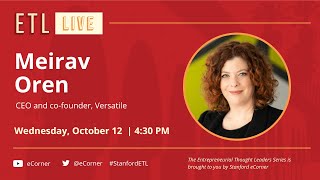
Meirav Oren, CEO of Versatile, talks about her path in construction tech, fundraising, and leading a company. She discusses the challenges of being a CEO, building teams, and what she's learned as an entrepreneur.
Chapters
Welcome everybody to the Entrepreneurial Thought Leaders Seminar at Stanford. Welcome YouTube community. It is great to have you as well as the extended Stanford community. I am Ravi Balani, a lecturer in the Management Science and Engineering Department at Stanford and the Director of Alchemist and Accelerator for Enterprise Startups. And we are so honored to bring you the Entrepreneurial Thought Leader Seminar which is brought to you by stvp, the Stanford Engineering Entrepreneurship center and Basis, the Business association of Stanford Entrepreneurial Students. This is the first time in two and a half years that we are back in this auditorium. I think it was in March of 2020 that we were here last maybe or even earlier than that. And it is so fitting that we are commemorating this shift to something new with a self identified non conformist Merav Oren. So I'm thrilled to have Merav Oren, the CEO of Versatile, here with us to kick off this new etl. Merav loves change and this is one of the most momentous changes that we've had in the last two and a half years. Merav is the CEO and one of four co founders of Versatile, which aims to turn construction into a fully controllable manufacturing process and make rapid data driven decisions that support job site productivity and safety. And Merav is going to tell you more about Versatile in a moment. Hailing from Israel, Merov is another example of amazing Israeli talent that the US has been a beneficiary of. And when she was growing up in Israel, she grew up with a strong interest in construction nurtured by her father who was a general contractor. And she advocates for the construction industry, which many may consider to be unsexy, but she calls construction innovative, forward thinking and worthy of the world's leading technology investments. She's a triple degree holder with a Bachelor's in Economics and management, a Master's in Law, and an executive MBA. And if that's not enough, she's also a former lieutenant in the Israeli Air Force. Mera spent 10 years in Israel at Intel, where she spearheaded biz ops and financial services and led international projects with multicultural teams. And then in 2011 she started her entrepreneurial journey leading several nonprofits and then sort of a precursor to Bristol, another construction company. And then ultimately in 2016 she co founded Versatile. Versatile has gone on to raise over $100 million in funding from funds like Tiger Global and Insight Partners. And also Versatile became the first construction technology firm that was named a technology Pioneer by the World Economic Forum. So without further ado, please join me in welcoming Merav to etl. So Mera I know there's so much that we want to talk about, but before we do, can you just describe to people what Versatile is or just give an intro, a quick introduction?
Yeah, Gladiator. I'm so excited to be here. I shouted it out. Like, two and a half years of not being in person.
Yes.
Oh, my God. So truly honored and thank you everyone, for joining us. I'll make your time worthwhile, I promise that. And yeah, if I had to introduce, first of all, like, just a couple of words, I'll start with kind of like what we stand for, right? And it's allowing people access to information at the end of the day. And I like to say to my team, we empower superintendents that happen to be the ones that build our world, everything around us. This building is relatively new, I believe, so someone was here building it probably not too long ago. Allowing them to control over their own processes in ways that they never thought was possible before is generally what we do. We do that through collecting a lot of data points in a very structured and repeatable way that allows us to truly tell the story of the job site and feed it back to our users in a way that they can act upon. So that's generally it in a nutshell. I'll say. And I'll say a word about kind of like the gap, I guess, of the industry, or what I perceive as the gap of the industry. We don't know how long things really take. Like, we don't measure. And if you don't measure, you can't really improve, can you? So I view Versatile almost as actuals on plan versus actuals, which is pretty much the basis of any improvement that I could think of. And that's kind of like what our solution looks like. And with that, I'll be done talking about Versatile other than the journey itself, which will bring it up a bit. Again, this is what the data looks like. If you want to make your users the center of your attention. They want to know that you've hit home in making things really simple for the people that you serve. So we make everything very easy to read, highly, kind of like digestible, as I like to call it. And we use the crane as a way to get the data out of job sites. And it just happens to be that that's our first product, and it serves that purpose of being deliberate in how we serve the construction industry, but it allows us to collect thousands of data points again and again and again. Translate that story, hand it over to superintendents at 5am every morning and those kind of like screens that you see on just behind me. And then honestly watch them shave off hours, days and weeks from their schedule, assume control over time, which is generally an unsafe time of the day, gain back, I don't know, five weeks. We're talking March of 2020. Some of our customers have gone into shelter in place just to gain that time back by controlling their process. So that's versatile in a nutshell, I guess. Yeah, we've gone on to raise just a little bit of money.
Just a little bit of money. Well, so I'm going to kick it off with some questions, then I'm going to turn it over to the students in about 15 to 20 minutes. So if you guys have questions, start thinking about them. Merav I wanted to start off with, I think one of the hallmark intuitions that all founders either have to hone or develop is figuring out when to listen to advice and when to say no to advice and stick to your own convictions. Now, I'm sure, and I've heard that when you were starting off, you know, people were trying to dissuade you from doing construction technology. It's not exactly the sexiest industry to go into or an industry that people that's known for, you know, being the birthplace of great tech unicorns. So can you share your perspective on when you should say yes and listen to advice and when you should go in the opposite direction?
Oh, that's a beautiful, beautiful question. And as you guys are kind of like at the earlier stages and I still remember it wasn't that long ago that I was probably in your seat and I'll start by saying always listen to advice. The part that I kind of like have a slightly different approach towards is do you follow advice and is that just doing what you're told? So I'll say listen to advice and never do what you're told and think the best stories I guess I can share around that would be to your point, construction isn't the most attractive industry or it doesn't perceive to be very attractive. I was told it's impossible. I was told that I couldn't raise money for a venture like this. And I think probably the best stories we just got a pre seed funding and I was getting a lot of advice from really smart people. These would be our first investors and they would constantly tell me what they think should be done. Now, probably being an Israeli as well, my tendency was to listen and filter and find my own path. And my own path is never do what they say. I'll say more than that. There are three partners, and the beauty was to actually connect what they were saying. And they. They never agreed. I don't think I ever heard the same advice from. From all three of them. So I would take that, and I would find a fourth way, which would be the versatile way, which would be my way. And I'm probably on the streets of San Francisco, and I get a call from one of those partners. I was like, you don't listen. You just don't listen. I was like, on the contrary, I do, but I don't do what you tell me to do. By the way, you guys never agree.
Just so you know.
And it was a defining moment, I think, in understanding that when people give you advice, they seem to think that you should just do what they told you to do. That is not advice. Advice is knowing to be in the backseat, to support, to tell you what I think, but always know that you know best. And that's how I give advice. Today. If I mentor anyone, I was like, I'm not in your shoes, and I'm not at the driver's seat, so I'm only going to tell you what worked for me or what I think, but that's it. A good advisor or a good mentor.
Doesn'T tell you what to do. So you always do your path.
Oh, my God. Yes.
You always create your own path, even if it's a slight modification. That's like a religious rule for you. And I think that is pattern matching. With many great founders now, Merav is sort of famous for asking for help and always getting it. Okay. And so I wanted to invite Merav to spill her secrets. Okay, can you share what are the secrets to asking for help and getting help? And what are the mistakes that you see other founders who ask for help and don't get it? Why do they fail?
Yeah, A. You're absolutely right. I literally get 99.9% of my requests actually delivered or fulfilled.
99.9% of things that you ask for, people will follow up on and do.
Yes.
Okay, so share, Spill.
Just about. Just about. So I'll start by saying everyone wants to help you. Like, even those advices that I was talking about, like, people really want to help. The entrepreneurial community is incredible. There's so many people that have been on this journey before me and before you, and they really want to help. The big problem is time. That's the one thing that we all don't have enough of. And when I was just getting started, I had time. But whoever wants to help me doesn't necessarily have it. And I remember just being extremely accessible myself. I would go anywhere that the other person would be willing to meet me at. I'd literally be time zone agnostic. I would meet anywhere, anytime, anyone that would be willing to help me. I would just make myself. I remove all constraints. And I think that's a big part of it. Another part of it. I'll tell you a story. So I'm a storyteller, so. And I think people learn really well from stories. So this is me pretty much at the beginning of our journey, mind you. Everyone tells me that I'm probably wrong and this can't be done. Like, I've heard a lot, but we've gone through Mass Challenge. I don't know if you've heard of the accelerator, but it's a great one. And we just graduated and we actually won.
Yeah, I think we'll get it figured out.
We won Math Challenge and the CEO of Math Challenge congratulated us. And I kind of said, I'm going to make it to Boston and then I'm going to ask for help. It's like anything you need. So I sent this email and I thought I was completely over the top. Like, it was a well structured but relatively long email that said, hey, I've done the research, I'm coming to Boston. These are the dates, this is what I need. And here is why I need it. And here are the people. Here are the, like, a little snippet of what I would want you to forward to these people. And like, I would really love for you to do this for me. I was specific. I did the research. I want to say a word about doing the research. And I asked for very tangible things. I knew he had the connections. And all I asked for is literally forward my email or forward the snippet to the person. And I explained why he delivered on all of those. And when I actually made it to Boston, he came out and he shook my head, was like, this is the best founder kind of like, help email I've ever received. I was like, I thought I was completely over the line. I'm like, no, because I really want to help. And most people will confuse me or will tell me, hey, please introduce me to investors. Do not do that. No one has the time to think for us, who's the right investor for us, who do they know? What is your business about? And why would that connection even make sense? So if I want to help, I need to know exactly what you're asking me to Do. So if I were to say, hey, I'm not even fundraising yet, which is what I did at the time, but I want to understand what it would take to get their money. And here's my question, and here's my why, Then they would know whether to say yay or nay to even the meeting itself. And if I don't have a product yet and I want to talk to customers, then again, I need to be very clear about the fact that what I'm asking for is to. To give them a glimpse of what the future looks like. And I was. I was kind of out there. I was like, they need to know what's coming, and that's what I have to offer in exchange for their time. And that worked like a charm. So today, when I get emails and founders do contact me for help, I think that's the first thing I say. Be specific. Make it easy for me to help you. And if you make it that easy, then people will help. Be specific. Do your research. Show me that you know exactly why you're even asking for my help and for my time. And chances are that I will help, just like everyone helped me earlier on in the journey and hopefully will keep helping me after I spill all my secrets.
Well, I think they will, and I think so. That's incredibly helpful and powerful. And on this idea of spilling secrets, can we talk a bit about vulnerability and leadership? Oftentimes, being a CEO can be a very lonely job, especially if you're doing something new and everybody's a naysayer and you sort of have this. There's an instinct to try to show strength, and yet, at the same time, some of the deepest, most powerful teams come through leaders exposing themselves in a vulnerable way. Can you speak to your philosophy about leading? Do you lead with vulnerability, and if so, what's your philosophy and approach and experience with that?
Yeah, I think it's probably a question to my team. I always kind of. I think leaders can always do better. I do my best to learn and understand, but wow. So transparency and vulnerability are hardly ever spoken of or touched upon, right? I believe I do. I think there's a right and a wrong in transparency, and it goes through understanding your audience. It's true for how you ask for help, I think it's like the way I personally operate. But if you take the same principles of understanding your audience, understanding what you're trying to give and what you're trying to receive, then using transparency in a way that allows people to understand your message, and then on vulnerability, I wouldn't say things like here are the numbers, just figure it out. I'll say here is what the numbers are telling us. Here's a story that I'm reading from these numbers. So I shared the numbers but not as a like okay interface. Just get it and hopefully you'll understand what they mean. I would usually use more of advanced tools of making sure people are along on the journey. Vulnerability once again, I'll probably share a story going back to I guess also why I started versatile and you mentioned my father. So yeah, I'm kind of like the black sheep of my own family because I went to intel that dad is a GC and my brother's a project manager. I shouldn't have done that. I should have been a superintendent. I came back to construction pretty much because of an accident on my brother's job site. He actually lost a worker that day and I kind of triggered the whole control over manufacturing. Give the power to the superintendents. Everything that we do today is pretty much triggered from a eureka moment that day about can job sites be controlled. And my dad is probably one of my best advisors and I've moved here, haven't seen him for a while, pandemics and all. And he actually came to visit when we were raising our cirrus B and he came and he left pretty much like this was a very short fundraise. I think he got here right about when we signed the term sheet and he left the day before we closed the round and I announced the round to our team internally a day after he left. And it's a moment of celebration. Everyone probably thinks that I'm super strong, right? Speaking of vulnerability. And I chose to share and I guess I'm sharing here too but I share that this was actually really hard for me because my dad is terminally ill and we're all humans and this would potentially have been my last chance of saying goodbye. And I was really busy closing around. So the reason I'm sharing this and the reason I kind of like realized that was to me that was natural. I didn't think of it as vulnerability or that this was just me sharing something with my team. I'm very open, but one of my team members sent me an email after the all hands saying, wow, I don't think you understood how incredibly powerful that moment was. And I didn't. But it made me think about vulnerability and about transparency and the things that you say and when you say it and how you show that you're actually human. So it's really hard to show that you're human. Because from everyone telling me that I cannot do this to raising over $109 million, 100 of those were during a pandemic in a, to your point, non sexy industry. And by the way guys, with a solution that actually is hardware enabled, SaaS software as a service like, very, very unusual, I must be good somewhat human and then somewhat not. There is a computer somewhere. The ability to show that, that it's okay is incredibly powerful. And my team actually taught me that by that email and by the responses that I got later. Because we could just be super strong all the time and have everyone think that we're super humans. Or we can say, yeah, we're doing things that no one else seems to have just cracked the code of just yet. And we're probably cracking some codes. Well, we also have a life, we have a family, we go through things and we regret not having time or not being able to say goodbye. I think there's a lot to say. There's more to be said about that.
Well, yeah, and I do think that when you humanize yourself, you give permission to everybody else on the team to be humans too and people. Hopefully the team coheres. I want to open it up for questions from the students. Are there any questions? And the way this. Just raise your hands and we will. The CA team will be bringing mics around and again your, your faces will not be on YouTube, but your voices will. But you're welcome to share whatever you can about yourself before you share gang. There, there's questions right here. You guys see this? Okay.
Hello, my name is Kasi. First, I want to thank you so much for your time. Recently I was doing a bit of reflecting on achievements and for example, I think a lot of us, Stanford is in a sense an achievement. And I remember before Stanford I would look at Stanford students as like, like there was a distinct gap between myself and the Stanford student. But then once I got here, I realized that I'm still fundamentally the same person I am from before. So I just wanted to ask, is success, is there something that fundamentally changes you once you go through success? Or is success kind of like a hub like Stanford is that gathers people with innate born qualities in them?
Wow. I view at least my personal journey, I always say, and I probably frustrate my team quite a bit when I say that. I always say that we're 2% done. If I'm 2% done, it might be too early to call success. But I think the journey changes you and different steps in the Journey should change you for the better though. I do my best to learn. Definitely hope that I pay tuition well. We're in Stanford, right? So if you make a mistake, it's only about what you learned from it. If you learn well, then the tuition was well worth it and you might be just one step closer to graduation. Ticker mark on yet another class. By the way, I'm also a dropout, but we won't talk about that.
Right? You can share, you can share. I think that's great.
My co founder, speaking of success. Right. So I do have three degree school out, but then there's one that I dropped out on the last class because I just, I was doing two degrees at the same time, two different universities working full time at Intel. Like I literally didn't know what train I was supposed to be on at any given time of the day. I was like, I'm just, I'm going to get back to that, you know, final class maybe in a year or two. And I never did. But my co founders always used to kind of like make fun of me saying like, we could still say you're a dropout in Silicon Valley. That's probably a good thing. Well, speaking of failures too. But no, I don't, I don't think success should change you. I think it should be taken with humility and with an understanding that there's probably new things to learn and if you've mastered one thing. I think I've said that it wasn't very long between our serious A and our serious B, for example. And I remember saying, wow, I think I've got this. And then it's probably going to be so different next time I go out there then maybe I, maybe I don't. Right. And count your success for what it was and seek for the next learning would be like how I would look at that. But I'm probably changed in many ways.
Thank you so much.
Hi, I'm Lara. So you mentioned that you're one of the co founders of your company. I just wanted to ask, how did you guys meet? What are your relationships like? You know, the different areas of expertise and what advice would you give in building a team to create a startup company? Building a team. Ask me again in a few years. No, again, constantly changing.
Right?
Small teams versus big teams. Founders would be a. I'm actually, I'm actually married to one of my co founders, so kind of like that. That would be the longest relationship. And I always say that that's a huge advantage because you've been through so much together you kind of like know how to power through crisis. The others was take the longest interview process. So one of my co founders was an introduction at a conference and he always said that I had him at a low. I actually argued that he put me through the longest interview process, sending me to, you know, his VC friends and all. But I knew I needed someone to kind of like translate the crazy scientist, I might be the crazy business person to a product language. So this was kind of like how we connected. And then the fourth co founder was a friend of the third co founder and was just the right person at the right time. So I think founding teams and teams in general is a point in time. It's like magic and it changes. Speaking of changes, it changes over time and the relationships evolve and it's a tough journey. So it really puts a strain on any relationships. And it's about knowing that something is right for you in the moment and allowing yourself to trust and to bond. Even if they weren't your best friends from kindergarten. Because I don't know many founding stories where everyone were like childhood friends. So there's a lot to be said about smaller or large, kind of like founding teams. I find four to have been a really good number. It's like a stable kind of like four legged table that you could put quite a lot of weight on it. And then over time it changes and you evolve and the company grows and it just really does change as the team grows. I generally look at startups as many projects. So the first two years and the second two years, if we could look at a company at a two year intervals and just think of everything as a project and people should come together over the project and complete the task and then we'll see what's next. And with that mentality you could form super strong teams without overthinking what's next. Because you never know in a startup anyways what's going to be next. So it's an interesting one.
So if a student is wrestling with whether or not somebody else should be considered a co founder, taking the leap and joining with somebody else as a co founder, is there any guidance that you have about when you know that somebody is a good co founder fit versus just a founding employee, what makes somebody cross that bar for you saying check this is my co founder?
Probably just the time. If it's really early in the journey, it's not an employment relationship just yet. You really need someone or you yourself just want to be a part of something that is so raw it hasn't even begun yet. And it takes so much building and so much willpower to create something out of nothing. It did not exist then. That's a co founder.
And can you share, have there been any struggles in having this co founder relationship? Because I'm sensing that over time. And are you able or willing to share any stories about the difficulties with co founder relationships and how you can still have good fights as co founders and stay connected?
Oh, just take it into a room and fight it out and walk out with a good disagreeing commit sometimes would be. Would be it really disagreeing.
Commit means we agree to disagree, but we commit to the decision.
Disagree and commit. It means eventually a decision has to be made and if we couldn't agree, then yes, there's got to be one decision maker. Even in a founding team, there's got to be one decision maker, mainly CEO. And then you walk out of the room as if you agreed. So whatever happened in that room stayed in that room and everyone else perceives that decision. And it's true for leadership, regardless of founding teams, the minute the decision has been made, it's final and you have to stand behind it. So think of a leader that goes back to their team and says, I didn't agree. I don't actually believe in this decision. Now let's go execute on it. I don't know, probably not going to work very well. If you say this is a decision, this is why we have to do this. And sometimes it involves tough decisions. Stop providing a service, kill a feature. People have worked really hard on something and you might make a decision to stop it altogether. You have to have that alignment. So yes, disagree and commit would be one of the challenges, not just in a founding team, but in any kind of leadership relationship. And it's hard. I'm not sure I have the code on that one. I can break the code on many things. Probably this one.
Not yet. But it sounds like one of your principles is, is that there is respect, that each co founder probably owns their own domain and they get to make decisions in that domain. But when there's conflict, everybody agrees that you or the CEO will make the decision. Even if they disagree, they'll commit.
Yes.
And you had that understanding from the beginning.
Yes. And if you ever lose that, then.
It'S time to separate and it's time to separate.
If you lose that, just separate it. You cannot continue without that trust and without that domain and without that disagreement.
Correct other questions. Cas, can you help pass the mics? We have a bunch. Yes, Hi, I'm Aman.
I heard your little anecdote on how you're at a stage where you weren't ready to raise money, but you still wanted to speak to people and get a sense of how you might do that in the future, even if that was an if not so much as commitment. We often treat conversations like that as transactional, that when I come to you, you know, I expect something out of you. But clearly those people didn't know whether your startup was going to build up to something that they could invest in. So how did you approach those conversations at the start and during the conversation itself?
Conviction more than anything else. So always be selling, always be closing, but have your intent out there, right? So those early conversations were, this is what I'm building. What will it take for you to fund this? And by the way, most of them said, I'll never fund this in all honesty. And they offered me great advice as to why I should not be doing that. I remember conversations with investors that said, I would invest in you. You seem like an incredible founder. Like you would go through walls to build what you believe in, but not this construction thing and this hardware thing or whatever. Like once you pivot, come back. But having those conversations in a non fundraising setting allows you to learn really fast, super fast. But you have to listen. So. And again, since I wasn't there to say I'm asking for your money and the framework was very clear, some of them became my mentors and my advisors to today. I did not take their money, but they're my best friends or my advisors. I think that's actually how we met.
One investor that Jocelyn and Stanford alum love.
Call it serendipity and the way to open doors, but those conversations led to incredible things that you don't necessarily expect. Speaking of that, asking for help on that first kind of like email that I sent, I ended up in a conversation with a reporter on that trip and he offered a stage in this really important construction industry event. And boy, was I not ready for that. So lots of prep, but I took the stage. I think I could date so much of our current customers and relationships and how we built the business and how we built our trusted kind of like partnerships with our first customers to that moment of someone randomly accepting my request to talk and tell them what I was building. I got sparkly eyes that you have when you truly believe you're building something that's going to change the world and you don't care if no one else believes you now everyone believes me. Speaking of success. Right? Like, it's too easy. It's hard when no one does. And that's exactly where you should shine. Like, just go all the way. Don't do what you're told. Listen to advice, but don't do what you're told. And speak to investors that way. So another thing about fundraising, without spilling all my secrets, I think the moment between getting a ton of no's to getting so many yeses, it got confusing. Honestly, that's another problem. No one ever talks about what happens when you're oversubscribed and you actually have.
To turn down first World problem. We can talk about that, too.
Turning down shared term sheets. Anyone want to talk about that? That's a good problem to have, but it's a real problem. Uh, I think too many founders have the approach of, like, please give me money. Like, I really want my dream to. To happen, and I want to partner with you, and I want to kind of like, I need your money and I'll then build it. And my approach has always been. And I realized that later on, it's just in a natural way. I never really gave it any thought, but my approach would be, I'm building this incredible thing, and I'm going to build it with or without you. Like, you have nothing. Like, your response has nothing to do with it. And I'm offering this amazing opportunity. Take it, leave it. It's going to be your loss if you kind of, like, didn't take it. And I will build. I will build with or without co founders. I'll build without investors. I will build with or without a team. Like, don't build without King. By way, it's just really hard. But that conviction that you know what you're doing and you're going to build it knowing that things will change and it's not exactly going to be what you believed it would be. I think I said, I'm going to start in New York. We never. We're not even in New York today. Like, there's many things that have changed along the way, but I think I always had that confidence that I am building it. And that's how I approached investors, if ever was just for, like, what does it take to. To get your money when the time is right.
Terrific. Great. Answer other questions. I think there's some people down here.
Robbie. I'm gonna ask on behalf of the students tuning in online.
Oh, please. Sorry. Thank you, Mandy.
Upvoted question on Zoom right now is how have you dealt with evolving roles? Mine or others? I think The CEO roles evolve as well. Similar to what I said about the two year, kind of like tenure, if you, like, you have to look at things. And that's an advice I got. By the way, it's not originally mine. I wish I could give credit. I don't remember who told me that, but if you truly kind of like sign a contract for, well, not for real, but in a mindset of this is what we're going to do, this is the next milestone that we're going towards, then the roles evolve naturally. And also kind of like where disagreements happen, you know, they have to separate almost naturally. And then as companies grow, I believe there are more opportunities. So coming from intel and even as an Air Force commander, if organizations are really big, you could move people around. You could say, okay, this is not the right role for you, but maybe something else in a startup you need to evolve or kind of like get off the bus in the next stop. So it's. I think it's still evolving. That's. It's one of the hardest kind of like questions to answer because I think if you ask me the same question in five years, I'll probably give a different answer than what I would give today. But I just, I look at people and I look at the roles and I would try to make it work. And I guess.
And do you ever feel imposter syndrome when you go into a new phase? When. And this is sort of dovetailing off of the first question, when you began. If you were looking at Series B CEOs, I don't know if you vaulted them on a pedestal and said, they have something that I don't have. Is your experience now that you actually had everything at day one that you needed or when you go into each new phase, are you feeling some type of imposter syndrome or a need to develop skills? And if so, how?
Oh, God, yeah. Don't let that syndrome get the best of you. It's brutal and absolutely. I think everyone goes through this on one stage or another where like, oh, someone turns on the light and finds out. But yes, it's real and it takes different shapes at different stages. But I'll say something about, like, serious B founders or even like every time that I was at a certain kind of like, stage in the journey, I would look at the ones that have taken the path before me and I would seek their advice. Speaking again of that advice, I aspire to talk to people that have done things that I haven't done because it's kind of boring having the conversations about the things I've already achieved, it's great. But then I'm the mentor instead of the mentee and I take that role sometimes too. But I'm not intimidated by people that have taken their companies to steps and heights that I haven't just yet. So I think every time I try to find the next kind of person to talk to that have done things that I haven't done yet and I look back at like, oh wow, I did have people on a pedestal for the stages that I just marked down on. And that's the beauty of being told something is impossible. You look for those who have actually done that. I was like, imposter syndrome or not. Yeah, if they can do it, I can do it too. So guys, if I can do it, then you can do it too is what I'll say. And always look for someone that has done the things that someone else tells you is impossible and you might just get it right. I like to say that I enjoy the tick mark of done over tasks that were rendered impossible just like a minute before.
Well, on that I think I'm going to end draw to an end. Our first inaugural ETL in person in over two years. So everybody join me in thanking Mera. Next week we are in person back in Nvidia Auditorium and we have the CEO and co founder of Allbirds, Tim Brown will be here and as always, you can check out that talk and other talks and content by going to our website at Ecorner Stanford Edu. So thank you all for joining us and thank you Merav, again.
Thank you.
And if you guys want to join a rocket ship, check out Versatile's website. They have opportunities so check it out too.
Thank you so much.
More from GHION.AI


O processo de reconhecer limites, mesmo quando a vida parece exigir sempre mais.





Depois de tantas histórias, aprendizados e pausas necessárias, o @interior_iza está de volta



