ETL Speaker Series: Michael Tubbs, City of Stockton
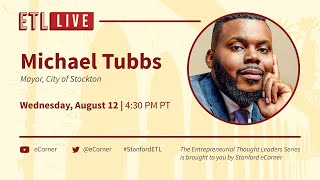
This content was created by GHION.AI . This content was uploaded by GHION.AI . This is a YouTube video titled "ETL Speaker Series: Michael Tubbs, City of Stockton" featuring a discussion from August 13, 2020, with Tina Selig, Faculty Director of the Stanford Technology Ventures Program, and Michael Tubbs, Mayor of Stockton. The conversation covers Tubbs' initiatives as mayor, including the Stockton Scholars program, Advance Peace, and the guaranteed income pilot. They discuss his approach to policy, community engagement, and his reflections on leadership and public service.
Chapters
Hello everyone. I'm Tina Selig, Faculty Director of the Stanford Technology Ventures Program, and I'd like to welcome you to our special edition of our ETL Thought Leaders Revisited presented by the Stanford Technology Ventures Program, which is the Entrepreneurship center at Stanford School of Engineering. Today we are completely delighted to welcome Mayor Michael tubbs back to ETL. A little background on November 8, 2016, Michael Tubbs was elected to serve as the Mayor of the City of Stockton and upon taking office in January 2017, he became Stockton's youngest and the first city's first African American mayor. In fact, Michael Tubbs is also the youngest mayor in the history of the country, representing a city with a population of more than 100,000 residents. Super impressive. In his first year as mayor, Michael Tubbs secured a $20 million to launch Stockton Scholars, which is a scholarship program that aims to triple the number of Stockton students entering and graduating from college. He also brought Advance Peace to Stockton, which is a data driven program that works to reduce gun violence in communities. And he also launched an incredibly impressive program, the public Private partnership with a seed money of a million dollars to launch the nation's first ever mayor led guaranteed income pilot. So this was super exciting. Before being Mayor, Michael Taubes served as Stockton's District 6 City Council person and he earned his Bachelor's degree at Stanford and received his Master's degree in Policy, Organization and Leadership Studies at Stanford Graduate School of Education. Well that is a mouthful. Michael, welcome back to etl.
Thank you so much for having me. So good to see you.
It's so great. Now first I want to wish you a 30 a happy 30th birthday. I know you had a birthday just recently and I must say you have done more in your 20s than most people have done in their lifetime. So in this talk we're going to do something special. We're going to both reflect upon your visit back four years ago when you came to Stanford and look to the future of what you're thinking about now. So we're going to play some short clips along the way and highlight some of the remarkable work that you're doing as Stockton's mayor. So I'd like to go back, take the Wayback Machine and start with a clip where you really talk about listening to your users and explain extreme users in your community to really understand what the real needs are. So let's start with clip number one.
But we started with what I learned at the D School to be known as extreme users. We started in one of the poorest housing developments in the city, probably not with a lot of voters. And we spent two weeks just knocking on every door there talking to them about their hopes, their aspirations and what they wanted for the city. But then talking to this extreme user group, the group that wasn't on our nation builder files, that won't show up on voter registration rolls, that we found our campaign message, it was really one about moving the city forward and that many communities had felt bankrupt for a long time, that the city's financial bankruptcy was only a symptom of a deeper bankruptcy in leadership, a moral bankruptcy and a bankruptcy of vision. And that's what we ran on. So everyone was talking about the fiscal constraints and bankruptcy. Really important topics but but for vulgar's they want to talk about what's the vision for Stockton.
Well that was super impressive. Okay. Even back then you were really using what you learned in school to figure out how could you address the real needs of the community. So who are the extreme users that you're talking to now in your community to help shape the policies that you're putting in place?
Wow, I probably should have watched my talk before this one, but that was great to see and I think a lot of that work has continued over while in my term as mayor. So to answer your question, the extreme users we're listening to now are a residents who are homeless and figured out sort of a sustainable solution to deal with the homelessness issue. That's a crisis in Stockton, as is in much the state of California. The other user group we've been listening to a lot are the guys most likely to be victims or perpetrators of violent crime. We spend a lot of time listening and meeting with them and do so about once a quarter. And then for the basic income pilot we listen to sort of Stocktonians who are one paycheck away for one $500 emergency away from really financial ruin. And I think, and again it's so refreshing seeing that clip because I think more so just the speech is really becoming embedded in how I and my team tried to make policies, particularly around kind of big ideas. It really starts with listening and figuring out sort of who are we designing said policy for and what exactly are the needs that we're trying to meet.
Yeah, it's super impressive. I mean it's funny in four years to think how much you were able to accomplish. Now you mentioned the basic income program that you put in place. I know that's been such a revolutionary project that a lot of people are looking to Stockton to get some insights. Can you tell us a Little bit about it. Some people might not be as familiar.
So one of the first things I did as mayor was identifying the issue of poverty and economic insecurity being kind of intersectional and the crux of a lot of issues we're facing in the city. So I learned about basic income through studying Dr. King at Stanford. He talked about this before he was murdered. And we decided to do a pilot called seed starting Stockton Economic empowerment demonstration. And I know Stanford students love to research. If you go to stocktondemonstration.org you can see all the data. But essentially for 18 months, we have just extended it for another six. We were able to give 125 randomly selected families that look like our city $500 a month. And what we found is that $500 is not enough to replace work or to make people stop working or to make Stockton not part of the United States of America. But it hasn't been enough to make work, provide an income floor, and to provide peace of mind and the ability for people to take risks. One of my favorite stories is from one recipient named Tomas, who told me that with his first $500, he went and interviewed. At first, I was dismayed when he told me that, but you're feeding to all these stereotypes. Why would you pay money to be interviewed? Tomas? That makes no sense. And he said, no, Mayor, I work hourly, which means I don't have paid time off, which means if I take time off to interview, that's $200 out of my pocket. And we live patient to paycheck. I can't take that risk. But with the $500, I was able to be entrepreneurial. I was able to take time off work, take a risk, better myself. And now I have a better job with more benefits, less hours. I'm able to do more with my kids. And stories like that have been so inspiring to me. And I think again, particularly during this time with COVID 19 and people unable to work or people being told, if you're coughing or have a fever, don't work. But also being told you have to pay your bills and don't have paid time off, our wages have increased with inflation, that I'm just more resolute than ever that we have to have some form of a guaranteed income and income floor, if not for everyone, for the vast majority of people, to allow people to build a resilience, but also to allow people to be entrepreneurs in their lives, to make decisions about whether to pay for the car loan, to pay for tutoring, to. To start that business. So, but it started with sort of a deep design session for a year with community groups listening. And that's what made me a believer. Tina is realizing that no folks know how to spend money. I could trust the people who I trusted to vote for me to know how to spend money. But a lot of it, again, came from listening and sitting with people in their environment to hear them tell me how they would use $500 before we even disperse any money.
So how did you pick $500? And how did you pick 18 months? Like, what were the. What were the reasons and the ways that you scoped this project?
I mean, we have real researchers who are PhDs who had some rigorous analysis, but from my layman's vantage point, we were able to get the million dollar grant. And we just did the math and we said, okay, well, we could do a thousand. We did $2,000, $1,000, $500. What we found was $500 was enough to get us to a longer period of time, 18 months, where there's some more rigorous conclusions could be drawn from the data because of the length of time we sell on $500 a month because one in two Americans can afford one $500 emergency. So I never just felt right, and it felt too big. $500, it's a lot, but it's not too big. And then number three, I literally sat in the back of the envelope and added up my Internet bill, my light bill, my water bill, my trash bill, and it was about $500. I was like, well, look, this is a good amount that will pay for a lot of bills for people. And so we sell on $500, which I think is great because we're showing that if $500 is beneficial and that's the floor, and anything more would be better. But at the very least, we know $500 will still matter for a lot of people.
Yeah. Super interesting. So you ran it for 18 months, right, and then did it stop?
No. So it was supposed to stop in July, but then in March, Covid happened. And we were hearing from recipients and others about how they were waiting for unemployment insurance, which they qualified for, which they paid into, which they still haven't received, and their bills kept coming. And that the $500 was their lifeline. It was the only thing that was keeping them afloat, which was very scary for me as a mayor of 300,000 plus people, where these people in the basic income program are fine, but what about the 300,000 other people I represented? How are they making it? And then Folks were saying that they needed the $500 because they're forced to quarantine, they're forced to stay home, they're not driving Uber anymore, they've been laid off. Their kids are home more now, so they spend more on food. It became very apparent that we had it will be inhumane to stop the program in the midst of a pandemic. So we're able to extend the program to January, which I think is important because we're able to do research around how basic income. It's not just in particularly important in times of crisis that the pandemic responds as a way to build national resilience. Economic security has to be a part of that. And now we'll have the next nine months to illustrate that. So we're going to continue to January. And then at the same token, two months ago, I started a group called Mayors for Guaranteed income, which includes 20 mayors, including the mayor of Atlanta, the mayor of LA, the mayor of Oakland, the mayor of St. Paul, et cetera, Pittsburgh, Philadelphia, New Orleans, who are all saying that we need a national guaranteed income during this time. And they're all going to do pilots, like we've done in Stockton, particularly because COVID 19 has made it very clear that we have to make sure people have the tools for the basics at least.
Well, it's so interesting because I want to play the next clip, which is very closely aligned to this, where you talk about the relationship between profits and policy. And, you know, should you let profits drive policy or do you make a policy that then you figure out, okay, here's a policy. But now we're going to have to figure out how to fund it and make it work. So let's watch the second clip and then talk about how you sort of tried to turn this around.
I'm extremely worried about my kid asking me one day, like, why, dad, in a time with all these technological advancements and all this good stuff stuff, people figuring out how to live on Mars and on the moon, and you guys had a black president, but people still had to go to the streets and tell people that black lives matter. I'm worried, I'm really frankly afraid about what happens when we let profit determine policy. And I think we've seen some of that with the private prison industry, where literally private prison corporations have helped write the country's criminal justice policies for the past 20 years. I'm worried at that we'll spend all our time and all our energy and all our smart on making cool products, but really forgetting about people.
Okay? So you have been totally consistent here in the way that you have been approaching your role. So how do you do this? I mean, how do you think about the role of financial support for the types of policies that you're trying to implement?
Yeah, well, I think part of it, Tina, is understanding that profit in and of itself isn't bad. The idea of making money and doing well isn't a bad idea. What is bad is that becomes the overriding rationale for policy. Like my job as a policymaker isn't just to make some people money. My job as a policymaker is to create the conditions where everyone can do well. And I think even now as mayor, I understand that so much more now that folks who have influence and folks who have access are able to influence policy in a way that not only drives profit, but also hurts people and also doesn't allow other people to enjoy some of the growth. So I'm not sure I'm answering your question. So what was the question again?
Yeah, just thinking about how, what drives, you know, how do you figure out what policies you want and then how do you figure out how to support them? Right. These things are very expensive. Universal basic income. In fact, I want to underline that because, you know, one of the questions that a lot of the listeners are asking about is how did you come up with the idea for universal basic income? And how did you even get support? So it's a perfect example. Like here's a big idea. How do you then garner support for something that feels so radical and expensive?
Got it? No, I think for me, for most things we look at as a team, is the status quo untenable? That's our first question, like, can we not live if this doesn't change? Will we feel like we failed if this doesn't change? If the answer is yes, that gives us the courage, the energy, the moxie to move forward with. Okay, then how do we find a solution that it's very worse, is a little bit better than the status quo? So we're making progress. So that's kind of the decision making matrix. Then once that happens, I was lucky enough on the basic income front to meet the Economic Security Project, one of the co chairs, Natalie Foster, an event for Tech for America in San Francisco. And we talked about how they had desired to do a pilot for basic Income. At the same time I had my staff researching tools to eradicate poverty and basic income rose to the top. So we're able in that way to do a public private partnership. And I tell people all the Time. Public private partnerships are great to test ideas because to your point about taxpayer dollars, even though we waste a lot of them on crazy things like space wars and things of that sort of, they're still a finite resource and we still should be as good stewards, mindful of how we're spending money. So public partnerships are helpful to test ideas. And that's what we did with the basic income program. 18 months we tested all films properly funded. And now with this group of mayors, measures for guaranteed Income, we're advocating for taxpayer funds. We're saying, okay, the idea has been tested. Now we have to scale it, because charity, as I think I said in that speech, is injustice. Programs aren't policy, and we have to incubate ideas. But then when we know it works, then we have to scale it. So to answer your question, part of it just comes from understanding how expensive the cost of inaction is, that if we don't do anything, how much will we continue to pay? And also just the idea that the status quo in many cases or in some cases just is not sustainable. It doesn't work. And as leaders, we are called to address those issues. You can't do that with everything. But there's 1, 2, 3, 4, 5 issues where you absolutely have to, at least to create this society that I would argue that we all deserve to live in.
I think it's a really good point, is that doing nothing is expensive. Right? I mean, if you're in a situation where things are really not working, it becomes very expensive to be inactive. So there's a question that a lot of people are curious about. Politics is very divisive right now. What is your approach to building coalitions to get meaningful things done?
Yeah, I think in Stockton, I'm lucky in a sense, because my council is four Republicans and two Democrats. I have to get four votes to get anything done. So anything we voted on. I've had to work with both Republicans and Democrats and some of the most influential people in the business community, my community, are Republican. So I think part of it is just understanding that you have to work together. That as someone who's a pragmatist at heart, who likes to get things done, I understand I have to work with people I may not agree about on 100 issues. If I agree with you on this issue, I will work with you and congratulate you and amplify you for your great work on this issue, while knowing we may have to fight about the issue tomorrow. So I think that's part of it. And I think for me, even though the policy is personal, the politics isn't, meaning that I am deeply impacted by the work I do. It's personal. And I try to be hard on policy but soft on people. So I try to go drive hard on this. What we need to do is what we need to do. If we have to disagree about, we'll disagree. If we have to have public rebuke, public rebuke. The next day realize I might need to work with you. So the next day say, bygones be bygones, let's figure out where we are. Can we agree on this issue? So I think that's part of it. I think part of it is also, especially at a local level, you could invest the time in relationship building because I think because of the diversity of Stockton, not just ethnically, but politically, I've learned so much about how my more conservative constituents, more conservative colleagues think about things or how they hear things. And I think it's maybe a more effective communicator, more effective messenger. And it's allowed me to consider issues from a different vantage point, which may not be my frame, even if I'll always agree with it. So I think it's been a useful kind of tool and skill. But underlying all this is this idea that I want to get things done. Like things have to get done. And you won't get anything important done, just working with people who agree with you all the time. You'll do some things, but for the big things, you need to have a big tent of people who may not agree with you again on every issue, but you found some common ground on this one.
I love this because although you didn't use the word empathy, you really talk about having incredible empathy for the people who have different points of view. And I'm sure you learn a lot from them. So I wanted to point out we have a number of people who've written comments about just how they're big fans of yours. One person said, I went to Stanford with you and, and I remember your commencement speech about growing up in Stockton, and I'm so impressed with what you've done. Another person said, I went to Stockton, to high school in Stockton before you were born, and to Stanford too. And I'm just so impressed. And this person wants to know if you're running for reelection, which I think you are.
Yes, I am running for reelection. 83 days to November. I'm looking forward to it and thank you for all the people, for the well wishes. It's so funny when I hear people say they were there for that convocation, I think speech that means you're four years younger than me, which makes me feel some type of way. But I appreciate it.
Great. Well, let's go on to the next video clip. So I love this one a lot because when you started, when you came, you were just beginning, you were just starting your political career and you basically talk about the fact that you didn't have experience and you had to learn from other people and the importance of really being a good listener and asking a lot of questions. So let's play clip number three about this and then talk about who you're listening to now.
There's a lot of pressure to feel like you're the expert, but I realized that not knowing everything has been so freeing because it's opened the door for me to connect with people who do have the answers. So it's been great to work on issues like poverty and realize that I have some Stanford experience and lived experience. But there are some subject matter experts who've been doing this work in this community for 25 years who may not have the degrees or the pedigree, but they know what they're talking about. It's been so freeing to say, you guys, you know what? I don't know. I don't know. I know that someone knows. So let's find this answer collectively. So don't feel pressured to know all the answers or have all the answers. Because part of, in my opinion, entrepreneurship and iteration is not knowing if what you're doing is going to work. It's the iteration experimentation that leads to knowledge. The knowledge is not already baked in.
Right. So I'm curious though, as you become an expert and get more experience, who do you continue to go to? And do you worry that if you go to people who've done it before, you're going to get the same old answers and as opposed to something fresh and new. So how do you gather new and fresh ideas?
Generally, I try to go to the people who've been doing it because even if I disagree or even if I want something new, for me it's important to understand what's working in the status quo or why something's the way it is. Because I found that oftentimes there may be a policy reason, an administrative reason, a grant report. There's a, oftentimes there's a reason. Whether you agree with it or not, there's a reason for a certain behavior or certain outcomes. I'm always curious for the people who are working, like, okay, why is it like this, because that helps me create different solutions which may look different than what I originally imagined. And then, number two, I think I still go to experts. So, for example, I was just appointed to the post commission for the state, so by One of the 15 people who determine police standards for the state of California. When the first or second largest police force in this country, and I'm a mayor, I've never went through police training. So I've had meetings with the community college chancellor who had overseas lobby training to hear where his pain points are. I've talked with my police chief about, what would you like to see better? I've talked with residents of my community, and I've also spent time with the center for Policing Equity, the nation's experts on policing, to understand from them, sort of on what needs to be done. And from all those inputs and then from my own research, I come up with kind of, okay, so I'm gonna advocate for. So I'm gonna push. I think I try to do that on every issue. I'm usually once a week on a call with someone who's a subject matter expert, a policy person. I'm Raj Chetty, who used to be at Stanford. I used to bug his office all the time, every time they issue a report. To understand, sort of with your opportunity index, what does this mean for Stockton? How do I operationalize it? How do I do it? So definitely still part and core of my governing philosophy is because I think oftentimes leadership is not about being a subject matter expert. It's about kind of using values to guide priorities, resource allocation, and just decision making. But that doesn't mean you have to know everything. You have to know sort of you should be smart, be able to read and complete synthesis. But you don't have to be the expert on everything, but you should be the expert at going to experts and people that understand what's happening on the ground and use their information and put it in conversation with sort of the values you have to kind of come to decisions and the benefit of all people in the community.
I love the idea of being an expert on going to experts. So that's a great line to remember. So we have a number of students who are really curious about how. How do you prepare to go into a life in politics? That they're saying what sort of skills and capabilities should they be developing if they aspire to go into a life of service like you?
I think in terms of service, number one, it's about service, which sounds very basic, but Dr. King talked about using a Conversation that Jesus had with his disciples about this idea of a drum major instinct. Intrinsic in all human beings is this desire to be the drum major, to be first. And he was saying that, and he was using this when Jesus told Peter and Paul, can't give you the left and the right, but the greatest of you should be the servant of all. And Dr. King interpreted that to mean that the drum major instinct in and of itself isn't bad. Like that idea of wanting to be first or wanting to be important, because it has to be connected to purpose, to be a drum major for justice.
Be.
Be a drum major for peace. Be a drum major for something. So I think that's the most important thing is understand, like, why do you want to run? What are you running for? And then what do you want to do? Because I think oftentimes people run with the idea of getting into office, but then when they get into office, they're unsure of what to do because they didn't really run to do something, they ran to be something. We need more people who are running to do something. I love that, because we have enough.
You know what, the wisdom that you're sharing is just wonderful. In fact, this next clip is one I think that is particularly powerful, especially for the students in the room. And you talk about the fact that you didn't intend to run for office. This is not. When you went to school, this was not your. And that it ended up resulting after some real big disappointments where the path you thought you were going to take got closed and some opportunity. You basically said, you know what? I need to do this. So let's play this clip, the fourth clip, about how the pains you experienced actually unlock the door to your passions.
So I told my mom, you know what, Mom? One day when I'm 30, 34, 38, 42, 50, I'll come back to Stockton and help out because the city really needs help. But then my senior year, I was applying for fellowships and jobs, and I didn't get what I thought was mine. I was an entitled Stanford student. I had good grades, I had worked hard. I had the best recs, I had the best resume. I thought for sure that was my job and my purpose in life, to be a Rhodes Scholar. And that's just what was going to happen for me. So I put all my eggs in that basket. And then it didn't work out for me. So then I remember being so upset, so hurt, like I thought I found my purpose. This is what I'm supposed to be doing. And now I Can't do it. And I start with that because it was in all these valley experiences, all these low points, whether growing up in poverty or losing my cousin or not getting the fellowship, that really clarified the path that I was going to take.
This is super important. So, you know, the idea that the lowest lows helped you unlock your path. So what. What allowed you to actually get out of that low spot? You know, a lot of people hit bottom and it's super difficult to get out. What was it that allowed you to get unstuck as opposed to becoming, you know, bitter and broken?
I think it's just my spiritual practice and just coming from a community of faith that speaks to sort of all things happening for a reason. And that even when bad things happen, part of the journey of being human is to unlock and try to understand what God, higher power, once you don't understand and learn from this experience. So that was super helpful just having a faith tradition that teaches that, like, everything's happening for a reason, even if it feels terrible. So it's figuring out, okay, how can this be used for a greater good? And then number two, I think, is realizing that as I think, as I said, rejection is just a redirection that you're doing everything right if you know you've done your best, that maybe the no was a good thing and maybe there's something else that's more in line in to what you shouldn't be doing. And the rejection was a way to get you there. Was easier said than done. I mean, I wasn't happy. I was upset. I felt like a failure. I felt dumb. Being a Rhodes scholar felt a lot safer, a lot more conventional, a lot more like, makes sense than, like, running for city council. So, like, even afterwards, the decisions to run for council wasn't an easy one to make. It was. It was pretty scary. But you always look smarter looking back. Like, looking back, it makes so much sense. But in that moment, you just understand that rejection also isn't permanent and that no one lives life. No one's life is one where everything happens the way you want it to happen, or everything happens the way you think it would go. And that the best things happen. Actually when you're rejected, when you face some resilience, you have to figure out how to get through. When you look back, like, oh, wow, I'm so happy I was rejected.
You know, I love. Again, your line about rejection is really about a redirection and using thinking like, you know what? I'm probably. I'm not going in the Right direction. That's a message assign. So there are a lot of people who are pointing out, and this is very critically important that we are living in a very unusual and very special moment in time where the nation is grappling with racism and inequality. In your position as mayor, what do you recommend to aspiring students who really want to help build systems that are actively anti racist and foster more equitable society?
So for students who want to.
Yeah, people who say, I want to contribute to this, I want to make a meaningful contribution. This is something that I feel driven to make a powerful. Help make powerful changes.
Yeah. Well, I think first of all, it's understanding that this is a marathon, not a sprint, meaning that we're talking about 400 years of a history that we're confronting with nihilistic. And it doesn't mean we don't need to push and demand, but that's mean we need to be realistic and understand that this, we have to take care of ourselves and have a strategy for the next 50, 60, 70, 100 years. Number two, I think with Stanford comes immense privilege. And I tell people all the time, don't apologize for your privilege, but put purpose to it in a big way. Put purpose to it is to allow other people who may have more experience, who may actually be very equipped to work on the issues you want to work on seat next to you at the table. I think one of the things I'm conscious of as mayor is making sure I bring as many people in with me to the table because I know that I'm able to get there because I went to Stanford, I'm the mayor, and they may not, although they're more impacted by what happens than I'll be, because my privilege insulates me from a lot of the insidious impacts of bad policy. Oftentimes, number three, I would say be educated, read, read, read, learn, listen so you're equipped. And number four, understand that no matter where you go, because what we're talking about in terms of racism, white supremacy is ubiquitous, Meaning that it's not just in politics, it's not just in policing, it's in every institution in our country, which means when you're in the tech board room where you're creating your startup, where when you're like, no matter what you're doing, you have to actively make sure you're fighting against and not perpetuating the systems you want to change. And then we also have to acknowledge that for some of us there's real benefit to the current system and to understand that in Changing these systems, you may be giving yourself less privilege, maybe giving yourself less authority. You may be giving yourself less opportunity to drive the agenda and be comfortable with that, because that's part of this process is understanding that so many folks have been excluded, marginalized, meaning that we bring more people in. You might not have as large a slice of the pie as you may be used to enjoying, which isn't a bad thing. But I just want to be really realistic about this. What we're talking about, we're talking about bringing more people in, expanding opportunity, and giving the ability to lead, the ability to be part of the conversation to folks who have traditionally been left out and marginalized, which means some of us have to shut up, some of us have to be quiet, some of us have to listen and lead that way.
So that was really helpful. I mean, I think that we probably have to listen to that many times over and internalize all those insights and recommendations. This leads us actually to the final clip that I want to share is one where you talk about the difference between charity and justice and how important is. I mean, when I hear this clip, I hear that charity is important, but that's in the short term. You really need to make some really systemic changes. So let's watch this clip and then talk about, you know, in this moment in time, what is the balance of need for charity and justice?
Charity is what we do, and it feels good and it's important, but justice is the hard work of surgery, of what it takes to. To move the country forward. And then I also think that in terms of my own work, that charity is me throwing resources at an issue and making the assumption that the problem is one of resources. If they had more of this, if they had more than that, if I give to them what I have, then that solves the problem. But justice is really about putting myself, my brain, my resources, my talent, my time in my body and on the line in a way, until we really get at a solution. And that's not sexy, that's not easy, that's incredibly difficult. But that's the only way we as a society will progress, in my humble opinion.
Okay, so that is a strong statement. So what do you think about? I mean, I'm sure you want people to donate and give money to the initiatives that you're running, right? That might feel like charity. If you want me to write a check. Okay, so I think you want people to do that, but then justice is longer term. So can you talk a little bit about the balance between these two?
Yeah, absolutely. I think charity is necessary, but not sufficient, that charity is important to do, because as we work for these larger structural changes and ideals, we have to deal with the problems of today. So charity isn't a bad thing. I think charity becomes adapting when that's all we do. And the underlying conditions that gave rise to need for charity aren't addressed. So I think, like most things, I like to have my cake and eat it too. It's like a both. And so I think charity is something that's necessary and that's that charity is not bad. It's necessary, it's not sufficient. And charity is a great entree into justice work. Because in giving to charity or donating to charity or helping a charity, you're implicitly acknowledging that something's wrong, that I'm doing more than I should be doing, or I'm giving more because this is not right. So then the next step in terms of justice is to ask, why is it not right? And it's usually some underlying structure or policy reason that gives rise to need for charity. And I think with that rigorous questioning and analysis, we can all hold ourselves more accountable to do charity, but to make sure our charity goes further. And the best way to make our charity goes further is that it's in service of justice. And we understand we're giving dollars, we're giving resources, we're helping who we can, while at the same time pushing and advocating and voting in a way that brings us more aligned to a day where our charity is not needed anymore.
Interesting. So this leads to one of the questions that's been asked by the students, which is they're studying entrepreneurship and they're saying in ventures, we learn about business models and competitive strategies. How does this translate into politics? Like, what's the business model that underpins the things that you're doing? And maybe is the business model a combination of charity and justice? How do you think about that?
Yeah, I think like, charity is like making payroll, but justice is the reserves, and particularly in time. We know the economy goes like this. If you're just barely making payroll every quarter, you're not going to be successful business long term, you're not going to be able to pivot when things like COVID 19 happens. I think it's the same way for a society that we have to make sure at the very least we make payroll. But that's not enough. We can't invest in new technologies, we can't invest in new pivots. We cannot withstand storms if all we're doing is paying Payroll. So I think charity is payroll, but justice is the reserves necessary to be able to pivot, to be able to invest, to be able to research and to try and to iterate. And you can't do that if you're just barely paying people their hourly rate, wages or their salaries.
So there's a question about, especially in this very unusual time, are you seeing more community led, sort of bottoms up change as well as tops down city led? Are you seeing more diversity in the types of groups that are getting involved with helping to make change in the community?
Yeah, I think that over the past four years, particularly now, people are saying that even though we like neurotub, he's our guy, we have to also be part of the conversation on driving change. And all the answers can't come from city hall or can't come from one person. So during COVID 19, a lot of initiatives like Stockton Strong, which is a group of the community coming together to provide mutual assistance and information to each other. The San Joaquin United, which is a group talking about how to hold our county government accountable for delivering services to people during this time, has really reflected an idea that the community understands that they too have a role to play, that they too have to lead and they too have to push. So absolutely I've seen more community led leadership and also very diverse members of our community. There's this discussion one of the groups had about women of color in Stockton in leadership and highlighting their work and some of the barriers they face. So actually proud of the way that's been progressing in the city.
Great, well, obviously great progress. There are a number of people who are very curious about your long term political aspirations. I'm sure people ask you all the time, you know, do you aspire to hire office, governor, president? I think you're starting to get a following here. So what do you think about this? Or are you really rooted just in Stockton right now?
No, I definitely think about the future. Excited. I'm running for re election but I think in 2024 I'll be termed out as mayor and then there'll have to be a conversation with my wife about sort of if the sacrifices, if the amount of time and energy invested in the political world, is it worth it? Because there's a lot of ways to make a difference. I spent a lot of my time talking to philanthropists, for example. I spent a lot of my time meeting with organizers and advocates, for example. I spent a lot of my time talking to business people for example. And they all had media people, they all have Incredible influence in terms of shaping culture, of bringing resources and providing opportunity. So to answer your question, I'm not sure long term what office or if any office I'll be in, but I know I'll continue to work on the issues I talked about four years ago and I'm still talking about now, and namely, how do we create an opportunity structure in this country that's reflective to what we say on paper, that we really believe that all people are created equal, that we actually do believe that everyone has inherent human dignity. And if that's in the government role, I'll do that. But if it's another role, I'll do that as well. So open to title, but very clear about vocation. That's just to create a better opportunity structure in this country.
Really. Thank you for that. The idea is it doesn't matter exactly the title, but you're going to be working on having an impact on your community. So I would like to sort of take the Way Back machine, you know, we looked four years ago. But let's go back to when you were a student. You know, what do you wish you knew? It's not that long ago. What do you wish you knew when you were, you know, sitting in the classroom watching people give talks like this? And then let's flash forward a little bit and then what do you wish you knew when you started in politics, you know, what sort of insights have you gained over those years that would have changed your trajectory in any way?
I did a fairly good job of this, but I wish I had knew more explicitly just how much college was about the classes I took, but more importantly about the people I met and the relationships I formed and forged. Some of the. I met my wife at Stanford, met Evan Spiegel, one of my closest friends, who's been a great partner in the work in Stockton at Stanford, met some of my best friends at Stanford, but had no idea going in that the most important part of college would be building relationships with as many people as possible. Because in 5, 10, 20, 30 years, these are the people that help shape the world, right? So I wish, I think I did a fairly good job, but I wish I had spent just more time being intentional about spending time with people. Not in a weird networking way, but I just want to build relationship with all the folks I can because these are the people who are going to help create the world that we'll live in in terms of my time as. And also I'm glad I was a nice person because I realized people have long memories. So to all the students watching and listening, treat everybody well. You have no idea when you'll need somebody, when somebody will come up at a dinner. Conversation with somebody will be a gatekeeper where you someone needs someone is a key to a connection. And people remember how you treat them. So don't, don't be weird, don't be a jerk and treat everyone well. In terms of the beginning of my political career, I wish I had learned that change only moves at the speed of trust. So you can have the best ideas. But if you don't spend time in community building trust and rapport with people, it'll be very difficult to face opposition. And also the fact that even when you're doing well and doing things well, you have to go back and report to your people because what you're doing up here may not be felt on the ground or understood on the ground. In that environment, chaos and misinformation could spread. So I wish someone had told me the importance of this over communicating and saying things over and over and over again about the things we're doing so that there's a common normation and common narrative that the community could work with.
Well, I love, you know in every one of your answers there's some comment you make that I just want to get written down and put on a tattoo. I don't know. This one is change happens at the speed of trust. Honestly, I think that's something we should all remember that without that trust, you can't make things happen. Michael Mayor Tubbs, you are a true inspiration. I know that our team at Stanford, the students who have looked to you as an inspiration, the community that watches so inspired by you and what you've done in a few years really sets the bar high for all of us to make really, really positive change in the world. So thank you so much. I know you have so much. Oh, I want to point out there's an amazing HBO documentary about you. I just watched it last night. It was riveting and fascinating. I highly recommend it and I understand that it is first for the next month, free streaming. You don't even need hbo. You just go. Do you go to the HBO site? How do you find it?
Go to hbo.com or use Google stockdom on mine. HBO. It'll come up. And I think it's incredible that they're showing the story of the city for free for a month. So I'm thankful to them for that.
It's really, really empowering and I'm delighted that the whole world gets to see and hear about your story. So thank you so much and wishing you all the best. We are here cheering you on. Count us as part of your team. Thanks so much.
Thank you. Thanks for having me.
Thank you so much.
More from GHION.AI


O processo de reconhecer limites, mesmo quando a vida parece exigir sempre mais.





Depois de tantas histórias, aprendizados e pausas necessárias, o @interior_iza está de volta



