ETL Speaker Series: Michelle Zatlyn, Cloudflare
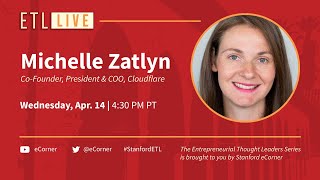
Ravi Balani interviews Michelle Zatlyn, Cloudflare's co-founder and COO, about starting the company, the challenges of entrepreneurship, and mental health. Zatlyn discusses what it takes to build a successful tech company from the ground up.
Chapters
Before we introduce our speaker, Welcome YouTube and the Stanford community to the Entrepreneurial Thought Leaders Seminar. I am Ravi Balani, a lecturer in the School of Engineering at Stanford and the director of Alchemist and accelerator for Enterprise Startups. And ETL is brought to you by stvp, the Stanford Technology Ventures program and basis, the business association of Stanford Entrepreneurial students. Today we are delighted to welcome Michelle Zatlin to etl. Michelle is the co founder, president and COO of cloudflare, an Internet security, performance and reliability company that is on a mission to help build a better Internet. Michelle is also another testament to how America is the beneficiary of outstanding Canadian talent. Michelle was born and raised in Canada, went to McGill, where she got her bachelor's degree in chemistry for all you chemistry majors out there, as well as business, and went on to do everything from being an economic research analyst to marketing to being a product manager before she came all down to the good old United States for business school at Harvard. And she got her MBA at Harvard. And at Harvard she also met Matt Prince, who is going to be her future co founder on this wild journey of starting Cloudflare.
And.
And at the end of business school, she also worked at Google, did a stint at Google, and then at the end of business school in 2009, she founded and started Cloudflare with MAP. Twelve years later, now Cloudflare is a $21 billion company with over 1800 employees and Michelle is still at the helm as the CEO, which is very rare to have a founder for that full arc. So please join me in welcoming Michelle. Michelle, lots of virtual love and applause from you from the broader YouTube and Stanford communities.
Thank you for the warm welcome, Ravi. And I will say I do a lot of speaking and that may have been the best, one of the best introductions I've ever been given. So maybe you should just come with me all around and you can just do that again because that was good.
Oh, I'm happy to. I'm happy to. Well, thank you, Michelle. Let's interview's over. We're done. Okay. So Michelle, but I will say that it is very rare for us to have a founder. I mean everybody. Now Cloudflare is like this public, darling, poster child of entrepreneurship and you're, you know, it's a $20 billion plus company, but it's rare for us to have a founder who's been there when it was just two people to now when it's 1800. And so I want to start especially for all the aspiring founders out there to Go back to the beginning, to what it felt like when you were actually starting out cloudflare. First of all, I think a lot of people say a chemistry business major who's now the COO of a major deep cloud infrastructure company. Did you always have this vision that you wanted to be the head of a cloud infrastructure company or a web infrastructure company? Or how did you know that you wanted to take the leap and start and be a founder of cloudflare?
Yeah. So no is the answer. I did not always know that one day I was going to run a cloud infrastructure company. I guess that should be encouraging, I hope to many of you. But then it leads to, well, then how do you know? And how did you kind of discover it? And I think the second part of that is I'm a big believer that opportunities appear for everybody, often at all sorts of different frequency and times, and those sizes and the quality of the opportunities vary. And sometimes you just have to go for it, I guess is the short answer. But no, I had no idea. I, you know, I, I grew up in a small city in, in prairies, the prairies of Canada. And I didn't even know what tech entrepreneurship was when I, when, you know, way back when. And I studied chemistry because I wanted to be a doctor. And I just kind of kept, my world kept getting bigger and bigger and I was really curious and I just was like a sponge. I wanted to learn. I kept seeing, oh my God, you can do this, you can do that. And I just kind of. My world kept expanding and that was great. Life is a collection of experiences. Go collect a lot of them. So I was collecting a lot and at some point I was doing my MBA at Harvard Business School and I met this really super smart serial entrepreneur, Matthew Prince. And Matthew always talked about something that he had done before, a project. He had a hobby, a side project called Project Honeypot. And he always talks about it over and over and over again. We were classmates and finally, like after a year and a half, I said to him, Matthew, you always talk about Project Honeypot, what is it? And he went on to describe that it was this open source, community based project that helped track web spammers online. I said, okay, how many people had signed up for this? He said, about 80,000 small businesses. And I thought, wow, 80,000 small businesses signed up for this. And I kind of said, how do they hear about you? You have no budget, no one knows what you're doing. How did 80,000 people. He's like, well, they talk about it. And I was like, what do they get for being part of Project Honeypot? And he said, well, they help track web spammers online. And I was like, okay. And then what do you do with that? He's like, well, Project Honeypot goes and work with law enforcement agencies to take these spammers offline. So we basically have this banter. And at the end of it, I was like, I don't understand why this thing exists and why anyone signs up for it. And at this point, he kind of went from being gracious to frustrated with me because, again, I didn't know a lot about the space. And he said, one day they want us to create a service that helps protect them from these cyber attacks. And that was a big light bulb. I did not know a ton about the space, but I did know something that whatever I wanted to do next post my post graduation was I want to be part of something where I was really proud of the work that the team did and what the work that the company did. That was a litmus test for me and this idea of, well, if we could help make the Internet safer, whether you're an entrepreneur, bring up an idea or a developer with a side hobby project, or a small business or a Global 2000, I would be really proud to work on that. And it was just this curiosity, and that now has turned into Cloudflare, which is a publicly traded company. And I know a lot more today than I did 12 years ago. But it was that conversation and seeking to understand where the light bulb came off. And I didn't know on day one that's what we were going to turn this into a company, but I wanted to see where it went. And that leads me here today with you, Robby.
And what a beautiful journey it is. But just to be clear about that, because I want people to understand what it feels like. In the early days, you didn't need to have certainty that this was going to be a $20 billion company. You just needed to have enough to know that you wanted to turn over another card and lock arms with Matt and jump in. And what made that clear for you was this part of it sounds like was an emotional sentiment that you were going to make the world better. And part of it was just. Just classic, you know, customer validation. When you're getting these proof points back from your customers, even though you might not have been a tech, you know, a web infrastructure expert.
Well, you know, this is actually a good point. So I was a student, and it was actually really easy to pursue this idea as a student. Because it became something we did for school credit. It became a side like it was instead of taking a class, I signed up to do this special, you know, study with Matthew. And the deliverable was to write a business plan and enter the business plan competition. So so instead of taking a class for credit, so we got the luxury, it was a real privilege to explore this idea for school credit, which I needed to graduate. And so I think that's why some really good ideas come from students on campus because you have the luxury to do these sorts of things, especially if you can sign it up as a special project that you can do for school credit. It gave us a cover. I didn't have to quit a job, I didn't have a job, I was a student. And I think that that is different. That's why a lot of people who have full time jobs maybe do things on the side because those are much harder decisions. And so we had that cover to say, let's just go explore this. And what really happened the next three months was the following. The first month, I just remember kind of this again, back to curiosity. World kept getting bigger. The first was this huge we are good to business school students. So I mean, I wouldn't just go do something because you want to do it. You want to do something that makes an impact, in my opinion. And so the first aha I had was, wow, there is a huge problem here. And the way that I saw that was we did a survey to these 80,000 customers that they had trying to understand I didn't know a lot about the space. And I remember I went and did this survey and the survey asked questions like a typical business school student asked, saying, how much do you care about this problem and what are the solutions you're using today to solve about this problem? And we sent it to 150 small businesses or 500 small businesses. We got 150 people replying, which is a high response rate. So that was proof point one. So clearly a lot of people responded. This was an engaged community. And the comments from there, you know, there was the quantitative where people mark things, but it was the qualitative answers that gave me this huge aha. And the quality of answers are things like, web spammers are the scourge of the Internet, they're criminals and they belong to being in jail. Web spammers make me believe in the death penalty. Now you don't need to be a cloud infrastructure expert to realize, holy smokes, there is a huge visceral pain point here. So like that Was the first aha. Okay, so there was clearly a problem. The next was part of the survey was like, what do you use to solve it? And all of these small businesses had no good solution. They were all using band aids, like Band Aid, Homegrown Solutions. So the first aha was clearly there's a problem. The next aha for us was well, could we come up with a solution to the problem? And this is where the technical solution and being a differentiation like really shone through. And we were really inspired by what David Ulovich was doing, open DNS, how he was helping deliver a better experience on the consumer side, the user side. We said, can we use DNS? We don't have to get into the technical details to do this, deliver security for the business side. And that was a huge aha. It was kind of a shift of where businesses were buying hardware to do this and small businesses couldn't afford the hardware. Could we create a cloud based solution? And we were again right at the perfect time in history and retrospect to start a company like cloudflare. There was just a huge shift happening and we happen to kind of stumble upon, wow, there's a problem here. We there is a way to deliver this as a service that not only makes it accessible to entrepreneurs and small businesses, but if we do a really good job over time, big companies too. So that was the second aha that we came up with a technical solution. So that was month two and then month three is. As a business school student, you gotta be like, is there a business here? I think it's one thing to have a problem, another way to have a solution. Can you build a business around it? Which is something hopefully we'll talk more about. And again, you don't know. We could have proved that out, but we assumed yes. And it was those three things that by the time I graduated, I had another great job lined up. It was hard to walk away from that. Actually. I remember it was at LinkedIn. I went to LinkedIn's campus down in.
Not Sunnyvale, but Mountain View or something.
Thank you. Gosh, it's like I haven't left the San Francisco borders of San Francisco. So I'm anyhow down in Mountain View. And I remember I was sitting in the cafeteria talking to this person who was supposed to be my boss. And I said, you know, thank you so much for the offer. And this was. LinkedIn was small. It was way before it was going public. They were growing like a weed. I was excited to go there. And I said, I have this idea we want to see where it goes. I'm going to go pursue my idea instead of come here. He looked me straight in the eye and he said, you were making the biggest mistake of your life because they were a rocket ship. And you know when you're offered a seat on a rocket ship, you don't ask which seat you get on. And I kind of said, and most companies fail. And I said, I get it, but I got to go see. I have to see where this leads. And so it was not super clear, it was not easy, but those were my steps along the way. And if you ask Matthew, his were different, his calculus was different. And so I guess I like to tell this story because it wasn't super clear. I kind of fell more and more in love with the idea. And even when I decided to do it, I still wasn't sure. It still took a few more months after that before I was really sure. Okay. I was like, oh, wow, we're really doing this. But. And so I think that people go through different processes and that's okay. Sometimes I think you read these stories and you think, oh, wow, people wake up one day with the best idea ever, and then the next day they built a hundred billion dollar company. That's amazing when that happens. But not all stories happen like that.
I think it's very humbling and refreshing. It's like fumbling into love. Like it's a cascade of steps. But what I think is interesting is that in that short period of time, in three months, you sort of hit through that syllogism of classic product market fit. Like you got to product market fit in three months. You validated that there was a huge pain point. It wasn't a vitamin, it was definitely a painkiller. You validated the approach and you validated that it was a great market. Now I understand, Michelle, that. So you have, you say no to LinkedIn. You have all these beautiful badges, you have your Harvard mba, you get funded by Venrock. Uh, and then I understand that even if we fast forward three or four years later, you, you've already raised a few rounds of financing, you have quite a few millions in the banks. Can you share with us how you're feeling at that moment in time?
Sure. Sorry, I. You know, it's so interesting.
This is a bit of a. Yeah, yeah.
Well, it's. I was going to say, you know, it's. You want to be careful. You don't re. Re. Rewrite history, I guess is. Is what you want to be careful of. And I sometimes I think back to, we came to the Valley in 2009, the summer of 09, but we really kind of launched our service to the world in September of 2010. So we kind of consider that the start of Cloudflare's history, even though we were working on it, but that's when we launched it, people could sign up. So September 2010 is kind of the date. And if you'd had me on the show in 2015, I mean, we were less than 200 people. We were a success. And I would say that back then I used to ask myself, I don't understand why anyone does startups.
And let me just take a pause here, just because I think this is so refreshing and this is such a great sentiment because we don't get this expressed enough in 2015. You're five years in, you have 200 employees, and you've raised how much money at this point in time, do you remember?
I can't remember, but I mean, for sure, I mean, I think. What was it? I mean, a lot. 100 and some. $120 million. Like a lot.
So you are likely from all of your peers who are looking at you, they're thinking, man, Michelle, Michelle, has she just. She chose, right? She jumped on and she's living the dream. So unpause. But can you express how it actually feels, how you were feeling if we talked to you in 2015?
Well, if you talked in 2015, and what I would have said is, I don't understand why anyone does it, because it's so hard. There are so many highs and lows. And now as I've zoomed and kind of have even more perspective, maybe the way that I best characterize it today, or maybe is useful to this group is I think if you. There are lots of ways to start companies and there are lots of different types of companies. Interested? My husband's an entrepreneur and he is a kind of cash flow positive, hasn't raised any money, profitable company, small team, but we were always swinging for the fence. So I guess this is kind of a swing for a fence point of view. And I think if you're going to start a company that swings for the fence, and by that I mean if you're swinging for the fence, when I was starting, a billion dollars was cool. Now that's not cool anymore. I think the bar has been raised to $10 billion market cap. And what was good enough keeps going up because the opportunities get bigger and it's easier and all these sorts of. Some things are easier. But anyway, my Point back to what I was saying. If you're swinging for the fence, which we were, we have been from day one. We kind of knew Cloudflare was either going to be a big company or not exist as a company for us, like a small or medium sized company just never really made sense for a bunch of reasons. We could go through another. But the, my point of view on this is if you're swinging for the fence, the first two to five years is really hard. Like it's just and, and why it doesn't. It's not the money, it's how do you get the talent. How do I convince all the engineers that are listening to this call to come work for a 100 person company it to be the founder makes a lot of sense. Even be the first 20 employees makes a lot of sense. You get outsized equity grants. But like in between there's so much risk and there's so many things that don't work out. It's so hard to convince people. And most people wait, it's like, well, come back to me once you've gotten to $100 million revenue run rate, which is usually after five years. Some companies do it faster. We're in a B2B space, so that's kind of made sense. And so it's hard to get people who really have done it before to come work for you. So you're in the space where you need great talent to come work for you. But the proposition doesn't make a lot of sense to most professionals. They're like, I'm just going to wait till you're a little bit further along where it's de risk more and I'm going to get paid the same. And it's hard. There's so many things that go wrong. Actually, Tom Eisenman, a professor from Harvard Business School, he was our advisor, he just wrote a book about why startups fail and he actually quantified all the reasons why companies actually lose steam. And most like just because you get to your Series B or C stage, which is where we were, a lot of companies still fail at that stage. They just never reach their full potential. We know lots of those examples. And so it's just so hard. You're clearly onto something. But is it sustainable? How do you make sure competitors don't respond? How do you get the right people? Is it differentiated? Will it last? There's lots of different pieces. So it's very, very hard. And so those first two to five years are just lonely. There's lots of highs and lows you're working way, you have way more work to do than you can possibly do for not just you as the founder, but the whole team. Because the definition of a company startup is there's nothing there to begin with. You got to do. And so it's really hard. So I remember going to dinner in 2015, small group dinner, and I wanted to hear all the good things. And I was like, I don't know why anyone does this. And they got mad at me. They said, I can't believe you're saying that. They kind of said, you have a responsibility to carry this torch. And I was just like, it is so hard. I really think I could go get a job as an executive at a successful company and my life would be a lot better. Now I'm on the other side of that, and I can see all the amazing things, and I would not trade it for anything.
But if you were going back to Michelle in 2011-2015, and you were talking to your Michelle self when she's in one of those moments when things are really hard, knowing what you know now, is there any advice you would give to founders when they find themselves in that phase?
Yes. And this is where I think, I hope there's more content and material and even resources available to founders, because there's a lot of entrepreneurs who are starting companies right now, and I think they're going to face the same thing. And you hear a lot about depression, and I really think these things are real. So the first is you surround yourself with great people and it kind of comes back to. It's hard to get those, but it's just having the right people matter a ton. And one of the things that, you know, if I could go back in time is as soon as you realize you have a real business, you need to start to build the team like you're running a business as well as you still build the awesome tech. Like, the tech is cool, but you also have to build a good business at some point. And I think that bringing in people who know how to scale businesses, a couple managers, can make a huge difference and help things go smoothly. And so I think that we were pretty slow to do that. So that's one thing that I think if you can, a couple of those people make a huge difference. And ultimately they make your life as a founder better. Because now you have an executive running an area where you're like, oh, wow, they are better at that than I could ever be. And we work well together. And so I think trying to get to that state is very helpful to a business at that stage. That's one. The second is, you know, you have to take care of yourself. And I think some people don't exercise. Maybe they end up drinking too much. They don't have loved ones or friends, or they don't never do anything but work. Like, they basically, they just are working all the time. I think that's unhealthy and unsustainable. And so finding a way to take care of yourself, whatever that means, that's different things. Some people, maybe it's working out more or prioritizing friends or prioritizing family or going on dates or whatever it is. I think that you are more than just your company. And it's. No one tells you that you got to do it yourself. And with a long list of things to do, you almost think it's selfish, but it's actually the inverse. You got to take care of yourself so you can bring your best self to work. And again, no one is telling you that. So you really have to do it yourself. And there's always more things to do, but you got to go home. At the end of the day, you have to have other things going on besides just what your startup is. And so I think those are two things that come to mind that I wish somebody would write more of and it become more common and investors would talk more about it, because I just. There's. They're real.
Well, and, you know, I think there's sort of a functional classism in Silicon Valley that people don't talk about, where we laud the big, hairy, audacious goal and the strategy and the, you know, the visionary founder who has this brilliant insight to go after this huge opportunity. And we sort of treat operations as a footnote, as just something that, you know, that's just. It's not real. It's not real strategy. It's not something we put a premium on. Can you speak to that a bit? Because. So, first of all, you are the CEO. Can you explain to our students and others what a CEO is and why you chose to have the COO role?
Sure. Well, it's interesting when you're a lot of large companies who are a lot larger than us would never have that title in a company, kind of a CEO. And then you have all these different department heads, and there's lots of good reasons for that. I think that back to when you're building a company, you're a startup, you have to create everything. So there's way more things to do. Than people to do it. That's just every growth company in the history of growth company. And if you are getting everything on your to do list, my, my, I'm guessing you have no customers. And so I think that that is just the definition. And so when you're building this company, there's just a lot to do. And so I actually think a lot of the reasons why growth companies kind of created the CEO chief operating officer role is because it's a really strong generalist who complement often the CEO, the founder in other parts of their business. And often you companies bring this in. It happened that Matthew and I made really good teammates and I kind of grew into that role and I earned it by great execution. And so that's it. And so really, you know, chief operating officer, I did a lot of things that Matthew, who was my business partner or CEO didn't have time for and he trusted me with and we made a really good partnership. And there's lots of great articles. Allison who is just the CEO of Gainsight, wrote a great article. Different types of CEOs why would you might need one? And a lot of people like the role because you get to be kind of in charge of things, partnering with the CEO in different areas. And again it almost becomes a compliment to the CEO where they don't have time. And you know, when you think about it early on, when you're 200 people, you don't have a general counsel yet or you might not have a, you might have just hired your head of people. You might not have all the executives and all the different teams but you need someone to say okay, what about this or that and help remove obstacles. And a lot of times you always come to do that. Fast forward today now and again. It's changed so many times over the time but today I run all the go to market so sales and marketing and customer support. It's how do we cloudflare interact with our customers, how do we grow, how do we make sure they're happy and they're growing with us and then, and then the people team also reports up into me. And so it's changed. That's not where it was when I, you know, when, when I grew into this title years ago. But this is where it is today.
And gang, by the way, I'm going to open it up to questions in five to 10 minutes. So if you guys have questions, feel free to lob them. Otherwise I will take the time. But so Michelle, do you feel like there are first, do you feel like the shift or the focus on strategy over operations is ill placed. Do you feel like we, we do a disservice by not putting more of a light on the need to scale operationally and what's required for that?
I think that's a fair question. I might characterize it a little bit differently. And just from what I see, especially because there's so many engineers in the audience, I kind of want to maybe, I think what you're saying is true. I might just even position it a little bit differently. I would say we are a very technical company. Cloudflare builds infrastructure for the Internet. We move a lot of bytes around the Internet for a lot, like over 25 million million Internet properties. It's a lot. We have a huge responsibility. We are super technical and super geeky. Like we're optimizing very low level code. Everyone at Cloudflare is very technical, just inherently of what we do. And what I would say is early on, like, we just, we were, we loved the tech. We love that we, we had came up with this differentiated techno technology and we were celebrated for that. And I think I see that a lot in Silicon Valley where technical founders, where you're celebrated for the tech. And we loved that and it was amazing. We still love that today. What I think that we discounted early on, and you described it as operations, I would even make it broader than that. What is really cool, and I don't think it's spoken enough about, is when you have built the amazing tech, is how do you build a great business to partner with it. That doesn't just happen by accident. It's just like good tech. Technology doesn't just happen by accident. You need to be thoughtful and the architecture and decisions matter and you don't have to grind out bottlenecks and capacity constraints like all those sorts of things. The same thing is on the business side, where I think some technical folks that I've seen early on, or even technical founders, they almost outsource the business building to other people and they are almost bored by that. And I think that one of the things that I've realized along the way, and now we realize it, but I wish we'd realized it even earlier, is what is really magical is if you have amazing technology with a great business and an awesome team, and then what I think is icing on the cake is a great impact in the world. That is how you build something truly magical. And I don't think that gets spoken about enough of the, the business building. I think people kind of see that as Almost beneath them. And actually that's what makes magic. You need. It's an important piece of the magic because that's how. And just maybe why I would say is eventually you get measured on your financial metrics compared to others. It's very hard to measure technical differentiation. You know, you know it, you can't see it in numbers, but you can very much compare how is your revenue compared to somebody else. What's your gross margin, how fast you're growing? These are the sorts of things that early on, no one's thinking about, but 10 years later, that's what the expectation is. And you want metrics that look even better than somebody else because your technology is so good. And so I think more appreciation for the business building would go a long way for some of those technical founders.
So then can I ask you to share if there are any insights on the business building piece of it? I understand that one of the purposes of ETL is to have the current leader entrepreneurs share their insights so that the next generation doesn't have to go through the same struggles and can hopefully also even deepen what they can contribute to the generation that comes after that. And so with that spirit in mind, are there any insights that you would want to share that you wish you had known when you had started?
Well, one is care about the business metrics. So, you know, I, I'll give you an example of that is I remember we hired our first executive and he actually still works for us and he came in to help run sales and we gave him such a hard time. We were like, no, that's not cool. Our customers are, no, we can't do that. No, we can't raise prices. No, no, no. Everything was no. And I think he was just like, okay, if our technology is so good and delivering so much value, we should also be able to capture some of that value. And again, I think we made things a lot harder for him his first few quarters than we needed to. And again now I think we found a way where we deliver a lot of value for all the customers, but you still have to be able to capture the value as a business and you get measured on your revenue and your revenue growth and can you do it with a high gross margin and all these sorts of things. I did not appreciate that the first few quarters that we had ahead of sales, everything was kind of like, no, we're not going to know. We're not going to send an email to our customers. That's sleazy. It's just like we made everything Harder than it needed to be. Again, we've gotten a lot smarter about that, which is good. A couple other things that I think that were really helpful that I think might be helpful for this group. Growth solves a lot of problems. And so actually growing quickly solves a lot of problems. You don't have to get everything right. I think people have this assumption that all the successful companies have everything perfect. And the truth is they only have a couple things really perfect. They've got a couple things really right, and the other 98 things are a disaster. But because they've got two or three things really right, they're growing quickly and it gives them time to go fix the things that aren't working without the public seeing. And that's really not intuitive. And I just think knowing that matters a lot, you get grow quickly and you grow quickly by getting a couple things right. And then it gives you more turns at the bat to fix the things that aren't working and then it kind of adds up. So that was.
Can I push on that a bit? Because I think a lot of founders wrestle with, should I optimize for growth or profit? For profitability and being sustainably profitable, especially in the early days, how do you decide if you should just. If you should focus on growth at the expense of profitability? Or maybe the answer is you do both. But for the founders that are struggling with what their North Star metric should be, if it should be growth or engagement or monetization and profitability, how do you decide?
I think it kind of goes back to if you're swinging for the fences or not. So we were swinging for a fence. We were literally, we wanted to be a huge company. We wanted to be, you know, a $20 billion market cap company. And now, you know, now there's a new goalpost that we're aiming for. And we knew this early, like, we knew this super, super early in that case you have to grow. I mean, profitability means nothing like it, like it doesn't matter if you're swinging for the fences now, the risk, if you are growing, then, then, then you're in trouble. But growth matters a lot more. I would say if you're like my husband, who is not, is not taking outside funding and doesn't care about one day being a public company and wants to deliver good service with a small team, well, they are doing something. It's growth plus profitability. It's different. They don't have the same constraints and making different calculus. And you do make different decisions because of that early On, I will say this is something that's also not intuitive. We were focused on growth, really important, but our revenue was slow at first. The first way we made money early on in Cloudflare was we had a free service and a $20 a month service. And then years later, we added a $200 a month service. And now we have companies paying us over millions of dollars a year. I will tell you, it is so hard to grow revenue when you're charging $20 a month. It's just like you do a lot, create a spreadsheet and you're like, wow, I gotta set up a lot of customers. And then $200 a month, you're like, wow, I grow faster. But, but to get to that 100 million and now a billion revenue and whatnot, like, it grows slowly. And so anyhow, my point is early on, and again, this was very Cloudflare specific, we cared about growth, but revenue was a metric that was changing slowly for us because the types of customers that we originally went to market with, we started with small businesses and we knew long term we'd go to large organizations, but that took years. It always takes longer than you think. And so we picked five metrics that changed really quickly to measure our growth, and revenue was not one of them. And I actually think that this is another thing that was unintuitive, where you as a founder, get to choose what metrics you're going to measure, get measured on with your board or your investors, and you can pick them, pick ones that matter to your business based on your point of view. And so we picked other metrics that changed a lot quicker than revenue for Cloudflare, because early on it just moved very slowly.
Can you give, can you give the examples of what those metrics were?
Yeah. So for us, early on, again, we start with small businesses or developers or again, hobbyists, like many of these engineers putting their hobby sites on us because we had to build. So how does cloud. What does Cloudflare do? We make the Internet faster, safer, and more reliable. We literally build infrastructure for the Internet, which means we have to buy a lot of servers and routers and switches. And by the way, those are really expensive. And that's not something you just snap your fingers and do tomorrow. It's taken 12, 11 years of a labor of love to build this global network. So Today we're in 200 cities with a lot of points of presence. And that's how. Because we're in 200 cities. If you are, I don't know, trying to access Your schoolwork from Paris, France, you get routed to Cloudflare's Paris, France data center. We make things every fast and do all this magic to make it fast and safe. If you're in Cape Town, South Africa, you hit our Johannesburg, and then versus if you're in San Francisco, you hit our San Jose. So we're cover the world so everyone else doesn't have to. And early on we measured by how much traffic is going through our network. So we said page views. So we said, and if you think about that, if Ravi's blog.com signs up for Cloudflare early on Ravi's blog, I don't know how many blog posts, how many views did you get to your blog, Ravi? I don't know, a thousand. And so it'd be that plus somebody's, I don't know, some entrepreneur had a hot website and they put it on. So maybe they were doing a hundred thousand page views. And so actually, page views, how many page views we powered through Cloudflare's infrastructure was actually one of the metrics we used for the first four years. Five, I think it was four years. Every board meeting, first thing we showed on the board deck. Because page views change faster than number of customers. Because it was like one customer brought so many page views and we had to process that. It made a lot of sense in our case, but it didn't represent necessarily revenue, but it just showed how much were we delivering on our promise to help make our customers traffic faster, safer and more reliable. Another one that we cared a lot about was on our side, you're going to build a service like Cloudflare. We were really obsessed about cost and really obsessed about cost to deliver the service. And so we said, okay, how much does this cost to us to deliver? And we were constantly trying to bring that down. And so that was one of the metrics we used. And so these moved fast. They changed really quickly. And again back to early on, you have to make momentum as an entrepreneur. You got to make progress. Like things have to be changing and progressing forward. It's like if you play basketball, the ball's got to be going down the court. Like it's. You just want to be constantly making progress against what you're doing. That's how you get people to come work for you. That's how you get investors excited. That's how you get partners excited. If, if you talk to a person who you want to work for you on January and July, everything's the same at your company. They're going to Be like this makes no sense. You want a lot of new things and change and progress along the way. And so we picked metrics that changed a lot, that showed a lot of progress that were important to our business and I think that served us really, really well. And revenue wasn't one of them.
That's so great. Thank you, thank you, thank you. I'm going to turn it over to the students for questions. So we're going to kick it off with. We have. Our first question is what advice would you give to a young person debating whether to go to a large established company or take the leap and join a startup small firm?
If you're early in your career, I'd go to a growth company. And so I guess depends what you mean by startup versus large established. So I think life is a collection of experiences. You want to collect a lot of them. And so going to either the market leader or a high quality growth company serves you really well. In your early in your career you learn a ton. There are more resources, you meet people, you might meet your future business partner there or future co founder or they go and get recruited somewhere else and they bring you with you because they bring them, they, they recruit you with them because you're so good at what you do. So I would optimize for growth. I'd look at companies, at how fast they're growing and the manager that you're going to work for, who you work for matters a ton and managers that are doing a really good job or rising stars within organizations have been there a little bit of time, are good people to bet your career on early because they, they will. As their career rises, their teams rise with them. And I, that's how I would prioritize it. I personally would stay away from companies that are growing slowly by slowly, like less than 10 or 20% year over year. There's just so many other exciting things. Growth, growth gives you a lot of opportunity, you get to see a lot of things.
That's great. Thank you. The next question is I really sincerely appreciate your talking about mental health. How would you respond to people being judgmental or critical about not working all the time and taking time for your.
Yeah, I think that's changing. I hope, I really hope it's changing. I don't think every company is like that, I guess is what I'm trying to say. And so if you're a talented, especially if you're technical and an engineer, you should go find a company where it's not like that. I mean look, you're going to be engaged, you're going to have a lot of things to do. Great. But you also want to be a place where people have something else going on in their life. I don't think you want to be at a place where you're sleep, where being at Your desk at 10 o' clock at night is considered a badge of honor, I guess is maybe another way to say it. And I think there are lots of companies that are no longer like that and so seek them out. It's talent. I feel like talent has the upper edge right now. There's a lot of people looking for great people to come work there. And so be deliberate and be purposeful where you go. And if you go somewhere where it's not valued, then maybe think about can I help change it? Because maybe they just haven't gotten to it yet and they need someone to help change it. And if not, maybe go somewhere else where it is valued. Because I do think it's not one company in the history, one company in the whole world that cares about it. I think there's more and this is becoming more topic. So I think it's a growing trend and I think that's a good thing.
And can I ask you, Michelle, just to follow up on that? I mean, you're married to an entrepreneur, so you both are like, you both took the red pill in double doses. Doses. You have two.
I don't know what that means, but.
Okay, sorry. You both jumped in, you jumped into the matrix and you both took the leap. So sometimes you have these couples that are hedged. You have like one person who is, you know, either dedicated to the couple and the family or, or one person, one person who's taking the risk or something like that. But I'm curious, just dovetailing this question, have you had any insights on work life balance between your competing interests with what you want on your personal life, what you want on your professional life? And are there any times when you have this sense of worry about being judged because you're not putting enough in, but also wanting to protect what you know you need for your own personal health or your sphere of health that you want to protect?
Yeah, there's so many ways to, so many pieces to that question, Ravi. I mean, there are things that I'll, I mean, and again, I, if I don't answer exactly and somebody wants to follow up, it's fine. You know, one of the things I will say, and again, I'm, I'm married, I have two kids and I'm, I, when I was graduating from my business school. I really wanted. I was super ambitious in my career. I really wanted to be. Have, like, a life partner, and I really wanted to have a family. And so I, like, wanted all three. And I happened to marry a partner who wanted that too. And it was. And that's 10 years later. Sometimes over the last year, you reflect on your life. You're like, wow, I've done it. I love my career, happy life partner, and we have really great kids, and I love that. And I'm very satisfied by that and proud of that. And I purposely sought that out and kind of made decisions along the way to help tilt the risk reward ratio in my favor. And I'm proud of that. And so I think that that's point one, that if that's something that you want, I think it's possible. And now not everybody wants that, and that's fine too. But that it is. And so, you know, my husband's career, he's also done lots of super interesting things, and he left a great job to go be a founder because he really wanted to have the entrepreneurship experience. And again, he's doing it a different way, but it's super successful in other ways. And I love that I'm his biggest champion, and I would say he's my biggest champion. And I hope lots of people in their life get to experience that, because it's great when you can find a life partner who believes in that. When we went public, I brought my two kids to the New York Stock Exchange, and we opened the bell together. So if you go look at photos, my kids are there. And I often reference Mom's big day in New York. Do you remember Mom's big day in New York? I mean, they were three and five. They have no idea what going public means, but it's like, this is Mom's big day, and it was really important for you to be there to see it and to celebrate together. I just. I don't know. I love that I've been able to. I don't carve that path for myself and for my family. So I guess there's that piece. I don't. I don't worry about getting judged. I put a lot of pressure on myself. I want to win. I want to win. I want Cloudflare to be super successful. I want to win. I want to do the best work I can. I want to be proud of the work I can. I think that when you're at a growth company, the. What was good enough? What was good enough? Last month, is no longer good enough today. And that is a sad. Like, that's just the reality of a growth company. Like, what was good enough last year is the bar gets raised every single year of what? Because, you know, the expectations go up and bigger customers and just expectations, bigger team. We have almost 2,000 people. Just different than when you have 100 people. Just different. And I think that you have to grow. You have to grow and you have to want. You got to be like, wow, I did that poorly. I got to fix that. And so I don't ever feel judged, ever. I think it's more about a desire to do a really good job and to win. And it's fun being part of a winning team. Like, it feels so good to be on a winning team. I played a lot of sports growing up. It's so fun to be in a winning team. It's so fun to be on a winning team where you do it as a team. I think what I'm proud about Cloudflare is a team. It doesn't matter how good I am or Matthew is. It's our amazing team. It's best. Part of my job are the people I get to work with. And I go to meetings sometimes, I'm like, oh, my God, I'm so lucky I get to work with that person. I love that feeling. And again, I think if you can find that in your career. I've had a lot of jobs where that's not the case, and so I really value that. I have that. And I try not to look, the grass is greener where, okay, not everything is perfect. Things are hard and there's never enough time. And you're like, oh, my goodness. Like, there's lots of things that are hard, but you're just like, but I'm showing up and I want to win, and I'm a player on the field, and I'm going to stay here as long as I possibly can, keep earning my spot on the team.
And is it more joyful now in the entrepreneurial journey? Is there a moment as you reflect back on the last 12 years, where you had the most joy?
I remember, I don't know if some people. I went for coffee with someone named Chris Neal. He's somebody in the Valley. And I remember I said, my goal, and this is before we went public, is to enjoy the journey more, because I used to kind of get bogged down, think about turning. Companies are highs and lows. And 10 times a day, early on, literally, you go from, oh, my God, I just closed this person to, oh, my God, the company's not going to exist. It's like 10 times a day, these huge highs and lows that over time get spread out as you become successful and you build a business, you build a team, and there's still many highs and many lows, which is much more spread out. And so it was a couple years ago, a couple years after that dinner where I'm like, why does anyone do this? It was a couple years after that that I just realized, like, I think it's back to kind of back to this mental health piece. If you read a lot of the mindful mindfulness books, it's about, like, just finding the joy in the moment. Jamie, my husband, was saying, like, yeah, like, so when our kids are crying, I'm going to try and enjoy that more. And I kind of laughed. I'm like, he's like, but that's what it's about. And so I kind of took that and I was like, you know what? I'm going to enjoy the journey more. And so it was. I think it was in 2018, so a couple of years before, a year and a half before we went public, and I just said, I'm going to enjoy. And so when things are bad, when there's that lull at work, I'm going to be like, how can I learn from this? And I really, like, it was like a mental switch overnight that I'm like, I'm just going to enjoy the journey more. And that's been. It has been more enjoyable since I've said I'm going to enjoy the highs and the lows. And when we're in a low, I'm going to be like, what can I learn? I'm grateful to be with a teammate who wants to solve this together. We're going to get out stronger. Means if we're. If it's a low point, that means tomorrow is going to be better. Like, all these sorts of things. And so I did make a mental switch, and I have enjoyed it more since I've done that.
You have. So it's not just, okay, it's real.
It's not a destination. It's not like, oh, my God, I'm going to go public and everything's going to be magically better. No, it's not. The problems get bigger, the expectations get higher, and I just wish you should just. I've gotten much more comfortable as I've enjoyed it more along the way.
I think there are a few people who can actually say that with the authority that you can Because I think now that you're at a $20 billion company, not even a billion or 10 billion or 20 billion, you have the authority to say that the goalpost keeps shifting even when you're at 20. Now you're thinking about 200 or. And so achieving the goal is a relentless pursuit. The goal will keep shifting and you'll never ultimately be satisfied in that sense.
I remember I went to a dinner. As you get more successful, you get invited to a lot of things, pros and cons to that. And so I got invited to this dinner and it was a new fun that somebody was sitting up and they had their LPs there. Ms. Lp basically said, we're not. This fund is about investing in companies that will be one day worth $100 billion or more. And I was so offended because I, you know, we were well past a billion dollar. We were past the billion dollar market cap, but I just was like you throwing out $100 billion as a new goalpost, just like, it's casual. I kind of was like, I feel like that's dishonoring all the hard work and all the other amazing businesses that get built between now and there. I'm like, sure, some might be big winners like that, but not every company has to be a big runner like that to be considered worthy of your time. I was really offended. Anyway, so those are the sorts of things that you have to deal with. But yeah, the goalposts keep moving. And again, you can either fight it or you can just embrace it and say, all right, let's see what else we can accomplish.
We have two more questions. This first one wants to double click on the sentiment about how, in the context of the 2000 feeling that you were relaying that you had along the lines of, why does anyone do a startup? Can you please share additional reasons, if any, beyond team building that made you.
Feel that way, of why to do it or why I felt like not to do it?
Yeah, why you felt like not to do it?
I just. The first two to five years is so hard. When you're swinging for the fence, it's so hard. It's just, it's, you know, you don't get paid financially, you're not making a lot of money early on. Again, there's some exceptions, but you're just not. There's just not enough resources. I mean, you're getting compensated, but not well. And so you're. So you're working incredibly hard for not a lot of direct compensation in the moment. Again, it's an investment for the future. And for some people, that's not a big deal. You have family money or whoever. But, like, for my husband and I was a big deal. Like, we just didn't have a lot of that. So it was just like, oh, my God, like, we lived in a studio apartment for many years, so two of us. Like, anyway, so I can laugh about it now. But anyway, so there's that. It's so stressful. Like, I mean, you are. You have to make decisions that you are totally ill equipped to make, but there's no one to ask because you're in charge. So you have to make a decision. And you think that sounds great until you're like, wow, these are people's lives that you're living, like, that you're responsible for. Like, they have a family. They're relocating their family to move wherever, to work with you. And you have to make sure that you can make their payroll and that your company is going to actually exist. So I think those sorts of things, you're just making decisions that you feel really unprepared and you don't have. Sure, you can call a board member, you might call somebody, but you kind of run out of people to call, and nobody really knows. And actually, what really is hard is you face these hard questions. You ask five smart people who you really respect what to do, and they give you five different answers. And then you're like a deer in headlights. You're like, oh, my goodness. Okay, so I have a hard decision. I just asked five people that I respect, and they all give me different answers. What do I do? And you got to make a call. And so that's really tricky. You know, again, for us, this was five years in. I had a lot of friends that were entrepreneurs who started companies at the same time. Some were going really well. Some literally were not successful. And so you see that, too. You realize just because you start a company doesn't mean you're going to be successful. It actually is. You have a ton of you. You have a lot of responsibility in whether it is going to be successful or not. And so I took that responsibility. I took that to heart. Matthew did, too. And so that was just. You kind of say, oh, my goodness, like, we're responsible for this. Whether we make a good call or bad call actually impacts a lot of things, the quality of the outcome here. And so that stuff is. It's hard to put into words, but when you find yourself, you're just like, wow, I have to make a call about something. I'm not really equipped to do. And it matters like there's implications to a bad decision and you see it really quickly and just never enough resources to go around. And so it's just you're working all the time and you're not paid very well and you got to make hard calls all the time.
And that's. Yeah, so. So I have to end it now because we're at time. There is another question. And Michelle, you have people I think want to work for you. So there's a question about what do you. What do you look for? What attributes do you look for to hire? But we won't have time to answer that question. But if you want to point anybody to the site, everybody go go check out the cloudflare site.
If you want us to careers, you can also tweet at me. I'm at Zatlin, or connect with me on LinkedIn. And I'm happy to connect you to the right hiring manager. We are definitely hiring across every team. We have 16 offices around the world, 10 different countries. And so we'd love to talk to you.
So just reach out, gang with that. I want to thank you, Michelle, for sharing so honestly and authentically and uniquely. I don't know if there's anybody else who. There's few people in the world who could have that perspective that you do. So thank you. Lots of love from the YouTube and Stanford communities. And that is ETL for this week. Please join us as well. And we will continue ETL for several weeks to come. So thank you, everybody.
More from GHION.AI


O processo de reconhecer limites, mesmo quando a vida parece exigir sempre mais.





Depois de tantas histórias, aprendizados e pausas necessárias, o @interior_iza está de volta



