ETL Speaker Series: Miriam Rivera, Ulu Ventures
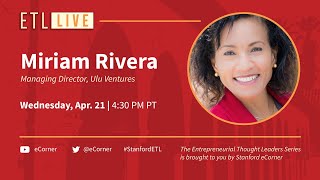
This content was created by GHION.AI . This content was uploaded by GHION.AI . This is a YouTube video titled "ETL Speaker Series: Miriam Rivera, Ulu Ventures" from April 22, 2021. It features a conversation between Heidi Roizen and Miriam Rivera, discussing Rivera's journey from Puerto Rico to Silicon Valley, her career at Google, and her role as a venture capitalist focusing on diverse entrepreneurs. They also discuss challenges and strategies for increasing diversity in venture capital and entrepreneurship.
Chapters
All right. Hello everybody and welcome. I'm Heidi Roizen and I'd like to welcome you to the Entrepreneurial Thought Leaders series presented by stvp, the entrepreneurship center in Stanford School of Engineering and bases the Business association of Stanford entrepreneurial students. Today we're delighted to welcome Miriam Rivera to etl. Miriam is the co founder and Managing Director of ULU Ventures, a seed stage venture fund focused on IT startups. Previously she was Vice President and Deputy General Counsel at Google where she joined as the company's second attorney. Her work to simplify contracts helped Google scale from an 85 million to 10 billion company in five years. Miriam earned her AB AM and JD MBA degrees from Stanford University. She just couldn't get enough of Stanford. She was also a trustee for the university and serves on Stanford's lead counsel and the Stanford Law School Venture Fund. She's been honored with the Stanford Medal awarded to fewer than 1% of Stanford alumni. She's on the investment committee of Acumen FundAmerica and is also a Kaufman foundation board member and an advisor to the launch with GS Advisory Council, a Goldman Sachs initiative to reduce the investing gap for black and Latinx founders. Welcome Miriam.
Thank you Heidi. It's wonderful to be here with you.
So great to have you here. So I'm just going to jump right in with questions. Let's get it kicked off with your origin story. Tell us about your journey to Silicon Valley from student to entrepreneur to investor.
So I came from, my family came from Puerto Rico. So this journey started a long ways across the United States. We were migrant farm workers and we joke that I was conceived in Florida and born in New York State. But I actually grew up mostly in Chicago before receiving a full scholarship to attend Phillips Exeter Academy where I attended for a couple years. And that's really where the beginning of the college journey began for me because I'm a first generation college graduate and it was partly because of teachers that said you really should go to law school that I realized, wow, if they think I should be a lawyer, that means I also need to go to college. So I took the scholarship so I would go to a school where most of the kids went to college. I ultimately graduated from the Latin School of Chicago before coming out to Stanford sight unseen. And really what drew me out this way was having gone to Exeter, I realized that in the east coast there's kind of a lot of old money, there's a lot of old families and the west felt like it was just an open, open to anyone to come here. And I Think that is really true of Silicon Valley in general, that we welcome people from throughout the world. And so when I came to Stanford, it was kind of a dream come true. Frankly, being from Puerto Rico, I believe that I was cold the whole time I was in Chicago, except when it was 100 degrees and I was boiling. And so it's been a wonderful place to, for me, feel like I grew up here because I was only 18 when I came and I've now been here more years than I care to mention. But the things that really attracted me at the time weren't even the things that I've ended up doing. So one, I want to say, say I thought I would work in the not for profit sector. My first career was actually in higher education administration. I worked for Stanford, I worked for the University of California, Santa Cruz. And it was only after I went back to law school and business school that I ended up moving into the tech sector. And boy, what a ride it's been.
Yeah, I mean, I am curious, I mean, Google, how big was Google when you went there in terms of employee size?
It was 160 people.
Oh my God.
So it was a small company and definitely a startup. And the funny thing is that I had worked on an IPO as a new attorney at Brobik, Flager and Harrison in 1995. And in 1995 the Internet had 35 million users worldwide. Wow. And there were only $35 million worth of advertising revenue generated that year. I definitely feel really old, but it's actually just been very quick. We've now got about 5 billion people on the Internet. I think that so much of my career and life story resulted from having early access to computers at Exeter and then even here at Stanford. I think we were really ahead of the curve in terms of adopting computers into the, you know, like you just had to at least do your papers on computer back then. And so that's been, I think, really informative for me as a person that didn't come from a family with a lot of no connections to Silicon Valley. I knew no one. But this school has provided so many opportunities for me to get to know people and to understand technology. And that's how the journey began to become ultimately a venture capitalist now.
Yeah. And what did make you make the leap from being, I mean, you obviously had a big job and big operating job and then you made the leap to investor. What, what prompted you to do that?
So when I started, I, I actually thought when I left Google that I was going to go and find My general counsel job, because I was the vice president, deputy general counsel. And what I realized was, was, oh my God, I think I've already had the best legal job I can possibly imagine. I basically created a worldwide legal team in five years and had the opportunity to work with such amazing attorneys. And like, I mean, these people were so hotshot that, like, among them, we had the next general counsels of Dropbox, Twitter. We had the first woman to ever run the US Patent and Trademark Office of the United States of America. Right.
So.
And we had like the first deputy CTOs of the US two of them out of my team. So it just was this realization of, like, I think I've kind of done it even without the title. And so I started thinking, what could I do where I used the skills and the knowledge that I've developed over, you know, 25 years in tech and I realized that VC might be a pathway. And I had observed other attorneys at Brobeck become. So I knew it was possible for people to make that change. And I think it's actually been a great background to have as a vc.
Yeah, I think it would be. Because so much of what we do as investors also hinges on the understanding of the legal side of the equation. Now, I know you've said it before that investors are okay, but entrepreneurs are the ones that get your heart pumping. And I'm curious if you can articulate what makes you so passionate about investing in those kinds of entrepreneurs who are the founders that get you really excited?
So the way that I think about entrepreneurship is that it's one of the most important ways that I think we can create things and take them to scale. The other thing is that it's a real personal journey that everybody who is an entrepreneur, like, literally has to figure out how to get out of their own way. Anything that they ever learned that isn't going to be helpful to them. They're encountering that from a personal perspective and having to overcome any lack of confidence that they may have had. Frankly, a lot of times, ego that they may have had the other way around. Because you're not a good learner when you have a big ego. The work of being an entrepreneur is about the most high learning role I think you can have as a person. And so it's just so exciting to see people going through that journey of building a business and undertaking the personal growth that it takes to become the best leader that they can. That's a super exciting part of it for me. Certainly. I love figuring out with technology, how can we Commercialize it, How do we monetize it? How do we get it in more hands? I love the partnerships aspect of building a business. We typically work in enterprise software, and enterprise relationships are very enduring. Some of the longest enterprise partnerships have lasted over 100 years. You really build a foundation for a business for the long term. I think that that's part of the special sauce that I bring, is helping the entrepreneur, some of whom are really great technologists, but not many of whom have done actually building a company to scale in that way before.
And I mean, you've been an innovator in another regard as well, which is you've been investing in diverse entrepreneurs before it became a thing. And obviously there's a lot of talk about that now, but you were doing it way before there was a lot of talk about it. And I've heard that you use a quantitative methodology and founders have to meet a high bar. And over 80% of the companies in your current fund are diverse teams. Can you expand on that a little bit more for us, by the way? We have a lot of diverse entrepreneurs in the audience, right.
And Silicon Valley draws the best entrepreneurs from throughout the world. And that's one of the passions that I have. Just starting from a kid like when I was in middle school, I went to a public middle school that had 60 different languages read spoken at home. That really gave me an early access, I think, to what was happening in the country that many people didn't quite realize that we were shifting from in 1950, a predominantly white community with some African American presence to one of the most multicultural countries that's ever existed on the face of the planet. And I always saw that as a real strength in terms of one being able to connect with other people, being able to understand the world. And when I went to Google, I came to understand how vital it was to actually building a big business. We were in 80 different countries in about your three of the. Of the business. Obviously, some of that was just completely remote. Right. But we had physical presence in 16 different countries at that time. And that is something that I realized that my background was actually really helpful. So some of the kinds of things that we did were we brought in attorneys that could read, speak and write Japanese or could read, speak and write Chinese, or, you know, different languages where we were going to expand business. It was so much faster to do business at the speed of the native language than it is for somebody who can only speak English to do business. So. And I realized that nobody really was commenting on. They were commenting a lot about how Google was so successful and they kind of missed some of the underlying fabric of what made that possible in that diversity. We also had of the 13 original VPs and founders, we had three women on the team. It wasn't really remarked on. And every team eventually came to have and unfortunately it shouldn't be this particular way, but it was typically a senior male and then a right hand person who was a woman on the team. And I saw that and I realized that that was really an important part of how we got to be so fast growing. And I wanted to do that in venture because I realized that at that time, you know, 2% of the dollars were going to women. It's still not that much more today, 13 years later. And that we were having people like from Google that were engineers that would go back to their home countries to try to raise capital to start a company. I just thought that was insane.
Yeah, yeah. Well, and I mean, you're highlighting something. I'm always shocked at this myself. And I remember thinking when I first started doing business with Google and being aware of the people in the leadership roles at Google, that it was a more diverse company than I remember other companies being at the time. But that said, Silicon Valley is notoriously bad when it comes to diversity, both women and people of color. What are your thoughts on the state of DEI in the Valley as a whole, as you know, not only for founders and the kinds of founders you fund, but for employers and employee bases. And do you have any recommendations for how we can improve that, what we should be thinking about to move that in the right direction?
Well, I think a big part of creating real equality of opportunity and also tapping markets that are underserved is being able to incorporate diverse talent. And that I think of as having kind of like the Stanford approach is you need to have t people where they're really deep in certain subjects, but then they're really broad in other ways. And so I think of the functional expertise that a lot of us are bringing to work every day as part of our depth of expertise. But then we need to have that breadth. And that includes different lived experiences, different linguistic backgrounds, it includes different cultural backgrounds, because those are the kinds of things that are going to help us respond to the market, which is a different market today than it was in 1950. You wouldn't know that from the color of venture capital and you didn't know that from the gender of venture capital, but it's like a completely different world. And venture capital looks like 1950s America, where almost Everybody that had a college degree was essentially a white man. And so from my perspective, if you really are actually a true capitalist, you should be looking for the opportunities that people are overlooking. And diversity is one of those in our country. When you mentioned our methodology for making decisions, we use a very quantitative approach to making decisions, both because it helps us to generate better predictions around the value of companies at a point in the future, because we're looking five to 15 years out, really, but it also helps us to do a better job of asking all entrepreneurs relevant questions about the downside and upside risks, to be able to parameterize their knowledge of the market, of the size, the consumers, the market segments. So much better. And we know from studies that are more available now that when we have people asking women questions about venture companies, they will ask a lot more downside questions. That includes women VCs. So you need methods to overcome your own bias so that you can actually do a better job. And so I try to encourage people to implement better processes at work so that they overcome. All of us have many shared biases, including us women against women.
Absolutely. I think that is something that I've certainly come to understand over the years and even my own biases that I see happen. And I think it is interesting, as investors, particularly very early stage, there are only so many metrics that you can employ. Right. There is, you know, the companies often don't have the kind of revenue or employee base or other things that you can assess in your due diligence process. And so there is a certain amount of gut feel and judging from your prior experience and what works and what doesn't in making a decision. But I think part of the problem with gut feel is sometimes gut feel even is informed by bias. And so you've got to be able to catch that and correct for it. So, I mean, I think that's an interesting thing. And, you know, obviously you've been in a situation of being the. You know, I used to joke that there were many times in Silicon Valley I'd walk in a room and in my brain I would run that song from Sesame Street. You know, one of these things is not like the other about myself.
Right.
Because I'd look around the room and I was the only one. I was only the only one. And you've had that. You know, you've had that even more. So I would say you've had experience with boards, you've served on private public, and you even served on the Stanford board. I'm sure you've been the first Woman and the first person of color on many of these boards. I'm just curious about what has been your experience being that person and how do you bring something to the table and be effective when you've kind of got that hurdle to overcome to begin with.
So we'll talk a bit about boards, but I have to actually give you some props, Heidi, because you were a role model for me growing up here in Silicon Valley. And I just want to let people know, like, how influential it is to have seen that example, like, of women being in that position of being the only one, but that you also had such a tremendous impact on me through the hand that you extended to so many women in Silicon Valley. Like, I don't know if everybody knows, but Heidi has this dog that she walks every day at the same time. And if you need to catch Heidi to talk, like it's a great time where she'll take anybody for mentorship, you know, and I have taken advantage of that time to be mentored by you over the years and walk your dog. And I've implemented it in my own life.
Thank you. First of all, I really appreciate that. And I have to say I often, you know, I mean, part of the reason I do it is I come away learning more than, than I give, I'm sure. And it just, it just, it warms my heart to hear that and see so many great women like yourself that have achieved such amazing things. And I'm happy to have to have been part of the steps in that process. And I will also say I have my dog knows more secrets. If only she could talk.
What a story she'd tell.
Ah, the story she would tell.
Yeah. And I ran across Heidi for the first time when I was applying to be a junior trustee or like the 25 and under trustee. And I had an interview at your house. And so I like, I remember aspiring to be on a board for a long time. I was fortunate as an early entrepreneur. Like in, I guess in the late 90s, I had started a company with five other folks from Stanford and it was a venture backed company. One of the things that I asked was to actually be able to attend the board meetings as I was the CFO and I was a secretary to the board. Part of that was because I knew that that's where a lot of the important things happened in the companies that I had worked for as an attorney, where a lot of times when you're a junior attorney, you're the note taker at the board meetings. And so I had already seen As a junior attorney, how important the decisions were that were made at board level. And also I really learned so much from just listening to people that had been in the work world and in tech for decades at times. And so I knew that that was something that I wanted to incorporate very early into my professional life. And so starting in my twenties, I was at least a secretary of the board and listening to the board. And so that's been incredibly helpful because, you know, a lot of this is kind of wisdom that you acquire over time. And so the more people that you are hearing talk about the hard things that happen on boards and you know, firing CEOs or, you know, issues with the company and cuts and other things that need to happen at the board level, I think the more you're prepared for the reality of actually running these startup companies and you're also aware of the blind spots that we all have in terms of not wanting to face really hard decisions that you often have to make in hard times. And so I've been really fortunate to have had early experience and then I've served on a lot of boards now because of ULU Ventures and being a vc, probably more so than anywhere else. But I've also had significant not for profit experience which has also been a tremendous learning opportunity for me. And for whatever reason, I seem to join boards right at around a major crisis in. So I joined the Stanford board in 2008, which if anybody remembers 2008 was kind of a critical time and we were essentially having to do layoffs at Stanford. Cash flow was very difficult because you couldn't liquidate assets for the life of you at that moment because everybody had special provisions that basically said like, you know, in certain times we can slow down how quickly you can exit investments or. And even with a AAA credit rating, Stanford had a very difficult time getting short term debt in the markets, even though it had been in that business for a long time. And then, you know, I joined and became the investment committee chair at the Kauffman foundation about a year ago. So guess what happened. So I got to join right at the beginning of a pandemic and one of the most volatile periods in stock history. So I have felt like, boy, my not for profit experience has been gold also in terms of learning to run organizations through crisis.
Yeah, well, you are the manifestation of the proverb, may you live in interesting times. Right?
Absolutely.
I found that often too. I joke about. In fact, I don't know if you find this, but I find this as an investor. I mean, we often joke about the fact that the first board meeting you go to is when you realize that the, you know, the problems.
Right. That all of a sudden, oh my God. What do you mean? What do you mean?
This is, this isn't going to ship or, you know.
Right, exactly. Or we only have four months of cash.
Yeah, yeah. So. So switching to the back to the other side, I mean, we have a lot of entrepreneurs in the audience or future entrepreneurs. What's the biggest advice you'd give to them in terms of looking for funding?
One of the, I think of looking for funding the same as looking for customers. You basically have to find a person who's a very good fit for what you're selling. And I noticed that people want to cast a wide net when it comes to funding, but it's important to really look at what it is that they fund. So, for example, you probably don't want to send me your life sciences investments. It's not something that I have as much background in as I have in tech. And the same kind of thing with a lot of consumer packaged goods. Like I am probably not going to be investing in the next potato chip, you know, lab manufactured or otherwise. So I think, you know, that's the most important thing. The other thing is to try to identify the route to an investor that will get you the most high probability of getting a meeting. And by that I mean you have to look at your networks. And LinkedIn has made this, frankly, so much easier because it's the same kind of prospecting you would do to figure out how do I get in front of this customer that I want to get in front of. You're trying to work backwards from the person through the networks that he or she has to your own networks. And then you're trying to find which person do I know that has the deepest relationship with that person that can say you should take a meeting with these people and because that person is the one to say it, they will take that meeting. Then the other thing is, when you're selling vc, it's not all about the pitch. I know there's the 30 seconds that you're supposed to have the story I want to be able to understand. You also have to have a well populated data room that actually supports and provides evidence for the fact that your business is doing all the things that you say it's going to do. And I noticed that a lot of the times people think of their data room as a secondary consideration in fundraising. And I guess having grown up, I also went through the 2001 bust. Right. In tech. So I've been through every cycle in the last 20 something years. The data room should always be ready because when the window closes, it closes fast. And with this pandemic, you know, out of our 70 portfolio companies in Fund 2, almost a third of them came back to market that year in a terrible year to raise. And the people who came out faster had a higher chance of getting funded.
Yeah, yeah. It's interesting. I mean, I think this is a looking back with some wisdom thing. I think when I was in my twenties, I thought everything was under my control and all the good things and bad things that would happen to me were my control. And looking back, I now recognize the macro conditions have so much to do with whether something worked or didn't. Right. And recognizing that right now we're in this super unique macro time, which is, by the way, in some ways has been the silver lining of being very strong for entrepreneurs. It's a great time to be an entrepreneur, but has also had some really hard things for entrepreneurs. And I would say particularly women entrepreneur, and particularly women entrepreneur who are mothers. I think it's been a challenge. I mean, work from home is, is definitely both a pro and a con. I'm just wondering if you haven't. Have you seen that with your women founders? And is there any advice you would offer to the, to the women entrepreneurs in particular?
You were a working mom, I was a working mom. It's still a hard job no matter what. I certainly think in a lot of ways, working remotely is actually even worse, obviously, because people didn't have school. Right? Not in the same way that we did, where at least you have several hours a day, where fortunately in most schools in America, your kids in a safe place, you can really just get so much work done. Knowing that this year with so many of our entrepreneurs working from home, we've just seen people. The whole village thing, like it takes a village became the reality of a lot of our founders that were able to make this a successful year. And I saw many of our founders that are in their 30s with children, like literally move in with their parents. And why did they do that? They did that because they had grandparents for their kids and somebody else could share the load. So I think that there's a lot of figuring out, how do we share the load? I certainly think that societally, the US Is really behind a lot of the world in terms of sharing the load, of educating and preparing our children for the world by not having good childcare universally available. Not Having Head Start for every low income kid, I'm a Head Start kid. I think that made a tremendous difference in my life. I think that. But kind of lacking the infrastructure that we have in this country. I'm actually always inspired by women entrepreneurs that are looking to help create infrastructure like this. So one of the companies that we invested in is called Zoom Z U M and it is a child transportation company.
I've heard of it.
That works with schools. And we were early adopters. I remember there was a mom who used to have a station wagon and she offered to drive kids for a fee. And we were it, you know, and so. But when Zoom came into the room and they had a technologized version of doing this, where you could know where your kid is, who your kid is with, and they're driving to school and they can do this at scale, I really saw opportunity.
Yeah.
And again, I think that's the different lived experiences. Like if you had an all male firm, maybe nobody would have really thought this was an interesting company. But ultimately it's turned out to be a company that in the last year, even during COVID has signed $300 million worth of revenue deals with top 50 school districts. That's part of, I think the opportunity for women is that you can identify problems that other people just overlook because guess what? Their wife was taking care of that.
Yeah, yeah. No, I do think, I mean, first of all, I do think that necessity is the mother of invention, as has been long said. I also think that sometimes you only really have change and innovation when it gets so bad, when people are thrust into a situation where they now have to realize. And I think for both, I will just say my own experience working with my portfolio companies, both women and men. I can't tell you how many times the naked two year olds walked by in the background. Or someone has said, I'm sorry, my dog is barking at the front door and I'm gonna have to stop the board meeting for a second because I don't know why they're barking. I've gotta go look at that. Or just people saying, I'm sorry, I've gotta go make L for my kids right now. I can't. You know, it got to the breakpoint and I think that there was a.
Level of.
Shared sense of, you know, an intimacy around the fact that our work lives and our personal lives are intertwined and they one does affect the other and we have to be a little bit more generous, I think, and understanding about all the demands on people. And I do think that there is this tendency and certainly it's been typified around particular gender and race. But I think it applies in a lot of places where for some people it's easier to solve for those equations and for those or have solutions for those issues and problems. And for other people, you're not in the position to be able to simply solve for those. And so the, the importance of coming up with solutions and doing that in a way that allows us to tap into the tremendous abilities of people who are juggling more things is going to be better for everyone. It's going to be better for society, it's going to be better for the companies that do so. It's a real strategic weapon, I think, for the companies that have been able to tap into solving some problems and opening that up. So I'm looking forward to seeing as we roll back again, I'm looking forward to seeing what new creative solutions people have because I think we got to experience things in a very different way. But anyway, let's turn to some questions. There's a couple questions here and I want to encourage everyone, please do use the Q and A window if you want to post some questions for Miriam. And Miriam, you want to start at the top and pick these.
First of all, somebody said because I'm Puerto Rican, so yes, proud boricua here. Then secondly, somebody was asking about the greatest challenges or disadvantages or advantages of being a woman of color leading in business. And I actually want to address that. There was a recent business school study published by Fuqua at Duke that talked about women of color leading versus white women and identified that maybe women of color in leadership roles are allowed to be more assertive and more aggressive than white women. I never really knew that, but what I did know is that coming up in the business world, I had kind of your typical even though Puerto Ricans are US citizens, it did feel like immigrating to the mainland when you come from a different place. And so I had the experience of being able to earn my stripes because a lot of the work that I did in tech was often really visible work with really visible contribution to the company. So like if I'm working on the first billion dollar deal that Google ever did, people are going to remember that. Like your boss remembers it, your CEO remembers it. And so over the years, Malcolm Gladwell talks about in outliers that people get idiosyncratic credits, meaning that if you are, you develop that credibility because of the things that you contribute in a culture, then you're given more leeway within that culture to do unusual things. And so I remember I took my maternity leave for my second child during the ipo. Wow. And I actually took it in part because I had established a department that was 50% women during a time when the California bar was only 35% women. And I knew that if I didn't actually embody the change, that I wanted to see that women would be told, you can do it all, but you have to give up everything. And I had already done that with child number one. I had my first child on a Friday. I went back to work on Monday as a startup founder. And I never wanted that to be the truth for another family after me. And so I had to model the role and the way of being that I wanted to.
It's so important. And it's hard to do.
Right.
Because you are driven to do these things.
Because I've been working behind the scenes for years to get that ipo. You know, like, I had gotten the car company Sarbanes Oxley ready, like literally compiling all the documents that you need for an IPO for years. Because, you know, we were kind of a startup and a little bit broken.
But I mean, to your, to your point, I mean, I think it. I mean, it's such a powerful thing to say because if you don't model the behavior, what you're telling people is, well, actually we pay lip service to this, but we don't really want you doing it. You have to model the behavior or others are not going to feel like they're entitled to it.
That's right. I think that's been one of the things that I've learned, and I know you had to probably do this. There's kind of the superwoman myth, and it's not a myth, it's superhuman. To have to raise young children, nurse, and like work on a billion dollar deal where you hardly sleep at night for an entire week. That is hard. That is.
And there are biological. Again, we won't go too deep in the weeds on this. I had both my children while I was a CEO and luckily I did have an office with a door, but people used to just open my door and walk in all the time. And I finally hand wrote a little sign that said breastfeeding. Enter at your own risk. Nobody ever entered. Go ahead, walk in. But you. I'm bringing my. I got to bring my kid to work some. My baby some days. Because it just. That was just the way it was.
That's the way it was when I was a startup founder as well, and frankly, when we had a series B, the VCs did not want a husband and wife team. And I remember then we were a husband and wife team. And we still are at ULU Ventures. We've been working together 13 years at ULU and we worked for two and a half years as startup founders. And, you know, there was a lot of bitterness and a lot of pain around that because, like, you start a company and is like, really important to you and you make every sacrifice, like you're bringing your kid to work, you're doing everything that you can to make it happen. And then to be dismissed because of your marital status was kind of difficult. Yeah, it really opened the door for future opportunities. I ended up getting a role with Latinx, general counsel at Ariba, which was an enterprise software company that eventually sold to Oracle, I believe, or SAP. Sorry, don't remember, but I wasn't there at the time. But, you know, he was a tremendous role model to me and that helped me get the job at Google and be successful in the job at Google. And, you know, that changed the trajectory of my personal life and created the opportunity to found ULU Ventures and to extend that hand, as you have done to so many women and so many people of color.
Yeah, and I do think, and that is another important thing too, I've had the hand extended to me in my career as well. And many of the people who handed me an opportunity were the men I worked with. This isn't about. This is about raising everyone up. This is not about only particular. I want women to help women, but I want men to help women too. And I help a lot of, A lot of, you know, of men as well. So, yes, it's not about limiting, it's about expanding.
It's not about limiting. It is totally about expanding. And, you know, my first partner that I worked for out of law school, business school, Tom Kellerman, still a practicing attorney, he had a team that for the first time in that firm's history had three women on it.
Wow.
He was a tremendous role model as well, and a person that has influenced my whole career. And so. And then Gabriel Sandoval, who was at Arriba, also a guy, you know, but it's just been, you know, so it doesn't matter who. And I have my white male mentees, lots of those too, you know, and. But I think it's all about people extending that hand and helping to lift others.
Absolutely, absolutely. Okay, we have five more minutes. You have a few more questions. You want to hit a few Here, let's see.
I'll talk about the data driven approach we use to evaluate investment opportunities. Our approach is called decision analysis. The father of decision analysis at Stanford is Professor Ron Howard, who's now emeritus, but he's got. There's a textbook on this which is also taught by one of his proteges at the University of Chicago. And basically in business schools we used to call these classes Decisions and Data or trees, because you use decision trees. But it is instead of looking at as the numbers are so important, it's the conversations that get memorialized through a model that applies quantitative numbers to everything. So you mentioned, for example, you have to have intuition around making investment decisions. Well, one of the things that we do is we actually quantify our assessments of teams. Like, for example, you know, this team we think has a 85% chance of success, and here's why. That one has a 95% chance of success. And here's why. And what that does is in a few years when like it's 18 months to 24 months, typically is kind of do or die at the seed level, meaning that you're going to get another round of financing or you're not typically in that time frame. And so we will know, did the team fight like hell and break up? Did they actually get a next round of financing? Did they actually get customers? And now we can update those numbers and so we can affect our own bias and learning through that process. And that is one of the ways that we do this. We also look at our pipeline, but like, how many women are coming into our pipeline? How many people of color are coming into the pipeline? How many people got meetings? How many people got to the second meeting, how many people got to the market mapping or decision analysis process, and how many got funding and how many dollars did they get? If you're actually watching these things long enough, you will be learning from your own bias and where it's happening.
Yeah, makes total sense.
And is that enough? The next one was how does a JD contribute or a drawback from your approach? It's so incredibly helpful because I practice commercial law and every deal, every dollar that you're earning in most companies is papered by some sort of contract. So for me, it gave me negotiating skills, it gave me understanding of deal structures, it gave me the ability to negotiate my own deals against the biggest companies in existence. So I found that to be quite helpful as an entrepreneur. Even back in the 90s when, like little Miriam is, you know, negotiating a deal with Eli Lilly and company and I'm retaining our IP rights and I'm getting cash up front and you know, like, so it felt, it felt really empowering to me. I certainly think that one of the things you have to be cautious of as a lawyer and a VC is I didn't realize how sensitive entrepreneurs were about their companies. Like, they literally feel like it's their baby. And if you have anything that you would negotiate hard, they might take it as like, you just called my baby really ugly. And you know, I'm used to like billion dollar deals where there's not, it's not personal. You're arguing very intellectually. And so I had to learn to be more gentle with entrepreneurs than I was against like, you know, Fortune 500 general counsels.
Yeah. I find one of the things that I was noticed when I'd go give speeches at the business school that everyone was always focused on the opportunity. But when I would go give speeches at the law school in class, like when you come and talk about a case, they would be more focused on the downside.
Right.
And do you think that is inherently one of the things you learn in law school is button things up so there's no downside? And I just thought it was an interesting mentality. But I haven't spoken in law school recently, so maybe they're all more upside oriented now. Maybe they're, you know, maybe the entrepreneurial spirit has hit the law school as well.
Well, there definitely are pockets of that at the law school. I kind of speak from experience because I've done like hackathons at the law school and, and also somebody's asking about, aren't there other ways besides women modeling good behavior to increase gender equality in business, equalize expectations where work and family responsibilities. And I certainly think that there are, I know, in our family, for example, my husband has a very intimate relationship with his daughters and is able to be the primary caregiver for our children and has been since they were born. One is individual women holding a standard of 50. 50 at some level.
Yeah.
And then frankly, I think that the more that women are working in the world, like now 75% of women are in the workforce, it's just not tenable to say you're going to do all of the house related stuff, the cleaning, the cooking, the grocery shopping, the child care, the interpersonal care that's required to keep, you know, intergenerational families working. And I see that more and more couples are doing life differently and they're much more conscious of these things. And I know, like at different times, my Husband gave up a CEO role because it was just too challenging at that point in his life to meet the expectations of being a CEO at a startup company.
Well, and I do think our society is hard on men too. When men say, hey, I gotta leave, I've got a soccer game at 4:00 with my kid, I gotta be there. You know, again, I think that for all the good of the Silicon Valley, you know, work all the time, lifestyle and some of the positive things that have happened, I do believe that there is this mentality that anything that isn't work is not good, that's bad. And it isn't just women modeling a different behavior, it's men being allowed to model that behavior too, and not being penalized, whether that is specifically or under a certain current. I mean, we all have to call it as we see it. And you know, and so it's on all of us to be making those changes as well. It isn't just for women. So we're almost out of time. We're going to have one more question here. You mentioned a bunch of people who positively influenced you and were your mentors. Do you have any advice for how other people can go about finding mentors and especially when you're a young attorney?
Yep. And I would say that one, there's a real lack of awareness of what a mentor really is. I don't think of the most influential mentors in my life as people who I've met with like weekly or that have like a deeply personal knowledge of me. A lot of them have been people within work contexts who have been willing to be transparent about the organizational dynamics of that context and helping me to understand the management and leadership and the proclivities of those folks. They're not my deepest personal friends or they're not my parents. And so I think for a lot of young people it's just being aware that you can get a lot of value from a mentor in much more limited ways. And you need to work on identifying people that you look up to that seem effective, that are willing, have the time and you have to really work at. How much time do I access this person? Can they give me a small amount of their time and have a big impact on my career? If you demonstrate that for the mentor, they will keep on meeting with you.
Yeah, yeah, great point, great point. Ok, one last question. We'll have a short answer. But you don't really need to work and I know you work like crazy. So do you have a personal mission? I mean, why do you do this. Why do you work so hard?
Yeah, my personal mission is to transform access to capital for women and people of color. And by that I mean underrepresented minorities. Minorities and immigrants. And the reason is I feel like I was given so many opportunities. Obviously through places like Stanford. I had a quarter million dollars worth of scholarship, like. Like I'm a little VC startup right here, you know, and so for me, it's all about kind of giving back and empowering people that are often told they can't be something, they can't do something.
Yeah, well, it's wonderful. I mean, it's amazing that you do that. And thank you. I mean, thank you for a fascinating discussion. This has been great to our audience. We thank you for joining the Entrepreneurial Thought Leader series. Next week, we'll be joined by co founder and CEO of airtable, Howie Liu. You can find that event and other future ETL events on our Stanford E Corner YouTube channel. And you'll find even more of our videos, podcasts and articles about entrepreneurship and innovation at Stanford E Corner. That's Ecorner, Stanford Edu. And as always, thank you for tuning in to etl. And thank you, Miriam.
Thank you, Heidi. It's been a pleasure.
More from GHION.AI


O processo de reconhecer limites, mesmo quando a vida parece exigir sempre mais.





Depois de tantas histórias, aprendizados e pausas necessárias, o @interior_iza está de volta



