ETL Speaker Series: Nikil Viswanathan, Alchemy
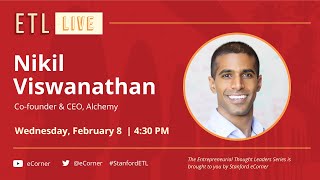
Nikhil Viswanathan, co-founder and CEO of Alchemy, talks about building infrastructure for Web3. Alchemy provides blockchain APIs and tools that power thousands of applications across the crypto ecosystem.
Chapters
Hello everyone, my name is Emily Ma and I would like to welcome you to the Entrepreneur Thought Leaders series presented by stvp, the Stanford Engineering Entrepreneurship center and Basis, the business association of Stanford entrepreneurial students. Today I am delighted to welcome Nikhil Viswanathan back to ETL because he used to run this whole thing when he was a student here. Nikhil is the co founder and CEO of Alchemy, the world's leading Web3 developer platform. Alchemy is hailed as the fastest growing company in history going from public launch to a 10 billion valuation in 16 months. With a team of only 37 at the 10 billion mark, the company also had one of the highest team to impact ratios in history. Alchemy powers over 100 billion in transactions globally including the majority of the NFT industry, top web3 companies and traditional enterprises. Alchemy is backed by Andreessen Horowitz, CO2, Silver Lake Lightspeed, Stanford University, the Google chairman, founders and the sex of Charles Schwab, LinkedIn, NYSE and many more. Nikhil is honored as Forbes 30 under 30. Received his BS and Ms. In Computer Science at Stanford and formerly did product management at Google, Microsoft and Facebook. A serial entrepreneur, he co created the number one social app in the world, down to Lunch which was featured in international press such as a New York Times business cover story. He has been featured in numerous media outlets including CNBC, Bloomberg, New York Times, Forbes, Fortune and TechCrunch. Welcome back Nikhil, over to you.
All right, well thank you guys for showing up. I know you have probably a lot of other things on Wednesday afternoon that are seem more fun than coming to class and hearing some random person talk. But I'm very appreciative and it's so such a big honor to be here. Really quick before we start, just so I can get a sense of the room. How many of you are undergrads? Okay, a lot of undergrads. How many freshmen, Sophomores, juniors, seniors? Okay, how many people are studying engineering? Adrian, Computer science counts. All right, how many people are interested in startups? Okay, how many of you want to start your own company one day? All right, cool. So there we go. What I want to do today is talk through a couple things. So two things that Joe and I always said, so my co founder Joe. So we always said from the beginning that you know, one day when we make it, we'll come and actually tell the story of how it happened. Because everything you hear is this company started and then you know, 16 months later it was an overnight success. And what you don't hear is the ten year journey behind that story. And what I'm here today, what I'm here to do today is tell you a little bit of that. So, caveat. I had planned to prep this talk and I was like, it's going to be amazing. It's going to be incredible. And then life happens. We had a ton of customer stuff come up over the last week and a half. It's been working nonstop, to be honest. I made the slides on the way here in the car. Thankfully, my parents flew down from Texas to come see the talk and drove me, so I was able to edit them. So. So I have two things. This will probably be the most unpolished presentation you've ever seen at etl. However, I really hope it's the most interesting one. And I hope it's one that you get to hear the behind the scenes stories that no one else will tell you. Because my favorite parts of kind of Stanford and technology and being in the Bay Area is getting to hear the stories that you will Never see on TechCrunch. Right? You know, whether that's when I was sitting and playing chess with Mark Zuckerberg, he's telling me about the early days in the dorm room at Harvard or the CEO of Microsoft's telling you about also at Harvard at him and Bill, we're building stuff in the dorms. Those are the things that you will never hear anywhere else. And a lot of stuff I'm going to share today we've never spoken about anywhere. So that's the intent, that's the goal. And let's get started and feel free to stop me and ask questions. So see? Loading. All right, I guess this photo's not loading. It team. We're good. All right, well, I will describe in words what this photo should be. It is a photo of my freshman dorm, Otero. Anybody live in Otero? Oh, no. And one person over there. Basically. When I was at Stanford my freshman year, my mom called me and she says, hey, there's this really awesome class you should check out. And I was like, mom. She's like, it's called Ms. And e472 entrepreneurial thought leader seminar. So oops. See, that's fine. It's okay. No worries. And she was like, it's called Ms. And e472 entrepreneurial thought leader seminar. I was like, you know, that sounds pretty cool, but I already signed up for Ultimate Frisbee and this ABS class, so I can't really go. She's like, what's an ABS class. I was like, oh, you know, you go and like work out your out. She's like, are you serious? Like, you need to go to this class. I was like, okay, fine. She's like, just go to one session of it and you'll love it. I went to one session. It was hooked. And I was hooked. It was incredible. It was like all the legends. I grew up in the super small town Texas, and things like Facebook and Google and Apple were just like websites on the Internet wasn't real things. And then suddenly you get to see the people who run those companies come tell you their stories. So I actually, the photo here was the exact spot that I found out that they called me when I was a freshman and they're like, we accepted you to come help run the class. And I ran the class for three years after that. And it was one of my favorite things I did at Stanford. And one day, we always said, we will have a big impact on the world and we'll come tell our story and we'll know we've made it when. And this is the mark when I get to come give a talk at etl. And it's funny because that day has come today. And at the same time, I feel like we haven't made it at all and we're just getting started. But it's a really, really, really cool thing for me. I've been looking forward to this for a long time and. Yeah, thanks for having me. So, to two goals here. One, I want to give you the behind the scenes stuff that we will never hear anywhere else. And two, I want to tell you the real story about what happened. So alchemy. Has anybody heard of alchemy? Raise your hand. Oh, wow. A lot of people. I'm very surprised. So, okay, for those of you who have not heard, I want to give a quick summary of what it is. In the last hundred years. There's three big shifts in technology. First one was the computer. Can you see this little laser pointer thing? The second one is the Internet. And the third one is Web three. Anybody interested in Web three? Blockchain? All right, cool. So they all formed in a similar way where underlying you had some kind of hardware or protocol layer. So for the computer, that was your ram, your cpu, your hard drive. But you couldn't build anything until you had a developer platform. So for the computer, that was your operating system. So Windows and Mac, what it does is it abstracts the underlying hardware, makes it easy for people to build things. Right? Build apps. And apps, as we know, are what normal people use. Normal people like us. So for the computer, that was your word, your Excel, your Chrome, whatever apps you use on your computer, right? And the interesting thing is this is what spins the cycle of innovation. Because now developers can build apps, so more users come, so more developers and so on and so forth. For the Internet, there's a business that you guys have probably heard of that most people have never heard of. It's called Amazon Web Services. Amazon has two businesses. One is where you buy things, which everyone's heard of, and then the other one is Amazon Web Services. Amazon Web Services basically runs the whole Internet. Anytime you open Uber or Airbnb and DoorDash, all of that is run by Amazon. The crazy thing is in 2021, 75% of Amazon's profits were from Amazon Web Services. 25% were from the shopping. Today, last year, 100% of the profits, all the profits of Amazon were for Amazon Web Services and the shopping actually lost money. So it's pretty crazy. But most of Amazon's market cap is from aws and for blockchain, Alchemy is that company. So we power all a huge chunk of the applications in Web3. So if you're looking at NFTs on Instagra, Instagram or on OpenSea, or you're using decentralized finance, all that stuff under the hood is powered by Alchemy. And I'll talk a little bit more about that and what it is later on, but just want to give you a high level idea. And the really important thing is why does this even matter? Why do we even care about this developer platform layer? As we say, it's some obscure thing. If you work on something in this space, no one will ever understand what you're saying. If you go on a date, you won't be able to explain what you do to them. There'll be a lot of challenges. But the really interesting thing is it's a huge opportunity. There are 250 million companies in the world, but these three, these are only three out of 250 million, right? But these are the three most valuable companies on the planet, right? And not that money is the ultimate measure of everything, but it's a measure of the scale of the impact you can have. If you truly want to impact life in a positive way for everyone on the planet, you have to build a developer platform for new technology. So that's a little bit about Alchemy, a couple of the numbers, just to give you some scale. We do about $100 billion in transactions, tens of millions of end users around the world. Anytime you look at an NFT that's under the hood, that's probably coming from us. We power a lot of big companies. Everyone from Stripe to Facebook to Adobe to OpenSea to a bunch that I can't name on here because they don't wanna give us logo rights. Cause they're very protective about it. But a lot of the apps used on your phone on a daily basis, if they're dealing crypto, we're probably powering that under the hood. This was the most recent TechCrunch launch. I only have like four T shirts, so I think I'm wearing the same T shirt in that photo as now. And remember this photo because there's a reference to it later on in the company. Just to give a sense of scale, the growth of the company. Again, I'll touch, I want to give a little bit of foreshadowing. I'll touch on all this later. But a lot of our investors and lawyers and stuff were like, this is literally the fastest growing company in history. And it was just on the surface, looks like this overnight success. But the whole point of coming here is to tell you about the 10 year journey before that really quickly. Three graphs. These are probably three of the most important graphs investors look at when you look at investing in a company. One, let's go to the top right, is sales efficiency. So what that means is how much does it cost you to acquire new customers. The second one is revenue retention. So once a customer stays, once a customer uses you, how much more will they pay the next year? Will they stick on you? Will they leave? And the third one is revenue growth. So annual recurring revenue growth right here. Companies are never on more than one of these graphs. And this graph, for context, is one of the top investors in the world. They asked me not to use their name because it's kind of their internal metrics. And I took out the names of all the other companies, but it's like companies like Airbnb and DoorDash and Uber and Stripe. It's like the fastest growing companies in the world. Companies are never on more than one of these graphs because either you're growing really fast and burning a bunch of money, or you're growing really fast and not retaining customers. Or you're retaining customers but not growing that fast. As you can see, Alchemy. This is our 2021 numbers. We were number on every graph. Number one on every graph and an outlier in every graph. So this is a quote from that investment firm they were like, this never happens to be like number one in all those, all those metrics. Right. Also, we were 37 people when we did the $10 billion round. Typically, companies are around like 5,000 people. So that was pretty crazy. And again, I don't say this to impress you. The goal here is to impress upon you. On the surface, it looks like this snap your fingers, magic thing, but once you see the rest of presentation, I think you'll agree that the only reason we achieve this is we're just way more persistent when everyone else told us we should quit. And hopefully the big takeaway here is, after all, this is if I can do it, all of you guys can for sure do it. So. All right, let's get started. So Lubbock, Texas, grew up in this super small town. Has anybody heard of Lubbock, Texas? All right. Wow. Actually, people have heard about it. When I came to Stanford, no one knew where I was from. It's a super small hick town. Every. It's like, take San Francisco and invert it. No building over three stories tall. Everyone drives a pickup truck. It's super flat. Most people half my high school didn't go to college. So it was just like a really, really interesting experience. But it was a ton of fun. Right. Came to Stanford, the absolute best time of my life. And, you know, hopefully you guys are having the most magical experience here. But I literally am still like super close friends with all my freshman roommate, my freshman dorm. And it was a really transformative experience for me being in a community like that and that. And one of the things you also see through this talk is you'll see a lot of themes that were foreshadowing for things before. Definitely very reminiscent of that Steve Jobs talking about, you can't connect the dots looking forward. You can only connect it looking backwards. So this was my freshman dorm. We went fountain hopping the first day of school. And this is like 5:00am and yeah, this was one of my, one of my favorite memories, one of the other things I really thought I wanted to do. So basically when I was thinking about what to talk about here, I was like, I thought about all my ETL classes and I thought about my favorite parts of it. And my favorite parts. When they showed the photos, they told us what the early days were like. They told us all the stuff you won't see the press. So that's what I tried to do here. And I put a bunch of photos in here. And this was one of our first football games. We painted up. This is my Freshman roommate right there. We're still very good friends. Like I might see him this weekend. Literally. Does anybody follow basketball? He's this like 7 foot tall guy. Robin Lopez has like twin brother 7ft tall also. And yeah, and it's actually quite funny because when I give talks here, everyone like, no one knows he's like objectively famous in real life, but no one actually knows him when it comes to Stanford. The two people they do know were another guy in my freshman dorm, Keith Schwartz. Do you guys have Keith for cs? Yeah. See that's, that's the reaction. And one of my roommates for a long time post college, Chris Peach, another professor here at Stanford. So, so yeah, so Robin is objectively famous in the real world, but at Stanford everyone's like, oh my God, Chris and Keith. So if we have time afterwards, I have a lot of Chris Peach and Keith short stories. All right, so through Stanford, one of my favorite things at Stanford was community. It was like literally one of the best experience of my life. And we always said, like, how do we create that freshman dorm forever? So during my summers I knew I wanted to go work at startups. Never thought I would work at big companies ever, but ended up doing product management on Microsoft, Facebook, Google. And it was really funny stories how I ended up there. Literally didn't want to go there. One of them was like, I was going to play Ultimate Frisbee at the Oval and I went to like, I used to get a sandwich, but then it was closed and they had a career fair. And I went to Facebook to grab the protein bar, but I felt bad. So they're like, do you have a resume? I was like, no, I'm in like tank top in cleats. Like, I don't have a resume. And then they emailed me afterwards and I was like, all right, fine. The really interesting thing here was I said, you know, one day I'm gonna have a company like this, so maybe I'll go and try to see how it's run. And actually the thing I took away was really the people. It was just like really weird thing where somehow and all the companies ended up hanging out with the execs at Microsoft. There's a hundred buildings, it's massive. It's like a whole campus. Right? But there are all the executives are in building 42 on the fourth floor. I'm this random intern. I happen to be on Building 42 on the third floor, right. And ended up hanging out with Steve Ballmer, who was CEO at the time and you know, spent Time with him. At Google, there was, you know, had meetings with Larry and would hang out with Sergey. And at Facebook, there's one desk next to Mark Zuckerberg. And, like, that was my desk, right? And it was just, like, so random. And, you know, again, I don't say this, try to impress you, but to impress upon you, I had this really powerful lesson. And that lesson was that these people are so driven and work super hard. Still flashbacks to when I was, like, bringing my girlfriend at the time on Sunday to, like, visit the office, and Mark was like, walking in to do work, and I'm just, like, screwing around. And I was like, oh, hi, how's it going? But basically the big takeaway here was they're incredible people, but they're just normal humans, right? And I really kind of reinforce this belief that if they can do it, like, I can do it too, right? So this photo is actually Steve Ballmer. He's the CEO of Microsoft's time. We. I told him. I was like, hey, you know, we should meet up. I run the speaker series. Stanford called etl. You should come talk there. He's like, okay, cool, let's. Let's find some time to meet. Remember, Microsoft's like 100,000 people. I'm a random intern. And basically I call. My mom was like, hey, guess what? Meeting the CEO of Microsoft. She's like, no, you're not. We're going to India that week. And I was like, can we move our trip? And she's like, no, we can't move our trip. Like, you need to tell me you can't do that. So. So I emailed a CEO of Microsoft, like, hey, really sorry, that time's not going to work for me. We're going to have to reschedule. Is very friendly. He shows up here. It was a class like this, maybe 120 people. I like to do things big. So we booked memod. We had like 3,000 people. Sold it out completely. If you go watch the ETL talk at. At. What do you call it? Steve Ballmer. First thing he says when he comes on stage, he's like, what the heck? Nikhil told me is going to be 100 people and there's like 3,000 people here. Um, so it was an awesome talk. So the. Let's see. Yeah, so the big lesson here, One of the things I'll try to do is, like, weave in the lessons. This was a really big one for me. Like, they're human. If they can do it, like, you can do it too, right? And again, that's the big theme I want to hopefully take away from this. This talk. So the other thing I did at college is I like building random shit, right? And sorry, I don't even say that on. On this televised thing. But basically, like, you know, a lot of these things were just things I built for fun. Like, here's this website that has, like, basically quoted all your friends. All my friends said, like, really stupid, silly stuff and we would quote them and then it was like this digital version of a quote board. This was when I was here, when Jim Harbaugh was here. And it was like we were the worst team in the country. Football team to like, one of the best teams in the country. And like, he was. Is David Shaw still here? No, he just left. All right, so, like, Jim Harbaugh was like, crazy and, like, David Shaw was totally stoic. So you can go see that Zoolander, Best movie in history. So I made a website on how to Blue Steel. Made like a quantified self thing. So built a bunch of things. Actually had a Dropbox folder of like 75 different things I built. I counted recently and there's like a few other folders. I couldn't find it. But the point here is, like, one of the things I really noticed is I just did this for fun because I liked it, right? It wasn't like I was like trying to start a company or anything like that. And the other thing I really noticed from talking to people was everyone who had built something great had just built a lot of things, right? So, for example, I think I had mentioned before, Mark and I were playing chess at Facebook, and I was like, yo, dude, did you know that Facebook was going to be the thing? He's like, no, man. We built like nine things before Facebook, right? Like, Facebook was just like this. We thought this thing called Wire Hog, this file sharing thing was going to be the big thing, right? The same thing with Bill Gates. He had built like a bunch of things before Microsoft. So really that was kind of a key lesson that I took away. We built this one thing actually, after E145. Technology, entrepreneurship. We had this idea for kind of this, like, events calendar that showed you all the events on campus. Because at that time, like, kind of there was nothing like that. And we built this and it was just this little side project. And over that summer, we were applying to, I think, Lightspeed or. No, it was StartX. StartX was just getting started. My friend was starting that and he was like, oh, do you want to come do a startup? And you Know, we went to these, a couple of friends and I got together, we went, talked to these guys who are advising us who were supposed to be like the first couple employees at Google. They basically listened to all our ideas for three hours and they were like, you don't have, these are all terrible ideas. Do you have any good startup ideas? And we're like, well, I don't have any ideas, but I built this little app that shows you the events on campus and like all of Stanford's using it. And they're like, wow, you're literally the dumbest smart person we've ever met. You have this thing, you have to talk about this nonsense for like three hours. And then you're like, oh, we have this thing that everyone on campus is using. Just do that. So that summer we actually took Fountainhop, called it Fountainhop because I love fountain hopping. And basically I actually own fountainhop.com and basically like we rolled this out to a bunch of other colleges. I won't share the full details. I'm happy to talk about it later on. Just for that brevity, we're already almost halfway through and we haven't even gotten like 10% of story. So basically, company did super well. The product is going really well. The team kind of imploded and fell apart. I didn't listen to anyone's advice. Worked with a bunch of people who had kind of known socially, but we didn't work well together as a team. Most heartbreaking thing in my life up to that point. And basically like we just ended. Everyone was like, we'll fund the company. This was between my undergrad and coterm years and we, and basically we just shut it down. And I was like, I can't deal with this. Everyone's arguing too much. So big, big, big lesson here. The most important decision you will make in your company, full stop, period, is who your co founder is, right? And I'll tell the story. My co founder Joe, literally the best person I've ever worked with my entire life. But this is the single most important decision. The other thing I'll say, like when you're in school is the best time to find your co founder. Everyone here has unlimited free time. I know it doesn't feel like that cause you have all these things to do, like parties and classes and acapella and all this stuff. But basically once you're in real life, it's much harder to quit. Convince people to quit their jobs and work with you. So if you want to do a startup, the most important thing you need to do now is is find your co founder. All right, so graduation rolls around. So I did my undergrad and I stayed for 2 years for Coterm. I considered 7th year just cause it was so fun. But then I was like, I should probably do things in real life. And this was our Wacky walk thing. Again, back to the theme of building, we built overnight. And back to the theme of procrastination, we built overnight this kind of full transformer out of spray paint and cardboard we found in the trash. And for those of you who are watching online and don't know what Wacky walk is, Stanford tradition. You dress up in crazy costumes for your graduation. So that was little graduation photo. That's me right there. And I think when I thought about my life, I was like, look, what do I want to do post college, right? And I didn't apply for any jobs. Mark was like, yo, come run this team at Facebook, we'll pay you a gajillion dollars. But basically the way I thought about it was you have one shot at life. You don't get multiple chances, right? Religion, reincarnation aside, how do you have a really big impact on the world, right? So the whole point here is that if you only have one chance, like how do you have a big impact? And the way I measure that impact is you have two axes. Your X axis is how many people do you impact. Your Y axis is like how deeply do you impact their life on a daily basis, right? Everyone's like, wait, I didn't sign up for math class right now. But basically like your area under this curve is your impact. So number of people times depth of impact. The X axis was always obvious. Never before in human history. Can you do this on a magic metal box and build something everyone on the planet uses right now you have software, you have the Internet, you can. And that's like an incredible opportunity. Happened to be what I loved, what I was good at from a young age. I was like, this is what I want to do. I was one of those weird kids where everyone's like, I want to be a firefighter or astronaut. I guess now it's like YouTuber TikToker. But I was like, I want to build software. I'd seen what Bill Gates did. I know in Silicon Valley everyone loves Apple, but to me I was like, wow, Microsoft, like brought computers to the whole world. And I want to do that. I want to impact life globally, right? And then on the tougher question is like, how do you really impact people's lives on a positive basis in a daily way. And for me the kind of first thing I realized was like hey, the number one thing that kind of made like affects your life is kind of like the basically like trying to decide how much of this story cause is a long story. Tldr I was an RA in Senior and Soto on the girls floor and I would do a lot of life coaching and I was like, hey, the thoughts you think and kind of your life plan and how you, how you go about kind of constructing your mental models have a big impact on your life. Can I teach people how to live their best life through coaching? So started kind of this, started kind of this, this kind of life coaching software company with this guy. And so we moved out into. This is a high street. So if you go down the Caltrain, down the Caltrain under, under the overpass and turn left on High street right around the corner from the patio, which is probably how you guys know it is this little house. It's. We lived here, me and Chris Peach and a bunch of other people. We had two houses of 10 guys. We moved here right off right after graduation. I actually didn't realize at the time but Yahoo and Stripe were built out of these houses. And then like it's funny because Yahoo is like not obviously a big company today, but it was the legendary company. It was like the Google and Amazon combined of its time. And it was really what kicked off Amazon Google to be big companies was because they got featured on Yahoo and powered Yahoo search. So we moved into this house and we started working on stuff, see. And I was like, all right, you know, I had told no to Mark Zuckerberg. I'm going to go build this company. It's going to be multibillion dollar company and we're going to have a huge impact on the world. It's going to be super easy and first you have to hit rock bottom, right? And I think everyone I know who's had like a really great story has goes through this experience for me. I graduated and you know, I was on top of the world. I love my friends, had incredible experience. It was so much fun. Stanford was like time my life. Six months later I had started working on this company. I had met this guy. We were kind of trialing out to see if it was a co founder. It was a good co founder fit, super nice guy was not a good fit with me and him. You know, we wound down the company. I just gave him everything. I was like, you take it. I don't need anything. Just like keep the product, keep everything built, keep the customers, all that stuff. So shut down, company broke, a co founder got dumped by my long term girlfriend, like through college and I was super lonely. I missed all my friends, right? Because I'd been surrounded by thousands of people to. When you're going after graduate, your work friends replace your college friends to some degree. But I didn't have any work friends because I was working by myself. So literally happiness goes from all time high to all time low. And it was a really powerful moment because one of the things I really think about is I have this philosophy and I've seen this play out in my life like multiple times. Anytime I'm like, man, this is like the worst thing to ever happen to me. I look back and I'm like, you know what, in the short term, maybe it's good because of this, right? And then in the long term I realized, wow, holy cow. That was absolutely the best thing that ever happened to me. And here's why, right? So in this case, I was like, you know what? I don't even remember what I thought the short term good was. I don't know if I even thought there was short term good. I'm sure I did, but it was a really rough time. But then I had this aha moment. It was kind of this maybe aha, week and a half where I thought about my life and I was like, wow, what is the number one thing that determines your life and your happiness on a daily basis? And it's really the people you're around. What if you were always surrounded by the people you loved, who inspired you, who motivated you, who helped you have like that best experience possible? How many of you loved your freshman books? Like, all right, this is less than I expected, but I need to talk to Stanford and see if they're not giving me a good experience still. But basically like that to me was I was like, if I can make Otero and I can make that forever. We were also known as like a cult. We all hung out together, we drew together next year. It was like this, like really, really tight group friends. I was like, what if you could have that experience for the rest of your life, right? And that was the realization. Also, you can see sometimes you go back and forth on slides. Cause I don't remember what order they're in or what's on any of the slides. So yeah, so if I flip back and forth, that's why. So the realization was basically like this experience. What if you could always feel like you're around your Friends, Everyone said that would be the best thing possible, but it's not physically possible because you're not physically present with people. Right. So, however, my mom always says, as soon as someone says you can't do something, you go and do it. Uh, I said, you know, technology fundamentally reduces the time and space between people. So, you know, that's what we want to do. Right. And this is. And going back to the axes, if I can make it feel like you have your friends in your life and we can do this for everyone on the planet, that will be a massive impact to the world. That will be a big change. And I want that to be my kind of contribution. So. So this was the mission. It was pretty simple. It said, help every person on the planet, like, fl feel like you have your friends in your life on a daily basis. So this is when Joe enters. So I'd been working on this for a little bit, and I want to take a little bit of time to talk about the co founder thing, because I think it's so important. I get so many questions on it. I think the short answer is there's no perfect magic way to meet your co founder. I will tell you the story of how Joe and I met, and you can extrapolate from that. All right, so this is me and Joe. We have a lot of fun. We actually lived together. I'll tell the story of how we met, but we actually lived together for five years. When we started the company, everyone was like, do not do that. It will be the worst thing ever. You guys will kill each other because you work together, live together. Not only that, we also did. We got rid of our office and worked out of our apartment. There were. This was a really cool story before COVID Now Covid kind of ruined it. There were, like, days. There were, like, probably weeks where it's like seven days in a row, and we wouldn't see outside. Like, I literally would not step outside my door and. Cause we'd be working so much. It was an absolute blast. Every second of working with Joe for the last, like, almost nine years now has been an absolute blast. We've gone through the craziest stuff. I told you all the stories. It would be like, how many who's seen Silicon Valley? The show, okay? Like, everyone was like, if your life was Silicon Valley, they wouldn't air it because no one would believe it. It's so crazy. We've gone through the craziest stuff. We've never gotten into an argument once. Like, not even once. And we've gone through crazy shit. So I think like this is. And everyone in our company who sees this is like, like the number one thing that causes failure in early stage companies is co founder disputes. And, and we were actually, I was actually just talking to one of our friends, Tony, who runs company Doordash, you guys obviously know. And he said the number one thing that he has seen that, that successful teams have is not the skill of the leaders, not how much experience they have, not what job function they have, but how well the leaders get along. And I think I have to say I'm super grateful for Joe, that he's been like the most amazing person to work with. Right. And I say this because I want to tell you how we met and show like why it's important. So we actually met because we were teaching assistants for CS145. Who's taken 145? All right, you guys should take it. It's a great class. And this was one of those connecting the dots backwards moments where basically we had, you know, easy. Being a CST at Stanford is the best job ever because you're overpaid. It's really fun and you just get to hang out with students and teach classes. Right? So Basically it was 2011 and we, we were teaching assistants. Normally the class has a hundred students. Really easy, really fun. That quarter they said, let's do this thing called online learning, which had never been done before, had 100,000 students sign up for the class. It was the worst quarter to ta. It was super fun, but it was like, you know, I was working nonstop around the clock. You know, we have 100,000 students in the class now. I still remember the night before the final writing code to generate PDF certificates for all 100,000 people. I probably got paid like $0.01 an hour that quarter for working on here. But Joe and I met through that. Then we graduate and there was kind of all these like missed connections where we put it together. Many years later, we four of us had actually gone to brainstorm ideas for startups. For some reason, Joe was there, I was there. We didn't end up not connecting on it. Then we moved into this house and you know, Joe and I were like, we had met but we weren't like friends. We like never hung out any of this stuff. I was looking for a 5.1 speaker system, so a frown sound for parties at our house, obviously when you move in, that's the first thing you need. And I see this post on Craigslist and this is August 27, 2012. So I emailed the person, and Joe was like, oh, wow, hey, what a coincidence. And he gave me the friend discount. Instead of $50, he gave me $10 off. So that was great. And it was funny. My response was pretty. Pretty on point. Later on, you'll see. Basically, I was like, hey, do you want to get lunch? Which is this app we end up making, and my phone's out of battery, so email me. My phone's always dead, and everyone makes fun of me for that. And, oh, yeah, also, I forgot the whole point about the databases in class. The taing thing was that basically, like, it was foreshadowing because databases kind of the precursor to blockchain. And then that was also. I don't even know if I said this. I think I forgot, but that class, right after we graduated, turned into Coursera. So we were kind of the first unpaid employees of Coursera. We're paid. We didn't get equity. And basically we were thrown into startup life from, like, the first day we that, right? So met Joe. So then. So, you know, he just sells me speakers. We go on with our daily lives. We don't. We don't. We don't talk, hang out. Interviewed 63 of the best Stanford CS engineers at that time. I had raised, like, bucks. I was like, I don't know if I want a co founder. I just want a first engineer. And then basically, I reconnected with Joe. He made this Facebook post. This is back in the day when Facebook was a cool thing. I really feel it all right now. And basically he says, hey, you know, I had all this stuff in my apartment. Laptop and stacks of cash. And I thought I just misplaced it, but I got stolen, right? And everyone is like, oh, I'm so sorry. I'm so sorry. I'm sorry. And I was going to write a comment. I was like, it's kind of mean. So, like, let me just DM him. Let me just message him. And I was like, yo, I'm sorry about your stuff. But, like, who are you? Like, who has stacks of cash lying around their house, right? Like, what is that? And I think that's very emblematic of Joe's and my humor, because he took that very well. And he was like, oh, no, you know, I just stole my lap, sold my laptop and tv, and so I had sex. Cash. Very small stacks of cash. And I was like, Are you an iOS engineer? Do you know how to do iOS? Because I was doing mobile at the time. And he said, oh, I kind of did a while ago, but I'M in Hawaii for a wedding. I was like, oh, we should just catch up. So we go to dinner at Counter Burger in Palo Alto. And it was one of those things where you just have instant chemistry. We sat down, we had dinner for like six hours. The restaurant's like, throwing water on the floor. They've stacked all the chairs. They're like flickering the lights on and off, and we're just like, sitting there talking. And it's one of those moments where we're like, we're so aligned. And I think with your co founder, it's really important. You're aligned in personality. You align in having the ways you have fun. You're aligned in the stress, in how you handle stress, but also you're aligned in core vision and values of what you want in your life. And I think Joe and I both had this thing where we said, we have this incredible opportunity to. Everyone does, but I feel like we feel like we can go really impact the world with the knowledge and skills we have. Why don't we try to go have a big impact? So basically, instant chemistry. Do you guys remember that photo? I said, Remember that TechCrunch photo? This was a photo that randomly we're doing in all hands, and suddenly our team pops this one up. I don't know where they got it from, but they decided to Photoshop it. And this is very, very emblematic of our team. Also, you can see, like, the Tinder logo on there. They will just like, if you are. If there's any photo view online, you better watch out because it's going to be photoshopped and ended. To a team, all of hands. And this is one of the more appropriate ones I can probably show here. All right, moving on. So there we go. So Joe and I, we. So we start building. So this is the High street house. This is Joe. This is Mehron, who's one of our investors. This is Jerry Kane, one of investors, also Stanford CS Profs. Yeah, they're awesome. Have been such strong supporters. And yeah, a lot of fun. Marion would come by and we'd like to. We had this whole guitar jam band set up and Jerry would come by and, like, drink and play beer pong with us. So it was. It was. It was. It was a lot of fun. And. And so. And this was. This was me, and that's D. Phil, one of the guys who works with us. And this is Sarah, Joe's girlfriend at the time and fiance. One last story, quick story about Joe. The first day we're moved, we're working out of the StartX office. We walk in and I was. I literally remember. I was like walking up the stairs. I was like, joe, what kind of music do you like? His girlfriend Sarah is like, okay. He loves teenage girl pop. And I was like, perfect. We're gonna get along so well. And later on, many years later, we got this call. They're like, oh, Jay Z really wants me here. We're like, nah, we're good. And they're like, dude, it's Jay Z. I'm like, no, we're good, we're good. They're like, do you know who that is? I'm like, kind of. I don't really listen to music. If this was One Direction or Taylor Swift. Totally different conversation. But we're good. We ended up chatting with him. He's very nice, but, yeah, that's very emblematic of me and Joe. All right, the other thing, you see that right there? That's the speakers he sold me a few years earlier. So we made good use of them. A lot of parties. It was a lot of fun. All right, I'm going to speed up a bit because I know we have 20ish minutes left. I might go over a little bit, but we'll go a little faster. All right, Startup life again. Joe and I were like, all right, we'll just build this and it's going to be the next Facebook. It's going to be great. So we built a bunch of stuff. So this was one of the first apps we built. It was kind of like the key thesis behind all this was what brings you close to your friends is not what you post on Facebook. It's not what you post on Instagram. But it's like the 5am hallway conversations when you walk back in and you're drunk and you're like, oh, man, you know, I, like, met this really cute girl or this guy, or, like, I'm really bummed out I got in a fight with my friend or I failed my test. Like, those emotions and those stories are what bring you close to people. And how do you capture that? Because after you not in person, that's the first thing to go. So we built a lot of stuff. Like, I mean, a lot. We built probably like 12 different products. TLDR. Nothing worked. And it was really hard. It was a lot of fun. It was always a blast. But it was like, super, super fun. And this goes back to the theme of building. But while we were building, we learned a ton, right? Like, one quick story was like, you know, the first time we built something. We basically like spent probably two weeks trying to think of the name of the app. Then we build the app and like a week later we throw it away because we're like, no one wants to use it. The next time we try to think of a name, we took three days. The next time we try to think of a name, we took a day. The next time we tried to think of a name, we took like an hour. Next time it was like, we just made it up on the spot because, like, we're like, we don't even know this is going to work. So you take all these lessons and I think one of the things you go through and, and I really think one of the things that happens is like, as you go along this journey, it's not really about what you accomplish, but it's like the person you become to be able to do those things right. And I really, really believe, like, even if Joe and I, we always said, like, even if we. Even if everything went to zero, like, we could start again and build it back up to have a big impact. And I think the only way you get that confidence and the only way you get that ability is through getting your reps in. So one other thing we used to do was we would go user test apps because we wanted to get really good feedback. And we'd always go to Berkeley. We dress up as Berkeley students because it was a little closer than Stanford and Stanford's not like real life. Like, you guys aren't normal people. So we're like, we need more of a representative. Apologies to everyone in Berkeley who's watching this. We need like more of a representative sample. And this was a really fun, cool experience. This was us at Berkeley running around pretending to be students. And we went so much, we started getting recognized and this one girl was like, wow, I should have known you went Stanford because you weren't on the Cal Bears. Wi Fi. Air Bears Wi Fi. You're on Calvis at or wifi. But it was a really cool thing and one of the things we took away from this. I'll talk about this later, but back in the day when you used to build iPhone apps, you had to get them approved by Apple. You still have to get them approved, but it used to be a two week process instead of like a one day process right now. So if you think about something like Snapchat or Facebook messenger, right? They will build a product. Let's say it takes two weeks to build a new version. You submit it to the App Store, it takes you Know, another two weeks to put in the App Store, then it's live. You get feedback for another two weeks from users, then you know you need to build another version, that's two weeks. Then you need to get approved in the App Store, it's another two weeks. So you're talking about like a two to two and a half month cycle. Just do one iteration of your product, right? And we were like, that is not going to be, that's not going to work for us. Right. Joe has this great quote which I think is like super spot on the, in startups and in the tech world, the big don't eat the small, the fast eat the slow, right? So like speed is absolutely the most important thing. And that is the number one thing you want to optimize for when you're doing a startup. So what we did is we took that two and a half month cycle, we cut it down, cut it down, cut it down until finally we kind of figured out the best way to do this is we would go to Berkeley and we would, we went to other college campuses also. But like we'd go to these college campus, we'd show people our app, we'd tell them we're just interns because if you tell them you made it, no one's going to tell you the actual feedback. They're just going to be nice to you. And we're like, yeah, we don't even care about this thing. Give us feedback and we'd watch the music and we'd sit down on the stairs at Sprawl Plaza, plug our phones into our computers and recode the whole app, right? And then hit deploy and then go to the next person. So we cut that two month iteration cycle down into two and a half minutes. And like no one could compete with us, right? And we took that same kind of strategy to crypto and enterprise, which moves way slowly, slower than consumer social. And that's how we kind of dominated the space. So. All right, okay, quick pulse check. Are these stories interesting? Because I can like cut the stories. All right. A lot of good, good thing. Okay. So four years, 12 products later, we basically have nothing. Everyone is like, yo, what are you doing with your life? All your, all my friends are making like gajillions of dollars at Facebook and all these companies, you know, when I, when I, when I didn't go to Facebook, you know, like every head of product, I was so impressed by Facebook, like how they recruited. I learned a lot. The head of product, chief product officer sat me down. He's like, look, just come here for, like, two years. And because I was like, chris, you know, it's a long time. I want to. I need to go build my own thing. And he was like, no, just come for two years. I will personally mentor you. We'll give you a bunch of money. You'll run this big team. And I was like, two years, a long time. He was like, come for a year. I was like, no, it's like, one year is a long time. He's like, just come for six months. We'll pay you a gajillion dollars, and it'll be really good and awesome. You learn all these things. It was really hard to say no, but I was like, look, this is what I got to do, right? And I really thought of, you have one life. You don't get multiple chances. So that opportunity costing your time is a huge cost, right? What if someone had gone to, like, Mark Zuckerberg or Bill Gates and was like, don't go build Microsoft or Facebook. We'll give you a billion dollars. Of course they would have done it, but look what they would have missed out on. And not that saying that everyone needs to go to a startup. But I felt really strongly this is what we needed to do, and we did it. And then we didn't get the results. So we're four years in, basically have nothing to show living out of our apartment. Me and Joe are living out there. We're having a blast to their external world. Everyone's like, what the heck are you doing? You know, you have. You're. You're living like, literally, this one girl I want to date with was like, you guys are, like, living in your freshman dorm still. And I was like, yeah, isn't this great? She's like, no, it's not great. I thought it was great. So basically, like, nothing worked, right? But I think I talked about this. It was always a blast. We had a lot of fun. We have, like, infinity more photos. I literally was pulling them up on the ride here. This was like Joe and I brainstorming. This is where some boxing class. Oh, yeah. This is when we were dressed up at Berkeley. This one, Joe was, like, bench pressing one of our friends. This. Okay, this, I thought was pretty funny. We went to Cal and we're like, oh, yeah, we go here, all that stuff. And then they're like, oh, you want to buy one of these shirts? They're like, voldemort went to Stanford. And I was like, that doesn't make any sense, because that means Stanford's Hogwarts And Cal is one of those, like, side schools that no one cares about, but whatever. So I thought that was pretty funny. All right, so then we were like, let's try one more thing, right? Like, you know, we had built all these things. We were talking to one of our buddies, Dylan, who builds a company called Figma, and they just sold for like $20 billion. And he was like, oh, yeah, my. Our low point was a meme generator they built before Figma. And Joe's fiance was like, yeah, your guys low point was ratemyfridge.com. it's like, whoa. That was not a low point. That was really awesome. We built this, like, smart fridge for fun that scanned everything in your fridge and your friends could comment on it. I think it's still there. If you go to ratemyfridge.com, it's mostly like beer and like tater tots. And everyone's like, this is like 2 out of 10 on healthiness. But basically we're like, let's try one more thing. And we tried all these kind of products, and basically we moved to San Francisco and we moved there to be around our friends. And anytime we text our friends to hang out because we were working all the time, everyone would be like, oh, I'm busy, I'm busy. So Joe and I would just go hang out, go to the gym by ourselves, right? And we're like, man, it's so annoying. In college, you can just see who's around. You have everyone's door open. But in the real world, you don't know. You don't know that. So we're like, what if you could just press a button and auto text your friends, right? And we're like, you know, it was like Sunday, the gym closes at 8. It was like 3pm we're like, we probably build this before we even go to the. Before the gym closes. Of course, anytime an engineer tells you you can build something, even if you're the engineer, just assume you need to multiply by three. So it took us probably a day and a half. We built this app again. We're like, no one's going to use it. It wasn't on the app Store. It was just on my Facebook page. We post a link to it and it blows up. So, you know, I'm fast forwarding through a lot of story. We suddenly one day wake up and it is number 18 on the app store list, which is insane. Like, absolutely insane. For years, like, no one used anything we built. And suddenly this thing, which wasn't even a Real thing. This wasn't even a company. Like, was so crazy that it was blowing up infinity stories around this. One of the things that was cool was we said, we're not going to bother. No one's going to use this. We're not going to bother building tutorial or account reset or any stuff. We'll just put our phone number there because it's our three friends, Jason and Ravi and Mateen, who are going to use it. So they'll text us. Turns out, millions of people around the world start using it, we start getting 1,000 texts a day, 5,000 texts a day, 20,000 texts a day. We actually break iMessage. I go to the Apple store for three days, they can't fix it. I email Tim Cook. I'm like, yo, please, you're our only hope. You have to help us. We almost live next door to you, but we got a better place. And basically, basically I get this call from his exec team and they're like, hey, Tim, read your email. He really need help. And then we Talked to the iMessage team and they're a classic Apple. They're like, you're using iMessage in a way it's not supposed to be built. I was like, come on, guys, I'm an engineer. I know you can handle 20, 50,000 text messages day to one phone. And basically they're like, look, you guys. I was like, what are we, like, the top 10 text message users? They're like, look, we can't say, but, yeah, you guys are top, like, 10 imessages in the world. I was like, look, man, don't tell me we get more text than Justin Bieber. They're like, we can't say, but yes, you get more texts than Justin Bieber. I was like, all right, that's cool. So basically, then what happens? We have this whole smear campaign. So we're like, blowing up on top of the App Store. Suddenly people are like, if you get this app, you'll get kidnapped. Which is completely fake because you couldn't even add friends on the app. It was just whoever is in your contacts already. So unless you're hanging out with the kidnapper on a daily basis, they're not going to get kidnapped. So the app crashed. It goes to zero, basically. Oh, my God. For, like, probably a year, six months. A year. Everyone was like, we went super viral. And everyone was like, oh, man, don't get that app. You know, we're like, we're going to keep going. Like, we're going to keep trying so then we hit our first overnight success. So it's probably five years in at this point. So you guys can see a little bit of that journey. And it goes to the number one social app in the world. And it was crazy. Like, one day you open your phone and it's like down to lunch below it. Facebook, Instagram, Messenger, Snapchat, like, all that stuff is below. It was like, surreal. We're like, holy cow, right? So, you know, this whole, this whole, these three slides could be like a four hour talk. So I'm going to move on from here, but I'm happy to answer questions on that later on. New York Times. This was a kind of funny, funny story. So New York Times comes and does this. We were like, we don't want press, we don't want press. We don't want press. They like banged on our door and we're having a smear campaign. So like, okay, maybe this will help. New York Times comes in and, you know, they do this like three days of photo shoots. I was like, look, guys, honestly, write whatever you want, but I'm single, so make me look hot. Like, that's all, that's all I'm asking for here. Like three days of photo shoots. We're going to get some good materials. This was another lesson. The press does not care about how you look. In fact, they want to have the worst photo of you because it makes you look like you're a nerd. And it's better for their page views, right? So after three days of photoshoots, they picked this photo with food falling out of my mouth. Like, we had some good stuff there, but, like, they did not use any of that. And it ended up being on and insult to injury, front page of New York Times business section was this very unflattering photo of me. Whatever. You know, we love adversity. So, yeah. All right, 2017. 2017. So again, just to calibrate for you, I'm five years out of college. We have this app that's kind of like pretty exciting, but still, like, still, we've made zero dollars. Like, we've not made any money money yet off this. And Joe and I are basically taking minimum wage at this time. We're living at our apartment, but it's always a blast. It's like a ton of fun. So, okay, 2017 happens and crypto starts taking off. So basically we have three big shifts in technology. Like we talked about. Computer, Internet, and web. 3. Each one kind of brought this new shift where computers gave this ability for humans or Sorry. For machines to follow human instructions. Internet comes along, says machines can exchange information. And then blockchain comes along and says, okay, machines can exchange value with each other. And that was like this crazy, revolutionary thing. And really, it was the first fundamental paradigm change since the Internet, right? If you look at things even like AI, which are so fundamental, AI is just a combination of these two things. Machines following instructions and machines exchanging information. This is the first new primitive that really came along. So the other big shift we realized was when these shifts happen, you have a chance to build a really, really impactful company, right? And if you make that shift, you can. If you time it right, you can have, like, a global impact. So Microsoft and Apple started in 1975, 1996, when the computer was happening. Twenty years later, the Internet, Amazon, 1995 and 1997. And, you know, we looked at this and we're like, wow, like, could this be the shift? And we had been very lucky to have a lot of our investors, whether it was John Hennessy, who used to be president here, chairman of board of Google, or Reid Hoffman or Jay Yang from Yahoo, and, like, who had been in the right place, right time. And we spent a lot of time with them and kind of learning from them, and we're just like, man, this could be opportunity of our lifetime, and if we miss it, we will never forgive ourselves. We can always go back to doing the social thing, but we got to give it a shot. So how are we doing on time? A bit.
You can go for 10 more minutes.
All right, 10 minutes. We're gonna go super fast. So we were like, we got to build a crypto. So we start. So we start building crypto stuff. This was the whiteboard of all of our brainstormed ideas. This. This idea right here ended up being the one we decided to do. But we were sitting that summer, and. And we. We were like, let's brainstorm stuff. One important thing to note was we always optimize for long term. We were like, we want to build a really big impact for the world in a positive way. And if one of the things that was really popular at the time was ICOs, you could raise. Like, we could have raised $250 million. Joe and I would have pocketed probably 50, 100. Like, it would have been a lot. Again, we had no money this time, but we're like, we're not going to do that because we. Even though it'd be great for us personally, we want to have a really big impact. And, like, that is our goal. And we don't believe this is the way to do it. So we're like, we'll continue being poor because we love it and let's. Let's build stuff. So the first thing we built was kind of this data science, machine learning hedge fund platform for people to trade. And so this was just a little bit behind the scenes. Here's, like, the first mock up. It's very high fidelity. Just me, like, scratching on a piece of paper. Here was us planning out what the product would look like. Here's me writing the first lines of code. Now I always have to remind new hires, it's like, look, I know how to code. They're like, really? It's like, yeah, yeah. I coded, like, every day, 15 years. It's like this ongoing battle to convince people that I know how to code. This was the first kind of screenshots of the platform. It basically helped people who are trading in crypto figure out what's going on. I put this in here because, like, one thing that's not obvious as you give these presentations is we always had a blast. It was so silly. Check out my Instagram stories. I have, like, a bunch of, like, old highlights of this, but it was, like, always a blast. We always had a ton of fun. This is Joe talking about how mozzarella sticks are healthy because it's like cardio for your heart, because it makes your heart stronger. And that is one thing we cared about a lot from the beginning. And still, this was our loft. This was where we worked out of here. There's Joe. Actually don't know who this is. That's Angelina, who was our first teammate, who we just celebrated her seven years with us. Last week she had shown up and I was like, I need someone to help me fold envelopes, to mail stickers to people who downloaded down to lunch and did invite their friends. And she was like, how long do you need me for? And I was like, probably half a day. But just show up and we'll see. And then, you know, seven years later, she's running a bunch of stuff at our company. And, okay, so the big realization, big realization we're building this platform. Suddenly we're like, man, we are engineers and we've been engineered. We have a master's degree in artificial intelligence, Stanford. We've coded 15 for 15 years every single day. It's really hard for us to build in web 3. If it's hard for us, how the heck is anybody else going to do it, right? If you want it to be accessible to the whole world. If someone in India or Africa or developing countries, like learning how to, or, you know, Texas is learning how to code, how do we make it easy for them? In order for the space to, to kind of blow up, we have to make it really accessible. So we drew this diagram. This was the very, one of the very. I think we drew on a whiteboard first. But this was one of the very first diagrams, if you remember that 9 grid. And the really startling thing was we had this idea probably a month or two in two months into building the hedge fund platform. When we did social, we changed our idea like every week. This has been the same for five years. Wait, it's 2017. Six years. It's been the same for six years now. Whenever we do a TechCrunch or press release or CNN, CNBC, people are always like, whoa. Like, you know, they send me the photo of when I drew it on the napkin for them or whatever. So we drew this diagram and we're like, okay, we need to build, we need to build this layer. But it was too early because in order to have this layer, you need to have customers who will be, who will be kind of paying for your business. But the crypto space was too early. So basically we waited. This was our first office we moved out of. Our friends Michael and Yani were building this payments company. They were playing down. They would live downstairs in our apartment. We'd play beer pong together. We'd host a lot of parties and it'd be like bitcoin. Bitcoin, bitcoin. They inspired us to get into crypto. We went and worked out of their office, like tiny corner of their, of their office. I don't know if this will play. It's a. Whatever, it's fine. It's a video of us building the first release in the office and shipping our first product. Oh, see if that plays. Whatever. I don't know how to play it. We'll skip it. And then we hit 500k in revenue. So this is before we even built a product. We kind of like sold 500k of software and, and remember, we had made zero money our entire lives. I'm seven years out of undergrad, I am five years out of grad school, and I've made zero dollars. And suddenly we make 500K and we're like, we made it, we made it. You know, product market fit, let's go. But the question was, you know, do we have product market fit? The first thing in your startup matters, do you have the right co founder, the Second thing that matters is, do you have product market fit? Nothing else matters. Fundraising, investors, conferences, speaking, things. Nothing else matters. Do you have product market fit? And the answer was no. For the brevity of this, you know, we're running out of time, but we have five minutes. So I'm going to, I'm going to skip the product market fit stuff. But tldr, it was our customers. We didn't have enough customers. We only had a few customers and their businesses weren't strong enough and they were still trying to figure out their businesses. So as they shut down their businesses, we were affected and we didn't have, we didn't have product market fit. Then we saw data on the ecosystem and we're like, now's the time to build the developer platform. So now we are on 16th pivot. Eight years out of undergrad, six years out of grad school, have still have nothing to show. We're like, let's pivot one more time, right? And we built the developer platform, which is our product today. So the first thing we did was we said, you know, we really want to know that people want what we have. So let's. We emailed 50 customers and got a bunch of feedback. We're not going to be like a research institution to try to build stuff. Then we, you know, people were like, they'll take six months a year to build. We're like, we're going to build in one and a half weeks. Our team was like, we can't. I was like, we're going to. And they're like, but, you know, I was like, talk me through what we need. They're like, well, we need to build a website. I was like, why do we need a website? We're an API company. Well, how do you know what's on there? And we're like, well, we'll text them. Okay, but how do you sign up for an account? We don't need sign up for accounts. They're like, how do you send them the login and API keys? I was like, well, text them. We don't need any of this stuff. It was literally like, imagine if you're running a company and someone comes to you is like, hey, you're using aws. Switch to us for your infrastructure. And you're like, oh, where's the login page? Like, yeah, we don't have one. Where's the website? We don't have one. How do I get my API key? We'll just text it to you and trust all of your infrastructure to this one. Week old company that hacked together something and that's what happened. But the need was such a big need that people did it right. So this was our very first ever customer thing called Cryptopunks. Who's heard of a cryptopunk? It was this little side project that I was like, no one's going to use this ever. Now each one is half a million dollars to a million dollars. These little art NFTs you could just clicked and claim one. Still regret I didn't do that. 2018, this is our first customer who onboarded and like we talked about before, like speed wins. And we just out hustled everyone, right? Mike and Joe. Mike was one of my freshmen at Soto when I was in ra, now runs a lot of our product stuff. We lived in the house together. Chris, Peach, Mike and Joe went to Prague. They hustled everyone to get to use us. One of our secret sauces is. I was debating saying this here because I know people are gonna watch it, but this is one of our secret sauces. We basically have real time chats. From the text messaging thing we did down to lunch. We put real time chats with all of our enterprise customers and we'd be really human with them. This is one time Joe and I are moving apartments. We finally moved out after five years. His fiance is like, yo, we gotta live together. And so Joe and I are driving the U haul because we're too cheap to pay for movers. And we're literally like, Joe's moving. I'm Instagramming and we're doing customer support for these guys in Vietnam. Our first couple customers, number one was CryptoPunks. Number two, our friends Alex and Devin, who built this thing called OpenSea. Just a small thing at the time. Now $13 billion company, Dapper Labs, NBA Top Shot. Another $7 billion company right there. A lot cryptokitties. A lot of our early customers were the people who are really building on crypto. So we build, build, build, build, build. Story's still not. We still haven't made it yet. December 2020 hits. I'm 10 years from undergrad, eight years from grad school. We've built 16 products. Basically have nothing to show. We did have a big milestone the year before where we finally started paying ourselves a real salary. And asterisk. Real salary means less than any of you guys will make when you graduate and go to work at Facebook or wherever. But 2019 was the first year I went to Chipotle. I was like, okay, I'll get the guacamole. And I'm not even joking. Like, that is, like, actually what happened. I was like, all right, we made it. And it was actually funny because Joe and I were at the airport a few months ago, and basically they were like, oh, do you want to go guacamole? And I was like, yeah, for sure. And I look at Joe's like, what a life. We made it. And then she was like. She was like, it's like $4. I was like, I'm good. I don't want it. And I was like, we haven't made it yet. So 10 years, had undergrad, eight years, focus on startup. I won't say, because it's going to be broadcast. There's a very large company that had come to us and tried to buy us for the third time. Joe and I were like, no, we want to do this. And everyone's like, dude, you're like, you guys, you can. If you do this, you will be set for life. You will. You know, you. You can focus on your health. You can focus on your relationships. You can actually, like, get a real apartment. You can maybe get guacamole again. Like, it will be a good life, right? And we looked at it. We're like, man, like, we've. You know, if crypto takes off, right? Because crypto is still small, is this tiny thing. Everyone thought it was going to die. You know, like, every week, someone in CNBC is like, bitcoin's fake. It's not even a real thing. And. And basically we said, look, if crypto takes off, this is going to be really big. We think it'll take two to three years, maybe five to 10 years. But if we had infinite money, we would just do exactly what we're doing now. It's a lot of fun, right? So we're like, we never wanted to sell. We thought a little bit about basically, should we take care of our team? But, you know, the team was happy. Everyone liked it. But it was like, you know, 10 years out of undergrad, you have nothing to show with your life, right? 2021, January, we're 13 people. We have no recruiter, no sales, no marketing. We have $0 in customer acquisition. Everyone's an engineer. And basically. And Angelina. And basically, we're like, all right, let's just see how this goes. 2021, we said two to three years for crypto takeoff, it ended up being 30 days. That was December. 2020 to January. 2021, January, the company's worth $72 million. February, we did around at 500. Everyone's like 500. I don't know. Is alchemy worth that much? September, we did around 3.5 billion. Everyone's like, 3.5 billion? I was like, it should be worth 5 or 6. You're getting a steal. Really cool story here. The guy who led our round at Andreessen Horowitz was Ali, who I ran ETL with for three years. Really, really cool, awesome guy. So cool to work with him. December, 55 days later, we did around at $10 billion. And it was a crazy story. Like this whole thing, this whole slide is many years off my health and my life with this insane, crazy thing. But it was also an incredible time and finally, like, you know, finally seeing some validation of the 10 years of hard work that we put in. This was the group that did this. This was the entire company. I think there's a few people that weren't here or joined after this was, I think August, we did our off site. So this is. You're looking at a $10 billion company that likes to have fun. And then 2022 happens and crypto takes, right, like every time. You're like, oh, we made it. It's like always. One more thing, however, because we're an infrastructure company, the company had like a really broad base and, you know, we grew very steadily. So this was when we were at. I'd take off all the numbers here, otherwise our team would kill me. But, you know, this was our $3.5 billion valuation. This was the 72, this was the 500, this was the $10 billion valuation. And this was six months into 2022. So it's been a crazy year for us. 22 was. Was really crazy. Obviously it's been a tough market. The last thing I'll probably. I'll wrap up with these few couple of slides because I know we're just about time. If I had to take one thing away from all this, right? And it's really be persistent. One of our investors was James Hong, who made the site called Hot or Not. Probably before all of your time, but kind of one of the OG viral social websites. And he was like, I'm really proud of you. You guys were like cockroaches. I'm assuming he meant this in persistence, not like looks or smell or any of that stuff. But I really. And I think this was so key. We were just, we're going to do it literally. Someone yesterday on my team was like, yeah, you guys are just like. When everyone else was like, this would be insane not to stop. You guys Just keep going and somehow it magically works out. And I think really this is one of the key things. And lastly, just kind of wrap up with the mission in a few photos. Really, it's pretty simple. We have a chance to. And this sounds crazy and I don't say this lightly, and I haven't really said this in public, but I really believe we can improve life for everyone on the planet. If you look at companies like Apple and Microsoft and Amazon and Google, it's like they've done this for billions of people around the world. We live in a day and age where that's possible. Twenty years ago, it wasn't possible. It was government, religion, politics which ruled the globe. And now it's technology, right? Like Internet, computer, Bitcoin, Ethereum. So but the second part, that's 50%, the second part is we want to have a blast while doing it. This is so, so, so key to our vision and so key to, like our culture. At Alchemy, I didn't get to talk about it a lot, but I think this is actually the most important lesson. If you take nothing else away, if you have a blast, you're going to love doing it. You'll persevere through anything. If you don't, if you're doing it for the money, I promise you there are way easier ways to make money than go start a company. If you want to have a lot of fun and really have big impact on the world, this is one of the best ways you can do it. And I'll just kind of end with a couple of photos. This is like our official like All Hands Friday ending slide. It's like the most recent shenanigans and silly stuff gets like put on there. This is our first holiday party where there are six of us. We did chicken nugget power hour. You have to eat one chicken nugget on the minute for 60 minutes. Way harder than you think. This was our 2018 holiday party. This was our 2019. So you see, the team was actually really small for a long time. 2019 holiday party. This is one of the best events we do. We do three events a year that are the best. One is off site, one's holiday party. The other one is Halloween Secret Santa. So you have basically you have to give someone a gift and they. You have to give someone a costume and they have to wear it. You don't know who it is. As you can see, they gifted me the Borat swimsuit. So I wore that on our zoom. Probably going to get saying that on public TV. This was our 2021 Cabo off site. It was the craziest trip of my life. So much fun. Still talked about to this day. This was our holiday party, 2021. You see the team's growing. This was our offsite last year in Mexico. Yeah. And this was our Olympics. I realized our team is insanely competitive. Everyone got so competitive on our team Olympics. And this was also Mexico off site, so. And then the very last slide I want to end on is last two slides. You know, all the press, the money, the investors, all that stuff, like, you know, is fine. It's like whatever. The two things I'm most proud of, number one, are customers saying, every single time, Every single time, you know, I use alchemy. It's been such an incredible experience. I don't have to wake up in the middle of night to deal with my infrastructure to kind of. I get to spend time with my wife. I get to go movie nights. You guys should be a health company because you're taking care of my health. The second thing is our team saying, this is not only the best kind of work experience in my life, but literally the best community experience. When someone came to me and they're like, we were gushing the other day. If someone paid me a billion dollars, I wouldn't want to be anywhere else. It's like college, but even better. And that, to me, is the ultimate happiness. So ending slide. It seems like we're $10 billion company. How far can we go? We only reach about 100 million people right now. Microsoft, Apple, and Amazon are billions and billions of people and trillion dollar company. It's still day one. This is just the beginning, and I'm super excited for the next future. Thanks.
More from GHION.AI


O processo de reconhecer limites, mesmo quando a vida parece exigir sempre mais.





Depois de tantas histórias, aprendizados e pausas necessárias, o @interior_iza está de volta



