ETL Speaker Series: Othman Laraki, Color
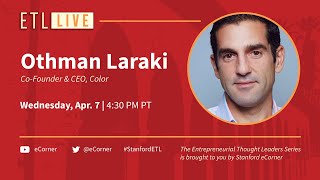
This content was created by GHION.AI . This content was uploaded by GHION.AI . This is a YouTube video titled "ETL Speaker Series: Othman Laraki, Color" featuring a conversation between Toby Corey and Othman Laraki, the co-founder and CEO of Color. The discussion, part of the Entrepreneurial Thought Leaders series at Stanford, covers Othman's journey, the founding of Color, its pivot to COVID-19 testing during the pandemic, and insights into entrepreneurship and market timing. The event was recorded on April 8, 2021.
Chapters
Immediately.
All right, we're live on YouTube. For the folks that didn't hear the logistics up front, I'm Toby Corey. I want to welcome you to Entrepreneurial Thought Leaders series. This is presented by stvp, the entrepreneurship center in Stanford School of Engineering and bases the business association of Stanford entrepreneurial students. Now today we are delighted to welcome an amazing speaker, Othman Laraki to etl. His story is so epic, his journey so incredible. This is going to be a fantastic interview. So quick intro on Othman. He is the co founder and CEO of Color, a distributed healthcare and clinical testing company. From population genomics programs to high throughput COVID 19 testing, Culler provides the technology and infrastructure to power large scale health initiatives. Now early in his career, Hoffman spent several formative years at Google where he worked on a performance infrastructure and client side software. And after leaving Google he co founded Mixer Labs which was acquired by Twitter in 2008. And @Twitter Othman was the vice president of product helping create the company's first revenue products and grew the user base from 50 to 200 million users. Othman holds a master's degree in computer science and management science and engineering from Stanford University. He has an MBA from mit. He's a longtime investor and advisor to leading companies such as Pinterest, Angellist, Slack, Instacart and others. And man, I don't know what he hasn't done. Welcome Othman. Welcome to the show.
Well, thank you for having me. I'm delighted to be here today.
Yeah, fantastic. Well, we have a lot to cover so let me just dive right into this. We caught up before this conversation and you told a really interesting story about cross country flight with your Color co founder and how you essentially decided to create the SpaceX of genetics testing. Now I was so impressed with that story. I'd love for you to share that story and explain how you saw that opportunity that ended up inspiring this current amazing company that you've built.
Sure. I mean that's, I think it's one of these things where you know, so actually it really started actually on the roof deck at Twitter even pre that where we, my, my co founder that started my, we started the Mixer Labs together and later we're both at Twitter at the same time and he has a PhD in genetics and but he went into the software world and so on and he happened to get his genome sequenced and he brought the data and kind of like we started just looking at the data that he had generated from that and one of the things that really struck us at the time was that there was kind of, it felt like there was this pretty interesting novel technology that was around genetics that enabled you to have pretty novel and deep insights into people's health, but for which the software tool chain was still relatively non existent. It was really still the domain of scientists who were using kind of Perl scripts to try to understand what was going on under the hood. And our initial thought process was like, well, it'd be interesting to see what happens if you have great Silicon Valley style engineers trying to make sense of all this data. As we started understanding the space better and just we're like, okay, what does the market currently look like? What are the applications of genetics that are out there? It turned out that genetics had already been kind of as a field going on for a while. And in fact, actually I had a personal relationship to it because I'm actually a carrier of a mutation in a gene that increases cancer risk. So I personally experienced it as a patient. And at the time, the experience that people had with genetics was one where it's like, it was this huge ordeal. It was, would cost like $5,000 to get tested. You need to meet with counselors and doctors and go back and forth with your insurance. It was like this big endeavor. But we literally, and we had at the time, you know, there's a lot of attention to SpaceX and so on. And one of the things we were like, you know, literally what does it look like if you put into a spreadsheet the pieces that it would take to do these tests with modern technology and really, does it really need to cost $5,000 or is it just because of the scarcity in the market and the market dynamics? And we couldn't make any sense of why it would cost that much. And so almost from first principles we're like, okay, we think there's a way to do this at least an order of magnitude less expensive. And that kind of kicked off, I think a bunch of questions in our mind because historically a lot of the pricing was set from a world where doing any kind of genetics used to cost thousands of dollars. And as the technology evolved down this exponential curve, the market didn't react and the price to consumers or patients stayed the same while the underlying cost had completely changed. And so that's where we're like, we think there's actually a way to do this in a very different way, which might just change where this building block fits in the overall health landscape. So that was kind of a little bit the starting point. Obviously a lot happened after that. But that was really kind of one of the first points where we were like, you know, thinking that there might be an interesting thing to do there and that we could potentially make a difference.
Yeah. That's funny. It sounds so familiar. I spent some time at SolarCity and at Tesla, and I remember Elon telling the story about how we got SpaceX off the ground and how we really use the first principles, kind of thinking. It sounds like you. You went down a very similar path.
Yeah. And I think. I think in some ways, I think in general, we don't tend to encounter a lot of exponential changes in our lives in general. And I think by default, we tend to underreact very much, as, you know, as a collective to that, like, both in markets as well as individuals. I mean, the last year around the COVID crisis is a great example of that. Right. Like, everyone, the entire world was sitting there seeing an exponential event happening, and it took a very long time to get the appropriate reaction. I think that happens both in positive and negative ways. And so I think that was just one among many examples of that.
Yeah, yeah. Well, look, I think too, like a lot of entrepreneurs, you ended up disrupting or starting to disrupt a really, what was an impenetrable space. Right. And sector. So can you talk a little bit about that? But first, from, like a system used to cost $5,000 and then down to 250 and then connected to that, like how you built a culture that can change a complex system rather than just deliver a product to the marketplace.
Yeah. You know what's kind of interesting, one of the things that's struck me over time through our journey here is that the thing that we thought was going to be the most important turned out to actually not be the most important thing, like, at the beginning. And what, even today. Right. Like where people think of color, especially in the genetic space, most people think of us as being interesting because we're a company that demonstrated that you could actually deliver these products in order of magnitude less expensive. But I think that's actually the second most important thing we did in this space, which is one of the things we realized over time was that across healthcare, the biggest barrier is actually not cost. Like, there's this kind of. There's a lot of talk about money and the cost of health care as being the big barrier. And one of the things that we realized is that even more painful and more challenging around health care access is. Is basic. Access is how simple and accessible the ergonomics of health care services. And like in General, one of the discoveries that I feel we made progressively over the years at Color is that it's all about like, you know, we people think that the challenge of health care is like science and medicine. Like, we need to create new therapies and we need to discover new, new blood test to find cancers earlier and so on. And those are great, but like, way more challenging and way more impactful on the real lives of real people in our society is like just basic access. And so we built this thing that, you know, changed the entire math around how you could help prevent disease and catch it earlier. But then we realized, like, actually we can't get it to people because there isn't a delivery system that is designed to reach populations in a scalable way. And I think actually that's by far the most valuable thing we built is actually the access machinery and the mode of delivering very basic things to a lot of people. In fact, actually that was at the root of kind of what. And we'll talk about it later. But like, all the work we've done in the last year has been deeply impacted by that around the infrastructure of delivery and that last mile of access of care much more than the kind of like super deep scientific work, which I think was very important to change the math. But even with the math change, you need to actually get to people. And to me, that's actually the most disruptive thing we've done and we continue to do.
Yeah, well, that kind of incredible vision and they have to execute like you have. Tell me a little bit about your culture and how you built that and what kind of skill set and what kind of mindset and temperament. How did you go about doing that?
Yeah, you know, to be honest, it's one of these things where better be lucky than smart. I wish I could say that we had, you know, very deeply planned it, but, you know, when we started Color, like, we did not realize how complex of a company it would be because, you know, like, all of us had been software people before and we only dealt in moving electrons. And when you're dealing with moving atoms and especially atoms that interact with people, there's a whole kind of like layer of complexity. And especially in healthcare where there's like, you know, such a huge kind of challenge of like, you know, not people talk a lot about regulation, but it's also even just like the burden of doing things that impact people and their. And their health and their lives. And so there was a lot of kind of pieces that we need to build. And I think what I meant by better be lucky than smart is that we got very lucky with the early set of people that joined us and that got involved with the company that I think ended up being deeply foundational to our culture and how we approach things, all the way from, like, some of the early scientists that got involved both internally, like full time, as well as some of our early scientific research partners, like, for example, the woman who discovered the BRCA1 gene, Dr. Mary Claire King, who used to be at Berkeley and now is at University of Washington, one of the top geneticists in the world, got very involved with us. We got a lot of these people that helped us be really good along these very different dimensions. I think that seed culture across these different dimensions, I think is really what enabled us to, you know, build a good product and even more importantly, I think build a team that continues to grow on that basis. I think that was probably the. I think one of the most important things.
Yeah, yeah. On our prep call, you and I had a fascinating talk and I was really incredibly intrigued as we had this discussion on timing, because the number one reason why startups fail, as it turns out, there's just no need for the product. And that's usually one of three factors. Either the idea just didn't have the loftiness to it, for whatever reason, or number two, the idea was good, but the execution was bad, and the product just didn't deliver a compelling experience for its intended user. And number three, there's this thing called market timing, and you obviously had some experience about that. But I think the question is how can entrepreneurs avoid being either too late or too early when they're excited about emerging technology? I know when I created my company in the mid-90s, had I started that company two years earlier, it would have failed. Had I started that company two years later, it would have been too late. So what sort of knowledge and kind of you think about there's some data that can come into that and how do you factor that in? How do you work with that piece?
Yeah, a few thoughts on that. I mean, first of all, anyone who tells you they can time the market, I think is just wrong. They happen, I think, when people have. I think. And maybe actually maybe there are some people who can time the market, and I'm not one of them. The. And I. And I feel. I don't know many people who would claim that. I think the odds of, you know, if you're approximate. I wonder if one way to break it down is like, are you approximately correct or are you very wrong? Like if you're more than five years off, you know, you're just off and you know, it's hard to tell. Like, you know, my first startup, you know, right out of Stanford was a mobile company and it was like multiple years even before the iPhone and Android, et cetera. And it was just like incredibly difficult to access the market. And you know, and that was just like no matter what level of insights we had then, et cetera, like we're not going to materialize the market. I think in general when there are like these like some, you know, new building blocks, new primitives that get introduced into our fabric of society and you know, disruptions and so on, I think those tend to be times when all of a sudden the ground becomes more malleable. And one way I'd think about it is you want to be able to have enough durability to live long enough as a company and a team that you are building value and building kind of your assets until the market really connects. And I think it's like I've either witnessed or been part of a few of these moments where when product market hits, things just go very non linear very fast. And I think there's no amount of creativity that will conjure it into existence. But I do think the best way to get the timing right is to survive until the timing is right, I think. And so, I mean, that's one way I would think about it. I mean, for color, I think it's been an interesting example. You know, we, we I think started very early actually compared to the. And really, I mean we were starting to grow and so on. But like, you know, the last year has been the inflection point for us and has completely changed the nature of our company and how we operate in the scale of what we can do. And that product market fit and our ability to be there for that was very much based on our ability to, you know, keep building and survive and you know, keep growing enough to be there for that. And then I think maybe the most important thing around the Pro that moment is when, when it's, when it connects, it's go time. And it's like, you know, all of a sudden like, you know, one year will be more intense and more value creating than the last five years.
Right.
And I think that's what we've had. So I don't know if there's an easy way to make it happen. I think it's really about, you know, trying to be around for it.
Yeah, no, I think you've articulated that really well, because it is, it's a combination of getting the right data and you can tell like if you're, you're not growing or your product's not resonating or it's not really breaking through through the market clutter, or are you just literally trying to keep cramming a round peg in a square hole, right? So, and it's something, there's some intuition that's baked into there and, you know, kind of some forward thinking. And I've seen it happen with so many great companies. So I think you have a really unique perspective on that.
Actually, one other interesting point that I've been thinking about around this too is like, it's always struck me especially for these, like, super scalable aspects of, with technology. I think when technology really works, it scales at the human scale, right? Like, it is like, you know, like great technologies. Whether it's like all the way from fire to the Internet, like when it's a great building block, the scale of those opportunities and the impact of those primitives oftentimes is way larger than what we think of at the beginning. And so one thing that surprised me multiple times is industries and markets that I thought were completely played out or just game over. And we were just at the first inning. I mean, actually, like, Google was a great example. I mean, I actually knew Larry and Sergey when they were at Stanford, you know, doing their PhDs. And I remember actually, like, I knew the person who helped them write their original business plan that they got their first funding from, from Andy Bethelsheim. And I remember hanging out at a barbecue and being like, yahoo. So big. There's all these search engines. You know, search feels like it's just over. Like, you know, that game is already played out. Why would you go do search? There's probably so many more interesting dynamic things that are out there. But, you know, search had not even really started at that time. Right. And I feel that happens like again and again. And it's happening even in social, right? Like, it felt like, you know, social was over with Facebook and then, oh, no, no, it's actually there's Instagram and WhatsApp and then, oh no, there's TikTok and Clubhouse. Like, it's just interesting how these primitives and kind of components, kind of how much longevity and ongoing opportunity there is for innovation and. And so that's another thing that surprised me many, many times.
Well, I think if you're right, if you're just so stuck in, like, hey, here's my idea, and it has to Work and you just keep again, cramming that square peg in a round hole. I remember I did a little sports app, this was before Facebook, and built this big app and did all this great stuff. And it turned out we had this one little widget where folks could communicate during a sporting event that was just like a small side thing we did that turned out to be the most popular thing. But wouldn't have known that we didn't get the product out there and start seeing what they were using and collecting all of that data to really understand where we need to kind of migrate our strategy to. So I think your points are well taken. One of the things that I think our students would love to hear, everyone obviously hears all the good stuff. Like this thing was a rocket ship, billion dollar valuation out of the gate. Things were great, super smooth sailing. We both know that that's not really how companies are built. But could you maybe talk about one or two of your most challenging times, like pivotal times when you had to make some really tough decisions and resiliency and you know, some of those things that really made an impression on you when. When it's tough. When it got really tough?
Yeah, totally. You know, I think especially for, you know, founders or people who are in leadership or CEOs or whatever of, of early stage companies, I think one of the most challenging patterns that's, I think are things that involve either expansion or contraction of your, the identity of, of what you are doing. And what I mean by that is like, you know, the, you know, to build something, especially when you don't have full products market fit yet and so on, you need a lot of faith and you're selling the dream to people, whether it's investors, people who you want to join you to help build it, and so on. And so you obviously need to have a lot of optimism and conviction around like, okay, this is the picture of the future and you rally people around that. And in order to build a great product, we together have to believe in that kind of definition of the future that we're all kind of gunning for. But we're getting feedback and data and the world is changing under us. And I feel like over time there have been like both times when we wanted to narrow our definition where we were shedding part of our identity and part we wanted to expand it. That I think were some of the hardest moments because it feels like you need, it feels like some people will feel that you break their promise, a promise that you made them, you made to them, where people feel like you told me, you know, that we were going to build a company in this box and that was the thing that was going to change the world. And now you change anybody know, it's a triangle. And that's not what you promised me. And I think that's one of the, like, it's something that's always a challenge for, you know, as a, As a founder, as, you know, someone who's trying to, you know, really the promise or really what you. The real goal is, is to build a company that is going to, you know, like, I want to build the most important healthcare company of our generation, right? Like, that is really the goal and the path that might take might change a lot. And so, like, I think two examples of like, where I feel like those are that one, one, I'll give you one contraction one, one expansion, one. Both of which were interesting and challenging. I think one was that, you know, we built this great genetics product that was, I think probably and probably still is like the best clinical genetics product on the market in terms of the simplicity of access, the quality of the genetics and so on. And we were trying to find how do you get it into the market in a way that scales to create a great business and a growing business and so on. And there are many paths to that, right? Like, we were like, you know, there's one path which was like, you know, more direct to consumer, where people just buy it out of their own pocket. One which is like the traditional clinical channel which is like, oh, you know, you convince doctors to order for people and then you bill insurance and goes through the traditional. Just be better at the old way of doing it, or there's going into a new market or new way to access the market through payers, through sort of through. Through employers and other sponsors of like, you know, other people who care about large populations of people. And about three years ago, like, you know, we were. We had like kind of this hedged approach that. Where we had more of a consumer side, more of a clinical side, that was more of a traditional diagnostics company and one that was more kind of like these large institutional programs. And the first two were existing markets, but one that we decided were not great markets, like, they were not the way in which you were going to change the world. And there was this other one that were like, you know, we think this is the pattern that aligns with the future, but it's still very speculative. And so we decided, and I decided that we were going to cut that third of the company that was actually trying to Go after those kind of, like, legacy markets that were clearly not going to be the future for us. Then we were convinced we're not going to be our future. And so that was, I think, one of the most challenging things I've ever done in my career, which was to decide. And, you know, and a lot of these people were like, you know, so I had a. You know, I had to let some people go. I had to restructure a big part of the company, inject a lot of uncertainty, basically. There's kind of like, you know, a lot of safety and feeling like, okay, well, there's this old crank that exists that, you know, at least is survival and saying, you know what? Actually, I remember, like, sitting, like, standing in front of the company and being like, you know, we're getting. We're letting go off the raft and we're swimming, like, there's no more raft, and we're going. And so. And that was very scary and. But probably maybe one of the most important and impactful choices I've ever made that I think, you know, and obviously, it was very challenging and, like, you know, to do it also with compassion. And, you know, these are all people, you know, impacted people that I cared a lot about that, you know, were close friends and so on. And so, like, we wanted to do it the right way, but really there was kind of, like, about, like, what is the right path for the company? And it was a contraction of our definition where it's like we were letting go part of who we were to try to be who we wanted to be. Right. And the other one that I think is kind of almost the opposite is what we did with COVID last year. And maybe we'll talk more about it, but, like, I felt like there's a very similar thing that happens when you redefine the. The canvas in a way that to people feels like, oh, this is defocusing, and it's letting go off our identity. You know, for a lot of people, like, you know, we. Because we were doing amazing work in genetics, saying, oh, now we're also going to do things in infectious disease. Felt like, oh, are we letting go of who we are? And it's like, no, actually, like, you know, what we want to be is, like, the best health care company in the world, and that touches a lot of things. And let's. And there's a whole redefinition of our identity that's much more broad that I think that was the right time to do that. And so I feel like those are the Two types of patterns that I think are both challenging, but I think sometimes the most impactful ones that we can, you know, we can make living this experience.
That's fascinating. Well, look, you teed this up so well, so let's pivot to Covid. And let me remind the students out there, we're going to be opening up the Q and a in about 15 minutes, so get your questions queued up. We'll probably get those first. You can also vote those to bump those up. So remind the students for that.
All right.
You created a super high throughput automated COVID testing laboratory. And I think what was interesting is that you figured out a way to integrate that with public health tools. I know you're testing facilities in Burlingame, but I think the last number that I saw, you're processing clinical samples of the capacity for tens of thousands of samples per day. But your initial business was focused on genetic testing.
Right?
We talked about that. Not virus testing. And then along comes this asymmetric event called the pandemic. So talk us through a little bit about that asymmetric event coming in, how you made that decision to attack Covid. Rather just stay on kind of your initial thinking and how all of those kind of vectors came together and got you where you're at, because that's fascinating.
Yeah, you know, it's. It's kind of interesting trying to, like, think back because, like, those were so, like, you know, sometimes you go through these very intense times where time and events kind of like get a bit, you know, like mixed and compressed. But like, you know, what really happened at that point was like, you know, so because, you know, we're in the space. And so in general in the healthcare space, I think we were very attuned. You know, for example, we, you know, we shut down our office way before, you know, all the kind of other companies and so on were in order initially, actually, we shut down our office to protect our lab, our lab team, because we were like, okay, just the density of humans increases likelihood we'll have an outbreak. And who are the people that have to be here to do their work? We want to keep them safe. And so we initially. But we kind of got kind of deep into the, you know, what's going on with COVID and trying to understand it, just to protect our own people progressively as that was happening. I think one of the things that kept being really striking is like. And one thing that struck me, I feel, at the time was like, you know, we feel when the world is kind of running, you Always think that there are people behind the curtain that make stuff work. And I think a lot of us were convinced that we see all the movies and we think, like, okay, something like this happens, someone in D.C. is going to press a button and, you know, people in hazmat suits descend and they're going to, you know, solve everything, you know, in a few days, and it's fine. But you realize, like, you know, there's no one behind the curtain. It's like. And it's like, you know, it's just us. It's like people like us. And one of the things that, you know, for us that really started, you know, you know, ticking for us was like, you know, a, this is increasingly seeming like a singular event, like probably the biggest health crisis of our generation. And it was increasingly being clear, like very, like, you know, early March. That was like, very clear. That was probably where we were heading. And B, we felt like we were like one derivative away, one degree away from being able to have a very big impact. Like, you know, the question we're asking ourselves is like, okay, clearly no one has a clue what's going on right now. And so if not us, who? Right? Like, if it's not people like us, who can make a difference and who will, who will like? And we couldn't come up with a better answer at some level. And so we just started, like, there's initially a very small group of people. Like, it was like, literally it was four people where we were spending about 18 hours a day calling everyone we knew who was somewhere in the space just to get their perspectives and to understand, like, their hypothesis where things were going. And after, like a couple of weeks, we came up with a few conclusions. Like, one was, we felt on the testing capacity side, there was a big dearth of just basic testing capacity. And we felt we could actually, we had built, we run an incredible lab in Burlingame. Like, because of all the work we do in genetics, which is actually much more involved than COVID testing, we're like, you know, we actually are running one of the most interesting high complexity labs in the country. We think we can take a relatively unique approach to actually running COVID testing. And then equally importantly was like, you know, from our genetic experience, like I was talking about earlier was like, you can make all the beautiful technology you want, but you can't get it to people in the US because we don't have a public health system. And that to us was actually a much bigger blind spot that we felt was very generalized and we felt we had a better answer for. And I think that ended up transforming the company in a very deep way where, like, you know, right now we're, we're running, you know, some of the biggest, like, COVID testing programs in the country, running some of the biggest vaccine programs in the country, where it's like, it's all about that simple last mile. How do you disseminate very basic healthcare building blocks deep into people's lives? And to us, that felt like actually that was. There was going to be a repeated version of that as we all kind of evolved through the crisis. And so. But initially it started off as four people. We then started working on the, on building our lab side and then working on the software side again, like as small grassroots effort. I mean, the initial, it went from four people to maybe about 20 people that were involved in the kind of the core thing. And then it kind of like spiraled from there and so. And it just kept growing.
So that's fascinating. What an incredible insight. Well, so as you're seeing that opportunity emerge out of nowhere, what was it like to get your team to shift? Right, because they didn't join an infectious disease company specializing in this pandemic.
Right.
So what was that process like? And how did you get everyone aligned and execute this enormous program?
Yeah, you know, it's one of these things, honestly, I don't know if. I kind of don't even know if I've done a good job at that, to be honest. Like, I think it's just a. Generally, it's kind of like what I said, like, kind of was referring to earlier about, like, I think one of those challenges of like those kind of expansion and contractions of identity and mission and, you know, I think, I guess I feel pretty good about where we've, how we've. How we've weathered it, but I think it is really interesting to, as a collective, right, Especially as, you know, the companies, you know, we're about 500 people now and you know, in a highly dynamic way environment, you know, I think one of the most interesting challenges and opportunities, you know, for people in leadership is how do you effectively communicate and bring people along for an evolving mission and vision? And I think it's like, you know, I think that's something that's like, you know, very much something that's an iterative process. Right. Like, and, you know, because I say, like, I'm not sure because, like, I'm. That's something I'm still, you know, you know, trying to do a better job at, you Know, as a CEO of the company where, you know, like things are still changing very, very rapidly. And one of the things that I'm a big fan of, the kind of the anti fragile Nassim Talib kind of book from the mindset of like, even for an organization, how do we make ourselves embrace entropy? Like as a team? I think one of the more biggest assets we can have is like to be a team in an organization that is able to effectively ingest and react to the dynamic nature of the world. I think that is, I think how startups really get an edge and have an advantage because that's not something that a 50,000 person organization can do. But for us it's hard, but we can still do it. And so I think that's kind of, I think one of the. But I think actually one other comment on this is I think it's also been another interesting challenge, I think for people, for all companies of all sizes in this last year is all of a sudden this move to a virtual work setting where we used to get all of this communication for free, that obviously we had the communication for meetings when we all show up to a conference room or something, but we used to have I think all this ambient between teams, people seeing each other in conference rooms or while they're having lunch and so on. And by moving to a zoom and slack primary communication channel, every, all the communication and transact interactions have become highly intentional and transactional. And I think one of the things that will be interesting for us collectively, you know, not just color, but like, you know, is how do we, you know, build and have teams that cohere and work together well and so on in this world that's increasingly, you know, virtualized. And where the communication channels I think are where you lose a little bit a lot of that kind of like human randomness of communication. And I think that, I think there's an interesting opportunity around that, like how to create that in a digital world. And so I think that's just something that, you know, we're definitely thinking a lot about as, you know, as a growing company.
Yeah, I think that's a super insightful trend. All right, a couple more of the topics and then we're going to open up for some Q and A. I see a whole bunch of questions are popping in there. People are voting them. So keep adding your questions, keep voting. In addition to all this amazing work that you've done, you're also an angel investor. So tell these budding entrepreneurs on today's.
Zoom call.
What does A breakthrough idea look like. What does an entrepreneur look like that you would be willing to write a check for? What do you look for as an investor?
It's one of those things where it's like, for example, if I look back, um, frankly, like my initial guess about which things we're going to do, bet you know, better or not, et cetera, have in general not actually been that accurate. I think in many ways I think it is the. Seems to me like one of the dominant effects is which spaces are undergoing a high kind of phase of entropy or high kind of like, you know, it feels like each kind of sub industry goes through like a window of time when it's ingesting or metabolizing all the new building blocks we have. And different industry, it happens at different industries at different times, sometimes for structural reasons and sometimes just, I think there's like a randomness of like things that, you know, create that catalyst. But I think, you know, probably, I'm guessing like, you know, when you look back at this like 30, 50, 30 or 50 year window of time that we're living through right now, it's going to be one of those kind of like Cambrian explosion events of humanity's kind of productivity and creativity. Because all of a sudden we've brought in all these building blocks at such a rate that dramatically increase the liquidity from ideas to reality and the ability to achieve, for those ideas to achieve scale. And that's. And I think that's just like fascinating to try to understand like, or try to make a guess about when that's going to happen for different slices of our lives. Right. And so, you know, I think we're all part of like this one very big arc of like, you know, the kind of, you know, software and communication technology and so on and that has a bunch of like subject s curves of these kind of like individual industry explosions. I think that, and I think that ends up being actually one of the dominant factors is like, you know, trying to be involved with that at different phases. And I think for example, like healthcare right now is like, I think going through that, you know, incredibly, you know, highly malleable, you know, intensive iterative process where like all of a sudden the industry is like, you know, able to ingest a huge amount of like change and innovation that wasn't even possible a year ago. And so I think that's kind of like one way I think about it is like, you know, it feels to me like right now, you know, probably healthcare is, you know, a huge one, you know, obviously I think like the kind of digital currencies is, you know, clearly kind of going through a. Actually that's another example of ones where you thought it was played. You know, we all thought it was played out a few years ago, but like, I think this is now when it's actually happening. And so, you know, so I think that's kind of like, you know, one way I think about it is like, you know, when are the most dynamic phases and then beyond that, it's like just trying to bet on good people, you know, and in general, it's like, you know, your past experience with someone that, you know, you've seen people do good work with high integrity, you know, that's probably the best bet you can make.
Yeah, yeah. Are there any other attributes you look. Because obviously as a. As an early stage angel investor, lots of times either the product's not done a certain amount of revenue or they're not scaling it anyway. So there's not a lot of data to evaluate the performance of those founders. So in addition to sort of their past work, which I think is interesting, we actually had to talk about that in 178. We can expand upon that when you join our class, but is there anything else that you look for or any other clues or patterns? You mentioned integrity, which kind of goes without saying, but any other insights?
I think, like, I mean, I'd probably like. It's like integrity, creativity and grit, you know.
Okay. Yeah.
And, you know, I think like, you know, I think grit is just to survive long enough that if you have the opportunity to have product market fit, you'll, you know, you'll go for it. You know, I think those are probably the, you know, the key ones. The keys.
Yeah. Yeah, I would agree with that too. So. All right, before we open up for questions, I want to actually finish with something completely unrelated to everything we've been talking about here. But when you were at Stanford, that was in the late 90s, and you actually helped produce some of the very first ETL talks. It's now more than 20 years later, and here you are as a founder rather than a student. Can you tell us what you remember about how ETL got started and were there any pieces of the original vision of the series that you seem to have carried through to today? So I'd be fascinated to understand your perspective.
Yeah, I mean, it was like, you know, sometimes how, like, again, like, just randomness changes the course of your life in a very deep way. And literally my involvement with Bases as an undergrad was probably the Single most important thing that happened to me while I was at Stanford. But so where it started, literally, I was, you know, as a CS undergrad, I was sitting in my dorm room one night and I was kind of, you know, getting a bit tired of programming, so I was like, okay, I'm gonna. I just went to the Stanford homepage, so. Stanford Edu. I was like, what do I. What am I interested in? And I'm like, I don't know, business and engineering. And so at the time, basis actually was called the Business association of Stanford Engineering Student, not entrepreneurial. That was like a renaming that happened later. And so. And this pastel blue page with a rainbow came up that was kind of like this kind of like, you know, just like someone who just took half an hour and wrote some HTML. I think it was a student called Mendel. You, if I were correctly, was an stdp, one of the very first STDP fellows. And. And, you know, and it had just started just the summer about three months before. It was, like, five, you know, initial grad students who started it. And so I just emailed them. I was like, hey, you know, what are you guys up to? Can I. Can I join you guys? And so I showed up. And so, like, it was them. And, like, I think I was one of the first people who kind of like, showed up. And I was like, the only undergrad. It was all these PhD students that at the time, to me looked like, you know, you know, gods on earth and wondering how they, you know, how they existed. And. And from there, ended up meeting Tom Koznick, who was, you know, the kind of the spiritual leader of that generation. And. And then, actually, I think. I think. I'm not sure if my memory is correct here, but I think literally the. I think it was the first etl. But Tom gave me the email address of this entrepreneur who I'd never heard of, this guy Masa, from a company called SoftBank. And I just emailed him. I'm like, hey, hey, dude, do you want to come do a talk at Stanford? Which obviously he was very excited about. And so he showed up and gave a talk. And I think that was literally my. If I'm not misremembering, I think that might have been the first person I invited.
Wow, that's fantastic. What an amazing story. All right, let's see. About 5, 15. So we got some really great questions in here. A number of them have been voted on. So let me start with the number one voted question. So it goes like this. The pandemic has allowed some businesses like Color to prosper. How are you trying to plan for the post pandemic world in your new business strategy?
Yeah, it's a great question. I mean, so the way I think about it is like, you know, I think the. When you think about the pandemic, like, you know, with COVID right, Like it's something that's going to be. It's an arc of like, you know, a challenge that we collectively have to face. I mean, you can think of it almost like as a, you know, a global war or something like that, where it's like a very highly disruptive event that we're all collectively societally dealing with and it's kind of creating an arc of disruption. But I think what's going to happen is that the post pandemic world is not the pre pandemic world. Like, I think what has happened and what is happening is creating a permanent change in how we live our lives in certain respects and for the way we think about our strategy and what Color is about. It is about building the public health infrastructure of the United States. That's literally how we think about what are we trying to do. It's like if you wanted to build the largest health system in the world that is reachable in every school, in every church, every community center, every place of employment to do basic healthcare services for people which we do not have in the United States, what would that look like? And I think what the COVID crisis has done is that it has forced in some ways and catalyzed the creation of that infrastructure. And so when I think about what is our long term goal and opportunity, I think that's what it's all about. And so the need to be able to do basic things for people's health as part of their lives instead of waiting for them to get sick so that they come to you in the hospital, I think that is like the, the thing that wasn't needed before, but we didn't have the activation energy. Like one, one example, one kind of analogy I use for this is like, you know, it's almost like how, you know, the highway system in the United States was created as a side effect of the world war to transport troops and equipment across the country. And you know, obviously that's a piece of infrastructure that has completely changed how we live our daily lives, right? Like how we think about commuting, how we think about access to work and food and healthcare and so on. And I think that kind of it pushed us up past this activation energy for something that we have needed for a long time. And now I think it's finally happening in a really real way. And I think. And that's really what how we think about what we're doing at Color.
Yeah, I think your opportunity is huge. You're 100% right. I think that Covid's changed the world in ways we can barely imagine right now. And I remember, and I was involved in Internet 1.0 and creating a company at that time, and I remember sitting down with some CEOs and talking about this thing called the Internet. And they're like, well, is that like the fax machine? It's going to go out of style in three or four years. But this pandemic really, I think, shifted and he used the word lifestyle. And I can see that just in healthcare alone, where prior to this you couldn't do a meeting with your doctor over a zoom call, now it's standard operating procedure. And the value of that is so extraordinary. And you're right, it's to get some preemptive work done because it's too hard, it's too complex, and there's just too much friction and cost. And I think your opportunity is massive.
And especially for people that are like the most underprivileged members of the COVID crisis has kind of brought that into focus where it's like, you realize it's not because we don't have labs that run tests or we don't have medications like we've had. When vaccines showed up, we all saw how long it took to start getting them to people. And we still have to face the real hurdle. I think that's going to be the most important issuing challenge is like, how do you get it to not the people like us who white collar can use the Internet, can take time off work and so on, but like farm workers or undocumented migrants or people who are skeptical about big business, the government and the health care system, like, those are the people that we need to reach to really have a public health impact. And I think that's what this kind of cycle of healthcare infrastructure really needs to be able to do. And so I think it's like, it's really gonna be a very deep and permanent change in how we think about just basic public health.
Yeah, you're 100% right. It's really all about a complete shift in the infrastructure. And I know at what Tesla really did. All those cars really ordered online. When did you order cars online and pick out what you wanted? Same thing with solar. All of that Infrastructure to take this grid that's expensive and 100 years old and transform into something that's modern, 21st century, that can focus on this massive climate change issue that we have. Let's see here. Can you elaborate on your career path and how that led to where you are today? I think that's a fascinating question. Starting out writing code, you're obviously very intellectually curious and a very growth mindset. But how'd that happen?
Good question. I guess I've kind of swung between larger companies and smaller ones, but I think frankly actually one of the patterns, actually I've never thought of it this way, but a very consistent thing that's happened of every one of those has been connected to people that I just thought were, you know, great people and I thought were impressive or smart and you know, I just, or, and high integrity that I really wanted to work with. And at least for me that's been actually one of the drivers where each one of these steps, I think, you know, so much of your life experiences doing work and so trying to optimize for things that are intellectually interesting with people that you really want to spend time with and you enjoy going through challenging times with. So I think that's been, you know, for me, I think the big driver, you know, one. Actually one other pattern that's kind of, I thought has been interesting is like, I think oftentimes I notice that people can be very self limiting because they think they're specialists in something or not specialists in something and think that there's this like really big hurdle to enter a space. You know, for example, a lot of people don't enter health care because they're like, well, I don't, I'm not a doctor or not. In reality, the people that we think are specialists, you know, that was an investment of one or two years. You know, you can actually get very high up the, you know, specialization curve relatively quickly. And so I think that's, you know, I mean, I mean your, your, you know, your, your examples, Toby, I mean with, you know, you know, someone like, you know, Elon Musk who is kind of, you know, across these industries that on the surface have nothing to do with each other.
Yeah, he never worked.
And you know, I think like, you know, and I think, you know, not all of us can, you know, I don't think I could, you know, be, you know, be deep in all those things that same way. But like, I think all of us can be relatively quickly deep in at least one thing, you know, every few years and So I think that's, you know, something where it's like, if something is interesting, it's actually probably not that big of a hurdle to at least pick it up.
Yeah, well, I think your career trajectory is just fascinating. And I think that one, you have this incredible intellectual curiosity and then you've actually gone out and experimented and tried a lot of things. You've seen a number of things and I think that's just such an important way if you want to be a successful entrepreneur, is how you've got to really be thinking going forward. So I think your path of getting, you know, working for some mainstream companies was really valuable and those things just led to this process of where you got to today. So this is a pretty quick question, I think, and I think it's a really important question in the age of Big Brother and data hacking that were going on. So how does color protect patient data and is it ever shared with third parties?
Yeah, it's super important. And so I think it's one of those things like that. I think one of those examples of like, as a broad society we are part of the thing that we're metabolizing together is like, how do we deal with, you know, a world where there's. There our ability to generate, store, transmit information has been. Is. Has grown to orders of magnitude than it ever has before. Right? It's. And, And I think that creates a huge amount of power, like value creating power and opportunity. Right. Like the same reason we can, you know, listen to music or why, you know, we can make all scientific discoveries and all these things that like, you know, incredibly valuable, but then they can also be misused like. And I think that's like, you know, one of the, one of these things where it's like, I think in some ways technology has no ethics, right? Like, technology just is, right. Like it's just kind of. And the ethics and the kind of is comes come along with the frameworks and how people utilize it. You know, for us in health care, you know, we are dealing with some of the most sensitive personal data sets in people's lives in our envelope of data for each one of us. And so the way we think about it is like, you know, historically the framework around health data had been that it's housed in the filing cabinet of a doctor and sensitive, but it's in one filing cabinet. Then they put the filing cabinet to these EMRs. So it's like in a hospital, in general, hospitals are actually like really bad at securing health data. It's just like we don't have that impression just because they're distributed, but they're getting hacked all the time. But the question is, for the future, what is the right way to manage health data? One conviction that we have as a company, is that the best way to do that is that treating it as you being the primary custodian of that data and operating with the principles of representing you, the individual, and treating the data as belonging to you. Because I think from our perspective, there are times where actually there's a lot of value that you have in the data being shared. And so we want to make that as easy as possible, but also we want to ensure that there's no use of the data that we make that would be counter your expectations. And so the way we think about it is like, is this going to surprise someone in the negative way if data is used in any way? And so we try to go to very extreme lengths to ensure that we stick within the contract of expectations that people have of us. And again, it's like, it's not a perfect framework, but I think for us, that's been kind of, in general, like, one directionally very valuable way to think about it is like, it's your data, and our job is to use it in the way that you expect us to.
And to change your expectations as well.
If we think there's a use that's important, we can help you modify your expectations, but that's the burden that we have to carry. Yeah.
Well, I know we're just about out of time, and I have some quick closing remarks. I do want to get one quick question out there, because I think it's. I'm going to concatenate a few questions out here, and I get this question often the time, but students are always asking, do I go right into entrepreneurship or do I work for a large established company? Kind of looking back on yourself, is there a right or wrong answer, or what advice would you give? Do you want to be a product manager at an established company, or do I start off on my own?
I mean, I don't think there's a single path. I mean, it's like, I think the. I think the main thing is, like, you're never ready, and you're always ready. I think from that perspective, it's like, if you want to do it, you should. Don't wait like, you know, the most precious asset we all have is our time. And so, you know, I think the thing I would not recommend people doing is, like, if they really want to go start something, to let people talk them into being like, okay, well, I have to bide my time and build my experience for 20 years in a big tech company before I can do it. I think that's actually the wrong reasoning. If you want to do it, you should go do it. Um, but, you know, like, don't wait to be, to be ready, because you never will be. It's like, you know, or you already are.
Yeah.
Yeah.
Great question. Great, great comments. All right, folks. Othman, thank you so much. This was a really, you know, great talk. And given your history with ETL and being our leadoff hitter for spring class this year, 2021. Just awesome, awesome talk, awesome story. I loved it all. And to our audience, thank you for joining the Entrepreneurial Thought Leaders series. Next week, we'll be joined by co, founder, president and CEO of Cloud Fair, Michelle Zatlin. You can find that event and other future events in this ETL series on our Stanford E Corner YouTube channel. And you'll find even more of our videos, podcasts, articles about entrepreneurship innovation at Stanford E Corner. That's Ecorner, Stanford. Eduardo, as always, thank you so much for tuning into etl. Have a great day.
More from GHION.AI


O processo de reconhecer limites, mesmo quando a vida parece exigir sempre mais.





Depois de tantas histórias, aprendizados e pausas necessárias, o @interior_iza está de volta



