ETL Speaker Series: Patrick Schmitt and Jenny Xia Spradling
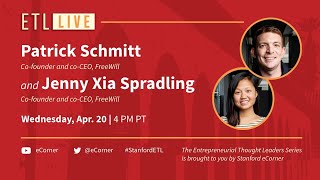
Patrick Schmitt and Jenny Xia Spradling, co-founders and co-CEOs of Free Will, discuss how they built a company focused on values and their approach to leadership and growth.
Chapters
Good afternoon, I'm Toby Corey and I want to welcome you to the Entrepreneurial Thought Leaders series. It's presented by stvp. We're the Entrepreneurship center in Stanford School of Engineering and Basis, the business association of Stanford entrepreneurial students. Today I am incredibly delighted to welcome Jennifer Jos Balding and Patrick Schmidt to etl. How you guys doing today?
Really well.
Fantastic. Well, Patrick and Jenny are the co founders and co CEOs of free will. And for those that don't know what that is. It's a social venture that has helped charitable organizations generate more than you ready for this? $3.7 billion in new plan gifts, stock gifts and qualified charitable distributions. It's just unbelievable. They were recently named two of the top 50 philanthropists in the world by Town and Country. Schmidt previously served as head of innovation@change.org I'm sure many of you are aware of the fantastic work they did there helping to grow that organization to 200 million members in just four years. Josh Spalding is an alumni of McKinsey and Bain Capital where she helped start the largest impact investing fund in the us. She was also a co founder of Paribus, a fintech startup that exited the capital one. She was also featured on the Forbes 30 under 30 list. And get ready for this. They Both earned their MBAs from Stanford University's Graduate School of Business. Let me welcome you both and how are you today?
Great, thank you for having us.
Fantastic. Well, we have so much ground to cover. Let's jump into it because I have definitely limited time here. So I want to just start off with Freewheel's business model because it's quite unique. Your company is all about philanthropy, but you're also really fast growing. And on top of it, you're venture funded as a profit startup. So let's just get started. What do you guys do and how do you generate revenue?
Yeah, great question. So Freewill is now actually yesterday our 200th employee accepted an offer. We've crossed about five and a half billion dollars in giving. So how did that happen? What does it mean? Well, five years ago when I met Jenny on Stanford's campus, we were both grad students. What we realized is that by far the biggest donation that anyone ever makes is a gift in your will. And so you might give 20 bucks, 100 bucks, even $1,000. And. And then when you pass away at some point, you might give away 20% of your whole life savings. And that's an enormous amount. And this becomes incredibly important as demographics are changing over the next 10, 15 years. So what we realized is that if we can make this type of giving easy, we could raise enormous amounts for charity. And the way we did that is we said, okay, why are people not donating more than they will right now? And it turned out to be two things. One, people hate estate planning, and two, when you actually do estate planning, no one asks about charitable giving. So what we came up with together was let's create an estate planning tool that is totally free, hence the name free will, and really nudge charitable giving in the process. So people give about five times more when they use those tools. And the business model is that we started out selling custom versions of these tools to nonprofits who could then share it with their own supporters. Those supporters would get a totally free service, right? They get estate planning, which they totally need and didn't have already. They get it for free. And many of those people choose to give to that charity in their will, resulting in enormous giving. And over time, we built that software, sold to charities, they loved it, and they said, wow, this is great. But we have some other types of giving that we can talk about later. Can you build tools for that now? So now we have about four different products on different types of giving that nonprofits all pay us for on an annual subscription basis.
Wow, that's really cool. I totally get the consumer side of that, Having gone through that process. It's really expensive and it's incredibly arduous. It's incredibly complex. So that seems like a no brainer. Tell me a little bit about on the charitable side. What were they lacking and how does your technology and offering solve some real problems for them?
Well, what we saw is that historically this thing called planned giving, which is, how do you help people and how do you ask people to leave some money in their will because the gifts are so big. Stanford itself has received some enormous gifts this way. And what we realized is that the nonprofits, what they were doing is they were just sort of sending out a bunch of direct mail and hoping. And it was so distant, right? The gap from asking to you actually putting your will might be eight years apart. It might be so distant. And by shortening that distance and saying, would you like to do it? By the way, Here's a way to do it right now just created an enormous shift. And we sort of talk about the old way was like, you know, sending an email about donating and making someone go get a mail order check from the bank and sending it in. It was so difficult and so onerous to Be giving that by making it really easy and simple for something people knew they ought to be doing anyway. It ended up being, you know, quite life changing for a lot of organizations.
Yeah, no, it's, it's awesome. I definitely went through your site. It's the UI UX is incredible. So congratulations on taking a really complex process and make it really easy and really compelling. Let's shift gears a little bit because what I'm really most interested in and what Generation Z is most interested in, we touched upon this in the past, but you guys connected based on a series of shared values rather than a business plan, which is quite unique. 99.99% of businesses really start with a business plan and the need in the market. But you really focused on the value side. So can you talk a little bit about what that means, what the process look like and how did you kind of get, you know, vibing in general, the founding free will based on this, the start of values. Yeah.
Well, I was very fortunate to meet Patrick within a week of stepping onto Stanford campus. And the very first time we met, I still remember it was a 15 minute walk. It was gorgeous out. We were, you know, just talking about each other, each other's backgrounds and the first signal of we might have something here is we both talk really quickly and we get very excitable. So instantly that energy was just there, you know, almost that chemistry that you're looking for. And so 15 minutes in, he pitches me the idea for Free Will. And having done some impact investing before, I thought, wow, this is a combination of three incredibly unsexy industries, but that together are incredibly innovative and could really be a win, win, win across the board. And so our first meeting after that, you know, I'm a math person. Growing up I did math competition. So I would think, okay, we're going to business model, we're going to size the total addressable market. But it was really Patrick's push to say, like, actually let's just get in a room and talk about values. Like are we even close? And so we spent an hour and a half in a small classroom with whiteboard just writing down, hey, what is the way in which we would like to interact with each other, with our customers, with our employees, like with the world. What do we want to represent? And that ended up being one of the most important meetings that we've had in our five years at Free Will. And it continues to be today. The reason why people join, the reason why people buy from us and the way that we operate with each other. So we ended up with four values. Kindness, joy, courage and focus. And one thing I tell folks is yes, you can have pretty values on your website, but unless it is a day to day lived experience, they aren't real values. And I think we've done a lot of work setting up the traditions and just the experience as soon as you reach us, whether it's as an employee or as a customer to really feel those values.
Yeah, that's amazing because as you may or may not know, the number one reason why early stage companies fail because of no need for the product. And the second reason is people, the wrong folks involved, especially at the founder level. And then the culture just never gets on track from the start. So the fact that you guys took some time and did that up front is really novel. And I think more importantly, how do you thread that through the organization? How do you lead by example? And it's one thing to put a slide together and lay out all this great altruism and great stuff, but then the hard part comes in and getting it through the organization and people feeling it and believing it and acting in that way. What did you guys do to get that threaded through your organization and how that whole process work? Because that's quite interesting too.
I can speak to this a bit and then. Patrick, pile on. Honestly, we could talk ad nauseam about our values, but I'll give you some examples. So kindness, for example, I mean a lot of what kindness means to us is not necessarily being nice all the time, right? It's not just like only giving compliments or only celebrating. What it actually means is kind of like meeting people where they're at, like as humans. And so it is the small acts on a day to day basis. Like for example, when we shared an office, everyone would wash dishes and put them away. You know, it was that sort of office. Like if we ran out of coffee for some reason, you know, the next day you would come and two different people would have brought extra coffee pods for the team, just. And it's those small things to really care for each other as humans that I think have really continued to perpetuate throughout the experience. Still today, you know, we just onboarded, I think are like 185th employee. And the consistent thing we get is like, wow, you know, you told me that folks were kind here, but I saw it every single day in every single meeting. And when folks come into that experience, well, it turns out that they end up being the kindest version of themselves to the next person too. And so a lot of that perpetuates just from early modeling and those small acts that you might not think matter.
Yeah. How about for your side, Patrick?
That's. It's a great point. I mean, a couple of examples is, you know, we score for kindness in the hiring process. And practically, what does that look like? You know, you can't just be like, oh, you know, she looks kind because she's got, you know, soft, soft features, or whatever you say. Okay, you know, tell me about something that didn't go well. And do they empathize with the other people in that project where they say, I really did my best ever and then product screwed it up? Well, maybe product did screw it up. But do you have a sense of why that happened? Are you thoughtful about it or are you just blaming folks? And so you can start to do that. And I think it brings this culture of people just looking out for each other. And one other thing we do that I really love is starting with, I think, our first employee. We created a list of pre readings and a bunch of them were our favorite readings at grad school. But there's something called Radical Candor. There's a whole book. It became a book, but it was also a nine page article or eight page article about how to give feedback. And so we really set the tone before you get here and then you show up. And people have really carried it forward this week. This past week, we have been as a team working on sort of addressing everyone as guys. Less right team is way more than 50% female. But I think colloquially a lot of us will say hey, guys, as sort of a meaning of hey all. And someone on our team said, hey, it feels very gender and it feels sort of like, you know, male norming, whatever, and try not to do it. And so we said, great, we'll try not to do it. And we all made a bunch of efforts. And then someone on our support team basically made the Slack bot. So when you say hey, guys, or something similar in Slack, it says, oh, did you mean folks? Oh, did you mean y'? All? Oh, did you mean people? And whenever you say it's randomly generated an alternative. This is an amazing thing. This is like very small, very sort of like lovingly supportive way to help everyone get better. And not like, you know, it doesn't say, don't say guys. You know, whatever. Everybody's trying their best. And so I think that's it. And then I think also, you know, we talk about things that we did wrong, we talk about mistakes that we made, we try to do it publicly. We try to be super clear in what's gone well and what's gone poorly without sort of blaming ourselves or blaming the person. And that creates this really open environment where we're solving a problem together as opposed to sort of, you know, trying to stake credit.
Yeah, man. Some of those techniques and what you. That Slack bot, that's really cool and really innovative and it just. Sometimes the smallest things make the biggest differences. And I think, you know, what I've learned in my career is that you really can't judge a person's character until you throw stress into the equation. And how do they react to that? Do they blame other people? Do they stick their head in the sand? And I think that sort of the interviewing questionnaire work is a brilliant idea to be able to really dissect and get into that. So I love it. I want to hear more about that. But let's talk about. You guys started with just the two of you, and I think you're 200 people now. You said, Patrick decided you're 200 person. My guess is that as with all early stage startups, so much changes, but then there's a lot of things that remain the same. So let's start with like what you guys have seen, like the biggest changes that have occurred since the original idea and getting value set up and getting off the ground. What were the biggest changes you encountered?
A couple of really big ones. The first was actually in pricing. We said, okay, why don't we, we'll sign some contracts and people will pay us $150 every time they get what's called a bequest, right? So every time someone puts them there. Well, and this is brilliant because we calculated that people are spending about $5,000 per request right now. This is going to be great. And so we went on. People said, oh, cool, this is great. We said, oh, this is wonderful. Go send this email to your whole email list and let's really see it. And they said, oh, no, no, then I want to get the most bang for my buck. So I'm going to send it to the eight people who are the richest and the oldest, and I'm only going to send them those because that's the highest value. And we realized that our pricing was actually working against success because people were afraid of being successful, which is the last thing you want. And so we changed it. That's one small example. Second example is we thought we were going to make free will and that was going to be the thing, and that was going to be the company. And along the way we saw that nonprofits in particular said, wow, this is so great. And there's not a lot of innovation in the space. And you all are clearly innovative. We have this new problem with giving stock. It's very cumbersome for our donors, it's cumbersome for us. Can you solve it? And so suddenly we became a two product company. And then that became true with retirement account giving. It's more recently become true of crypto giving. And so now we're one of the leading providers of crypto donations to the nonprofit world. And that's really interesting. And so we didn't expect to be more than one thing because we have this really good idea. That's the start. But it turns out that companies are sort of platforms, and once you have a great team in place and customers who believe in you, many of the best ideas actually come from outside. Not just. Not me and Jenny. Right. Just not anywhere on our team. And so that's been really, really interesting.
Yeah. Well, it sounds like one of the attributes are having really great listening skills is too many people are either too arrogant and think they know everything and know exactly what the customer wants. And it seems like you guys have had the exact opposite of that, been really great listeners and being in tune to your customers in your market and what opportunities look like. My guess is there's some core things that have not changed that still make up the foundation and DNA of free will. Tell me about that.
Well, I think one of the things you nailed early on, right. It's the sort of humble inquiry that we are used to being wrong.
Right.
Five years into a company, we could spend an hour telling you about all the things we've done wrong or all the mistakes we made. Right. We don't expect to be right all the time. We expect to be rapidly experimenting, figuring out what works and what doesn't. And so we really look for volume of ideas and then figuring out how to test those as quickly as possible. And so that stayed really constant. A lot of that came from our lean launchpad work in the edge school with some of the great folks there. And so that's been really core. I think this sort of this feeling of team first. Right. Has been really, really valuable. I think the push towards diversity started with the two of us. You know, we'd have a conversation a week into starting the company, realized we saw something totally different, and then we'd start to unpack it. Why? Oh, because. Because, you know, we had this different professional experience, and then we had this different, you know, childhood. And this is this. Why do we have that? Well, our parents grew up vastly different. Right. And so we came with all this sort of different perspectives, which is a wonderful gift, but also takes some really genuine attempts at understanding. And so that's been really true across the team. And I think a lot of companies start with two people who are relatively similar in a lot more ways, because that's who you grew up with or that's who you worked with at Google or whatever, and that actually doesn't give you the same breath. And I think that's been a huge value. And as people come on who are obviously vastly different than Jenny and I, but sort of starting with the space of, hey, we're all going to be different, let's make a big effort here. Has been a staple since the beginning.
Yeah, Jenny, how about from your point of view?
Yeah. I mean, something that we didn't realize was what we were really good at until we asked our customers partway in and has stayed true is making complex things easy. Like, we didn't know that that's what we were known for, but it turns out legal complexity, financial complexity. Even during the COVID recession, you know, a third of nonprofits went out of business, and we just went out of our way to create guides to help nonprofits be able to apply for funding, because we knew that we could take something complex and we could put it in just normal human words. And that has time and time again ended up being a strength for us in our learn blogging. You know, we provide a ton of content for free for individuals thinking about estate planning, for nonprofits thinking about how to make their nonprofits sustainable. And we've begun to be really known for that as part of our brand. And it was just a reminder that you might not even know the ways in which you create value or the ways in which other folks kind of see you until you really ask the market. So keep going back and back and back again and again.
Yeah, that's awesome. Hey, want to remind the students out there, don't forget to post your questions in the Q and A so you can bump those up. Man, you guys are known for just incredible novelty, right? You started with an incredibly complex business plan, solving a really big problem that no one's been able to crack that code on. You started with values, and you also decided to be co CEOs, which also is quite unique. How'd that come about? And how do you guys kind of divide and conquer and. Or speak as one voice and tell us a little bit about that because that's really cool.
It's such a joy. And sometimes I wonder how people do it alone. I mean, I think that leadership can be quite lonely and having a co CEO has been the best. And um, it started out, you know, a lot of people end up co CEOs because they can't figure it out at the beginning and that's usually a mistake. We actually didn't start as co CEO. So originally I'd come to Jenny with the idea I ended up being CEO. Jenny was, among other things, sort of chief product officer, chief, you know, cfo, all these other things. And about, gosh, eight months in we looked up and said, you know, it's not really reflecting how the company's actually running. Right. We're really splitting things down the middle. We make a lot of decisions together. Jenny owns a whole big portion of the company, Patrick owns a whole big portion of the company from a decision making standpoint. And also I think we both are invested in the idea of having more female CEOs in the world, but really it was more the case that this was just how we were operating and it was worth recognizing that. Now what you can end up is people ask dad something and dad says no. So they go ask mom, right, what he benefited from historically and continue to do. So it's just hyper clarity of decision making and roles. Right. So we're co CEOs, we do not have the same role. Right. Jenny oversees a whole bunch of finance and tech and our people team. I oversee a whole bunch of our sales and marketing, our partner success and some other things. And there are decisions where we can, either either one can make it right. And, and then when we're going to decision together, the first, the first question is always, okay, whose decision is this? Before we get into negotiating or talking about it. And because what you don't want to do is sort of like split the baby and end up with a compromise that's not really good. But it's sort of between what you think saying, okay, well this one's Jenny's decision means I can say, okay, here are all the things I know and I trust that you're a brilliant person who is kind and thoughtful and believes in free will and you'll make the best decision. And so you end up with like shared sort of shared discovery as opposed to negotiation and we end up in much better outcomes. Jenny, what did we miss?
Yeah, I mean, I think Patrick mentioned this a bit, but being a CEO is really lonely and having someone just to celebrate the highs with but also to go through the lows with. I mean, I remember in the early days, the California Bar association reached out and was like, we are going to shut you down. And Patrick and I are still students at this point. We're like, oh, my gosh, this is never going to work. We are like dead in the water month three. And just to be able to take a step back and really brainstorm together, what are we going to do about this? And not have, you know, egos or titles or things kind of in the way. I think that that was. That was really helpful.
Yeah. Have you guys ever had a disagreement, a strong disagreement, and did you have a process to adjudicate that?
We have strong disagreements all the time. Right. We have tons of ideas. We have, you know, Jenny has an incredible background. I've learned a lot of things and so we disagree. But you think same process. And I think, you know, the old intel model of disagree and commit, you know, Jenny will make decisions, I'll make decisions, and then once it's made, we're 100% behind each other and it's been really simple and straightforward.
Yeah, that's awesome.
If we never disagreed, you wouldn't really need two of us.
Yep. They wouldn't be thinking outside the box. Right. Ever be creative. Let's talk about what I think is arguably the most difficult thing with any startup, which is raising money. Because you're hiring people, you're always looking at what your cash out is. You're always worried about that. You're always trying to raise money. It's incredibly difficult. It's not for the faint of heart. And Jenny, you spent some time around social, you know, social impact investing. So one talk about, like, what that is and did you pursue that with free will? If so, why? If not, why not?
Yeah, I mean, I think y' all had a great chat with someone at Obvious Ventures before. So that's a great example of an impact investor. The way that I think about impact investing is that you have two things that you're optimizing for. Right. Back to math mind. There's one, which is the ultimate value of the companies in your portfolio, which are generally determined by long term, how much cash does this generate for people who own shares. And the other thing, which is some sort of mission statement. And when we were deciding how to raise our first institutional capital, there were two real questions we were grappling with. The first one is, do we be a public benefit corporation or do we go out as C Corp? And the second one is, do we raise from traditional VCs or do we raise from impact investors or even other folks? I mean, being a nonprofit was on the table for us. So how do we make those decisions in terms of incorporation? I think Patrick and I are both really passionate about the idea of a public benefit corporation, which is an entity which in its bylaws says what is a social mission that we're going to solve? Meaning the very first legal contract you draft up as a company, it is written there. And the reason why we want to do that is because a public benefit corporation, unlike you know, a B Corp. Stamp or something like that, has a unique quality that if at the end of the day, for example, you want to sell and there's a big offer from a for profit company that has nothing to do with your mission, and there's a lower price option from another company that will be a better steward of your mission, you have the ability and the fiduciary duty to your stakeholders to be able to take that lower offer for someone who cares about your mission. And that's an amazing amount of protection to have as a company in order to really build that legacy of a company that's pursuing a particular thing that's not just profitability. So we decided to do that even though the day before we went out for fundraising, someone from Greylock said, absolutely, don't, you'll never raise money. It turns out no one even asked us in the seed process. They were like, ah, I see your metrics, they're good. Can I give you money? And so that was, you know, a much easier process than we were warned against. And then the second thing around, who to take money from, it's a really, it's something that I really encourage folks to put thought into. We said that we wanted to go after traditional vc and the reason for that is because we said we want folks who are going to push us as hard on the financial metrics, which is an area we want to be really strong and healthy in in the early days as much as possible. And we believe that because we have this public benefit corporation protection that, you know, a lot of these folks live in VC land and aren't just impact investors. So we wanted to open up scope to both of those sets of folks to. But every company is different and not every company is a good fit for traditional vc. They have a very particular model which is very boomer bust. They want one out of 20 portfolio companies to work and all the others go to zero. And that's fine for them. That might not be what you want for yourself as an entrepreneur. And it might not be what your mission needs in order to be successful as a company either.
Yeah, well, one, I think you're again trailblazing in another area because that's I the early stage company I'm involved in and we want to make that shift and we're getting lots of pushback. Oh, the capital markets aren't really used to that and you know you're going to be potentially diminishing your valuation and on and on. And I think the courage to push through that and it sounds like you haven't had that hasn't been a factor for you. And I think one, I applaud it because as you know, the C Corp has one fiduciary responsibility. Increase shareholder returns. That's it. Increase shareholder value. They don't care about employees, nothing about in the bylaws, about the planet or social issues that we're dealing with. And that's it. And when you change that, that dynamic where you're in your bylaws and the way that the companies run and have a fiduciary responsibility to that, it's a game changer. My guess is that your board meetings are different. And have you seen any pushback at all with have you made that decision?
Toby? Shani knows I don't really like playing defense, would much rather just play offense all the time. And so people would say, are you worried about the mission? And we'd say no. That's like the secret sauce. Right. If you're talking to investors and they push back on it and say, have you talked to any young person in the last 10 years? They all want to work at mission driven companies. Clients want to work with mission driven companies. Other investors want to invest in mission driven companies. And so is this a weakness? No way. It's a strength and it's more likely to result in great outcomes. And that sort of shut folks up pretty quickly and we got to move on to whatever the next question was.
Yeah, I love it. I just love the courage, I love the conviction and I love thinking outside the box and doing what's right because it's challenging with the current antiquated funding models and everything, capital markets, et cetera. So dovetailing onto that, I think you just raised a nice chunk of money into series B. Talk about how that gets spent, you know, is it focusing on profitability, growth? How do you adjudicate between those two? How much goes into product development versus customer success or what have you? What does that process look like?
Yeah, I mean, there's no secret formula, you know, like 20% this, 10% that. For us, a lot of it is going into growth and product development. And why, when we look at this market, we just see that nonprofit tech does not have much investment, which means there's a lot of opportunity for us to create new, helpful things for that market. But the decision to fundraise actually was the interesting one for us. You know, we're not the type of company to fundraise as much money as possible just because we can. And in large part because of that discipline. The employees at Free Will still own a ton of free will. You know, they haven't been diluted, and we have a lot of control over that mission. And I think one principle that we have gone by is if we're fundraising, we're going to know in advance exactly what those investments are going to go into, and we are going to have expectations around what is that going to return, both in terms of shareholder value as well as, you know, service and mission to the market. So, you know, had we not seen growth opportunities, we probably wouldn't have fundraised because we have a healthy company.
Yeah, I think in related to that, how do you. What does the process look like for adding new products or services as you're looking to invest and expand? And how. How are those prioritized? How are those viewed? What does that look like for you guys?
Yeah, listen, Jenny, feel free to add on anything. You know, it's a really interesting dynamic, right, because we end up as sort of the center of innovation. We have lots of our, you know, lots of our team is thinking about new ideas all the time and also doing a lot of deep listening. Right. It's not just us. It's frankly mainly not us listening to what the sector wants. And so we'll hear an idea once and it will go in the back of our head and we'll think about it, we'll hear it 10 times, and we'll start to think, oh, should we do something here? And then what are the questions? Right. The questions are probably threefold. One is, what is the tam? Right, Total addressable market, or sort of, if it goes well, how well can it possibly go from an impact standpoint? What's the incremental giving or something else that might happen this way? Second question, from a revenue standpoint, what's the total tam? How many people could pay for this? What would they reasonably pay? How many of them are, what does that look like? And the third is focus is a core value of ours. And so what is the opportunity cost against the things we're currently doing or the other things we might do in the future. That if we do this, is probably going to shut up a couple avenues because it's very hard to sort of unring a bell once you get a product in the market. And we actually just, we just pulled one back in the spirit of focus. And it's a hard thing to do sometimes, but it's really served us well. That's, I think, how we think about it. And then as much as we can, we try to run, we run beta tasks with dozen clients who are most interested and we'll see how it goes. And we try not to launch things otherwise.
Yeah, you touched on a really important point and it was amplified during my time at Tesla and working with Elon, which is most companies can fill whiteboards of cool ideas and cool things to do and out of the box thinking, but the real great leaders, it's really more about what not to do versus trying to boil the ocean. And so I think that's, that's also a remarkable trait and having that discipline and that focus because it's very easy to get off track and get spun out about not relating it back to your core mission and your core strategy and how to really move the needle. So that's pretty awesome. Let's talk a little bit about your customer base getting wills together. And my guess is that most of them are baby boomers and kind of in the late stages of their life. So has that impacted how you built the site and building the customer experience? This is a two part question. That's that the second one is my students were quite intrigued. They're obviously not thinking about their will. So the second part is like, give a pitch why they should, why they should get involved now in this process.
I can take a crack at both. So in terms of serving baby boomers, it's awesome. Y' all do more of it there. It's another underserved market and I think a key thing we learned is, it turns out, you know, I was looking for resources at the D school around what is great UX for baby boomers or silent generation. And it turns out all the answers to that are just the same answer as what is great ux? It turns out that if you build with fewer options and big fonts and really high contrast, everyone loves that ux. And so in terms of the impact that it made, I think one, it made us very aware of those trade offs and probably for the better. We have a 4.9 rating on Trustpilot because people really like using the product regardless of their age. So that's been pretty amazing. And to your second question. Well, Patrick, do you want to take a second question? Sopoff.
I mean, the pitch is like, just do it. You're probably not going to die this year and neither are the three of us, but you never know. And it can take about 20 minutes. And you might think, you know, I'm a student, I have negative money.
Right.
I've got a whole bunch of loans. But, like, you have some stuff you need to figure out. What, what someone, you know, what does a funeral look like, right? Is it going to be religious? Is it going to be there, sort of specific people you want to talk there, things like that, you know, what song plays, all these things that actually just like, you know, it's fundamentally not for you. You're like the only person who will never, ever benefit from your will, definitionally, but like for the people who love you, are going to take care of you and sort of take care of what happens. It will be so incredibly meaningful. And I've had friends who passed away without wills, and it's really hard on the family and an incredibly hard time. And you know, I have friends who have much older relatives who pass away that are will, and it's really hard for them. And so I would do it, but I would also sort of tell your parents and grandparents and other folks to get on it as well. And the most compelling way to get that is that for you to do it yourself and then pass it on to them.
Yeah, Well, I think too, my guess is that this is a dynamic process and as you're going through different changes in life, wills and living trust can be updated and can be changed as you go. So you're not locked in. Locked in the, you know, locked in from the day that you get that set up.
Yes. Also not giving financial advice, but for anyone who has cryptocurrency and does not have anyone else who has your keys, those are going to go nowhere if you don't have something like this in place. So think about your pets. At some point you'll be thinking about kids and houses and things like that. But for now, get some safety in place.
Yeah, that's a really, really good point. Okay, you guys both had some really, really interesting careers, different ends of the spectrum, so to speak, before you founded Free Will. But could you share your role and experience that you think most prepared you for your job as founders and co CEOs?
I think my answer is the Experience of just doing it. The thing that drew me back to free will was working on Paribus with two co founders who I thought, you know, like, we were friends in college, we were a year out of college. I thought, you know, we have no chance to make something cool. I certainly don't see entrepreneurs who look like me who have been successful all the time. And it was that experience of getting to, you know, talk about all the possibilities of the product and dive into just logos and colors and names and getting to create something from nothing and knowing that if we hadn't done it, that impact wouldn't be there. That felt really special. And, you know, we only worked on it for about six to 12 months before I said, you know what? Immigrant parents? No. Financial fail safe. I'm going to go and take a safe job. Imposter syndrome. I don't feel like we could do it. And ended up taking a corporate job. And it was two years later that that company, Paribus, exited to Capital One, ended up being huge and gave me the savings for me to go to business school and for me to found free will. And so it was just a reminder that, like, anyone can be a great entrepreneur. What you really need is the ability to dust off, you know, when you fall down and keep going, that is the number one thing that you need. So that was really meaningful for me in the early days to learn that.
Yeah. How about you, Patrick?
I had no real business background before going to grad school. I never thought I was going to be a CEO. Had worked at nonprofits, had worked in politics. I think the job that really changed my life is I was working right after President Obama got elected, working at Democratic National Committee, running the whole email list that had been built during the campaign because a bunch of folks went to the White House where you can't do political stuff, and we would just run endless experiments. There were like 10 million people on the email list. So we could try everything just to give you a taste of it On a credit card page after you click on an email, if the president's picture was on the page, we realized, oh, that would increase donations by 10%. And by the way, if Barack is facing the credit card form instead of facing away from it, it's another 10%. We just discover these things. And I think it really shaped my view of, hey, you're probably not right. So let's just try as many things as possible and see what happens. And even when sort of coming up with the idea of free will, I was in the process of writing down four business ideas every day for months. And there are some really horrifically bad ideas in there. And that's okay, right? There's some decent ones and it's just sort of like, idea, idea, idea, try, try, try, try, try. And things work out when you do that. Right? We're just unlikely to be right on the first try any time. And so many entrepreneurs I think, think, oh, I don't have the perfect idea or I tried it and it failed. And I think it's, it's, you know, it's not like, yes, persistence is helpful, but also just like endless creativity and willing to experiment as opposed to getting so tied to anything. Really, really changed my life in a big way.
Yeah. Well, in addition to Jenny, you talked about resiliency and that's critical to part of the form of having a successful startup. And Patrick, through iteration and working through that, there are so many students out there. Entrepreneurship has exploded across every campus around the world. Now it is the hottest topic and lots of folks are wondering if you were to give them one or two things to focus on or activities or books to read or what that might be, what advice would you give those students out there? Listening to today's podcast and then we'll open up for some Q and A.
The top thing that comes to mind is it's all about the people. Your best moments in running a company are going to be about the people. Your worst moments are going to be about conversations you have to have with people and be kind to the people around you. It's a long marathon. And be kind to yourself.
Fantastic. How about you, Patrick?
You know, I think one of the reasons free will is successful is because Jenny and I are weird and find some things that a lot of other people find boring. Really interesting. Right? The overlap of philanthropy and estate planning and tech. Like it's not a really big venn diagram overlap in terms of people doing that so stuff. And I would think about, you know, it's very easy to get caught up in whatever, you know, the 10 other companies you've heard about. But if you know 10 companies are probably a thousand of them and think about what are the things that you find much more interesting than other people do. And that's a really interesting space. And then I would say, you know, you can't spend enough time thinking about or building the co founder relationship. Like I think every day how lucky I am to have met Jenny. And you just, you know, anyone can tell you this and I'll tell you this and you'll forget it tomorrow anyway. But like, you have no idea on week one that it's going to be a five year journey where you spend 10 hours a day for a half decade and hopefully another half decade and maybe another decade and a half. Right. With the same person solving problems. And like, yeah, we spent a lot of time, we spent a full meeting on values. Right. For an hour and a half or three hours. And like, nothing can prepare you for it. And I think we just got lucky. But as much as you can sort of build your own luck there, both by making sure you find the right person and then really working on the relationship like that, it's just, it's sort of fundamental to everything.
Yeah. Well, we're going to take some questions from the students, but my two biggest takeaways from today's discussion are, number one, it reminds me, you guys remind me of the antithesis of a Steve Jobs ad back in the Apple days in the 80s. I don't know if you guys are even born then, but it was basically when something like this, it's, you know, the crazy people that actually think they can change the world actually do. And you really embody that in your innovation and just constantly thinking outside the box on how to solve problems and it's just awesome. I think that's just the main staple of really great entrepreneurship. And two, I think that to really define what a modern 21st century human looks like and acts like and values, and it is really uncommon. Most of the startup world's about the product and about your balance sheet. We didn't talk about that once today, and it was really about the human side of it. And I think it's just incredibly refreshing. I love what you're doing. I applaud all your work. I think you just shared just some amazing, helpful insights in this really short period of time. So anyway, thank you so much. So we got a whole bunch of questions piled up here. First one with the most upvotes is in that first meeting, when you talked about shared values, do you recall any values that you considered but decided not to emphasize or practices you knew you wanted to avoid?
We have lists of probably 100 values words. And I think that the thing that struck me from that exercise was it's not actually about the word. It is about how you define the word and how you act the word. So whenever we came to disagreements, for example, we were talking about transparency, like, should transparency be a value? And when we really dug into the why, like, why do you think transparency is a value? We would say something and Then we pictured another values word and it was like why? And you dug into it and we're like, ah. The common theme behind the reason why I think transparency is important is because it empowers other people. It doesn't, you know, you treat them as an equal because they are have privy to the same information that you do. And like underlying that really it's about kindness, it's about respect. And so through that exercise, it's not to say that transparency is a bad value, but it's to say like, okay, are you finding themes in the why behind the words that you're picking? And then just pick a word that means that for you. So that's what I'd say to that. Patrick?
Yeah, I think actually transparency was the same memory I had because we are transparent 95% of the time. And I think there's sometimes when transparency really is at odds with kindness, for instance. Right. So Toby, let's say sorry to bring in this hypothetical. We had to let you go yesterday. Right. And maybe it was bad behavior, maybe it was low performance, maybe it was something else, whatever. And like we're not going to tell the whole team why we let you go because it's going to hurt your ability to get a future job. It's going to, you know, maybe it makes, maybe it changes the opinion of people who like you. And then people are like, well, that's not transparent. Like, great, we'll take it, we'll take the, you know, someone being mad at us for a little while so that we don't throw you under the bus for this. And that's where, you know, so we try to be transparent all the time, but it's not, it's not our sort of like number one flag that we want to hang everything on. And so that's.
Yeah, well, my guess is too, I've been in those shoes too. And it's always difficult because it's not personally wire letting that person go, it's just they're just not the right fit. And I think that, my guess is I've always tried to role reverse where if I'm the one that's being let go, how would I want that person communicating that information? For me, I think if you can do with dignity and grace, even though it is painful and it's a tough situation and it sounds like you guys really live by those values. So that's pretty awesome. Okay, next question. It sounds like neither of you were particularly technical. How did you navigate the technical elements of your product, decide whether or not to Bring in a technical co founder dealing with hosting and security, especially with the work that you do. How'd you guys solve that issue?
Yeah, I mean, I think one thing to think about is what is a superpower that you need for your business to be successful? And at our Clarice, we have amazing engineers working on the team. We had an amazing technical co founder. I'll talk about how we met him later. But, you know, it's really the business model that is the innovation and what we do and less so technical innovation. And a lot of businesses are like that. And it's okay. Even though it sounds, like, scary to say in Silicon Valley where, you know, like, engineering and technical co founders are king and queen. So, um, that's one thing. Um, but we were so fortunate. Um, I was taking web apps at Stanford and my TA was like, ah, you are not dumb and I like you as a person and you're clearly working on something on the side instead of paying attention and all the lectures and things like that. Um, so, you know, what are you working on? And so that's kind of how we started the conversation. But, you know, up until two years into the company, I was still, you know, checking in code and my team couldn't wait to get me out of it. They're like, go do product, please. But yeah, you know, in the early days, you kind of need to figure out what is the minimum viable skills or team that you need in order to get this thing off the ground so that you can test and see if the market wants it. And that's what we kind of built around.
Yeah, that's awesome. Startups are hard and there are way more problems and they're way more difficult times than good times. But I imagine there's some really, really bright spots. So if you guys were to look at the one thing that brings you the most joy or has through this journey, what would that be?
I got totally caught off guard by what turned out to be the answer, because I would have thought it would be signing a big client or even crossing a billion dollars in giving is a huge deal. And what it really is is getting to promote people. And it's something I just, like, didn't expect it. I mean, I promoted anyone for the first six months or year of the company because they really have employees and they did their job for a little bit. But the people that come in as interns, that grow into employees and grow into managers and grow into leaders is incredible. And just being able to watch the growth that you supported, that everyone around Them supported that they supported themselves and promoting and people get repeatedly promoted. That's amazing. And being able to see people who are sort of building their career free will, not just having a great time, which I think they also do. I never expected it to be the happiest part of it, and I think it might be.
Yeah, I mean, big plus one to that. The other thing that comes to mind, also a surprise, is we get a lot of messages in from users who say something like, I'm in the hospital, I'm going to die in the next week and you are able to provide me a really important service to me and my family for free. And otherwise I wouldn't have been able to do it. So thank you. And I think I'm just tearing up kind of thinking about it. But yeah, you know, a lot of folks say you work in death tech. That must be so depressing. And I actually think it's the opposite of that. It is so uplifting to hear from people and even in product be thinking about folks when it's really about your values, the people that you care about. And when folks use the product, they end up at the end of it being like, you know what, I got to spend 20 minutes thinking about the people and things that really matter to me. And that was really nice. And so just encouragement for folks who are exploring that space that it can be really fulfilling.
Yeah, that's a deep story. Thanks for sharing. I even thought of that. So that was pretty, I was pretty deep related to that. We all know, you know, nonprofits never have enough money. They're always worried about how they're going to support their staff, where they're going to raise the next chunk of money. And so they don't have big budgets, obviously. So I think. And I'm actually interested in this student question as well too. But the question goes like this seems like the harder stakeholder on board of the nonprofits. They do not have the budget, enterprise have, enterprises have. And what unique nuances and differences from the traditional tech did you notice and use to your advantage to hack your way into accelerating onboarding these non profits?
You know, I. It is different but. But in positive ways and negative ways. Right. Small businesses have even more turnover and tighter budgets than nonprofits do in many cases. And so there are a million and a half nonprofits in the country. And so the Red Cross United Ways of the World operate very differently than sort of the First Baptist Church down.
The street from you.
And so it's a whole range. And even within the nonprofit world There are vast differences. What's the hack? I think really, really, really giving a damn about nonprofit employees has been some of the secret sauce. And why is that? Because everyone cares about the mission. And in some ways, the employees are expected to work for as little as possible, as hard as possible, or else they're not really in it, you know? And also there's a lot of turnover in our profit world, so they're not getting a lot of training. There's not a lot of sustainability. There's not a lot of, like, management best practices and things like that. And so we put a ton of effort into making their jobs easier. And just as an example, during sort of peak Covid, Jenny put a ton of time into creating a guide on how to get some of those PPP loans. That is not our job.
Right.
It's not really related to her thing, but we had done a little bit of work around it. We knew Jenny's very financially savvy, and we distributed. I think that like 10,000 of those guys literally saved a ton of people's jobs just by being able to implement that. Nothing. And people get it. You can't fake it. And we don't sort of care about our employees, care about those folks as a cool marketing hack. It turns out it is a cool marketing hack, but it's because it's actually what the company's built around. And so as much as possible, we try to think, what are the things you're dealing with and how can we make them easier across the board? And that's built, I think, a lot of really big fans and evangelists in this space. That wasn't true two and a half years ago when we weren't able to really go to bat for those folks.
Yeah, I think, as you guys know, scaling a company is incredibly difficult. You're obviously navigating that. But one of the questions, which I think is super insightful, how do you scale the values? My guess is that you're going to be 1,000 employees in the not too distant future. How do you scale the values?
This might be a disappointing answer, but I actually think it's easier than you think. One thing Patrick and I talk about a lot is the kindness value. It's not that we believe that some people are intrinsically kind and there are other people who are not kind. It turns out if you put folks into a kind environment, they end up being the kindest version of themselves. And that perpetuates. So I think the key learning is just figure it out in the early days and if it doesn't feel right, like make it right in the early days because everything you put into place in the early days is going to perpetuate. Yeah.
Yeah. Patrick, any thoughts on that?
The other thing about, you know, that's interesting and strange for US is at 200 people and presumably beyond that, like, if you're not bored of hearing yourself talk about the same things all the time, you're not doing it right. And you know, Jenny and I both like new things, are very creative, whatever, and, and you know, like a dozen people started Free will last week and like a dozen more are going to start next week. And we have to say we have to continually repeat the values helping people understand the model. And in a way that, that feels silly from us, but for a lot of people it's the first or second or third time they ever heard it, especially in a remote environment. And so being willing to be repetitive and be consistent I think is a real key there.
Yeah, I think it's time for a couple more questions here. Here's a good one. What's a good resource you'd recommend for learning more about public benefit companies and both their downsides and upsides? No.
Do you know?
I don't know of a lot, but I will say there's one person I learned a lot from is someone Tony Wang, who has been deep in this space long before it was cool. He now has his own law firm called Mission Law, which is appropriate only working with social mission oriented companies. And any content that he would put out, I would follow that or reach out to him. Tonyission Law. Tell him I sent you.
There you go.
There's. There is almost zero percent likelihood that your company fails because the Public Benefit Corp. And it wouldn't otherwise. Right. Like, don't spend time stressing about this. Make it or don't. You'll be fine either way. You can totally start a mission oriented C Corp, but do it and then focus on making sure you find product, market fit and great people to work with. Like, this is not. This shouldn't be the area of angst for you. There's plenty of other things to stress about.
Yeah, really great advice. All right, we got time for one more and then I'm going to wrap it up. So this is a really great question. Since the amount of donations ultimately defines the value of free will for the nonprofits, do you get any repeat donors? If so, how do you engage users to keep them coming back to donate even after they have created their will? If not, are you considering attempting to Expand your products to attain repeat donors. And that helps me too. There might be other way where they come back and actually have given, let's say 10% and then a year or two years later they increase that. And then the second one is, are you thinking about, I think I read that about 30% of your users donate. So that obviously 70% is also some low hanging fruit.
So yes is a short answer. Folks come back and on average they will increase the amount of giving more charities more amount over time rather than decrease. But another thing to be aware of is we launched a whole suite of real time giving tools. So stock giving, crypto giving, all that sort of thing. That is an annual or more activity. So we absolutely think about the user experience in order to bring folks back to donate to the cause they love.
Patrick, that's what Jenny said that I think that planned giving was our start, but we've really expanded into all other types of giving that we think of as sort of the big, complex, meaningful stuff. And by the way, if you're working on crypto products or NFT products and want to think about how do we have charity into that, just let us know. We're constantly thinking about not just what's happening now, but where philanthropy is going and how can we help nonprofits navigate those difficulties.
Yeah. All right, you guys, thank you for an amazing discussion and I just love how bold you are, the courage that you guys put forward, the resiliency, just constantly thinking outside the box and I think doing things differently and I think perhaps more importantly, really defining what it means to be a human oriented company, what it means to be a human in the 21st century. And we got a lot of challenges and we need more Patrick's and we need more Jenny. So thank you guys so much for a fantastic talk and to our audience, thank you for tuning in to this session of Entrepreneurial Thought Leaders series. Next week we'll be joined by McGregorly founder and CEO Jorge Rios, whose company helps millions of people use mobile apps without an Internet connection through Bluetooth based Mesh networks for mobile. You can find that event and other future events in this ETL series on our Stanford E Corner YouTube channel. And you'll find even more of our videos, podcasts and articles about entrepreneurship innovation at Stanford's E Corner. That's Ecorner Stanford Edu. And as always, thank you for tuning in to etl and thanks Patrick and Jenny. I tip my cap to you both. Thank you for a fascinating talk.
Thanks Ravi.
More from GHION.AI


O processo de reconhecer limites, mesmo quando a vida parece exigir sempre mais.





Depois de tantas histórias, aprendizados e pausas necessárias, o @interior_iza está de volta



