ETL Speaker Series: Ravi Mhatre, Lightspeed Venture Partners
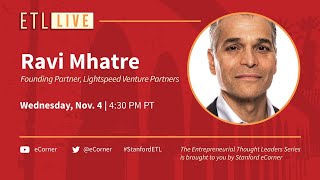
Ravi Mhatre from Lightspeed Venture Partners talks with Stanford lecturer Ravi Balani about venture capital, the future of technology, and lessons from his career in investing.
Chapters
Welcome, everybody, to the next installment of the Entrepreneurial Thought Leaders Seminar from Stanford. Welcome, everybody from the Stanford community. And welcome also to those outside of stanford from our YouTube community. I'm Ravi Balani, a lecturer in Stanford's Department of Management Science and Engineering and the director of Alchemist and Accelerator for Enterprise Startups. And I'd like to welcome you to the Entrepreneurial Thought Leaders Seminar presented by stvp, the Entrepreneurship center, and Stanford's School of Engineering and Basis, the Business association of Stanford Entrepreneurial Students. Before we formally kick off the interview, I would be remiss to not call out the momentous time that we know this is. And so thank you all for tuning in, especially now post election Day. And I do think that moments like this exist to remind ourselves not to take for granted things that are so foundational and to really marvel at some of our foundational systems that especially in times like these, we realize how even representative democracy was once a bold experiment, a startup centuries ago. And it's taken generations for that bold experiment to give the right to vote to all Americans. And I think days like these, we were reminded of how precious, how sensitive, and how much of a privilege these foundational systems are. And they also are moments when we can reflect on the privileges of other foundational systems, like the privilege of entrepreneurship and of venture capital, the fact that we can, we sort of take for granted that you can start a company, go and get capital from somebody else to pursue your dreams. Do those valiantly fail and not be reprimanded, but encouraged to try again. And that that system that we are really standing on the shoulders of generations, that laid the foundation for this to exist. Much of that soil was planted by leaders at Stanford like Terman and Shockley, which I won't go into now. But that soil has now created the foundation for this fertile ecosystem on which we can thrive, where we have founders and venture capitalists and all these amazing flowers and foliage have bloomed. I do think it's a good day just to reflect on that and to take that and to realize, not to take it for granted, but to realize what a privilege and how precious these things are. I think there's few people that are better than my next guest to speak to this, because our next guest is not just the venture capitalist of one of the top funds in Silicon Valley, but also a founder. He represents everything that I think is the potential of what Silicon Valley stands for. We are incredibly honored today to welcome Ravi Machara. Ravi and I share a name, but we default to different pronunciations. And so I am going to. I may err on the side of saying Ravi, not Ravi, but it's Ravi Matras, I think is how he is known formally by most of the external community. So Ravi is a triple degree holder from Stanford with a bachelor's in economics, a bachelor's in electrical engineering, and an MBA from the business school. Before venture capital, he also did many different roles. He ran a product management group at Silicon Graphics. He worked in management consulting at Booz Allen, and he worked as a software engineer for bdis, a Silicon Valley biotech instrument manufacturer. He started in venture capital as part of the investment team at Bessemer, and then he founded LightSpeed Ventures in 1999, I believe today LightSpeed's now on their 11th fund. In April, they announced closing $4.2 billion in new capital across three different funds. And Ravi has personally led investments in enterprise stalwarts and served on the boards of companies where he was one of the first investors, if not the first institutional investor in companies like Mulesoft, Nutanix and Appdynamics. He's recently also taken an interest in consumer side ventures with companies like Cheddar and Lightspeed. Also counts Snapchat among the companies that it was an early investor in, which came out of the Stanford ecosystem too. So please join me in giving Ravi a virtual warm welcome from Stanford. So welcome, Ravi. I would love to kick things off by I think venture capital is this glorified and romantic job that is oftentimes shrouded in mystery that many people wonder about. I wonder if we could just kick things off by you just describing what a day is like, really, for you as a venture capitalist. What is a typical day, if there is a typical day?
Yeah, it's a great question. And I think for anyone in the audience who's curious about venture capital, I would encourage you to ask as many people in the investing business as you can to create a sort of a collage or an image of what it is. Because each day really is quite different. When you are in the venture capital business for long enough, you have a variety of responsibilities to the entrepreneurs who you've already backed. You're meeting with new prospective founders. You're spending, you know, particularly in a bigger firm, a lot of time supporting your partners who may be looking at new companies and meeting with new founders. You're also thinking about where new market opportunities are. And so each of those is a different discipline. And it. And when you really, you know, I went back and looked at my calendar when Ravi Malani asked me that question, and I was really surprised that it almost gets to the point where it's, you have attention deficit disorder because you're having a context which so much. But you know what? I do think there are some common threads when you think about any day when I wake up, a couple of sort of guiding principles for me. One is that you are constantly in a mode where I think to be good in the venture capital business, you have to be a listener and a learner, and you have to always have the mindset that you are in whatever context you're in, you're trying to really absorb new information and add it to your understanding of the world around you. And again, that could be meeting a new entrepreneur who's got a vision for a new space. And you want to learn as much as you can from that person because it'll inform your view maybe on a whole market or maybe other companies in related areas where your firm is already invested. The other thing about, I would say a common thread is every interaction you have in venture capital really is about a relationship with another individual. Again, it's your partners, it's prospective entrepreneurs. It could be your limited partners, founders you work with. And these are all situations where you are, you know, you really don't have direct line authority in all those contexts. You are, again, having a relationship that spans a long period of time. It's built on, you know, a bilateral trust. And you are in a mode of needing to both hear what the other person is saying and needing to persuade them typically or influence them through some indirect means. So, you know, those are kind of more abstract principles. But I'd say if you, if you ask me about any day in the life, in my kind of sort of activity, I'm always in the mode of essentially meeting people and trying to listen closely to what it is they have to tell me and, you know, what they are excited about. And then I'm, you know, in a mode of typically wanting to, you know, find ways that I can be additive and build trust and create value in that relationship.
And so, Ravi, if there are other students now that are thinking, you know, I would love to do that. That sounds fantastic. What advice do you have for students who want to become venture capitalists?
You know, my strong advice would be, as a first step, talk to and get to know people who are in the investment business. And venture capital also is not a monolith. There are a number, a variety of different ways in which people practice technology investing. There's an angel ecosystem there. Now, this Whole cohort of solo capitalists. There are people like me who are investors at large global investment firms and everything in between. There's some firms that specialize by sector. So I think it's. I would encourage people to really talk to as many people as they can to get a flavor for the job. Because I do think, you know, investing again, what would be the common threads if you're going to be in the investment business? It is a business where you have to have a really long term view and be comfortable with relatively little feedback along the way. You measure a venture capital investing career in years or in decades. And sometimes when you enter the business, you know, it can be a couple of years before you really have even made some investments that are meaningful. And then it can be, you know, in my case, some of the companies Ravi Balani talked about, it was a decade before we knew ultimately where the companies would end up. And so when you're thinking in timeframes like that, you have to be comfortable that you, you know, that you really end up in a mode where you believe in what you're doing so much that you're not as concerned about milestones along the way where you're getting specific feedback and wondering, hey, you know, do my, do other people around me or does the world think I'm doing well or not well? So. And there's determination that goes with that. I think, you know, there's a large part of the investing business in today's environment where there's so much capital coming into technology, you have to be comfortable again. Building relationships is maybe a nice way of saying you have to be a salesperson for yourself and why you think that you have the right to earn a relationship with the very best founders who are the ones who will produce the most value. So there's an element of talk to a lot of people and also know yourself because you investment business is in many ways quite different than being in an operational role in a company. And you have to just decide are the things. There's some amazing, marvelous things about being in the investment business. It's incredibly stimulating the diversity of topics that you have the opportunity to learn about the amazing people. That really is, you know, you're sort of in a job where it is your mandate is to go build relationships with really remarkable people with founders. So there's, there's a lot of incredible things about the role. But I do think it's a very specific and unique type of role that you have to play and you want to learn if it's A good fit for your personality.
Now Ravi, you I think, have one of the most eclectic sets of experiences. And you know, it's always a privilege for us to have a Stanford alum, but it's so rare for us to have somebody, one who has three degrees. You have three degrees, you have an economics degree, an engineering degree and an mba. And you've also had a variety of different work experiences. You were in product management, you were a software engineer, you're in management consulting. If somebody is thinking about going down the venture capital path, do you think there was an essential experience or a more critical degree that you held to be more valuable that you would also tell the next generation to think of to pursue?
It's a great question, I think, and this is more of a just a view of the world. We've hit a point where technology, whether it's because of the cloud or mobile technologies or interconnectivity. I really believe that the foreign language requirement for every student in any college should be computer science. It is sort of, it is the language of technology. And I think, you know, not just venture capital, but almost any field that as a Stanford student you want to go into, whether it's as a minor or some way. Being comfortable and versant in the language of computers is critically important for, you know, having a, you know, foundational grounding for the future of whatever you're going to do. You know, in my particular case, I have always been, it's just been always a personal passion point, even before I went to Stanford in computers, in tech, really wanting to know how technology worked. And even, even in, you know, a lot of my investing career, I've invested in companies and in parts of the markets that are more, they focus on selling deeper technology products to enterprises. And I think if, if that's an area of the investing landscape that you have interest in, then having a technical degree, a deeper technical degree absolutely matters because it's very hard to understand, you know, if there's a, you know, in a sea of companies that are building next generation infrastructure for the cloud and you have to get deep into, you know, the stack really knowing whether something can be special or can be differentiated. It's hard to do that without a true technical educational foundation. But I think in the investing world today, you know, such, and we may talk about it later, such a broad amount of the opportunity are actually in companies which are much further up the stack. I mean, the tools that, you know, today versus when I was graduated from Stanford in the 80s that are available, I mean, you can be relatively non technical and in the Amazon cloud you can stand up, you know, a computing infrastructure that deals with literally petabytes of data. You have all the ability to create sort of on demand a very scalable and friendly, you know, web application experience for users. So I think, I think really that you know, the requirement to have a technical degree to go into venture capital is less today and I think it's more, you know, about choosing a degree where you think, where you learn to think critically. I feel like the best learning I had going to Stanford, I just, you know, it was an incredible experience to be around lots of people who were intellectually curious and the takeaway for me was oh, you know, I'm, I'm getting a degree, I'm learning some actual skills that have again in the 80s, some relative half life but it was really more the people I was around in the, I think Stanford now calls it intellectual vitality, but just the sort of basic tool set to know that I was learning how to learn and making that a lifelong part of, you know, how I really perceived what I needed to do to advance my career is I think, you know, the most important skill to hone while you're at Stanford.
That's great. Thank you. Now, if you're looking over the horizon now where you're sitting, do you think that venture capital is fundamentally going to be the same, let's say if we shift forward 20 years from now, or do you think it's fundamentally going to look different?
20 years is an eternity for something in the technology industry. And I think we're in the cycles of innovation are actually accelerating and compressing in terms of the, of the time frame. But I think, you know, at least for the foreseeable future, the idea that are there areas where, you know, human knowledge is, you know, it's substantially far from the efficient frontier as we know it, where technology and the idea of innovation at the intersection of technology and science, you know, will that be a fruitful area for at some level the ability for new ideas to advance humanity? I certainly believe that that that guiding principle of I think where you know, investing in technology has been so accretive to society, I think that through line won't persist. You know, the areas and the kinds of ideas that are going to be most important will certainly change. And that's, it's an interesting thing. I mean the ideas and where again the most we call it the alpha or the innovation sort of frontier is, you know, evolves more and more quickly. And I think that will continue to be the case. But I think, you know, overall, particularly in some of the areas like in life sciences as an example, in, you know, the area, the intersection of computing and robotics, which really for the first time means that instead of technology having to reside inside of, you know, sheet metal wrapped servers on CPUs, you can bring the full force of technology innovation into the real world. I mean, we're at the very beginning of, you know, of those technology waves and what that really is going to mean for the world and for society. And I think, you know, just as an example, those are two areas where I think, you know, there will continue to be opportunities for innovation. The world will look incredibly different in 20 years than what it looks like now.
I want to ask you, Ravi, about your experience with founders. As a venture capitalist, you've had the privilege of seeing thousands of founders and backing many of the great ones. And I'm wondering from that vantage point, are there any unintuitive insights that you can share about what separates the great founders from just the good founders?
You know, and at Lightspeed, we, you know, often our entry point is at the very ground floor when a founder, you know, may have an idea. But really the journey is going to be one we know could be five to 10 years, and a lot of things can change over that period of time. So I would hesitate to say that there's some thing that can be identified and if such thing exists, one would know that a founder is going to be exceptional. I do think that there are qualities of the people, and we think a lot about that before we are, you know, are going to embark on a shared journey that could take five to 10 years. And some of the qualities that we look for, there tends to be some, I'll just call it broad commonality. And, you know, some of those things, I don't know if they're unobvious or obvious, but we're really trying to find people who at some level, their passion and excitement for what they're doing, it doesn't come from the idea that they feel like they want to be an entrepreneur for the sake of being entrepreneur. It is almost never a function of wanting to make money, although that can certainly be a byproduct of being a successful founder. It is almost always that. And we're really trying to get to know these founders well enough to understand the why of why are you doing what you're doing. And there's something that burns very deeply in great founders around just the desire to see the idea they have become a reality. And more than that, not just become a reality, but then be spread at some level to an audience of users that's much bigger than, you know, any one individual could, could, could have happen. And at some level there's this idea that, you know, these founders, they, they really feel passionately that if that happens in whatever sort of chosen area they're focused on, the world will be, you know, a better place or a world that they think, you know, can, can have more advantages than it does today. So there's some element of that, that, that really, it's almost like we're looking for people who are five sigma on, on that and, and it comes in different flavors and different shapes and sizes, but really trying to understand, you know, you know, are people who are starting companies doing it for that reason of just having an idea they believe so strongly they want to make into sort of a broad, a big reality, you know, is that quality there?
Okay.
And at some level, I think it's hard to fake that.
Yep. And if I can, Ravi, can I turn the magnifying glass then on you as a founder and sort of invite you, if you can, to do some self analysis? One of the things that we've been, what's been sort of a theme this quarter is thinking about how different identities in people's lives have shaped their entrepreneurial journeys. And I wanted to see if I could invite you to speak to one. Were there certain identities that were salient in defining you as an individual, and how did those shape your journey and what do you attribute your success? There are many amazing venture capitalists. There's few that have founded companies that have succeeded to the extent that lightspeed has. So any reflections?
Yeah, I think it's a great question. And you know, I mean, I feel like the word identity is somewhat overloaded term in today's day and age. But you know, if I were to share a little bit of my, you know, kind of personal journey of how did I get to here and how do I see myself? You know, if you look at my family background, on my mother's side, I have a grandmother who was an immigrant from Eastern Europe. My mother grew up in a single parent household, was raised by my grandmother who worked in a factory her entire life to, you know, really make ends meet. And then my mother had to find a way, she put herself through school. They really cared about education. She ultimately got a, got a PhD in clinical psychology on my father's side. My father is originally from India. He came to the US in the 1950s, took a boat here. And, you know, and it's a more common, you know, sort of narrative, I think, for non resident Indians today. But he was in an early cohort of people who, you know, came to this country to get an education and really with the expectation that he could have a better life here, but without really knowing what to expect or what that would mean. And, you know, I think. And my parents were really unusual in some respects and Eastern European, you know, perspective generation, Jewish American woman and an immigrant Indian father. You know, they were in some ways very ahead of their time, I think. You know, and they, and my father, he ended up, you know, first getting a PhD in biochemistry and then ultimately became a business person in the, in the biotech industry. And, and, you know, I watched them, you know, growing up and I didn't really understand at the time. I think, you know, there were many ways in which the US probably wasn't the perfect idealized place where everything, you know, just went well and everything, you know, was easy. On the other hand, I saw them, you know, really have both of them a mindset which is, you know, not taking things for granted, you know, embracing at some level that they were different and that, you know, that they felt strongly about wanting to connect with the who and what that they were and feeling that this country, you know, was somehow. It's definitely not perfect, but I think for both of them, in their own ways, if you really understood their backgrounds and where they came from, having a deep appreciation for the opportunities that did exist in this country, notwithstanding its imperfections. And I think, you know, that's something, as I've gotten older, I realized imprinted on me quite deeply because I, you know, at some level, in terms of how I identify, I'm sort of a uniquely American product in terms of my diverse cultural background. I don't identify as being part of some, you know, majority establishment. And I think, you know, this idea of, I feel like I've had an incredible set of opportunities that going to Stanford and other ways in which, you know, I was able to do things in the US as a, you know, as a someone who was a child of, you know, essentially immigrant parents that in most other countries I think it would be impossible to do. And so, you know, when I think about my kind of path through life, I think I have the, you know, a little bit of the, maybe a chip on my shoulder, you know, and the idea of, you know, I want to make the most of being in a place where, you know, people who are diverse and who maybe self identify differently you know, again, I probably episodically experienced feeling like I didn't belong. But on the whole, I think I've always believed that relative to any other place, if I wanted to make an opportunity for myself, then it was on me to do it and I would have, you know, great chances to do that. And, and that it was more about taking responsibility for that as opposed to thinking about the ways in which maybe, you know, life wasn't totally fair or, you know, other people might have had an easier path. So, and I think those qualities, if you, if I think about, you know, why we started Lightspeed, you know, there was an element. Bessemer, the firm that, you know, originally got me into the venture capital industry, is an amazing firm. And I had, you know, a terrific mentor there, a gentleman named Felda Hardyman, who I, I think he's retired now, but he, you know, he took a chance on me and any, you know, had no necessarily reason to, but he gave me a start in the business and I really realized that I wanted to, you know, as opposed to working in a firm that was preexisting the three other classmates I had from Stanford who also had, you know, different backgrounds each. We all decided we wanted to, you know, make a go of doing something together. And I mean, at some level it's, and we all, I think had a little bit of that notion of, given our, how we self identified of feeling that we wanted a little bit of a chip on our shoulder and we're going to just believe that we wanted to work with each other and we knew it, you know, it might not work, but willing to take those risks, not expecting anyone to hand us anything and we were really just going to go for it and try to build a business. And there were times when it's, you know, I do, I feel like I have more of a, in a good sense, empathy for the founder journey because there were times, I mean, Ravi Balan, you probably know, after the late 90s boom when it looked like the technology venture act capital industry was going to end. And for new people in it like me and my three co founders, we thought we were going to be out of business. And so there were times when it was very rough and we didn't exactly know what the future would hold. But it was the kind of experience that I think if you identify as someone who is just, you know, again sees what the opportunity can be versus worries about the ways in which maybe the opportunity isn't perfect. It taught me that this, you know, it was that this place has been in a, you know, amazing place to be able to have success if you're willing to put the effort into it and have a long view. And again, entrepreneurship, if you, if you fail once there, you can, you can come back and try again. So sorry for the long winded answer.
No, that's fantastic. I'm going to ask just one more question, then I'm going to open it up and I'm going to be pulling questions the audience and so gang, please submit questions or upvote. I want to ask you about. So Lightspeed's been active outside of Silicon Valley. Not just outside Silicon Valley, but outside of the US and there's a lot of discussion now about whether or not Silicon Valley and San Francisco are still going to be the epicenters that it was in the past because of the high rents and other issues that are coming up. I'm curious if you're long or short Silicon Valley relative to the rest of the world. And do you think that Silicon Valley will also get disrupted by another hotspot around the world?
Yeah, I think that's a great question and we talk about that all the time within Lightspeed. And I think it's back to the point I made earlier. Technology really has hit a tipping point where I don't even think it's fair to call it a vertical industry anymore. Technology is pervasive and the words digital transformation are used often to talk about how. I just think the funding, the foundation of how people live their lives, and this is a global phenomenon, is really now based on a technology platform. So and with that, I think the opportunities to create businesses that are technology forward exist globally. And I feel that Lightspeed, you know, we were, we started to believe in that thesis about 15 years ago and have created a firm that now operates on, on five different continents. And I do think that that opportunity set will continue to grow. On the other hand, you know what I would say, the way we tend to describe it internally, I think there are many places in the world where you can meet founders who are dreamers and have big visions and behind which you can invest and build big companies. On the other hand, I think Silicon Valley, I don't know if it's totally unique, but it is fairly unique in being a place where you have a community and culture of dreaming and imagination. And that is what's fundamentally different. I think Silicon Valley, at least in our minds for the foreseeable future, is always going to be a place where it's just in the air, the fabric of the community in Silicon Valley is such that people presume that the impossible can be made possible. And that I think that basic idea that just is completely accepted in Silicon Valley means that there will be more bold innovation and ideas that continue to be Silicon Valley led, I think, versus the rest of the world for now. But that doesn't mean there won't be individuals who are remarkable and have the vision and the ability to be imaginative. And in the rest of the world, we certainly think those opportunities will exist, but it's more of individuals versus a culture and just a mindset of a whole community around that.
Okay, terrific. I'm going to turn now to the questions from the students in the audience. One person's asking, has the pandemic changed the way founders and potential investors engage with each other? Are face to face meetings required anymore and any guidance on how founders now solicit funding from VCs?
We're definitely in a new world and a new normal. Post Covid, where initially it was 100% of engagement with founders with the portfolio was happening digitally primarily over zoom. I think the realization six or seven months now into the post Covid era, there's a recognition that as good as our digital technologies are, they are far from replacing, you know, the signal and the again the relationship and trust value that can be built through human contact. And so I think until we have a better handle on vaccines and ways to systematically treat for Covid, we're in this mode where because of the particularly with new investments, the criticalness of needing to have some in person interaction, there's a model that exists today where most of the interactions happen digitally, but then before an actual investment closes in most cases for lightspeed, we will attempt to have some format of a socially distanced but in person set of interactions with the founders that we're working with. And I think that once again we're sort of more through this sort of COVID pandemic and people are more comfortable with getting together in person. I think we won't go back to the baseline of where we were before, where the preponderance of meetings are in person. Technology and being able to meet remotely creates leverage and productivity windfalls. So that will continue to exist, but I think we are going to for the foreseeable future continue to have part of what we do be based on in person meetings.
Okay, that's great. There's another question about how do I approach a VC if I have a great startup but I don't have any VC connections?
I think lesson number one in being an Entrepreneur and being a VC is you have to, if you're going to be a founder, you have to learn how to build your network. Because whether it's building, you know, and getting to new customers or partners or key people you want to hire or investors, when you don't know those people as a founder, a critical skill is to learn how to get introduced and create a network that you can spin up so that you, you can essentially get referred into these relationships with many venture capitalists. It's probably true for entrepreneurs as well. There's so many places you can spend your time that in most cases without some type of a referral from a mutually known connection, that can create a sense of qualification or trust. It can be hard to get people's attention. I think there's always the scenario you can send a cold email. But I think again, the idea of, you know, look at the, you know, at an Investor's background on LinkedIn, is there someone that you, you know, that may be a common touch point trying to create a sense of, hey, you know, we have a, we have a, we have some common ground or some basis of a common school we went to is it's important to think about that as a way to, you know, really get the attention of investors if you, if you don't have that network, you know, and this is your first startup.
And does it matter if you're international or overseas or is it the same advice?
Well, in some geographies, international or overseas, the same applies, but I think it's easier to connect with local investors in those geographies if theses exist over there. I think otherwise be prepared to spend a lot of time, you know, really, you know, cold calling and probably having a low conversion rate. You know, obviously there's other, there are exceptions. I mean, if you have bootstrapped the company to the point where there are, you know, there's sort of real data, real, you know, key performance indicators around users or around growth or you know, ideally around monetization, then I think you can have a greater chance again of maybe walking into a cold meeting. But chances are, you know, most investors may actually already know about you at some level through the systems or, you know, the company tracking that they do.
There's another question on what's Lightspeed's edge? What's your pitch to founders on why Lightspeed is the partner, especially that they should go with, especially in this era where there is some optionality?
Well, we start with understanding internally that we, you know, like we're not, we're not all things to all people. It goes a little bit back to what I said. Lightspeed. If you look at our firm, we, we do have a substantial amount of capital. We have people at the firm who are very experienced in investing at the earliest stage, but really trying to identify founders and ideas that where the ambition is to grow very large scalable business over time. So, you know, so that immediately qualifies into a certain smaller cohort of people just based on the idea or the ambition they have given the global platform. If a founder has an idea and they really want to take it global, well, certainly, you know, kind of pan regional if it's a company. You know, there's certain sectors where we just, we have, you know, Lightspeed's origin story is around deep technology, infrastructure investing. So there's some, you know, somebody who wanted to build a, you know, an autonomous vehicle. It's a multidisciplinary, high degree of technical difficulty problem where we can understand it and where a lot of capital would be required. So I think, you know, for us it's about selecting into founders that we think we're a good match for based on, you know, our network and where we're deeply knowledgeable and where we think we can add value as much as, you know, you know, it's as much about the founder picking us picking the founder and the founder picking us together. And I think, you know, the other piece, just more generally different firms have different styles. We tend to be, you know, very focused on, you know, many of our companies. The founders who start the businesses end up, you know, transitioning from the founder to the entrepreneur to ultimately the CEO and the leader of large companies. And so we are again looking for situations where the founder wants to be on that kind of a journey versus, you know, maybe building it to some point and then hiring a new CEO. I mean again, that happens sometimes, but we're, you know, we tend to again look for situations where the people who we're going to do business with really understand how, you know, where Lightspeed's been successful. The way we tend to work with early stage kind of founders and early stage people in a company and they believe that that's the right fit for them.
Ravi, I know that Lightspeed is known by founders, but I think it's even more known by limited partners or at least certainly from my perspective. I've seen LPs are people that give money to Lightspeed. So just as founders need money from venture capitalists, venture capitalists solicit money from limited partners and limited partners speak glowingly about Lightspeed's returns. Do you think that Lightspeed success is because you guys have competed fundamentally differently in venture capital, or are you competing fundamentally the same, but just competing better or something else?
Well, you know what they say in any business, 90% is execution. I think, you know, when you get in there, there are in particular in Silicon Valley, there are a lot of great venture capital firms that have been around for a long time and that have, you know, institutional knowledge and experience. And it really does then boil down to whatever your chosen strategy is. Are you, you know, are the people who are the new generation of the leaders at the firm, are they really engaged and excited about executing against the investing mission?
There's a question about what are some sectors in tech that you feel most bullish about for the next decade? I know that you historically have been focused historically on enterprise infrastructure and enterprise companies, and now you're shifting more towards consumer and it sounds like even life sciences. What sectors are you now excited about and why?
Yeah, personally for me, a couple of six sectors that I think, and I alluded to it earlier, that where I just think there's such enormous opportunities for games, for doing things through technology that I believe could make the world better, could create quality of life improvements on a really material scale for people. One area is in life sciences we are just getting to the point where again, because of things like, you know, DNA sequencing becoming a cheap way to digitize the life science industry, where that industry is going to be able to participate in Moore's Law's curve of, you know, basically computing and problem solving getting better by a factor of 10 every probably 18 to 24 months. And so I think, you know, you know, again, everything from how drug development happens to, you know, how you would diagnose a disease and understand how to be treated, these are things where, you know, science has provided meaningful leaps forward over the last 60 or 70 years. But I think in the next 10 or 20 we're going to see even more unlocks than we probably have cumulatively in the last 60 or 70. And it really does relate to being able to, I mean, the human body is, is a very incredibly complex analog machine. You know, we have 4.3 billion, you know, DNA, DNA pairs in our body and the ability to use computing and data to, you know, understand each human individually and understand, you know, from what we know, how medicine and how science should be applied. You know, people have called it personalized medicine. That's part of it. I just, you know, from everything we've seen I think that's an area where the gains that are going to be made are going to be, you know, just stunning. I mean, as an example, again, it's not a political comment, but in the last year, with the, with the advent of COVID you know, this is a disease where really the virus was not understood a year ago. And within a year we're likely to have a vaccination. I mean, historically developing like the AIDS virus, which is, you know, we ultimately developed a vaccine that took 10 years. And with, you know, kind of the standing on the shoulders of what was probably learned through the R and D process with AIDS and other viruses, we're now going to be able to go from a standing start to developing a vaccine that, you know, will have, you know, may not be perfect, but again, real clinical effectiveness in one year. And I think, again, that that's just an example, but I think we're going to see whether it's treating cancer, whether it's, you know, diseases that afflict most people in the world, you know, autoimmune diseases, you know, inflammation. These are things that diabetes that are not, you know, small parts of the population. These are things that enormous, you know, groups in the population as you age, you know, are afflicted with these diseases. I think we're going to have see, you know, unbelievable cures there. So that's one area I'm very excited about. The other I alluded to, we're about.
To run out of time and I want to ask one last question, but if you can. Yeah, you can, quickly. Sure you can, you can. I don't want to tease people. You can mention that other area quickly.
And then I talked about it before, but I do think, you know, the way to think about robotics, which again, these are, these are great areas for lightspeed because it takes a lot of capital. They're multidisciplinary problems. It's not an easy thing to solve for. But again, I think robots combined with machine learning and AI are going to be a place where we're just going to see a lot of labor problems that exist in the world today be solved by computing and automation. And again, when you really look at the implications of that, it will be far reaching. I mean, there are social problems we'll have to manage as well. But I think we're on the cusp of seeing things that look not like anything we've seen before.
I will. Thank you, Ravi. I'm going to end it. I know we're a little bit over, but we started a little bit Late. I'm going to end it with just our classic ETL question, which was from, which is Tina Selig's canonical question, which is, what do you wish you knew when you were a student? What do you wish you knew when you were 20? And if you knew it, what would you have done differently?
Well, with my 50 year old mind, I say, well, when I was 20, I wish I spent even more time taking advantage of learning from, you know, Stanford was an incredible place with resources, but just learning from the people around me, you know, we all go through life and you, you know, experiences is a great teacher. I think, you know, the thing I would tell my 18 year old self is get mentors and try, you know, to learn. It's hard in your 20s to be as much of a learner by doing, which I think was probably one of my superpowers, but be as much of a learner by listening as you are a learner by doing. And I think most, most students probably in this audience are if you, if you've achieved getting into Stanford, you know, learning by, you know, doing and by, you know, studying is a skill that you must have and be good at. But the idea of forging relationships with people who have experience and learning to trust that even if you haven't touched and done it yourself, there's information you can get from the people around you. Also, you know, anywhere you are in college, try to meet as many people as you can. It's an incredible group. Make friends, learn from people who have different backgrounds than yourself. You know, that was one where again, I, it's just, I think it's an opportunity to, you know, before you have to go in and have a job, just to be able to learn how to engage with different kinds of people. I found that that is something, when I look back, it served me really well just to be able to see sometimes other people's perspectives helps me to solve problems better. So I think mentorship, you know, spending as much time building quality relationships and friendships, maybe outside of your comfort zone are things that, if I'd done those in addition to sort of studying and learning the way I learned, I think I would have, you know, I probably would have made even faster progress in my life after school.
Well, that's been fantastic. Thank you so much, Ravi, for sharing so generously. I know we're doing this all virtually so you can't feel the energy around you, so I'm just going to give you, there's tons of virtual applause and love coming your way, so thank you. So much for joining us on etl. And thank you, everybody else, everybody, for tuning in. And that's this week's etl.
More from GHION.AI


O processo de reconhecer limites, mesmo quando a vida parece exigir sempre mais.





Depois de tantas histórias, aprendizados e pausas necessárias, o @interior_iza está de volta



