ETL Speaker Series: Rodney Sampson (OHUB) and Jessica Norwood (RUNWAY)
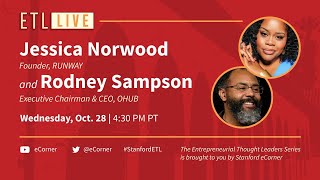
This content was created by GHION.AI . This content was uploaded by GHION.AI . This is a YouTube recording of Stanford's Entrepreneurial Thought Leaders (ETL) speaker session titled "ETL Speaker Series: Rodney Sampson (OHUB) and Jessica Norwood (RUNWAY)" (recorded Oct 29, 2020). Moderated by Chuck Easley (Associate Professor), it features Jessica Norwood (founder of Runway) and Rodney Sampson (CEO/Executive Chairman of Opportunity Hub). The conversation addresses entrepreneurship and racial equity—systemic barriers facing Black entrepreneurs (friends-and-family capital gap, discrimination in financial institutions), COVID-19's disproportionate impact on Black-owned businesses, inclusive ecosystem-building and talent pipelines, practical investor responses (Runway’s "right relationship" approach and emergency support), and guidance for allies, students, and institutions. The talk is aimed at Stanford students and a broader online audience interested in equity-focused venture-building.
Chapters
Hi, I'm Chuck Easley, Associate Professor in the Department of Management Science and Engineering at Stanford University, and I'd like to welcome you to the Entrepreneurial Thought Leaders series presented by STVP, the Entrepreneurship Center in Stanford School of Engineering, and BASES, the Business Association of Stanford Entrepreneurial Students. Today, we're delighted to welcome Jessica Norwood and Rodney Sampson to ETL. Jessica Norwood is the founder of Runway, an organization that uses entrepreneurship to close the wealth gap in Black communities by providing pre-seed and friends and family capital to fund Black-owned businesses. She's also a Center for Economic Democracy fellow, a lifelong fellow of the Sanford School of Public Policy at Duke University and Southern University College of Business, and the Political Power Fellow of the Hip-Hop Archive at the Hutchison Institute of Harvard University. Rodney Sampson is the CEO and Executive Chairman of Opportunity Hub, O-Hub, a multi-campus entrepreneurship center and tech hub. O-Hub serves as a startup pre-accelerator, coding bootcamp, and angel investing platform for founders from underestimated and under-tapped communities. Prior to O-Hub, Sampson co-founded several media and technology companies. He's also a nonresident senior fellow at the Metropolitan Policy Program at the Brookings Institution. And a venture partner at Draper Gore Holm and a professor of entrepreneurship at Morehouse College. So welcome, Jessica and Rodney.
Thank you.
Thank you. Good to be here.
It's great to have you guys. So first, let me briefly share some of the reasons why I personally see this conversation as so important, as well as why I'm grateful to have you both here with us today. It's really been a jarring and eye-opening summer with ongoing injustice and police brutality against Black America, highlighted by George Floyd, Breonna Taylor, and now Walter Wallace, to disproportionate impacts of COVID-19 on vulnerable communities. And so from my perspective, I teach and do research here at Stanford on entrepreneurship. And both education and entrepreneurship are intended to be ladders upward in society. Providing paths to economic justice and more equitable opportunities. Yet it's clear from the data that historically our institutions have systematically excluded many from these very ladders to better economic opportunities. Even among those who have, against the odds, succeeded, those narratives are often not highlighted as well as they should be. Martin Luther King, in his speech, "The Other America," at Stanford in 1967 emphasized the importance of economic justice for social justice, and also emphasized the vital role of the student generation in his speech. So one thing seems clear, which is that the future entrepreneurs who do master these skills involved in creating diverse, inclusive organizations will be the ones who not only move us closer to a more equitable society, but also create the more innovative, higher-performing companies. And as we always say around STVP, the bigger the problem, the bigger the opportunity. So clearly there's a deep, massive opportunity here for those that have the interest and determination to pursue it. So I want to start our conversation by painting a picture of the opportunity that equity work presents. So please help us to understand the opportunity that diversity, equity, and inclusion work present for entrepreneurs, innovators, and investors. And Jessica, let's start with you and the work that the team at Runway are doing. What's the problem you're working to address, and what do you see as the opportunity?
Thank you so much, Professor, and hello everybody out in Stanford land. I'm very excited to be talking to you. So let me calibrate this question a little bit right now with something that I've been thinking a lot about. And I mean, I want to say this and then I want to invite you to do what I do after, after I say it and take a deep breath, because the world is not going back to the way that it was before. And this is where you take the deep breath. And I think you've got to let that register and let it sit in your body. That is part of the answer to that question, part of the problem between, you know, what's already been mentioned, climate change, COVID, the disparities in tech access, racism, and a financial system that quite honestly does better when we are at our worst is a huge problem that we're facing right now. 60% of Black businesses have closed due to COVID. And the Federal Reserve flat out said in its report that the reason that those businesses closed was because of systemic racism inside of the financial institutions. And so I see that as a huge problem to be solved, that those businesses could have stayed open had they been given opportunity along, all along the way. And it doesn't have to be like that. That's the exciting part. The exciting part is that with entrepreneurs such as the ones assembled here, we have a chance to really push for another conversation. And I think that opportunity really looks like reimagining right now. The idea that you reimagine every single thing that is out there. This is the time where we are in that moment where you've read about it in history books, where these great innovations and these great moments happen and you wonder who were those folks who did that. And I think it's the folks right here, right now, listening to the Zoom that would be a part of that opportunity.
Awesome. And Rodney, OHub complements this work that Runway does in many ways. What's the problem you're working to address, and what's the opportunity that you see?
Well, first and foremost, I'm excited, uh, to be here, uh, with my colleague Jessica. And definitely thank you, uh, to you, Chuck, and just the entire team at Stanford, and to the students as well who are learning in Zoom land, or whatever land you're learning in, I want to salute you for still taking your education serious during these particular times. You know, I'll, I'll frame my answer this way. As an early outlier in the tech startup venture ecosystem, I had success. And ultimately, probably knowing it, but without knowing it, actually became a part of the problem. And I think as entrepreneurs, we talk a lot about the companies and the ideas, but we don't do enough to really truly understand the problems that we're actually solving. And to solve, you know, to become obsessive about a problem, you have to, you know, definitely understand the problem. So I like to sort of lay a foundation here, you know, around the problem. I'm from Atlanta. I live in Atlanta proper today. We are number 1 in income inequality in the world. And this didn't just happen this year. We've been trending with this unfortunate statistic for several years now. When we peel back the data, what we saw changing in our macro metropolitan area was that there was an influx of high-growth technology companies moving into Atlanta, particularly with the slowing down of our real estate industry because of the last economic downturn. We, we saw a lot of resources being shifted into our innovation economy. Atlanta being home to 26 Fortune 100 companies also ramped up their investments in corporate innovation, in venture, etc. So it's like, oh my God, all of these— now all of these buildings are going up, all of these innovation labs, you know, research institutions are expanding, nice shiny, you know, new buildings. Bikes, scooters, the like, everywhere, right? Everything is awesome, right? But actually, for a lot of Atlantans, native Atlantans who happen to be Black, things weren't evolving and changing. And so that income equality gap was growing because the density of innovation was displacing the native citizens out of the inner city. So now when you hear inner city in a major city, it's not urban or Black anymore. It's inner city specifically because of geography. And that's because Black people have been regentrified out of most inner cities in major cities around America. So I'm taking the time to actually clearly define part of the problem. Northwestern University released a study maybe 3 years ago now, CityLab. It's on CityLab's website where there's a direct correlation between innovation density and income segregation. Now, innovation density was defined by the number of patents filed in said metro and the commercialization and the venture capital invested in said metro. Now, you being in San Francisco, proximate to Silicon Valley, are thinking like, wait a minute, This story sounds familiar, right? You know, tech companies popping up everywhere, density of— density of venture capital in the city, yet there's so much poverty, there's so much drugs, et cetera. And so to bring it home, I saw myself as this out— this successful outlier, innovator, entrepreneur, investor, you know, thought I was doing good by becoming successful all by myself, which is OK to do, but realized that I had become a part of the problem. And so to respond to the problem that I was creating as an investor, as a member of the startup ecosystem, it was important for me to do something about it. So O-Hub is the solution to myself, but myself is just an archetype of the density of innovation edge technology and venture capital that's fueling 60% of net new jobs in this country. So I'll go into deeper what OHUB does maybe later, but I wanted to start us off by clearly— like Jessica clearly defined the problem she was working on inside of the capital markets with the loss of 41% of Black businesses. There's another problem that we're working on related to creating equity, racial equity, inside of the technology startup and venture ecosystem, particularly.
Great. Well, we're definitely going to circle back to a lot of these topics that you guys have touched on. And Rodney was bringing up the bigger picture context of inequality. And Jessica, I really liked what you had to say about this being an opportunity to reimagine a lot of the systems and innovations right now. And so I wanna start with those kind of big picture systemic issues. And a lot of what we try to train entrepreneurs and innovators to do is around practicing a mindset of opportunity and not fearing failure. So I wonder if we can peel back those concepts a bit and think about how they connect to systemic racism and to institutional barriers. And so I'll come back to Jessica. Let's talk about the financial context in which many entrepreneurs of color are building ventures. How does the funding and bootstrapping context for those entrepreneurs of color differ?
Yeah, I think when I'm starting off and I'm talking about systemic racism inside of these financial markets as this baseline of what we're up against, and I want to start in a really— where Runway, where I work, I start in a really discrete, very early part of the story. And there's a particular reason why I do that. There is $60 billion a year that's spent on friends and family money. And, you know, you've probably all heard the term friends and family. It is when people tell you you have a fantastic idea, but you should borrow money from your friends and your family. And, you know, on average, that number is about $30,000 of gift or investment that folks receive when they're getting started. But when you look at the racial wealth gap, when you look at that number, you realize really quickly that Black folks are not gonna have friends and family that can put that kind of money into their businesses. So this is the beginning of the entrepreneurship journey that I wanna lay out for everyone. Right at the very beginning, you're already facing systemic racism and discrimination, right at the very beginning. And so when we look at this and what I really like about how you talk about this, Professor Easley, is this piece around mindset of opportunity and not fearing failure. So what happens when you don't have that $30,000 to get going and you can't go to a bank or friends or family or anybody because those loans at the beginning are deemed too risky Right? And so what happens is that this mindset of opportunity for a Black entrepreneur, they're going to always be perpetually living inside of a fear because they can't afford to fail. There is no backup. There is no other money. There is nobody coming. And what they're having to do is take a little money from their regular— their main income, or they're having to, you know, move money from here or there perpetually in this startup mode, sometimes even 5 years, still on this whole startup thing. And then the innovation moves forward, or somebody else gets a wind of that idea and pushes forward. And because they didn't have the capitalization, those ideas don't ever leave the back of that napkin. And what I like to talk about inside of this, and the reason why Runway and why I start off with friends and family, is because, as I mentioned earlier, about reimagining— and this is a word that I'm going to keep saying a lot of, about reimagining— because what I was looking for was an opportunity for people to reimagine what it was like to really be friends and family? What would it look like if the system responded in a way where it gave and made investments as friends and family? And what I call the money that we put out is I believe in you money, because what's lost inside of this is that place where people actually look at Black and brown entrepreneurs and see them as innovators, see them as creators, see them as worthy and needed in solving the problems that are impacting their communities. So the startup part, this sort of bootstrapping, it impacts the psyche. It impacts the actual business itself. Because a lot of this, what we're saying is, we don't really find what you have to be credible. We don't think you're worthy. We don't think you're valuable when we don't put those early kinds of resources in.
Right. And I watched the other day— I recommend anyone to check it out— the video of one one of the first entrepreneurs that Runway funded, and just hearing her exclamation of joy at finding out the news, you can, you can really see how much this means to people to be believed in, in that way. Rodney, much of your work is about creating pathways to opportunity. Tell us more about that, and how does your work situate aspiring Black entrepreneurs in closer proximity to opportunities?
Absolutely. So for 7 years, Opportunity Hub, or O-Hub as we affectionately refer to it, has been building what today is now referred to as an inclusive ecosystem building platform. And we didn't call ourselves ecosystem builders 7 years ago. We were just doing the work of developing people with the skills and then helping them get the careers and then helping them to start their businesses, helping them get capital, and then helping them get access to markets. And all of that is done through, you know, a series of programming, a series of events, a series of people helping people access networks that they don't have. And we started off by doing it in spaces, and then we evolved from like a place-based strategy to a programmatic strategy. And now COVID has accelerated our platform strategy. So we're like a full-stack platform now. And when you think of O-Love, I want you to think of it in terms of there's a baseline level of is exposure. You know, I grew up watching cartoons after school, and G.I. Joe used to come on every day, and every day they would, you know, say knowing was half the battle, right? So exposure to information like this, you know, classes and career pathways like you all are privileged to be getting as you pursue your undergraduate or graduate studies at Stanford. You know, when you think about there's so many people in America, period, but particularly in socially disadvantaged communities, which disproportionately is going to mean poor, which disproportionately will mean Black and Latinx, and not all because, and I like to say this, I don't like to be homogeneous when defining Black culture because there is a Black wealthy class, there's a Black middle class, there's a Black emerging class economically. But when you compare it to our white American brothers and sisters, it's definitely incredibly nascent. But that's not to say that it does not exist. I don't want to paint a picture that— and this is a part of the stereotyping that has been done as, you know, a response to the criminalization of Blackness in America, which speaks to what you were saying earlier, Chuck. And Jessica, you were alluding to this as well. I said this one time at the Securities and Exchange Commission, I hashtagged it, I said failure is not fraud. Failure is not fraud. And so A lot of Black people carry that weight. We are seeing it playing out in terms of the criminal justice system and police brutality. But if you take the same intent that the officer had with George Floyd, or the officer had with Michael Brown, or George Zimmerman, that intent that he had with Trayvon Martin, if you could productize that intent and then apply that inside of every American institution to the point that you don't even have to perceive of yourself as an individual discriminatory person or racist person. The system has been codified to the point that if we just allow the system to operate as is, it will criminalize Black people, non-white people, non-Americans, i.e., immigrants, or non-heterosexual, cisgender white men. Right? So if you're not that, then everything else is sort of kind of looped together. And I'm not to make this a social science conversation, but I think it's important to understand that in terms of how you get— oh, I'm a great guy. I have a Black friend. My study partner is Black. And that may be true. But when you think about what it might have taken for that person to show up as their whole selves, you have to think about that. So when we talk about the cultural competency of developing Black technologists, Black innovators, Black scientists, Black entrepreneurs, Black investors, you name it, right? Black business leaders. When you talk about that, you have to approach it with a cultural competency lens. And that's, I think, what the secret sauce is of Opportunity Hub. We're able to teach people and help them understand and help them to build their confidence inside of a majority white space that their unfair advantage is their ability to survive, not just survive, but to thrive in survival mode. And I want to say this really quickly to the would-be entrepreneurs here. If you can find you a Black founder that will align with your vision and mission, sky's the limit. If you could find you a Black woman founder, now you really, really, really talking. And all the data is there. So O-Hub essentially helps to connect the supply side to the demand side. Right, the supply side of talent, founders, to the supply side of jobs and capital. And that's the easiest way I think I can explain what OHUB does without also being as philosophical as I might have just been.
That was, that was great. So both of you mentioned COVID-19, and I want to pick up on that thread in the conversation, um, and how the pandemic has disrupted the current environment. So you've got businesses shutting down, you've got migration of people to different parts of the U.S., you've got pressure on relationships with investors, employees, consumers, huge challenges to fostering connection in communities. So I'll stick with you, Rodney. What, what should entrepreneurs and innovators be keeping top of mind at this moment, especially when it comes to migrating across the country or business creation in cities like Atlanta?
You know, the rules have changed, and they literally have changed in a year, less than a year. And if you were ever thinking about being a data analyst or data scientist or tapping into that, now is the opportunity to see and experience the data coming to life. And if I were a first-time founder— and I'm still a founder, I'm always reenergizing myself by reading and learning and studying ideas. Just this week, I am— I guess I had the privilege, I haven't had much sleep, but reviewing 500+ applications of Black founders for our $2 million pitch competition that— with Steve Case and Revolution and Morgan Stanley. And just going through the data, It's incredible to see the ideas and the products and the companies that are coming forth in this pandemic. And so the thing that I'm inspired about, and I said this the other day on Yahoo Finance, and Jessica, you can appreciate this, is the 41% of business owners who might have shut down, the Black business owners, the positive news is that they were already business owners and they know how to build a business. We perhaps can help reposition and refocus them onto solving the problems or providing the services businesses that would be more in demand during this new normal. And so as you look at the business trends, where are people spending their money on the consumption side? In the enterprise world, what type of software solutions are people looking to hack? You know, if you juxtapose climate change, to the political environment and to the racial, you know, reckoning that's going on, plus the coronavirus, you got 4 sectors that if you found a problem in that sector and you solve it at scale, you would create a successful business and hopefully multi-generational wealth for yourself. One last point, when you talk about the redistribution of talent, we've been saying this for a while, that there would be something that would happen that would cause a redistribution from the coast back inland. And I think what this pandemic is doing, it's sending people from San Francisco, from New York, from these density centers where you can't spread out and where it's perhaps easier to, you know, to get COVID-19. You know, if you're spread out a little bit more, it might be a little better to navigate. And so you're seeing folks leave these density areas and redistribute themselves back into the middle of the country and into the South. And I think it's a great thing if those cities would reposition themselves to reinvest in the talent that's there to get ready for those companies that may be moving there and maybe hire. And so I see it as a huge opportunity. I mean, even when I think about real estate brokers, if you were focused on certain markets, if you can connect with people in another market, you know, you can then reinvigorate your business. So I think there's a lot of opportunities. I mean, we could hack 2020 all year and look at the problems that have to be solved, and there's gonna be a lot of people that make a lot of money doing it.
Definitely. So Jessica, you're an investor. Companies are relying on your financial support. Tell us the story about what's happening in your relationships and how you're navigating this time with principles of equity.
Yeah, I mean, I love— I could listen to Rodney talk all the time because one of the things you talked about with O-Hub is that secret sauce around really understanding culture. And I think that that is very much what we do at Runway. Right at the time where we really understood that COVID was happening and it was serious, right around the end of March or so in April, I would talk to my team and first wanted to make sure that they were all sorted out and situated. We're all entrepreneurs ourselves. And so just making sure that the team was good. And then we reached out to our investors and talked to them about the capital needs and things that we were looking to do at the time. And one of the things that we really practiced at Runway is what we call right relationship. And right relationship is really all about disrupting those power dynamics, really leaning into agency and interdependence. Um, so we practice with, uh, our community right relationship and, and, and that goes from, um, the investors all the way to our, our borrowers. Um, I believe that, you know, how you start is how you're going to end. And so if the dynamics are off right in the beginning around moving the money, then, then inevitably I might pass that along to my entrepreneurs. And that's something that we just don't want to ever do. So we talked about what kind of capital we needed and very quickly, because we've been sitting in community and building relationships, and these are investors who've already decided very strongly to practice their investments through an anti-racist lens. They're very clear what needs to be done right now. This is, this isn't, this is go time for all of us who have been in this work for a long time. And we were able to then talk to our entrepreneurs once we kind of had an, an eye on what monies we could raise and, and what we were looking to do. And we asked the entrepreneurs, you know, what would you need? We, we ended up giving more marketing support. As an investor, this is what we're doing, paying for more marketing support so that they could pivot their businesses more online. We spent more money on business support, mentors and so forth. This is the investor paying for more mentors to work with them, to actually revisit their business models, to really look at what their strategies are going to be and to get some of that emotional support, because this is a this was a very panicked time where you're trying to parent and you're growing a business and you're doing all of these things. So even just emotionally being able to talk and have somebody walk with you through some of those things. And then we ended up giving universal basic income to all of our portfolio. And the reason that we did that, nobody had done universal basic income for Black businesses, but the reason that we did universal basic income and not a grant or anything like that, we wanted them to know, use the money however you need to use the money. Use the money for childcare, use the money for groceries, use it for your rent or your mortgage, use it to reinvest in your business. We want you to make it because if you make it, we make it. And so we, um, we, we, we did universal basic income payments. And I'll never forget when we talked to our entrepreneurs, we had them all on a community, uh, Zoom call and we let them know that we were gonna be able to do, uh, payments for the next couple of months, along with other sort of deferments and workarounds and other things that we came up with. And, um, we all had the ugly cry. Like we had to go off camera for a second and just cry and then come back on. And one of the entrepreneurs said, and I'll never forget this, cuz it just kind of just dropped into my body in such a way, said, you've done more for me and my community and my business than the federal government has. And what I, It was deep. And what I realized at that point, it didn't take much. What it took was understanding the culture. What it took was really understanding what these businesses and these entrepreneurs were facing and going through. And it took us making an investment that we were going to make it together, that if, if, if, if this was going to work, we all needed to be there on the other side of this. And I'm excited because 100% of my businesses are now open. Um, and where the national average is around PPP resources, I think was like around 2%, the Payroll Protection Program, 87% of our businesses got those resources. And this was because it's a Black woman and Brown woman-led financial organization that is made up of artists and entrepreneurs and mothers and, and lovers and friends who are really practicing that level of equity that we're talking about.
And sticking with you, Jessica, for our audience of aspiring entrepreneurs and innovators, I can already see in, in the Q&A, um, you know, many of them are inspired to create meaningful change in the world, but at the same time, tackling system issues can seem daunting. Uh, why, why in your mind should entrepreneurs feel empowered and optimistic, and, and what do you think success looks like for racial, economic, and social justice?
Oh, such a good question. You know, I think this is an incredible time, and Rodney touched on a lot of those issues that, you know, when we look at, if we just mapped out 2020 and really looked at all of the intersecting points and some of the issues, we could find many, many, many opportunities to solve for the things the most pressing needs. Particularly right now, we have a system that has left us in a place where we're not able to really be with and care for our loved ones. We, we're hungry, we're throwing away food, we want housing and houses sit empty inside of portfolios. There's a lot of inequity happening right now that needs creative people to, to solve. And so I think the times are wonderful. I think this is the time where we get to really lean into this reimagination around what would it look like if this financial system really loved Black and brown people? What would it do? What would be the outcomes of that? And I think of the sort of in big picture of all of these things, like what would it be? I think we would be moving to borrow your word again, Professor, opportunity, we'd be moving into an opportunity and abundance framework in the way that we built instead of a fear and a scarcity model when we build. And I think that there is— no, I know that there is generational wealth to be had by actually thinking and moving more inside of the framework of abundance and opportunity. And that's what it would look like in the end. We would be healed, we would be healing, we would be rested, we would feel— and particularly for Black businesses and Black entrepreneurs, they would feel finally comfortable enough to stand inside of joy. And this is a big deal because we haven't always had the luxury to not be pushing and running and doing, but to be able to sit for a moment and actually feel a joy and lean into it. That to me would be the outcome of what, what happens once we create this new thing.
So I want to get to Q&A from the students. And so please feel free to put your questions in, upvote other questions. But before we turn to the Q&A, let me go back to Rodney. In your view, if our audience members take one message away from this talk, what do you want them to understand?
I want them to understand that despite the environment we're in, it may seem hopeless, it may seem that there's despair, you know, and I'm talking as as a Black man in America, that when I was coming along, we were suggested to be an endangered species and that we wouldn't live to 27. And I'm now here at 47. So if I can maintain optimism despite of any tweet, any post, any news, anything that I might hear, then I know and know that you can do it, you know, as, as well. This is an entrepreneurship class. That means your mindset should be entrepreneurial. And so I want to encourage you to be a different type of entrepreneur and to really think about everything through an anti-racist lens, a lens of racial equity. Nothing in America that has been achieved as it relates to the emancipation of chattel slaves, to demolition of Jim Crow, to unfair housing, unjust education, and now access to economic opportunity has been done in this country without white allies. And those of us who live long enough, you know, I'm part of the FUBU tribe too, for us by us. I grew up in Black Atlanta. Everything I saw that was inspiration to me growing up in Atlanta was Black. And when I got to Tulane as an undergraduate, it was a shock to then— it was a culture shock to then have to learn how to vibe with my Jewish brothers and sisters and with my Latinx brothers and sisters, my white brothers and sisters. But I grew up in Atlanta seeing Black excellence, and I saw you all use that hashtag. And what I want to encourage you all to do is since you're at this age where you are pre-career, many of you in your respective lives, is to become that ally. Now that means you're going to have to do some work. It's okay to read all the books, read all the articles. That's a part of the work, but actually being uncomfortable to exist in Black spaces, bring value, listen, never see yourself with a savior complex, come to learn and understand that we are here to build and we might as well be building together. And so that's the message I really want to I really want to send home, particularly to the students. We could talk technical shop all day. Maybe we'll get into some of that in the Q&A. I love doing that. But I want to see you all as the future allies. I want to see you on cap tables. I want to see you as technical co-founders. I want to see you as advisors. I want to see you making introductions. And what I want you to do is make sure that you become colleagues and associates with your Black and brown students on campus. All right? You on the path to being woke now, so you're gonna have to like embrace it and be responsible for this conversation we're having today.
Awesome, awesome. So Rodney has foreshadowed the student question that I wanted to pick up on as well. So maybe I'll turn to Jessica to give her take on this one. The question that came in from the students was, what's the best way for non-Black populations to position ourselves as an ally to Black businesses outside of simple consumerism?
Yeah, you know, as usual, Rodney is on point. I really think that when I talk about this idea of reimagining, so the invitation is, if you want to get into this allyship or you want to get into a relationship, where you're really working, you're really about that, you woke, you passed woke, you are activated at this point. You are reimagining everything. You are moving from a place of an anti-racist lens inside of your analysis of everything, from your consumptive behavior to your investment behavior, to where you bank, to where you shop, every possible thing you can think of. You should be analyzing and thinking through those things with an anti-racist lens. The reason you do this is because I want you to build up the habit. I want you to get into practicing. I want this to become so second nature that you breathe in and you breathe out and you're instantly already in the flow, already in the conversation. So that's the first thing is if you're not currently studying with someone inside of this anti-racist frame, find some credible folks to work with. The other thing you're going to need is you're going to need community. You need community because you need accountability. So you're out here thinking differently and moving with this anti-racist lens. I want to see you be with other folks who are doing the same thing because accountability is made and community is built when we all start moving together, when we're doing this interdependence thing, where we're realizing that your success is my success and so forth. So that requires community. I think this idea that entrepreneurship is something that you're going to go off and do on your own and then voilà, bring it back, isn't going to work in this context. It is going to have to be something that, yes, you look at the data and you make sure that supports, but you are going to have to deeply rely on your conversation, your community, and your relationships to pull a lot of these things off. Um, I think I would say the last part inside of all of that, uh, my recommendation is while you're thinking differently, to be, um, to be bold. To be bold with your love of humanity. To not give up. To go really, really, really big. Like, blow yourself away. Like, surprise yourself. Like, when you wake up, you're like, whoa, did I come up with that? Give yourself that level of spaciousness right now. Be incredibly bold with your love for humanity and think really deeply about what kinds of conditions really make a whole and healthy and loving community of folks. That's where I would go. I would spend time in that place. I'd spend time, as much time as you, as we think about what X return is gonna be or what evaluation or what, or what other metrics and things, spend more time right now really thinking about the boldest way that you can show your love for humanity.
Awesome, awesome. Let me remind the viewers that we're taking questions both from students in the webinar, and we're also taking questions from YouTube. So staff is going to transfer YouTube questions over to the Q&A module. The next question from a student that I want to get to, um, so, uh, this person says, thank you both for being here today. This has been a great opportunity to hear about macro systemic issues. As a member of the Stanford community, what can we as an institution, or what can educational institutions in general do to better combat these issues? Rodney, do you want to take a stab at that one?
Sure. I think that understanding the depth of the problem is, you know, and I keep going back to that, but I mean, we're having an entrepreneurial conversation, right? And I think, you know, when you see a problem that has so much depth to it, and the response is normally performative, and you can't understand why there's, you know, a retroactive response that may seem negative, it is because you don't understand or haven't taken the time to understand the depth of the problem at hand. And you could pick one, whether it is police brutality or the criminal justice system. And when you start to look at the data and you understand that private prisons use— and public prisons use— third and fourth grade reading levels to determine how many prison beds they will need in the future, you know, in terms of like developing a pro forma. You know, think about it, there's someone right now that has developed a P&L based upon 3rd and 4th graders not being able to read. That is their unit economics. And you think about the history of police patrols in America, and how police patrols were created to round up and take slaves back to the plantation that had escaped, and how those police patrols became deputized after the emancipation of the Southern slaves and throughout Jim Crow. And so when you look at the evolution of an institution and the culture of that said institution, then you see that this is a much bigger problem than what's being said. So when people react to it, it's like millions of people around America were protesting because of George Floyd, and they're like, it's just one guy. And it's like, no, it's 8 minutes and what, 40-some-odd seconds that is representative of 400 years of police brutality. And then you get some folks who say, well, you know, what about, you know, Black-on-Black crime? First of all, there's no such thing as Black-on-Black crime. Most crime statistically is proximate, right? You know, most folks who are committing crimes are lazy. They just, you know, it's like we live in the same community, It's a myth that a lot of people leave a community, go to another community, and that's where most crime happens. Crime happens internally. So just like it happens in the Black community, it happens in the white community. It happens in communities where people live. But if you only look at it from a performative or a surface-level basis, you're always going to have a response, whether it is your rhetoric, whether it is your protest, protest, and that's why we saw a lot of tech companies, a lot of institutions hashtagging Black Lives Matter. And a lot of folks like Jessica and I were offended by it because we're like, if all you can do is come up with a hashtag and say, you know, at this company we believe in yada, da, da, da, da, da, and we're thinking about, we're thinking about what we can do next, where you got all of these subject matter experts first that can literally tell you how to create racial equity today in your organization that will yield a greater economic output for said organization, we're sitting back like, really though? For real? Seriously? And so to summarize that, I would say that don't just look at anything or a problem at— do your customer discovery. On solving those problems and do your own work. And if someone else does your work, you're going to have to figure out how to pay them or compensate them or bring value to them. Even if you're on campus and you want to become anti-racist and you want to become an ally, you showing up, buy me a beer and asking me a ton of questions is labor. On my behalf. We've got to figure out how to make it reciprocate in that. It's a long way of answering it, but hopefully that I was able to drill down on understanding the depth of the problem, no matter the problem, no matter the systemic issue.
Definitely, definitely. So, you know, we've touched on so many big issues and so many big topics here, from, from, you know, the opportunities out there, uh, to the impact of COVID-19. To a lot of these systemic issues with our institutions. You know, we could go on, on for a long time here, but unfortunately we've, we've run out of time. So I just want to end by saying thank you so much, Jessica and Rodney. This is a really amazing discussion, and I know you've sparked a lot of inspiration and a lot of thoughts out there. So I really appreciate your time. Thank you very much.
Thank you so much.
Thank you.
And to our audience, thank you for joining the Entrepreneurial Thought Leaders
More from GHION.AI


O processo de reconhecer limites, mesmo quando a vida parece exigir sempre mais.





Depois de tantas histórias, aprendizados e pausas necessárias, o @interior_iza está de volta



