ETL Speaker Series: Sarah Friar, Nextdoor
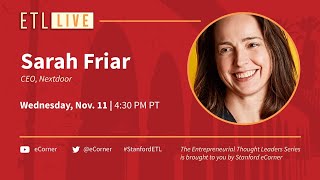
In this Entrepreneurial Thought Leader (ETL) seminar, Stanford professor Tom Byers interviews Sarah Friar, CEO of Nextdoor. The conversation begins with a brief overview of Friar’s diverse career—engineering at Oxford, an MBA at Stanford, senior finance roles at Goldman Sachs, McKinsey, Square, and Salesforce—before focusing on her leadership of Nextdoor, the world’s largest private neighborhood social network. Friar explains Nextdoor’s mission: providing utility (local services, information) that draws users, while the community aspect keeps them engaged. She describes her first 100 days as a listening period, including a global tour of Nextdoor’s 11 markets, and how she identified common community needs such as kindness, loneliness, and the desire for local help. The discussion moves to the COVID‑19 surge, noting an 80% increase in daily active users, the engineering challenges of rapid scaling on AWS, and the platform’s role in disseminating accurate public‑health information and coordinating with agencies like FEMA and UK health ministries. Friar details product innovations such as the Help Map, Help Groups, and a Community Reviewer program that combines local human moderation with machine‑learning nudges (kindness reminders) to curb misinformation and hate. She emphasizes the importance of diversity and inclusion as a business imperative, noting that two‑thirds of the executive team are immigrants, recent board appointments of Black leaders, and ongoing work on gender and racial representation. The interview also explores Friar’s personal journey—from a farming village in Northern Ireland to Oxford engineering, an MBA, and eventually tech leadership—highlighting resilience, risk‑taking, and the value of cross‑sector experience. She references frameworks like Clayton Christensen’s Jobs‑to‑Be‑Done and the “expertise‑passion” quadrant for hiring and leadership, and advises emerging entrepreneurs to embrace failure, avoid perfectionism, and model vulnerability. The session concludes with reflections on community‑first product design, the balance between data‑driven moderation and human empathy, and a hopeful outlook for future ETL series.
Chapters
Hello everybody. I'm Tom Byers and I want to welcome you to the Entrepreneurial Thought Leader seminar series here at Stanford or sort of at Stanford virtually. I'm so pleased that we have Sarah with us today. But I also want to make a special shout out to the folks at stbp, which is the entrepreneurship center at Stanford School of Engineering. I'm so proud to be part of and basis the student club called the Basis, excuse me, Business association of Stanford Entrepreneurial Students. They're the people that have been putting on the ETLs all year. This is our last one for the calendar 2020 and we've done 35 this year. So what a great way to end what has been an incredible year for the planet and for our country and for Stanford University. So today we are very delighted to have this big finish and welcoming Sarah Frey Fryer. Excuse me. To etl. I'm so nervous.
Don't worry at all.
What is it about you? Oh wait, it's your resume. Okay. Two years ago you were named CEO of Nextdoor and I am a member. And I'm not just saying that since we knew you were coming. I've been a member for a while and it is the world's largest private social network for neighborhoods. Prior to doing that, you were at Square and everybody knows about Square. You were CFO there as well as senior vice president of finance and strategy at Salesforce. Before that you've held executive roles at. I got to bring you to office hours sometimes and people want to ask me, should I be a banker? Because you were at Goldman Sachs, should I be a consultant? You were at McKinsey, should I go into tech? You've done that as well. You know, big company. Should I do a startup? So you've done it all, Both Goldman Sachsman McKinsey and you serve on the boards. And I like this a lot at Walmart and Slack, two different kinds of companies. They're both trying to innovate in a hyper competitive situation. And you were the founders and this is really close to our heart at stvp. Everybody knows this, that's been watching these, how important this kind of stuff is. You co founded Ladies who launch a nonprofit that celebrates and empowers women entrepreneurs. So the other, the rest of this is what really excites me. You were a engineering undergrad. I was at the, the University of Oxford or Oxford University in England. I hope we get to talk about that a little bit Engineering because you know, we are here in the school of engineering virtually. And then you got your MBA from the Graduate School of Business just across the campus here at Stanford. So let's dive in. How are you doing today?
I'm great. Thanks, Tom.
Really appreciate it.
That is way too much of an epitaph. I feel like I died, maybe. So now I will just let everyone down because don't believe the hype of the resume.
Yeah, yeah. Well, let's dive in though. Okay. Let's talk about nextdoor first. We got a whole bunch of stuff here, but let's dive into the nextdoor. So you. Could you describe nextdoor for everybody just in case they do not know about it? And then what attracted you to take that job? I'm sure you had lots of opportunities.
Yeah.
So in a nutshell, nextdoor is the place you go to tap into what's going on in your neighborhood, what's going on around you locally. It can be a great place to solve problems. If you're looking for a plumber, which I was this weekend, an emergency plumber, if you're looking for a great place to go, grab a coffee that can deliver it to you safely right now, you might want to sell a used bike. You might want to find out what a local event is going on or what the local health and human services department is saying about COVID 19. So we really service all of the stakeholders in a neighborhood. It's very different from other social networks in your life. So there's clearly a platform for your friend network. There's clearly a platform for your professional network. There's many other platforms that are being born all the time in Internet land that are hyper innovative. But your neighborhood is very different. It has this power of proximity. One of the things that we know is that in times of crisis, for example, now during COVID 19, it is your neighbors who often become that first line of help, that first line of defense for you. Actually, when you're in. We usually say in nextdoor's case, you come for the utility, but you stay for the community, which really ladders up to our purpose. Like the why nextdoor? Like why I wanted to put my career on the line and go to this younger company was really because we want to cultivate a kinder world where everyone has a neighborhood to rely on. So I'll pause, happy to take more questions on it. But it's a special company and it's really got a special purpose and mission in life.
Oh, I really like that. I heard a version of that. Which phrase you just used. Come for the utility, stay for the community. I heard a version of that the other day was it's come for the mission, which is the utility mission, but then you stay for the community. And I think Nextdoor is a perfect example of that in a variety of ways. Well, can we go back to the first hundred days? So just two years ago, December 2018, I don't know if you knew what was coming. If you did, tell me what's going to happen the next two years. But let's just talk about this first 100 days and then a little bit more about managing during COVID So the first 100 days, what were you trying to accomplish?
So I think, you know, like any leader, you really want to make sure you're more in listen mode in the beginning. You need to learn, you need to come up to speed quickly. What I usually tell newer managers or newer executives that are coming to work with me is yes, you should take 90 days, but in reality you have about 30 where you really can just get away with listening. And then you need to start putting a few scores on the board so that you're starting to gather that credibility. But I would still hold back from any large changes unless you're in triage mode, like unless you're joining a company, for example, that's truly on the brink of a disaster. But if the company's kind of doing what it needs to do, you really, I think, want to hold yourself back from too many big decisions till about day 90. But then I think you need to put forth what's your forward vision as you look out over the next 12 months. So in my case in that listen mode, of course it was listening to my employee base and really understanding where they were coming from, but more importantly, listening to our customers. So I actually went on a bit of a world tour, which thankfully I did in 2019, not in 2020, because I wouldn't have gone that far. And I literally visited 10 of our 11 countries that Nextdoor is live and working well in. The one I missed was Italy, ironically, which would have been a great place to go visit. What you find when you're out in the field is of course every country, every culture, every neighborhood is slightly different. And yet these commonalities begin to arise. And that's actually where I could see, of course every country has slightly different needs from a utilitarian perspective, but the commonality was a lot around this community piece and it was two sided. On the one hand, there was so much hope and kindness and great everything from kind of small acts of kindness on the platform to really, really big things that I would see happening. You know, for example, when I in Melbourne, I met with a community group where a woman who had lost her husband had just started having a weekly breakfast on a Sunday morning. Darlene is just a fantastic personality and since she started founding her breakfast, more and more people have shown up. In fact, she's had two engagements happen. So turns out nextdoor can even be a dating platform for some. But the flip side of that is what I heard consistently was also this conversation about loneliness and about how even in a hyper connected world, more and more people were feeling stuck behind panes of glass, but not having real world interactions. And that really kicked off a lot of the work about how do we bring soul into our platform. So it isn't just utilitarian that it has this spirit behind it of building social capital and helping communities unite from online to offline. And that's founded a lot of the work we've done, even in 2020, where of course Covid now really amplifying I think those feelings of social isolation and loneliness. We've just done a bunch of research which we can talk about, but with three of the famed researchers around the world on this topic.
Yeah, I would really like to do that. I'm sitting here thinking we've had a lot of speakers. I was mentioning about the 35 and we stood up ETLs in the summer and of course you can imagine that was in the midst of the crisis or the multiple crises happening once and a lot of people were talking about their immediate reactions. We have the benefit here, given that it's toward the end of 2020, to be a little more of a retrospective, but then what's changed? So you had have had a lot of growth. My understanding from what we read that just a massive growth and that sometimes can be a challenge. It can be challenged to grow too fast. So like to hear about that, maybe a different kind of take rather than here's how we did to get to deal with the immediate stuff. What can you share with us about that?
Yeah, I mean you do get a little bit this sense of perspective now because it has gone on over a much more elongated period of time.
Right.
If you talked to me in March, April, you were in the eye of the fire.
Right.
And you really were trying to rise to meet the moment, but everything was very much of the moment. If I look back in hindsight, the first thing we saw was a big surge in members coming onto the platform. And that actually began in Italy, that country that I mentioned earlier. And we could see it come Through Italy, France to the uk, we knew it was coming to the US and then actually Australia. I remember having long conversations with my country manager in Australia who kept saying, we're an island. This is really not going to impact us. And then of course it did, and now it's actually circling the globe in these surges. So number one was just this huge rise in usage. Almost 80% lift in our daily active users from February going into March. And so for the entrepreneur engineers out there, like on the one hand, for the business person, you're like, yay. And then if you're in the back end, you are in a holy shit moment. Sorry, I probably shouldn't say that on screen, but where your engineers are literally working day and night. Because of course we all say we're building platforms that naturally scale, but the reality is you don't expect that sort of just growth to happen overnight. And it certainly really starts to show where some of the cracks in the system might exist. We're lucky we're a relatively modern platform, so we're built on an extensible architecture like aws. But nevertheless, there were lots of things that we had to really make sure stayed up. The next big thing for us was thinking about mis and disinformation. We'd actually been in preparation mode for the US election and we had come out of Brexit in the uk. So we had done work to really.
Think about how do we make sure.
Nextdoor is the place you come to for the most credible real time sources of information. And so that was kind of step two is how do we keep our neighbors safe? Because even when people are being neighborly, sometimes they don't even realize they're propagating misinformation. It sounds like a neighborly thing to say to someone, hey, did you know if you take extra iron tablets, you're immune, right? Whatever thing the Internet has thought up that week. And so we really quickly had to make sure that wasn't happening. And luckily we had a lot of credibility with public agencies. Right. Nextdoor works with folks like FEMA when hurricanes are hitting the United States. We had been working with the UK government, we'd been working with the French Ministry of Health. And so really quickly we were able to bring folks to the platform like Governor Newsom, Governor Cuomo, Governor Raimondo in Rhode Island, Mayor Khan in London, who wanted to know that nextdoor could be the place to put their latest and greatest information. So that was kind of step two. Make sure accurate information is right there, front and center. The Next thing we saw was this kind of rise of help to give. And it's a very natural human reaction that in a disaster. It's actually one of the things I love about humanity is that when we are kind of at our most base moment, like, I don't know, you're in the storm and someone's been swept away, you don't think, what political party are they in, what color, what race, you know, or what gender. You just stick out your hand and help pull them in out of that stream. And that was. And also, I think, particularly with COVID you know, who knows how to react to a global pandemic. So people wanted some personal agency, like a feeling of control. And so the way to get some personal agency was of course, to say, how can I help? So we saw a lot of how can I help? We weren't seeing the other side, which is people saying, I need help. And that takes a bit longer because it's actually a very vulnerable moment for a lot of people to say, I need help. And so we had to think through product, and we can talk about some of the product innovation we did, but things like our global help map or global help groups as a way to kind of lower the barrier to someone being able to say, I actually need some help at the moment. Personally, in my neighborhood, I connected to two people, and it's interesting because both are in about that kind of 50, 60 age group, and they spent an inordinate amount of time the first time I talked to both of them, explaining why they didn't really need help. You know, I'm super fit, healthy, I normally run, blah, blah, blah, blah, blah. And it was really their way of saying, I don't normally need help. But in both cases, they needed me to go to the pharmacy for them because they were immunosuppressed and couldn't leave their house. And I think that was a unique feeling for a lot of people. And usually you depend on family or friends, but suddenly that wasn't available to you, Right? My family lives in Northern Ireland. I have older parents. I want to make sure they're getting everything, but I'm actually leaning on my neighbors there to make sure that my parents have what they need currently. And then finally, the. I would say more recent areas we've focused on have been local businesses and local nonprofits, because these are incredibly important parts of a neighborhood. Our local economies will never be the same if we let our local coffee shop, our local dry cleaner, our local hair salon go out of business. And yet that's what's happening. So we're trying to connect both neighbors who would like to help. And we saw initially things like GoFundMe campaigns, but in reality, businesses are both kind of very proud. They don't want to accept charity, but they also need to be sustainable.
Right.
Go fund you will only take you so far. And so as they pivoted their business models, we're trying to help them get that message out. So making sure for holiday shopping, you know that your favorite local business is now online or I just saw a restaurant that was struggling and so she has become the queen of. She now parcels and sends, oh my.
God, I'm forgetting the name of them right now.
But little wontons all around the US she actually ran a Chinese restaurant, but has pivoted to being kind of this.
Distributor of this particular type of food.
And that's how she's, she's actually doing better in her business than she was when she was a restaurant. So how do we help neighbors find out what their businesses are doing? And how do we help businesses who need to really let neighbors know what they're doing and where neighbors can help most?
Well, let's. I'm fascinated about how you turned 2020 or you and your team at Nextdoor turned it into a chance for innovation, because that's what this course is all about, you know, entrepreneurship and innovation. So let's keep going. You talked earlier, you touched on the social isolation and loneliness and you mentioned that when you were talking about your neighbors, could you talk a little bit more about how the psychology and the psychologists that you've assembled to assist in this product innovation.
Yeah, so it is, you know, as.
A, as an innovator, I really buy.
Into the path to innovation being through customer insight driven kind of an approach. So, you know, lots of deep customer insights translate that into kind of a design effort that effectively creates the wireframe and ultimately the mock ups that say this is what this product could feel like.
A lot more testing and then finally.
Kind of real hands on keyboard. Okay. Now we're building this with like true finesse and resilience to it. You know, I don't know in your course who you teach, but I really love Clayton Christensen's jobs to be done framework. And it has such deep roots in Silicon Valley.
Right.
Because I would even credit the follow.
Me homes that Scott Cook did at Intuit as great examples of this.
And I think the insight is what's so interesting because if you ask your.
Customers what they want, often what they.
Tell you they want is not actually what they want at all. That's the classic buggy web story.
It's also, even if they are using.
Your product and you ask them what they're doing with it, it's actually often.
Not what they're really doing with it.
And the insight really comes with that deep ability to watch your customer in action.
So, for example, in the case of.
Innovation and trying to rise to meet the moment for next door, during COVID.
We looked at something like help map.
And almost our first inclination was to say, okay, let's create it. This is great. We're going to create a map, and we're going to drop pins on the map of people who have helped to give. And then we're going to drop pins on the map of people who have help wanted.
What could be more perfect? We'll color them differently. Then what we realized when we step.
Back from it is like, wow, we're like creating a map of the vulnerable, which seems like a really bad idea in hindsight.
So we kind of did, let's not do that.
And realized that actually the way that you could allow more vulnerable people to speak up was in a smaller subset community of your community.
And so we kept the help map because actually, for a lot of people.
It did work the way it was intended. But we actually found that help groups.
Were ultimately the product that lowered the.
Catalyst to involvement to an extent where actually people felt comfortable doing it. By the way, that research has now been extended as we think about. If you think about the next social crisis that happened certainly in the US but is really a world crisis around Black Lives Matter and racism in our country and in the world, broadly speaking.
We could also see some similar things going on where people of color might.
Not feel super safe in their neighborhood and therefore super safe in their main feed on next door.
But when we take them into a.
Group where it's a smaller group of people, they can suddenly be much more authentically themselves.
Often what they want to do in.
Those groups is a little different from what we might see in, say, a more predominantly white area. I mean, these are really tough subjects that people don't like to wade into.
And yet we know by bringing together.
Kind of, I call it the EQ and the IQ coming together. I think if I were to critique.
Silicon Valley, we definitely kowtow to the.
Font of data, data, science, machine learning, AI.
But the really hard thing is when.
You bring human behavior together with a deeply more automated, mechanistic system. And when those two things interact, how do you make sure you're amplifying really positive things and actually thinking about how you moderate the more negative things.
Not to a place of kind of.
When people talk about moderation, they often think it's about literally turning things off.
I think about it more certainly from.
A neighborhood context of how do I help people disagree but not be disagreeable? Because if we suppress, tougher conversations will actually never find their way to a solution. I've been trying to talk to my.
Kids a little in the last few.
Weeks about Northern Ireland, of all places, because my son's writing a paper on talking to his grandfather. And growing up in a community that was actually at war meant that you.
Had to be able to have tough conversations.
Otherwise, how could you solve an actual war? And you had to deal with everyone.
Around the table, like deciding that some.
People shouldn't be at the table. You can't get to peace because then you don't have all the stakeholders involved.
Oh, I want to talk about your life in Northern Ireland more in just a moment, but I'm so glad you brought up Clayton Christensen's model or phrase jobs to be done from that paper he did. We love making recommendations for the students watching this and other learners around the world to go and learn more about entrepreneurship and innovation. And that's a great place to start. Not only that work, but his seminal work before that about disruptive innovations. We really miss him. He passed recently and has had huge impact on all of us who teach entrepreneurship at Stanford. And it's interesting. The students really gravitate toward that model. I just used that framework in teaching about two weeks ago, right after you and I were talking about it, and it was the students who brought it up, saying, look, we should all read this piece. I said, yeah, that's great. So his work continues even afterwards, and it's great to see it being used or having such an impact with you at nextdoor. So can we change gears a little? I'm watching the time here. I want to also remind everybody that this is a chance for people who are live with us, either Stanford students taking the course for credit on Zoom or those on YouTube. You just post a question. Our staff will make sure that I get my eyes on it, and we'll do our best to get them into the mix in the next. The last half of this show. So it's the halftime show, and during the halftime show here, we're going to talk about your career journey. You got to do that. You brought up Northern Ireland and, you know, no laughing matter. You, you were in Northern Ireland during the Troubles.
Yeah.
And something that on a little more positive note, you were born in a farming village and I married somebody who was born in a farming village, but in North Dakota, which is kind of in the north too, so very similar. And you know, we talked about that and I've just learned a lot about what it was like, that mentality of a farmer and the amount, the work ethic. It probably. It makes entrepreneurship look easy and we always talk about how hard it is, but it's sort of that along with our athletes, you know, they also amaze me with their time management. But farmers do the same thing. So let's talk about why. How did you end up at Oxford studying engineering since this is an engineering school?
Yeah, well, you're right. I grew up in a very rural area. You're absolutely right that I think farmers are the ultimate act like an owner moment too. Right. Because there is no job too small or too big that they don't have to do because who else is going to show up to do it? And so, you know, a lot of my summer jobs involved particularly being on my Uncle Louis farm. He would have us up at like 6 o' clock in the morning doing extraordinary things. Let me tell you how I got to engineering. It was definitely atypical. I grew up in a world where if you did like sciences and math at school, which I adored and I was super lucky to be, you know, both had teachers who got really involved with us. I also, interestingly, was in a cohort of girls and we all outperformed. I don't know what it was, but there were like five of us and we're all still really great, great friends, but we were all hardcore into particularly math and physics were like our two things, but us, the traditional path was straight into medicine. My brother is a doctor. Or maybe if you were really thinking outside the box, you might have become like an accountant or a lawyer. But it was not that typical to go to engineering. And I think what I saw in engineering was I was just so naturally curious all the time. I love to take things apart. Like on that uncle's farm, I was always the person like fixing the piece of machinery or trying to figure out like how the rotator cuff, like linked to this piece of whatever and why it was broken. And it just seemed like a very natural transition. Oxford was hard because it was also atypical from my community, so there was no one to turn to. My parents, neither of my parents went to college. There was a lot of fear, I think, from them of what it was going to mean if I was going to go off to England, which was more expensive. There was a lot of hurdles, but I almost feel like that gave me a lot of resilience, actually. Now when you talk about the, you know, the path of an entrepreneur, you really have to be resilient and you have to be incredibly optimistic. Not naive, but very optimistic. Because you got to kind of win people's hearts to come with you. Like you can win their minds because of a good business plan or a good piece of technology, but like, you got to have their hearts. So they'll go with you into the, you know, into the deep battle. And I think I got to learn a lot of that early because it was like a big leap to go off and do something that was really atypical from what my friends were doing, what my family expected. When I got to Oxford, it was just, you know, it was so amazing to be challenged the way I was being challenged to have that kind of. Actually, one of the things I really appreciate about an Oxford education is the one to one tutorial where you have to debate to go back to that point about disagreeing without being disagreeable. Your tutor would just hand you less so in pure engineering. But I did a course called MEM Material Science, Rheumatology, Economics and Management. And in the EM piece, right, you just got handed the side you had to take and then you had to show up a week later and argue it. Even if you fundamentally disagreed with it, your tutor did not care. He or she was just like, show me what you got. And I think that is a great learning too, about walking in other people's shoes, like learning empathy and really thinking about both sides of an argument and something, you know, I don't know if I see enough of that in today's culture. I would love to see more of it.
That's why I think neighborhoods are a.
Place to do it.
Right.
I totally buy into Tom Friedman and kind of the neighborhood being the unit of change or David Brooks, actually, I think said that. So, yeah, so that took me to Oxford, took me to engineering. One highlight, I would say, in terms of the risk and. Sorry, I know Tom, you want to jump in? I went and did an internship in Ghana for Ashanti Goldfields. I took kind of a lab process called Biox. My tutor was working on it. I wrote my thesis on it, actually did a master's in engineering and went to see what a real live mine would be like. I realized ultimately it was not for me. It was a very Kind of frankly sexist environment that I didn't see where I could be successful. But it was again just. I'm so glad I took those risks early in my career to travel, to do kind of scary stuff because in the end it's not that scary. You don't have that much at stake. Later in life it's harder. You have kids, you've got roots put down. I think it's way harder to go take those risks. So that's always my advice, like lean in, travel, take risks.
Well, it also gives you global exposure because we are a global community. The debate about the pros and cons of globalization. That's fine to talk about that theoretically because there are some issues, there's no question. But how are you going to be. It's sort of like you thinking about being in both persons shoes. How are you going to be informed to think about those downside risk of globalization if you haven't actually been there?
Totally.
And frankly if you have ever read Hans Rosling's book Factfulness, I think about it a lot as a board member where for most companies you want to go where the high growth market is. It's so much better to be a small fish and in a hyper growth large market with a really big tam because then you can afford to screw up plenty and yet the kind of the tailwinds are at your back. Like I would say that was very true of Square, it's very true of Salesforce. I believe it's very true of Nextdoor. And if you look at where global growth is going to be, right. It's coming out of Asia today, really China. But 10 years from now it's really going to be Africa. And it's not a country.
Right.
It's a continent and every country is very different. But to just as a. If you see yourself as being an entrepreneur a decade from that two decades from now, but have no knowledge of one of the largest growth markets like it's always a head scratcher to me when people are like only want to see North America or see Western Europe.
Yeah. And then real quick, the last thing on this, on the career part and getting ready to be, you know what you're doing now as being the CEO of a great company. What about the MBA? What's your view? It's been about 20 years that you almost.
No, it's like two years ago. What are you talking about?
Given that perspective, what's the value of an MBA given that you've gone into tech and you're a CEO?
Yeah. I am definitely very positive on an mba. Like, for me, it was a really important kind of transition period, partially because I changed countries, right? So I had an expectation. I'd been in South Africa, actually right ahead of time with McKinsey. I had this expectation that I would be going back to London. And suddenly I did this zag that brought me to California, to the farm.
Like, what a life changer.
So just that in and of itself was, like, a good reason to do it. I do buy in that academically. It's also very helpful. Like, I think with the benefit of those 20 years that you alluded to, I now really understand the benefit of classes. Like, I took Jeffrey Pfeffer's class on power in organizations. Power and Politics was what it was called at the time. Jack McDonald was an amazing tutor on the investment side. Sadly passed away recently. But I remember taking his class and thinking, God, this guy's such a slacker.
He doesn't actually teach.
He just invites people to talk. And now I sit there and I was like, wow, after 11 years of being an investment professional at Goldman, I'm like, investing is such an apprenticeship business that you can't learn it from a book. You really have to learn practitioners, and you'll figure out ultimately the right mode for you to operate in to be successful. But you have to hear practitioners at work. I think the same is true of entrepreneurship, actually. And so I really buy into the academic side. And then the final thing, though, is the network, right? It's amazing. I mean, actually, in my current CEO position, one of my Stanford, like, in my class classmates is on my board next door. That same thing was true when I was at Square. They just kind of pop up everywhere. And so. And there's a bond that is different about a small class like Stanford. So you can tell I'm, like, pretty high on the business school.
Yeah, well, me too, but I went to Berkeley's business school, so I would say the same thing about them. But, okay, so for my last little block, and then we'll go out to questions from the students, and what an appropriate way to be the last set of questions I ask in any ETL for 2020. Let's talk about diversity and inclusion. It is one of the defining issues of 2020. There have been many. So let's just cut you the chase. I know you care about it. I do, too. But it's been. That word this year has been activate, action. What actions have you been taking at nextdoor or with your nonprofit or whatever? What actions have you been Doing about diversity and inclusion.
Yeah. So, I mean, number one, I think you have to view it as a business imperative.
This isn't about kind of good and welfare in the world.
That's important too. But I think you have to start from it being a business imperative. And we know it creates better business.
Outcomes, like going back to the jobs.
To be done, insights from your customers. Like, everyone you surround yourself is effectively giving you feedback kind of as a microphone to your customers. Customers.
And so if your board isn't diverse.
If your senior executive team isn't diverse, if your product building team isn't diverse, you just don't even realize the biases that you're building in. So I think if, you know, in.
Our case at Nextdoor, we want to serve the world. Like, we don't believe there's a place.
On earth where people don't want to have a neighborhood to rely on.
So we have to look like that global population. So I'm really proud of the fact.
For example, that 2/3 of my executive team are immigrants, which is probably not what you all expected me to say, because I could give you all the stats on, we do very well on gender. We have more work to do on people of color, but it's getting better.
But I think even just that immigrant.
Thing, because I didn't want just a us perspective in our build, I have just added two new board members who are both black.
It was a place that at the.
Most senior level, we weren't showing up. Well, I came to Nextdoor really in full force about gender, gender equality. It's always something that I felt really passionate about.
But I realized my blind spot is I wasn't thinking on the color side.
And I'm sure part of that is even just how I grew up. But regardless, it's not an excuse. So adding two new board members. So John Hope Bryant from Operation Hope, who is one of the most passionate speakers.
I hope at some point, all of.
You in life get a chance to hear from John. And then Andrea Wisham, who was the.
President of vice EVP at Harpo, so.
She actually was Oprah's effectively COO for about two decades.
Nextdoor needs to learn to tell stories.
To really help members understand why we have such strong utility and community, but also to amplify what we want the platform to do. So who better to get than a person who's helped the best storyteller in the world for two decades?
So going back to, yes, I did.
It because it sends a signal on the importance of diversity. But I Did it first because it's just a great business move. In the case of Ladies who Launch.
I think something to think about.
You're all listening to me. Very young in your careers.
And so some people take the tack.
Of I'm going to be philanthropic afterwards.
I'll do what I need to do.
I'm going to have to work really hard and then I'll think about philanthropy.
Personally, I look for kind of places.
Where I can find the overlaps of.
The things I care about.
Like there's a Japanese kind of framework called ikigai, probably butchering how you say it.
But the idea is like, what are you passionate about?
What are you good at? What can you get paid for? And what does the world need? And if you find those four circles to overlap in the middle, you're in ultimate flow. Right. You just don't feel tired. You can run forever.
And I would say that about Ladies.
Who launch, which is built on this premise of community education and inspiration for female entrepreneurs. But that word community next door, which is all about community, it's something I'm.
Good at and it's something I'm very passionate about.
So I feel like it gives me tremendous energy to wake up every day and kind of run the next mountain, but bring my team with me to do that.
Well, thanks. I'm going to go to some questions from our listeners or watchers tonight. Here's one we're backing up a little bit, but I hope that's okay with you because this is a really important issue too. And let me get this straight. Social media platforms like Facebook and Twitter have been under immense pressure to moderate its discussions, you know, unless you've been on a rock this month. Right. And specifically with misinformation and hate speech. So because you're also a social media platform, what are you doing on this issue? I know we touched on a little bit, but I think it'd be great to talk about it specifically as opposed to what other social media companies are doing or a similar way.
Yeah. So where we differ, first of all, we're very clear that we're a community driven platform with community guidelines. So there is a set of expectations of how you show up. And one of the things actually through the course of this year we worked on was putting a neighbor pledge back up on the front on the home screen. So the first time you come to next door is either a new member or if you hadn't been back for a while, we now remind you what that neighbor pledged to be a good neighbor. Right. So you know, be helpful, not hurtful, don't discriminate, no place for racism, et cetera. And by the way, we got there through a lot of work with Stanford Spark, so I don't know if you know Jennifer Eberhardt's work on bias and so on, but it's a great place where we often use the kind of psychology side of the house to come together with the products that we create. So that's number one, we are a guideline driven platform. So therefore we're clear on things that we will remove or even people we will remove if you're constantly breaking guidelines. Secondly, we are locally moderated. So this is a decision the founding team made long before I showed up. And I think it was a brilliant decision because it's based on the idea that really only with hyperlocal context can you know how a piece of content is actually showing up.
Right.
There's no way that I think someone based on the west coast of the United States can have any sense for what my dad's neighborhood is feeling about a post that, say, might include religion, religious overtones. Is it tongue in cheek and jestful or is it actually hurtful? And so what should stay and what should go? And I think it's very hard to do that with just pure machines. And I'll come to that because we do also use ML, but the kind of the layer cake bottom layer is local moderation. Now, we've had a lot of work to do there. Even in 2020, we realized that a lot of our moderators were either overwhelmed or they didn't represent the diversity of their communities. So we actually rolled out a new program called the Community Reviewer. And I've been astounded. Like, really fills me with hope for humanity. How many people want to in their local community, we do use a layer of technology. There's kind of the easy stuff like profanity that machines can find. But over time, how do we train machines to know if a piece of content is going to get moderated? And then actually we inserted something called kindness Reminder. So again, we're always trying to pull you back to like, what is our purpose and our mission? Like, why would you join this community? Again, something Dr. Eberhardt worked with us on, which is this idea that if we know that what you're about to post is highly likely to be flagged as reported content, we tell you and we say, hey, remember, great communities are created with kindness. You might want to edit your response. And so instead of me writing back, tom, you moron, I might say something a little kind of like, tom, I really disagree with you and here's why. And again, that was premised on this idea that first of all, people don't like to think that's in some future state. What they do is going to be reviewed and reviewed unfavorably. So we're playing on that human emotion and just by popping up that interstitial, we slow you down. So we take you out of your kind of more biased dinosaur brain back up here, your frontal lobe, your thinking brain, where you're able to layer biases with education or shared experiences. There's a lot of stuff that we do that is very different from other platforms. I think they're starting to follow somewhat. I've seen, for example, that pledge starting to get used in other places. And you know what? I'm fine with that. Like, if it's going to make us all a little bit nicer and kinder in an online setting, I think that's.
For the good of the world.
Thanks. Well, I wish we have so many questions, so I apologize for folks who submitted one and I won't be able to get to here in these last five minutes. I want to go back to you, if you don't mind a little bit, because there's a couple here. And I'm just imagining a student out there looking at you saying, wow, she seems pretty genuine and human and authentic. I mean, just, she's not from another planet. She's from Northern Ireland.
You should be my kids, they'll really let you know that as well.
Yeah, I want that to come across and people say, wait, wait, I could do that. You know, I mean, I think you do that. So let's dive into that a little bit. There's one here that, oh my goodness, it moved. Oh my gosh. Oh, yeah, yeah. So the transition from being a CFO or senior VP or whatever to being CEO, what is that these last two years been like for you? What's your surprise about it and what have you learned? What's the deal from what means when you leap from being a member of the senior executive team to being the CEO, the person that everything rolls up to?
I mean, the first thing I would.
Say is I just try never to think about it. I actually just believe that you get to work every day, you act like an owner, you look at the work that needs to be done, and then you figure out it's kind of the two by two of like, do you have expertise and do you have passion for it?
And that's How I think about a.
Lot of my frameworks for how I put people in the right positions, Right? So if you have both expertise and passion, you're probably the right person to do the job.
And it doesn't matter what title you.
Got, you should figure out how to be in that quadrant. If you have no expertise but a.
Lot of passion, that's a dangerous zone.
Go hire people as fast as humanly possible, because you're probably going to destroy value every day because you're kind of waiting around in an area that you don't yet know what you're doing in. In the no expertise, no passion, you're probably not going to ever go do that, because why would you spend your life doing that?
The other zone that I think is.
Dangerous for a lot of people, and.
It'S something to think about as a.
CEO, maybe even more so than a cfo, is where you have expertise but no passion.
Because often I find as a leader, like, there's a point where I want.
To take some of the burden off my team, and if I know how to do it and can go do it, you can load yourself up with a lot of work like that, and then you kind of wake up a year from now, two years from now.
And you realize that you don't actually.
Love what you do.
I once had a boss who said.
The highs got lower, the lows got lower, which was what finally caused him to leave. Just don't get yourself to that point. It is incredibly important that we find our energy sources through our work, through the people we surround ourselves with.
And some of that is really being.
Honest about what you don't like to do, even if you're good at it, and then figuring out how to find the people who are passionate about that thing around you.
So it's a long way to say.
That I don't really buy into titles. In fact, one red flag for me when I'm hiring is someone who is.
Very focused on the title. They're going to get exactly what the.
Job description is, and what am I.
Expecting of them in the next six months. Because in a startup, first of all, titles are all made up.
You can be whatever you want to be. The job description should. If it doesn't look wildly different six months from now, we're all doing something wrong because the company should look wildly different in six months.
And then if you expect me to.
Tell you what you need to do to be successful, you should go work for a big company, you shouldn't work in a startup because so much of.
A startup is, you know, you're constantly.
Watching for where the gaps are emerging and then you go put yourself into that gap to kind of keep lifting the company higher.
So, I mean, I'd be totally Pollyannish.
If I didn't say there is always, you know, in the CEO role.
I think a couple of decisions that end up really just coming down to you. Like there was times at Square where.
Jack and I would walk and talk.
On a decision that I could talk.
Out with him because, you know, in the end he's the CEO and I was the cfo.
So he wanted me to make the decision.
But if I was really having a.
Hard time, I did ultimately have someone.
To talk it through with.
In the case of being the CEO, sometimes there are just certain things that.
You can't really go to your team with in the end. They're usually often people decisions, frankly.
And that's where a good board member.
Or a good mentor, you have to make sure you have a group around you that you trust but will kind of tell truth to power as well.
Yeah. Well, it's been amazing to think of your last decade getting a chance to do those walks with Jack Dorsey just to make sure everybody understands that he was CEO of Square and Twitter at the same time. And then Marc Benioff able to do that also to watch the Walmart CEO Doc is amazing board member. And of course over at Slack, I mean that's another opportunity to observe and see what's going to be your style. So these takeaways have been awesome. I love it. Experience plus passion. You got to have both. And I love the. Still love the one come come for the utility or mission, whatever and stay for the community. That's amazing. All right, we gonna put you through our ritual which is think back to yourself, you know, at Oxford and you go over there to sayee to the business school or somewhere and there's a. There's somebody talking about entrepreneurship and leadership and all that. You know, what's the most important piece of advice that you would give that young person you were back then, now that you are, you know, you've had this, These experiences last 25 years or more. What, what's the most important advice you'd like our students to have today?
So thinking back for me at that time, one was like, just, you don't.
Have to be perfect.
Like I came from an environment and I think, I think gender plays into.
This too, by the way. Work. I was always the A student.
Like I always got the A. And while it was incredibly accelerating of.
What I was able to do in life. It also can really hold you back because that fear of failure gets higher and higher.
And if I think about my career.
At Oxford even, I definitely continued to take classes and so on, where I knew I could be successful.
Business school is a little different. I think by the time I got.
To business school, I was more willing to take some newer risks.
I was confident that I would still be able to make it out the other side.
I mean, Jack even said it to me when I was leaving Square. One of his major pieces of advice was don't be afraid to fail publicly because.
And it was actually less about my.
Own perfectionism getting in my own way.
I think I'm getting somewhat beyond that.
It'll never totally leave me. But it was also about how important it is to model that behavior for others.
And, you know, Silk Melly talks a.
Lot about, you know, celebrating failure and taking risks and not being afraid to fail. It's so true and yet it's so hard to do.
And so, you know, looking back at.
That kind of 18 year old or whatever through 21 year old when I was an engineer, you know, I just felt like I had to be so perfect all the time.
And I think I probably put a.
Lot more pressure on myself than I needed to.
That was like drinking from a fire hose, but a really nice fire hose. Thank you so much, Sarah.
You're welcome. Thank you.
Oh, my gosh, I wish we could do it go forever this evening. So I have to bring this to a close, though. I want to thank Everybody for joining ETL all this year. All 35 episodes that none were more fun than this one. We're currently putting the final touches on ETL 2021. We'll be back just like we've been for many, many years back in mid January. We welcome everybody. Either Stanford students are taking it for a class or our audiences around the world on YouTube. So we will see you then. Just keep your eyes on the ETL newsletter for what the lineup's going to be. We're solidifying that now. And I guess this is the time we do declare victory.
Thank you.
In November, we wish everybody a really safe and happy set of holidays coming up and take care of yourselves and be kind to each other. With that, it's a wrap. Thank you, Sarah.
Thank you.
More from GHION.AI


O processo de reconhecer limites, mesmo quando a vida parece exigir sempre mais.





Depois de tantas histórias, aprendizados e pausas necessárias, o @interior_iza está de volta



