ETL Speaker Series: Sylvia Acevedo, Author
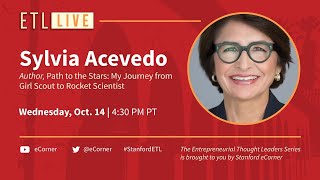
Sylvia Acevedo, former CEO of Girl Scouts USA, talks with Tina Selig about her path from Girl Scout to rocket scientist to NASA engineer. She discusses leading through the Obama administration, building diverse teams, and what it took to succeed as a Latina woman in STEM.
Chapters
They're going to tell me when I'm live. Hi, I'm Tina Selig, faculty Director of the Stanford Technology Ventures Program. And I'd like to welcome you to the Entrepreneurial Thought Leader series presented by stvp, the Entrepreneurship center in Stanford School of Engineering, as well as basis the Business association of Stanford Entrepreneurial Students. Today, we are really delighted to welcome Sylvia Acevedo to. Sylvia is an entrepreneur, an investor, a business leader, and a rocket scientist. She wrote a book called Path to the My Journey from Girl Scout to Rocket Scientist. I love that title. That's just a great title. Her book tells the story of her journey from Las Cruces, New Mexico to NASA's Jet Propulsion Laboratory and then into executive positions in Apple, Dell, IBM and other leading companies. Then she joined the Obama administration and was the commissioner at the White House for an initiative on educational excellence for Hispanics. Really, really impressive. She was Most recently the CEO of the Girl Scouts of the USA, which supports more than two and a half million girls worldwide and generates over $800 million annually from their iconic cookie sales.
Pretty exciting.
How many cookies did you eat, Sylvia?
Oh, my goodness. Hi, Tina. And hi everybody. Really great to see you.
Really delighted to have you here. So I want to start out by.
Talking about your remarkable career path.
You were one of the first Latina students at Stanford to earn a graduate degree in engineering and then went on to careers at NASA and Apple and Dell and Autodesk and then the White House. And of course you also started couple of companies yourself. To what do you attribute your drive and success?
Well, you know, thanks, and it's really a pleasure to be here. You know, I'm really grateful. I had amazing teachers. I was a product of Head Start. I was in one of the first pilot programs for Head Start. So I'm so grateful for that. So early childhood literacy getting me off on the right step. Libraries. Love those public libraries. Before the days of search engines, you know, public libraries were it. And I was so curious about the world. And I read as many of the books as I could. It was a small library, so I think I read every book in the children's section. And then I'm really grateful for my teachers. I had teachers who were really supportive of me and believed in me. And then also that Girl Scout experience that really taught me how to create opportunity. And also one of the greatest sales techniques that I learned from the iconic cookie program as well.
Oh, that's so great.
What did you learn about sales from selling cookies?
Oh, you know, so first Is, you know, when I grew up, my family, we really lived paycheck to paycheck, and sometimes we didn't even have money, and we had to go live with family members, so it was kind of tough. And we also, at times, lived on dirt roads, so we really didn't know how to create opportunity. So one of the first things I learned in Girl Scouts was how to create opportunity, because I really couldn't afford to be in Girl Scouts. But my troop leader said, yes, you can. You gotta sell for everything you want to do. You gotta sell a lot of cookies. That was a really large number of cookies I had to sell. So she taught me how to create, you know, create opportunity and make your dreams come true. So first you set that goal, and then you break that goal up into smaller increments. And then when you. You start working it, and if you need help, you ask for help. Now, that sounds simple. And everyone who's on this call, you know how to do that. Otherwise, you wouldn't be on this call. But to somebody raised in living paycheck to paycheck or near poverty, you don't know how to break out of that cycle. So learning how to create opportunity, that was huge. How to make your dreams come true. And then the other thing, and I've used this my entire life, is never walk away from a sale until you've heard no at least three times.
Oh, that's really important.
That's great.
It was because I grew up in a very traditional Mexican household, and children weren't supposed to speak first to adults. So that's kind of hard to sell cookies if you don't speak first. And so my troop leader gave me that. That advice. And so when I. The first time somebody said no to me, I just stood there in front of them. And then I said, is there anybody else that might want to buy cookies? And she looked at me, and she said, no again. And at that point, there's a thought bubble over my head that says, Truth Leader Mrs. Provine says, Never walk away from sale until you've heard no three times. So I asked again. You know, anybody's day you would make if you bought some cookies. And she called me Socks. But, you know, taught me persistence, resilience. And I use that, you know, going forward. I use that when, you know, my band director wouldn't let. I played timbal. I played the drums. I was first chair. He wouldn't let me march with the big timbali drums because I was a girl. And I said, well, that was my first, no, why else can't I? And he said, well, they're heavy. And I said, okay, so you don't think I'm strong enough? So then I worked up, worked out, worked out, worked out. So I got strong enough so I could carry those to Molly. So, you know, even at that young age, I began figuring out, how do you get to that? Yes. How do you overcome the obstacles? And that, if you're an entrepreneur is an important skill to know is how do you find common ground? How do you work around the obstacles?
I think Sylvia might have frozen. What sort of obstacle do we have to work around right now? Sylvia, we're going to get. Are we going to get you back?
Yeah, I hope so. Okay.
There you go.
That's okay.
I magically did it. You know, I brought you back. So I think this is a really.
Important point, is that learning how to.
Sell was a very pivotal skill in your career that you learned in Girl Scouts. But I'm going to guess that there are other skills that are consistent across all the roles you've played. I'm curious what. Because you've played so many different roles, whether it's in. At the White House or starting a company or in these tech firms, what are the skills that you found that were consistent across all these different roles?
So it's really important to start off with clarity about what you're trying to achieve. And especially as you move into leadership positions, having people understand what it is you're trying to achieve. Now, that sounds simple, but what I found when I've taken over departments or organizations is being very clear about what it is you're trying to achieve. So communication of the goals and the mission of the organization is super important. The other one is teamwork and working with others. The whole collaboration that is so valuable, and then also getting people to work with one another. I mean, that whole cultural aspect that's really like, how do you treat one another? How do you respect one another? Those things are skills that stay throughout. So leadership, persistence, resilience. You've got to learn how to manage the ups and the downs. Sometimes when you're like, everything's going great, you're like, it's always going to be like that. And actually, then, you know, with business, it all goes through cycles. So being able to manage through that is also so very key.
So I'm curious about what differentiates you from other people, because I love the fact that I read somewhere that it was doing stargazing as a girl, when you run the Girl Scouts, that that Sparked your interest in space. And I'm curious, what differentiated you from other girls who look through that same telescope? What was it that made you open to the possibilities that and everybody else didn't necessarily see the same possibilities?
That is a wonderful question. And lucky for me, my troop leader sat next to me and she's the one that pointed out the constellations because otherwise I would have thought they were just twinkly lights. But later she remembered that. And so when it was time to earn badges, she encouraged me to earn my science badge. And frankly, I wanted to earn a cooking badge like all my friends, which I ended up doing as well. But I also earned that science badge. And she encouraged me to do it around space. And so when I did it around space, I decided to make an Estes rocket. And I'll tell you, I failed. I failed five times, but I kept going at it. That all girl environment, a teacher wasn't saying, oh, I guess you're not good at that, or this is just for boys. We trying to figure out, how do you problem solve? How do you figure out what do you need to change to make it successful? Finally, on the sixth time, that rocket went into the sky. And I remember thinking, I can do this, I can do science, I can do math. And that was incredibly untraditional. But I had that confidence. So I began taking more math and science and I started doing more math problems. Like the teacher would assign the even and I would do the even and the odd. And any kid, when they're doing something and they get better at it, they like doing it even more. And the more you do it, the better you get. And I got so good at math, I became a rocket scientist. So I think that early example of overcoming obstacles, problem solving, getting that confidence and realizing that I could do this, that confidence stayed with me and has still with me my entire life.
I love that story. And I think it's also really interesting how one person in your life can say something that changes the trajectory. This person who said, you know, why don't you do the science badge? You know, just give opens a door for you. And once that door is open, and I think it's important not just for the students who are watching as students, but to think about what is the messaging they give to other people. You know, that we all can play that role of opening the door and helping other people see the possibilities in front of them.
Absolutely. And I know as a mentor to many and reaching out to so many kids around the country, it is so important that you are positive that you're encouraging and that you help others see the possibility that is within them. Because we have so much limitless potential. And it's so important that you really inspire others and to really ignite that passion within them. Because everyone has that feeling of, you know, I would really love to be doing that. And maybe they don't share it with others, but if they see that you believe in them, they begin to believe in themselves as well.
So I want to, at this point, remind the students who are watching that they can chime in with some questions on the Q and A. I'm definitely going to be reading them, and we'll be happy to ask them to Sylvia. So I'm super curious about the Girl Scouts. I think I was a Girl Scout for about five minutes, so think of all the things I missed out. You've been in the program since you were a little kid and and ended up becoming the CEO. What has changed about the program over the last decades in preparing young women for leadership roles?
Well, you know, even from the very beginning, the founder, Julia Gordon Lowe, was really interested in science and stem. So some of the first badges were electrician pilots construction. So that has kind of stayed in, but, you know, it kind of ebbed and flowed throughout the decades and in the last 10 years, but even most recently, a really renewed focus on science, technology, engineering, and math, never losing sight of the great outdoors as well as leadership skills. And clearly that iconic cookie program has launched so many entrepreneurs. I can't tell you how many business women I meet that have told me, oh, my gosh, I got my start selling cookies, or they'll make sure that I know that they were the top cookie sellers in their area. So those kinds of skills have stayed. But you'll see, especially when I was there for the last four years, we really had a renewed focus on making sure that we included the outdoors. Because if you think about outdoors, the first S in STEM science is the great outdoors. And I really wanted girls to put down their devices and wonder, look out at the sky, wonder about what does it use all your senses when you're outside? The crunch of the leaves as you're walking, the smell of the air after the rain. Use all of your five senses. I like to say we're not human doings, we're human beings. And so that S of science was so important, especially to realize it in the great outdoors. But all the others, you know, so many of us are living now with our mobile devices or electronic devices, and it's so important to Be able to be the creators and the designers, not just the users of technology. So really saw a huge appetite for learning all about that in Girl scouts. Last year, 2019, over a million STEM badges were earned. And in cybersecurity, over 180,000 badges were earned. I mean over 10,000 badges a month were being earned in cybersecurity. Hacking, malware, password protections, all sorts of great devices, ways to learn about cyber cybersecurity.
So I'm curious, is it necessary to still have a girls only program? Shouldn't these skills be taught to everyone? I mean, how do you, how do you think about that?
So you know, we're talking about children. So first of all, it's kids 5 to 18. In addition, really trying to learn something in a non traditional way is really challenging for a lot of girls to get outside of that space. Now I do realize if you're thinking of a bell curve, I was probably on the really edge of that bell curve. But if you're trying to reach the grand majority of girls and getting them interested in stem, you have to do it in a way that is interesting to them, builds confidence and then builds on the competence. And really designing so much of the programs around how girls learn and lead, which was a big focus at Girl Scouts, we had a lot of researchers that focused on that very thing. So I'll just give you a quick example. So teaching malware and networking. So if you think about how are you going to teach seven and eight year old Brownies malware and networking in a way that's interesting and relevant to girls? Well, one of the first things did is get girls to sit in a circle. Turns out that girls love to sit in a circle, especially seven and eight year old girls and talk. Then we gave them a ball of yarn and they passed the ball of yarn to one another so that every girl got a chance to get the yarn. So right then in just a few minutes you've created a physical network and then you demonstrate that one of the girls on the network had a virus. And even though she didn't talk directly to every girl, because they're all connected on that network, which they can be demonstrated in the ball of yarn, they can see how that virus spreads to all the girls. So in a very short span of time, you were able to get the girls to interested because you were doing something they like to do. They were able to be confident because now they understood it and now they're wanting to be competent. Now things like malware, physical networks, that doesn't really Intimidate them. So imagine all the programming's being designed like that around how girls like to learn and lead. Then they truly get interested. And that's why you saw over the last few years just a tremendous spike in the girls activity levels in stem, because all of those programs were designed in a way to get girls interested, then confident and then confident.
I love that. I actually, I think that's a really, really interesting example of starting with just getting a hook, finding a hook to get someone in, get them curious and starting to feel like they feel like they have some confidence that they understand at least the frameworks. And then they say, okay, now I'm going to build my confidence. We have a bunch of questions that are flowing in. So I'm going to start with some student questions. We have a question about, okay, a bunch of them have gotten voted up. This one I'm going to read. It says, while I find entrepreneurship very exciting, I'm wondering if I might get caught up in working too much and forgetting about my values and what makes me happy. How do you find balance? So it's a sort of balance in your life. I'm thinking both sort of work and rest of your life, but also in terms of having your own values lead you versus, you know, bringing your venture to some successful outcome.
Yeah, it's really important to have your passion in line with your priorities. So that is very key. So if work life balance is very important and you're really passionate about something, you've got to really figure out how can that be expressed in that particular venture or idea. Now, I will say that, you know, when you're starting a company, it does take a lot of time and it's really hard to just say, okay, I'm only going to do this from 8 to 5, so you're going to have to have partners, other people who are going to be supporting you along the way so that you can also carve out time for, let's say it's just your family or making sure that you're going to work out or staying in shape or whatever. So it's very clear that you've got to have those things very focused that you're saying, I'm going to have this, I'm going to carve out the time. But realize when you were starting a company, I'll use a rocket example. So much of the fuel is used in the initial launch. And so it does take that. I mean, it does take that concerted effort. So maybe you say, all right, during this time, I'm Going to allow myself to be very dedicated and kind of minimize this other challenge, other aspect of my life. But then I'm going to then figure out when I can start incorporating those things back into my life.
Actually, I think that metaphor is beyond brilliant, Sylvia. That is just so brilliant. The idea is when you're launching a rocket, I love it. Of course, you came up with that when you're launching a rocket. So much of the fuel is burned up at the beginning. The idea is to get escape velocity. For any endeavor, there's an enormous amount of effort that goes. That goes into the beginning. And that might be something you can tune down later. But at the beginning, if you don't do that, you're not going to be able to be successful.
Yeah. Escape gravity.
Yeah, exactly. So based on this, we have a number of people ask questions about what was it like working at NASA? What sort of projects did you do at jpl? So maybe you could give us a little bit of an insider's look at that experience.
Yeah, that was fantastic. So one of the things is when you work at NASA or the Jet Propulsion Labs on any of those missions, Christmas or that great holiday season, the gift that keeps giving is when your spacecraft is going to be near its target. And so I got to work on two missions, the Voyager 2 and Solar Polar Solar Probe, which got renamed to Parker Solar probe. But Voyager 2 was going by Jupiter. Right when I joined that mission. Okay, that is like all the holidays in one. We didn't all have personal computers, and it was the first time we were getting to see Jupiter and its iconic moons up close. So the pictures you have of Jupiter were from that Voyager too. I remember they would be broadcast streamed live and, you know, you didn't want to miss a moment. So we slept there 24 7. I remember sleeping in a sleeping bag and being in the cafeteria area because that's where they had all the screens. We could look at them. And it was just so amazing to see, you know, Jupiter up close, that big red dot. I was assigned to work more on analyzing a lot of the data that was coming from two its moons, IO and Europa. So just such an exciting time of really doing a lot of data analytic work, but also being caught up in that moment when the spacecraft was going by Jupiter. Then the next mission was the Solar Polar Solar Probe, which is back then, it was pretty amazing to think about sending a spacecraft really close to the sun, only 4 million miles. So that seems like 4 million miles is really far. But if you think about it right now, if you're thinking about a football stadium and we're one end zone and the sun's at the other end zone, well, now this space is going to go all the way down to the four yard line. And so you begin to think, wow, what kind of equipment do we need? What kind of materials to build the spacecraft so that they don't melt? You know, all the nuclear wind, there's just, you know, getting hit by meteors. So how do you solve for that? So some of the material that was needed wasn't even created then. So that's like an amazing aspect. Like, okay, we want to do this and we've got to find some material that can withstand these kinds of temperatures. So I love that because that was an experience of thinking as big as you could. Just wonder, right? Because you had to think about as you're designing this aspect, this mission to the sun, what do you need to be thinking about? And the big what ifs? And I love that because it really stretched my brain and all of us were really like, what else? What aren't we thinking about? How else could we consider this? What are some of the other things that could be impacting this? So I just really remember that experience as just being amazing because of how it really enlarged my thinking, made me really understand the universe of possibilities and I really enjoyed that time.
It sounds wonderful. Now we know that NASA JPL is, when taking all these super hard challenges, sometimes they don't work out very well and you end up with failures. We have some questions about this, about how do you deal with adversity and failure and whether it's personal or professional, organizational, how do we teach people to be resilient in a situation where you have failure and you really need to figure out how to pick yourself up after things don't go as you hoped? Especially when there's a lot of risk.
Right. You know, it's important to try to plan as much as possible to minimize that, but realize that to be successful, you are going to fail. And if you're always successful, it is almost as though you're not stretching yourself enough. They always say that. It's like if you're hitting the bullseye every time, you got to step back away from the target. So understanding that if you fail, you know, failures, I like to say that failure is first attempt in learning. And so to really say to yourself, I failed doesn't mean that you're a failure. It just meant that at that time that didn't work out. So then you figure out, why didn't it work out? What could you control? What couldn't you control? If you think about the year we've been living in, 2020, there were some things that were frankly just out of our control. Right. In other times, that isn't always the case. But it's so important when you're trying things and they didn't work out to take some time to figure out why they didn't. And I will say that is another thing that I have done throughout my career is after we've done anything, even if it's successful and also if it's not been successful, if it's failed, we always say, okay, what went right? What went wrong? What could we have done better? Because you learn from that. Even the most successful activity event, you've got to take that moment to go back and figure out what went right so you can figure out how to make sure you do that again. What didn't work as well as we wanted. So you can work on how do you fix that? And then what would you like to do a little bit differently? I always instituted that and that was just. I was surprised how many people just do something, oh, it didn't work out and move on to the next without taking that moment. Really first attempt in learning of learning from that experience.
Yeah.
I'm a big fan of thinking of failure as data. And if you don't mind that data and analyze that data, it's a huge missed opportunity. So I love the way you put it. It's sort of the acronym of failure as first attempt.
Yep.
Great.
I'm going to repeat that. Thanks. So really curious to hear about your time at the White House. I mean, what an incredible opportunity to work in the Obama administration on such an important goal of focus on educational excellence for Hispanics. How did you get that opportunity and can you tell us a little bit about it?
Yes. You know, I was in Austin at the time and I had just been a successful entrepreneur who just sold this company, Riva Technology, and I had options and I could have gone back to technology at that point time. But fortunately for me, somebody had encouraged me to mentor and tutor a kid in a Title one school. And at that moment, I learned that that girl needed a lot of work on dental hygiene. And I went to the teacher, I was irate, like, how could you not help this child? And she said, sylvia, this entire classroom, in fact, if you have 35 bucks, this kid broke his glasses and needs to get them repaired and doesn't have the money. And what I realized from that moment Was that teachers are amazing and they excel at the one on one or the one on few. But the demographic changes were happening so quickly, and also the healthcare and economic disparities were also growing so quickly that their solutions just didn't scale to the size of the need. And I remember thinking, you know what, I'm not an educator. I'm not great on the one on one or one on few, But I know how to scale that I can deal with. And when I learned about the need, for example, In Central Texas, 11,000 kids needed glasses that didn't have them. And yes, they could get vouchers, but the challenge is it was really tough to get the vouchers. And then when they went to get the glasses, the business tried to sell up and it was just a real challenge for the families to get the glasses. And I realized, like, if how can a child learn if they can't even see? And there's 11,000 kids. And there were great organizations that wanted to support, but they wanted to support with 10 glasses or 100. I'm talking 11,000 glasses, which required a systems solution which we provided. We got a mobile van donated. We made that into a vision lab where we actually created glasses on the spot. We got volunteers, and then we had optometrists also volunteer their time and they would go school by school and make glasses for kids. And it is one of my most heartwarming memories of having a kid who put his glasses on and looking up at his mom and smiling and he said, you're beautiful.
That's so wonderful.
I know. And so then I also discovered that kids didn't have books at home. And I began grassroots mobilization campaigns. I ended up raising, getting more than 250,000, a quarter of a million books distributed. 10,000 home libraries started getting away 25,000 dental kits. And that spread from Austin to Los Angeles to Miami to Atlanta. And at that point, I got the notice of the Obama administration. So they asked me to join this commission, which was unusual because they were all educators, they were university professors, they were academics, and here was an engineer in their midst. But what was interesting is I was really focused. Remember you asked me, what are some of the transferable skills? Well, one of them was really be focused on the goal and what you wanted to accomplish. And so I focused on early childhood. Then I realized that we had a lot of kids who were in Head start or other pre K programs and their native language at home wasn't English. But federal funding at that time would only support English only programs. And you Know that if you can teach a kid in its native language and then bridge that to English, they will learn both languages. And, you know, dual language really helps the brain as well, and it would give America a workforce that could be globally competitive. And so I stayed focused on how do we get that policy changed so that federal funding could be used for dual language programs so the kids would still learn English, but they would also be supported in a way in a language that they already understood, so they could learn English that much faster. And I'm pleased to say that that focus actually got that policy changed in. Knock on wood, it still hasn't changed. But again, it was that focus. And it was a really exciting time to be working in education.
Well, how exciting. That must have been wonderful. And clearly you had an impact. So we're living in a time where there is a very strong focus and a lot of attention on serving historically disadvantaged groups. Now, as a Latina woman, what obstacles and opportunities are you seeing emerge now that didn't exist before?
Wow, I'm just so excited about so many great opportunities that exist. You know, I like to say that, you know, my first job, if you've ever seen the movie Hidden Figures, and the woman had to run to another bathroom. There wasn't even a bathroom. So that was a huge you're not welcome sign, right? And I stayed and I brought a bike into work and I rode my bike to the nearest building. And finally, after six weeks, they said, okay, we're gonna, you know, get you your own port. A potty. And it said hers on it. And that, you know, where was this?
Where was this?
That was when I was first working at Sandia Labs.
Really? There was no women's restroom.
There was no women's restroom. Hey, but you know what, if you go to, even to the White House and even to Congress, the women's bathrooms are add ons. And that's one of the things I really learned is that, you know, the men's bathrooms are really prevalent and very proximate. So all the women, we would be hustling sometimes to another floor to get to the bathroom, and then we'd run back just to make sure we got back in time for the breaks. But that's because architecture at that time didn't envision women being in the power positions in government. So, you know, there's a lot of that that exists wasn't just in engineering, but, you know, and I see there's just so many great opportunities. And so it's so important to see that you've got to prepare and do your homework. You know, I always like that. It's not a handout, it's a hand up. So be prepared, get your mental state in order, get rid of the chip on your shoulder. You know, I had to do that as well. You know, I had a chip on my shoulder, got rid of the chip on my shoulder and really be part of, of being the solution at your company or making a difference at your company. Those are the things that I'm really excited about for people. I think all people have a much better opportunity. Yes, there's been some, obviously there's historical issues, but I know for myself I'm so grateful that I've had many opportunities and sometimes, you know, I've had to really work to open up the doors of opportunity. But then I've work really just as hard to make sure that there's a path behind me. And in fact, you know, I named my book, it's a middle school memoir, Path to the Stars. But I actually would like it to be like a highway of opportunity for those who the rising generation coming up.
Well, so we have some questions from the students about, you know, how can they follow in your footsteps? They're so inspired by your story and the path that you've created. How can other people think about creating their own really exciting career path?
You know, I really do believe the first person that you have to convince about anything is yourself. And that is that confidence. For example, we talked about that rocket in that when I finally, after failing so many times and having that rocket go up, I just knew inside of myself I could do this, I could do science, I could do math, even though the world around me was telling me I couldn't. But I had convinced myself that I could. So for whatever your dream is, you're the one. You have to say, I can do this. And know that within yourself and then figure out what is it going to take to get you there. You know, you see that my Stanford diploma. You know, when I was in fourth grade, my teacher in a very far sighted fashion, showed our class in Las Cruces, New Mexico, which back then was a small desert town. She showed us pictures of great universities. And when I saw the iconic red tile roof and sandstone buildings and then the beautiful green hills, remember I grew up in the desert. I said, I want to go there. And she looked at me and she said, you know Sylvia, it's one of the best colleges in the world, universities in the world. And she said, and you're smart, you can go there. And so at fourth grade, I just said, I am going there. And, you know, that's like an amazing, amazing goal for myself. But, you know, I set about, what is it going to take so that I can get there? And I methodically went and did all those things. One of the first things I realized is I had to get really good grades.
What's so interesting is that you had someone who said to you, hey, guess what, Sylvia? You can do that. That's a realistic dream. There are other people who get different messages where people say, that's unrealistic. You know.
You know what?
You can never forget it. You'll never get in there, or you're never, you know, that's not a place for you.
Well, you know what? I had plenty of that in my career and even in high school. My high school counselor, when I signed up to go to college counseling, she looked at me and she said, what are you doing there? I said, you already get college counseling. And she said, girls like you don't go to college. And statistically, she was right. But as an educator, she was really wrong to say that. You know what? That was like, the three nos. I stood up, went into her office, and she followed me in and she said, well, what are you going to study? And I said, I'm going to be an engineer. And she laughed and she said, girls aren't engineers. And I went on and as you know, became a rocket scientist and engineer and all that. But also in my career, many times, you know, I did global and international travel, and it was really hard to convince them to let me do that. And in fact, twice in my career, I had to pay for my trips to the countries before I even had that assignment in that company because they didn't believe I could go there. So on my own dime, I went to these two different countries. I met business leaders, I got letters of recommendation. I came back and put those on my boss's desk. And they're like, we're hiring boss's desk. And then what could they do but to hire me, you know, another time. I could not break into another company's international business no matter what I did. I had amazing sales track record on the domestic side. And so what I did is I created a presentation showing that if they had the same kind of penetration in multinational accounts in the Pacific Apple, Pacific region as I had back then, I would be able to, you know, their sales would be up by several hundred million dollars. And I remember the sales vice president, I had my little presentation, got him for just A few minutes in one of the side team rooms, he looked through the presentation. He said, oh, wow, this is great. And he went to grab the presentation. I put my hand on it and he said, don't I get this? And I said, yes, you do, but it comes with me. And that was what it took.
That was Sylvia.
I know, but I kept getting no after, no after, no. But I finally broke in. So there are a lot of times that I've been told no. I've been, you know, and I try to figure out how can I get to that yes. And, you know, it takes time. It takes a lot of time sometimes. But I didn't give up.
I think really important lesson here is.
A, you need to know what you want and then you need to fight for it. So there's that first step of figuring out what it is you actually want to accomplish and then making a beeline, even if you're going to get some barriers. So we have a wonderful note from someone who says that they are a.
Fellow New Mexican, a Sandia employee, and a female minority and is thanking you so much for being here. And she says, I want to understand how you chose to go into entrepreneurship and business and sort of think of your life through that lens, as opposed to being a laboratory scientist with an interest in, you know, space. So how do, how do you think about whether you want to be on the front ends of research or entrepreneurship business?
So it's about knowing yourself. So one of the things getting back to JPL and the Solar Polar Mission and the Voyager 2 mission. So the Voyager 2 mission, fantastic. Went by Jupiter, all this great stuff. The Solar Polar mission, great in terms of thinking about the universe of possibilities. But then as I mentioned, materials hadn't even been developed, so it was going to be decades. And I knew myself I needed to have more readily achievable goals and activities, more like in the quarter by quarter or year by year and not measured in decades. So, you know, that's when I realized that, you know, I needed to move to more of an industry that had that kind of faster pace. So that's when I moved into technology. And I did start first in engineering, but then I said, well, so, but how do people move up? Because I trained as an engineer, but then I'm working in a business environment. And so I went to my boss and I said, so how does one like get to be one of those bigger bosses? And he said, well, you've got to have. You're in engineering, but you need to have product. You need to have sales, you have to have P and L responsibilities. And then he looked at me and was like, but that's not for you, right? And I was like, no. You know, I. So I methodically organized my career to get jobs in product marketing and sales and then P and L profit and loss responsibilities at a company so that you could then become an executive. So it was really conscious on my part.
I love that. And it echoes some of the things we've heard from other speakers. So it's, you know, you can, you can trust that this is a path that what you, you know, that, that others have followed and had been equally successful. So one of the students wants to know what you did at Apple.
Oh, so a couple things. I was in the domestic area first, so large account marketing, sales and marketing to big multinationals and then moved over to Apple Pacific and then went into the Latin American area where I worked with distribution, bringing in software distribution for the first time in that area for the Apple products, which was great. And then building the business channel as well.
Great.
Now, I, I want to go back to your really unique perspective. Being a minority woman in a very important leadership roles that you've had. Can you share some insights about the importance of having a diverse workforce?
This is something we're thinking a lot about these days.
The value of having people on your team from very different backgrounds. Not just because it's the right thing, but it's also the smart thing to do. Can you talk a little bit about that?
Yeah. You know, especially today when things are changing so rapidly, to have team members who also bring a different perspective so that you can all come together is so helpful because when there's so much rapid change going on, to have people who have had a breadth of experiences is absolutely vital. So I really find that to be incredibly beneficial. Also, I have found working with people from other either cultures, whether they're different American cultures or other international cultures, it's really important because they're already in their brain in a way being bicultural because they're, you know, what you call code switching, they're doing that. So they're like basically having two ideas at the same time and saying, okay, this is what that is. That like really builds a lot of flexibility, thinking, you know, outside the box thinking. And so when they come into a team, they're frequently thinking about, you know, how you're thinking of a solution. They're able to add a nuance or dimension that you previously didn't have. So I have always found that to be amazing to have teams that have wide variety of different experiences and backgrounds. But I will say you need to have a management team. And that's where culture comes in, that it's really, you're respectful of people who have differences of different ways of being or thinking. And I know I always wanted to have somebody who would always challenge as well. And a lot of times it's more comfortable managers to have people who like, just line up with you. But I always like people who also challenge because you need to have that additional thinking. Especially when things are changing so rapidly. You need to be prepared for many different possibilities.
So speaking of code switching, you know.
We have a question from a student.
About the fact that, you know, you went from being an engineer to ending up in management and sales. How did the school skills you learned as an engineer translate into a world of business? You know, were those skills helpful?
Oh my gosh. You know, for one thing, the math is a lot easier. Right? You know, numbers, it's like two. Yeah, it's like, oh, okay. You know, it's only two decimal points, not a huge long number. So, you know, the things too about scale. You know, I had talked about, you know, working with in grassroots mobilization for education. I wasn't daunted by the fact that you have to get 11,000 glasses. I wasn't daunted by getting a quarter million books. Right. The scale is not a challenge. And that was so useful when I went to Girl Scouts because again, if you think about the scale of the iconic cooking program, I mean, Girl Scouts is the largest female independent organization the world because of the cookie program. And you know, that's 200 million packages that are moved every year. And if you think about the scale involved in that. So I was able to bring a lot of leadership around rethinking the supply chain, the logistics, the payment, I mean, the IP around the names. So there was so much of my business background that came in and was really helping to the organization. And it wasn't just the business, but also the engineering concepts, the problem solving, the design thinking. You know, you design engineer your manufacturing, how you think about that process, the project management. I'll tell you, project management is a skill that you can use in any industry. So those things were so useful moving into business. And right now, when the world systems are changing, what I'm seeing across industries are systems engineers, industrial engineers are really having their moment because the systems are basically being recalibrated, recreated, and not just at a domestic level, but at a global level. And so being able to hold that kind of complexity and ambiguity and still make sense of it and move it forward is an incredibly valuable skill.
Well, absolutely. I think that's terrific. So I want to ask the final question, which is a question I always like to ask all of our speakers, and that is splashback.
You know, we're going to take the.
Wayback Machine, and we're going to go back to your being in school at Stanford, and you're now not speaking in this class, you're now taking the class, and you're 20 years old. What do you wish you knew when you were that age?
So what I wish I knew. There's probably many things, but one of them is to have really stayed in contact better with my classmates, because now I'm finding them again. But I really wish I had enriched my professional experience by maintaining those ties. The other one is I wish I had even been more confident and believing in myself and taken on even more risks. I feel like I did a lot, but I feel like, you know what? I think I probably could have swung for the fences even a little bit more.
Really?
So you would have given yourself even bigger challenges?
I think so. You know, I think I probably would have. But back then, one of the things about being a trailblazer is there really isn't anyone else's career. You're really being able to model. And so, you know, I feel very good about what I've done, but now that I've done it, I thought, well, you know what? Maybe I could have even done more.
You could have done more.
Isn't that funny?
It's like you always get to a place and people look to you as a. As a real success, and you're going, yeah, but what's the next mountain I could climb? What's the next one? So I'm curious, are there any classes or activities or things you would have done or wanted to have learned that you said? You know, I wish I had taken that when I was in school.
You know, I'm grateful that I did take. I took sailing. I took. And those are really useful skills to have. You know, I. I do wish I had taken a little bit more history, because I really enjoy history, and history can really help us understand the future by looking at people's patterns and the past, you know, But I really did enjoy a lot of meeting people from different areas of the world, and not just in my engineering classes. I made sure that I met students from other classes, you know, other schools as well, and that was a really useful. That was really beneficial. It's kind of been fun because lately I've been running into more of them. A lot of the students in the business school that were in that era when I was there.
Great. This was, you know, so fascinating. I can't thank you enough for inspiring us and for inspiring all of the young people that you have throughout the last decade. So thank you so much, Sylvia. This has been an amazing discussion. I'm really excited to let the listeners know that next week we're going to be hosting Eric Wan, the founder and CEO of Zoom, and Santiago Sabotofsky, the general partner of Emergence Capital. So join us again next week for another exciting discussion. And again, thank you so much, Sylvia.
Thank you very much.
More from GHION.AI


O processo de reconhecer limites, mesmo quando a vida parece exigir sempre mais.





Depois de tantas histórias, aprendizados e pausas necessárias, o @interior_iza está de volta



