ETL Speaker Series: Vlad Tenev, Robinhood
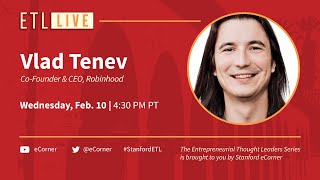
This content was created by GHION.AI . This content was uploaded by GHION.AI . This is a YouTube video titled "ETL Speaker Series: Vlad Tenev, Robinhood" from February 11, 2021. It features a seminar hosted by Ravi Balani, a lecturer at Stanford, with guest Vlad Tenev, co-founder of Robinhood. The discussion covers Vlad's journey, Robinhood's mission to democratize investing, recent challenges faced by the company, and Vlad's insights on entrepreneurship and the financial system. The seminar is part of the Entrepreneurial Thought Leaders Seminar series at Stanford.
Chapters
Welcome YouTube and Stanford Communities to the Entrepreneurial Thought Leaders Seminar. I am Ravi Balani, a lecturer in the management science and engineering department at Stanford and the director of Alchemist and Accelerator for Enterprise Startups. Well, the Entrepreneurial Thought Leader Seminar is brought to you by stvp, the entrepreneurship center in the School of Engineering at Stanford and basis, the Business association of Stanford Entrepreneurial students. Today we are very excited to welcome Vlad Tenev to etl. Vlad is the son of two parents who both worked at the World Bank. And then Vlad went to Stanford for his undergraduate studies where he fell in love with math. He was a bachelor's degree in math for all you math majors out there. And he also met his future serial co founder, Baizhu Bhat. But before he jumped into startup land, he flirted with academia. He was going to get a PhD in math at UCLA and he was thinking about becoming a professor of math, but he took the red pill. He dropped out and he joined byju down the entrepreneurial path. They went on and he got a master's degree at ucla. They went on to start the courtesy masters. Oh, is it courtesy masters? It's the best type of masters. You get the degree without. Well, yeah, get a courtesy master's degree. But Vlad and Baiju went on to start two trading companies before they started Robinhood in 2013. Robinhood's mission is to democratize investing for all. They are one of the fastest growing brokerage platforms, one of the top apps on the Apple Store. They have just done a huge raise, which we'll talk about as well. And Vlad is on a litany of lists. He's on the Forbes 30 under 30 now that he's a bit older. He's now on the Fortune 40 under 40. And so we are thrilled to have Vlad here at etl. A few things before we begin. I first just want to note that Vlad agreed to do ETL before the intensity of all the recent events broke out. And he also agreed to honor his commitment, despite what I'm sure is not the most spacious calendar in the world. And so I just want to say thank you to Vlad for honoring the commitment to etl. I also want to say that our intention with this talk is to really treat this as a learning opportunity and a learning experience for all the founders that are listening to the talk and all the future founders that are out there. And so, you know, normally ETL is an experience where founders reflect on salient moments in their experience. It is rare for us to have somebody who's in the throes of a salient moment itself. And so while we will be using this as a time to talk about some of the timeless lessons that have come out, we'll also be talking about the timely issues that have also emerged just recently. And it really is a privilege for us, for us to do so. If you have not followed all of the news around Robin Hood, I would urge you to play pause now and just go do that, because we have a limited amount of time. And so we're just going to jump into questions. And we also will, you know, in the course of the questions, I think some of the salient issues will come out. Okay, so with that, let's jump in. So, Vlad, I'd love to just start off by knowing that you've had, I mean, just from the outside, this has seemed like certainly a unique last two and a half weeks. If you had to choose three words to describe what the last two and a half weeks have been like, what words would you use?
Let's see. Well, first of all, I should say I'm grateful that you guys are still having me on your program. Right. It's certainly been an interesting couple of weeks. And I would say that actually the last thing I did before COVID hit, right, about a year ago, I think it was Valentine's of 2020, was a Stanford event. So I was a panelist at treehacks in 2020 right before everyone went home. So I'm a proud alum and always happy to take any opportunity to talk to students because I was, not too long ago, a student myself who didn't know what I was going to do with my life and ended up, as you said, in a math PhD program, which was a great experience. So, first of all, I'm grateful to get to your specific question. I mean, it's been challenging, right? That's the first thing, right. It's challenging as any kind of experience that you haven't seen before can be. And it requires it's required the best of me. Like I've really had to level up how I operate, how I lead, how I, how I solve problems. And it's been exhilarating. Right. I think seeing seeing the company respond, seeing, you know, the company recover from obviously, the events of last Thursday, which were very stressful to do things that normally would take six months to a year in a couple of days. It's just been awe inspiring because we've got people at Robinhood that give them 24 hours. There's people that can do anything. So it's awesome to be leading that and to be a part of that and to be a part of this cultural moment. For the first time ever, mimetics and society and social media is interacting with the real financial system. And to be at the center of that, I think, is a huge opportunity to actually redefine how finance works for this next generation. So you see kind of years, years happening within weeks. And I see. I'm very optimistic that Robinhood can. Can rise to the occasion and not just operate our business and keep growing, but really be a leader in shaping what the future of the financial industry looks like.
Well, it's interesting because you guys have definitely been the symbol of disrupting the financial services industry. And at the same time, many people would say that being the CEO of a startup is more akin to leading a movement than being the head of a corporation. And you guys, I think, definitely have. But most recently, I think you've also curried the rage of the movement that viewed you as the platform that really leveraged everything. And so it's interesting to hear your reflections on the last two and a half weeks. Do you think when we look back on this period in the future that you will view it as a boon or a blow for the company?
One thing that I think it's what's been really special for me is that when we were in the thicks of it, like Thursday the 28th, Friday the 29th, I got so many messages from former investors, mentors, people that are close and friendly. And the one that stuck out to me was one of our early investors said, Vlad, crises are. When a crisis is successfully navigated by a company, it unlocks the next level of value creation. Right. And so obviously you don't want a crisis to kill you because then you're dead. But if you successfully navigate it, I think it's a huge accelerant to the company and to the mission. So we're still writing history, but we're doing everything in our power to make it a boon for Robinhood, and we shall see how the future holds. But whatever is in our grasp, whatever we can do, we'll try to move in a positive direction. And I know we disappointed some customers who wanted to trade those stocks on Thursday. But I look back at some of our other controversies. Shortly after my last Stanford event, March 3rd of 2020, a day which lives in infamy in Robinhood lore, we had some system issues. Customers weren't able to trade to buy and sell for pretty much an entire market day. And, you know, we spent a lot of time and effort just sort of like rebuilding certain systems at Robinhood to make sure we can scale with the growth and with the exceptional growth that we've seen in the past couple of weeks. Knock on wood. And I'm knocking on wood here. The systems have been reliable and operational, and so I'm a big fan of making a series of original mistakes. So we don't want to make any. We don't want to make no mistakes, because then you're not doing anything. But if you make a series of original mistakes, as we put it, then you definitely don't want to make the same mistake twice. And that's our philosophy.
And I understand the idea of learning, you know, learning through these mistakes, but there's also genuinely a lot of real hate and rage also that I think is coming from different elements of the community, too. Where do you think the criticism is most undeserved from the last two and a half weeks?
Yeah, I wouldn't say it's undeserved anywhere. Right. People have a right to feel upset at Robinhood not letting them buy the stocks that they wanted to buy. I think if we look at the financial system that we have to operate in, it's a complicated system. Right. And I don't think as an industry, we've done a great job explaining it, and it really affects people's lives in so many ways. And I think what I've been trying to do a lot better is using my presence and the fact that people are interested suddenly in how these things work, to educate and educate in as an entertaining way as possible to how some of this, like financial plumbing and infrastructure works. So we've been having a lot of memes on the Internet around T +2 settlement. You see T +2, Judgment Day, and all of those things where people are really getting into understanding the underbelly of the financial system and asking really powerful questions about if you can buy a TV and get it delivered in same day, why is a purely electronic transaction take two days to deliver the shares? These are good questions. And I think we owe it to ourselves and our customers to not just solve the immediate problem ahead of us, but also think about how we can make the system better so that it behaves like they would expect it to behave. And if that requires pushing for some policy changes like the settlement cycle, if it requires better explaining our business model and how market makers make money and how Robinhood makes money, then we're excited to engage in those conversations across a wide range of forums as well. So I think people are Just people are frustrated. And a part of that is a lack of understanding for how our financial system works and a confusion about why it doesn't work in kind of obvious ways that we would expect it to.
Well, let's jump into that then, because I do think that one of the things that's interesting about Robinhood, that's an abstraction for a lot of different startups is that you have multiple stakeholders. And it's not a, it's a complex organization. You have your users that are using the platform as basically as a brokerage. You have these regulatory bodies that can constrain how you guys act. And then you also have these market makers that also provide revenue. When you have all these different constituents, how do you decide when there's conflict between them, how to make decisions?
Well, I actually, I don't think there's frequently a conflict between the customers and the regulators because, you know, we serve our customers with the blessing of our regulators. So if the regulators like, if we don't make them happy, customers don't get access to the service. So those two are very aligned. And I think we're going to navigate policy changes like I mentioned, but I don't think there's too many situations where we're faced with a choice where we would actually consider being non compliant or violating regulatory obligations. Yeah. Because that's actually really negative for our customers. Of course we'll have to explain what the obligations are and what we did, what we did and why we did it. But I think those two are actually in close concert. And aside from that, our North Star is making our customers happy and doing right by them. And that's always gonna be what we prioritize first and foremost.
Did you see the Social Dilemma? The Netflix special or the next?
I did, yeah.
So as you probably know, there's a bunch of Stanford alums that were involved in that documentary or mockument. Well, not, you know, the film. And one of the basic takeaways of that is that we had these Stanford alums that were pivotal in these foundational platforms like Google and Twitter that became disenchanted with what they saw. And I think, you know, one of the essences of the film was a quote that said that if you're not paying for the product, you likely are the product yourself. And there was really this call for transparency and where the revenue was coming from and who the real customer was in these platforms. Who do you consider to be your customer?
Yeah, so I've heard this a lot and it's a great question. I Think we have to address it. I think the idea that your customer is who you generate revenue from is a little bit misplaced. Our customers are our end users. I mean, without our end customers who actually have accounts on the platform, we're not going to be anything. Right. So the analogy of anyone you generate revenue from becomes a customer kind of breaks down. When you think about Visa, for example, right? Like, let's say you're a grocery store, right? And you know, you get paid by, by the card networks. Every time someone creates a transaction, you get paid by Visa. Does that mean Visa is the customer of every grocery store and the people buying the groceries aren't the real customers? Probably not. Right. So I think, you know, this, the saying sounds great in theory, but breaks down under like all of the most common circumstances. And it breaks down with Google, right? Like who's Google's customers?
But I think the point of the social dilemma was that it was that there was actually a need for transparency. Because if you're not overly transparent, there is a corrosion that is very, very powerful. What's your philosophy on transparency? I understand, I understand your point on the semantics of customers and also who really is the customer and the importance, exactly what you're calling customer. But I'm curious about your view, as the founder of what's become now this movement where there is real social responsibility, what is your view on transparency, on how the whole business model works and how the whole operation works?
I think we could do better there and we're trying to do better. I mean, not a lot of people understand how payment for order flow or market making works. And I actually created a tweet storm to start a more in depth conversation on that yesterday. So if you look at my Twitter, I'm kind of getting into it. I'm asking questions. I want to understand from the broader community what the misconceptions are. And then we're also going to be holding a, a roundtable discussion. Likely it's going to be on Clubhouse, where we invite some industry leaders and actually have them participate in a discussion about payment for order flow. What is it? Why do we have it? Like, why do some other countries not have it? How important is it to commission free trading? And we want to sort of excavate this a little bit more and we'll see where it leads. And I think hopefully it'll lead to somewhere positive or at least some more transparency and understanding by the public around how technology mixed in with finance works.
If there is that desire, there's the desire to be Transparent. Can I ask some questions to just clarify some situations about Robinhood?
Yeah, go for it.
So how can you explain how you make money and what is the biggest source of revenue?
Sure. So we make money from payment for order flow. And the way it works is every time you place an order on Robinhood. And payment for order flow, to be clear, is one of many revenue streams, but it is a significant one and it's one that's probably most poorly understood. So essentially, market makers execute orders for you kind of analogously to if you're spending money, Visa processes that transaction for you if you're a grocery store and then they process that transaction. Market makers take risk, right? They take principal risk because they hold positions for varying lengths of time in each of these securities. And they rebate. They rebate to Robinhood a portion of money which then becomes payment for order flow. So that rebate from the market makers, which is kind of analogous to, in the Visa analogy, interchange, the interchange rebate to the issuer for your card becomes revenue.
Is.
Sorry, is that helpful enough?
It's helpful, but let me ask a couple more questions. Is there any revenue made off of inefficient pricing during the micro window of those transactions with the money market makers? With the market makers?
So this is regulated, and there's a rule called REG nms, which basically means that if an order is executed by a market maker, they have to make sure to look at the prices on all of the national exchanges. So that's the nasdaq, the nice, all of the lit markets. And if that market center offers a better price than what they'd be able to execute it at, the market maker actually would have to route that order to the exchanges. So you're basically by reg nms, guaranteed on certain orders, national best bid or best offer or better. And so what that means is a lot of people say, why don't you route directly to exchanges? Why do you use these market makers? Well, it's better for customers because you get better prices at as good or better prices than routing to the exchanges. Exchanges charge fees, which market makers don't. So you don't have to pay the exchange fees and you get price improvement on top. And I do think there's a need for more transparency there. And if you look at my tweetstorm, I point to our execution quality statistics, which show you what percentage of our orders are NBBO or better. It shows you the execution quality in the form of EQ relative to the national best bid or best offer, which is the reference price on exchanges and how much better do our orders do? And we're publishing that and we intend to keep refreshing that and be a little bit more transparent. So for sure, it's very complicated. Customers primarily care about what prices they're getting and we want to make that more clear with providing more of this data. But I do think this is a better situation for customers than if we were to route to exchanges.
And so, and I, and I know you know this, but then obviously, you know, this came to a head with the whole GameStop saga because it feels like there's conflicting interests across these stakeholders where the market makers that you are dependent upon for revenue are holding the opposite positions of the retail movement. That has really been what has, you know, what, what Robinhood has at least metaphorically been about. And so I know you've talked about.
Well, I'll just address that. Right. Because there's a couple of different issues with that. So if you're a market maker, you're actually prevented by regulatory information barriers from sharing data with a hedge fund affiliate. So, for example, a lot of people mix up Citadel and Citadel securities. Citadel is a hedge fund. Citadel securities is a registered market maker providing execution services to brokers. Citadel securities isn't allowed to share data from customer transactions with the hedge fund. And I'm sure people aren't getting into the details of parsing that through and they're reaching conclusions and there's a lot of conspiracy theories, but let me just say that's not going to be happening. And I can't claim that I know everything that goes on in our market makers, but it would, it would be a violation if it were to be happening.
So just to ask the question, did Citadel or any Citadel affiliate ask or influence you in any way to remove the ability for people to buy, to buy GameStop stock?
No, that was a Robinhood securities decision made, made in communication with our clearinghouse partners when we were discussing our deposit requirements. So basically, we have to put money up based on the risk of the positions and the activity. And I went into this a little bit in my conversation on Clubhouse a couple of weeks ago and a few others. And due to the growth and due to the sort of lots of trading in a very low number of symbols, those deposit requirements were increasing, which led to us having to position close only that small number of stocks on Thursday and then Friday, we unrestricted them a little bit. And as we got sort of the full range of the $3.4 billion that we raised in, we were able to unrestrict them fully by the end of. By the end of the following week.
And then the pricing on Robinhood is the most efficient and beneficial for its users.
Yes, we publish our pricing statistics. The execution team conforms to best execution guidelines, and you can see all the statistics on our website. If you look at my Twitter.
And then I'm just going to be asking this out of the spirit of being more transparent, because I was looking through all the Reddit threads. Some users are claiming that Robinhood is blocking statements that would prevent users from transferring to another broker. Is that true?
No, we're not blocking anything like that. I mean, sometimes there can be operational issues and things here and there, but the team is working hard in the context of all of the growth and all the new interest in Robinhood to make our customers happy. So certainly there's an area, certainly customer support and service is an area we're investing a lot in. And I think we've seen some great improvements, but always more to do, especially when you're going through hyper growth.
So I understand all this. I still think that there are still these feelings that are out there of an inherent conflict of interest. What's the plan, from a reputational perspective, for Robinhood to recover its reputation due to the perceived conflict of interest, even if you earnestly believe there isn't one?
Well, I think the biggest part is just to communicate more transparently. Right. And to tell people what's going on and. And educate people how it works.
And do you feel like, and I'm asking this from the spirit of all the other entrepreneurs that are out there. Is your experience of this moment that you're trying to be transparent and people are just having misconceptions about you? Is that what the experience feels like?
I think we've gone through a transition. We're obviously being more transparent as time goes on. I think we're being more. Robinhood is probably communicating about these things much more directly than other brokers would or other financial companies have in the past. We obviously have constraints to some degree. I mean, I'm not running a social media company. I've got regulators and all sorts of stakeholders. And I think that's the reason why financial services companies typically don't talk business model and all of the ins and outs so much. But we are in a new world. And so I think last Thursday or two Thursdays ago and Friday, when we were kind of in the thicks of things, I heard the feedback that in my interviews on CNBC and Bloomberg and all those other outlets, I could have been a little bit more clear with the timeline and we've been working to address that. But I think right now, if you look on our website, if you look at some of the recent material on Twitter, we're trying to really put as many details as possible that clears up what's going on. And I think people, if they look for the information, they'll find it. It's out there and I think we've been pretty clear. So the challenge that I've been facing is there's a lot of people that aren't really willing to parse through it. And this sort of like story of, oh, it's just simple and it's the individual investors and the hedge funds and you have to be on one side or on the other. So Robinhood restricted these stocks. So it automatically means it's the hedge funds that's on. Robinhood's on the side of the hedge funds. I think getting through that is challenging. And all we can do is just get out there and reinforce our message and say, hey, we're Robinhood. I started this company because I believe in the individual investor. Without our product, this wouldn't even be able to happen. Right. Like you wouldn't be here today investing in any of these stocks. So of course I'm, I believe in the individual investor and their ability to participate in the markets. So.
And you've, and I know you've said this already, so I didn't want to reiterate it, but just to confirm, you said that the whole situation on the 28th was driven by the NSCC. Is that true? It was 100% due to the regulatory, the regulatory bodies. That was 100% of what drove that decision?
Yeah, absolutely. It was like, yeah, you know, like, like a bank, a broker has capital, capital requirements, deposit requirements at these agencies and we have to conform with those or else we're in violation of the law.
And so I want, before we go into the Q and A, I want to talk about the next. There's also a lot of interest then in what's the solution? Is it governance to prevent this from happening? I know you've been a really strong advocate for real time settlement. You know, getting rid of T2 is not considered easy or trivial. And so I'm curious if you could paint the picture for us of what you think is the path forward. Is it technology technologically driven? Is it going to be. Do you believe in another form of governance or what's your.
I think the technology is actually relatively straightforward, you know, and a lot of people have been. I think when I. When I wrote that blog post and tweeted it, you had all the blockchain people coming out and saying, blockchain already solves this. I think blockchain is one possible solution. Crypto can do it. You can also use standard database technology. But I think the status quo is it's mainframes. The stuff is running on mainframes. And there's actual physical paper certificates involved that are being stored in, you know, basements. And, you know, when Hurricane Sandy in New York happened, however many eight years ago, there was actually a problem, right? Because, you know, I think some of those facilities flooded and they had to be carted. The certificates had to be carted to special drying facilities where they could be dried chemically in New Jersey. So there's a lot that can be improved on the technology. But I actually think the real problem is a communication problem. I think people need to understand what's happening and they need to see a picture of what the future could look like where these problems don't exist. And I think the picture of that is compelling. And it's not just Robinhood's capital and deposit requirements that would be improved. Even though I think some of the criticism to my proposal is, oh, look, Robinhood wants to get away from raising billions of dollars, and so now they're trying to change T +2. But there's lots of other things that improve, too. I'll give you an example. Right now, you can short a stock multiple times. The way that works is I'm holding a stock, I lend it to you, you short sell it, someone's buying that on the other side, and they can lend it to someone else to short sell. And that's how you end up in this chain of things where stocks are shorted, like 140%. And it's a technology problem because we don't have the systems to keep track of what's going on. So I think that could be resolved with technology. And I think the real impetus is how can we paint a future where we're using the best technology to power our financial system, and how can we actually make the American financial system sort of the envy of the world again and really invest in that infrastructure? And what are some of the other really powerful things that will come out as a result of that that we can then build?
Before I go into the Q and A, I want to ask one takeaway on timeless hacks for our future founders, which is what I find remarkable, Vlad, about your journey is that there have been all these moments where you really had no expertise and what you were going into and you end up overcoming that and building, you know, a leading offering. You guys were, you didn't have a design background and you built sort of the first mobile, first driven real platform you decided to go into. You scaled this company from just you and Baiju to now, you know, millions of people on the platform. You guys have gone into crypto, you're now it sounds like, have to decide how to communicate and how to do an effective communication strategy.
Who would have thought that's the hardest problem, right?
Well, I'm curious, do you have honest hacks that you have learned through all these experiences where you're jumping into the unknown on how you have learned things that you weren't necessarily on paper, well equipped to do?
Oh yeah, there's a lot of hacks. Let's see, what's my favorite one? Yeah, I would have said up until recently that sleeping with my phone on the, on a, in a different room was, was a good hack until there's an emergency at three in the morning and people really need to get to me. So maybe, maybe that's not a useful one. In all cases. Not drinking I think is a pretty good hack. You know, I quit drinking before I turned 30, so I'm 33, almost 34 now. And I think just like the ability, I think it's hard to appreciate how much that helps you just like be on the ball day in and day out. So I did it kind of as an experiment, but it was so good that I just never stopped and went back to it. And you know, I was in college at Stanford, I, I had fun as all college students do. And I think that, I think that the sooner you just sort of get down to business and work on your mission, the better, the better off you'll be. So wish I wish I did it sooner in a sense that's one. And then I think you got to take care of your body and get rest and be on a routine. You know, there's enough happening, at least with my business that's unexpected that I think everything else, if it's sort of like predictable and routine based to a great extent, can be very helpful. So I fall asleep at a pretty regular time. I work out several times and try to take care of myself physically and I think the rest of the night.
When do you sleep and when do you wake up?
I think it really depends. It depends. The last couple of weeks I haven't been sleeping as much as I would like to. Yeah, usually I try to get at least four hours of sleep a night.
Oh, I don't know if that wasn't what I was expecting. Okay, well, we're going to go into the Q and A because I know there's a lot of interest. So let me start off by There's a question. Do you feel the current Gamestop debacle is proof that the financial system, including Robinhood, is rigged against normal investors?
I don't think so. I mean, I think there's certainly things that can be improved, you know, people. But I would say generally the financial system worked and there's maybe some things that need to be improved. But I wouldn't use the current meme stocks anecdote as proof of anything being broken. I think it's actually to some degree proof that a system works and is resilient to unexpected events. I mean, to be clear, this was a five to ten sigma event. So that's basically one in 3.5 million is a five sigma event or less frequent. So to some degree no system is prepared for that. And we're still here and the financial system is chugging along and individual investors can trade. So I think it's too early to dismiss the financial system as being irreparable.
Based on this, but just to push on that. What's your vision for 2030 in terms of what investing is going to be like? Do you think that we're going to be seeing a fundamental shift from institutional to retail driven investing or any other big.
I think you're already seeing that shift. I think that shift is happening and it happened in 2020. Right. With millions of retail investors joining the market for the first time. You know, it really started sort of at the, at the bottom of the market in March of 2020, and it's continued throughout the year and really accelerated starting January 1st with kind of New Year's resolutions and the events in January. So I think that train has left the station and you're seeing kind of the. The democratization of finance and the individual investor play. And I think you're going to see more transparency from all of the market participants because individual investors demand it. Right. They want to know what's going on. They want to understand how the systems work, especially if your money is involved.
Okay, I'm going to move forward with. There's a bunch of other questions from students. Vlad, what do you say to people who point out that Robinhood encourages short, quick stock trading, which is the exact opposite practice one should take to make money in the Market in the long term.
Yeah. So we get the critique from both sides. Right. Robinhood, why are you encouraging short, quick trading? Robinhood, why can't you let me do my short, quick trading when I want to do it? I would say a couple of things. One is that if you think about Robinhood as a platform that prioritizes access, I think it's true. We do prioritize access, but we build for safety. We, we want to make sure customers have a safe experience on our platform and is very, very important for us. And it's a very powerful tool, the ability to invest in the markets and trade in your pocket. And so we don't offer short selling. We don't offer undefined risk options trades where people can lose more than they have in their account. Our extended trading hours are more limited than some brokers to make sure that customers have access to liquidity. And we don't offer bulletin board or pink sheet stocks. Right. All of our stocks that we offer on the platform are listed. So these are all ways that our platform is in some sense more restrictive than those of our competitors. And we want to make sure that if we do offer people these tools, there are appropriate guardrails in place so that they can use them properly and understand what's happening. And we're also investing a ton in education. A couple weeks ago we launched Robinhood Learn 2.0, which is our revamped educational portal. And the idea there, and this has had millions of visitors since inception. The idea is to take someone all the way from the basic concepts of what is a stock to explaining to them how multi leg options strategies work. We're investing a lot in this and, and I think we're very, we've made a lot of progress and there's more to do. But Robinhood aims to be the safest and most democratic and accessible investment platform for our customers.
I'm going to move forward. There's a question that, and I'm just going to read it out, that the securities, the U.S. securities and Exchange Commission charged Robinhood $65 million for misleading customers. Was it a conscious choice to break the rules and pay the millions in fines? And the question says, as long as Robinhood can profit in billions, was that a deliberate choice to pay the fines or what was the thinking behind that?
Well, I should say first that as part of our conversations there, I can't confirm or deny any of the details of that settlement. What I can say for sure though is it refers to historical practices and a Robinhood that is very, very different than the Robinhood today. We've made tons of enhancements to our legal team, our compliance team. The process is in procedures that we're operating in, and everyone on the team prioritizes safety and integrity the most. So certainly there's some things in there that we could improve upon. And we could improve upon sort of how we communicate, the business model, how we communicate, how we make money, you know, our procedures that we do to operate. And there's been a lot of improvements since 2018, 2019.
There was a question. Sorry, things just shifted quickly. There's a question about your recent fundraise. So you've raised $3.4 billion in one week. I believe that was the number for the fundraise, which is an enormous amount.
72 hours. Yeah.
In 72 hours. I don't think. I used to work in venture capital. I've never heard that happen. Can you provide some. Can you expose. Can you take us through what that was like? How did you close so much capital so quickly? And how did you. Can you share how that happened?
Yeah, I mean, it started off as a phone call to Mickey Malka from Ribbit Capital, who's a friend of mine and obviously a big investor in Robinhood. And I said, mickey, we have this issue. We restricted these stocks in order to unrestrict them. We're likely going to need some more capital.
We.
And he said, vlad, how much do you need? And we didn't have all of the sort of models in place yet to project the activity going forward. So, you know, we started off with a few hundred million dollars. And then we realized, well, we're number one on the App Store. We're going to see a lot of growth, a lot of sustained growth likely through next week. Let's just make sure we radicalize the chances of having this happen again. So we ended up expanding that and getting on a ton of phone calls with other people through the weekend. And, you know, it was just humbling to see how much people supported the company. I mean, people literally lined up to offer us capital in these times. And I think we're very fortunate to have investors that believe in us so much that they'd be willing to do that on such short notice.
And if you think that the removal of T2 doesn't happen, of getting to the real time moment that we want, does the liquidity needs, does that affect, do you think, the profitability of Robinhood or its IPO or even the space in general, in terms of you're trying to build a similar fintech company in terms of the capital requirements to do so.
I think to some extent it disadvantages smaller entrants into the space. Right. I mean, if you're a startup brokerage, it makes it very difficult to clear and settle your trades. Not everyone is in a position like Robinhood to raise billions of dollars in a relatively short time period. And so to some extent, I think even without T +2, Robinhood's probably going to be okay with this. So it's really about the health of the financial system and what should it look like? And it's not just our deposit requirements that could benefit from this. I think this is just generally an issue that has broad support. And if you look at sort of the details of why it takes. I mean, let me explain to you kind of the analogy here. And I gave this in an interview, right? Let's say you're buying a candy bar from a candy store, right? So you'd expect to show up to the candy store, give them the money and get your candy bar and go off on your merry way. Right? But what's happening right now is you show up to the candy store, you give them the money for the candy bar, they take that money, lock it up in a vault, the candy store takes their corporate cash and puts it up in a at the bank to pay for the candy bar, and then they give you that candy bar two days later. So it makes absolutely no sense. Right. So the simplest analogy and the simplest thing I think needs to happen here and I think there's legitimate reasons for it. We didn't have the technology 30 to 40 years ago to maybe do all this in real time, but now we do.
Okay, there's a question about Chamath. So you can choose if this is a top. This is the top question on the list. It's Chamath claimed via Twitter that he passed on investing in Robinhood for the seed Series A, Series B because he didn't trust in the company's integrity. Do you have a response? What are your thoughts on Chamath?
I do have a response, but I'll save that to give to Chamath directly.
Okay, well, I'm not going to play.
The transparency in some calling out your moth in public without. When I have something to say to someone, I'd like to say it to them directly.
Okay, I'll end where there's a question about. As someone who. I'm just going to read the question. It says, as someone who is not initially planning to start a company, what factors motivate you towards Entrepreneurship and what trade offs have you made by choosing business over academia?
Yeah, and that's a really nice question. I think a big part of it was just wanting to work with my friend again. When Baiju and I were at Stanford, we bonded because we were kind of banging our heads against the wall till late at night, working through problem sets. We challenged ourselves. We were both taking graduate math classes as undergrad. You know, There are these three unit classes that have like 20 hours a week of coursework. And so I think going through that, going through that experience and then, you know, I ended up in grad school, he ended up in the financial industry. We kind of missed that. And then so when the financial crisis came, we saw an opportunity to start something together and we felt that there would be enough upheaval in the space that would make room for a new challenger in financial services software. And I don't think we knew at the time, but I think that sort of upheaval in 2008 was a social upheaval and not just only a sort of a financial infrastructure upheaval. So it directly led to Robinhood being created.
And are there any lessons that you learned in math and I understand you're a physics aficionado too, that you think have helped you in entrepreneurship.
I think that math and physics is a very great example of playing the long game. Right. Like, why do people get into it? You make very little money and let's say you graduate. And I experienced this, right. I graduated Stanford with a math major in pure math. You're not, I, I wasn't very employable at the time. Right, because everyone wanted to know, do you code? And as a math major, you do a little bit of coding. But I'm not a computer science major. Right. So then obviously the path is math grad school, where a lot of the top programs just don't have high budgets. You have, I think Harvard has like room for eight math PhD students every year, for example. And it just gets more and more selective and selective and the stakes and the competition gets harder and harder the more you ascend. And then maybe eventually you get tenured when you're in your 30s or 40s. And the payoff is creating something that sort of adds to the body of work, of society, to the general sort of body of knowledge. And maybe if you're lucky enough, they teach it in schools and people will learn your theories and your work. So it's very much a long game. And I think that type of long term thinking of just doing the right thing and tolerating some short term pain and struggle and being misunderstood. That's probably the most salient lesson from math because there's people that studied computer science and hum bio and they would go off to med school and others would go and get a job at Google when I was there. And that's very direct. But I think Baiju and I both were not interested in that and we just really wanted to prioritize doing something that made an impact on society and it took a different form. But both math and entrepreneurship kind of have that as its kernel.
Well, that's great, Vlad. That is.
Did you like my math joke? A kernel. Kernel is a math term actually.
I'm glad you pointed that out. That went above my head for a second. But that's a true math joke, Vlad, so. Well, Vlad, we're at time. I want to say thank you so much for coming into etl. There's obviously a lot of interest around what you guys are doing and we appreciate you sharing. Everybody else gang for joining us, thank you all From Stanford and YouTube for joining the Entrepreneurial Thought Leader Seminar. Please join us next week when we have the CEO of Masterclass, David Rogier here as our guest. And that's etl. Thank you all.
Thank you everyone. Thank you for having me. It's really an honor to be here in front of everyone.
More from GHION.AI


O processo de reconhecer limites, mesmo quando a vida parece exigir sempre mais.





Depois de tantas histórias, aprendizados e pausas necessárias, o @interior_iza está de volta



