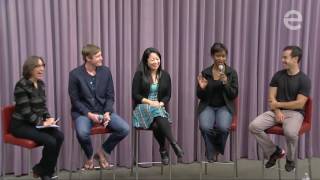
Four founders discuss how they measure success. One is building the world's largest sequencing facility for early-stage cancer detection. Another, Opus 12, aims to reduce greenhouse gases and has hit technical milestones proving stable operation. A third runs a VR company focused on reducing athlete injuries.
Chapters
What does success look like for you?
When will you know when you've gotten there?
I would answer it a little bit differently. I don't think— the journey is so hard, to be honest, that you can't just be looking for one moment in time where you say, I've done it, I'm successful. I think a lot of CEOs will tell you the moment they IPO, that's when they think they really feel it. And I think that's true, I think it's a great moment, but then it's done, and then what's next? So I think really to get through all of the hard times, 'cause it will be very hard, you have to enjoy every moment of it every day and all of the struggles, and you have to want that, believe in what you're doing and enjoy the process. And so I'd say there are very hard times, but every day I'd say you wanna make sure you're successful that day, and that's what will push you forward. I wouldn't try to look for one moment in time and just aspire to that, 'cause that may not get you through all the really tough times.
So what was your goal today?
My goal today is to inspire lots of Stanford students to go out there and start awesome companies and not worry about how many people tell you that you can't do it, but just if you wanna do it, go for it, and what you end up doing will probably be very different than what you started doing. But that's fine, and that's important, and that's how it should be.
So who else wants to jump in?
I think for us, success is very clear. What we're really trying to do is change the paradigm for how cancer is detected. So through that journey, we are building— actually, we've already built what will be the largest sequencing facility in the world by the amount of throughput. We're putting together the largest clinical trials that have ever been conducted in the history of medicine and building an incredible team with disparate skill sets that have not come together very frequently before. And what we're trying to do is really, you know, find cancer early when it's cured. When you can find cancer early in the stage 1 or 2 phase of the disease, it's possible to cure it by surgery and radiation. Most cancers are detected late stage, so at that point it's typically palliative and it's really not curable. And so what we're trying to do is entirely shift the paradigm of how cancer is screened for. And so you can imagine going eventually to your annual checkup and having a tube of blood drawn and through an analysis of that blood be able to tell, you know, do you have cancer, yes or no, and if so, where is it in the body, is it at a point in time when it can be locally treated.
Yeah, so I would say at Opus 12, you know, we seek to make CO2 great again. We define success bigly. We are going to build a company. It's going to be the greatest company ever seen. No, I mean, for me, the ultimate success is actually 10% reduction in greenhouse gases globally by 2030. That's kind of my big vision. I mean, you know, clearly there's like smaller goals in between there. I mean, we need to prove out our technology. We have to de-risk it. We need to show that we can run stably for 1,000 hours, then 5,000 hours. We need to prove out the market. We have an initial market that we're going after, which is a smaller market where we're producing chemicals for small chemical manufacturers. And then we have our larger market where we want to produce cost-competitive CO2-neutral fuels. So we have many goals along the way, but what keeps me going and what I'm in this for is to make the ultimate impact of making a dent in the amount of CO2 that's in the atmosphere. There might be more profitable opportunities in kind of smaller markets, but for me, what drives me is impact. I really want to build this company to make an impact on climate change, so that's how we set our goals.
Yeah, for us, success we hope is already happening, which to us means better decision-making. So for professional athletes, we are targeting being on the field and being able to practice as well off the field. So using virtual reality to potentially even do things like reduce injuries. So for us, being able to replicate that sense of I can mentally practice in a similar way and not have to put my body at a physical risk to do so, to us, that's the dream is to reduce that risk of injury for athletes and potentially have to be able to reduce practice time and help those athletes make better decisions off the field.