Hank Wuh: Disruptive Innovation Can Happen Anywhere [Entire Talk]
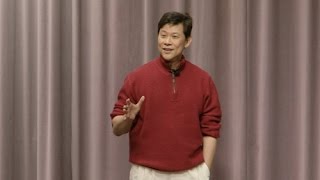
Hank Wuh discusses how disruptive innovation happens outside Silicon Valley through his company Skyventures, which develops technologies in healthcare and material sciences. He covers entrepreneurship challenges, market expansion, and balancing profit with social responsibility.
Chapters
Hello, everyone. It's great to be here. Can you hear me okay in the back? Yes. Now, first of all, I want to know how many people are from Hawaii here in this room. How many people have been to Hawaii? How many would like to go to Hawaii? Okay. This room has good judgment. I know that. It's great to be here. I have very fond memories of my days at Stanford. The biggest memory in my head was when I was doing my surgical residency at Stanford Medical Center. I was a resident, chief resident at Stanford. I was so poor that I bought a Cadillac for about $600. And it was a great car, except for the fact that it didn't have a reverse gear. So I could only drive forward, but not backwards. So it took a lot of extra time to look for parking stalls where I could drive forward at the. At the end of my shift. And the headlights didn't work. So when I'm driving on the freeway, I have to turn on the emergency blinker so I could see the road every other second, basically. But I have really fond memories. It's great to be back here, and I'm looking forward to telling you a little bit about what we do at Skyventures. This is my office. Please come and visit anytime. Sky is a word that we invented, we created. Kai is the Hawaiian word for water, ocean, of course. Sky is the blue sky. So where the ocean joins the sky is the horizon, which holds infinite breadth and possibilities. Hence the name Skyventures. Our business model is very simple. We look for the smartest people, the most ingenious ideas we can find on a global scale. And we transform them into businesses that are profitable, high growth, that can do something good for the world that we live in. And as you can see from our model, invent, disrupt, and inspire. And the word disrupt is in there because we like to focus on the kind of business that really game changers. Because it takes just as much time and energy and work to build something that's really a game changer than something that's incremental. Hence, we like to focus on disruptive. What is interesting, however, is we do all of this in a part of the world that is the most isolated landmass on Earth. This is a Google Earth shot of Hawaii. So for those of you who have been there before, did anybody go to Hawaii? Not on an airplane. So we are in the middle of the Pacific Ocean. So we are about 2,400 miles from California and almost 4,000 miles from Japan. Highly isolated, but the point of today's sort of sharing with you. With you is the fact that entrepreneurship can take place anywhere, by anyone, in any subject matter. It matters not where you're located. Silicon Valley, Stanford is a great, fantastic location. It is the Mecca in the minds of many, but it's not a requisite. It is not a requisite for innovation. It is not a requisite for creating great enterprises. So I would like to invite all of you, when you have a chance, to come and visit us in Hawaii and come and visit us at Skyventures. We'd love to get to know you and share with you what we do. So just a plug for Hawaii while we're here. It has the highest percentage of millionaires in the United States. You will find every celebrity entrepreneur in Hawaii shopping at the same Whole Foods and Safeway. Oprah lives there. Dell lives there. Schrab lives there. Pierre Midier is there. Steve Case is there. Everyone is there. We have the longest life expectancy in the United States, and we have, in fact, Honolulu was one of the 10 healthiest cities in the entire world. Very ethnic diverse. For those of you from Hawaii, you know that. And we also have our own time zone, Hawaiian Standard Time. So when I was growing up, Hawaiian Standard Time used to mean that it means 30 minutes late, basically. But this is also very interesting. The attractive lifestyle also makes us one of the largest importers of entrepreneurs in the entire world. I would say, outside of Silicon Valley, we probably have the highest concentration of entrepreneurs who are between successes and who are between failures of anywhere else in the world. And it's the perfect place to incubate, to start, and to nurture the next really big idea. Besides, we're the most isolated landmass in the world. So no one really is going to steal your idea until it's been nurtured along far enough. And we take a lot of young people every summer. So last summer, we had 15 interns, and we had kids from everywhere, including Stanford, Harvard, Yale, Princeton, Columbia, all around the United States and the world. In fact, I got a call in March of last year from the fellow who did a summer internship with us the year before. He said, hey, Dr. Wu. He said, I'm going to quit Columbia and start my own company. And I said, chris, that's great. Have you told your dad? And so, so he finished Columbia and he's now working a company with us. So, like many other companies here in Silicon Valley, our basic guidelines are not so different. Right? Go after big business, at least a billion dollars in market size, strong ip, good management team, and everything we do, we Hope at the end of the day will benefit the world and the community that we live in. We also pay a lot of attention to Asia and to China in all that we do as a very important market that we go after. Who's from China here? Okay, thank you. So we have a number of portfolio companies, six of which are really sort of very much in the midst of being grown and looking at exits. I will share with you briefly some of these companies. And by the way, so Hawaiian style, Hawaiian time, very casual. If you have a question, raise your hand. I'll be happy to entertain them at any time. So we really have two categories of businesses. One is in the area of novel materials. These are materials that I think are great platforms that can grow in many different ways with multiple market applications. So the top three, TruTag, CBA Polymers and Hygienics. Trutag is an edible barcode that is extraordinarily information rich, very inexpensive, that can be eaten and can tag everything that goes into your body, basically. So think about the implications of that. CBI Polymers is a green tech for environmental radiation, which I'll tell you a little bit more about. And it had a very large role in Fukushima in the last couple years. And igenx is working on the most advanced technology for an artificial cornea to treat blindness to restore vision for the 10 million people in the world who are blind today. So think about these technologies, right? These could very well be prototypic companies right here in Silicon Valley, except we're doing this in Hawaii. We also have healthcare services platforms, including these three companies. Our SkyVision Institute is focused on vision surgery, everything you can imagine. Refractive cataract, oculoplastic glaucoma, retina surgery, as well as corneal transplantation. We have an endoscopy institute that has the capacity to do about 15,000 surgeries a year for the early detection of cancer. And we're also looking to build the largest corneal transplantation center in China today. Finally, we're putting the next vision of sky together, which will be a fund that's going to be dedicated to software and healthcare. It, which I'll tell you a little bit about. So Trutax, Trutags is an editable barcode. And as you find, the common denominator for all these companies are threefold. One, a really big problem that needs to be solved. Two, a very unique solution, and three, a great team. So why are we in this business? Well, counterfeit is a big business. In fact, it is conceivably the Largest business in the world. The margins are huge, everybody's in it. It touches every product, every region, everywhere. So in essence what we have created is another form of identification. Like a fingerprint, like a retina scan. Except in this case we can do it in very large volume and create massive amount of information on a customized basis. We started with a silicon wafer, much like what we do here in Silicon Valley for semiconductor manufacturing. And we can convert them into basically silica. In the process, we can embed billions of combination of spectral codes into the material. But the beauty is this, right, Silica is already approved as an excipient in drugs. It's been used in many, many types of pharmaceuticals. Hence there is no regulatory risk associated with the development of this particular product. And so again, as you saw earlier, give you a sense of scale, right? Grain of salt, grain of sugar and the grain of true tags. So in this particular case, we can insert over a billion combination of spectral code and we can read it. The simple reflection from a light source can be picked up and deciphered as the basis for tracking, tagging, anti counterfeiting and identification. So a light shine on a tablet can be read by an iPad enabled reader. In this case we can tell you this is Lipitor, 20mg loco expiration date, manufacturer site, and so on and so forth. And this is a very powerful technology. Size of the market, it's quite large. There's one and a half trillion tablets made every year in the world today, of which one third are branded or high value products. So that's the target for the counterfeiters. And so that basically makes up the $80 billion counterfeit drug market. But unlike a Prada shoes or Gucci Bang, when you take a counterfeit medicine, it could have catastrophic consequences to the end user. So this is not just about economics, but it's also about something that's extremely important for society at large. We can do these things for roughly $0.01 a pill or less. So that's roughly a $5 billion sort of opportunity for us, just in the pharmaceutical side equation. So for every 2% of the market that we're able to penetrate is worth about $100 million in revenue, basically. So it's a powerful technology, it's an interesting sector. But we're not limited of course to pharmaceuticals. You think about all the different things that we ingest or things that we don't ingest. Whether it's Chinese milk powder, whether it's computer chips, wine. The folks from Chateau Lafitte had come and Talked to us and said, hey, this is really interesting. Would it be possible to put this in very high end branded wine and spirits? We said, sure, of course, it's possible. However, could you send us six cases of Chateau La Fille so we can do proper R and D on the equation? So every one of our portfolio companies has an executive team that seasons and understands the domain extremely well. So Ken Mansfield is the president. He was the COO of a company that he helped started called Authentics. Started with five employees, just a startup company, grew to a point where eventually was sold to the Carlyle Group. Peter Wang is our chief operating officer. Spent many years in Silicon Valley, very transaction oriented attorney, was involved in IPO of Leapfrog and Quokka Sports. So great management team that understand the security business, understands transactions. So that's truetex. Any quick questions before I move on? Igenics Igenx is another one of our material science companies. In this particular case, we're focusing on developing a solution to solve the problem of corneal blindness. This company came to be when I was on an airplane flying back to Hawaii from California and I sat next to an ophthalmologist who kind of shared with me the problem of the world not having enough donors for cornea or organs at large. So it turns out it's a huge problem, particularly in Asia. Because of a number of cultural and religious reasons, Asians by and large are very reluctant to donate organs. So on the left what you see is a picture of a blind cornea. On the right is the same cornea after transplant. So it turns out that more corneas are transplanted in the world today than heart, lung, liver, kidney, pancreas combined. It is the number one human transplant procedure in the world. 10 million people in the world today could benefit from a corneal transplantation. The entire world's donor base is only about 100,000, which means 99% of the people who are blind in the world today are will basically never have a chance to see for as long as they live. And that's the reason we embarked upon this project. So Even with the 1% of the population that could conceivably access a human donor cornea, there are many drawbacks. The rejection rate is roughly 20%. So one of every five cornea transplant rejects because there's no matching that takes place, there's no ABO blood typing or matching, there's of course the risk of disease transmission with a human donated organization. And they have to be a lifelong topical immunosuppressive medication so there clearly are limitations. So we have developed material from recombinant human collagen that has this very unique property to allow epithelialization and nerve growth to take place within the organ. We have now seen a fairly long term follow up in a group of patients that have been transplanted. And we have just finished the completion of a manufacturing facility that can supply basically the entire North American market right in Honolulu. And this material, interesting enough, can be laser sculpted to give it the right refractive power, which makes it extraordinarily interesting and powerful. Because conceivably this technology could be used not only to treat the 10 million people with corneal blindness, but to be used for refractive correction things such as presbyopia as well, which impacts basically everyone over the age of 50, 55. So our advantages are multifold, unlimited supply. We're no longer be restricted by the 1% sort of lottery for someone who wants to regain their vision. Off the shelf convenience. If you're a surgeon, you want to schedule a case for 3 o' clock Tuesday next week, you can go ahead and schedule that surgery. You don't have to wait for someone to pass away will and donate their cornea for someone to be able to pick that up, process it, harvested and transported to a recipient. And the fact it allows nerve and epithelial growth is extremely important from a clinical standpoint and no lifelong need for immunosuppressives. We have an opportunity to Capture really a $2 billion market opportunity. But equally important, we have a chance to do something that fundamentally is extremely important from a humanitarian standpoint for the 10 million people around the world who are blind and who basically would never really have a chance without technology such as this. Doug Post, who was the COO at VISX, which was acquired by AMO for 1.3 billion and then which sold to Abbott. 1.2 is our vice chairman and Tony Lee from Silicon Valley, who's done three venture backed medical device companies, all successfully exited, is our chief operating officer. So again the same thing, right? Big markets, strong ip, great management team, except it's done all in Hawaii. We also have another healthcare services companies. I'll go through these very quickly. We run a surgery center that has the capacity to do 15,000 surgeries a year with 13 surgeons. This is really sort of a very synergistic play with our core eye business. When you come to Hawaii, please come over. If you need to have eye surgery, it will be on the house. Just give me a call. This is the lobby of our center and it's beautifully constructed. And this is part of a franchise that we hope to sort of expand throughout Asia and China as well. And of course, as I mentioned before, we do all types of eye surgery. And we also have an endoscopy center where we do colonoscopy endoscopies for early detective detection of cancer. And similarly, if you ever want to have a colonoscopy, please give us a call. CBI Polymers. This is the last company I'll share with you before we go to Q and A. So in the course of developing our artificial cornea, we had to assemble a team that's really world class in material science. And, and then we saw an RFP from the US government asking someone to develop material that could bind radioactive particles. So we had this group of really great scientists sitting around the room and said, hey, could we try this? Of course, that wasn't an area of our commercial expertise, but we certainly knew about materials and we knew about binding at a very deep level. So we competed for that price. We won. We got a bunch of funding from the US Government and then eventually develop a product in an arena that's for surface decontamination of radioactive and hazardous chemical materials. So it turns out that this is an industry that's not the most advanced with respect to innovation. The disposal of hazardous waste has never been really a sexy area of pursuit for technologists. But the cost of waste disposal, as you can imagine, is really tied to both the volume and the weight of waste that you generate, basically. So the economics are huge in this area. So we have developed a material that's got this exquisite ability to bind surface contaminants. And again, pictures are worth a thousand words. So this is a regular asphalt surface. Somebody's driving. You can see the oil and the grease and the grime on that surface. You apply this blue gel, you wait for it to dry, and when you remove it, I think you can appreciate that on this slide, you can see the area in the back has already been power washed three times. Everything has been picked up and contained in that particular gel. This is mold mildew on a concrete sidewalk. You can see the before, the during, and the after. This is a bilge tank, petroleum, before and after. So imagine the amount of labor and cost savings involved in the deployment of this particular technology. So let's say if you're going to clean 100,000 square feet of radiological waste using traditional technology, which is really soap and water, radiative wash detergents, you'll probably generate around £140,000 of waste. And the, and the cost of disposing that based on weight and volume will cost you about $350 million using this technology. Because the material at the end of the day is very compressible, it's very lightweight, you don't require the use of water. We can do the same job and generate only about £13,000 of waste. So the cost of disposal for that is roughly only 33 million. So you're saving in this particular case $317 million by the deployment of this particular technology. So we have customers all around the world in all sectors of industry at this point. And then of course, as all of you know, Fukushima happened about two years ago, March 11. And this is going to be a very long, very costly cleanup. And in many ways Japan is like a brother to us by virtue of the fact that we're in Hawaii. So we did a lot of work to volunteer our time and efforts to help with the remediation and the cleanup in Japan. This is one of our team members making a donation to the Japan Hyper Rescue team helping the cleanup. This is our chief scientist in Fukushima. And so this is an automobile that was driven in and out of Fukushima. If you're in Japan, if you see a car with a Fukushima license plate on it, don't go near it because likely there's still residual radiation on it. And the radiation's been tracked in this particular case where you apply the gel, you strip it off, you take away all the radiation and you can do the same thing with tires and so on and so forth. So people are spraying entire automobiles and buildings and so on and so forth. So this is a kindergarten outside of Fukushima with the kids since the event on March 11, for six months they couldn't go outside to play at all because everything surrounding the building was radioactive. So we actually assisted Japan government and we did a complete decontamination of the entire school so the kids could go outside and play. And that was part of the basis for the CNN coverage of this particular event and technology thanks to one of the best publicists in the world, Paula Page. So as a commercial opportunity, 31 countries have nuclear power plants in this world. And there are 439 nuclear reactors every 18 months. Every one of these reactors needs to be maintained and shut down and restarted and cleaned basically. So very interesting. So you know, long term opportunity based on the technology. We've also launched a secondary brand called Prestor for environmental building restoration. This is a law enforcement officer's monument in Washington D.C. you can see the before, the during and the after. Because the idea is we can actually remove debris and dirt from really fine surfaces without any damage or injury to that surface. This is St. Vincent's in New York. Very beautiful European style church. And they have many years of soot carbon deposit on the walls, but certainly they don't want to power wash the inside of the church. You can see the before and the after on that Runford tile on the limestone. And in fact this is an entire wall in front of where the candles are being burned. You can see sort of difference there, basically. CBI polymers. So our next thing is we're going to actually put another fund together that's going to focus more on the software and the healthcare IT side of the equation as well. You know, we realized there are lots of these accelerators that are springing up everywhere in the country. There are many of them in many parts of the world and there are several that are very well known here. Techstars, Y Combinator and so on and so forth. So how many of you have entered one of those competitions? How many of you plan to if you enter one of these competitions, if you win, come and see us in Hawaii. We would love to work with you, back you, support you and help you. Because that's the business that we're in, is working with really smart people with great ideas, developing technologies that can a really fundamental impact in the world. And guess what? You can do it in a part of the world, right? There's very little traffic, it's got great weather, you can body surf, boogie board, right? You can go on Hawaiian time and you can live longer than anybody else. To help me with this venture involves a couple guys. Dennis Coleman, who was introduced to me by Tom. Dennis was the founder of Symantec, fourth largest software company in the world. Inventor Spell Check. And Bill Malone, who just retired from Cisco as their cto. He's from Hawaii, he grew up there, he just moved back there. So we're going to forge a fund to really look at young entrepreneurs in this area. So that's it. That's the lineup at Skyventures. If you have a chance, I would really urge you to come to Hawaii. Come and visit us. We'll be very happy to talk to you about any ideas and innovations you might have that will really have a fundamental disruptive impact on the world that we live in. So I hope to see one or several of you in our photo lineup for next year. Thank you very much and I'm open for questions now. Please raise your hand if you have a question. And.
Doctor Wu. Okay, I have two questions. One on the cornea transplant, does insurance on the numbers of the potential market, does insurance play a role on that in that at all? In those numbers? Like for example, like let's say there's 10 million people that need the cornea transplant and like do you say X amount of those people would need insurance to cover the procedure? And I understand your question. Will insurance cover that procedure?
Yeah, yeah, very good question. So our market numbers, the 2 billion is only the addressable market in the parts of the world where people have the ability to afford to pay for cornea, whether through self pay or through insurance. But as a corporate policy we have also established a non profit charity with a specific purpose of donating cornea in those regions of the world where people would not have the ability to pay either through themselves or through insurance. How do you make sure your entrepreneurs don't just go surfing all the time? We can't. But they're self driven, right? If they go surfing all the time and that's all they did, ultimately they're not going to be successful. Right? So if they're not going to be successful, they're not going to last very long. So there's a process of self elimination and it's interesting. So I'm a swimmer, so I swim almost daily in the ocean before the sharks come and it's great. It's sort of like my problem solving time in that water for 40 minutes. So Hawaii offers a really interesting environment but I think people that work just as hard, they're just as driven, just as committed. Except you have a lifestyle that's sort of really unmatched. Basically because someone was going to slack off. They can do it in Palo Alto as well as Hawaii basically. What key personal characteristics do you find make the best leaders or best successful entrepreneurs? That's a very good question. One is an enormous amount of optimism in general and second is a very high level of tolerance for pain. Because right. Startups are difficult, you're met with challenges, unlike walking into an established company where things are kind of laid out here you have to sort of figure out the map and find the car and find the gas and drive the car yourself. I mean it's all about creating something for nothing. So you have to really love it to thrive at it.
These are some more specific questions about true tags and the scalability of the problem. I was wondering about your capex and that when you were talking about scalability, is it already at a State where you have a minimal order quantity that will actually apply to the.
Yeah. What do you do, by the way, for.
I'm in a consulting firm.
Okay. All right. I'm just curious. It's a very good question. And so we have the capacity. So you're right. It's a catch 22, basically. So we have a large portfolio of prospective clients globally, basically. But we've also. So we figure out enough of the nitty gritties of this technology. We understand efficiency, scale. So when it comes to pharmaceuticals. Yeah, no question. We can do massive volumes at $0.01 a pill and make it a very predictable business from a capex and profit standpoint. Sure. It depends as far as your failure rate. I don't know the answer to that.
Doctor, do you mind describing the moment where you kind of walked out of med school and made the decision to go more the innovation path as opposed to the standard medical practice? What was it that caused one direction versus the other?
It's when my catalyte caught on fire. So I actually didn't walk from medical school into business. I came to Stanford to do my training as a surgeon. And so I got into Stanford. I was resident. I was chief resident. But being a surgeon and being at Stanford, it was just a great place because everyone was entrepreneurial and sort of the concept of being creative and problem solving was all around you. So I was very much bitten by the bug. So the idea was really to look for problems to solve in the operating room, because there were many. And eventually we got into the business of creating inventing devices and solutions that could solve these problems. And we discovered, sure enough, there are people who would invest and pay large sums of reward for coming up with a great solution. And that's how that transformation eventually took place. And when the Cadillac caught on fire, it really crystallized everything else. Will follow up on the question he asked.
When you say, like, high tolerance of pain, like, could you give an example or like even more specific of what you mean by that in that context?
Do you play sports?
I used to play sports, yeah.
What did you play? Soccer. Soccer. And what was training like when you were playing soccer? Were there days when you pushed so hard that you just think, oh my gosh, I cannot go another five minutes? Would you say it's like more of.
A mental game then?
More of what? A mental game. A mental game. Oh, absolutely. Oh, absolutely. It's very much a mental game. Sure. It requires a certain amount of mental toughness, I think. I mean, it's not for everyone. Not everyone's different, right. It's about casting life, right? If you're really tall and thin, you shouldn't be a wrestler. You should be a volleyball basketball player. Entrepreneurship is the same thing. Some people thrive in conditions where there's uncertainty and there's challenges and imperfection. Other people really hate that. So it really selects for different sort of people. No right or wrong, no good or bad. Just everybody's different, basically. And so.
So I'm just thinking about, you know, the application of the products that you. You want to get into as many fields as possible and just kind of spread out the word of the product. But at the same time, you're definitely going to run into some. A lot of problems with safety issues and some other issues only by actually trying things out where you actually know if something can be worked somewhere. And yet, as entrepreneur, when things are all going well, it's perfect. But even as when you have a great product, when it's actually maybe had having one or two very serious safety issues in some other areas, especially a lot of them are kind of in the medical field, how do you balance that? How do you know that a risk is something that you want to actually take?
It's a rare moment when things all go well as an entrepreneur, but it's no more dangerous than walking across the street on a Friday night in Palo Alto either, basically. So, I mean, it's just a constant sort of assessment of your risk and your return. Of course, you want to be thoughtful, you want to be strategic, you want to understand your risk so you can deal with it proactively, basically. But entrepreneurship is a risky game, basically, and that's just the nature of the beast, I think. Another question, sir.
This is a product question. Dr. Wu, on the polymers product, when you clean the radiation off the car, the vehicle, is there a method that you can tell the percentage that it's fully cleaned?
Sure, sure. Geiger counter, right? So with a Geiger counter, you're going to be able to know how much radiation there is before, how much there is after, how much you capture. It's actually fairly, fairly standard. Easy. It's easy to do, basically, yeah. Whoa. I see five hands go at the same time. I feel like we might have the same exact question.
What do you do with the waste once you clean?
It depends very much on what it is that you're removing. So if it's radioactive material, there are very strict statue that you have to follow. So what you're doing is really you're capturing and transporting that to a safe place, basically. But if it's, you know, dirt off your backyard. Right. The material is incinerable, super compressible, water soluble, biodegradable. So you can actually, you know, you can actually literally throw in the trash, basically.
So to follow up with another product question on the true tags, I think you had said that there's like some crazy amount of combinations that you can make and it works based on reflection. So I was wondering if that, if the reflection has to with do with some sort of different patterning you're doing on the surface of that silicon dioxide or whether you are molecular changing the concentration.
It's actually nanopores. So we're actually creating nanopore structures within a silica basically.
Can you talk a bit about SkyVenture's business model and its relationship to the entrepreneurs?
I'm getting the sense it's something in.
Between, sort of like an incubator or a pure.
So it's not a pure VC in the sense that we don't just deploy capital, but we're quite hands on. So typical. Typically we will work with an entrepreneur in a very early stage, but we will actually really sort of roll up our sleeves because we're operators, we understand sort of the pains of what it is to do a startup company. So we'll not only deploy capital, but human resources and time and energy. So it is a hybrid, it is very much a hybrid between traditional venture capital and a technology accelerator. Yeah, good question.
How did you, you mentioned with the Cornea product you've got the arm that does that for those who can't afford it, you know, kind of. And so kind of a corporate social responsibility thing. How do you, how do you, how do you determine how much to put into that versus, you know, being a venture capital firm? How do you draw those lines? Is that you making that call?
Is that.
Any thoughts on that balance between the social responsibility in that sense and the profit making aspects?
Sure, that's a really good question. That's probably a fairly long discussion that we could share after the session also. But Skyventures really, as the parent company, we, we allowed our portfolio companies to make their own decisions about business models. But it has to make sense because the business has to be successful in order for the philanthropy to be successful. So the car and the horse has to be in the right order basically. But there's a happy medium somewhere where you can truly do something good for the world. You can also build an enterprise that's got a great brand, that's profitable and it's got a lot of growth ahead of it so, so like anything else, right? It's. It's judgment. Right, it's judgment.
So also about the cornea transplant, like how did you expand the market in China and like kind of adapt to the health, health care system?
Say again?
How do I what like expand like the market in China.
Are you from China? Yes. Yeah. Which part of China are you from?
I'm from Shandong.
Where?
Shandong province.
Okay. I was just there. Qingdao. Qingdao.
The healthcare system is very different.
It's very different, but it's changing and it's evolving. I was in Shandong just last year, I went to Qingdao and they have the largest corneal transplantation hospitals in all of China. But their volume is not very large because there's a lack of donors basically. So I think China is a, it's a powerful economy, it's developing very quickly and things are evolving and I think. But it's a very different system. So our basic approach in China is to work with very strong Chinese partners, right. That can understand best ways to sort of enter that market and work that market. What we provide is a very fundamental technology, a source of supply that is extremely rare and valuable. But we cannot go and learn the system in every country from scratch. Right. So for China, for Japan, for Korea, for Europe for that matter. Right. We're all working with local partners basically. So that's our fundamental approach.
I have a question about what kind of technology based products that you're actually willing to try and see. Like how long do you for example, you know if something that's going to really change the entire, entire field, but it's going to take maybe 15 years to try it out? Are you actually willing to get into the field or are you more interested in something getting involved with something that is going to going to have quick.
Results but depends the chance of the serif is up or not. Something that's going to take 15 years is best at a university, that's the function of a university of an academic research institution is basic fundamental knowledge. Basically we would love to be in a position where any of you have an idea that we can prove if there's validity or concept in a commercial marketplace because there are tests you can do. Right? We're not in the business of creating fundamental technology from scratch because that's unpredictable. It could take you a year, it could take you 100 years and we don't have 100 years. So really it's about testing and validating commercially viable ideas, but not fundamental research. Fundamental research is for the university Basically. Back.
Can you give a couple examples of how sky has helped the companies you've covered up there beyond your funding?
I'm sorry, I couldn't hear the second part of your question, how sky has.
Helped a couple of the example companies beyond the pure finances.
Sure, sure. In a number of these instances, we were sort of the founder, if you will, of the business. So in the case of truetex, for example, it was a very smart scientist who had a great innovation, but there was no management team, there was no initial proof of concept, there was no development of the reader technology, there was no manufacturing. So we at sky actually played a role as part of that founding team, if you will. We set up these different components so we can prove a concept, demonstrate there's commercial value, and then ramp from there. So, yeah, de facto. I mean, we are a founder in many of these businesses, if you will. Much more than just a financial investor.
How do you normally find the technology for these businesses? So you say that you're in the business of really accelerating commercially viable technology, but what kind of strategies do you use to find where this technology is being developed so that you can bring it to market?
It's like anything else in life, right? Serendipity plays a part in that and it's also about sort of the network. So for me, we have a lot of network through my alma mater, right? Hopkins, Stanford, Harvard and the likes. We do a lot of work with different universities, we fund different types of research. We have 15 interns that come through our shop every year. And every one of them bring like really unique, interesting ideas. But we're in the business of people more than anything else, right? It's about connecting with really smart people who. With a dream, with a dream and a vision to do something different. But no one person can do that alone, right? It takes a lot of efforts and it takes a lot of sort of appetite for risk to make that happen. So we're in the business of people, really. And, and so I'm really glad to be here today because I suspect one of you or many of you have such an idea or have such a sort of dream in your mind, basically. And you are exactly the folks we want to be talking to. Basically. Very hands on question.
What do you interns do.
On the first day of their internship? We require everybody to learn how to do CPR and use an automatic defibrillator so they can save somebody's lives during the course of their internship. And we send them to different tasks depending on their level of interest. So there's enough sort of technical projects that they're very sort of science and technology oriented and they can actually go into a lab and work on something. Some other folks are more interested in business. We would put somebody on a supply chain analysis, figure out the capex, the risk factors and all that stuff, of course. But we require every intern to make a presentation at the end of the internship on an idea that they would like to pursue. Kind of a full blown business plan. Right. Think through this. What would it take? Why is this worthwhile? How do you make it a big business? How do you plan to do it? Because we want everyone to have some presentation skills so they can go out there and pitch an idea when they're done with this internship. So it's fairly. So it's fairly flexible actually. So you seem to be a very.
Busy man compared to all these events you're involved in. How do you distribute your time?
I always swim in the ocean daily. You saw my office earlier. And I try to distribute my time again around people, but not events or projects. So every one of our companies has a leader, has a chief operating officer or CEO whose job in life is to live and die by that company. So they are it, the buck stops with them, basically. And my job is to find those kind of people who really have not only the expertise but the passion to make that business successful. So again, I spend most of my time on people and ideas.
What would you say are areas of health care where there are unsolved problems and where innovation will be needed?
I would say it will be virtually all aspects of healthcare that requires innovation. But I think the area of healthcare, it in particular is a very large area for a whole variety of reasons that you're aware of. And that's very much an area that we are particularly interested in diving in much deeper. In fact, there's an entrepreneur here I met earlier who's got a great idea. I won't say the name, but we met just about an hour ago. Through all of this, what would you.
Say has been your biggest failure? And how did you move?
There are so many. Instead of giving you sort of one, I, I think maybe I can sort of summarize for you. At the end of the day, there are a lot of factors that have to work in concert for one of these ventures to be ultimately successful. And timing is one of them. Because you operate in an environment where there are lots of other smart people in the world with equally great ideas. You operate in an environment where there's lots of funding and Resources in this world, chasing after great ideas. So I guess the big challenge is you have to know where you are relative to everything else. I tell people it's like sailing. You got to have a great ship, which is your technology. You got to have a great crew, so they know how to sail, but you also got to have wind, basically. And you can't do it without if one of the three variables are missing, basically. So we've made all kinds of mistakes, of course, right? Picking the wrong guy for the management. There are people who have perfect resume, but when they show up, when they have to make their own Xerox machine or get their own coffee in the morning, they're shell shocked. They say, oh my gosh, I've never done this before. What am I going to do? You don't know that till they really show up. You have technology that looks fantastic and a week later someone equally smart comes up with something that completely obviates that particular technology. So these are all things that happen. But as they say here, right in the Valley, you want to fail early so you can go on. Nothing wrong with failure. The worst thing is never taking a chance in the first place.
What are the key aspects you look for in the people you surround yourself with?
Very simple. I want them to be smarter and better looking than I am because then I don't have anything to worry about. They can take care of as many tasks, as many difficulties as possible. Always higher up, recruit up, basically. One more.
So the cloud and service providers like Amazon Web Services and Rackspace have made the fixed cost of starting an IT.
Company essentially zero at the beginning. What's going to be the next big.
Thing in the medical space that similarly lowers the barrier to entry.
There are many. I can talk to you afterwards, actually, but that's extremely valuable. Right. So now it's an even playing ground. Right. So what you need now is people with really smart ideas. Right. That means someone who is a great inventor with a great concept and a critical insight. You can be as competitive as the next guy who's got a big infrastructure behind them because you don't have to build that stuff from scratch, basically. So the playing field is really even. That's why being creative and smart, having great insight is going to make a huge difference. That's why healthcare, it is going to be a hot area, I think. Thank you. Yeah.
How does start.
So it was actually that airplane ride, I was flying back and like the.
Initial capital had to come from somewhere. How did you. Okay, we're gonna. This is our first project, first company that we're gonna start with. How did that all sort of start?
It's like the old fashioned way. I went home, sat down, took up my checkbook, and started the company, basically. There. Thank you.
More from GHION.AI


O processo de reconhecer limites, mesmo quando a vida parece exigir sempre mais.





Depois de tantas histórias, aprendizados e pausas necessárias, o @interior_iza está de volta



