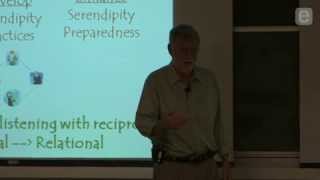
This content was created by GHION.AI . This content was uploaded by GHION.AI . This is a YouTube video titled "John Seely Brown: Shaping Serendipity" created on December 10, 2010, featuring John Seely Brown discussing the concept of shaping serendipity in a rapidly changing world. He explores how to create environments conducive to new ideas and the importance of deep listening and reciprocity in building relationships.
Chapters
Question Serendipity is not a bad thing. Serendipity sounds to most people like luck. Question might it be possible to actually shape serendipity and basically a world that is rapidly changing? It's an interesting issue. We don't even know the. The question is to ask whom to look for in a stable world. I use Google. You know, the kind of question doesn't work too well in Google is please tell me what I need to know that I don't know I need to know. Yet it turns out that not many answers come up. But shaping serendipity, if there is a way to do that, a way not to just count on luck, but to think about how you may be able to choose the right kinds of environments. By the way, you saw that in spades. If you follow Dusty around the world, choosing the right kinds of spikes to visit. What are the practices that you want to develop so that you have a better chance of picking up new ideas as you encounter them? And how do you actually kind of prepare yourself in order to be able to receive very strange ideas that you have to do a lot of thinking about how to appropriate in this context. I want to go through some of these practices. You're seeing some of them as they laid out in Dusty. But the bottom line here is that all these encounters involve deep listening. That's not a big deal, but deep listening with reciprocity, that's to say, what do people get out of talking to you as well as what do you get out of talking to them? Because if you're doing always the take, guess what? Then pretty soon you find people don't really like to spend that much time talking about new type of stuff. So one of the questions is how do you kind of think about this and how do you move from an initial transaction interaction to actually start building relationships based around this notion of actually reciprocity and deep listening?