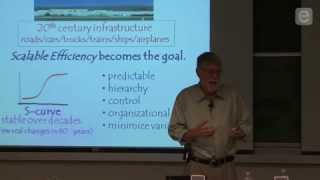
John Seely Brown argues that 20th-century institutions built for scalable efficiency no longer work in a 21st-century digital world. He points to declining returns on assets and says the old model is broken, opening space for entrepreneurs to build something different.
Chapters
So let me just start off with a very simple observation. Our old institutions suck. As we'd say someplace they ain't working very well. Something is broken. Maybe something fundamental is broken. Nothing to do with the current financial crisis. Maybe something much more fundamental. Getting to the root of that may open up a view that really says there's a whole new set of opportunities for entrepreneurs. But why do I think they're broken? I could spend the entire talk on that and you'd be deeply bored. But just two mild observations we have at the center been computing, not return on equity. Because if you look at return on equity, it is possible to play an infinite amount of financial gains through debt financing that can disguise, as we now know, almost anything. We've been looking at hard assets and return on assets. And if you look at the last 65 years, return on assets have plummeted 75%. And there's absolutely no sign that this is going to change. In fact, it keeps going down and down. There are no tricks in this graphic. We could talk about how the top quartile rather than bottom quartile is performing, blah, blah, blah. That'd be a whole talk on this game. That's not what I want to do. I will mention one curious thing for the economist economically inclined students. If you take this to where it crosses zero, which means our corporations have gone out of business, it happens to be, ironically, at the same point that the debt equals the GN gross domestic product. We don't think those things are correlated. But it's an interesting observation to me. More interesting is in the old days, you do a startup, you do really well. The company would build, build, build, build, build, and you eventually make it into the s and P500. And if you made it in the s and P500, you would live there for a really long time. 75, 85, 95 years. We've been able to kind of compute these business cycles. How long companies that make it into the s and P500, success that is called how long do they last before they get toppled, before they die or are acquired. Not that acquisition is quite the same as death, but it's an interesting question. And we're looking at getting down to a point where basically people in the s and P500 might last only five or 10 years. You got to ask, what the hell is going on? Or as I sometimes say, depending where I am, why are we paying CEOs so much? It's a different story. Here's an observation that at least underlies some of this Game Alfred Chandler got us to understand in the 20th century, basically, there's a fundamental infrastructure that enabled us to transport goods with amazing efficiency and organizational architectures built up to leverage the fundamental infrastructure of the 20th century. And that's kind of a gloss. But one of the most interesting things about this infrastructure is, first of all, it's a simple S curve. It means that for a short period of time, there are tremendous disruptions. Think about electrification is another example of that. The period which things change and then they stabilize out for a pretty long time. Basically, if this is the infrastructure, the key to success, by and large, is the notion of scalable efficiency. Build a lot, use the transportation mechanisms to distribute it, blah, blah, blah. But for this to work, you have to live in a predictable world. You got to be able to predict ahead of time what to build. Build a lot of it, store it, ship it out. Obviously, that also means because of scalable efficiency, you want hierarchy, you want control. And if you study organizational theory almost anywhere, basically think about organizational routines. They define what a corporation is. And we all know that, that the game is how to minimize variance. And that's kind of the picture of almost all notions of how the 20th century firms really worked. And by the way, almost everyone in this room had the same impression or the same experience coming through K through 12 schools. Our K through 12 schools are built on scalable efficiency, a factory model. Basically, we can predict for you what things you're going to need five or 10 or 15 years away. And we're going to build up a stock of assets for you to learn to acquire, so that eventually you get to use them very much like how corporations actually work. The catch is, Today's world, the 21st century, is qualitatively different. We no longer have an S curve. We could argue, especially on this campus, about this curve here. But basically, the digital infrastructure, the technology underlying the digital infrastructure looks like it's going to continue to follow an exponential. It may not be Moore's law. We're going to change architectures, we're going to change algorithms, we're going to change a lot of things. But this exponential curve may be slowing down, but it is marching on. And the technological infrastructure we're going to build things around is, of course, more than just technology. It's a social, technical system. And so you get interesting kind of institutional mechanisms creating in order to be able to make this stuff work.