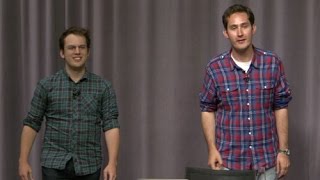
Mike Krieger recalls launching Instagram on a single server and scrambling to handle millions of unexpected users. He and Kevin Systrom learned Linux and cloud operations on the fly, leaning on friends and former teachers for help. The chaos forced them to trust themselves and solve problems without prior experience.
Chapters
But it turns out there's things you can do in school that I think are valuable. And when you're trying to pick courses and figure out where to focus your time, the classes I look back to now and think, wow, those are the ones that help me deal with that uncertainty day to day. Are the ones where day one of the quarter they tell you, we don't know what you're going to be doing for the next rest of the quarter. You'll get this at the D school a lot. And in all the entrepreneurship classes, it's your job to ask the question, figure out the question that you're going to tackle and then, and then answer it for the rest of the quarter. That's just a very different experience from, well, These are the 10 problem sets you're going to tackle and then we'll deliver them at the end. Of course, going through those motions is really important as well, but having that ability to ask the question. And Kevin will talk a little bit more about this in the next one, but also just work through the rest of that quarter. And the rest of it is the engineering we end up doing we call Sink or swim school of engineering. So we launched on this little machine server in Los Angeles. We had no idea what we were doing. We were like, well, maybe some people will sign up within 24 hours. We had so much demand on that one machine that all of a sudden we had to scale out to what we now have. Millions of users. None of us had touched Amazon's cloud platform at all before launching. We'd kind of heard of it, but shied away from it. And it turns out that there's no motivation stronger than a bunch of people knocking at your door saying, I want to use your product, fix your thing. And we put in. I don't really remember the first two months of our startup because we didn't sleep and I think short term memory goes out of the way. So I'm told we put in a lot of late nights that we're all about saying, what do we need to do to get our product to a place where people can keep using it, get excited about it, scale to the challenge and you'll learn those things because you're bright and intelligent. You started a company because you trust yourself. So having that faith and not shying away from a big challenge because you're like, well, what if we're successful? We won't know how to scale. I barely knew how to use a lot of the Linux software sysadmin stuff. And now we know it really well and probably if we did it again, we'd have a totally different approach. But it's a little bit of Zen beginner's mind. You focus on the simple, important stuff first. If you're not worried about scaling ahead.
Of time, it's really good to have friends that are computer science teachers.
Absolutely. It's all about building that network. Week one, I had worked at Meebo beforehand and I was doing mostly front end development, so I wasn't doing a lot of hardcore scaling stuff. And I remember like 8am in the morning, I'd be waking up. My friends who had a more normal job is be like, I have no idea what this means. How do I do this? They'd come in, we'd buy them beer, and you build that network and they'll help you out because they're excited about what you're doing and it becomes less about feeling like you're the entire source of knowledge for your startup. Right.
And I think what I'd add to the original point of going to events or talks is that it turns out what you get from those things aren't necessarily the takeaways that we're going to put up here on the board, but it's the people sitting next to you, it's the people you meet before the event, after the event, the people that you're sitting next to, chatting with them about the stuff that you're doing that end up being the most valuable part of your entrepreneurship experience. Going down the line. The fact that I remember being at a party, I think it was like maybe sophomore year in college when Facebook had just moved out. And I ran into Adam d', Angelo, who was the CTO at that time, at this little party, and we kind of kept in touch since. And on the day we went down, that first day we launched, we had all these problems. I was like, who's the smartest person I know, who I can call up? And Adam spent like 30 minutes on the phone with us just walking us through the basic things we needed to do to get back up. And those little events are the things that matter. So as much as you're paying attention to the stuff on the slides, make sure to spend some time after the talk getting to know the people around you.