Lyndon Rive: The Science and Incentives Behind Solar [Entire Talk]
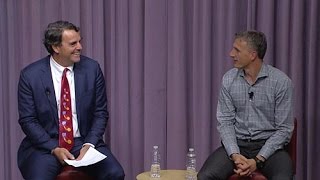
This content was created by GHION.AI . This content was uploaded by GHION.AI . This is a YouTube video titled "Lyndon Rive: The Science and Incentives Behind Solar [Entire Talk]" from October 30, 2015. It features a conversation between Tim Draper and Lyndon Rive discussing various topics including personal anecdotes, the sport of underwater hockey, and in-depth insights into the solar energy industry, particularly focusing on SolarCity's business model, challenges, and future prospects. The talk also touches on environmental issues, government incentives, and the potential for solar energy to address climate change.
Chapters
So Landon, I thought I'd just start by starting with the question that's pretty much on everybody's lips right now. What is your theme song and why? He's used to these. We did this at Draper University. And good. This is a stumper.
I know. I'm trying to think of like when in laws would listen to music. Theme song.
How about something that matters to like. I mean it could be like we are the world. Right?
A good one. It didn't come to me like that. I'll take it.
Okay, we'll go with that. We'll go with that. Okay, so tell us a little bit.
Except say Kung Fu fighting. Oh, that feels more like the theme song. It's Kung Fu fighting. Yeah, it feels like that every day. Kung Fu fighting. Just go to fight. Keep on fighting.
Okay, tell us how underwater hockey is played. Eventually we'll find out about SolarCity, but.
Yeah, I'm just going to put things on the foot. Listen, always have time for that. So mask fins, one handed, stick a pucks made of lead at the bottom of the pool. You play six players a side in the water you have four subs, so 10 players a team, 15 minute halves. You go down, hold your breath, play as long as you can before you run out of air. You give the puck to your buddy, you go up, get some air and you just alternate. Now it's actually not a, a big spectator sport as you can imagine, but it's tremendous fun. In fact I'm trying to get Stanford to create a team. So any plug you can do to get there?
Are there any like rules? Can you dunk? Can you keep a guy down?
Yeah, yeah. No drownings allowed. It's kind of like bossable where there's actually no real fighting but you can check somebody. It can be a little fighting but it's actually a very, very friendly sport. It's often played coed. Actually mainly played coed. Only at the international competitions is it played men and women, but mainly at the local pickups. Coed. So it's real friendly. If you like swimming, this is far better than swimming. Swimming, you get tired of that black line for a long time. And then if you like water polo, those are the type of players that often come and play the sport.
You need a bottom that's uniform.
Yes, that's the one criteria. You need a flat bottom or I.
Guess you could play from side to side.
You always play over the width of a pole. It's the width of an Olympic sized pool. So it's 25 meters by 15 meters is typically the length and width in feet. I forget what that is.
That should be a varsity sport here. Okay, so, okay, so you are a very close cousin to Elon Musk, and your brother also grew up in the family, apparently. And so your mothers were twins, right?
Yeah.
So what was it in this family? I mean, this is amazing what you guys have accomplished. And is it like, did they say, lyndon, you have to save the world, you have to, you know, the world's getting too hot, we need solar energy. Or did she just sort of, kind of let you run free?
And hopefully the environmental thing came up way later. We were brought up in South Africa. The country still doesn't do recycling. It's just to put it in perspective. So there's no. Maybe they're just starting now, but it's not. Environmental is not a big focus, or at least that wasn't when I was growing up. That happened as we got older and I'm not sure if it just happened that we wanted to solve the problem. But before SolarCity, we had a software business. And nothing wrong with software. Great, great software companies out there. But when you're in the grind, back to the kung fu fighting, every morning you're waking up and you just get into the grind and you just work, work, work. At the end of the day, if the only outcome is financial, that gets old. And you want something that can get you more motivated because otherwise you don't work as hard, you don't push yourself as hard. And so finding a job where you can actually have a financial reward, but also have an environmental reward or a different reward, something that helps humanity, that's exciting because you can get up, feel passionate about it and it's a double win. That's kind of what led to it.
So, yeah, you. Okay, so before SolarCity, you ran Everdream.
That's right.
And Everdream did other things, you know, is a different business. How has that affected SolarCity? Did you learn something from Everdream that made you realize that you, you should be doing something a little different at SolarCity?
Yes. So one thing I liked about Everdream, it was an OK outcome. It wasn't a wild success. We ended up selling to dell computers for 120 million in that period. We went through the dot bomb and DFJ supported us all the way through, by the way, thank you very much. They gave me my first $2 million check when I was 22 years old. Wow. Real money. But anyway, so that started Everdream, but in that period the financial crisis, specifically the software financial crisis in the Bay Area occurred and it was the technology crash. The experience somebody learns are facing real, real problems makes you a better athlete. You have to work harder, you have to hone your skills better. And so I'd say that experience helped a lot in SolarCity. We had to solve problems that we probably wouldn't have to solve if the company didn't have the financial or at least the technology crash. And then we grew out of that technology crash and then ended up selling it to Dell. So it was a okay outcome, but that I'd say was invaluable.
So okay, now SolarCity, you install all the panels everywhere and then it generates energy and that energy goes up onto the grid and after a while, somehow you end up owning the, the whole grid. I mean, you end up owning at least all of the energy that comes off those panels. How does the financial model work?
Yeah, when we started the business, the entire market, specifically the residential market, the only way you could buy a solar system is if you bought it. So you have to use home your own capital to pay for a commodity, which is an operating cost. And so the only reason for actually doing this is if you really are like a strong environmentalist or you have disposable cash and you look at the long term returns, then it's a fair investment. So essentially in the beginning, solar was a product for the rich. You had to have lots of money to come out with it and at least disposable cash to pay for it. So we looked at it and said, okay, we have to create a business model where it makes it really easy for people to adopt solar. And the way how people buying energy today, they don't actually go pay for the power plant, they just pay for as you use it. So we created that model and allowed us to install the solar system for free. So the customer doesn't pay for the equipment, doesn't pay for the installation, but only pays for the energy. And so then as the energy produces, they pay for that, and then we charge less for that energy than they currently pay from the utility. So given the choice of paying more for dirty energy from the utility or less for clean energy from us, that's what helped us, that's enabled us to grow. The level that we've grown right now we've made it an easy decision for a customer to get clean energy.
And part of that differential has come from some government subsidies that have declined.
A little bit significantly.
What's your thinking on that? Where do those come out over time. What happens? Why did they give you the subsidies in the first place? And then why are they decreasing them? And what do you think is going to happen in the future?
Yeah, all energy in the country is highly, highly subsidized. Like highly subsidized. And the subsidies go so deep you can't even identify the subsidies. If you asked them, please come up with a list of all the subsidies. They will miss them, I kid you not. They'll be like, wait, here's an example. I started to get that backdrop. It's a passionate point for me. In California, you have to get a building permit to install a solar system. That permitting process delays the installation. So imagine you have a highway, you've got cars coming in and all the cars have to stop for a week. A week. That's going to cause a serious backup. Not only is it the cost of the installation, but it's cost of throughput of the business. There's few things. We don't need a permit in the state. If you're going to do a, a small fence around your house, you don't need a permit. If you're going to do a small retaining wall, you don't need a permit. If you're going to do a small tool set, you don't need a permit. And if you're going to do an oil derrick, you don't need oil derrick. Just saying, if you want an oil derrick, you don't need it. So it's just like, that's not an incentive. That doesn't get captured anywhere as an incentive. It's just the way you deploy world derricks. And here's the crazy thing. If you want a structure around the oil derrick, you don't need a permit for that either.
All the fraternity guys are thinking, how do we build a derrick?
An oil derrick right here. Normally when I show this, I saw houses in Malibu. Nice house, beautiful house. Well Derrick, NASAs. It's like, how did that just pop up? The building department doesn't even know they're there. You don't have to ask for a permit. That's how crazy. In Texas it's faster to get a permit for a fracking facility than it is for a solar system for a house. Oh yeah. So that was just my little rampage on energy incentives. So at the start, solar did get incentives and most of the states offered rebates. So the two primary incentives, it's a state incentive and a federal incentive. The state incentives helped initiated the market. It was really, really important. In California, there was the Million home solar initiative that worked really, really well. It's not quite a million homes, but it got the start of it and it was a billion dollar program. The plan was that program to last for 10 years. It only lasts like six and a half, seven years. But the industry did its job, so the industry reduced its cost as the state incentives reduced. And now for the last three years, there's been no state incentives in California. Most of the states for the last three years haven't had any state incentives. So the only remaining incentive right now is the federal tax credit. And the federal tax credit has a 30% tax credit for solar systems. And that's going to be expiring in 2016 for residential owners. And for commercial, it's going to go from 30% down to 10%. I hope that doesn't happen. It'll be bad policy if it does happen, but we are preparing for that. It actually.
Oh, you said it will be happening.
It's going to happen. It's going to expire.
Oh, it'll expire, but is there a possibility? The choice is do they renew or do they pull it away?
So it's going to expire unless D.C. makes a change. The there's a fair amount of gridlock right now in dc, but I think it will get it renewed a year of a higher probability than not that it doesn't get renewed. If we look at the problem we need to solve, climate change is a real big problem. I don't know how many storms it will take for us to realize this. I don't know how many fires will take before we realize this. How catastrophic does it have to be before we go, oh, shit, we have no choice but to react. I think the signal will be loud enough right now, but it looks like we have to turn the signal up even further. So hopefully we don't have to. But bad policy would be not to continue with that as we have the solution to the world's biggest problem. And if we stop it, I think 20 years from now we go, okay, we had the solution and we decided not to fix it because of a tax delta between 30% and 10%. That'd be crazy. Now the true best solution to do is not to extend the federal tax credit for solar. Don't have it. But penalize those who are killing us, who are polluting the atmosphere. Like pay for the pollution. It's very basic. If the pollution was a liquid, you'd have to pay for it because it's an air. You don't have to pay for it so pay for the pollution. And so that would be essentially a tax on carbon. But based on the political influence, I think that's a low probability of that happening. So if that can't happen, then continue incentivizing those who are providing energy. That is not bad for us.
So you're, your work is two questions here. Your work is saving the planet. It's an ambitious goal. Your work is saving the planet and Elon is sort of helping with the saving of the planet, but he's also trying to get us off the planet. Which is more important and is there do the curves somehow eventually flatten out where you get the global warming and then there's SolarCity and it starts to flatten out? Or are you just sort of delaying the inevitable where we all just fry?
For those who play a sport, do you ever give up professional sport? Doesn't matter what the score is, you never give up, you just play all the way through because things can change and you can go through. Right now the scoreboard looks pretty bad, but I, but I think we can win. But back to Tesla SolarCity and occupy Mars. The SolarCity, the solar industry is addressing electrical issues. So electricity is the cause for the largest air pollution in the country, right at parity with transportation. So electric vehicles then address that. So you have to address both our energy consumption and our transportation if you really want to have an impact on climate change and to be taken it from both angles and then the eject path is Mars. But that's more for like a catastrophic event.
Now do you, I mean let's say the whole planet was covered with solar city panels. Does that slow global warming in some way or is it just a cleaner way? Does it make it so that there's less particulate? What's the science here?
So absolutely it will have an impact. Now it'll take a long time to undo, but you'll stop it from getting worse. But this is a 20, 30 year Nishtor. This is big. And if it's just the US it still doesn't solve the problem. We have to get the U.S. we have to get China, we have to get all the big countries. Then we have to start focusing on the developing countries because they're burning a cheap cost of energy, which is coal. So we have to address it all over the place. But assuming that scenario, if we had a magic wand and we can do it right now, we'll solve the problem. Absolutely.
So here's another question. Have you thought like is your r&d department working on something Kind of science fictiony. Like putting solar panels outside the atmosphere and in effect blocking the sun's ray at noon or something like that, where somehow you're collecting the energy outside the atmosphere and then beaming it down.
So if you think of all, most energy, actually most all the energy that we burn right now comes from the sun. Light hits a plant. Let's talk about inefficiency. Just like to walk you through the equation of most of our fossil fuel. Light hits the plant, the tree gets bigger, then eventually the tree dries. Then it goes into the ground for a million years, then we dig it out, then we haul it out to a factory or a plant, we burn it. That burn then heats up water, creates steam and moves the turbine to create electricity. Then we haul that electricity all the way back to your house and then you can use it. That's step one alternative. Skip that process. Put little glass panels on your roof, capture the light, create energy. I think that is more efficient than that other process. So we'll get there. And the cost curve has come down significantly. So now we are more competitive than kerosene, more competitive than diesel. This is no subsidy at all. In the US we're more competitive than most energy sources in most states. We're in 18 states today. But that is tied to the. It is dependent on the 30% tax credit.
Okay, let's switch to your.
Actually one other comment on the R and D department. Yes. No space thing. We do have an R and D department. We've just announced the most efficient module, solar module in the world. I'm not sure if you guys saw that. That was a big deal.
Good job.
That's nice. Taking a record from a competitor feels good. But just the satisfaction, that record will move around. So it's trophies. You get to keep it for a little while. Competitor takes it, you get it back. So it makes us all better. So it's actually a good thing. But in terms of as we look expanding internationally, we go to many countries. And back to the incentives. I'm from South Africa and the finance prime minister came to us saying, hey, you should expand to South Africa. Okay, sounds great. Good sun, amazing country. What's your cost of energy? The cost of energy is around 15 cents a kilowatt hour. Okay. It's not bad. That's pretty good. It's pretty efficient. Why is it so low? We highly subsidize. The government pays about half the cost of energy. Okay, so you're saying without the government subsidy, your coal generation and your cost of energy would be roughly 30 cents. Yeah, it would be roughly around 30 cents. So we need to come in there and compete and help you with this. Yeah, absolutely. We need you. We have a big energy crisis. We have blackouts all over the place. So you're paying for half of coal. What's your plan for solar? Oh, no, we can't give you anything. We have to solve this problem. You're subsidizing.
It should give you 15 cents.
Exactly.
You could end up getting paid.
It is amazing how many developing countries out there where a source of stimulants is to pay for the electricity, which is bad. Rather just give it as a credit because it artificially holds bad energy cost low. And that's what, that's what we're up against. And that's worldwide.
Yeah. So you got to change people's thinking. You have to work on it a lot of things. Every entrepreneur has to face that. And the entrenched people who are entrenched are going to clearly fight that. And so you're going to be. It'll be a fun long term Kung fu fighting for you. Just keep kung Fu fighting. So here are, you've got. You said 13,000 employees, is that right?
It's 14.
14,000.
We add a little few every month.
A lot of overhead.
Yeah, it's revenue generating. Yeah, we're trying to keep overhead flat. We've got a cap and trade program. Cap and trade's good. If you want an addiction overhead, go to trade with somebody.
So are they W2 or 1099s or both?
All our employees are W2s.
Oh, okay. So they're full time employees.
Full time employees, benefits, stock options, everything. So it's like number one asset in the company is our employees. Really make sure that they have good wages. It's a challenge. But we've successfully managed to pay people more at the same time, reducing cost. So we're happy about that incentive plan that we came up with that enabled that to happen.
So how do you. I kind of think, you know, people probably ask how do you manage that many employees? But maybe it's how do you communicate with all those employees? How do you get that? You know, whenever you come up with something new and you need to pass that to the 13, 14,000 people, what do you do to make sure that it penetrates and they grok it and they're ready to.
Yeah, it's not easy. That's a big problem. So we've tried different things. The one that seemed to work right now is every week we have what we call SolarCity TV. And then we'll get different people to speak on the tv. It's an AMA show. We broadcast it into the entire company and it's a good participant shows up so we can track the amount of people logging on, how many people watch it afterwards. And that's a good way to get information out. And then email, which is never that great, but we do a fair amount of email. Email's intense in the company, a little too much, but that is a form of communication. And then just making sure that you communicate to your leadership as much as possible so then they can carry it.
Is there a feedback loop back to you? Is there some way that they see something out there in the marketplace, they can turn around and say, hey, you want to pay attention to this?
Yes. So it gets harder as the company gets bigger. But the culture that we embrace is total open communication. Anyone who sends me an email, I always respond, although there's a lot, I'll get back to them. Best to send me emails on Fridays because then you're going to have the best response time you got the weekend. If you send me an email on Monday, that could be a long response time. You may have to wait till the next Saturday before I get to that one. Weekends on my catch up time on email. So always respond on that. It's a cube environment which is common here in the Bay Area. And you make sure you get out in the field all the time.
So you do it all on weekends. Your wife doesn't like that too much.
So here's the trick.
I have some of the same problems, so I just want to.
The way I think I managed to solve this is I managed to find my wife when I was really young. We met when we were 14. I tried to date her for two years, she said no, but at 16 she said yes. So we've been together ever since. Got married at 24, had our first kid at 30. So she's my lifetime partner and the best person in the world. But the secret of that is she doesn't know anything better. She has no idea. You mean this is how it works? And so then when I find friends, I make sure the friends are with husbands like me. Meaning that they're never there, they're always working. So you keep this little box. He's starting to figure out that's not true and that 80 hour work weeks is not normal and that the dad or the husband actually has to be there sometimes. So the pressure's getting there. We've negotiated a lot of things. I'm a very analytical guy. I like data, I like to measure things. So when there's a debate about, hey, you're not at the family enough, I go, but it feels like I've been with the family enough. No, you haven't. And so this emotional thing where you just have to guess what the right answer is, I can't handle. So we actually came down to a quarter. 16 hours a week is my quota that I have to achieve to be with the family. I know it sounds rude.
Can you be sleep during summer?
No, no, it has to be quality time. And so 16 hours, it's doable. So if you do one hour day, then weekends are okay. If you don't do anything in the week, then you've got eight hour days on weekends with the kids and that's a long day. I love my kids to bits, by the way. But yeah, so that's. She's fantastic, but she's managing it.
Okay. So back to the business. When entrepreneurs come to me and they say, hey, what should I have to get funding from you? How do I do that? I'm always saying, well, one of the things I'm always looking for is how do you get your customers to become your sales force? So what are you doing to getting your customers to become your sales force? How do you get them out there doing your work for you?
Yeah, that's really good. One third of our business comes from our customers. And so we've essentially created this ambassador program.
So there are referrals from neighbors or something.
Neighbors, yes, it's a dual referral. If you're a customer and you refer your neighbor, your neighbor gets a discount and you get an incentive. So if you don't do it that way, you're kind of selling out your neighbor because you get an incentive. But now the difference is you're hooking up your neighbor. Very big difference. And so this is a small change. So hook up your neighbor, get them a discount. So that has worked well. And then they can become ambassadors too, and hook up their neighbors too, and ambassador program. And sometimes homes don't qualify. So you run across a house that the orientation of the house, or there's too much shading or the roof is too old or something may be wrong with the house. But the person's passionate about solar and passionate about trying to help climate change, they may just become an ambassador. And we have a lot of ambassadors on even customers that start referring customers to us.
So if you guys are the leaders in this market, but there are still some competitors that are coming along. What is your competitive advantage and how is that going to play out in the future? And is it easy to jump into your business or not? And then maybe what might come and hit you from some other angle where you get blindsided like Napster did to the music industry.
Yeah. Yes. So in terms of what differentiates us is our vertical integration strategy. So from the beginning, we've decided to vertically integrate. Now the downside of that is you have to manage 14,000 people. That's a lot of people. Now the upside of that is you can optimize cost, you can optimize customer experience, you can optimize for product. So early on we made the decision to vertically integrate. And so when we looked at our competitors, they were not in order to get solar, somebody else would sell you the system and they would probably do the installation too, but some other one else would do the financing. In some cases you would have extreme, you'd have somebody sell you the system, another person, you'd do the financing and then another person would do the installation. In fact, it's still quite a bit of the market. You have three different companies you're working with just to get a solar system in your house. And so out of the gate, our competition was ahead of us because they could leverage other people's infrastructure and have them do the sale installation. But when you are in a small market like us, that infrastructure gets depleted. They can't grow more than those 20 or 30 partners. And the only way they can grow is either they provide the working capital needed for those companies to grow or grow at a rate that they can just grow with their own profit that they make. So it's just won't be able to grow faster. And so out of the gate that model was better. At least it seemed to be better. And then we overtook it at a healthy pace. And the reason being is because we invest in infrastructure, we can invest in that warehouse and get it up to the right capacity, because it's our warehouse. But unless you improve the efficiency, you'll get a point where you just can't drive the cost down because the glass is going to cost. The glass, like the glass is going to have a cost. The aluminum around the frame is going to have the cost. The plastic or the back sheet at the back is going to have that cost. So you're not going to be able to get that cost down because those are very much pure commodities. But if you have generation two, so if you have high efficiency, this is to simply say if your module is double the efficiency, then you can provide double the amount of power or energy on the same fixed cost of that solar frame. And so that's why we invested into it. We're convinced we can create high efficiency solar modules at the same price as standard efficiency modules. And then if you're able to do that, you can either install more energy on a roof or install less panels on the roof. And so you actually have, not only do you have the extra revenue from that power, but you have efficiency in your crew and you reduce your cost.
So if you play that out though, won't other suppliers go, oh, I see how you do that, I'm going to do that too. And then they start driving the prices down again. And you, you've got this big plan and all these assets you've wasted on this thing and somebody else is doing a better job.
That's right. You just got to do the better job.
You have to just keep pushing. So are you thinking you might just keep driving new technologies, keep on driving.
But if the others follow, remember, at our growth, if you fast forward three years now, four years from now, our capacity, the manufacturing capacity is only going to be one gig. That only may be half a third or a quarter, depending on what year they look at of our volume. So we want the other ones to get a product as good as ours. We want it to come down. We want to push the industry to say that standard efficiency is not okay. No one is working on generation two. And the only ones who are working on that are startup companies who just don't have the capital and don't have the bankability, the assets. So it's like the circular event that even if they do have amazing technology to get it to market is near to impossible because nobody will buy the module because there's no warranty behind it. At least there is, but it's nothing. And so you have to get the big manufacturers to chase this technology. And my hope is that it pushes the other manufacturers to do it too.
And now you're manufacturing these in the United States.
So.
Did you run into any problems or opportunities or whatever by setting up a plan in the United States and what state did you put it in and why?
Yes, so we have it in New York, it's in Buffalo. So it's a million square foot building. Actually, I have a live camera feed of it. It's still being built. It's really cool. When we acquired the solar company that.
It'S in Buffalo, does it benefit the manufacturing to make it cold to have cold weather outside?
Yes. Not really, but the whole thing and the fact that it is in Buffalo, actually one of the primary reasons is you can use hydro. Creating solar modules is energy intensive. So if you can actually use clean energy to create clean energy, that's better than using dirty energy to create clean energy.
So are you using Niagara Falls to do this? And so that. What do you pay per kilowatt hour from?
We're still negotiating, but just standard rates are around 5 cents a kilowatt hour. Wow, that's cheap. By the way, one of the reasons why we have a factory in China, one of the reasons why we didn't do the big factory in China is that the cost of energy in China is actually fairly high. It's like 15 cents a kilowatt hour. And so when you look at your shipping cost, but not just your shipping cost, when you ship equipment, you have your carrying cost of your inventory on the ocean. So you got to include that into your working capital cost combined with the energy cost. Logistically we think that Buffalo can be very competitive.
Yeah, that's great. Buffalo needs the jobs too.
That's the most reason.
I'm sure they put, they give you any subsidy to go to.
They gave us a good incentive.
Yeah, that's great.
A fair, a fair incentive. Buffalo incentive. It's fair.
So I guess we've gone into most of that. Are there any other things that you're thinking about as you pursue as you grow this business, as you, what is it going to look like 15 years from now? I always have this 15 year rule for my entrepreneurs when they come to me. I say is this company really going to be there in 15 years when we have self driving trucks that take all your robot factories that take everything through. Self driving trucks that, you know, construct your house by itself.
Little printer.
Yeah, with a 3D printer. And all those very strange interesting things that we're kind of excited about having happen in 15 years. What does SolarCity look like and how, you know, how are you going to make it even cooler than it already is?
So I think the, this may even happen sooner than 15 years. We're starting to see this curse right now. Most of the markets we're in right now we compete against the, the utility that's our number one competitor. We're starting to see policy shift changes where we're going to have two customers, we're going to have the homeowner to which we sell energy to and then we're going to have the utility as a customer as well to where we sell grid related services to. So that I think is going to change. And so then what's going to happen is the utility, I don't think the utility is going to go away anytime soon. So utility provides a good feature. The utility is now going to have access to millions of little power stations across their grid. With the solar generation and the storage device. They're going to have the software application which they will then essentially manage millions of distributed systems the same way we would normally manage their own power plant. And they will load balance the grid, they'll manage the grid, but instead of them building out the infrastructure themselves, they can use other people's infrastructure. Now we've seen this model happen. Salesforce.com is probably known for software as a service. And they kind of created a logo around that. No software, this essentially infrastructure as a service. Somebody else is providing the infrastructure and the utility then will use that infrastructure as a service. Now why this policy has to change today the utility cannot use somebody else's infrastructure because they don't make any money. Like the rule is very clear, you only make money if you pay for the infrastructure. If you don't pay for the infrastructure, it's a pass through cost. So if we sell it to the utility for $10, they can only rate base $10, so they make no money. If you create an open field, it'll allow tremendous innovation into the electrical infrastructure. I don't know what technologies will be created, but create an open platform, say, here's the problem, bid out the solution, Utility subscribes, takes the winning bird of that solution. If the utility would have done it themselves, let's just say that project would have cost a million dollars. They bid it out. So they would make 10% of that million dollars. If they bid it out, new technology would come out. Maybe it only cost 500,000, they still make 10% of 500. But this way the utility has a lower cost, the ratepayer has a lower cost, and it allows for innovation in a market that has seen almost no innovation. The best innovation that we have right now is smart meters. And they're not that smart, but it's not being used. It's like you don't have to go and send somebody to actually measure the meter. By the way, a lot of places still have to measure the meter, but it has no control function, it just sits there. So just remote measurement of your meter, that's the stuff we've done in the last 15 years in our electrical infrastructure. Then we can do better than that.
Now could you start to link SolarCity customers and create your own grid. And would that make any sense?
We are doing that. So we launched a microgrid product beginning of this year and that's starting to take up do really well. Why it's important for microgrid, not necessarily because we think that's going to be a big market, it's going to be a decent market. But we want to show that this combination of distributed solar combined with storage actually makes the grid more stable. You actually have a more reliable grid. You actually have it far better. So we're going to prove it out and then go back to the utility and partner with the utility, say, look, use this, use this software, use this application, use our assets, get other people to log on to it and manage your grid more efficiently.
And you really think it's worth it to bang your head against that wall, that utility wall, rather than just slowly but surely build your own grid so that we don't really need them.
So the one thing that.
Or is it that solar doesn't quite generate enough?
No, we can. So one thing that you need is you need load balancing. And only way you do that is you have to have a wire from house to house, right?
And then you need the, I mean you could have batteries too, right?
You have the batteries. But even if you have batteries, so if you have a self contained unit with no access to the grid, you have to design the system for your one day peak load of the year. So it's a pretty difficult, you're oversizing the system for your use. But if you can connect wires from one house to the next house, this person's one day peak load doesn't match this person. You can load balance. And that's essentially our distribution infrastructure. That's what the utility has, that's what they provide. The lines coming into our neighborhoods are ugly. We definitely do not want two of them. Right? So that's the one place where the monopoly still makes sense, is to only have one set of lines coming in. And so you want to bang your head against this.
Okay, what if you did this every time you installed in a house? The deal is you also drill underneath and you drill a wire that goes into every neighbor's house to the wall and then if that neighbor signs up, you then link and they're linked and then another neighbor signs up and they're linked and then just slowly but surely it just grows out, nobody sees it, it's done on the property.
I love that idea. Other than the fact that it's illegal.
Wait, wait, no, no, you go to the end of the property. Oh, it's illegal to go to the end of your property.
You don't connect two homes electrical system. No, I connect them.
You're not allowed to. No.
Even if you buy who created that law, even if the property is your own property, you can't connect them unless you get special approval to do that. But yeah, no, no, it's is that.
That'S just like the utilities have rigged the deal.
Oh, a lot of cases. That's the case. So not impossible to get that changed. But that will be a big, big. That'd be a big fight. We could start setting it up.
I was just thinking, just to that moment, just to that place.
Yeah, I like that.
Yeah, yeah. And then you do it on the other side. You only connect them when the law makes it.
Yeah, exactly.
Make it legal.
Get everything right. You get the colors of scale. When the law turns on. Boom. Exactly. I like that.
There we go.
Hopefully they can change before then.
Okay, I got one more question, you guys. I should probably have the hook eventually, but I got one more question and that is how do investors value SolarCity? What's the.
Not today.
Not very well today. It seems undervalued. But how do they look at it? How do the optimistic investors look at it and how do the pessimistic investors look at it? Because it's such a complex system.
Yeah, it's a.
With the loans and then long term you become a utility.
And so the best way to look at it is what value are we creating every time we deploy a solar system? So when we deploy a solar system, we have to pay back our tax equity investors, we have to pay back our debt providers. So after we've paid back everyone, how much money is left for us? Because the tax equity investors and our debt providers cover our cost. So we have to pay them all back. And when you do, the net present value of that cash flow that comes to us after we paid everybody back, we make roughly a little over a dollar a watt this year. The forecast that we reported in our last earnings call was 900 to a gig of deployment. So at a buck, that'll be roughly making 900 to $1 billion a year. So that would be at the current, at the current.
At your current level, 900 to a billion dollars revenue to you or net.
So it's net after all. Cost. So it's net. Net net.
No way. Companies should be worth $20 billion, a lot more.
So the debate comes in with investors is okay, well that value is an NPV value. Over a 30 year period. We use a 6% discount rate. Some investors may use an 8% discount rate. Apply whatever discount rate you want. It's worth a lot more than it is today then.
I see. So that's a dollar a watt now, but it happens way later. So you're really getting, you're getting a dollar a watt over 30 years. So you do have some sort of a discount.
$4 or whatever. 30 years. Oh yes. So the NPV value is roughly a dollar.
So NPV at like a hurdle rate of 3% or something.
We use six. Yeah. And so you can run sensitivity and if you just look at our current installations, so after Dan and everybody else, it's roughly around $3 billion. That's just the assets generating cash today. Those are the assets we've deployed. An example I like to use is we have a geese. It makes golden eggs. If you just look at the golden eggs, that's $3 billion. Currently there's no value for the geese, for the goose. So what's more valuable? The thing that makes the golden eggs. Well, the golden eggs and the thing that makes the golden eggs. In case you're wondering.
They'Re figuring it out, it is midterms. They're trying to figure out like what.
Actually looks more valuable than thin.
The answer is A, B or none of the above.
The thing that makes the golden eggs, the golden goose is better.
So what's our timing? Anybody? What time is it?
It's 5:23.
Okay, we got seven more minutes. Okay. So. Yeah, in a second. Okay. So what? How do you think, you know, you've dealt with local governments and federal government and state government. You've dealt with all these governments. What do you think we should do? I mean, well, first, do you think they operate properly? And then second, what needs to happen?
So governments vary by state quite a bit. I got to give tremendous credit to California. I think it's one of the best governments in the world. Governor Brown is an incredible leader and is passionate about our climate change challenges that we have. So it is good policies in California. They've came up with long term programs, no stops and starts, and has allowed the industry to grow. So about 40% of the US industry is in California. New York is now reinventing its whole electrical infrastructure and is starting to deploy that vision I'm describing where infrastructure is a service and you can interact with the utilities. So, so that's going to be another. So Governor Cuomo is another strong leader in this area. A few of the other states have done too, but then a lot of states haven't done anything. So we have the solution. We know how to solve the problem. We just need to start implementing it. And I think the biggest thing that can happen, the industry is growing at 40, 50%. It will continue to do really well. But the biggest risk to the industry right now, I'd say is the 30% tax credit. So that would be a federal policy and it would be a shame to.
See federal policy to get rid of it completely.
It automatically expires or at least it goes down from 30% down to 10%. Unless there's an active change to keep it at 30%, it won't.
And you said it's 2016, so you would. That would have to happen in an election year and that would be. It would be hard for people to get anything done in an election year, right?
Yes. So there's a small probability that might happen the end of this year with the oil export bill. That may get momentum. And if that gets momentum, then as a trade, continue the federal tax credit. If that doesn't happen, then the only other option would be in the lame duck end of next year. And then if that doesn't happen, then you'll have a lapse on the credit and then maybe get it through in February. Ish.
When they renew, how long do they renew for? Is there some period of time?
We have no idea. So before it was renewed for eight years. Fossil fuel doesn't have an expiration, just in case you want to know.
Okay, we had a question right over here.
Thank you for sharing with us. I have two questions. First of all, you talked about the two different customers, the homeowners and the utility. Have you thought about enterprise with government or different company agencies? Second question, you talked about the policies that might need to be changed, such as tax on carbon or incentive, less incentive. The 30% connecting neighbors. What do you think is the most inhibitor, like the one thing that you need to change in terms of government policy to move this forward into the next phase of expansion.
So what's the first question?
Well, he wants the 30%. He wants that to stay.
Yeah, 30%.
He said what government policy?
Yeah.
Oh, he said, well, what government policy needs to change to improve the environment for something like SolarCity to thrive?
Definitely the 30% tax credit, that's key. But the other part of your question is businesses as well. So we're known for our residential business, but we actually are the largest commercial provider too. We've now just taken the leaderboard on it, we have about 8% of the market in our commercial rooftop installation. We do a lot of commercial as well.
Okay, cold call. Question right here. Front row texting. Come on, what's your question? No, she has one. Come on. Here it is. Ready, go.
I'm a medical student, and I'm not an engineering student, but I guess my concern is that you have solar energy. About what fraction of that is converted to actual electrical energy? Like 20%, 10%?
What's the efficiency?
Yes.
So the question is what percent of the energy the solar energy coming into the panel is converted to electrical energy?
Yeah, Call it depending on the modules, but between 15 and 22%.
And with the new panels, that's the 22%.
Okay, so 80% is deflected off into heat.
Right.
Basically. So you can see, like you can create deserts essentially, where you are sending off really high energy heat into the atmosphere. And that can have a lot of environmental considerations that might be hard to model or predict at this point. But I'm interested to know in terms of like your concerns with the lack of efficiency, but then also the underlying damages that you can take. Like, what are you going to.
No, no. But the heat comes anyway. So 100% hits right now, but in.
Terms of like the environment or the habitat beneath the actual plants.
Beneath the plants, yeah.
So because you create these factories, Right. Like there was an example that I read about in Arizona where they create these large solar plants to collect and process the solar energy. But then people have concerns with the surrounding environment because obviously you can't.
Oh, this is solar thermal. So she's been, you've been reading about how the tortoises had to be moved from.
So there's different ones. So you have one that reflects to a concentrator that then heats up water. So that's, that's a different technology, still doesn't cause damage. I think I want to just emphasize at least there's some environmental impact, but a lot less than a power plant. The alternative is like, go there, build a nasty power plant. And that has a far bigger impact.
Because assuming, like clear, complete, clear skies, you have peak hours from 9am to 3pm and it. If these are commercially available panels built in home, I mean, like the energy that you produce is per square meter, like what, a thousand watts?
So roughly speaking per square meter, you do 1,000 per square meter. One kilowatt hour per square meter is 100% efficiency. That's just kind of how the math turns out. So if you doing that, you're looking at 200 watts, 200 watt hours. Why don't we take one more question?
I'm definitely doing another cold call. You. Yeah, yeah, you got a question?
Come on.
Best questions come from the cold calls. No, no, don't look back. Come on. Yeah, you, you got a question?
I think that's completely very distinct. Better questions come from. No.
Did you hear that? You hear those questions?
I didn't understand it though.
Well, they were the best questions. So go ahead.
No, no, no.
Okay, go ahead, take it, whatever. I work for a software company, solar software company, as a service called Citin and we do sales and financial asset management and remote system design. How do you see technology we talked about when there's going to be the self driving trucks and factories, how do you see technology playing a role in the years, next five, ten years in your sales and asset management level?
Massive. When we got started, a good engineer would take a day to do a design. Now they do 10 designs a day because of software automation. So it has a massive impact. And companies doing that, I think not just the design aspect of the full asset management, sales management. Yeah, absolutely. That can have an impact.
Okay, we're going to do one more. I'm disappointed in you. You in the back. Always center back. It's always the weirdest question. Come on.
My name is Ali, I'm from the graduate school of business and my question is related to energy storage. Storage. So when Tesla's gigawatt factory comes online, is that going to affect your business model at all or not? And second of all, if any of us are particularly interested in energy storage, should we be pursuing that through Tesla or will there be room in solarcity? It depends on what you want to do in energy storage. Wants to repeat the question. So first question is when the factories are the gigafactory, there's two gigafactory, one solar, one battery. But when the battery gigafactory is up and running, what type of effect will that have on our business? And then the second one, if you're interested in getting into the space, in the battery space, do you want to get it to go through SolarCity or to go through Tesla? So first one, as soon as the gigafactory is up and running, that's going to help the business tremendously and will even help it before it gets to full capacity because the cost of storage is coming down dramatically and as that factory ramps up, the cost comes down. We can start adding this to our solar systems and really creating an interesting product. Once again, the product is not necessary backup, although that will be the primary. The initial product, the biggest product, is offering grid related services to the grid. That's the infrastructure, the service part that I was describing earlier. In terms of what you want to do, it depends on what your personality is. If you're looking at looking at applications for deployment, then SolarCity is a good place to go. If you're looking at engineering how you can improve the chemistry of batteries, then Tesla is definitely the better place. So it's like it depends on what you want to do.
All right, we're done. We got the hook.
More from GHION.AI


O processo de reconhecer limites, mesmo quando a vida parece exigir sempre mais.





Depois de tantas histórias, aprendizados e pausas necessárias, o @interior_iza está de volta



