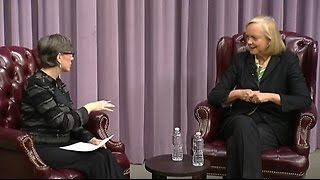
In this talk, Meg Whitman recounts her unexpected rise to CEO of Hewlett‑Packard in 2011 amid a period of turmoil—three CEOs in three years, missed earnings, and eroding confidence among customers, partners, employees, and Wall Street. She explains her leadership approach: rather than cataloging hundreds of problems, she focused on what HP did well, reviving the company’s "founder DNA" of innovation, customer‑first focus, and early corporate social responsibility. Whitman describes the immediate actions she took, starting with cost‑out measures to align the cost structure with revenue, and then employing highly symbolic gestures—dismantling a walled‑off executive parking lot, removing barbed‑wire fences, and moving executives into open workspaces—to signal cultural change and restore trust. These symbolic moves, learned from her political campaign experience, were intended to quickly convey a new, inclusive direction without extensive memos or announcements. The narrative illustrates how leveraging core values and visible symbols can help a struggling organization regain health and confidence.
Chapters
I arrived at Hewlett Packard in the fall of 2011. In many ways, quite an accidental CEO, because I actually joined the board in March of 2011. And my friend and my board member at ebay called me up and said, hey, listen, you know, HP is looking for some new board members. It'll be so fun, you know, we'll be on the tech committee together. Nothing's going to go wrong. It's a well run company, it's 12 minutes from your house. This is going to be great. And I said, absolutely. And six months later, I was the CEO and I came at a very difficult time for the company. I was the third CEO in three years. There had been a fair amount of drama at the board level of this company. The company had begun to lose its way and lose confidence of customers, partners, employees as well as Wall street because the previous CEO had missed earnings 2/4 in a row. And so I came in and you never quite know what exactly you're getting into. And I would say the situation was reasonably dire. And so we set about really creating a plan to get ourselves back in health. And the first was we had to go back to when you come into a company like I did, the key to this is not to come in with the list of the 127 things that need to be fixed. And the key is what does the company do really well and how do you do more of that? And that is the way to win hearts and minds and frankly is the easiest way to get a company back on its feet. So we went back to founder DNA, and for all of you entrepreneurs in the audience, it turns out it's very hard to kill founder DNA. And this was a great thing for Hewlett Packard. So we went back to the core values of this company, which shone through 75 years later, interestingly enough. And even though there had been acquisitions and all these things, the founder DNA shone through very clearly. And it was innovation. What has been the differentiator of hewlett Packard for 75 years? It was putting customers first. This company has a history of doing anything for customers, sometimes at great expense, but fantastic customer focus that needed to be reignited. And then lastly, interestingly, corporate social responsibility. Bill Hewlett and Dave Packard were all about corporate social responsibility before it was a term and it was a thing. They were environmentalists before that was a focus. And so I went back to the core founding principles of the company and said, let's do more of that while we made our to do list of things we needed to do. And the first thing we needed to do was take out cost out of the company. Because the revenue trajectory was not in line with the cost structure. We needed to restore confidence in the customers and the partners. And so one of the very first things I did was look for symbolic value, which is one of the things I learned running for governor of California. And we can talk about that in a bit. But sometimes the most important thing you can do is something that's quite symbolic but symbolizes what you want to occur. And one of the things we had at Hewlett Packard was a walled off executive parking lot with barbed wire fences around the top, like it was a prison or something. And then all the executives were in these wood paneled offices that looked like a bank in the 1970s. And there was guards outside this sort of executive area. And I said, you know what? Let's tear down the executive parking lot and walk in the door just like everyone else. Let's get out of the offices into cubes and let's get the security off of our entrance. And I didn't need to write a memo on that. I didn't need to put it on social media. The whole company knew immediately that there was something different. So those are just some of the things that we did at the beginning.