Meg Whitman: Lessons in Situational Leadership [Entire Talk]
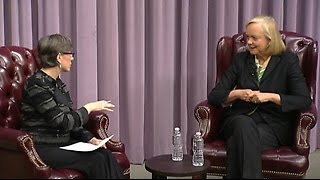
This content was created by GHION.AI . This content was uploaded by GHION.AI . This is a YouTube recording titled "Meg Whitman: Lessons in Situational Leadership [Entire Talk]" (created 2017-02-09). It is a public talk/interview with Meg Whitman and a moderator (labeled SPEAKER A) in front of an audience. Whitman discusses her experiences at eBay and Hewlett‑Packard (turnaround actions, culture change, leadership style), her run for California governor and public service, Silicon Valley’s relationship with government and global trade, diversity and hiring practices, and advice for students and early‑career professionals. The excerpt reads like a moderated presentation with audience Q&A.
Chapters
Nearly 80 years ago today, on January 1st, 1939. Bet you know that date, right? It was a time of great concern in this country. And two grad students in the school of engineering, Bill Hewlett and David Packard, who were introduced by their professor, Fred Terman, started Hewlett Packard. They built the company hp, and it became really pivotal in driving the technology and cultural norms of Silicon Valley and also the world. It's had a huge influence on all of us. And in fact, right outside this auditorium, if you turn right, you will see an exact replica of the HP garage where Bill and Dave started their company. Now, HP Enterprise is now run by Meg Whitman. She took the reins of HP in 2011, and her career before then was incredibly impressive. She's held senior roles at Disney, Procter and Gamble, Bain, hasbro, and spent 10 years as a CEO of eBay where she oversaw the growth of the company from 30 people and $4 million in annual revenue to more than 15,000 employees and $8 billion in revenue. She also ran for California governor in 2010. And today she's the president and CEO of HPRE Enterprise. Please join me in giving her a wonderful welcome. Today. We're going to get a chance to sort of look at the lines between the resume and get your insights on some really important topics. So let's start with hp. Yeah, you got to the company during a really interesting time. The company was really struggling to kind of find its feet, and you came in really to turn it around. Can you tell us about that process, your thinking and what you ended up doing?
Sure, absolutely. By the way, there's a couple more seats down here if people want to come grab them. Yeah. So I arrived at Hewlett Packard in the fall of 2011. In many ways, quite an accidental CEO, because I actually joined the board in March of 2011, and my friend and my board member at ebay called me up and said, hey, listen, you know, HP is looking for some new board members. It'll be so fun. You know, we'll be on the tech committee together. Nothing's going to go wrong. It's a well run company. It's 12 minutes from your house. This is going to be great. And I said, absolutely. And, you know, six months later, I was the CEO. And I came at a very difficult time for the company. I was the third CEO in three years. There'd been a fair amount of drama at the board level of this company. The company had begun to lose its way and lose confidence of customers, partners, employees, as well as Wall street. Because the previous CEO had missed earnings 2/4 in a row. And so I came in and you never quite know what exactly you're getting into. And I would say the situation was reasonably dire. And so we set about really creating a plan to get ourselves back in health. And the first was we had to go back to when you come into a company like I did, the key to this is not to come in with the list of the 127 things that need to be fixed. The key is, what does the company do really well and how do you do more of that? And that is the way to win hearts and minds. And frankly, it's the easiest way to get a company back on its feet. So we went back to founder DNA, and for all of you entrepreneurs in the audience, it turns out it's very hard to kill founder DNA. And this was a great thing for Hewlett Packard. So we went back to the core values of this company, which shone through 75 years later, interestingly enough. And even though there had been acquisitions and all these things, the founder DNA shone through very clearly. And it was innovation. What has been the differentiator of hewlett Packard for 75 years? It was putting customers first. This company has a history of doing anything for customers, sometimes at great expense, but fantastic customer focus that needed to be reignited. And then lastly, interestingly, corporate social responsibility. Bill Hewlett and Dave Packard were all about corporate social responsibility before it was a term and it was a thing. They were environmentalists before that was a focus. And so I went back to the core founding principles of the company and said, let's do more of that while we made our to do list of things we needed to do. And the first thing we needed to do was take out cost out of the company because the revenue trajectory was not in line with the cost structure. We needed to restore confidence in the customers and the partners. And so one of the very first things I did was look for symbolic value, which is one of the things I learned running for governor of California. And we can talk about that in a bit. But sometimes the most important thing you can do is something that's quite symbolic but symbolizes what you want to occur. And one of the things we had at Hewlett Packard was a walled off executive parking lot with barbed wire fences around the top like it was a prison or something. And then all the executives were in these wood paneled offices that looked like a bank in the 1970s. And there was guards outside the sort of executive area. And I said, you know, What? Let's tear down the executive parking lot and walk in the door just like everyone else. Let's get out of the offices into cubes and let's get the security off of our entrance. And I didn't need to write a memo on that. I didn't need to put it on social media. The whole company knew immediately that there was something different. So those are just some of the things that we did at the beginning.
Does HP's historical role in the Valley really play a role in your thinking about the strategy for the firm?
Well, yes, because one of the things I said, because people asked me, why did you take this job? I mean, after you have been the CEO of ebay, you. It's not clear to me that you should be the CEO of any other company. It doesn't actually get better than being the CEO of ebay. And it seemed to me that this was only downhill potentially. And I said, the reason I took this job is that Silicon Valley, HP is very important, I would argue, to Silicon Valley, to California, to the United States and the global community. We are the largest private employer in Costa Rica. We're one of the largest private employers in the Philippines, one of the largest private employers in Romania. So, you know, our footprint globally makes a difference to the world. And we thought it was important to sort of restore this California icon, this technology icon, to its former glory.
So let's talk about ebay and about what things you learned from that experience that, again, apply in your current situation. I mean, what are the differences and what are the similarities of these very different types of firms?
So I think you could not have found yourself in two more different situations. So when I joined ebay, as you mentioned, there were 30 employees, and the company was growing at 70% compound monthly growth rate. Can you imagine? Meaning February, the company was 70% bigger than it was in January. And so the thing there was to actually, how do you keep up with the growth? How do you figure out what is driving that growth and then do more of it and then try to mature the company, but only at the right pace. You don't want to put too much structure, too much procedures, if you will, in. In a very entrepreneurial company? And so how do you get things on track for an ipo, which we knew would happen in about nine months, and then how do you keep up with the growth? Hp, of course, was a very different situation. It was a turnaround. And as I said, we had to take out a lot of cost. We had to reignite the innovation engine. We had to change the culture at ebay, we actually had to cement the culture. So completely different situations. I am a big believer in situational leadership. You need to figure out what the situation is that you find yourself in and then you need to set your priority and your agenda and maybe even your leadership style to match that situation. And these were as too different situations as you can imagine. So you just take stock and you say, what's the most important thing to focus on? How do you win hearts and minds? And I had to win hearts and minds in both places because Pierre Omidyard, the 26 year old founder, when I arrived, you know, he was beloved by the 30 people that worked there. And how do you sort of insert yourself as a CEO in a way that you get support from the organization? There were 325,000 people at HP, but I had to do the same thing at just a bigger scale. So you have to figure out what the most important things are and then do your best job that you can. But there are some things that business is business. What are the customer needs? What's your value proposition to the customers? What's your financial architecture? And, and how do you have enough process and discipline in a big company, but also in a small company? I mean, when I came to ebay, the books were actually on QuickBooks and we had to sit around and figure out what the cost of goods sold was going to be, because there really wasn't any cost of goods sold. Right. And so we had to say, well, listen, certain amount of customer support is probably cost of goods sold. There's probably the technology and the cost of running the platform could be construed as cost of goods sold. So different challenges, but you just have to sort of figure out what the right thing to do is that will allow you to help that company be successful.
So I love the fact that you said your leadership style has to change and morph depending upon the situation. Can you describe what your leadership style was in each of those situations?
Yeah. So at ebay, really this was for me, you know, how do I integrate into this very rapidly growing company in an area that you have to remember, this was in 1998. I mean, the Internet was kind of a new thing in some ways then. And so how do you. Basically my view was I had to put my arm around Pierre Omidyar because he knew more about the Internet than I would probably ever know and I knew more about business than he might ever know. So one plus one had to equal three. And so my first thing was I'm all about enfranchising Pierre and making sure that he stays and that he can impart the product vision and frankly, the vision of the community that he had. That obviously was very different at Hewlett Packard because the founders were no longer there and the senior management team was in disarray. So the senior management team needed actually quite a strong leadership hand. Listen, this is how it's going to be. This is the rules we're going to play by and here's how we're going to work together, which was not necessary in the little company. So you just have to morph your style to what the situation is, and yet don't deviate from your core values of treating other people like you would like to be treated yourself. Always try to do the right thing for the company. What's the right thing to do, and then do that, because the core values of these companies are incredibly important. EBay, it's almost like parenting, setting the core values of this young child. And then at hp, we was bringing the core values that were the founding values back to the fore.
Well, fascinating. I know you also, we all know you also ran for governor. Now, what made you interested in public service? That is a totally different type of role and certainly different type of leadership. What inspired you to do that? And maybe why should other people in the room consider that as well?
Yeah, good question. So, so here was the view I had at the time that I had really a remarkable career. Thank you to California and thank you to Silicon Valley. I mean, I'm just a little middle class girl from Long island and ended up here running one of the great companies of the early Internet. And I graduated from Harvard business school in 1979. Only 10% of our class was women. And I was just afforded incredible opportunities. And I thought California played a big role in that. And I thought you might recall in 2010, California faced a lot of challenges. There was an enormous budget deficit. Both the current account budget deficit, because costs were more than revenues, but also an unfunded pension liability for all the public sector union employees in the state, which was really close to almost $300 billion. Our public school system. In 1956, the year I was born, our public school system in California was number one in the nation. Today it's number 49 out of 50 states. Our infrastructure was falling apart. There was a great deal of risk to the Port of Los Angeles and Long beach because of the new canal and the fact that the container ships were going to be going through the new canal, not necessarily into Long Beach. And by the way, the economic engine that the port of Long beach in LA is for the LA area is remarkable. So I thought, you know what, I can actually potentially make a difference here and so spend actually about two and a half years running for governor. And it was the experience of a lifetime. I have to tell you, I went to almost every county in California, from Humboldt county in the north to San Diego County. I met with all different people from across the state. And this state is remarkably diverse. For those of you who don't know, the Central Valley is actually more like Indiana and Iowa from a farming perspective. Southern California, way Southern. Like San Diego is actually in some ways like the Panhandle of Florida because of all the military down there, the Navy and all of that. Silicon Valley is unlike anything else. And then San Francisco's a big cosmopolitan city, not unlike New York in many ways. So it was an experience of a lifetime. I will tell you, it is the hardest thing I have ever done. I bet this movement from business to politics is much more difficult than one might imagine, really. And I will tell you, this notion of running a government more like a business is actually not valid. It's not valid because the government is not a business. And you cannot actually decide that unilaterally. You are going to do things without regard to the Congress and the Supreme Court and things like that. So I will also say that running for governor, running for office in today's world is a full on combat sport. It is constant combat. And I think to be successful in many ways you need to be wired for combat. And actually I'm not really wired for combat. I'm a much more of a consensus builder. And so that's the reason that litigators actually do very well as politicians. It's why so many politicians are actually lawyers schooled in litigation because they're good at arguing. And so I found it to be very difficult. And the last thing I would say is when you lose an election. And the good news is 5 million people voted for me. The bad news is 6 million people did not. But it's a very personal thing because when you're with a company or an organization or you're part of Stanford, it's you and that organization. When you run for office, it is a referendum on you. And it's actually, you know, like people didn't like you, they voted against you. And it's quite personal. And so it's hard to recover from that in many ways. And you know, part of the way I ended up on the HP Board, as I mentioned. So I lost the election in November. And it's a very difficult thing because the next day you wake up and you go from doing like 1,000 events a day, doing everything, you wake up the next day and you have nothing to do, and your friends do not call you because they feel so bad for you. And so it was very tough. November, December, January. I'm hanging out in my family room at 4 o' clock in the afternoon watching Ellen DeGeneres. And my husband, who is a neurosurgeon at Stanford, came home early that day from work and he sees me in the family room watching Ellen DeGeneres at 4 o' clock in the afternoon and he goes, oh, this is really not good. This is really not good. You need to pull up your socks and like, go figure out what you're going to do. And as if on cue, Mark Andreessen called that very afternoon asking if I'd like to be on the board.
Yes. So being in government and public service is this combat sport. Why should people think about doing it? I mean, it's obviously governing is really, really important. How do we motivate people to get involved in a way that's going to be meaningful? I mean, now more than ever, we really need to do that.
So I think, listen, it is incredibly important. What the government does is it sets the environment for the rest of us to be successful, for Stanford University to be successful, for Hewlett Packard to be successful, for the startup community to be successful, for the Red Cross to be successful. And it matters who runs. And so I would encourage all of you to think through your career aspirations, what you're interested in doing and where you can make a difference. And think about running for city council, thinking about running for school board, think about running for Congress, think about running for state senate, state assembly. And my recommendation is that you start at an office level that you can work your way up. I mean, I actually went from zero to governor of California, which is, if it were a separate state, a separate country, I think most of you know, it would be the seventh largest country in the world. California would be the seventh largest country in the world. And that was probably a mistake. You know, if I had it to do over again, maybe you would run for Congress or you'd run for state senate, or you run for state treasurer and you'd sort of, you'd get into this new arena. Because I would say campaigning is entirely different than being in business, entirely differently. We are trained in business. When an investor asks us a question, Or a customer asks us a question, we answer it forthrightly, straightforward. And that's not actually what politicians do. There's a reason for that, that you have to be quite careful what you say. Because actually, depending on what you say, there's huge sections of the population that you may alienate and you have to build. And that sounds really disingenuous in some ways. It's in fact not because you've got to build coalitions that you can put together to win the election and then try to work on governing. So it's a. I'd say you all should think about it. I mean, it was a remarkable experience. And frankly, it made me a better CEO. It really did make me a better CEO. And I'll give you an example. I have a much tougher skin than I did before I ran for governor. And you can't help it. After two and a half years of being shot at, you end up getting a thicker skin. And when I was named the president and CEO of Hewlett Packard, the press was not great. Some of you may remember this. Meg is a consumer technology gal. She doesn't know anything about the enterprise. She ran a small Internet startup to 8 billion in revenue. But this is $110 billion company and the press was really not good. You should go back to Google and look at it. And it happened that the day I was named was a board meeting. And so that morning we all come into the board meeting and I'm reading the newspapers and some others are reading on their tablets and the board feels really badly. They're like, oh, Meg, this press. We feel so bad. We talked you into doing this. We feel so bad for you. I'm reading the press and I said, this is the best press I've had in two and a half years. This is all good all the time. So it's just a matter of your, you know, your perspective. And I will tell you also that communicating to large groups of people in a campaign or at a very large company like Hewlett Packard is actually a skill. And if you watch politicians, they do a number of things. It is not about the left brain. It's not about the facts and the figures. It's about the stories you tell. And so when I came to hewlett packard with 325,000 people, 80,000 contractors, seven major lines of business operating in 170 countries, there's no way you're going to win hearts and minds by diving into the left brain and telling people about the cash flow and the Operating income and the return on invested capital, those are important. But when you're trying to rally an organization to a mission, it really is about the stories you tell. And I learned that campaigning, that's really fabulous.
So we have this really interesting situation, right, where you said, what happens in the government affects us dramatically. And yet there seems to be right now a real impedance mismatch between what's happening in Washington and Silicon Valley. How do we deal with that? And what is the relationship with Silicon Valley and Washington going to be going forward?
Yeah, so I think we are in a somewhat unprecedented time. In my adult life, I've never seen anything quite like what is happening. And so all the rules that we used to play by are to some degree upended. So at ebay, when we were focused on what. So ebay was a very interesting case study because ebay created something that never existed before. Okay. So before ebay, if you were a collector of Civil War memorabilia, you would go to antique shops in your arena, in your area, but you would not be able to do that on a global basis. What ebay did is create an efficient market where there was no efficiency because you had no visibility into whatever you were interested in. And it became a national and a global marketplace. So we were creating something that had not existed before. There was no land based analog for ebay. And so when that happens, you are actually creating situations where new laws have to be made because the regulators are thinking about regulating something that they don't know, they don't understand. PayPal was another example of that. When we expanded PayPal to other countries, often there were three different regulators trying to figure out who got to regulate PayPal. So we would go to Washington, we would engage in the legislative process to make sure that the people who were making the laws understood what our issues were. I'm not sure that's exactly how we would go about that today. So I think we have to watch and see how this settles out, because right now we're in a flurry of executive orders. In the end, there is much that can be done by executive order, but there's much more that will have to be done through the legislative branch, the Senate and the House, and then there will be challenges in the court that may go all the way up to the Supreme Court. So I think we're in a bit of an unprecedented situation here. But I would also say that we have an obligation as a tech community and Silicon Valley to make sure that we make our views known when we think something is not right either not right from a values perspective or not right for our businesses or not right for our community. And I think the most recent example, of course, was, you know, the immigration ban and the sort of spontaneous demonstrations at the airport. I think you've seen virtually every tech CEO make a statement of some kind about how this is not in keeping with what has made this country great. And in particular, you know, the entrepreneurs in Silicon Valley, you know, I would say many, many, many entrepreneurs. I don't know the exact number, but it's got to be more than half immigrated to this country or are first generation immigrants. And so that's an important thing to keep in mind. So I think we have an obligation to make sure that our views are known in a situation that is, shall we say, fluid.
Yeah, it's really complicated. And I think one of the things that's really interesting is the relationship between not just Silicon Valley and Washington, but Silicon Valley and the rest of the world. Maybe you could talk a little bit about that. I mean, obviously we do a lot of outsourcing to other countries. We bring a lot of things in from all over the world. How is that? How do you see that changing in the short term and the long term?
Yeah, so I'm not entirely sure, honestly. I mean, part of the challenge that we have right now is it's not exactly clear how this is going to unfold. And so I think we just have to watch and see what happens here. Our belief, and my belief personally, is that actually global trade is part of the essence of the United States of America. That if you think about our business, we manufacture in a number of different places around the world. We ship to all different countries. The supply chain for the tech industry, not so much, you know, obviously the non existent supply chain of a Facebook or an ebay, but the supply chain of companies that make products has been built up over five decades and actually exists for the most part in Asia. And so we have to be very thoughtful in even if we were to assemble in the United States, if the supply chain is not in America, and the current thesis about what the tax regulation could be is it could be very detrimental to companies. And my view is that actually economic globalization is totally the right thing for this country and it has left some people behind. There is some dislocation. We should be helping to retrain and helping very much to help those individuals who've been displaced by global trade. But the truth is, and most people understand this, is that most of the jobs in the United States in manufacturing have not been lost. By global trade, they have been lost by automation. And so you can shut down global trade and you will not actually stem the job loss. So I think there's other policy decisions that need to be undertaken to help the people that have been out of work or underemployed. And if there is a good outcome of this election, I would say that it has shone a spotlight in places like Toledo, Ohio, you know, Upper Peninsula in Michigan, different places in Pennsylvania where people have not seen the economic growth that we have been fortunate enough to see here. And actually that's a great wake up call for the country. And I think there's lots of different ways of going about solving that problem.
Great. So I think one of the issues people think about is American competitiveness and whether we are really need to think about what we need to do to stay in a strong position. Do you see that shifting? And is it something we really have to worry about as the world gets smaller?
So we have to worry about American competitiveness? I think for much of the last century we had undisputed competitive position in the world. But think about what has happened in the last three decades. The world has become flat in the world of Tom Friedman. There are other populations around the United States that can do things cheaper and more effectively than we can. And I'm not sure that that's necessarily a bad thing because then we need to continue to invent and continue to invent new industries that employ the next generation of people. And so my view is we still are the most competitive nation in the world in terms of innovation. I mean, think about what we invent here, what is invented in other parts of the world. This is still, we are innovators at heart and we still lead the world. That is not an assured thing. Right? I mean, you think about what's happening in China and other places, that is threatened. And so we need to make sure that we are doubling down on education. By the way, I think our higher education system in the United States is still second to none, but our K12 is not. And it's not just California, it is the entire country. And we need to fix that. And we need to make sure that we encourage people of all backgrounds and races and genders to focus, I think if you have an aptitude for it, on science, technology, engineering and math. Because we are at the beginning of the revolution of science, technology, engineering and math, even though we're 50 years in. So I think we cannot take for granted. We've got to have, listen, I am for tax reform here. Maybe not the one that's being put forward. We'll see what happens. But we do have to have competitive tax rates. I think we do have to have R and D tax credits. I think institutions like the National Institute of Health, you know, like darpa, I mean, these are really important things that need to get funded and need to be at the forefront of American competitiveness.
So let's see, switch gears a little bit here. You are this very successful woman in a very high tech world and we hear a lot about gender issues and diversity and the challenges that women, especially young women, have finding their place in that world. What are your thoughts? Is it really a problem? And if so, how do we think about going about fixing it?
So I think it is a challenge. I mean, if you just look at the gender diversity and frankly the racial diversity in Silicon Valley, I mean, I actually think Jesse Jackson was right when he called this community on the carpet two and a half years ago. He was right. But it is not an easy fix because what has to happen is the pipeline of kids coming UP, K through 6, 7 through 12, university graduate school, has got to more accurately reflect the community. And if you don't, I'll just take women for example. Most young girls drop out of a science and technology and engineering math background in middle school. And if you don't hang on to them in middle school, they don't come back in high school and they don't come back in college, in which case you have an engineering school, you know, that is not representative from a gender perspective or other. So I think there's a lot of encouragement and not hand holding, but just encouragement and making sure that everyone has an understanding of what the opportunities are in front of them. Because listen, engineering's hard, right? We're in the school of engineering here. Engineering is hard and you kind of have to gut through it in many ways. So I think there's lots to be done. I think the other thing is that we have to, you know, there's the Rooney rule, which is when you are looking to hire someone, you've got to have a diverse state of candidates. Because if you don't work on a diverse state of candidates, you end up with a non diverse population. And I'll give you a perfect example. When we split Hewlett Packard, I think most of you know, we split the $110 billion company into two companies each, each $50 billion. There were two Fortune 50 companies inside HP. Can you imagine? And so the board had to split. Basically eight board members went one way, four Board members went the other. So we were on a hunt for new board members and we had to work quite hard to get diversity of gender, race, ethnicity on these two boards. And I decided that we were going to actually manage that. We were just not going to let it happen, but we had to manage it. And you know, for example, it was very difficult for us to find Latino board members. And finally I said to the headhunter, remember headhunters? And I love headhunters, executive search firms, they perform an incredible service in our economy. But remember, a headhunter makes money by having the shortest time. From initiation of search to finalization of search. If a headhunter assignment goes on for nine or 10 months, the company's probably losing money on that search. Right. So the objective is, how do you do the search as fast as possible? Well, the easiest thing to do is just go to your database and serve up the people who are already in your database. That doesn't usually yield the candidates you need. So we had a very difficult time finding appropriate Latino directors. And I finally said to the headhunter, I said, you know how there's that women in business list, the 50 most powerful women in business. There must be a list of the 50 most powerful Latinos in business. Let's see, start at the top and start calling. And so actually then we ended up with a great group and frankly, the boards are stronger today than they were before, and they're stronger because of this diversity. So sometimes you have to manage it and sometimes you have to be quite prescriptive to the headhunter. And I was not going to hire someone who was not as qualified or anything like that, but I wanted to see the full breadth of who we had.
So that was wonderful. You were obviously engineering the board based on those goals. What other ways do you engineer the culture at hp? I mean, it's something I'm personally very interested in. What are the levers you have at your disposal and how do you pull them?
So probably most of you know, and you know this, that changing culture at companies is the most difficult thing that you do because cultures are very entrenched. And particularly for a 75 year old company or now an 80 year old company, I mean, this is really difficult. I will tell you. It was also pretty difficult even with 30 people at eBay. You know, it's easier because you can manage by walking around and you can see everyone. But it's the most difficult thing that we do. So my view is we have to have what are the key things that we're going to stand For. And we talked about that before. Innovators at heart, corporate social responsibility, and we'll do anything for customers. And then you have to say, what are the things that are getting in the way of us being a great company? And for Hewlett Packard, one of the things getting in our way was sense of urgency and jumping on the problems. And I think it's because, listen, when customers have problems or there's hard problems to be solved, sometimes people back away from those challenges. You know, who wants to go see a customer that's, you know, not particularly happy with you? But if you run to the fire, I promise you, these problems do not get better with age. It's not like fine wine. You've got to run to the fire. And so we had a couple of things that we really focused on. Run to the fire was one another was escalate the problems in 24 hours and resolve them in 48. And we gave permission to escalate. Right to me. And the culture was not a great thing to escalate over your boss, because your boss would not be happy that you had told your boss's boss that there was a problem. We had to completely change the culture, which is, if you did not escalate, then that was the problem. And this is now washing nicely through Hewlett Packard because we didn't punish people for escalating. We actually celebrated them. But I will tell you, this takes time. I was probably at Hewlett Packard for almost two years, and we'd been talking about this, talking about this, and we were making progress. And then I went to visit Hewlett Packard in Poland, and I'm sitting in a group like this with all our HP employees who were still looking at me like the company had looked at me back in the fall of 2011. Yeah, I'm not sure about this. And so, you know, they. It was interesting. So a fellow raised his hand and he said, you know, that whole escalate in 24, resolve in 48. I just think escalating in 24 days and resolving in 48 days isn't the right thing to do. The pony express had not gotten to Poland. Okay. By the time this got to Poland, 24 hours and 48 hours had turned into 24 days and 48 days. I mean, can you imagine? And so repetition is a really good thing. I mean, someone told me not too long ago, the prayer does not get boring with age. It does not, you know, with repetition. The prayer does not get old with repetition. So repetition, as you're trying to change a company culture is super important because you find pockets of people like HP Poland who hadn't actually gotten the message quite accurately. So it's repetition, it's focusing on a small number of things. I am a big believer in the three bucket theory. People can remember three things. They cannot remember 10, they cannot remember 16 initiatives. They can remember three things. And so as you think about changing culture, what are the three things you're going to focus on? And then when you go done, you can go the next three. But if you sort of have a list of let's do 16 different things and change 16 different values, it just gets lost in the wash, honestly.
So we have a lot of people in the room who are looking at you sitting here and thinking, wow, I would love to be in a leadership role like this at some point in my life. And the types of roles that they're thinking of as they're getting out of school are product management and management consulting. And you had these roles when you started your career. Can you talk a little bit about the types of things you learned and gained from those experiences and how those influenced you as you moved through your career?
Sure. So one of the things that I think I was taught by my parents was when you think about going to college, go to the best college that you can get into. When you think about going to graduate school, get into the best graduate school you can. Okay, you guys did that check. When you think about joining a company or an organization or a law firm or whatever, I think it's true. Go to the best company that you can get a job at. If you don't want to go to a startup. And I'll talk about that trade off in a minute because. So I went to Procter and Gamble, which was my first job out of college, which was in Cincinnati, Ohio, which was not exactly my dream city. But for what I wanted to do, which was marketing, it really is and still is in many ways the best marketing company from a traditional perspective in the world. And I learned things at Proctor and Gamble that I still do today. It was almost a graduate degree in marketing and product management and I learned tremendous amount there. One thing I learned was do the very best job you can at the assignment that you are given. So often when you come out of particularly MBA school, I think you have a bit of an exalted view about what you should be doing. And my first assignment at Proctor and Gamble after I got my MBA from Harvard was I was assigned to a test market shampoo brand called T4 which turned out to be Ivory shampoo. You will notice that there is no Ivory shampoo. So we know where this ended. But the assignment as a brand new, newly minted Harvard MBA was, how big should the hole on the size of the shampoo cap be? I'm sitting there going, oh, man, this is really not good. I'm sure they have people who know the answer to this question, why am I being asked to do this? And I thought very seriously about going to my brand manager, my boss, and saying, this is really a dumb assignment, and I'm not doing it because there's someone at this company who must know the answer to this question. I decided that was not really the best strategy. So I said, you know what? I'm going to do the very best job that has ever been done at the Procter and Gamble company to figure out how big the hole in the shampoo cap should be. I did quantitative research. I did qualitative research. I interviewed customers. I went nuts, and I wrote the best memo. Because in those days, that's how P and G communicated. I wrote the best memo that's ever been written on this. And they said it was really fabulous. And then I asked my brand manager, I said, but you knew the answer to this question, didn't you? You must have known the answer to this question. He said, of course we knew the answer to the question, but we wanted to teach our new folks how to get things done in the environment. And the key lesson that you got in this memo was when faced with the choice of a consumer who prefers a smaller hole in the shampoo cap, but that means the consumer uses less shampoo, which isn't as good for the company. Which choice do you make? And of course, the answer is you make the choice on behalf of the customer. Because in the end, if you make the choice on behalf of the customer, it works out best, maybe in the longer run for the company. And that was the lesson they were trying to teach me. So, you know, just be. Just put your head down and do the best job that you can do. And if you're an MBA student, do not be thinking about what your next job is. Think about doing this job really well, whether it's coding, whether it's finance, whatever it is. And that has stood me in really good stead. Just put your head down and get the work done. And be fun to work with, be easy to work with, be enthusiastic. Listen, I select executives all the time for roles. And if I have two individuals who are equally qualified, equally delivered the result, and One. One is enthusiastic and glass half full, and one is kind of a bummer. I picked the enthusiastic one because it's, like, way more fun. And so think about the enthusiasm. Enthusiasm in life, I think, goes a long, long way.
So in a minute, I'm going to open up for questions from the room so you can think about the burning questions that you have from Meg Whitman. So if you could go back to school and you were sitting in the audience here and you were an undergrad or grad student, what do you wish you had known? What do you wish you had done differently? Obviously, things have worked out pretty well, but is there anything you wish you had known or done or learned when you were at that stage of your career?
Yeah. So, you know, hindsight is 20 20. Right. But I think what I would, if I knew how the world was going to unfold and what I would, you know, the environment I would be here in Silicon Valley is I would have been an engineer and I was an economics major, and I would have forced myself to be an engineer because I think it would have stood me in good stead to run these technology companies. And I probably would have tried to be a computer science engineer, given what I ended up doing. So that'd be the number one thing I would change. The number two thing I would change is I went directly from undergraduate school school to business school, and I finished business school at 21 years old. And frankly, what I should have done is graduated from Princeton and gone to work for three or four years before I went back to business school, because a lot of business school just went right over my head because I had no basis of experience, but I got in, my father could pay for it. And interestingly, what my father said to me, he said, listen, Meg, if you go today to business school, coming out of business school, particularly as a young woman In 1979, let's remember this, you will actually get a better job than you will coming out of undergraduate school. So this is going to be the right trade off for you. And he was not wrong, actually, he was not wrong. But I do think that probably, you know, I would have gotten more out of Harvard Business School had I had some work experience. So as you think about your career and what you want to do and you think about going to grad school, I almost think almost any grad school you want to go to, actually just a couple of years of work experience in the real world, understanding who's doing what to whom and how it works is probably good advice. And listen, many of the Business schools are not even letting people in without work experience. But if they let you in, I would take a deferment and go work.
Great, thank you.
Those are two things that I would say.
Very helpful. All right, any questions? Yes, back there, please stand up.
So you talked about automation and how it's taking more jobs away than global trade is. How do you see us coming up with a solution for that? Because obviously it's a huge problem. So the question was, you talked about automation taking away more factory jobs and things like that than actually global trade. And what do you do about that? So listen, I think this is only going to accelerate and we got to figure out from a policy perspective what we want to do. So think about the self driving semis. This company, Auto, that Uber has bought. I think in maybe five to 10 years, most of the trucking jobs in the United States will be driven by autonomous driving semis. There is a very significant percentage of men in the United States with a high school degree who drive trucks. I'm not sure the exact number, but I'm going to say I think it's like 15%. I mean, it's a big number. And those individuals will be out of a job. So what do we do? And my view is as a country we have to think about what are the next generation industries that we want to own and how do we create centers of excellence such that. That is, these are the next American industries. And I'll give you an example. 3D printing, AI, robotics. Listen, precision manufacturing. That industry is not owned by the United States today. It's owned by Germany. If you go into almost any factory and you look at the factory manufacturing tools, they are made in Germany. That did not have to happen. Germany does not have labor rates lower than us. They just decided that this was something that they were going to own. And I think the United States now needs to say, what are the next generation industries and how do we make sure that they not only get started here, but they grow here? And then how do we train a workforce of high school educated people? Because not everyone is going to go to college to be in those industries. By the way, quality assurance is not a job code. QA is not a job that you actually need an engineering degree to do. You can train people to do quality assurance testing. You can train people to do a lot of these jobs in the context of apprenticeships, of community college, of frankly changing to some degree the high school curriculum in the United States. I'm going to come back to where I started on this. The Education system in this country has got to change to marry where these industries are coming from. And if we don't marry the future industries with our current education system, we're going to end up with an even bigger dislocation. And this is not easy, by the way. This is super not easy. But I think it's doable. If you take a long range plan on, okay, what are the industries we want to own then? How do we create a workforce that will own them? I think the inventors are already here. They're probably in this room. But the folks that are graduating from high school without an advanced degree, how can we help them be successful in these new industries? There's one other problem here, which is the geographic dislocation. So AI robotics, 3D printing are likely not going to go to some of the locations that the jobs have been lost from. They're probably not necessarily going to be outside of Toledo, Ohio or outside of some of the smaller rural communities. So how we figure out that challenge I don't have an answer to, but we have to figure it out because the jobs are not necessarily coming back to where the people used to work at a steel mill or a Ford Motor Company plant or whatever.
So I just want to double click on a piece of that of long range planning. Do you think of the ethical consequences of the technology that we're developing now? Because there are consequences of whether it's autonomous vehicles or AI or virtual reality. And these are things that you probably think about from a perspective at HPE is. And do you think about what the ethics are and the consequences of this, of developing?
So we think about the ethics in terms of privacy, in terms of that kind of thing. You know, listen, singularity is a super challenging ethical dilemma. What we don't think about is the march of technology. I mean, autonomous driving vehicles are happening whether we embrace it or we don't embrace it. It may happen in some other country, but it's happening. AI is happening, robotics is happening, 3D printing is happening. And I don't think you can ever be in front of that, you know, trying to stop technology or stop progress because you're trying to solve some other problem. You've got to solve the other problem in the context of where technology is going. And if we haven't learned anything in the last 50 years, we have learned that.
Right. It's interesting to think about. How do you bake in thinking about the consequences? You know, if we had thought about the consequences of cars and pollution and urban sprawl, we might have Done things differently.
Absolutely. So you got to think about it. And you know, often Republicans say that you shouldn't think about what industries this country needs to own and stand for because it sounds like managing the economy. I think that's actually I'm a Republican, but that happens to be wrong, I think, because if you are not planning this, then like it sort of happens, you know, if you don't know where you're going, anywhere will take you. And this is a big problem. We have to think through the long term effects of what we want to own, how we want to do it, what that means for the education system, what it means for, you know, any number of other policy perspectives.
Right. Another question. Yes, back there.
Please stand up. So the New York Times has argued that presidential campaign is the ultimate startup. Did you find that to be true of a gubernatorial campaign? And how did it relate to our traditional conception of a startup?
Yeah, so please repeat it.
So the question he asked is, did you think of the president, I think said that presidential campaigns are the ultimate startup. And did I feel like the governor's campaign that I ran was a startup? So, yes, I mean, in some ways, because when you start the campaign, there's no employees. I mean, there's nothing. It's like you and an idea. And so you have to quickly build this organization. You've got to figure out campaign policies. I mean, when I ran for governor, what did I know about education policy in California, what did I know about water policy in California? You have to learn all that and you actually have to have a point of view on this. So it is in some ways a very rapid startup. The difference is that there is a well worn path for how to do this. Okay, so when Pierre started ebay and I joined him at the very early days, we actually, it was totally unbroken snow. We didn't actually know there was no paradigm. When you run a campaign, there is at least a paradigm of other people who have run campaigns. So you can learn from that, you can hire people who've been on other campaigns, but from a, you know, a startup, like hiring people, getting an engine in place, you know, it's a startup and then when it's over, it's over. And so in some ways it is like a startup, but there are people who've done it before. And frankly, if you run for office, if you start at the city council level and then you're running for senator, you know, you've got some history.
Do you think that game is changing?
Well, I have to say this most recent Election. I have to say, every law of politics, as I understood it, was upended here. And I don't know whether this was the candidate, the time, what actually changed everything here, but this was unprecedented. I think I used that word before. I've never seen it in my adult life. I've never seen anything quite like this. And so I don't know if this is the new normal or this was an aberration or there's so many things that have happened, you know, in the country in the last 25 to 30 years where all the chickens are coming home to roost. I think there's more work to be done to think about that.
Great, thanks. Another question.
Yes. You talked about HP's corporate social responsibility as the largest private employer in Costa Rica and Philippines. On. And you're also. HP is also based in a company where the president is calling for America First. So I was wondering what you think about the balance would be and how you plan to balance it. Yeah, so the question. Oh, sorry. So he said you talked about HP's corporate social responsibility and the fact that we are the largest private employer in many countries, and how do I balance that with the president's America first mantra? So I actually believe that if we do the right things in the communities in which we do business and we are good corporate citizens and we provide great employment opportunities in many countries, that actually, that builds the strength of Hewlett Packard right here in America. And the two are not mutually exclusive. In fact, they are doing good business outside the United States, makes Hewlett Packard is an American company stronger. Ebay was a totally global company. And actually the work that we did with eBay, Brazil, eBay, China, eBay, which eBay in every single European country, made more jobs and made the United States stronger. So I think these things are not. One is. It's not a choice, actually, they work together. And my view is the world has become totally global. I mean, again, you know, if you think about the advances of technology, this world is entirely interconnected. And this notion of the unintended consequences of policies. You need to think this through. Do you remember that game that I played as a child? Many of you did you know, the thigh bone's connected to the leg bone. The leg bone's connected to the knee bone. The knee bone's connected to the hip bone. Listen, this whole thing is connected. So if you are to put a tariff on goods coming out of Mexico into the United States of 35%, that's not the end, okay? That is the beginning of A ripple effect that you have to think through before you decide that that's a good policy. Because if you put a 35% tariff on that means that most retailers in the United States who import many of their goods from Mexico and other places, the prices of those goods go up, which means the consumers that you're trying to help are actually hurt because the T shirt that you used to buy for $9.57 now becomes $18. And if that happens, then what happens to retail employment? What happens to, you know, the pocketbook of Americans who used to walk in and be able to buy a blender for $26.27? That blender is now $50. So there's all these unintended consequences that we really need to think about here. And it is no question, it is a global economy. And as I said before, the supply chain for certain industries has absolutely moved to Asia, and that's okay. And that's actually a good thing. And to recreate that supply chain in the United States, I think is not the right answer, but we'll see how it pans out. What value does the vision of HP provide to shareholders? And how does that contrast? Like IBM, it keeps all their services, all their servers and software in house. So are they, like, outdated? Is this the new model or so? So, oh, the question was, how does you know, how does HP's values sort of connect to Wall street and how we serve the shareholders? And how do we differ from IBM? I think is the question the vision of hp. The vision of hp. So listen, we have any number of constituencies here. We have employees, we have customers, we have partners, we have the Street. And by the way, we have regulators and governments around the world who are very much part of our overall constituencies. And we have to balance the needs of those constituencies. And there's no question that we have to return to shareholders. Shareholders own our company, and it is not a private company. And by the way, Hewlett Packard is owned by lots and lots of individuals, not just the big funds like Fidelity and Vanguard and Babcock. So we have to provide a return to those investors. And so we try to balance that. I think you asked a question about how we compare to IBM. So IBM is largely out of their infrastructure business. So they sold their PC business to Lenovo. They sold their server business to Lenovo. They have a small storage business. They still have the mainframes, of course, but they are largely a services and software company. And they ultimately decided that infrastructure was not something they wanted to be involved in. We have actually doubled down on infrastructure. Not only the traditional data center infrastructure, but the software defined infrastructure. And as we think about where our people should be located around the world, we want to do it in areas where there's a match between what people can do and where the lowest cost is. And we try to balance that. So I would actually argue that probably IBM and their service business has as many people in places like the Philippines and Bangalore and other places as many, many other services companies do. Because the way services companies do their business today is they run out of centers of excellence. And IBM has centers of excellence in all the traditional low cost locations, much like HP does and Aptos and T Systems and of course the Indian sis.
So I'm going to ask the last question.
Sure.
So what final sort of advice might you have for all the young people who are listening who are inspired to be entrepreneurs and entrepreneurial in their careers?
Yeah. So I think you have a choice. When you leave school, do you want to go right to a startup or do you want to, if you will, go to an academy company where you can learn some of the basics? And I think it completely depends on your opportunities. And listen, we hired a number of undergraduates and graduate students who their very first job was ebay, when ebay was a tiny little company. And that worked out really well for them. In fact, one of my most senior finance executives I talked out of going to Stanford Business School. He was a summer intern and I talked him out of going to Stanford Business School and staying at ebay turned out to be financially a great decision for him. So I think you have to figure it out. You have to remember that I'd give people a couple of pieces of advice. One is I think you need to check the person that you're going to be working for. Okay? Your biggest influence as you leave school is going to be the person you work for. Do they share the same values? Do you think they're going to be a good mentor and help you learn? Your job in your first five years out of undergraduate school or graduate school is learning. And that is going to be largely driven by who you work for. So whether you go to a startup or you go to a big company or academy company or whatever, find someone you think you're going to learn a lot from. The second is, do you think the company is something that you enjoy? Do you like the mission? Do you feel like this is a group of people you want to do things with? You are going to spend a lot of time at work? I mean, in my Career. I have spent a lot of time at work, probably more time with my husband than my husband, with my husband, and. And probably more time in many ways with my kids. And so you really need to enjoy the people you work with and love the mission of the company. And then the last thing I would say is do something that you really like. And the first couple of years out of school, you get to decide, okay, maybe you're going to start out coding, but you don't really like that you'd like to do something else. Maybe you start in finance, but you really decide you'd like product management. You start out in product management, but you actually think it's better to do strategy. So in your first five or six years, you've got lots of chances to try things out. You should try things on for size and see what you think. And then the last thing is, the one thing that you have in your career is your reputation. What do you stand for? Howard Schultz, who is the founder and CEO of Starbucks, sat on my board at ebay. And we had one very difficult decision that we had to make. And I'll tell you that decision back at ebay, the we were really run by largely a libertarian perspective. If the item or the category of goods was legal for sale in the country in which we were doing business, then it was legal for sale on ebay. And Howard Schultz came to one board meeting and he said, you know, Meg, I'm deeply concerned that there is Nazi memorabilia for sale on ebay. So it turns out that Nazi memorabilia is perfectly legal for sale in the United States. It is not legal for sale in Germany. It's not legal for sale in France. It's not legal for sale in many countries, but in the United States, it is legal for sale. And so Nazi memorabilia was legal for sale on ebay. And he said, meg, I just think this isn't the right thing to do. And Pierre Jeff Skoll, who was Pierre Omidyar's co founder, actually took the opposite point of view. He said, but it's a slippery slope. You know, if you ban Nazi memorabilia, then what's the next thing that you have to ban? And what does that lead you into? And Howard said, I don't know. I know I can solve this problem. And he looked at me and he said, meg, what do you want the character of the company to be? And in the end, we decided to ban Nazi memorabilia. We decided to ban firearms, tobacco, alcohol. I mean, we then got into a situation of making judgment calls about things that we wanted to ban. But the guiding principle is, what's the character of the company? And it was an incredibly instructive lesson for the company, and it set us on an entirely different path. I'll give you another example. In the early days of ebay, there was something called the Digital Millennium Copyright Act. Probably some of you know that the law states that if you have a very large site with lots of things on it, if you police the site, you are legally liable for the things that appear on your site. If you do not police police the site, you're good to go. That anything that shows up on your site, you exercise the Digital Millennium Copyright Act. In the early days of ebay, there were bootleg copies of video games that were appearing on the site. And there was one particularly that had escaped one of the big video game companies, laboratories, called Cop Killer. And I got called in front of the CEOs of all the video game companies, and they said, meg, you've got to put police the site. You know, we can't have Cop Killer on the site. This is not something that we, you know, think should be out there. And I said, well, you know, the digital. The Digital Millennium Copyright Act. I went back to the board that afternoon, I explained the situation. I said, but, you know, we can't really do anything about it because of the Digital Millennium Copyright Act. And then again, you know, the board said, meg, what's the right thing to do here? What's the right thing to do? And someone also said, you can't let the lawyers run the company. And so that afternoon, and I looked at Pierre and he said, gee, this is a tough one. I mean, you know, this is a tough one, but do what you think is the right thing to do. And so that afternoon, we actually started policing the site and took off all the infringing, illegal items like that video game. So I only give you those two examples because in the end, who you are, what you stand for, when the going gets tough, do you do the right thing? And I would encourage you to do that, because while it may be inconvenient, while you may lose your job, while you may have to leave the company you're working for, in the end, it is who you are, and it is your reputation. And the only thing you take with you through your career is your reputation. And the people that you meet on the way up are the same people you meet on the way down. And so I think the other last bit of advice, in addition to character, is, you know what? Treat other people like you would like to be treated and always extend that helping hand because it will come back to you. And honestly, you know, you have ups and downs in your career. And honestly, the people you meet on the way up are the same exact people you're going to meet on the way down. And just remember that because how you treat people, you know, when you've had tremendous success, arrogance, presages of fall. So thank you.
This was so wonderful.
Please join me in welcoming. Thank you.
More from GHION.AI


O processo de reconhecer limites, mesmo quando a vida parece exigir sempre mais.





Depois de tantas histórias, aprendizados e pausas necessárias, o @interior_iza está de volta



