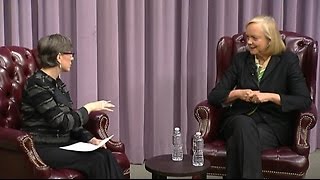
In this talk, Meg Whitman argues that government and politics set the environment for success across institutions—from universities to corporations—and urges listeners to consider public service as a career path. She recounts her own trajectory from a business executive to Governor of California and back to CEO of Hewlett‑Packard, emphasizing how campaigning taught her skills that made her a tougher, more effective leader. Whitman contrasts the straightforward communication style of business with the nuanced, coalition‑building rhetoric required in politics, noting the need to craft stories rather than just present data. She shares a personal anecdote about handling negative press when she became HP’s CEO, illustrating how a campaign‑honed perspective turned criticism into motivation. Throughout, she stresses the importance of storytelling, building coalitions, and developing a resilient mindset for leading large, complex organizations.
Chapters
What the government does is it sets the environment for the rest of us to be successful, for Stanford University to be successful, for Hewlett-Packard to be successful, for the startup community to be successful, for the Red Cross to be successful. And it matters who runs. And so I would encourage all of you to think through your career aspirations, what you're interested in doing, and where you can make a difference. And think about running for city council, thinking about running for school board, think about running for Congress, think about running for state senate, state assembly. And my recommendation is that you start at an office level that you can work your way up. I mean, I actually went from zero to governor of California, which is, if it were a separate state, a separate country, I think most of you know, it would be the 7th largest country in the world. California would be the 7th largest country in the world. And that was probably a mistake. If I had it to do over again, maybe you would run for Congress or you'd run for state senator or you'd run for state treasurer. And you'd sort of get into this new arena. Because I would say campaigning is entirely different than being in business. Entirely differently. We are trained in business. When an investor asks us a question or a customer asks us a question, We answer it forthrightly, straightforward, and that's not actually what politicians do. And there's a reason for that, that you have to be quite careful what you say because actually, depending on what you say, there's huge sections of the population that you may alienate. And you have to build— and that sounds really disingenuous in some ways. It's in fact not because you've got to build coalitions. That you can put together to win the election and then try to work on governing. So it's a— I'd say you all should think about it. I mean, it was a remarkable experience. And frankly, it made me a better CEO. It really did make me a better CEO. And I'll give you an example. I have a much tougher skin than I did before I ran for governor. And you can't help it. After 2.5 years of being shot at, you end up getting a thicker skin. And when I was named the President and CEO of Hewlett-Packard, the press was not great. Some of you may remember this. Meg is a consumer technology gal. She doesn't know anything about the enterprise. She ran a small internet startup to $8 billion in revenue, but this is a $110 billion company. And the press was really not good. You should go back to Google and look at it. And it happened that the day I was named was a board meeting. And so that morning, we all come into the board meeting, and I'm reading the newspapers. Some others are reading on their tablets and the board feels really badly. They're like, oh Meg, this press, we feel so bad, we talked you into doing this, we feel so bad for you. I'm reading the press and I said, this is the best press I've had in 2.5 years. This is all good all the time. So it's just a matter of your perspective. And I will tell you also that communicating to large groups of people in a campaign or in a very large company like Hewlett-Packard is actually a skill. And if you watch politicians, they do a number of things. It is not about the left brain. It's not about the facts and the figures. It's about the stories you tell. And so when I came to Hewlett-Packard with 325,000 people, 80,000 contractors, 7 major lines of business operating in 170 countries, there is no way you're going to win hearts and minds by diving into the left brain and telling people about the cash flow and the operating income and the return on invested capital. Those are important, but when you're trying to rally an organization to a mission, it really is about the stories you tell. And I learned that campaigning.