Mobilizing the Future [Entire Talk]
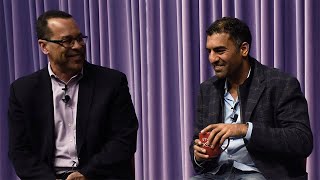
Raj Kapoor, Pedram Mokrian, and John Viera discuss how autonomous vehicles and digital technology are reshaping transportation. They explore urbanization challenges, sustainability, and how companies like Lyft and Ford are building the future of mobility.
Chapters
Who you are defines how you build.
So my memories of this program were actually as a student where this course was actually offered in the Terman Auditorium. For those of you who have any recollection of where that was, it's now turned into a pond on the other side of campus. But I remember sitting there as a student and just sort of listening to all these amazing speakers. I am not the amazing speaker. These two gentlemen here are. I've asked John to come all the way from Michigan to actually join us this afternoon. And Raj from just down the street. I know them in different capacities. And Raj and I used to work together at Mayfield, which is a venture capital fund, and I'll let him talk to you about that. And John and I are on an advisory board on Phillips Petroleum together. So it's really interesting. Two completely different perspectives, but one common theme which is the future of transportation. So we're really excited to have this conversation, but before we get going, I'd love for Raj just to kind of a couple minutes about yourself and what you've been doing lately at Lyft.
Yeah, so great to be here. I was a mechanical engineer twiddling around in the mobile robotics lab in Carnegie Mellon back in 1992. Lo and behold, after doing a long career in Internet entrepreneurship as well as being a VC at Mayfield, I'm back in robotics kind of because I'm running our autonomous business. And we have, as you mentioned here, a facility with about 300 people that we're building out the full hardware software system for self driving in addition to some other things I can talk about. But anyway, so I've been an entrepreneur, started a company called Snapfish, an online photo service. That's a long story over a beer where I sold it once, lost a lot of money and then bought it back again, and then sold it again to hp. And then there was Mayfield for seven years. I was really fast by network effect businesses. Businesses where you could potentially increase the value of every person on it by other people using it, because that builds a real true competitive moat. It's hard to build competitive moats today. Intellectual property is not as much of a moat as it used to be. So that's been an exciting seven year stint there. Working alongside people like Pedram was amazing. And then I started another company in the fitness space which was called FitMob, which kind of inverse the fitness model. Again, a separate beer conversation, probably not here, but had to iterate that three times and finally got it to work and merged it to ClassPass, which is now the largest fitness subscription service that's out there. And the interesting thing that happened in terms of how did I get involved back into this, I led the Series A in Lyft, which was Zimride at the time. So I was there when the company was about 20 people. And I did that because I was as much passionate about also climate change and making a difference as. And I thought, why in the world are there all these cars where only one person's in them? They're 75% unoccupied, running around. And I've also read enough to know that if you add more cars and more roads, it doesn't solve the problem. And so I thought there was a better way there, which is why I invested in that. But then after FitMob and ClassPass, I was thinking about what to do, and I came over to Pedram and to Stanford in particular and spent some time here and realized that. And I really wanted to make a difference on climate change. It was 2016. It wasn't about telling people about climate change, although it still feels to some people in the White House, we have to say that. But it was more about making action. And what Padram opened my eyes up in the work here by Ray and others that are here, is that urbanization is this massive trend that's going on, which is that there are two and a half billion people over the next 15 years moving into cities. There's $5 trillion being spent on urbanization. If we could take a percentage of that and direct it towards technologies that are carbon efficient, more so, and using technology to do that, you can make a huge difference. You don't have to wait for policy changes, you don't have to wait for consumption changes. If you can just go to the core root of the growth and where the money's being spent, it's around urbanization. And that got me thinking about it, which then got me full circle back to where can I make the biggest impact in that the team at Lyft said, come here and do that. And so that's the story of where I am.
Terrific. And on the exact same theme, Jom, I know that your last position at Ford was actually focused on sustainability, but maybe you can sort of tell us a little bit about your journey there and the types of things you're doing.
Sure, sure, absolutely. So, yes, my last position was in sustainability at Ford, but I'll leave that to last. So I was at Ford for 34 years, and I know a lot of you out there. When I graduated back in 84 and University of Michigan undergrad, mechanical engineering. I remember at the time, you know, my father came to me and he was a depression area kid and he's like, you know, it's great, right? You're working for his big company at Ford. You know, you're going to work there 40 years. And I said, whoa, dad, there is no way I'm going to be at the same company, you know, my entire career. As a matter of fact, the average coming out of school way back then in 1984 was five to seven companies. So I said, dad, maybe it's not seven, maybe it's not five, but four companies for sure. So great idea, but no, I'm probably going to be moving around. It was just kind of interesting. After 30 years, I got a call from my dad and he's like, you know, you're kind of at the same company, so just wondering, when are you going to start making a move? So I never thought that I was going to be there that long, but it was because I had such a variety. So Pedram had mentioned at the introduction some of the things that I've done. Sustainability. But I actually started as an engineer, mechanical engineer. I know a lot of first and second year students here in engineering school. I didn't really know what I wanted to do. Got into automotive, kind of did the traditional design, engineering, development, engineering, worked in our assembly plant. So I was really an operations guy. But it was interesting when I look at where I ended up in sustainability. I go back through my career and actually one of my first real interesting projects that I worked on, it was in the late 1980s and it was working in the alternative fuels organization, right. That was developing, I'm going to call it power trains for any type of fuel except for petroleum. So I actually was focused on natural gas. So our team developed the first natural gas pickup and actually sedan. And so I started loved that space, but kind of moved on into more traditional roles. It was mentioned chief engineer, which you have profit and loss responsibility for different vehicle lines. I was a chief engineer for Ranger, the Ranger pickup truck in the late 1990s. And the relevance again to sustainability was I had this little side project called the EV Ranger. So this was a Ranger in the mid-1990s. Super high technology. The bed was filled with lead acid batteries like you find under the hood. I'm like, whoa, this is high tech, right? But it was really interesting, that particular project. Again, thought it was interesting. Didn't know that that's what my focus was going to be, moving Forward, but then fast forward 10 years later, I actually was named to lead our sustainability efforts for Ford. And when we talk about the sustainability efforts, that's our environmental efforts. So it was all about, as we look at the vehicles that we produce, how do we ensure that the materials that we're using, the vehicle are responsible? Right. That they're having, you know, hopefully a zero impact on the environment. And then also lots of work on emissions, if it's CO2 emissions or other emissions. Right. That was a big focus of how to develop those strategies. Clearly the plants we build those products in was a big focus. I would say though that the hidden gem of sustainability, and it's something that I'm going to be touching on, I'm thinking throughout this talk, was the social aspect, right? From a social sustainability. And it was something I wasn't that familiar with. I was an engineer, a technical guy, but I had this team of social sustainability experts and they actually, you know, when I was there, developed a policy letter which is kind of like an amendment in the United States. Very hard to have them at Ford. So you have kind of like this constitution and these amendments are kind of policies that are inviolable. And this policy letter addressed human rights, working conditions, fair wages, anti bribery, and we added sex trafficking, human trafficking to that. And it was so awesome because we put this together first in the industry and not only did we use that to make sure we're behaving correctly at Ford, but we're actually able to drive that into the supply base. So really making a difference in the world. That was a piece that. I'll tell you what, when I was a first and second year student at Michigan, that wasn't even on my radar screen. But you know, my background helped me in the overall sustainability space. Loved that. I eventually picked up a all of the negotiation responsibility for environmental standards for fuel economy emissions. So very interesting working with governments throughout the world, from China to the US to Saudi Arabia. And let me tell you, the governments are a little bit different in those countries. Right. So very fascinating on driving our sustainability through those regulations. And then currently I'm retired from Ford, but I'll just say quickly. So I'm an executive in residence at the University of Michigan of something that they call the Herb Institute. And the Herb Institute is a program at Michigan that combines a two year MBA program at Ross Business School with a Master's in Environment and sustainability. So you get 2 degrees and there's just a big focus on taking sustainability and making it part of your business mindset. Moving forward.
Yeah. Such a great story. And one of the reasons so typically ETL is typically one person opining on their background and their views of the world. But one of the reasons we decided to have these two gentlemen on here is because they actually represent two completely different perspectives on the world of transportation. You have a company while Lyft by itself is about six and a half years old. I know Zimride was longer, but it's about six and a half year old company born digital versus 115-year-old company. Right. Born mechanical. Yet you're kind of converging onto the same spaces. Right. You're starting to really think about sort of ways with which you're competing, collaborating, cooperating. But I wanted to sort of get your different perspectives of what does that mean to be sort of digital in the world of transportation. So from your perspective, I know, you know, obviously network of businesses, but also from some of the work and some of the statistics that you have, John, and sort of connected cars as well. So what does it mean to be digital in the world of transportation? How does that push us forward?
Yeah, taking a step back. Transportation is one of the most important vital areas. It's linked to so many things around even education, poverty, making sure people can get to jobs, making sure people can get to their medical assistance. I was shocked at what second order effects that occur because of a transportation system. And it is the industry which now is going through probably the biggest upheaval that has ever been there since the car was there. And one point of history is that when the Model T which you guys are responsible for, thank you very much, was first created and mass production came to being. You could see this picture in the 1900, I forget the exact early 1900s of Easter parade in New York. And there was just one Model T and it was all horse and buggy. Thirteen years later, no Internet, no social media. Thirteen years later it was all cars and one horse and buggy that was there. And it's amazing how quickly that technology disseminated because it's so vital and so important. So what we're seeing now with the advent of digital and a whole bunch of other things that are there as well as AI and that we're going into another revolution. That's right now it feels like it's going to be happening slowly and like most things, like you look at the mobile revolution, it's going to hit like super aggressive and turn everything that's there. And the reason is not just because there's technology and we can do it, it's because we're facing a fundamental problem. Americans spend more on transportation than they do on food. It is the second largest expense, aside from housing. 90% of the way that Americans move around is through a car. Their car is utilized. No offense to the car industry. And I think I feel good talking about this here with Ford because I think Ford gets it and Ford is moving in the direction. But a car is utilized 4% of the time, 96% of the time it's sitting and not being utilized. And when it is utilized, it's 75% unoccupied, as I mentioned before. So we have this asset that people are spending a lot of money on that is also responsible for, unfortunately, there's significant amount. 94% of accidents are caused by human error. We have emissions problems that we've talked about before and of course, congestion of adding more cars and urbanization. Two and a half billion people moving into cities. So when you add all that up, it's not just technology, it's that we have to have a solution. We need a solution in the next 10 to 15 years. And it just so happens that the building blocks are here now, which is on demand technology. The word that's often used about the future of automotive transportation is case casc, which is connected, autonomous, shared, electric. And the thing that I will say right now is that if you just have one of those technologies, it's not going to work. You need all four for this system to work. For us to fundamentally rewire the transportation system in the world, all four must be there. Because if you just have autonomous, you'll just end up with a lot more cars. And that won't necessarily solve the problem. So you need shared. If you have autonomous and shared, you're still generating emissions. And we can't even afford one more ton of carbon into the atmosphere than we've already been putting in. So you need all of them that are there. And so that's what I believe represents this huge change, is that atoms and bits are coming together. It's not just about digital. Two years ago, we were an Apple and you would just connect to drivers that are out there. Now we have 35,000 cars in our fleet and we're building hardware up the street. So our world has become Ford's world and Ford is getting into software. I won't speak for Ford, but you can.
You're doing pretty good, right? You must have studied the finance a little bit, Raj, but no, that's good, Very good.
What's your view from the Ford Perspective.
So it's interesting. And Raj and I did not talk before this particular class, I swear to you, but I'm so glad you brought up Henry Ford. So thank you for that, that little plug. I'm going to refer you the graphic up on the screen, because the connected piece and data in particular is really, I think, changing the transportation industry. So if you look up at that graphic, it said, you know, every minute in the United States, 30 new vehicles were sold. Well, I'll tell you, right, if you go back in the recent history of even the automotive sector, it was all about selling the box, right? I mean, that's what we did. We sold the box, and it was it. We sold that box. And, you know, there's quite a few that were sold. However, what we have been realizing is what Raj brought up, right? Look at that right side, right? You sell the vehicle one time. People are only using that vehicle every so often. When they're in the vehicle, though, look at that. There's a lot of miles being traveled. People aren't necessarily, from a personal ownership, just buying their own vehicle, but they're moving into shared rides because they're saying, hey, I need transportation. I. I need mobility. Maybe I don't need to buy a vehicle. So maybe vehicle ownership is changing. And does the auto industry need to start thinking about not just selling the box, but also the use of the vehicle, getting into those types of businesses? And then clearly, from a data standpoint, there is so much data being generated right now, and when you think about the goodness of how that data can be used, right? And Raj touched on a lot of different elements, Right. It could be the element of data use in terms of smart vehicles for lower emissions. Clearly, from a connectivity standpoint, vehicle to vehicle, vehicle to infrastructure, you could really address safety concerns and address the accidents. When you talk about vehicle to infrastructure, how are you linking in with other entities outside of the industry to ensure that that data is being used by cities to help out with congestion? So. So I think that there's huge opportunities from a social standpoint to use data moving forward from a business standpoint, just to throw some numbers out there. So to produce the box, automakers throughout the world, and you name it, if it's US automakers or European or Asian automakers, 6 to 12% profit margin is considered at the high end, 12% is considered really good. Right. In terms of building that box, when you talk about getting into the services, and I know Raj is probably not going to divulge the profit margin of Lyft, but I'll tell you what, when we look at the profit margin associated with the use of the vehicles, right, it's 20% profit margin, easily and higher. So when you think about that, if people are moving more toward those types of vehicle uses, the profit margin's a lot higher. We have all this data available to, to do some amazing things for customers and for services. The industry is really starting to say we want to get on that right hand side, really use that big data to our advantage.
So in terms of just using the data to the advantage, I just want to touch on this point and the point that you made before, which is sort of the social impact, right? And so let's just dive right into that. Transportation makes such a huge component of our lives, right? And we don't really think about it much here because there's so much around it and access to cars and vehicles and ride shares. But there's a huge swath of the world right now that really has not necessarily been taken advantage of all of these technologies. How do you see sort of the world of transportation not only touching the developed ecosystems, but also the developing ecosystems from just a social perspective? And where do you see the future going there?
Yeah, so really good question, Pedram. And I'm going to reference Henry Ford as well, if I could, Raj. Okay, you're allowed. So I'm going to reference Henry Ford because I'm going to take us to where transportation hopefully is going. And it could have a big impact from a societal standpoint. So kind of going back to the time of Henry Ford, Model T, five dollar a day wage. When you talk about having a societal impact, a positive societal impact, clearly you could say, yeah, that was very positive. Right? I mean, doubling the daily wage that other industries needed to follow really helped build up the middle class. But I think it wasn't just building up the middle class. It now made it affordable for more of the masses in the United States to have this mobility, this transportation. And around the turn of the century, the average American didn't travel any more than 25 miles from their place of birth to when they died. Never went more than 25. What was the reason for that? Right. Infrastructure wasn't there. Roads weren't there. Transportation was unreliable. Hopefully he had a good horse. Right. So that was a big problem. When the Model T came along, the first person in the outlying areas that had the Model T was who? Does anybody want to guess what was the first occupation that had the Model T? Anybody want to guess? I think I heard it back there. I Don't know. We'll give credit to one of the first year students, doctors, right. So doctors had the Model T because they are able to get out to the villagers, right. To actually provide medical service. That was a big breakthrough. Then people started to be able to afford these vehicles on their own. They could get into the cities, right? For medical, for education, for jobs, for all kinds of things. So that was fantastic. Right. Mobility was an enabler for really building up the standard of living. Now, let's fast forward to today. Let's look at a lot of the developing countries, like sub Saharan Africa, for instance. Here's the bottom line, right? Time will never happen to the point where the masses in Sub Saharan Africa are probably gonna be able to afford personal use vehicles. However, there's still a need for those individuals, particularly those living outside of the city, to have access to medical, to education, to all of those types of services. And what I'm really hoping transportation's gonna start doing is to say, how do we use the brain power, how do we use innovation such that we can take mobility and bring those services out to the villages? How do we change the business model so that villages could own a particular vehicle and get into the city? That's what I think from a societal standpoint, mobility could have a huge impact in these developing countries.
And Raj, I know that you got back into Lyft because you're looking broadly at sustainability. And you and I spent a long time actually looking at cities and infrastructure and urbanization. And we both agreed that sort of Lyft's role within that overall ecosystem was pretty profound, not just from a sustainability perspective, but just from a social impact perspective. So can you kind of talk about that journey and sort of the things that you've actually seen firsthand now that you've been there for a couple of years?
Yeah. I would say first of all, that what's interesting is that the roots of Lyft go back to the founder and CEO. Logan visited, of all places, Zimbabwe. And that's why it was initially called Zimride, by the way. And he noticed that entrepreneurs would purchase these 19 person, 18 person buses and go figure out what are the most profitable routes and run a shuttle service around. And they made a much more efficient use of vehicles than what we were doing in the United States. That was the initial calling there. Now fast forward to that concept is what was born. And now Lyft is readdressing that concept. So one thing to mention is that we also believe that the consumer's not really thinking about Ride sharing necessarily. They're thinking about getting from point A to point B. And already if you open up Lyft, it's evolving to the point where it's about getting all the options out there, even though some of them we don't even touch a dime of money on. So, for example, we've integrated transit options. We integrate walking wherever you can to actually because it's much more efficient in terms of a pickup. And then there's bikes and scooters that have also been put in, which are an efficient way. Short distances if you're going yourself and the weather can support it in doing that. So what we're seeing is bringing that whole set of solutions is really what unlocks the connection with the city and being able to get in all the different areas that you need to go in doing it. So I would say that initial idea that he had going then to the efficiency that's there. One of the other things we've done is how can we, and this is something that hasn't happened, but we're thinking about how can you do things like reinvent what buses are. So providing efficient transportation to people, especially those that can't afford it, has been done basically through government subsidy, where you're running these very large buses, 60 person buses at demand times that don't necessarily need it, but you need to make sure that you can hit every community. It's really important. That will always be a need there. The question is, can you make that a lot more efficient? So one of the things that the industry has introduced, including Lyft, is this concept of shared rides, but also with walking. And really what it is is an on demand bus. So people are saying I need to be picked up in five different locations. And what we're doing automatically is saying, okay, you walk two minutes, you walk three minutes, you walk four minutes. And we're making virtual bus stops and we'll pick you up along the way, which is a lot more efficient than going point to point to point, which would take too much, too much detours and you won't get the same matching efficiency that's doing it. So with that, now you can start putting larger format vehicles on and you start getting to what is a more efficient transit service and a more efficient bus service. And these are things that we're exploring. We're working with 35 different transit agencies right now trying to help them figure out how to solve those problems.
Yeah, that's amazing. So speaking of those types of problems, let me get a little bit provocative here and let's for a second assume that you had a magic wand, right? And you had the ability to solve one problem, be it technological or market oriented, that would sort of unlock a vast array of opportunities in the transportation sector. What would that be? What problem do you think is worthy of being solved immediately? That sort of unlocks a whole new future of transportation.
Yeah. So if I had the magic wand, I would say that that magic wand would be to actually come up with an incredibly, incredibly affordable energy storage system for renewable energy. So it could be a battery like storage system, fuel cell source, but incredibly affordable. Because right now the challenges and everybody's working hard on reducing the cost of lithium ion batteries and other things right now. Here's the problem, right? With electric vehicles, somebody said the good news is with electric vehicles you could take a renewable clean energy source, right? And the cost of it and Pedram we've talked about is really coming down. So you kind of have free energy, it's clean. That's the good news. The bad news is you got a $10,000 fuel tank. You go to the internal combustion engine. The good news is you got a hundred dollar fuel tank, but the fuel is not clean and it's expensive for the customer. Right? So that's the problem. So, so the solution is how do you have the first element but take away that $10,000 fuel tank? So if I had a magic wand, it would be energy storage at an incredibly low level. And if you could get energy storage at an incredibly low level, then you'll absolutely be able to touch on the societal issue of how do you make mobility and transportation affordable for the masses.
So I'll give you a quick answer and then more related to the AV world, the quick answer that you and I have also talk, in my opinion, is putting a price on carbon. I think a lot of things will flow out of that when we think about shared rides that will drive potentially more because it would make it even more economically attractive. All the things that we're talking about with renewable energy. So that's the policy thing, which I'm not sure I'll be able to have an impact on in the next 50 years. But in terms of what's the other piece that goes a little bit deeper into the automotive industry that's there. So let's take a look at autonomous self driving. It's a hot area. There I Think are over 150 programs that are going after this. And each of the programs, my estimation, needs to spend about $800 million to a billion dollars. A year in sustained R and D and no one really has an idea that can tell you it's going to be done on X date. It's something that is continually going. You look at the amount of money going into that and you wonder why. Why is it all going into that? Well, it makes sense if you think about it from a venture capital perspective. This is a $2 trillion market. So to write a billion dollar a year check, let's say it takes five years, so $5 billion check towards a potential $2 trillion market, no problem. So you're going to get. There's going to be no issue on capital that's going to go after this. And this is why we have so many companies and you're hearing even the last couple days, people raising a half a billion dollars, $900 million that are credible teams that are going after this. But I think what's going to. But the challenge is that with all that capital and with people not sure about what their core competency is, they're each building in silos. And so a lot of the work is being repeated across all of these different programs that are there. I think eventually it's going to make a lot of sense to really start sharing more so and to make that more efficient. And I don't think we're there yet in 2019, but I'm hopeful in the future and especially when it comes to safety and thinking about the lessons that one program has learned, sharing those out so that the others can learn this. The airline industry has done this successfully where if there's a safety problem with a plane, it gets broadcasted out to every single airline and every single person, the supply chain, and they figure out the solution and they solve it because they don't want to make safety a differentiator. I don't think that's where we are today, but I'm hopeful that we also won't be there. And so the ability, getting, making that sharing happen, I think is going to be critical to an efficient and safe future.
I think it's such an important issue here because I do agree with you. There's a lot of silos going after this opportunity because it's so large. But at the same time, kind of looking back from your perspectives, you're coming from effectively the box and you're coming from the network. Right. If I were to be so crude, where do these things collide in the future? Right. Is the value in the ownership of the network or the intelligent box or some kind of hybrid in between? So if we were to fast forward, not just lift and forward, but just sort of these ecosystems in general. Where do you see these things actually converging and sort of playing fair and friendly with each other? Or do you actually see one side dominating the other? Is there a steady state where I'll take a shot?
So I think the point, I think that's important here is that you need both. I think we are moving towards a transportation network future. We're already there and it's happening quickly. But to do that, you need to have vehicles. And those vehicles are going to come in all sorts of different shapes and sizes. Scooters, bikes, anything with potentially electric drivetrain, that'll be there. You're going to need both that are going to be there. The opportunities for innovation are massive in both areas. So let's just take for a second vehicles. Again, I'm not the expert as much as Ford is, but when I think about, and we talk to our customers in the future about first, if you look at vehicles, they've been optimized around the driver. Now you can optimize the vehicle around the passengers. And so what we're going to think about is when we're getting into our lifts is what is my cabin experience? That's what's going to matter the most. Not necessarily the styling on the exterior of the car or necessarily the brand of the car that's going to make a difference. It's going to be, what is that cabin about? Same thing when you go on an airplane journey, you care about the seats, 180 degrees, do I get the little fluffy pillows, how's the food, et cetera. And you can think about all of the different activities that this opens up when you are a passenger and there is no driver. Whether it's sleep, lift, I need to get my work done. Lift, I need to entertain. Lift, social lift. All of those things can have different configurations. And now imagine every single one of Those cabins has 5G connectivity and the experience that you can have inside those. So I think there's plenty of room for innovation on both sides and innovation results in creating value.
Couldn't agree with you more.
No great example of something that the auto industry is looking at is when we're looking at the box. Absolutely correct. If you don't have that driver, I mean, the designers are going crazy. Like, oh, my gosh. We're talking about having incredibly comfortable interior spaces, that their creativity is going through the roof. I think the other piece associated with that, getting back to the social side, I think it really opens up the door for accessibility. When I talk about accessibility for those that have physical challenges for the elderly, I mean, I think there's huge opportunities there. That brings tremendous value to society. I think the other area, when you talk about a convergence in this space outside the technical area, is the policy area. How could I call it? These entities that are working in this space actually work together, like the example Raj gave with aviation, to actually come together to discuss what is the right policy that we need to implement, for instance, to have the right. I'm gonna call it deployment of autonomous vehicles. Cause Raj mentioned it earlier. If you have a bunch of autonomous vehicles driving around and I'll pick on somebody, I'll pick on Lauren over here. Cause Lauren's been so wonderful. Let's say Lauren, she's gonna get an autonomous vehicle. She absolutely loves it. And you know something, that vehicle's gonna drive her from. And I'm just getting to know the area. Maybe she lives in Daly City. Hopefully, that's. I don't know. I'm just throwing. I saw it on that. She's going to get her autonomous vehicles, go from Daly City into Palo Alto, drop her off, go back to Daly City, wait for her to get done with work, and then come back into the. That's not a very efficient deployment of autonomous vehicles. So I think that there's a huge opportunity from a policy standpoint for entities to get together to say what is the right policy? And I'm going to call it regulatory environment to ensure that these new technologies are deployed as efficiently as possible and absolutely always in a way that's accessible for particularly the underserved.
So before we turn it over to the audience, there's a lot of young budding entrepreneurs out here, and I was wondering if each of you can sort of give one either counterintuitive or sort of a lesson learned from the transportation ecosystem that you think would be sort of parted wisdom on this audience that you can sort of share with them. Is there something that most people are talking about which is either dead wrong or sort of counterintuitive or just a bright spot that you've seen that you think there should be a lot more focus and attention on from your perspective?
So I'll give a personal less about transportation and then I'll talk more about kind of mission. On the personal side, I would say, especially coming from Stanford or Carnegie Mellon or University of Michigan, whatever these schools are, the one most important thing you have to remember is you don't need to be the smartest person in the room. Even Though you think you are, what really is going to be successful is when you capture what is going to be benefited from the other people that are there and that you don't have to have all the answers in doing that. That, I think takes a lot of pressure off because the world is about collaboration. It's not about a single person that's going off and changing the world. That's rarely ever the real way things happen. Second, in terms of mission, I would just say that we are at this amazing time. When I graduated, especially business school back in 1996 and the Internet was just coming out, it was exciting. The Internet was going to change everything. But we all went and started digital businesses that were about entertainment, photos. These are important things, but not super important right now. The opportunities in front of you all are around to change the world and have impact in a significant material way. So don't shy away from that. And I respect the people that came out of Stanford to start Snapchat, but don't start another Snapchat.
John, your take.
Yeah. First of all, something that Raj mentioned that I absolutely want to reiterate and that's passion for whatever you get into, have passion for what you do. And if you're getting into businesses, I just go back to, you could work for amazing companies that are producing amazing products that are making a lot of money for those companies. But think about how your insights could actually help make a difference in the world as well. Outside of just making money, regardless of the discipline you're in, you could always be making a difference in the companies that you're in, either from an environment or social standpoint. So absolutely go after that. In terms of something that's counterintuitive. I think maybe I'm dreaming too much at night now that I'm retired and I got a lot of freedom in my mind. I don't know. But when I think about the big breakthrough in mobility and transportation, I'm thinking it's going to come from a group of entities that we're not even noticing today. I think there's just going to be this very creative group figuring out what's really required in the future in a non traditional sense. And they're going to be the ones that are going to be coming up with this amazing breakthrough in mobility and transportation.
Awesome. So love to open it up to the audience to see if you guys have any questions for these fine gentlemen on any topic you like.
First question, two questions. If I'm a business, am I going to be paying for autonomous vehicles to Go pick up my customers and bring them to me and market to them on the screens while they're on the way. And second, are flying autonomous vehicles. Pipedri. I mean, Lilium Jet and other people are working on it, but.
So the questions were flying autonomous vehicles and whether or not businesses would actually be willing to underwrite transportation and market to their customers as part of their offering.
Yeah, so I would say on the business side that'll certainly be the case. But when you do the math, look at, for example, the advertising or marketing opportunity in a vehicle the way it is today, it's not very large compared to what a consumer is paying for the transportation and the amount that a restaurant, for example, would pay to acquire a customer. So I think the math is a little bit challenging now, but as costs go down, maybe there are other ways to get there and there's some level of subsidization that I think we can see in doing that. I think so. I've looked a little bit around flying vehicles, flying taxis, et cetera. And I think from a science perspective it is valid and it is absolutely feasible. There are, I think if you think self driving and autonomous has challenges, probably in my opinion, 3 to 5x the amount of challenges that are there. So I think the timeline is a bit further out to get that right and to get all the policy questions around aerospace and noise, et cetera, right.
Back there.
So as someone who was in Lower Manhattan during Hurricane Sandy, I would have appreciated probably a lift gondola or a Ford gondola more than a driverless car. What are your thoughts on how human mobility will change in the wake of things like the IPCC report and stuff like that? Are you guys looking beyond or just keeping the wheels on the ground even if they're floating?
Yeah, it's a great question. It's a great question. I think that as we think about climate change and the impacts on coastal cities, and again, mobility is going to be very key. And I think that there needs to be more thought and discussion now about what those mobility sources could be. And again, it gets back to affordability. We could have submarines and all kinds of crazy things, but it has to be affordable. And oftentimes when you think about the cost reduction curve, you have to start things sooner than later. And I think we're all seeing the impacts on coastal areas happening a lot faster than what we expected. And I think there actually needs to be more focus now on what those mobility affordable mobility solutions need to be.
So one comment there is that what's amazing is I'm sure some of you have been following the micro mobility revolution, which is basically bikes and scooters and how quickly certain cities have just been like, you go there one day and two weeks later and it's like you can't get them off the street. They're everywhere in doing that. It's obviously some people think it's a nuisance, but in general people are using it, they love it. It's unlocked an ease of use and convenience that they didn't have before. But one of the challenges that's presented with the current micro mobility solutions, which are basically e bikes and E scooters, is extreme. And I will call it, I'd categorize it as extreme weather because what we're going through right now, I was just in Lake Tahoe this weekend and there was like six feet of snow in two and a half days. They closed all the roads. I couldn't even get out. That was fun, but it was a problem for people trying to go somewhere. But the point is that how do we co the current that bikes and scooters look and are designed don't work in those type of extreme weather circumstances that are there even some bad weather. So there's a lot of energy that's going in the industry to rethink how we can do micromobility that can work in an all weather environment as one example.
So as far as I know, the air transportation industry has notoriously small margins. And I was wondering if you think there's a parallel between the ride sharing industry, like land transportation industry and the air transportation industry and if there isn't what makes ride sharing a good business.
So the difference in margins between air travel and road travel from a sharing perspective.
So I can't go into a lot of details or anything about Lyft, but what I can tell you is just a high level perspective on what I think about that question, which is that there's no doubt about it, we're not going to hide behind this is a huge scale business and in a scale business that's there you need to rely on the fact that there's significant. What's going to matter is the volume of profits, not necessarily what is the, is it a big fat software margin? And the fact is that we are dealing with hardware, we are dealing with traffic congestion. There are fees that are being charged also from cities, et cetera. So I don't think the expectation is that we're going to be getting the ride sharing industry or other industries that are similar are going to get software type of margins. It is a different business, but the scale of this is much, much larger than the air industry. I was wondering where trains come into the picture. I mean, in Europe, trains being used pretty efficiently.
Everyone's very mobile.
Yeah.
So we have Ford, we have Lyft, but we have no trains.
That's right. We need a train manufacturer. Right. You know, it's a good question. You know, trains are incredibly efficient. I think from a, you know, cost standpoint and from a policy standpoint there's just a lot of challenges to bring on. I'm going to call it, you know, trains and you know, that form of transportation. I think as you look forward to the design of cities in the future and the adjustment of cities in the future, you know, we talked about urbanization and how, you know, all this population is moving into urban areas. I think that trains are going to have to be a big part to hopefully enable people if the reason they want to get into the city is because that's the only way they have access into the city, so they have to live there. I think as we're designing future cities, I think trains have to be a big part of enabling people to get into the city, but avoiding the congestion of either having them living in the city themselves or actually bringing vehicles in. But it is a policy challenge.
So I would say we've looked at high capacity rail systems like that are very efficient and they're more efficient than cars. There's no doubt about it. That is part of the reason why we think part of the solution is to integrate in transit. And that's why we're working aggressively on that to do that. So it. Absolutely. And in fact what we want to do is surface for the consumer. Hey, you could save 15 bucks if you actually take a train now and it'll add seven minutes to do it. So make the trade off what matters to you more in doing that. So I think they're going to be there and it matters. What I think is exciting is that there's also innovation coming in the trains as well. The capex for putting a mile of train as well as the OPEX on it is just huge. There's so much technology that could be applied to bring both of those factors down, which can make it more affordable, which is I think, part of the issue. So I would say that the transportation industry hasn't put enough attention on that, but I know that it's being worked on and it's an exciting area.
More from GHION.AI


O processo de reconhecer limites, mesmo quando a vida parece exigir sempre mais.





Depois de tantas histórias, aprendizados e pausas necessárias, o @interior_iza está de volta



