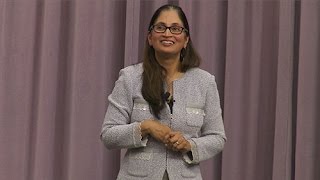
Padmasree Warrior traces how innovation has evolved from lone inventors through corporate labs like Bell Labs and Xerox PARC to today's open models. She argues the next shift requires people who bridge multiple domains—hardware, software, design, UX—rather than narrow specialists.
Chapters
And so if you kind of look at the history of innovation in the early days, very early days, we had the era of the solitary genius, as I call it, right? Now we had famous inventors who invented paper, printing press, light bulbs, and we talk about these people to this day. We use their inventions. And so that was an era where we had a person or an individual really dedicating their life to invent something. And came up with a big invention that changed all our lives. So that's sort of from— we went from that model where we were focused around inventions to really about applying those inventions, which led to the Industrial Revolution. It was more about applying those concepts to change manufacturing and change the production of energy and so forth. From there, we went to companies creating labs. And so this was the era of Bell Labs and Xerox PARC and so forth, where they were researchers whose job was— it was to innovate, and everybody else didn't need to innovate or be creative. And so we kind of separated innovation into being a function, and we trained people to innovate in the labs, and everyone else was supposedly going to go run that business. And that worked well for a number of years. Labs produced lots of patents and intellectual properties, and that was the era that continued for a while. And then We shifted again and we said, no, innovation actually can occur anywhere. Really gonna be more about open models of innovation. And actually Cisco participated in this model also. We have something called iPRIZE and iZone where we post problems that we think are interesting for innovators to solve. And we source ideas from everyone around the globe and we select ideas that we think are interesting and we fund them with no strings attached. There isn't any direct benefit necessarily to Cisco, we just feel actually the industry and therefore Cisco will benefit in this model. So we kind of went through that model of innovation. It's changing again and I think it's changing again in the following ways and we're seeing the early signs of this. It's changing again to become much more of a multi-domain innovation. What do I mean by that? If you kind of think about the most innovative companies today, The most innovative companies today combine creativity between hardware, software, user experience, industrial design, UI design. So it is more than just having a technical innovation or technical invention, it's really about crossing different domains and creating ultimately a better experience for the user or for the business. It's very complex to implement because because no one can really be an expert at all these things. So when we say we want to create an innovation project, whether it's a small company or a big company, the ability to really bring together these different skills is really important. So that's something we are looking for as a company when we look for ideas and we look for opportunities for people to come work with us. We look for people that can actually cross their domains and cross multiple domains to innovate. You don't have to be an expert at everything, But you should be able to interface. If you're a hardware designer, you have to really understand how the software integrates with that and how that's delivered for usability and user experience. So there's two slightly different things.