Padmasree Warrior: Realizing Innovation at Enterprise Scale [Entire Talk]
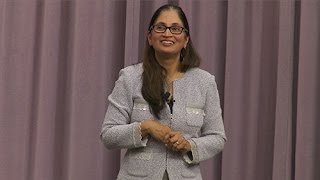
This content was created by GHION.AI . This content was uploaded by GHION.AI . This is a YouTube video titled "Padmasree Warrior: Realizing Innovation at Enterprise Scale [Entire Talk]" from October 18, 2013. The talk, given by Padmasree Warrior, discusses the impact of technology and innovation across various industries, the evolution of the Internet, and Cisco's approach to innovation and acquisitions. It covers topics such as the Internet of Everything, changes in leadership, and the future of education and cybersecurity.
Chapters
Thank you. Hello, everyone. It's a great pleasure for me to have this opportunity to talk to you what I thought I would do in the next hour or so. And I will Talk for about 40, 45 minutes and take questions at the end. So bear with me as I go through my talk and keep your questions to the end. But I do want to engage in a dialogue, as we kind of all know, regardless of the phase of our career or education that we've been in. Technology and the pace of innovation obviously is the lifeblood of the tech industry, of which I'm a part of. But technology and innovation in many ways have influenced pretty much every industry. Manufacturing, retail, entertainment, communications, of course, and energy, smart energy now. And so pretty much every part of the industry has been influenced, and in some cases, some industries have been turned upside down by the influence of technology. So it's got this incredible power to change, not just how we consume solutions, but how business gets done. And so I'm going to talk to you more from the perspective of what I refer to as the business of innovation and the business of innovation in the context of all of this change. So if you kind of think about what is changing in technology, firstly, of course, the explosion of the number of devices. And I actually have some data points I want to share with you today, and I will go through the data and then summarize those in terms of trends, because some of this data is from Cisco's research and it's pretty amazing. So if we kind of think about the number of Internet devices, or we call it connected devices, there were about 1,000 devices connected to the Internet in 1984. So that number went up to about a million in 1992, a billion in 2008, 12.5 billion in 2010. And we expect by 2020 there'll be roughly 50 billion devices connected. And by the way, these devices are not just smartphones or smart tablets. Many of these devices that we call connected devices are actually going to be sensors and sensors and anything with an IP address, right? And we joke at Cisco that at some point we'll have children born with an IP address. And maybe that's actually going to be the profound change in how we are identified, not just through our name, but something that's more unique than that. So that's a big shift in a very short period of time. In addition to that, Today, already in 2012, more than 80% of enterprises, businesses, traditional enterprises, have consumed applications from the cloud, meaning they are not traditional enterprises typically created applications that lived in a Server that was controlled and watched over by IT organizations in these enterprises. And that model is completely getting disrupted by the cloud, where they don't necessarily own the infrastructure, where the application is getting created, and applications can be created in one place and consumed in another place. So that's another big change. In addition to that consumer Internet, we all know the influence of that, and that's growing at a rapid pace. And here's some additional data points. There were 300,000 apps that were available in 2010 with 10 billion downloads. In 2012, there were 2 million apps available. And in just one week, IDC reports that in 2012, there were almost 2 million apps that were downloaded. So that's a huge number. Along with the explosion of devices and apps, the other thing which is relevant to us at Cisco is the amount of information. Digital information is growing at a tremendous pace. In 2012 alone, we created more data than the previous 5,000 years combined. We created roughly 4 exabytes of data. And we expect that this connectivity will continue to grow. And by the end of this year, the number of mobile connected devices will exceed the number of people on earth. And by 2017, there'll be roughly 1.4 devices per person on earth. So that connectivity is amazing. So if you kind of look at all of that data, to me it summarizes what's happening in the technology transitions into three big buckets. The rise of the mobile. It's not just mobile devices, but actually how new apps are getting created, with mobile first being the consumption model and new breeds of applications that are coming up. And then the rise of cloud, which is not only a technology transition, but a fundamental business model change, because people do not want to necessarily invest in IT infrastructure or technology in a capex model, where it's a capital expenditure and you sort of could plan for that and would budget for that. And businesses ran that way. More and more people are treating technology investment as an operating expense. So businesses, lines of businesses today are actually spending more on IT than CIOs, which is a fundamental change in how the IT industry structure and value chain has been established in the last 10 years or so. So those two are pretty important. And I think it's really important from a technology perspective because compute architectures are shifting from a client server model to a mobile cloud model. So it is technology, applications, infrastructure, how business gets run, all of that is being changed. On top of that, we see the next wave of the Internet being what we call the Internet of Everything. And so what do we mean by Internet of everything? So if you kind of think about the Internet roughly, you can categorize the life of the Internet to have four phases. The first phase of the Internet was all about access and connectivity. So Cisco and others created a way to aggregate or abstract away different protocols that existed. And we created a way of having a multi protocol router that was sort of the beginning of commercial Internet as we know it. So from that time, connectivity was what we focused on. Access, digital access was the big opportunity. And I would say email was probably the killer app in that first phase of the Internet. The second phase of the Internet was when we started digitizing commerce. And so more, more and more business transactions, how we consumed applications, how we paid for different things, was all done digitally. And that kind of gave rise to E commerce. And we saw new companies emerge in that space and retail. And in the beginning, maybe some of you are too young to remember this, in the beginning, people were really nervous to enter their credit card numbers on the Internet or put them on a computer. And today we don't think about twice about using our cell phones to pay for things and buy things. Right? So the second wave was really about the rise of the e commerce and digitization of business transactions. The third wave, we started looking at digital interactions and that was the rise of the social. So that I would say was probably the last five to seven years or so. Now words like friending, liking these things are all very new words that actually the Oxford English dictionaries entering into, changing in the English language use of some of these words. So the next phase, which we believe will be the fourth phase of the Internet, is what we call the Internet of Things. So Internet of Things is really about not just machine to machine connectivity or sensor networks, but it's actually what do you do with that data and how do you use the power that we are creating in machines to enable us to have a better lifestyle, better health care, better education systems, better manufacturing productivity. So the reason we refer to it as the Internet of Everything is the way we define Internet of Everything is really about connecting people, process data and things. How do we connect all of these. And we estimate that transition in the next wave to be roughly $14 trillion of value, that there is potential for us to unlock that value. So that doesn't mean that it's a total available market. That means there's new revenue opportunities as well as new profit pools that we could unlock through this Internet of Everything. And I'll talk a little bit more about what that is and how that breaks down. So what I thought I would do is in the course of this next few minutes, I'll talk a little bit about how is innovation itself change changing in this new model as we bring more and more technologies, what will be some opportunities for all of us as innovators to be thinking about creating value? And I'll share a little bit about how Cisco thinks about innovation and the processes that we use. I think it was mentioned I run mergers and acquisitions for Cisco. I'll talk a little bit about Cisco, our history, and where do we see our methodology of entrepreneurship going? Okay. Actually, I want to also talk about leadership at the end, because one of the things that will change for those of you that are still in your education process, is how we thought about leaders in the past is changing very rapidly. And so leaders also have to acquire very new skills to lead in this new world. So I'll talk a little bit about that. So let me begin by talking about how is the. The model of innovation changing? So if you kind of look at the history of innovation, in the early days, very early days, we had the era of the solitary genius, as I call it. We had famous inventors who invented paper, printing press, light bulbs. And we talk about these people to this day. We use their inventions. And so that was an era where we had a person or an individual really dedicating their life to invent something and came up with a big invention that changed all our lives. So that's sort of from. We went from that model where we were focused around inventions to really about applying those inventions, which led to the Industrial Revolution. It was more about applying those concepts to change manufacturing and change the production of energy and so forth. From there, we went to companies creating labs. And so this was the era of Bell Labs and Xerox PARC and so forth, where they were researchers whose job it was to innovate and everybody else didn't need to innovate or be creative. And so we kind of separated innovation into being a function, and we trained people to innovate in the labs and everyone else was supposedly going to go run that business. And that worked well for a number of years. Labs produced lots of patents and intellectual properties. And that was the era that continued for a while. And then we shifted again. We said, no innovation actually can occur anywhere. Really going to be more about open models of innovation. Actually, Cisco participated in this model also. We have something called iprize and izone where we post problems that we think are interesting for innovators to solve. And we source ideas from everyone around the globe. And we select ideas that we think are interesting and we fund them with no strings attached. There isn't any direct benefit necessarily to Cisco. We just feel actually the industry, and therefore Cisco will benefit in this model. So we kind of went through that model of innovation. It's changing again. And I think it's changing again in the following ways. And we're seeing the early signs of this. It's changing again to become much more of a multi domain innovation. What do I mean by that? If you kind of think about the most innovative companies to today, the most innovative companies today combine creativity between hardware, software, user experience, industrial design, UI design. So it is more than just having a technical innovation or technical invention. It's really about crossing different domains and creating ultimately a better experience for the user or for the business. It's very complex to implement because. Because no one can really be an expert at all these things. So when we say we want to create an innovation project, whether it's a small company or a big company, the ability to really bring together these different skills is really important. So that's something we are looking for as a company. When we look for ideas and we look for opportunities for people to come work with us, we look for people that can actually cross their domains and cross multiple domains to innovate. You don't have to be an expert at everything, but you should be able to interface. If you're a hardware designer, you have to really understand how the software integrates with that and how that's delivered for usability and user experience. So there's two slightly different things. So in that context, Cisco thinks of innovation as really having four pillars and we call them build, buy, partner and integrate. And we feel we are a very unique company in that regard. So Cisco is made up roughly in our history of about 30 years of 169 acquisitions. We are a company that's been brought together by bringing different cultures, different products. And it's sort of very interesting to think of us that way. And we joke inside the company and say we have. Sometimes we say we have 250 CEOs in the company. So when we acquire companies, people who've led companies that have come into our company or we've hired them after they've run some business, brings a very interesting dynamic within our company because it creates a whole entrepreneurial spirit and how people innovate and think about it. So it's a positive side of it, on the negative side of it. It's very difficult to get everyone aligned because everyone wants to go off and do their own thing. And I just talked about how innovation needs to be much more multi domain. And so I think this is a balance that most of us have to deal with as we go forward. Being not necessarily being an expert in every domain, but also having a vision to realize where you need to partner. So the way we approach innovation, acquisitions and investments and being part of a very vibrant technical entrepreneurial community is very much a strategic pillar for us. We roughly expect 1% to 2% of our growth every year in revenues to come through acquisitions. So that's something we plan for, we actively look for. We go search for companies that look interesting. We're also an investor in addition to acquiring companies. So we actually have something like a venture fund inside our company that's pretty big. We don't advertise the total value, but we have several investments across the world. So that's sort of how we think about inventions and innovation. I think that will be the model going forward. So it's not just build and buy, partner and partnering, meaning sometimes our investments, our portfolio companies actually become partners for us. And then the value we bring to those portfolio companies is actually exposing them to our channel, our brand and our customers so that the startup gets the scale of a bigger company without really being part of a bigger company. The benefit to us is we get to understand the startup idea or the innovation in a much more intimate way than we would otherwise do. So that's sort of how we think about partners. And then integrate is something that we added new and the reason we added it is one of the things that's very important in business. And I think it's going to become more important in the Internet of everything. And the reason is every vertical definite in the industry is going to be influenced through this Internet of everything. So integration means when you acquire something, how does that product work with an existing platform that's already there? That's one challenge. The other challenge in integration is much more cultural. There's a cultural value of the startup which is very agile, fit within a big company of 60,000 people, $100 billion worth of market cap. How do those two reconcile with each other? So we're very careful about how we think through that. And because we are such a acquisitive company and the this is very much a part of our strategy, we've established what we call golden rules for acquisitions. And we kind of think of these as criteria that we actually screen different opportunities with. The first thing we look for is it aligned with the vision and the strategy of our company and we look for things that are disruptive but perhaps adding value to us. One of the things we really believe in is that we sometimes have to disrupt our own business model and our own products that because someone else is going to do it to us otherwise. So we actually purposely sometimes. And again, this is a very unique thing that Cisco does. We create something called spin ins. We take ideas that our engineers come up with and we fund them to go do a startup. We actually give them money to leave our company and go build something that is disruptive that could affect our business. But we put some conditions, if they're successful, we get the right to buy them back first unless we decide not to do so. And so the benefit for that in that model is that entrepreneurs who are doing that know that if they're successful, there is a planned good exit for them. The benefit for us is that we keep that entrepreneur and the opportunity close to us, especially if it's going to be disruptive to our core. And through our history, we've been able to reinvent our business model two or three times with this. That's a good side of it. It does create tension though because not everybody can leave us and do startups all the time. So we're very selective in how we do this. So people don't get to go to do the startup. Always feel like I missed out on this chance. So I think there is a human element to how this needs to be managed that we are very cognizant of. So that's how we think about innovation. And I think this is going to be the new model for how companies, big companies as well as small companies have to innovate going forward. So I want to now talk about. So in this model for innovation, I mentioned Internet of Everything and I mentioned that Internet of Everything really has almost $14 trillion worth of value. So how does that break down when you think about Internet of Everything and what verticals do we think actually will first adopt this next wave? From our research and we've talked to many different industries around the globe, we think actually there are few verticals that will adopt the Internet of everything or actually we'll see benefit of this in a prioritized way. And actually almost in a there's a big difference between the top three verticals and the next set of verticals where we see the $14 trillion breaking down too. So the top three verticals that will be changed with technology and that will be influenced and be disrupted through the Internet of everything are first and Foremost manufacturing. We expect there to be a lot more robots and robotics involved and automation involved in manufacturing. At the same time. All of this data from these different machines and sensors has to be analyzed in a different way. So what that means from an invention and innovation point of view, there'll be opportunities to create new database structures because all of the databases that were created in the past have to be remodified for data from sensors. The network itself has to be reinvented for this Internet of everything because the network now traditionally had to deal with moving packets from point A to point B and finding the most efficient route to do that. Now the network has to deal with immersive applications like video, which care about no latency, no jigger. It has to be real, it has to be immediate to dealing with lots of data from machines on the manufacturing floor transmitting small bits of data. So the bit rate is small, but the volume of data is very high. And it's all unstructured data that you have to look for patterns. So the network really has to have this ability to do both. So we at Cisco are working, our engineers are working on modifying and thinking about the network architecture for the future to do that. So that manufacturing as a vertical is roughly about 4 to 5 billion a trillion dollars worth of value with Internet of everything that actually distributes pretty evenly across the different geographies. So Europe, Asia, North America are all will be the first adopters in this. The next vertical after that is we expect to be retail. And retail and actually transportation are pretty close next. And the retail industry as we know how we buy things has changed dramatically. Right. I talked about E commerce being the second wave of the Internet, but more and more now people are actually buying things, consuming things online at the same time. We still want to go experience that, have that retail experience. So we are working with creating an opportunity for the retailer to attract us as consumers to go to the store but have a better experience. In other words, if you put sensors in the parking lot where you don't have to drive around aisles to find an empty parking lot, the parking lot can talk to you and tell you there's an empty spot on the third floor, second row, this number, you can go park there. And then you would be more inclined to go to the mall or the shopping center. So there's things like this that we are working on. We actually have deployed a pilot in one of Cisco's parking lots where we put sensors for employees to find parking easier. So retail connected with. So the revenue opportunities for the retailers they'll attract more customers to come in. For the city or whoever owns the parking lot, that's additional revenue opportunity. For us, it's additional revenue opportunity. And for the people providing the infrastructure, that's additional revenue. So that's kind of what we mean by value at stake. So retail and transportation will be the next two verticals. One after that is interesting and that's energy, and we call it connected energy. And connected energy really has almost two phases to it. One is what in the industry is called smart grid, which is essentially if you take all of the energy distribution from the time it's created to how it's distributed to our homes, that's a very inefficient process today. And if we can turn that into a Internet protocol IP based architecture, we can drive much more efficiency in the distribution. We can keep track of loads. And so for the power company, it's a huge benefit where, where they can actually charge us by when the peak power is and they can do load balancing much better through the loads that they have, et cetera. The other aspect of it is actually how they extract that energy. So smart energy and alternative energy of course is one area. But even in the traditional energy refineries, for example, the way they do drilling today is they send these drill bits under the ground to look for oil. And these things have sensors at the bottom, they collect a lot of data, but there's a huge amount of delay from the point the data is collected to when they analyze it. And they have to make decisions on whether to drill there or not based on this somewhat inefficient process. If we can create a way to more efficiently have real time analysis of that data, and that involves new routers on the edge because you don't have time to haul everything back to the data center or the cloud, as well as new kinds of analytics techniques, there's a big opportunity in that business, opportunity in that. So those will be some of the examples of where we are focused on, where we feel the Internet of everything will influence all of us. From a business point of view, of course, from a consumer point of view, we're already seeing the beginnings of this with Nike Fuel band. How many of you have a fuel band or use a fuel band or a Fitbit or Jawbone up? These variables are now becoming quite popular and of course our friends at Google are looking at a different way to have machine to human interaction with the glass. So there'll be lots of these kinds of applications and we are focused on how does the network Support all of this data and bring you back for businesses or consumers value and the analytics with that data. So that's sort of how the Internet of everything we feel will evolve. So we feel it's actually something is an opportunity not just for Cisco but for the entire industry to create this next wave. I'll talk now a little bit for the next 10 minutes or so about leadership and how we think about leadership in the context of this and how is that changing? So I think if you look at leaders, leaders for the past 10 years or so and actually I give talks at business schools too and I sometimes blame them for creating spreadsheet driven leadership models where we are actually looking at spreadsheets and making decisions on to make investments or not make investments. We do that too all the time. But that model is changing where now leaders are expected to have the human element and be approachable and have authenticity makes a huge difference whether you're attracting people to recruit them to work with you or actually creating a work environment where people feel they can contribute a lot of. So this is something I firmly believe in. And I think more and more leaders who are successful have to be both analytical but also empathetic. And so I think that is really the danger is when we use technology and we can automate everything. And I just talked about how Internet of everything can do all of the analytics and tell us how to make better decisions. We still kind of have to have the authenticity in leadership that's going to be important. The second I think big shift that's happening is leaders now no longer get to dictate or tell the groups that they're leading what needs to be done. I think decision making is still an important attribute, but along with that, sharing experiences and coming collectively to decisions is really becoming important. And that doesn't mean just your team. By the way, I actually use Twitter quite a bit and I use Twitter to test ideas sometimes it's not necessarily from my own group. I talk about the Internet of everything and I'll post something and I'll see how many people are responding to it and what the general feedback is to that. So this engagement model and how you engage people in a broader sense, I think influence is a big aspect of leadership in addition to just making decisions. So I think having an influence platform and social media can really help in this. But actually being able to use that is it effectively as a leader is extremely important going forward. And the third I think big shift is leaders in the future have to be really more about being community builders. And what do I mean by that? So I grew up in India, so I belong to a community of Americans from India. So I've lived here a long time. And I went to IIT in India, so there's an IIT Alumni association that I belong to. I went to graduate school at corporate Cornell, so I have a Cornell community that I belong to. I'm a woman engineer, so I have a community of women in tech that I belong to. Of course I have a community of Cisco people that I belong to. I speak at lots of universities. I have lots of people from universities, startups, et cetera. So you as an individual belong to many different communities. How do you balance when to share something that you got from one community with another or not? And so this leads into lots of complicated discussions about privacy. Do you use the information somebody puts on a social website in the interview process or not? You belong to both communities. So I think this whole topic about privacy and what you can share and how as a leader, you deal with belonging to multiple communities is going to be extremely important as well going forward. And leaders in the past really didn't have to deal with that. Now, of course, you have an option not to participate in any of that as a leader. Right. People ask me, why are you on Twitter? Aren't you afraid that you'll say something? Because although I say this is my personal platform, people read whatever I post, as the CTO of Cisco said. So you can never confuse the two. There is no such thing as this is my personal platform. This is my work platform. They do blend. So I can choose not to be on it. But then I'm losing out as a leader to have a broader sphere of influence, which is not good, I need to have that broad sphere, sphere of influence. So knowing really how to deal with that is a very subtle but complex skill in leadership that people need to develop going forward. So I'll stop there and see if you have any questions. I'm curious, when you said Internet of Everything, where in the Internet of education do you see the most value added? I saw that you went to amongst the. So given your educational background, where you see the edge tech industry. Okay, great. So the question, I was asked to repeat the question because you don't have a microphone. So the question is in the Internet of everything, where does education fit in and how is education going to change Quite a bit. I think education actually will change fundament. How education is delivered and consumed will change dramatically and already is changing dramatically in the following way. I think we have to Separate learning from education. Right. There is a slight difference. If you say learning is about content, I'm actually learning the content in a class that's delivered to me. That's different from the education I get growing up on a college campus being in a residential program. So I want to separate the two and I think both are going to change, but both some somewhat different learning first in terms of how content is created, how it's packaged, how it's distributed, that will go to a massively scalable platform. I think influenced by cloud, we think media will play a huge role in it. We're actually already working with several universities where we deploy our technology called the telepresence technology. And an instructor can be in a classroom instructing and that's at the same time in real time. People through this immersive video experience can watch the course and participate in this course from very distant locations. So for example, we team up with a university in India that has professors from Duke University teaching classes and vice versa. So I think we'll go to much more of the scalable model for content delivery and content consumption. So how does that interfere with the residential program? And I may be a bit controversial here, I don't know. I mean, I think there is a notion that says tuitions are going to reach a certain point, especially in the United States, where undergrad education especially is going to be unaffordable for majority of our people. So how will we deal with that challenge? And so there's a big debate actually amongst the tech leaders as well as university leaders now emerging saying do we need to have a four year residential program or in some curriculums, can you reduce that to a lesser period and still have the learning occur online or through a different platform? So somehow I think there'll be a hybrid model that will emerge and the Internet of everything will enable the former. The learning part of it, how content gets created, how it gets distributed, how will we consume it versus being in an environment in the university where there's a whole lot of education that occurs. Right. So I would say the following.
Yeah, so historically the growth of Internet has been connected to the rise in peak consumption of individuals, but this is biologically constrained. You cannot consume more than a certain amount. So now you're saying that there is an Internet of things where we have a lot of sensors which will be driving consumption. Further, the problem is that sensors do have very low peak rates. So even if you aggregate a lot of sensors, you don't have as much as a human consumer. The question what would be a contingency plan at Cisco. If the Internet growth stagnates, what is it? What is the contingency plan? If the growth of Internet stagnates and.
Doesn'T happen, what will happen if it doesn't occur, the growth.
What happens to Cisco?
What happens to Cisco? So I think the way we think through that, firstly, it's not just that it's going to continue to rise. I think there will be many more devices and there'll be many more things connected to the network. But it doesn't mean that you're actually looking at all of the data. There isn't a human being looking at every single data from every single sensor. That's where I was talking about where that data goes in, how that gets analyzed and presented back to us as users. There'll be one opportunity to innovate there. What we are focused on at Cisco is firstly, how does the network support all of this data that's coming up? And we are working also on something that we call distributed compute at the edge, because everything doesn't need to go back to the data center. And so you can build access devices at the edge. That'll. And I'm getting a little bit more technical than probably necessary here, but we'll be building the access devices at the edge that will have compute capacity and analytical capacity that will expose the value, so that can be more real time. So the network and the Internet essentially does a lot of the work. So it doesn't mean it'll put a strain on us and the biological constraint that we have and how much can we consume as human beings? We can actually simplify a lot of that, which we don't do today. Today we simply collect a lot of the data. Yeah.
So can you talk to us a little bit more about the structure of innovation at Cisco? Who are the people who are thinking about things 20 years in the future? What sort of incentives are there in place to really come up with really breakthrough ideas?
Okay, so the question is, can I talk a little bit about the structure of innovation at Cisco? Do we have a group thinking about the future and a group working on products? So the way we do innovation, there's a lot of innovation that happens in our engineering organization. We invest roughly $6 billion in engineering worldwide. We have about 26,000 engineers distributed across the globe, and they're working on everything from access points to security technologies, to data center, to collaboration, video, networking, all of that. So there's a big group of innovation that occurs in that group. In addition, we have groups that work with customers, that focus really on understanding the customer issues and customer problems and translate that technology into value, business value. So there is innovation. We call that a services organization. So they're actually delivering business, business services. So they guarantee outcomes to our customers. So they will go into a manufacturing customer of ours and say, we can help you transition to the Internet of everything. And so there's a lot of innovation in that group that does that. In addition, in my group, in the corporate group, in the center group, we have a group of people. Actually Maciek, who leads that group, is here. We have about 50 to 60 people in that group that are very focused on the future. And they work with universities, they work with labs, they work with incubators, they work with startups, they scan everything. And we have people distributed all over the world to do that. So that's another way we think about what is happening, we keep in touch with what's happening and we make investments. We make investments in startups and we make investments in incubators and in funds that invest in other companies. So there's a huge pool that we pull from and that's kind of how it's structured. The incentives vary. I think each group is measured on a different incentive and we have different metrics on how we measure that. How many new products did we release? What part of our revenue is coming from new refreshed products versus traditional products? How much of our profit is coming from new products. We also talk about moving into different adjacencies, as we call it. So we've kind of expanded from being a switching and routing company to becoming more of a data center company, security company, a collaboration company, video company. So through our years we measure ourselves on how quickly are we moving out of our traditional footprint into new areas.
Yeah, you spoke a bit about your MA team and I was wondering whether Cisco handles its own MA internally and.
If you could talk a bit about.
Perhaps the recent acquisition that you made and how that contributed to your growth potential in the future. Yeah, so we do. We have a very, very solid M and A team that has been, I think, at Cisco For 20 of the 30 years we've been in existence. So we've done our first acquisition in the early 90s. So we go way back in how we think about acquisitions. That team is pretty self sufficient. We do everything from creating the map of what space we want to acquire in working with the business groups to put that strategy together. They work with the architects to create the architecture. So we already have what we call A pipeline of companies that we may acquire in the future. So we don't share that. It's our trade secret, but we guard it quite safely. But we have a pretty good idea of what we will be acquiring, or roughly these sorts of companies that we'll be looking for. So we have a very disciplined process in how we execute that. We go through a pretty gated process. So once we have that map, once we decide this is a space we want to acquire in, we do something called a concept commit. We will go and we will present the idea to the team. Comes and presents the idea to myself and our cfo. We map out the architecture and figure out, and they get permission to go look at that acquisition, do more diligence. And so then we engage in a diligence process. We try to understand their technology, we try to understand their sales model. Because oftentimes when you're acquiring companies, it's really important to understand the go to market mechanism, not just the technology piece. So they engage in a diligence process. And if you're satisfied with the diligence, we do something called an execute commit, meaning we're asking for the team, the M and a team asks for permission to go, then start negotiating, put a term sheet. And so we have a very disciplined process to go through that. The way we think about acquisitions, we think of them in three buckets, and each one we measure, and I'll talk about which ones contributed to revenue, because not all of them contribute necessarily to revenue. So we think about acquisitions in three buckets. The first bucket is what we call tech and talent acquisitions. So these tend to be, from our perspective, small, smaller acquisitions. So $100 million valuation or less, roughly. So for us, that's small. And we think of those as tech and talent acquisitions. So we're either acquiring the technology or acquiring the talent. And with the understanding that they'll come into Cisco and work on something that we already have going, they sometimes are also called tuck in acquisitions. So they actually support our entire strategy. Then we have a middle, middle set of acquisitions roughly in the $100 million to a billion dollars or so range. Majority of our acquisitions tend to be in that space where they are strategic. They fill a gap for us, they extend us into a new market, but they have potential for growth. So they don't have the growth yet. And we can add strength to them and grow them fast because we have a huge sales team that can sell that product. So they fall in that bucket. And the third category, which are probably the most complex but contribute a lot more to revenue are what we call platform acquisitions. So platform acquisitions are $1 billion above. We just closed one yesterday, a security acquisition called Sourcefire that was valued at 2.7 or 2.4 billion. So that is a security company, that is a platform company. So platform acquisitions that Cisco has made already are companies like WebEx which is a cloud conferencing company that we bought. Tanberg, which is a video conferencing company. Star Int was a company that took us into mobility gateway. So sourcefire now. And so these tend to be platform acquisition and they usually come with their own brand, their own sales team marketing. So they tend to be more complex from an integration point of view, but they also bring a lot of revenue. So I would say the ones that I am most excited about in the last 12 months that we did, there's several and I have to be careful I don't pick my favorite child. I think Meraki is a company that acquired is a San Francisco based company started by three PhD students from MIT originally. They create a way to deliver networking capabilities from the cloud and they have a very unique way of doing that. And so that's exciting for us because not necessarily because they have a huge amount of revenue yet, but they're growing really fast. But it's in our core business, in core networking yet addresses the things that I talked about mobility, cloud and Internet of everything. So I personally like that one the best. But all of them are great and all of them contribute to our revenue. We actually measure how much revenue we got through acquisitions. Let me go way back there and then I'll come forward. So you said that you sometimes put some of your employees in order for them to go and pursue their own project. Has that ever backfired? It doesn't back. So the question is when employees, when we fund employees to go do their startup in the spin in model, has that ever backfired? It doesn't backfire from the spin group's perspective because we usually only back entrepreneurs that we have confidence that they'll deliver. So they have to have some track record with our company that they've delivered before. What it does create in the spirit of being open is some morale problems with people that are working inside the company. Because when we buy the company back, obviously financially it's much more rewarding for the company that's coming back. But from a company point of view, it is no different than us acquiring another company because when we are acquiring a company financially, the people that we are acquiring make more money than what we are engineers who've been working make but on an average our hope is that people will get this opportunity to participate in spin ins over a period of time. So it does have pros and cons but for us it's really worked well that model. But we don't do it a lot. I think we do. I think our big innovation comes from within the company. Let me go back there. You.
Yes, ma'.
Am.
From an academic standpoint, what part of aspect of your education do you think best prepared you for your position today?
Let me come here. There. What part of the education.
What part of your education do you think best prepared you for your position?
What? That part of my education. So I'm a chemical engineer. I'm actually a hardcore engineer. I went to school in India. I did my undergrad from IIT Delhi and then I did my master's at Cornell. So I think really having a foundation in engineering has helped me a lot. I ran engineering at Cisco before I took this job. So I'm not an investment banker yet. I'm running M and A for Cisco. And I think the reason I was asked to do this because I was running co leading worldwide engineering for Cisco. So I was building products, my team was developing all of the technologies. It's because I think there's a unique requirement going forward because of all the changes that are driven by technology. Cloud is a technology architecture change, but it's also a business model change. I think having that foundation in engineering and technology has really helped me because you can always learn the business experience and really understand how to deal with customers, how to deal with revenue models. I have people that know how to do acquisitions. I have a great team that knows how to do acquisitions. Back to the question earlier. So I would say what really helped me is having a foundation in engineering. I wouldn't trade that for anything else. I'm really glad I'm an engineer. Yeah. So as you look at this hockey.
Stick of more and more devices and.
Building more and more devices and you look at your corporate social responsibility and recycling.
How do you innovate reducing the footprint.
Of this pile of stuff so that.
You can actually recombine?
Yeah. So we participate in many different. We have a very active CSR group that actually does several things. One thing we do as we are developing the technology, a big part of our focus is making our technology much more energy efficient. In fact, we just acquired a company called Julex does that energy management for infrastructure. So that is definitely a capability because power consumption, cooling requirements in data Centers, and actually it's more in the infrastructure rather than the devices because the endpoints are fairly energy efficient. So I think focusing on that is an important part of our strategy. We want to make the infrastructure that Cisco builds for the Internet of everything to be much more energy efficient. In addition to that, we have a CSR group that we go out in the world. We have something called networking academies. We train students and people to learn about networking. And we graduate these people. We give them certification that Cisco certifies that this individual knows networking and understands how to operate the infrastructure. Of course, we train them on Cisco infrastructure. We have worldwide distribution of these networking academies in many remote regions. And we graduate, and I don't remember the millions of students every year we graduate from these networking academies. In addition, what we do in verticals like health care and education in many countries, not so much in the United States, these verticals, specifically health care and education, but in some cases even transportation, there's a lot of regulation and government influence. So it requires a public private partnership to change health care in Africa or in India and even in China. So actually, our CSR group participates a lot in enabling that public private partnership, and then we develop some solutions and we contribute that for the benefit of the country. Before we commercialize, we did that in China. When there was an earthquake in the Sichuan province, we went and contributed our video technology so they could be psychiatric help provided remotely to this area that was affected by the earthquake. And that technology was so useful that the government in that region of China asked us to commercialize and deploy in other parts. So those are examples of things that. That we do beyond just the energy and the footprint part. Yeah.
In a world where there's an Internet of everything and there are 50 billion places online, how does cybersecurity have to evolve?
That's a great question. That's why we spent so much capital buying a security company recently. So security is going to be a huge challenge. And I think the model. So the question. Sorry, I'll repeat the question. In a world where there's going to be 50 billion devices that. That are connected, how will we make sure everything is secure? So I think security, and I'm talking more about data security and network security in this context is also changing. Where in the client server model, it was relatively simple to secure things. You had a firewall, and because there was a laptop and it had an address or a desktop and it had an address, and you could put a firewall there and protect that and the data center could be secured and you had both parameters that, that were secure. Now the parameters are exploding, the devices are numerous and also the data center is virtualizing and getting distributed. So you have the challenge on both ends of the connectivity equation. And then of course there's lots more apps that people walk in. There's a notion in business that we refer to as byod, bring your own device to work. And that's now changing to byoa. People want to bring their own applications into the network. And so once if something, something is corrupted, we don't know what is corrupted. So the model for security used to be that people built a firewall, they built a network security, they built content security. These things were all separated. We think in the future this model has to be much more integrated. So we were working on building a security as a platform with APIs, perhaps that as threat landscape advances, we can actually come up with new ways of taking care of those threats. So instead of delivering a platform that's fixed, how can we deliver a platform that has APIs that we can implement new ways of preventing threats as the threat landscape advances? So I think the model will shift from having best of breed solutions to much more of a platform approach. Yeah.
When you acquire a company, usually the very culture that make a company successful is being loaded by the acquiring company. So are there any ways for you to address this problem with regards to how you actually use this model as a form of innovation?
How do we integrate the company?
Yes, especially when you actually do a spin off of the company for innovation purposes because it will be a huge problem if you are spinning off a lot of companies, but the culture doesn't really matter.
Yeah. So how do we make sure? Sure when we acquire a company there's a good cultural match with the companies and we've kind of learned hard way. We've had a few acquisitions that didn't work out. Not necessarily because they were bad companies. I think culturally they were different or the market was very different. We made a foray into the consumer space, we acquired a few companies in the consumer space and we realized our culture wasn't necessarily to be a consumer company. And so they didn't fit in because they were a consumer company. So we learn from our mistakes and one of the things we make sure these days is there is a cultural fit. So firstly we make sure that the spaces we are interested in is the acquired company is also interested in expanding. So we look at enterprise companies, enterprise software companies or video companies that have a more business application, not necessarily consumer companies, because that's not what we are good at. Secondly, we actually meet the team. As I said, we go through a concept, commit and execute commitment during that part. Part of the diligence process we go through is the talent diligence as well as the cultural diligence. So we spend time starting all the way from our CEO. It doesn't matter whether it's a small acquisition, medium acquisition or big acquisition. John Chambers, our CEO goes and meets with the company, spends time with the team that we are acquiring to make sure we feel that culturally there's a fit. Sometimes it's really having conversations to or three times and we walked away from deals where we felt that there wasn't a cultural fit. But we're not perfect. We have made our mistakes and as we make our mistakes, we try to learn from that. I think I have seven minutes. Give me another question.
So when you look around this room you see that a very large percentage of the students here are women. And you are a woman in right? These engineering students, you're a woman in a very male dominated industry. Can you talk just a little bit about that and whether you've found wonderful opportunities or interesting challenges?
Yeah, it's interesting. I'm so glad to see so many women in this room. This wouldn't happen I think at a Cisco meeting. So I'm very proud of you guys. So we are trying to change that, right? I think I do definitely feel we need to have more women in tech industry overall. And my passion is more women in stage STEM fields. More specifically because you may be in tech industry but I would like to see more women engineers, women scientists, women technologists. The ratios and the numbers you all know, it's still fairly small. So challenges wise. Did I find it challenging? Did I find it different? It is different. I think it is definitely an industry which is different for women. But it's not something where I feel you can say I can't be successful. I think my personal experience has been the good thing about technology and technical fields is that it's a pretty data driven field and it is pretty results driven. It's fairly. You have domain expertise, you contribute that domain expertise, you're building a product and that's easily measurable and it is a performance driven industry. So those are the good things. My advice is be a domain expert, participate, get known as an expert in a particular area. I think you have to be whatever gender you are working in, a big company or a small company, you have to be known as an expert in something. I think building that expertise and being known for that is really important. I think the challenges come more from a perhaps our own limitations. I think I tell people the fact that I'm the only woman in a boardroom or in a board meeting I use to my advantage. People will remember me because I have a strange last name or because I wore a bright red jacket or whatever it is and I use that as an opportunity to make my point. So I think we can also use it to an advantage to sort of emphasize and build that as a personal platform and I think I would encourage women to do that more. I would love to see more women in the technology industry overall I think we do bring a different perspective. I think all the things I talked about in the new leadership model many of those come naturally to women and I think it is a great opportunity for us to lead the industry to this multi domain innovation model.
Well I hope all of you will join me in thanking our wonderful guest.
For her inspiring touch.
More from GHION.AI


O processo de reconhecer limites, mesmo quando a vida parece exigir sempre mais.





Depois de tantas histórias, aprendizados e pausas necessárias, o @interior_iza está de volta



