Quando tudo vira do avesso ( e faz sentindo ) com Daiana Garbin e Thaís Vilarinho
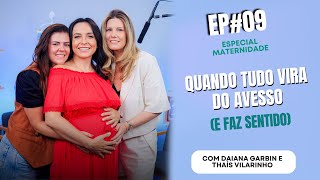
Isabella talks with Daiana Garbin and Thaís Vilarinho about motherhood, work, and self-esteem. They discuss how becoming a mother changes your sense of self and why having support matters when everything feels upside down.
Chapters
It's great to be able to have confidence in this exchange because we are all evolving. People ask me a lot. What was the biggest lesson I learned from motherhood? And without a doubt, it was, you have almost no control over anything. In pain, right? In challenges, we no longer realize how much we grow. When we don't have children, we kind of settle down. We kind of let things go. Let things go. But when we are mothers, they. There is no way around it. You have to grow. You have to educate that child. Hi, and welcome to Interioriza. You already know that this special season of motherhood is for us to exchange ideas for you who want to make better decisions that involve all of parenting. And this season was born from a challenge that I encountered while searching for information. And my guests today, also from a challenge, used the lack of information they found as an impulse to make their lives today an instrument to help other people. So here with us, we have Diana Garbihm and also Thace Velarimho. Girls, thank you. Thank you very much. Thank you. Nice to be here. How happy you are to be here with two dear friends. Let me tell you something, Face. Do you know how long I've been trying to get dawn on this show?
Do you know how long?
A long time.
Her and Obama. I don't know who it was. Harder. Yeah. So hard. Oh, I'm feeling really good now. But seriously, seriously, because this maternity season, in fact, the show has been going on for over two years. We've already invited Di for several phases, it's true, but we've never had our schedules overlap.
We.
We've never been able to. Really. That's the first topic of our conversation here. How challenging it is to balance what we want with what we should, with what we can, with what we can afford.
Right.
With the unexpected events that happen in our maternity ward.
Right?
Yes. Because the first time you invited me, I was very involved in my daughter's treatment. I remember I told you, issa, I can't do it now, and I can't. It's not because I didn't have time. I can't do it emotionally. So there's also that there's an agenda. There's your emotional availability to talk about something. There are a lot of issues, right? No, no. There's not much to talk about. Right. Okay. Imagine. Imagine everything. But it's interesting that you say that, because invitations will come all the time, but our maturity here needs to determine whether I'm able to or not. And every time Da said to me, issa, I Can't do it right now. I knew you were facing and overcoming challenges that, no matter how much you explain, are very difficult for a mother to understand. Right. All the stages you went through so that now you are calmer, I feel you are lighter, happier. But now, like Issa now. Now it's my time. Is everything okay with the moon now?
Everything is great. Yes. I think, Issa, that I can say without a doubt that I am living the best moment of my life. And this has a lot to do with all the suffering and learning that I have experienced in the last few years. So it is very curious how life imposes situations on us that we never imagined we would experience and how this can transform us and incredibly, paradoxically, make us happier, calmer. But I think that, like, calm was a new thing in my life. I was an extremely anxious person. Everything was for yesterday, irritated, extremely rigid, demanding. And then life has its way with you and shakes you up and says, honey, don't you control anything, my dear. Because we have this thing. I need to control everything. I need to. And motherhood has this thing that is very beautiful, right? Do you think you will control what will happen to you? You will control your children and face with children in their teens. Right. So I think people ask me a lot, what was the greatest lesson I learned from motherhood? And without a doubt, it was that you control almost nothing.
I think it is almost nothing, Right?
Exactly. Time goes by, right? Motherhood changes phases and we control less and less. Less. I'm sorry to, but that is the feeling we have. Okay, Thais, now tell me how you, as a speech therapist today, become one of the most active mothers. Right. In this journey of. I'll call it education. Right. Of our children. Thais, for those who are not familiar, she is the author of the book Me fora da Kaisha or Mais Fora da Kaisha Fora mei fora da Kaisha and recently released a wonderful film called Mara de Mais. In other words, what was the challenge that you faced? Did you face the challenges you faced to help other mothers today?
So my oldest son, Mateusz, he's 17, right. So 17 years ago, this thing we're doing here, which is so wonderful, didn't exist. It didn't exist. There was no talk about motherhood, especially about the beginning of motherhood, which is so challenging, right. That we get kind of lost there trying to find ourselves amidst the labor and breastfeeding, and we can't find ourselves. So no one talked about it, and I didn't understand and I tried to communicate with other women, and I would say, wow, it was so hard that morning. How was it? So at the playground, oh, everything's fine here. Everything's fine here. After that, I met two friends, right? I made two friends through motherhood, and we spoke the same language. I said, look, it's not just me. Why not talk about it? Right? If it's something that was an issue for me, right? That was distressing me at the time, why not talk about it? I think other women will identify with it. And that's what happened, you know? So more and more mothers started to come to the texts on Mother Outside the Box. And it's really good, right, for us to think from a place of vulnerability, of difficulty, to open ourselves up to possibilities. It's a lot, right? And some people say, oh, no, but what do you mean? Are you going to say that motherhood is difficult, but it's like everything in life, it has its good side and its good side, right? It's challenges. Why not talk about it? And it was a very good surprise. And it's really nice. Like, I've been on Instagram since 2014 until today, I'm talking and communicating with mothers. And so it's a beautiful purpose that motherhood has brought to my life.
Look how amazing. In other words, in the difficult times, in the challenges of motherhood, instead of playing the victim, you went out there and looked for other mothers. They started doing this when everything was a mess. Guys. So 17 years ago, right? Today, when you see these. 14.
14. Yeah, it's 14. No, 11. 11 years ago. Since I started in 2014, that's.
That's it. And then today, when you see these movements, you say, wow.
Wow. I think it's wonderful. I think there's always room for everyone to talk. Everyone has to talk because the more we talk, the more mothers benefit, right?
That's why this season exists, so that we can help other mothers with the challenges we're going through or have already gone through. I see here Mother Outside the Box, which is the best seller. That was the first one, right? It's the first one.
Then came this one, Mother Newborn we, which is more specific to pregnant women and postpartum women, which is the best gift you can give to a pregnant woman. A postpartum woman.
Will this be mine?
Of course.
Okay.
For sure. I already loved it. Mother Newborn, obviously. Then came imagine when I was a teenager. It's just that I have two teenagers. And it's been really cool to talk about adolescence because just like, no one Talked about the period. No one talked about adolescence in a frank way, right? Oh, no, my son does that to me. No, I'm not going to talk about it. But people, we. We have to talk.
We have to talk.
And so it's really, really cool to be talking about adolescence. It's close, right? To mothers, to teenagers. Anyway, for me, it's a really wonderful exchange.
And then the last one, the Kachula Mar de May, the Sea of Mothers.
Right. A fiction that I wrote with two very dear friends, Beatriz Inner and Ty's Poeta. The poet which talks about. It has a name, it has Mother in the title, but it talks above all about friendship between mothers. How powerful that is. Right? That you can have a participating partner, you can have a support network, but you have friends who are mothers who are going through more or less the same phase that you are going through. This exchange is like that, fundamental, very important.
Exactly. I've known Dia for a long time. The other day we went to lunch and it was an exchange like that. But it's such and such and such and such and such and such. Right. It's really good for us to be able to have confidence in this exchange and because we are all evolving, learning, Right? Exactly. I think that we have less and less sincerity in exchanges nowadays. Right. We. You see on social media how other people's lives always seem wonderful and perfect and everything works out. So when we have people close to us that we can share. Look, it's hard for me here. It's hard there in motherhood, in experiences. Yeah. And these relationships have an impact on our quality of life, on our mental health. That's great. It's been discussed by countless experts how much friendship and sincere relationships make a difference in our lives. Right? Absolutely. I. I think I've never had an episode with so many books here with, you know, with such powerful authors, because Ty has four and Donna has two. And just as Thace faced a challenge and put her experiences in books, Diana also faced challenges and then with her own body. So we're talking about Diana now. Diana, still Diana before she became a mother. Right. The first one, Making Peace with Her Body, which is a wonderful book. And I remember when you called me and said, issa, I'm not in a position to narrate my book. Will you do it for me?
Yeah. I'm the audiobook. Who likes audiobooks. The one who recorded the audiobook was Issa. First like this. I don't know a more beautiful voice. Right. Look, I don't know a more Beautiful voice. And you know, Issa, I don't know if I told you, Issa, I even went into the studio.
I went to the studio.
No, I didn't know, to record the zendo. The publisher wanted me to record it in my own voice.
And I just cried. I started reading the book, look, and.
I couldn't record it because it was such a significant pain in my life. Right. Well, anyway, many people don't know this story because I released this book in 2017. I had an eating disorder for over 20 years. So I lived a completely unhealthy relationship with food and my body. And I tell in this book, fazendo es posis como corpo. This journey of all this suffering, of treatment. What is an eating disorder? It is a book that has two parts, the suffering part and the journalist part, in which I interview doctors, psychologists, psychiatrists. So I am very proud of this book because it is recommended bibliography in postgraduate courses, specialization courses, in doctors offices. So it makes me proud, right? When health professionals recommend it. But I need to tell you about this vulnerability. I can't read this book. I can't relive, resent this pain, because I feel very happy, very light, very free nowadays, with my body and with food. And this is a pain that is part of the past. So now that the channel is going to be 10 years old, I thought I should write Making Peace with the Body too. But something inside me still pulls me not to go back to this pain. That's funny, right? I was talking to my husband the other day. Should I write another book? He said, of course, people want to know how it was. I said, but I don't want to. There isn't any yet.
Not yet. There will be a time, maybe, right? Yes, yes. There isn't time yet. And respecting this feeling is fundamental for it to be a pleasurable moment.
Yes.
Writing a book is not easy, we know that. So it has to be pleasurable.
Yes. And then in 2020, I launched pregnant on the Moon. In the middle of the pandemic, the perfect life doesn't exist, which in some way is continuity, because this book is everything I learned, everything I learned in my treatment, in the new job that I have. I know that your audience here has many people who are in transition, right? Career transition, life transition. In 2016, I made a big career transition with which, you know, we work together as reporters for Globo. And I resigned in 2016 because I wanted to talk about mental health. And I didn't think that on open TV at that time, there wasn't a space for that. So I said, well, I'm going to create my channel. I'm going to create my own program on YouTube. And I started ICU in 2016, initially talking about eating disorders. And then I expanded it to. Because I realized that the problem was broader than I imagined.
All the pain that mental health causes and the aspects that it involves. So it is a book in which I talk about all the issues that I needed to deal with within myself.
To find a path to healing, to develop as a person. Because at the end of the day, I think that we are here in this life to improve. Right, Issa? I think that we are here to learn from our mistakes, from our difficulties.
From everything that we don't like about ourselves and from everything that happens to us. Right. And I'm sure that those who are watching us are thinking something like, wow, but it must have been easy for them.
Uh huh.
Because we always tend to look at a pain that we still have. Right. We are not able to have more information, how easy it is to overcome. And let's see if you agree with me. The pain that doesn't bleed hurts twice as much.
Yes. The pain that no one sees. Right. Because she has a huge pain and.
Prejudice in the way others look at her. Imagine how hard it was for you to deal with all the challenges you were experiencing at the station where we worked.
Uh huh. Great. Because working in television requires a huge concern, a huge demand for weight, for your image, for always being impeccable. You know, I'm really happy when I watch television today and I see diversity, a variety of bodies, ages, skin colors, body sizes, young women. And because it wasn't like that when we worked there, we were forced to straighten our hair. And.
Then all that is in the past. Now let's talk to the mothers of today. Thais, what do you have to tell us? Of the three of us, you're the most experienced. Yeah. Teach me. What did your motherhood.
Change for Thai? What are the challenges with older children today? Oh, I think I was even writing about that today, like a text. How much motherhood is how much we in pain, right. In challenges, we don't realize, but how much we grow. Great. And motherhood has this power, right? Because like when we don't have children, we kind of settle down, kind of let it go, let one thing go. But when we are a mother, there is no way. You have to grow, you have to educate that child. You have to sew. Like it transformed me in many ways, you know? Yeah, yeah. Professionally, yeah. That's what you're talking about, anxiety, right? Of us being able to. Yeah, yeah. Make an effort to improve, right. This issue we have with our emotions, because they are seeing us, how we deal with life. And then they are a reflection, right? We are their example.
Have you become a better person after Mateusz and Tomas?
Absolutely.
You, you have this awareness for everything like that.
And as a friend, as a sister, and as a daughter too. Because I think that we get to a place where we understand our parents, you know, understanding what they gave us, the best they had to offer, right? I think that when we don't have children, we judge them a lot. Oh, my mother could have done this. My mother could have done that. My mother could, right? I had this question. My mother was always a teacher, she always worked. My mother could work less to spend more time with me, Total. And then today I see, I said, people, how selfish we are, right? With our parents and everything they offered us. So I think we improve in so many aspects. And then I see here in adolescence, I'm even writing a text about it, right? Because I think I see many mothers of teenagers today who are very insecure and such. Geez, how come we don't believe in ourselves? How come we don't believe in what we did there, right? In this whole path there of childhood, right? Babies and childhood. Why don't we believe in ourselves? Why are we doubting so much? Why do we think we don't have the power to communicate with our children? Why? Right. It's a very adolescent issue that I think mothers are very afraid of, very worried about. Of course, we have challenges that our parents generation didn't have. Exactly. But like, we can't lose that, man. Like it's with us. It came from us. We went there, we did so much, right? We. I close my eyes here, I remember Thais there with a baby in my arms. And then with a child with all the things we were talking about, with the challenges of education. Wow. I did it. I'm here with a teenager, man. I'm going to make it. I'm going to do it. So I think this is very important, right? For us to talk to them because. Exactly. Because the teenagers, the mothers are going through a hard time because of the screens and everything, right? It's just that I think, okay, that we are living in a period that is very new for all of us, because come on, Instagram started in Force in 2010. So before that there was Facebook, those things. But the way social networks invade and permeate our lives today started 10, 15 years ago. I think we are the first generation, like, who has children in their teens today, who is dealing with this. Because in ours, I had contact with the Internet. I was already 18 years old when the Internet arrived in my city. So, man, we are all lost without knowing how to deal with this. If we stop to think, we who are women over 40, sometimes we also use the Internet too much. We get lost in the feed. So it's not that there. And what teenagers are doing and what we are doing, how are we managing ourselves? How do we. So it's a new world for everyone. And it's scary. Everything that's new is scary. So I try to read, I try to study, because I don't really know how to do it either. And. But I like what you said about us trusting our instincts, trusting the relationship we build with them since we were little. Because, funny, when I entered adolescence, which started with this thing of wanting to have a boyfriend, of starting to discover my own body, I would ask my mother. I had that. I felt it in her, not in my father, who was very angry, never. But I had the safe harbor. I knew I could ask her things because she always seemed open to me. So that's what I think. I want for my daughter to feel like a safe harbor. This is built in childhood, right? It's all built up so that he can reach adolescence and say, mom, look, I kissed a girl. Mom. I'm feeling this, mom, right? You're going to bring it really cool.
And I'm sure it will. Because you keep this path free without judgment.
Yes, exactly. Of course it's not perfect. Of course. Teenagers have things they won't talk about, right? We were teenagers once, but I think.
Teenagers, exactly. I've never lied, I've never gone without telling a party that I went to in secret, right? I've never been in secret, of course.
But I think there are things that are crucial, right? I think it's more of an emotional place. For example, if something is happening at school, if he's suffering, if something appeared on the Internet for him, someone calling him. So these things are crucial. I think that having the confidence that you will talk to your mother, that your mother will listen to you, right? That she will help you solve that problem, that you don't know how to deal with, that is essential. It is very important they come. That's great. I'm very happy.
In other words, our guests have faced challenges and used those challenges to help other people. When I ask you, do you feel like a Better person after the two? Yes, a lot.
So what is it like after the moon? Wow.
I feel like a different woman. A different woman. And it started during pregnancy.
Right.
Because of all the problems I had with self esteem, and I usually use a term that is self worth.
I didn't value myself at all. I didn't. I felt that I had no value as a person, as a woman, as abilities. It was a lack of self esteem and self love. Impressive. Well, having given birth to the moon, having fed the moon through my milk, gave me a feeling of the power of nature, of being a woman of self confidence. You. No. Yeah, yeah. It's funny like that. It's like, I can do it. I managed to do it. I gave birth to a child. So when I talk about feelings of incapacity, of inadequacy, of not being capable, I had a lot of pregnancy, and the first year of the moon gave me a feeling of, I am capable. I am capable. I gave birth to a child, I fed a child. And so I never imagined that pregnancy would bring me this. Because I wasn't a woman who dreamed of being a mother. Since I was little, I dreamed of having professional success. I dreamed of making money.
Our story is very similar.
Yeah. I never in my life played with dolls and dreamed of having a baby. And I didn't. Diana wanted to make money and have professional success and have this independence. My mother raised me to be an independent woman in this way. So being a mother was always put off until later. So much so that I became a mother at 38. Right. And so curiously. And I was very afraid of being a mother. And then one day I read a phrase that said, wherever your fear is, there will be your greatest learning, your greatest achievements. And for me, that was it. Motherhood brought me an avalanche of self love, self esteem, self worth, and on the other hand, also self compassion and acceptance. Because I soon realized that I would never be a perfect mother, that I would never be able to handle all the demands, that there were days when I cried from exhaustion and tiredness. And I had a wonderful postpartum period. I had, like, the postpartum period of the moon was the happiest time of my life. Many women experience, you know, postpartum depression. And I was very afraid because of my mental health history.
And the first year of the moon was the happiest year of my life.
And then look how life is. When she was 11 months old, we found out she had eye cancer, which is called retinoblastoma. So all this to tell you that life is completely unpredictable, impermanent. Because look. Look at what I told you. The biggest fear of my life, everything.
I put off came to motherhood, transformed me. I felt like a confident woman. I was living the happiest moment of my life. Now it's going to happen now. Now I'm going to achieve everything. Then life comes along and gives you a setback you never imagined you would experience. And this strength you felt was extreme for you to deal with everything you.
Had with the treatment. Wow. Yes. Great. You know that today I'm rereading the Perfect Life Doesn't Exist because I have a project to take lectures all over Brazil. So I'm writing new lectures, scripts, and I read and I have. I am a woman of great faith. And I am sure, Issa, that it was God who guided me to write this book, showing me everything I needed to learn to be able to endure my daughter's treatment, the strength I needed to have to guide this little baby through chemotherapy and many surgeries. So this book is God preparing me for the challenge that would come. I can only believe in that. The time to write is for self knowledge, right? You need to go inside, you need to look at your issues to be able to write. Wow. It's incredible.
It's exciting to hear from you. Die because we will experience everything we will experience to guide other people today. How many children does the Olho Knows Olinos NGO help?
Yes, we are. I don't know the numbers right now. The Olho Knows Olinos ngo, right? Yes. We started the Olho Knows Olinos campaign and then we created the NGO because we began to understand that families had little access to information. Retinoblastoma is a very rare disease, so no one even knew what it was to get a diagnosis. And when the family gets the diagnosis, the treatment is very specific and it is not available everywhere in Brazil. So families were lost, unable to get the appropriate treatment, and the cancer progressed. Unfortunately, we still have a situation where children die without medical care because they cannot find referral centers to treat them. So my husband and I decided that we needed to create an institution that could guide these families. So our work today is for families who receive a diagnosis of retinoblastoma or suspect they have seen some sign in their child's eye. They send us an email and we help them. We quickly find a doctor to treat the child in their city. If it is diagnosed as retinoblastoma, we find a referral center as quickly as possible for the child to receive treatment. Either near their state or if there is no referral center, we bring the child to Sao Paulo. So I usually say that I cannot accept that in my country, a child with retinoblastoma does not have the dignity of receiving the same treatment as my daughter. I cannot accept this. I will not rest. We receive treatment through the sus, a quality treatment, all free of charge, the same as the best treatments in the world. When we receive the news, we research the world over, because, thank God, we would have the privilege of treating my daughter anywhere. And here in Sao Paulo, I can tell you that at GRAAC we receive treatment the same as the best reference centers in the world. The United States, Japan, wherever retinoblastoma is treated this way. So we will not rest. The children in our country will have access to the same treatment as my daughter. And that is what we are trying to do. Let's give it a round of applause, right, guys?
Yes. I need to acknowledge that you use the same verb to guide families, right? Because imagine if there is an eye problem. What we need is help and guidance. Because it is not only the children who have eye problems. Parents also fail to see any hope.
When they do not have information.
Of course. Look. So it is great that you are doing this work. I remember that you gave an explanation. I wanted you to repeat it for the mothers who are following us. In a photo, you can already see some change in the little eye, right?
Yes. Retinoblastoma causes what we call. Doctors call it leukoya, which for us, layman, is as if the child had a cat's eye. It has a white reflection. When you take a photo, our pupil should be red. Hmm. Red is healthy because the back of the eye is red. So in a photo, with a flash, it should come back red. Cat's eye. When the child has some disease, it turns white, so it has a different reflection. Sometimes the child has irregular eye movements, sometimes strabismus. And a crooked eye can be a sign of retinoblastoma. So the advice we always like to give to families is that any change in a child's eyes should be taken to an ophthalmologist. Because it could be just something easy to fix with glasses, but it could be a more serious disease, not just retinoblastoma. We have countless diseases that can make a child blind. That's why the main message for you who are watching us is to give to everyone who has a child. You have to take your young child to an ophthalmologist in the first year of life. The baby, the first one born before the age of one, needs to be evaluated by an ophthalmologist because this can save the child's vision. We have thousands of blind children in Brazil eisa due to preventable diseases, because their parents simply didn't know that they had to take them to an ophthalmologist for a diagnosis.
So I understand you. I've been the godmother of a ballet company for the blind which is part of the F.A. bianchini association for 10 years. Wow. You've been doing this work for a long time, haven't you? For 10 years. 10 years ago I was in the newsroom. I went to do this work to cover it. Imagine that it was the first ballet company for the blind in the world. There you go. Wow. That's awesome. It was very exciting. From the moment I first met them, I was so impressed. Okay. Fernanda Bianchini. By the way, the association is celebrating its 30th anniversary this year.
How cool.
So what are you saying? Yes. In fact, how many people today do I see who got there when they were very young or children, and who could have had a different outcome, but for lack of information.
Yes. And access to a doctor.
How are they now? There you go. Can you imagine if Mrs. Donna and Mr. Tiago had remained in the victim's chair, saying, my God, why did this happen to us? My God, why did I think about it? Let's not talk about it thinking about it, because we question ourselves a lot. But why is this happening to me?
Yes, yes. Issa. In the first few months, I didn't. We weren't in a position to say anything, because you're completely devastated. At first your world falls apart, right? You're in shock. I went into denial in the first few weeks. I told Thago the doctors are wrong. It can't be. You'll see tomorrow on the mri there won't be anything. The doctor made a mistake. Imagine our daughter can see everything. She's perfectly healthy. Then the MRI shows two tumors the size of an olive in each eye. And Ciaba would say to oh, it's here. He would say, but she's going to have a chemotherapy session. She'll be cured. I would say it took me three or four months to understand the seriousness of what was happening. Uh huh. And again, I'm sure it was God protecting me from unbearable pain. Huh? Because this mother needed it. And I needed strength to, as I always say, all the chemotherapy sessions in the moon were surgeries with general anesthesia uh huh. So a mother who has already given up a child for general anesthesia knows what I'm talking about. And how many surgeries has she performed? Oh, many, Issa. She has performed many. I haven't even lost count. Because all the exams for the child, for the baby who is undergoing cancer treatment, require general anesthesia. Wow. Because a baby can't stay still for an MRI. How can a child up to 5 years old stay still for an hour in an MRI machine? So that's why right at the GRAC hospital, you need to anesthetize the child for the exams and in the case of retinoblastoma, for chemotherapy. So I remember very emotional situations when I would, right. Go to the surgery table with her on the stretcher in my arms. Uh huh. And I was singing as if we were going to a party so that she would be happy, so that she wouldn't cry, so that she wouldn't get upset. I was terrified. And I was going, I'm going to get emotional. And I was singing and I was saying, daughter, it's going to be great. I was singing and when I handed her over, she was asleep with anesthesia. I. I broke down because there, you know, you see a child so small. So I needed that strength. And maybe that's why it took me so long to understand what was happening. And then when I understood the gravity of the disease, right. Its seriousness, the possibility that there was metastasis, which unfortunately is what happens when retinoblastoma leaves the eye. It metastasizes to the brain, to the spinal cord, and that's how children lose their lives. So it's a very serious disease. And then in January, we were diagnosed on September 29, 2021. In January 2022, my husband said, well, until we talk about it, there's a tumor growing in a child's eye and the mother doesn't know. Wow. How did he convince me with that sentence? Because I said, no, I can't afford it. It's going to be everywhere. The media is going to write about it everywhere. I don't know what they're going to do with our daughter with this information. I was afraid of her exposure. I was afraid of how this would happen. You know, I'm very concerned about Lua's privacy. And of course, even so, doing the campaign with her eyes on her eyes is something that always brings me ambivalence, which I know we need, that it's important to alert the family. But I'm always worried about my daughter's Exposure. That's why you can see that I rarely post anything about Lua. Yes. At the same time that I need people to know about the information I need to protect my daughter from exposure. So as everything in our life is ambivalent. But how beautiful this is, right? That you talk about ours. It touched me that you started singing, guys. This is your mother, right? I'm a mother, guys. How beautiful. Wow. I was singing and we would take her little toys and stay. Because, like, the child doesn't know what's going on, you know, she's in a hospital. She had surgery, but she wakes up under anesthesia. She was 11 months old, guys. So we would take little toys, little music. Then as she grew up, you know, the treatment went on for almost two years. She already understood a little better. So then we had to distract her even more and take toys. And I have such admiration for mothers who go through any difficult treatment with their children. Because the child's suffering is immense. The more she understands, the harder it is. And the family's suffering is inexplicable. Because I would say to God, for the love of God, put this disease on me. Take this away from my daughter. Right? We see a child suffer. Seeing a child go through things is very difficult.
Yes. And children will react with our emotions. If you have then even though you are there acting, and then at that moment we have to act, and then you are thinking about the child's well being. She doesn't have the repertoire to do things differently. Yes, yes. Thais. Before we wrap up, I wanted to understand what kind of box you wanted to get out of. Right. More than 10 years ago. Because today your texts and messages come with the title Mother outside the box. What kind of box do you want?
Look, I think I identify so much with dy. And that's why. Right? We identify a lot because it's a lot about getting out of perfection. Okay? Right? About wanting to be a perfect mother who can handle everything, who does everything perfectly. A mother who doesn't exist. Right. A mother who isn't human. So how much do we. I. I feel how much I sought this in the beginning, you know? A. No, I don't need anything. I don't need help. It's okay, I'll keep doing it. I'll do whatever. I'll do it. And we need to get out of this. Right? I think that for us to be able to be happy, a A not just motherhood, like Da is saying here, right? The perfect life doesn't exist with life if we don't get out of this box. We won't. We can't be ourselves, right. We can't accept our flaws, our difficulties, and then we don't grow.
Yes, obviously.
Because we keep hiding, right?
And what's more, and I always say that we don't grow and we get.
Sick, we're all going to start losing our mental health and then it's going to be a whole other thing, right? That's what happened to me a lot in the beginning. I think I got sick a lot because of that, right? Because I thought I didn't need help, because I wanted to do everything perfectly. Because. And then I went. I think I got sick. That's why I needed to get out of this box. And I needed to tell other women to get out of this box, right? Because what you said, only what happens to me. No, no. I want it to be worth it. I want other people. Right?
What did you feel when you swallowed your emotions? Can you be clear?
Oh, oh, I swallowed that. That, that, that, that. That. Real ties to the detriment of a ties who had to fit in with that suffering. Right? And then when we discover this, we. I think that this comes a lot with motherhood. We see it like this, right. I think motherhood brings this power, right, that Da was talking about. Wow, I breastfed, I gave birth. And over time, we think like this, man, I'm capable of anything. What's this? What am I ashamed of? I'm worried about other people's opinions because what are they going to say? Oh, okay. I write the texts, right? So of course, in the beginning it's always someone else. Oh, but what are you doing on the Internet? I write. That's what I say. That's what I want to do.
You are a communicator. DAI is a communicator. And we are communicating a message that needs to be spread. We right through all the channels. We have the possibility because there are a lot of mothers suffering inside a box. Of course. Before we wrap up, I recently received some information, Dr. Draws de Varela, that I need to share. Take this. Let's see if it changes your answer. Dr. Dreo. Meet me there, Doctor, because then I'll start showing off, right? 44 years old. Look at my beautiful belly. He said, Isabella, a study came out that mothers who give birth after 40 live longer. That's really beautiful. Do you think about having more children, right?
No, I don't. I'm already in perimenopause and I don't think about it. But I really believe in this because it gives us strength. He explained.
No, he just didn't manage to give me the full study yet. Let's Go back now, Dr. Brausce. Let's go look. But hehehe. He says, he says, he says women. A study came out that women. And it was so spontaneous because I was like, huh? Or are you ready? The message gets through, right, old man? Yes, I know my responsibility has increased a lot. Being pregnant for the second time after 40. And it's incredible because after you take care of your mental health, it's amazing how the body works.
Yeah.
Oh, right. I see many women in a lot of suffering trying to get pregnant because they have a tremendous level of stress and cortisol. And that total inflammation is going to be. It's going to be. It's going to be more challenging. Right. So that everything flows. But then Dr. Droz arrived and I said, women who gave birth after 40 lived longer. Look, do you think about having more? Not me. I'm so happy. Absolutely sure. Oh, I'm already 43, right. I'm going to be 44. But I'm tired. Boy, I admire your disposition. No, I'm very tired. I was born tired. My mother says I was born tired. So look, since this is a subject that divides a lot of opinions, I'm going to share with you something else that also caught my attention. Because when I was single, or if I was in a relationship and still had doubts, we look for so much information outside and don't take into account the information inside. Then I discovered that there's a test, right? It's not a test, actually. Oh, by the way, it's a digital ovulation test that lets you know when you're ovulating.
How cool.
So for those who want it, here it is. Take the test. Hey, it's today. And for those who don't want it, no matter how much you use it, no matter how many other contraceptive methods you use, you will empower yourself. That is, you will take control of what is happening in your body that you are not sure about. Yes. I thought this was fantastic. A technology for our benefit, so you can make decisions with more certainty. Imagine us when we were single, when we were still trying, right? Like, is this the right person or not? We have already put ourselves in situations that we regretted. Obviously.
Yes, everyone. Right, Right.
So for me, being ovulated will give you a lot of freedom, you know? Definitely.
Today, don't even think about it. Or it's today.
Or it depends, right? Today, don't even Think about it. Or it's today. Oh. Before we move on to our final considerations, I would like to thank Priscilla Pacifico, who helped me, along with Sanjos de Ninher and Jew Butler, make this scenario. So cute. Did you like it? It's so cute. So cute. And clear Blue is with us. So bringing this information that will help other mothers make decisions.
It's great.
In addition to your books, the EU Viho Channel is the most beautiful thing, because when I see you here.
Huh?
I feel the love in the air. Because you chose me. You chose this time. Right. So I'm very happy to see you here.
Yeah.
And the EU VIHO channel turns 10 next year.
10 years already. 10 years, Issa. Can you believe it already? Yeah. Then I think, wow, what a challenge, right? Ten years ago, to start talking about mental health when nobody talked about mental health. Right. And. And, and I'm very happy to see how this topic has gained visibility. Of course, there is still a lot of prejudice and a lot of judgment regarding mental illness, because as we said at the beginning, nobody questions the pain of a broken leg. Unfortunately, we human beings question the pain we can't see. Yeah. Yeah. So it's how important it is to talk about this, because I usually say, if we don't have mental health, we have nothing. Nothing. Nothing. Because there is no such division. I was just talking today on the way, saying that when we get nervous, you don't feel your heart racing, your mouth gets dry, you tremble. So emotions cause physical sensations and people think they don't. People don't understand this properly. So, like, having health as a whole, what does it mean to be healthy? Being healthy also means having mental health. It's not possible to divide this. So I'm very happy with the direction the world is taking, with people allowing themselves to look at their pain, to embrace it. Because anyone who has gone through a mental issue knows that it is a pain that paralyzes your life to a great extent and affects all aspects of your work, your mental health, your relationships, your children. So it shouldn't be a privilege to take care of this, right? It should be everyone's right. I think this is our battle now for the coming years, so that all people in our country can have access to this care, to this information. So congratulations on the work you've done. It's really beautiful. And thank you for giving us this space here to talk a little bit with these mothers.
So I'm watching the ngo. Olho knows, Oli knows the books, and now the lectures this year, I'M going to start giving lectures. Hey, if anyone's interested, send me one. Including international ones. International ones. My first international lecture this year. Wow. I'm so proud. So proud.
And you face are May fora da Kaixa, Right? My Instagram. I'm always there. I'm going to launch my book May fora da Kaixa in Portugal now at the Lisbon Book Fair in June. I'm super happy. I have the short Marda Maze, but I'm always there talking to my readers. It's always a very open channel there. We exchange a lot there. They're at Mei fora da Kaisha.
Mei fora da Kaisha. I'm seeing it here, right? Hey, Dai launched it through Sustante. I love Assistante. And you launched it through Buzz too. I really like Anderson from Assistante. So, a kiss, right? To all of you who also believe right. In our work and they help us share our ideas in books that change many decisions, many, many outcomes.
Yes, right.
I think we have to get closer to those people who help us change the outcome of any situation. So, Thais, thank you very much. I hope it goes by too quickly. Good times go by too quickly. And to you who have followed us so far, thank you for your time and trust. If you understood that this message made sense to you, also share it with those you care about, with those who can benefit from these experiences that I am sure will help other people make better decisions. Until the next episode.
Bye. Bye.
This episode is sponsored by Clear Blue, a PG brand.
Turns 10 next year. 10 years already. 10 years, Issa. Can you believe it? Already? Yeah. Then I think, wow, what a challenge, right? Ten years ago, to start talking about mental health when nobody talked about mental health. Right. And, and, and I'm very happy to see how this topic has gained visibility. Of course, there is still a lot of prejudice and a lot of judgment regarding mental illness, because as we said at the beginning, nobody questions the pain of a broken leg. Unfortunately, we human beings question the pain we can't see. Yeah, yeah. So it's how important it is to talk about this, because I usually say if we don't have mental health, we have nothing. Nothing. Nothing. Because there is no such division. I was just talking today on the way, saying that when we get nervous, you don't feel your heart racing, your mouth gets dry, you tremble. So emotions cause physical sensations and people think they don't. People don't understand this properly. So, like having health as a whole, what does it mean to be healthy? Being healthy also means having mental health. It's not possible to divide this. So I'm very happy with the direction the world is taking, with people allowing themselves to look at their pain, to embrace it. Because anyone who has gone through a mental issue knows that it is a pain that paralyzes your life to a great extent and affects all aspects of your work, your mental health, your relationships, your children. So it shouldn't be a privilege to take care of this, right? It should be everyone's right. I think this is our battle now for the coming years, so that all people in our country can have access to this career, to this information. So congratulations on the work you've done. It's really beautiful. And thank you for giving us this space here to talk a little bit with these mothers.
So I'm watching the NGO Olho knows Oli Nos, the books and now the lectures. This year I'm going to start giving lectures. Hey, if anyone's interested, send me one, including international ones. International ones. My first international lecture this year. Wow, I'm so proud. So proud.
And you face are Mei for a Dakaisha, right? My Instagram. I'm always there. I'm going to launch my book May fora da Caixa in Portugal now at the Lisbon Book Fair in June. I'm super happy. I have the short Mar de Maze, but I'm always there talking to my readers. It's always a very open channel there. We exchange a lot there, there at May fora da Kaisha.
May fora da Kaisha. I'm seeing it here, right? Hey, Dai launched it through Sustante. I love Assistante. And you launched it through Buzz too. I really like Anderson from Assistante. So a kiss, right? To all of you who also believe right in our work and they help us share our ideas in books that change many decisions. Many, many outcomes.
Yes, right.
I think we have to get closer to those people who help us change the outcome of any situation. So face. Thank you very much. I hope it goes by too quickly. Good times go by too quickly. And to you who have followed us so far, thank you for your time and trust. If you understood that this message made sense to you, also share it with those you care about, with those who can benefit from these experiences that I am sure will help other people make better decisions. Until the next episode.
Bye. Bye.
This episode is sponsored by Clear Blue, a PG brand.
More from GHION.AI


O processo de reconhecer limites, mesmo quando a vida parece exigir sempre mais.





Depois de tantas histórias, aprendizados e pausas necessárias, o @interior_iza está de volta



