Sal Khan: Education Reimagined [Entire Talk]
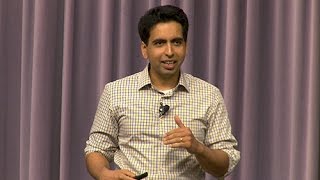
This content was created by GHION.AI . This content was uploaded by GHION.AI . This is a YouTube video titled "Sal Khan: Education Reimagined [Entire Talk]" created on April 21, 2014. It features Sal Khan discussing the evolution and impact of Khan Academy, including its origins, growth, and influence on education. He shares personal anecdotes, the development of the platform, and its use in schools and by individual learners. The talk highlights the transformative potential of Khan Academy in providing a free world-class education to anyone, anywhere.
Chapters
It's always great to be here. And I actually do like to start just kind of getting a gauge of where everyone is. So I saw how many of you all were students, actually would be more. How many of you all are not students might be more interesting. Okay, so there actually are. And how many of you all are undergrads? And how many of you all are grad students? Okay, that's interesting. And how many of y' all have used Khan Academy at some point? Oh, okay. And how many of you still use Khan Academy Every now and then and. Okay, that's good to know. And how many of you have no idea what Khan Academy is? There's always somebody. Okay, good, good. No, that's good. I'll talk to you. So, as I guess a lot of folks know, Khan Academy, it's associated with these videos. But hopefully what we'll kind of talk about over the next hour or so is that it's, at least in my mind, much, much more than just videos and will continue to be so. But to get everyone on the same page, I will start with this little montage of videos just so people get a feel of what they look like. All these interactions are just due to gravity. This is an age right after Isaac Newton. I'm told the humidity makes it feel hotter. Why is this? Excellent question, LeBron. Can you determine which light bulb is being switched? Things actually can interbreed, although for these two in particular, it seems like the mechanics would get kind of difficult. I can keep playing around with these numbers and see what kind of colors I can come up with. If this does not blow your mind, then you have no emotion. Let me back up. So those are the videos, but as I mentioned, it's. It's much more than just videos. This right over here is our computer science platform that we launched about two years ago. And it's really. Our thinking was, well, can we show people the creative side of computer science, where it's not reductionist, what's a for loop or a variable, but really build portfolios, create games, screensavers, explore mathematical concepts, whatever else. This right over here is kind of, I would say, the meat of our experience, which is students can pick missions to work on in mathematics, they can work on their skills. It starts to build a statistical model of what they know and they don't know. It suggests exercises that are appropriate to the students. The videos are there in case the student might use it when they're done. They get this mission completion. There's all sorts of game mechanics around it, and we'll talk more about where all of that stuff is going and what other types of experiences we have in the pipeline, so to speak. But before I go there and before I talk about how all this happened, this is kind of a snapshot of where we are right now. It's being used in some way, shape or form almost anywhere. 10 million users every month. 300,000 teachers are using us in some way. At least they've been registered as teachers. And we just crossed the 2 billionth exercise done on Khan Academy. There's about 5 million a day. But I'll rewind back to, I guess, the humble beginnings of this. And it's fun to talk in this area because all of this happens, happened not too far from here, or at least eventually happened not too far from here. If you REWIND Back to 2004, I was a year out of business school. I had just gotten married. Family was visiting me out from New Orleans. This came out of conversation that my 12 year old cousin Nadia was weak in mathematics. I asked her what was going on. She took a placement test at the end of sixth grade. She says it had unit conversion on it. She had, she gets confused by unit conversion, ounces to gallons, miles to kilometers. And because of that she bombed it. And they placed her into a slower math track. And so I told her, look, I think with a little work you can get up that curve. And I don't think she or her mom fully appreciated the implications of being put in a slower math track in sixth grade because that kind of carries with you the rest of your life. And so I said, and I'll tutor you if you're up for it. And so Nadia agreed. She goes back to New Orleans, I'm in Boston, we're on the phone every day, half an hour every day after work, after school for her and we start working with each other. And first few weeks kind of painful. She'd psyched herself out. I'm not good at math, I can't get this stuff. But slowly but surely, things started to click. About a month into it, she started to get unit conversion and kind of catch up to where her class needed, where her class was. And then she got a little bit ahead of the curve. I started teaching her some algebraic concepts and things and. And at that point I became what I call a tiger cousin. And so I called up her middle school and I said, I really think Nadia Rehman should retake that placement exam from last year. They said, who are you? I'm her cousin. And they actually did let her take it and she did very well. And she went from the slow track to the advanced track. And so I was, you know, and we continued to work together and I was like, wow, you know, I didn't have. That was a very small intervention I did. And it had an impact on Nadia's trajectory. So I was kind of hooked. And so I started working with her younger brothers. And then a bunch of things happened over the next roughly two years. First, my boss, you know, the firm I was working for, and I use the term very generously, it was my me, my boss and his dog. The dog was the chief economist, small hedge fund. And my boss's wife just took a position as a professor at Stanford Law School. And so because of that, we moved the firm out here. We moved out Silicon right on Sandhill Road, that kind of five story building right next to the Safeway over there. And the other things that happened was word got around in the family that free tutoring was going on. And so I found myself working with 10, 15 cousins every day after work and school for them and to help myself kind of scale up a little bit. My background was in software. And I think anyone who's ever dabbled in software has always fantasized, well, this could be really useful for education or to give people practice problems or whatever else. And I'm not the first person to think that. And so I started writing this little exercise generator for my cousins. Just give them as many problems as they need. If they needed help with something, it would give them hints, give them solutions, put a little database behind it so I could keep track of what they were doing. I had to put it on. It was a web app. So what domain name is available? And after a long time I said, well, it's just me and my cousins. Khan Academy is available, I'll call it that. And it kind of sounds like something real. And so I did that. And you fast forward so all the way. So now I'm living out here and actually I literally used to ride my bike through campus every day on the way to work. And I was at a friend's house, this is November 2006, and I was showing everybody all this stuff. All my friends knew that I had this crazy project with my cousins. And I was showing the software and everything. And one of my friends, his name is Zuli Ramzan, and he said, well, this is cool Sal, and this is neat software and everything, but I only have one question. How are you scaling up your tutorials, your lessons? And I said, no, you're right. This is really hard. What I could do with just Nadia or just Nadia and her brothers when there was one, two, or three people, I can't do now with 10 or 15. I'm doing these crazy conference calls sometimes. One week, Sasha asked a question, and I had already covered that the week before with, with Ali. And so Zully says, well, crazy idea. Why don't you just record some of your lessons as videos and upload them onto YouTube? And I said, no, that's a horrible idea. YouTube is for cats playing piano. It's not for serious mathematics. But I went home that weekend, got over the idea that it wasn't my idea, and I decided to give it a shot. And those first few videos were on pre algebra, basic algebra, whatever else uploaded them. I started telling my cousins, hey, look, here's some of the concepts that I think you all have asked a lot of questions about. So why don't you review them or get introduced to them through these videos? And then when we get on the phone, we can dig deeper. And after about a month of that, they gave positive feedback. They said that they found it really valuable and to the point that they even said that they liked me better on YouTube than in person. And on a whole bunch of levels. That's a completely counterintuitive comment that somehow the virtual on demand version of a cousin could be better than the real thing. But what they're really saying is that the first time you're being exposed to a concept, you don't want someone who might be judging you or is waiting for you to understand it. You want to be able to ask the silly questions without judgment, watch something over and over again. What they weren't saying is that they didn't appreciate me in their life, that they appreciated that I took interest, that I was trying to motivate them, that I was trying to give them the bigger picture, that I was there to answer questions that they had. So I took that as positive feedback, kept making more and more and more content, and as Obviously, it's on YouTube, it's public. And it soon became clear that people who are not my cousins were watching. And the initial comments, there was just some thank you that started coming in. And even that's a big deal. I don't know how much time you'll spend on YouTube. Most of the comments are not, thank you. They are something a little more colorful than that. But then I started getting comments, hey, I've just retired from the military and I want to go back to college. And this is what gave me the intellectual bridge to re engage and do college level mathematics and got letters. This is the reason why my child with a learning disability is able to engage in school. This is the reason I'm passing algebra. This is the reason I didn't drop out of high school. There's really intense things. I got this letter in those early days. This was 2007. It was like a year into it. I brought my wife. I was like, this is incredible. This mother, both of her sons had dyslexia and said, these videos are the only thing that's connecting with them. They like the handwriting and they like the narration and. And because of what it's doing for their family. Her whole family prays for my family every night, which is heady stuff, put things in perspective. I was an analyst at a hedge fund. There wasn't a lot of prayer or a lot of praying for us at least, or at least in that way. So you can imagine this was an incredibly satisfying just hobby for me. But then you fast forward, obviously the traffic keeps growing and growing and growing. And the videos kind of take a life of their own. They were initially there as kind of this supplemental thing for my cousins, a thing to complement this software thing that I was working on. And I was still working on the software, but the videos started taking more and more of my time. But you go to 2008, at that point, there were probably several tens of thousands of people using the videos every month. At that point, I still didn't think this was what I was going to do for my life. I actually liked my career kind of being a investment manager, analyst, whatever you want to call it. But I did set it up as a not for profit at that point, thinking, oh well, maybe I could get some donors and maybe we can get enough funding to hire a small team just to start working on this in a more substantive way, maybe working on the software part of it. But then by 2009, at this point now, we had on the order of about 100,000 people who were using the site every month. And I frankly had trouble focusing on anything else. This is what I was excited about. This is what every cycle I was like, what's the next video I could do? How could I make this better? How could I cater to these requests that I'm getting from users? My wife and I, we looked at our financials and we had some savings, but it was essentially for a down payment on a house here, which you all know is not a simple matter. But we said, well, look, this looks like there's something here. And it looks like the time is right. Let's give it a year, essentially, live off of savings and see if we can get this not for profit off the ground. I think all entrepreneurial beginnings, whether they're not for profit or for profit, they do start with a little bit of this wildly optimistic, maybe even delusion, because you do get data points. A lot of people say, oh, this is great. This is great stuff you're doing. Oh, you should talk to us. We might be interested in funding it. And so that gets you really excited. But then you start the meetings and you have all these great meetings, but then you start to see a pattern that, wow, a lot of people like this, but it's not quite what they invest in. It's not quite what they fund. This is a different thing than they do. And that kept happening for the next several months. And as you go into the spring of 2010, I started to get worried. We were digging. My son had just been born. We were digging into our. We had to move into a house with higher rent. We were digging into our savings, about $5,000 a month. And I was getting five $10 donations on PayPal. It was amounting to about $500 a month. And if it was any of you, thank you. But you can imagine it was a fairly stressful thing. And I was starting to wonder, could I even go back to my old job? What will they think? And all that. But I did, even in moments of weakness, start updating my resume. But then all of a sudden, a $10,000 donation came in. So I immediately said, what's going on here? And I see her name is Ann Doerr, based in Palo Alto. I immediately email her, and I said, well, thank you so much for this incredibly generous donation. If we were a physical school, you would now have a building named after you. Ann immediately emailed back. She's like, well, you know, I'm local, and I've started using your site with my daughter. I also use it myself to understand. I had all these videos on the financial crisis and economics and whatnot. I'd love to learn more about what you're up to. And so I think it was like, three days later, we meet in downtown on University Avenue at an Indian buffet restaurant. And Ann asks me, so what's your goal here? And I say, well, look, when you fill out the paperwork with the IRS to become a not for profit, there's a line that's mission colon. And I guess a line or a line and a half. And I filled out A free world class education for anyone, anywhere. And Ann says, well, that's ambitious. How do you see yourself doing that? And I told her, this is just, this is a mission. It's not like I don't plan to just check it off tomorrow and then move on to healthcare or something, But I think we can make a lot of progress. I showed her screenshots of the software. I said, in my mind, it's not just about videos. We obviously could do a lot of videos, we could translate the videos, but it's more than that. We have to create interactive experiences. Ways for students to get feedback, ways for students to connect with each other, ways for students to work on projects, kind of, you know, I only dreamt about the computer science stuff at that time, ways for them to tutor each other. And Ann says, well, you know, somewhat surprisingly, you've made a lot of progress here. I only have one question. How are you supporting yourself? And in as proud of a way as possible, I said, I'm not. And Ann kind of processed that. And we part ways. And 10 minutes later, I'm coming into my driveway in Mountain View and I get a text message from Ann and it says, you really need to be supporting yourself. I've just wired you $100,000. So that was a good. And you know, things started just getting crazier and crazier from there. You fast forward about a month. You know, I was this virtual teaching, video making guy, but I've never viewed that as somehow replacing a physical experience. I've always viewed this as liberating the physical experience. Hey, if people can get explanations at their own time and pace, if they can get problems and feedback at their own time and place, if they can get core skills at their own time and place, that frees up the human experience for more interaction, for conversation, for simulations. And so to kind of explore that idea, I was running. This is actually the second year. I was running a little summer camp with a friend, Aragon Burlingham, out in Portola Valley. And we were in the middle. It was for middle school kids and we were in the middle of a simulation. I had six kids playing a game of Risk. And while that was happening, the other 20 students were trading securities based on the outcome of the game of Risk. Very good game. And one student invented naked shorting on his own. Not naked shorting without owning the security. You're selling it without actually borrowing it. But anyway, it was fascinating. That was a 12 year old. I told him we could get him an internship. But while that thing was happening, all of a sudden, I started getting text messages from Ann, which you could imagine I now take very seriously. And they read along the lines, and they were hard to read. There were like six or seven in a row, and I couldn't tell which came before which. They read along the lines of, I'm at the Aspen Ideas Festival in the main pavilion at the Aspen Ideas Festival, Walter Isaacson on stage with Bill Gates. Bill Gates, last five minutes talking about Khan Academy. And I didn't know what to make of this. And so I immediately boot the nearest seventh grader off of a computer, and I start looking for some evidence of this event that Ann is referring to. And after about 20 or 30 minutes, I did find the footage of the event. It was Walter Isaacson, head of the Aspen Institute. They're sitting on stage, ask Bill Gates, what are you excited about these days? And Bill, I call him Bill now. Bill just starts, says, there's this new site called Khan Academy. I use it with my kids. I use it myself. He goes on and on and on and on. It was clear he'd spent a lot of time on the site, and you could imagine what I was feeling. It was surreal. I was excited. But then I started actually getting nervous. Those videos were for Nadia, not Bill Gates. And I go home, and a few friends started to catch wind of it. A few of them actually were in the audience, and they immediately emailed me and whatnot. I showed my wife, and then, what do I do now? This thing clearly happened someplace in the universe, but what's the next step? Do I call him? I'm assuming he's not listed. And they frankly left me in that limbo for the next two weeks. Two weeks later, I'm in our walk in closet, about to record a video, and all of a sudden the cell phone rings. It's from Seattle. I answer it and. Hello. Hi, this is Larry Cohen. I'm Bill Gates, Chief of staff. You might have heard that Bill's a fan. Yeah, I heard that if you're free in the next few weeks, we'd love to fly you up to Seattle and learn more about what you're doing and see if there's ways that we could work together or possibly support you. And I was looking at my calendar for the month, completely blank. So I said, yeah, you know, maybe on Wednesday I got to cut my nails and do some laundry, but I think I could meet with Bill Gates. And so we met. And the meeting Frank, was very similar to that meeting with Ann. What do I hope to do? I kind of painted the vision of all these slides that I had and what this could be, how much more than just videos. And they kind of processed that right around the same time. Folks from Google reached out, asked the same types of questions, told them the same thing. And all of these things just went really from famine to feast within a matter of months, where all of these people all of a sudden say, we think this is a real thing that's worth supporting. In October of 2010, Gates foundation and Google gave the first initial funding. And since then there's been many other great supporters to kind of build the real vision of a free world class education for anyone, anywhere. And what we kind of focused on in the beginning was the extension of that software that I started working on with my cousins. And this right over here is kind of a zoomed out version of our knowledge map. And the knowledge map is no longer our primary navigation interface. But I like to show it just because at least it's a conceptual depiction or a visual depiction of how we think about at least math. You saw in the videos, the site goes well beyond math. It sounds like a lot of y' all have experienced Khan Academy well beyond math. But math is still where we've invested the most. And the general idea is each of those circles are a concept in math. At the top are basic arithmetic. And as students show mastery, it moves them down that graph, that map, and on a lot of levels. That's common sense. That's how a video game works. You beat level one and then you go to level two. It's the way a martial art would work. You practice the white belt, and then once you master the white belt exam, then you become a yellow belt. It's the way practicing a musical instrument would work. But we always point out that's not the way that a traditional academic model works. The academic model, especially the academic model of roughly the last 200 years, groups students together, usually by age, and then it moves them together at a set pace. And what typically happens in the classroom is some part of classroom is devoted to lecturing on a new concept. Some part of it is reviewing the previous night's homework. Students go home, they do more homework, come the next day, review homework, lecture, homework, lecture, homework, lecture. After about two or three weeks of that, they have an exam. And let's say that exam, the current unit is on basic exponents. And on that exam, let's say I get an 80%, you get a 90%, you get a 95%, you get a 60%. Even though that exam however imperfect it might be, even though it identified those gaps, the 60% person didn't know 40% of that exam. Even the A student didn't know 5% of that exam. The class then moves on to the next concept, a concept that's likely to be building on top of that, negative exponents or logarithms or whatever else. And to kind of understand on some level the absurdity of that. Imagine if we did other things in our life that way, say, home building. So you bring the contractor in and you say, well, we've been told that we have three weeks to build a foundation. Do what you can. And so they do what they can. Maybe it rains, maybe some of the workers don't show up. Maybe they fall sick. Supplies don't show up. After three weeks, you get the inspector to come, and the inspector says, well, you know, that part's not quite up to code. That concrete's still not dry. I'd give it a 75%. So, great, that's a C minus. Let's build the first floor. Same thing. We have two weeks. Do what you can. 80% second floor. We have four weeks. Do what you can. And you keep doing this process, and then all of a sudden you're working on the fourth floor and the whole thing collapses. And if your reaction to that is what our reaction typically is to kind of failures in education, it's like, oh, we must have had a bad contractor, or maybe we didn't have enough inspection, or maybe the inspection wasn't good enough, and maybe that was some of it. But the obvious problem was that the process was broken. We were artificially constraining how long someone had to do something. Then we went through the trouble of doing an inspection, of assessing the current state of things. But when we identified gaps, we just ignored them. And then we built on top of those gaps. And then we're surprised when all of a sudden we have a kind of a failure of the entire system. And so what we believe in is instead of holding fixed when and how long you have to learn something. And the variable is how well you learn it. A, B, C, D, F should be the other way around. What's variable is how long and when you have to learn something. And what's fixed is that you should get to a high level of at least proficiency and preferably mastery. This right over here, right when we got out of the gate, it was kind of surprising to me, but it was always a dream to be used in schools. And some schools reached out to us, especially locally. And in Los Altos. And they said, how could you imagine this being used in a real classroom? And we said, well, we don't think the lecture should be the focal point of the classroom anymore. We don't think. And if lecture isn't the focal point of the classroom anymore, you don't have to move everyone together at the same pace. You don't have to separate the strong from the weak students anymore. Instead, students can learn at their own pace, watching videos if they need to, doing exercises, getting feedback. And the classroom should be a place for interaction. And we can arm teachers with dashboards like this. And this is just one of 50 ways that teachers can look at the information. And you can use this to facilitate kind of peer to peer learning where a teacher can say, okay, look, it looks like James is having trouble with solid geometry. A teacher, if I'm the teacher, I could either say, okay, I'm going to go sit next to James while everyone else works at their own pace. Or even better, I could say, okay, looks like Marcia is proficient in that. Maybe she could tutor James. Or maybe Ben has already mastered it. He could tutor James, and then they both benefit. James gets the benefit of getting personalized attention. Ben or Marcia get the benefit of learning to kind of empathize and communicate and explain concepts and frankly, learn the concept that much deeper. This is some data from a charter school in Oakland, California. It's Oakland Unity. It's serving an underserved population. It's a 9th grade algebra class here. And I want to be very careful with this slide because I don't want anyone to walk, walk away with the impression that Khan Academy is this miracle thing that you can just drop into a classroom and the butterflies will fly and the flowers will bloom. It's a tool. And like any tool, it's going to be as effective as the folks who are using the tool. And a lot of what the results I'll talk about in a second are in my mind primarily due to the teaching staff at Oakland Unity. And just to get a sense, this was a school that in 2010 was in the 20th percentile in the state of California amongst 9th grade algebra classes. And in that one year without any Khan Academy, they were able to get the 76 percentile so huge jump just by amazing teachers. And when we even asked the teacher, Peter McIntosh is the head teacher, what did you do? He's like, well, I just wanted them to kind of take ownership of what they were doing. So he was already, even without Khan Academy, trying to get into a self Directed, personalized learning world. But then he said, but then I felt it asymptoted because there was only so much that I could do with the students and we were kind of hungry for this. And then I learned about Khan Academy. And then that's what took them to the point where in 2013, there's only nine 9th grade algebra classes in the state of California who have outperformed this classroom. And what's been interesting about this is Peter Macintosh. He says, yeah, the math is nice, it's great. It's nice that they have great math scores. But he sees it as something more than that. He sees it as a mindset changing tool. Where these students were typically, and this is not just this classroom, this is a lot of classrooms. They were passive. They said, teacher, tell me what to do next. Yeah, I'm not good at math. Oh, they'll engage in a problem for four seconds and then they'll give up. And then sometimes view the teacher as the antagonist. Hey, that person's going to try to fail me. They're going to give me a hard test. I have to do a little gamesmanship with them. And it changes that to okay, this is my goal. Here are all the tools that I have to reach my goal at my own time, at my own pace. And my teacher is a collaborator. They're trying to get me to where I need to go. And as soon as you have that self direction, you have that ownership over your learning narrative that pays dividends in every class you take. And they saw that, that these kids actually improved in other classes because they learned to take ownership of things. Now the one thing that we remind ourselves is this is schools. But still the great majority of students are students using 90% of the 10 million who come to Khan Academy every month are just people who are using it on their own to tap into their potential. Like maybe a lot of y' all were when you use it in high school or even use it today. And so this next video is kind of one of the coolest examples that we've seen recently on this.
So I actually dropped out of high school twice, both during my freshman year and when I eventually came back. I was put in sort of lower level math and science class because I was so behind. Then I discovered Khan Academy and I was able to skip two years worth of math just through using the site. And I came into school, I took the exam with students who had been enrolled in the class all year. And I was actually able to get the highest or the second highest scores in the class. So for me, Khan Academy really changed the trajectory of my entire life, because without it, I don't think I ever really would have been inspired to learn and to love math and to love science. I ended up graduating as a valedictorian and going on to Princeton, where I'm now a computer science major. And I'm absolutely passionate about learning about computers, about math, about science. And without Khan Academy, I don't think that these things would really matter to me the way that they do today. So I'd just like to say a massive thank you to everyone at Khan Academy, Saul and the team. Please keep doing the good work that you're doing, because you're really changing lives.
And what's been neat about that is when we found out he's a computer science major, we said, hey, you know, we have internships for those of you in the audience. I'll tell that as well. We'd love for you to apply. And. And he applies. And in the interview process, strong hire, strong hire, strong hire. And actually had some of our engineers, like, who is this guy? He's just rocking the interviews. And I said, why are you surprised? We helped educate him. So actually, we gave him an offer, he accepted. He's coming this summer, which is super exciting for us because it comes full circle, where we're essentially solving our own labor problems. But it's neat. He'll be able to hopefully make Khan Academy that much better for the next generation of Charlies out there. This is something that maybe some of you all heard about. A couple of weeks ago, we made an announcement. The College Board made the announcement that they're launching a new SAT in 2016. And part of that. And this is what's kind of neat about it. It's the first time that the College Board has recognized, they've always kind of known, but they're officially recognizing that there is this at least perceived inequity and probably real inequity around people's access to prepare for the SAT or their familiarity with the sat. And so their new president, David Coleman, he reached out to us, and we'd obviously been talking about this for some time. We only announced it a few weeks ago, but the goal is leading up to that new sat. So this time next year, we're going to be launching, and I want to use the word very carefully, essentially, the best free test prep for the sat. But what we're excited about here is there's two things we talk about. Khan Academy gets a lot of credit for the free for anyone Anywhere. But we take the world class part just as seriously, that we just don't want to get a free pass because we're free, but we can be a little bit substandard. For us it's about being world class, that we want to be the best tool that just happens to be free. But above and beyond that, the reason why they really wanted to work with us is that they appreciate that we are not about, hey, you have the SAT tomorrow. Here's 10 test taking strategies to kind of slightly optimize your score. That we are really about learning, that we're about taking someone from one knowledge state and with enough perseverance and effort they can get to another knowledge state and maybe on top of that they can polish and get familiar with the test and some strategies and whatever else. So our real goal is to, and that's why I use the word test prep very carefully. This isn't going to be what you normally associate as kind of something superficial. This will be a very rich tool heavy on analytics, where students can go get as much practice as they need it understands where they are, understands what they need to work on and so that they can really kind of put their best foot forward when they show up for a fairly high stakes examination. Everything I've talked about so far has been kind of the English speaking world, the developed world, but as you can imagine, some of what we're talking about could have even larger implications in the rest of the world. This isn't something that I personally spent a lot of cycles thinking about. I was just working on whatever I thought was interesting next or working with schools in the US and whatever else. But we had other NGOs and groups taking our stuff offline online and taking them all over the planet. This actually had started as early as 2007. And all of these are actual pictures of Khan Academy being used. And, and all of these are fairly exciting stories in their own right. But probably the most exciting one, at least on this screen is the one in the top right. I used to say talks like this, who knows, maybe one day this will be used in Mongolia. Just imagine that's kind of the furthest place. And then I get a letter from the young woman in the top right from Mongolia. And it's actually kind of similar to Charlie's where she had some text and she said, and she had a link to a YouTube video. I click on the video and it was similar to Charlie's. Thank you. I'm enjoying this. This has really helped me enjoy math, whatever else. And my Initial impression was, oh, that's great. But she spoke English quite well. She clearly had access to the site, clearly had access to YouTube. So I immediately assumed that she must be middle class or upper middle class. But then I read the text of the email and it turned out that there were a group of volunteers from Cisco who were using their vacation time to go to Mongolia and set up computer labs with broadband and orphanages. And so what you see in the top right there, those are girls in the orphanage using Khan Academy. And Zaya was one of those orphans. And that by itself was kind of this science fiction epic thing to even process for us. But then on top of that, Zaya has since been one of our top contributors in the Mongolian language. In terms of actually trans, once again, like Charlie, contributing and giving back to the resource that hopefully helped her. And kind of in line with this, how do we reach more people on the planet? And you know, we've been working on an internationalization effort especially intensely this last year and a half or so. And once again, it's not just about translating videos, that's definitely part of it, but it's about translating the entire experience. And the first full experience we launched was Spanish this past fall, where everything I showed the computer science, the exercises, the teacher dashboards and the videos are fully translated. And what's really neat, and this was kind of a side effect, we actually didn't design for it, but it just happened. You could actually have a classroom where you have five students who, they might be weak in English, they can operate on the same mathematics, the same standards in Spanish, and then the teacher could get the dashboard in either English or Spanish. So it's kind of a neat way of your English shouldn't be your barrier to necessarily progressing in mathematics. So it's something we're pretty excited about. But to get a sense of what this all looks like in other languages, I'll show this next montage. I'm Zaya from Mongolia. Your videos are so interesting and funny. Make more lessons. So these are just more pictures of Khan Academy being used all over the planet. These are just people emailing this stuff to us and we, we just get excited about it. And the one thing that I tell everyone I talk to, I tell this to the team at Khan Academy, I remind them on a regular basis. I tell this to our supporters, to our volunteers, and I want to emphasize it's way more than just me now. We have 60 full time employees. We've had nearly 100 teachers who have helped us write content, not just Teachers, professors, grad students, helping us write content. We've had 14,000 people help us subtitle videos or work on the translation project in some ways. And obviously there's so many teachers who are giving us feedback and whatever else. So it's much, much more than definitely me and even just our core organization. But what I tell everyone is this is kind of an exciting time. And frankly it's not just in education. There's other stuff going on as well. But even in education it feels like we're definitely an inflection point. Information revolution, whatever, whatever. You'll hear a lot about that. But whenever there's new inflection points, there's new problems, but then there's kind of a chance to create new institutions that address those new problems. And it was kind of a delusion when I'm literally sitting in my walk in closet thinking, well, maybe Khan Academy could be something like that. But it's becoming more and more real. And our hope is that really over the next 10, 15, 20 years that just maybe we could, it's not going to happen overnight. This thing called learning, this thing called education, that has historically been the key determinant between the haves and have nots, we can make it that much more equal. We can get that much closer to it being like clean drinking water or shelter, a fundamental human right. Thank you. Just so you know, I planted those first four people just so that you guys, I wanted to see how independently you think. So yeah, I'd love to take questions. So like the paradigm of people learning by themselves is really great at the grappling. How exactly are you going to get that into the public schools? Yeah, yeah. So the question is the idea of self paced learning or personalized learning and using the classroom for more interactive things. These are make sense and these may be good ideas, but how do we actually get them into the system, into the public school system especially? You read about all of the barriers and all of the resistance to change and whatnot. I don't know the answer for sure. I think there's some reasons for optimism and then maybe some smaller reasons for, for a little bit of pessimism. But I think there's ways to get around it. The optimism. Los Altos, which was the very first district to reach out, frankly, before we even thought about seriously that a district would even want to do this. They're a public school district, obviously they're in kind of a special place in Silicon Valley and they're driven to a large degree by the parents who really want to see innovation happen for their students. But they have a very forward thinking school board and superintendent and teachers and, and at least showed us that a lot of these, a lot of the people, people often point the finger at, oh, unions, if you have unions, you're not going to be able to do anything, whatever. They have all of those things, but they were able to move fast and they were able to experiment. So to me, the big lesson was where there was a genuine will and a genuine desire. At least in a school district like Los Altos, which is smaller and doesn't have all of the issues as some of the larger school districts have, they were able to move. Now, with that said, there was definitely a difference between when we started with four classrooms and five classrooms and you had your four or five teachers who were just early adopters, they got it before we even showed up, kind of like Peter McIntosh at Oakland Unity. And it was a great experience. But then when we went district wide, we started to see a little bit more of the reality. And once again, this isn't about good teacher, bad teacher, it's just about if you're a teacher, what do you imagine the role of a teacher to be? And I think a lot of educators view their job as to cover the material. At least if I've covered it, maybe I've done my job, I can go home and I can sleep properly. It takes a huge leap of faith if you're a 9th grade algebra teacher and little Jimmy is really, you know, that he doesn't even know how to divide decimals. But it takes a huge leap of faith to let him work on that, knowing that if he builds that strong foundation later on, algebra is going to be that much more intuitive for him. Instead, your impulse, well, let me just at least cover the algebra and let him learn to pattern match it a little bit so he can kind of pretend to answer the question. So I've done my job. So our takeaway is the classroom. The optimistic. The classroom penetration has been far faster than we would have expected. At the same time, the full implementation is not as much as we would have expected. And so what we're trying to do now, instead of trying to go into district A or District B or school A or school B and say, hey, let's see if we can change together. We're now going the other way, where we're looking at the universe of people using us. Our first pass is just looking at the data like who's using us in a substantive way. Then when we see that, we keep filtering it down to like, oh, these people are interesting. Let's visit them, let's see how they're using it. And we start to identify this handful of people who are getting it. Frankly, they're getting it better than I would have gotten it. They, they're really pushing the envelope. Let's understand how they did it. And some of these people are in public school systems, some of them in charter schools, some of them in private schools. What did the teacher have to do to kind of let the system let them do it? But then what are their practices? And so we're in the midst of that part of it where we're trying to understand what they're doing, document it and then share it with other teachers and then also helping them to push their boundaries further where they've been able to do that much. But maybe if we help them and we recognize them, their school or their district will let them go even further. So it's an open question, my general sense, and very few people view education this way, but education is actually, it's fundamentally aspirational. It's all about, everyone's always looking like, okay, what's the institution that's better? What's the neighborhood that's incrementally better than mine? What are they doing? And I want to emulate them. And you see that throughout AP Test. AP test is actually an example of systemic change that happened without government intervention. It happened because in the 60s, I think, or maybe 70s, Phillips Andover decided that, hey, our students in calculus or chemistry or physics, this is a university level course, our students should get credit for this. And so they started working with association of colleges and they started to get credit for it. And then you could imagine some others say our students are just as good, we're just as good of a school. We also are going to do this. And then over the next 30, 40 years, we're now at the point where there's very few high schools in the country that kind of even aspire to be half decent, don't offer AP courses. And so in our mind is if we can either highlight or help catalyze even a handful of exemplar. Look at what they're doing. And it isn't just good to watch, but look at their data, look at the outcomes, both objective and subjective. Look at their students, they're healthier and they're able to do things that you wouldn't have expected the students to be able to do. I think you're going to have kind of an aspirational effect. Now, once Again, it's not going to happen overnight, but I think it will happen over time. I think we got lucky. Where we fell into Los Altos, most school reform people go where it's most broken, where there's 20 variables that are really hard to fix. And even when they do fix it, they do these herculean efforts. Then the next district says, well, if this is such a good system, how come they're not doing it in Palo Alto? How come they're not doing it in Atherton? And what was interesting about this Los Altos experiment is as soon as we did in Los Altos, all of a sudden Palo Alto wanted to talk to us. All of a sudden Atherton wanted to talk to us. All of a sudden the private schools wanted to talk to us, and the schools that were facing much more difficult hurdles in the inner city wanted to talk to us. So it kind of helped us understand this dynamic of, yeah, if we can create some exemplars, I think we can start to have cracks form and people start moving in the right direction. How do you think this will translate into the university setting?
Specifically, how?
Khan Academy provides education. But universities provide both education and certification. Yes. So how will this translate into the university setting? And Khan Academy is kind of focused on, I'll phrase it, you said education. I would say education is made up of learning, credentialing, and socialization. And right now, most of what we're doing is the learning side of things, while university is kind of all three of those things. And I think there's a bunch of. In my book, the one world Schoolhouse, the last third of it, there's a chapter on what would a university, the idealized university of the future, look like. And in my mind, so when I think about it from at Khan, we're always hiring. We look at some of yalls resumes, and what always impresses us. If I see Stanford on your resume, I was like, oh, that's impressive, because I know how hard it is to get into Stanford. If you went someplace else, you said, I got into Stanford. And you actually showed evidence of that. It's pretty close. I know it's a great experience and everything, but beyond that, I then care about what have you done? And it's hard for me to decipher a GPA or an A or B in this class or that I want to see a portfolio of creative works. I want to see, hey, have you written an app? Have you written a book? Have you a painting or a sculpture, whatever it might be? That is a huge signal to us. And what I'd also love to know is what do your peers think of you? Are you someone who contributes to a community, who people want to work with? That's the person that I want to work with. And so I imagine the ideal credential of the future is that it has kind of a baseline. These are your skills, your competencies. And frankly, I think pretty much everyone who gets admitted to Stanford is kind of already there. I mean, that can get improved and they can learn more specialized things or broaden their knowledge, but they've already, their critical thinking skills are already quite, quite good. But then on top of that, I want to see what you've made and I want to see how you fit into a community. And so the university of the future, I think would be very focused on that. It would be, you come and I was just at Carnegie Mellon last week and I told them the same thing. I said, carnegie Mellon or Stanford or I went to mit. I told the folks at MIT this, especially with this caliber of student, they should come. And you have the community, you have all the great things, the dorms, the clubs, everything else. But your day to day is not in a lecture hall, taking notes, trying to prepare for the next exam. Your day to day is making things. Your day to day is making things on campus, doing research, collaborating, starting businesses, doing art installations, using the community around here in Silicon Valley, leveraging this, doing internships at every firm year. It could be in tech, it could be in design, it could be in anything. And so when you come out, you have this amazing community, this amazing connections with all of your peers, but you also have this incredible experience base and this incredible portfolio that would carry way more weight than any gpa. So I hope that. And I've heard even Don Hennessy say things to the effect of, yeah, he doesn't see why there are 300 person lecture halls in universities anymore and whatever else. And so, and I've heard other university presidents say the same thing. So the hope is, what's interesting about this whole MOOC thing that's happening, I think the single biggest thing is as soon as the MOOCs came out, you had a bunch of, well, how do we know they work? And then they, how do we know we work right? Immediately said, wait, we have never really had to address that question. We've never done a double blind. Like, here are the students who took physics in 1998. Here are the students who did not take physics in 1998. Now that it's 2008, let's randomly find them and give them a physics test and let's see if there's any discernible difference between the scores on the two. So it actually started making higher ed and I would say the ivory tower, especially the Harvards, the Stanfords, the MIT's start to really reflect on well gee, we've been kind of getting a free pass for several hundred years. Maybe it's time that we introspect on ways that we can up our game. And that's I think overall been a very healthy thing. But yeah, I see the, I think in five or I think definitely 10 years you're not going to have the 300 person lecture hall anymore there in the back in the tie dye shirt. Yeah. So obviously Khan Academy is incredible with mathematics and sort of quantitative subjects. How are you going to transition into more creative things? It looks like you did a lot of really awesome stuff in computer science, but what about teaching someone to understand Shakespeare or write a book paper, deliver speech or paint or something like that? Yeah, no, good question. So right now, at least in the math stuff we've handled a lot of the kind of the core traditional math skills but even there I would say we haven't gone into the creative part of math. We're not telling students, hey, create a novel proof. How are we going to measure whether they did that and things like that? So how do we start to think about that? And as you point out, our computer science was kind of the first stab at that. We didn't want to say hey, learn to write a for loop. Ok now you know that now to do while loops and whatever else we said. No, look, it's a creative thing. You should start with a blank slate. We can give you examples, we can give you tutorials, but the real goal is for you to build a portfolio of work and get peer feedback on the portfolio. I mean this is what happens at design schools and schools of architecture and fine art schools and things. And so what I imagine, and once again I view Khan Academy as a piece of a whole education spectrum. So even Khan Academy today, if I'm architecting a school the way I view it is education is a huge spectrum of things. At this end is the most kind of rote, your multiplication tables and spelling and whatever else and then maybe just go more and more in this direction. It's more and more open ended, more and more creative, more and more opportunities to succeed and fail. And if Khan Academy, I'd like to think is already not just doing, it's already hopefully giving you some intuition of traditional mathematics and this and that the computer science tackles a little bit here we have some videos on some things that touch on the humanities. It's not claiming to give you the full, even, frankly, math education, but it's covering some of the pieces that would be helpful to be exposed to in a math education so that you can focus more on this part of it. So in a classroom, that would free up more time, hopefully for Socratic dialogue, for critiques, for peer feedback in a humanity setting. I think anytime that there's an opportunity for explanation, why not make it as a video? And once again, I wouldn't force it on people. And this is coming from someone who's made 4,000 videos. I think the videos are the least important part of Khan Academy. They're there in case you need them. If you do have, hey, I wonder how that works. That's a nice thing to have that explanation on demand, but I don't think that should be forced on someone. So I could imagine, say, in something like history, it doesn't hurt to have a scaffold. It doesn't hurt to have a big picture. So we've done a few videos already on Khan Academy. You saw the Walter Isaacson video. We're partnering with the Aspen Institute, and there's going to be some neat conversations with Walter Isaacson and some people that you will be surprised to see on Khan Academy. People that you've seen in the public sphere but talk about things that they don't talk about on CNN to talk about the third Amendment. How come that one never gets the attention and dig deep and be intellectual about things? And so that gives people scaffold and you know, Khan Academy will give some opportunity for people to communicate about it and whatever else. But then if you have that kind of as a scaffold, then you can go deeper in the classroom. The teacher doesn't have to give the lecture anymore. Once again, it could be more about Socratic dialogue. And frankly, this has always been happening in a good humanities class where, hey, read the book or read the article and let's discuss it. And now this would just give you more resources to experience at your own time and pace and, and then you can go into the classroom and go deeper. Writing, I actually could imagine very similar to computer science, where it's, you get a place to write. We could suggest projects for you. We might give you some workshops, so to speak. But you write, you get peer feedback, you build a portfolio, you get rated on your portfolio, you rate other people's work. So I think there's ways we can do, but I won't claim that that's going to give you everything. Yeah, right. Going forward, what would you say that Khan Academy's biggest challenge would be? So the question was, going forward, what will be our biggest challenge? And so as an executive director of a not for profit, I will say we're always fundraising. So that's our. But I think our biggest challenge is. I think it's staying true to our mission. It's not getting distracted. I would say we have found ourselves. We're not for profit. We're obviously in a different. We're playing a different game than everyone in Silicon Valley. But at the same time, it's tempting because we're in this place that has certain value systems, some of them positive, some of them can sometimes not be positive. Where you do say, oh, they have that many unique users, and we have this many unique users. And we grew 50% this year. They grew 51% this year. We have to emulate what they're doing, otherwise we're going to fall behind and all of that. And. And it's human nature to kind of. And it's healthy, actually, to have that competitiveness. I mean, that's sometimes missing from some nonprofits. But I think what we keep reminding ourselves is we're not for profit for a reason, that we want to kind of play the long game, that we don't want to just grow fast, have some type of exit or some type of acquisition, and then who cares what happened? I'm done, and I'll go do what I need to do. We want to be around in 100 years or 200 years, and we want to be a place where five or 10 Silicon Valley has a place when it's five people. It's really kind of Wild West. You start getting some people. As soon as you have some traction in the marketplace, you start attracting kind of talent, and you start getting your best talent. Right around that phase. Then you go into the ipo. Right as you're approaching the ipo, you start to get a few people who start thinking a little more in terms of dollar signs. Then the IPO happens, and then people are looking for the next adventure. And. And then you see a lot. I mean, this story is told over and over again in Silicon Valley 10 or 15 years in the future. It's not the place that the hotshot Stanford grad wants to work anymore. They want to do the new company. That was where this company was 15 or 20 years ago. And we don't want to Be that we want to make sure that we're always attracting the best people, that we're always an organization that's innovating, that's always focused on our bottom line, which is our mission. And so, yeah, I think we have growth that we can be proud of. For us, if we had to pick two different realities, one reality where a billion people are using us, but they're using us in a, you know, it's a nice place to look up stuff and, you know, answer their questions, that's one reality. And another reality is 10 million people are using us. We don't grow at all, but it's a substantive experience and we are changing their life and we are like, we're actually helping to educate them and we can measure it. We would rather do the second of the two experiences because at least in our mind that's a, a more substantive place to be. I'll go. They told me to. Professor Selex, okay, I understand that you're thinking of actually starting a school. Can you tell us a little bit about that? Yes. So, and I'll do this on a leap of faith. No tweeting about this. I don't know how much control I this part. No, no, it's okay to bring it up. No, no, it's not like a topsy. No. So the simple answer is yes. We are exploring it. And in my book I kind of outline what a school of the future could look like. And I think, hopefully we all appreciate from this conversation is that we don't view Khan Academy as just a website. We view it as an organization that's out to create tools and catalyze change. The idea behind a school is going to that earlier question about how do you create change and how do you create aspirations? Well, you know, we've seen even the most forward thinking schools, they still have a lot of constraints around them, some of them imposed by others, sometimes imposed by their own minds that hey, the bell's going to ring every 55 minutes, or we have to separate physics from calculus from art, or we have to separate kids by age group or just even the way the school is, even if they believe everything we say, just the way the school is built keeps them from doing a lot of what we're talking about. And so there's nothing like having a five year old that makes you think about, well, what's he going to do? And my daughter, two and a half, what's she going to do? And so maybe we hit several birds with one stone and nothing's final. Yet. But yeah, we are exploring in this area, kind of starting, I guess, for lack of a word, a lab school. And the whole idea is it would be. And once again, I said no tweeting because I don't want to make it seem too formal because nothing is in stone yet. And frankly, we also want to give it room for it to breathe and fail. I mean, if you're really experimenting, you're going to fail. And we want it to have room to fail so it doesn't have, oh, after one month, look, it's not working. This isn't the right project. But the whole idea is rethink all assumptions, but then share everything and then just kind of open it up to the world and hopefully make it a place where we can have teachers visit, we can have educators visit and officials visit and, and see what we're talking about of what is possible. And what I've told everyone involved in this is this isn't. If we just kind of create another school that gets kids in Silicon Valley into Stanford or whatever, that's not a big, that won't be an achievement for us. I mean that's almost a self fulfilling prophecy on some level. In order for this to be aspirational and to create change, we have to show things that people haven't seen before. Show that 12 year olds, 13 year olds are capable of engaging in the world, they're capable of contributing to organizations, of starting things, of having novel ideas, of taking on real responsibility for themselves and for their peers. And we'll see. We'll test where that boundary is. Fabulous. I'm sure all of you agree that this is truly inspiring. Join me in thanking Sal Kalman.
More from GHION.AI


O processo de reconhecer limites, mesmo quando a vida parece exigir sempre mais.





Depois de tantas histórias, aprendizados e pausas necessárias, o @interior_iza está de volta



