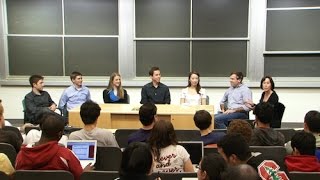
Steve Garrity and others debate whether startups should bootstrap or raise venture capital. They emphasize market validation as crucial and note that experienced partners matter when taking VC money.
Chapters
So for. At least. So we're actually fully bootstrapped still. And we did that for a very, very specific reason. So I don't know if everyone should know what bootstrap means. Basically using money from operations, cash flow and or savings to fund the company. So we were in a position where our product was actually making money almost from day one. And so we actually didn't really need to raise capital, and we really, really appreciated that flexibility. So I think one lesson for everyone to learn is, is you really need to go into the fundraising process knowing why you want to raise money, what you hope to do with it. And a lot of times companies will go and raise money right off the bat with the expectation that that's like a really big success metric to feel like you're going in the right direction. And sometimes it'll be too soon. So for us, you know, having six months at the very beginning of really just pure incubation, trying lots of projects, trying this, trying that, seeing what worked, building it, launching it the next day, improving it based on feedback, that flexibility we might not have had if we had raised money from investors with a specific idea. And then we were like, we want to change it? They would kind of freak out about that. So there's kind of a balance there in terms of how long you want to stay bootstrapped. And we really, really appreciated that flexibility early on, in our view, when you want to raise money, it's really around how to scale the company. You have a good idea, the company's working, you have some profit, hopefully, and you want to really expand and reach the next level, not just in a growth cycle, but also in a step change, jump. And in that sense, money is really good. Speed up that process.
Great point of view. So let's hear a counterpoint.
Well, I couldn't agree more with Josh. I mean, Steve and I waited six months before we even thought about raising money. And Josh is right. In the beginning, you don't know exactly what you're going to do. You come up with a million ideas, and then you end up going with one, and then you end up changing it a few weeks later or a few months later. And so for us, we did a lot of prototyping, we did a lot of talking to who our potential users would be, and we finally came up with a product. And we said, okay, well, we don't want to look someone in the eye and ask them to write us a check until we know that this thing works and we know that this is something that people actually want and that they'll pay for and they'll use. And so our criteria really was about having paying customers and real market validation before we would even pitch to even an angel, much less a vc. And ultimately we talked about, is this a lifestyle business? Can we, can this just be a single, a double, a triple? Well, we'd be happy having that. And we realized that we could, but this is actually a much bigger opportunity. And we'd stumbled upon something that people really love to do, love to use, and something that's really changing people's businesses and their lives. And so I'd say the primary motivator for us ultimately to raise money was that our customers demanded these features and they wanted these things to be built. They told us that they would pay us, they were already paying us. And so we knew that we needed to accelerate the product development cycle to give them what they wanted, achieve their business goals.
But why did you take VC money? I mean, you could have taken out a loan, you could have borrowed more money. I mean, you did make the decision though, to go the VC route.
Yeah, well, I would say that in terms of the amount of money we raised, we really wanted to put all our eggs in one basket and put a big bet on this. And we've gotten enough validation that we felt comfortable doing that. The other thing was that we found the partner that we went with provides a lot of value. And terms of, they've done this before, they're really experienced, they have a lot of great connections, and a lot of the areas where Steve and I didn't necessarily have experience or connections, they've really been able to step up even in the few short weeks where we've started working with them.
Anyone want to chime in with a different point of view? Yeah.
One really quick tangent would be if you guys are focused or interested in the web space, you know, a big shift in the last several years is that you actually don't really need a lot of capital to prototype something. So if you think about productivity tools like Google Apps or Gmail, all the different things that are available now through open source technologies, the actual cost barrier to go build something and kind of test an idea is much, much lower than it was in the last couple cycles of the web boom, which means you actually don't need to kind of go through that process of fundraising, because fundraising does take time away from necessarily product development. And so you want to make sure if you're focused on the web, that you can make the most of that.