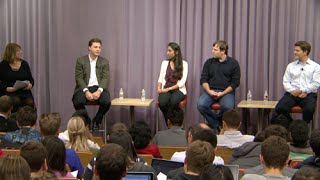
Kit and Steve Garrity discuss what entrepreneurship actually is and whether it can be taught. They explore the qualities entrepreneurs need and how education and environment shape whether someone becomes one.
Chapters
An interesting question, I think, for a lot of people that end up coming here. And I'll just speak about my particular case. I hardly knew what it was when I got here. So for me, being exposed to entrepreneurship and people starting companies and doing all this neat stuff was sort of the first thing. And so whether that existed somewhere deep down that I didn't know about beforehand and then was just revealed because I was in this environment, I think is my particular situation. I am one of the lieutenants in my current company. I'm not the actual founder, and the actual founder of the company is a brilliant technologist who's a little different than a lot of us and certainly different than me. And he's special. And I think there is an innate thing in a lot of people that allows them to start a company when it's very challenging to make a living doing that. And we as a company have had our backs against the wall a number of different times and then been successful kind of coming out of that. So for me, I wasn't the entrepreneur. I wasn't the entrepreneur, but part of a founding team and a very early employee was kind of more the role that made sense for me. And it's something that only would have been unveiled had I been in a place like this.
I think to Kit's point, you can teach a lot of the skills, so you can go learn startup finance or you can learn marketing or hiring, whatever it is. I do think there's something a little bit different. There's actually a really interesting book written by a Hopkins med school Prof. Called, called the Hypomanic Edge, the link between a little crazy and a lot of success in America. And the argument basically goes that entrepreneurs are. There's a high correlation between the way entrepreneurs describe themselves and the way that hypomanics describe themselves. And hypomania is basically a. It's basically a reduced version of manic depressive disorder. It's a really interesting study, but it basically says it's things like the ability to operate on very little sleep and lots of energy and the ability to kind of consistently be told no and not believe that you're wrong, which, by the way, could be a really good or a really bad thing. But there's a certain set of skills that you would kind of associate with entrepreneurs and kind of this category of being special. As Kit gently put it, most people would just call it crazy that I don't know that you can teach. So I think there's kind of some qualities that are very inherent and just you either have them or you don't. And it's not a good or bad, it's just different. And there's a bunch of things you can very much learn about it.
You can teach frameworks, you can teach methodologies, you can look at case studies, see how other people have done things. But when it comes time to actually making your own company, you almost forget all of that. It's all in the moment. It's all about how passionate you are. You'll have 30 people telling you you can't do it, but you're still going to push through. And I think at that point, pattern recognition becomes important. Like, look, I've seen, I've read case studies, I've seen other people hit these same roadblocks. So I kind of know what not to do. But there's no book on how to make every single decision and how to kind of go. Once you've made the decision to start a company, what is the step by step on how to make it successful.
But there are a lot of great entrepreneurs out there who I'm sure are not in places in the world where they have the ability to go out and start a company. I mean, the best pianist in the world may never have seen a piano, right? So who just has that innate capability inside of them? So making sure that you're getting exposed to and aware of the ability to start a business, that's an important first step. Obviously.
I was just thinking about this. I don't know if they still do it. When I got my acceptance letter to Stanford, it came in this folder and the front was printed something along the lines of, for all the nights you stayed up late to get something done, for all the nights you didn't go out with your friends to finish, to go the extra mile on that project, blah, blah, blah. Like all these traits they considered special Stanford students. I still have this folder. Today I read it and I was like, wow, there's something inside of me that was kind of like, wow, that's really cool. It's very similar to a lot of the traits I think you would kind of consider inherent in entrepreneurs, which is maybe exactly your point with this study. There's something special about the way that Stanford chooses people or trans people.