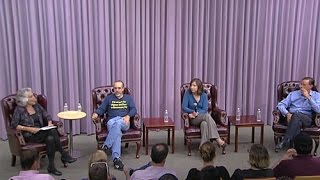
This content was created by GHION.AI . This content was uploaded by GHION.AI . This is a YouTube video titled "Steve Jurvetson: New Approaches Shape Novel Breakthroughs" (recorded Oct 12, 2015). The excerpt is from a panel/talk moderated by an interviewer (Speaker A) featuring Steve Jurvetson, "Astro" (likely Astro Teller), and Christina. They discuss future-facing technology trends—how deep learning and machine learning are transforming industries (rockets, drones, robots, satellites), the use of off-the-shelf hardware, stratospheric balloons and satellite broadband, robotics applied to energy and transport, advances in biology and life sciences, and how researchers choose long‑term academic research directions.
Chapters
So now let's turn to the future. Steve, what's the coolest thing in the pipeline?
Oh, what time frame? Like right now cool, or?
You call it.
Oh God, it's all over the place. So the high-level observation would be that when I started in this business of investing in startups 20 years ago, it was all in a few industries of software, semiconductors, and biotech. And we didn't do biotech at DFJ. So it was software, semiconductors, and variants— computing, photonics. It all felt the same. And today it's like a whole whole variety of industries that are being transformed because of deep learning, machine learning techniques. So everything from rockets and drones and robots and satellites that used to be really bad industrial businesses, they're now becoming software-centric businesses. So in every one of those sectors, it's kind of a recurring theme of how they're doing it using off-the-shelf hardware from cell phones repurposed in new and interesting ways. And that's exciting. And then closer to Christina's area of focus, the whole revolution of learning going on in life sciences and how that percolates back to IT in general. Do we build complex systems? How will we build these AIs of the future? I think we'll be informed by the way biology has done it, both as an existence proof and metaphorical inspiration for how do you iterate on an algorithm and compound intelligence over time or complexity over time. I think those are the metaphors of the future for how we do engineering.
I'm going to interrupt you for one second. Can people hear OK? Raise your hand in the back if it's OK.
Good question. It's OK. Hand is OK? Good. That's rare for me. Good. All right. Yeah.
All right.
Thanks.
Yeah, no, because I think this morning it was tough. So thanks for the check-in. And so I think— I mean, the field that excites me the most is biology. The technique is machine learning and deep learning across all fields. And then that comes, that leads to all kinds of new things like satellites that will observe the Earth every day and broadband everywhere on the planet via satellite and building new life forms that do interesting things, building organs for transplant that are not gonna trigger the immune system. There's just probably 18,000 different student projects that would have seemed like science fiction even 5 years ago.
So Astro, can I ask you that question?
You just did. I mean, obviously there are specific things that I can't answer. But one of the things that excites me, which is related to what Steve said, is when I look at the commonality across a lot of the things that we're doing at X, I notice that a lot of the projects are both non-traditional in being robotics, but in fact actually are robots. So we're trying to get the other 4.5 billion people who don't have a good internet connection today an internet connection via a network of stratospheric balloons. But in fact, those balloons have to do a lot of sensing. They have a lot of actuation. They can rise and fall. They're trying to pick the winds that they grab and cause themselves to sail to keep themselves into useful places. So if you have sensing, You have computation and you have actuation. In the very general sense, you're a robot. Our airborne wind turbines are actually this shift from a huge amount of steel to mechanically solve a problem to essentially a very small tether and a super hard control system problem, which is essentially bringing robotics much more centrally to this issue of generating energy. Our cars, self-driving cars, are kind of the poster child for nontraditional robotics. Our self-flying vehicles for package delivery are very centrally sort of robots. So in the sense of robots as walking mechanical people, I don't know how fast that's really going to change the world. But I see a lot of these issues about bringing techniques from machine learning, from mechanical engineering, from ways of embedding intelligence into products as an alternative to making them mechanically safer or mechanically cheaper I see that as a very general thing that we're going to be able to do over and over again to solve problems in the world.
That's cool. Given this revolution that's going on, all the changes, Christina, you work in a lab. You do your research. How do you choose from that whole menu of really exciting things what to focus on and what you do.
So, I think the first thing for any of us is to really ask yourself, ourselves, what are we passionate about, and what do we want to be doing? Because when you think about what problems you want to work on and what type of world you want to live in, there are many different routes to take, but you want to choose something that you're going to want to put your whole self and your whole sort of heart, body, and mind into. So that's the first thing I think that really drives that decision. The second thing when I think about problems that I want to work on is, and especially operating within an academic environment, I mean, we, or at least I think our role is to not just think 2 to 5 years into the future. Our role is to think sort of 10, 20 years into the future. We should be doing things that are are going to build the foundational technologies and advances that then eventually will move on into industry. So I think we want to look 10, 15, 20 years into the future and ask ourselves, what are the big problems we see? What type of world do we want to live in? And what is either the foundational research or the applied research that we want to focus on that we believe is going to make an effective transformative changes in the world around us?