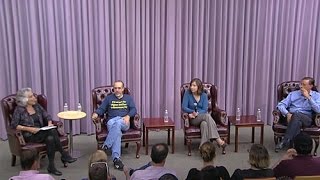
Steve Jurvetson, Christina, and Astro discuss whether technologists bear responsibility for how their innovations are misused. They debate dual-use risks, job displacement, and whether engineers should consider potential harms before building, or leave governance to policy and regulators.
Chapters
A lot of the technology, Steve, that you fund, Astro, that you develop, Christina, the potential technology you develop in your lab, there are a lot of societal implications. And some of them are not always positive. How responsible do you feel for the societal implications of what you invent and invest in? And how do you think about linking technology innovation and societal responsibility? And you want to start it off, Steve?
Sure. It's a deep question. So in the short and immediate term, you can be responsible by saying, oh yeah, there are certain categories you won't invest in. Things that are just distasteful. But I think the deeper question is dangerously powerful technologies, which are all around us and compounding dramatically, as you know. And soon, sort of the ultimate vector is heading towards technologies that will be trivial to execute as an undergrad that could kill much of humanity for almost no money. And that, in a world, that's a difficult world to imagine in the future. So we as humans are pretty static in terms of who we are. Our culture evolves. At a less glacial pace, but still somewhat glacial compared to all these technology advances. And so there can be a bit of a disconnect, both in terms of capabilities to do harm, as well as all kinds of ripples through society. So I believe technology is synonymous with progress. It's kind of like, it's hard to detach progress in any sense from advancement of ideas, right? Because the technology could be something like the scientific method itself, or a new form of governance. That's a form of technology. But most of what we focus on are the technologies that are accelerating dramatically. And I think it's a net positive on almost all fronts. I think there are some really big implications, though, as it rends the fabric of society. So we already see how we live very differently today than 50 years ago culturally versus 2,000 years ago. It's astounding how much progress we've made. And violence keeps declining. And our future might be bright. But I do worry about things like an ever-accelerating rich-poor gap. That might be an inevitable byproduct of network economies being part of most information businesses and most businesses becoming information-centric at their core at different rates over time, where there just won't be jobs in agriculture. There won't be jobs driving cars, which is about 20% of paid employment today. That's all clearly going away in the near term. And all those new jobs come. And we'll all become information workers and entertainment workers. And that sounds great, except for people who don't want to do that. And it's all globally competitive more than regionally competitive. And so none of this will happen right away, but I think an extra trend is that we need to understand a world where that will just keep accelerating, not be self-rectifying. But for perhaps policy, but for some waves in philanthropy, which I find encouraging, but there's also a lot of self-reinforcing feedback loops on that. So that's one thing I worry about. I don't know though what, as an individual in an individual technology area, could do about it other than acknowledge that larger trend that's an emergent phenomenon and say, well, there's a big problem I could try to solve as an entrepreneur. Let me think about that future and let's say, wow, you want to provide for basic human needs for everyone when there are no jobs. Well, how about Maslow's hierarchy of needs— food, shelter, clothing, healthcare, and education— if Maslow was alive today? And let me do an app to provide free healthcare forever for everyone via smartphone, because in the future we have to have that or we'll be in trouble. You know, it could be an entrepreneurial sort of impetus to solve the problem instead of wringing our hands about it. And so that's what I'm looking for as an investor, to say, Technology is going to do what it does. That's exogenous to us. We're like the vessels for ideas and like a genetic sort of bag, if you will. We're also a memetic bag. And we spread ideas promiscuously. And that's just going to happen. And we can't stop it. So how about tilting our efforts to anticipating that future and helping the transition to be a little less cumbersome as it currently seems to be?
Christina?
So as somebody who develops technologies and thinks about what technologies we want to develop. I mean, so I think it's definitely the case that as engineers, we have a responsibility to think about the broader societal applications of the technologies we develop. This comes back to— part of it comes back to how do we choose what to work on, right? I think it's also the case, and I run up against this a lot, and I think we have to acknowledge that there's dual-use aspects of almost any technology, right? I mean, and many times in ways that we can't even imagine, right? A simple, very right example, I mean, did we envision or imagine, right, that airplanes would be used to sort of fly into buildings, right? I mean, that, and so you have to, and so you're not going to be able to envision or even predict all the ways that a technology might evolve, right? And all the ways that someone might take a technology. I think there are, with many technologies, you can think about sort of short-term, right, or immediate, how it might be misused. And then you can come to some conclusion about whether you think What is the, basically, what are the pros and what are the cons, right? What are the trade-offs? And is the overall good worth the risk? And then I think what plays into it also is you want to think about policy around it. For some potential risk, for some potential dual use, there's a lot that we can do working with regulators, working with government to think about policy that can be developed to ensure that as new technologies are introduced, we're mitigating what's happening in other societies and making sure that that's being minimized. And thinking again about the culture of how we train our students So that we're training cadres of students and engineers that are going to go forth and innovate and apply things positively.
Great. Astro, the final word on that topic.
When we're working as scientists, as inventors, as entrepreneurs in any area, obviously there's a significant responsibility. But that responsibility can't be to control the outcome of society. That's not the job of any of those people. It's not necessarily anyone's job, but if it is anyone's job, it's the job of the public sector, not the private sector. Now, that doesn't waive all responsibility from those people, but it means that their participation in the process is one of transparency and education. That means participating with the public sector by saying, here's what we're working on. Here's what we know about what it's likely to be in the future. You can help, or we can help you think through what we might not know and maybe discover some of those things ahead of time. Let's talk about that. I want to make sure you, the public sector, understand as best as possible. And then that's your job, not our job, to control this thing. Because when we pursue any kind of technology from a perspective of fear and secrecy, we are crippling it, we are turning it into something less than what it otherwise could have been, and we are ceding the real development of that thing to the very people we're most afraid of. So instead of painting these technologies as the poster children for our fears, we should be accepting that the world is changing and doing our job as educators to the public sector of the ramifications of these things, but then continuing to move these things forward without embarrassment.