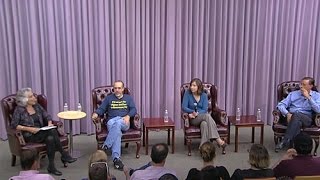
This content was created by GHION.AI . This content was uploaded by GHION.AI . This is a YouTube video titled "Steve Jurvetson: You Need Skills of Dynamic Stability" created on October 12, 2015. It features a discussion among multiple speakers, including Christina, Astro Teller, and Steve Jurvetson, about the education of 21st-century engineers. They emphasize the importance of interdisciplinary learning, adaptability, and lifelong learning in the face of rapid technological change.
Chapters
I'm anticipating that you three might have different views on this, but I'd kind of like your thoughts on how do we educate the engineer of the 21st century. What's the view of a broad education versus, you know, should we just become Stanford tech? I mean, 30%, 36% of our students are graduating in engineering. Let's just, why not all of them? And what do you think is important about what one learns in college and carries forward from it? And so maybe I'm going to give it over to Christina for the first try on that one as the educator who's actually in the classroom teaching. And then I'll go to Steven Astro.
First and foremost, and especially if we're talking about engineers. I think, and I know a number of my colleagues also believe, because we have a lot of conversations about this, that one of the most important things we want to teach our students is how to, to choose what to work on, right, because you are going to go on and continue to learn and continue to add to your knowledge. But being able to kind of make decisions about this is something that is something good for me to invest my time in. This is something that is not. These are the implications of this particular technology that I might develop. Here's the ethical implications, here's societal implications, here's implications in terms of access and how will that affect the world around me? Those are really important things to learn and where to spend your time on. So we try to structure a lot of our classes to bring those elements in, right? That's the first thing. Second thing, I actually do think it's important for students, especially now, to be able to work in teams, interdisciplinary teams, and leverage each other's expertise and also be really good and effective at communicating with each other and, and handing off tasks and being able to pass off knowledge in that way. So that's another thing that we try to bring into our classes. And the third thing that I will say, which is just sort of very broad in general, and this came up in a earlier discussion we were having today, is I think many people would agree, and I might be biased in this, but many people would agree that there really is sort of a revolution happening within the field of biology, right? Especially with sort of advances that we see in genetics, genomics, the way that we treat DNA as information. And I think traditionally biology has been almost sort of a niche, right? Many of us, many engineers only take biology. Don't have to take biology class, right? We might have to take a physics class. We might have to take a Chemistry class, but there's not a broad, even basic literacy in biology. And I think we really need to change that and treat it as something that everybody should be broadly literated in to really be able to move, you know, into this next realm of technological advances that we're going to see. And that will also allow us to think about how we bridge biology with computer science, with information science. Right. With mechanics, I mean, et cetera, and allow us to move across these different disciplines. And I think that's very important and something that is a deficiency right now in how we train students.
So, Astra, do you agree with her?
I think that that's exactly the right set of stuff that we look for. How great are they at communicating? How great are they at learning, how practiced are they at working in groups? So that's the stuff that we should be training people to do. I'm actually not a huge believer that you have to pick what it is you're going to be an expert at now. Study that really hard and then go out and shop that expertise for the rest of your life. The bad news is that the stuff that you're learning now is going to be Fairly irrelevant in 10 years. Seriously. I mean, just get prepared for that. It is going to be irrelevant.
Yeah. Remember that when you're doing your homework sets tonight.
No, no.
But the good news is that the skill of learning things quickly, figuring out how to understand first principles and be able to reconstruct your knowledge even after you forget 90% of it later, those skills are critical for the rest of your life. And picking up those through those homework sets matters actually way more than the actual knowledge that you're taking in. I just had someone sit down with me who used to be a tank battalion commander. His first job after being a tank battalion commander was to come to X and he was doing field ops for Project Loon, the stratospheric balloon project. Now a few years later, he is literally designing the balloons. He had no background in any of that before, but he's fantastic at it. And he was saying, well, maybe it's getting time to hand that over. My team has really developed and I'd like to kind of go back to the early stages and do some more stuff. And I said, why don't you just join another field ops team that worked for you the first time? Just go get some mud on your boots, jump into a team. Even though you're really expert at these things now, they won't know it.
And.
And you're probably going to develop a new set of expertise that has nothing to do with balloon design by the time you're done. So don't get wound up about it. Just take that quick step back and you'll rock it forward again. And I think the same is true for everyone in this room, that if you plan for static stability, you're going to be really frustrated. But if you can build the skills of dynamic stability, it's going to be awesome.
Steve, I want to amplify that and totally agree. A framework for what Astro is saying is if you believe, and I, I think you should, if you're close to science and engineering, that we're in an era of ever accelerating technological change, you can think of Moore's Law as one epitome of that. Then a corollary is the lifespan of any given idea, company, technology, product, you name it, is going to become more and more ephemeral. And so your career, your life of lifelong learning becomes all the more imperative, right? Process learning, how can I learn? How can I engineer better, how can I pivot to something new from what I've done are critical skills. So translating to what that means here today, think about methodologies of engineering. You had the scientific method, you have methodology of traditional engineering, you have these unusual things like deep learning, machine learning that are closer to an evolutionary algorithm. And learning more about that in biology and how it infuses all fields would be important. So if I could take what Christina said, I'd say everyone here, no matter what you're studying to learn a little bit about biological systems and how they work and a little bit about computer science, will be almost like the connective tissue between almost anything you want to do in your life. Because I think those are the metaphors, the frameworks that will apply to almost everything. And then you might think in terms of what you prioritize, what do you uniquely bring to the table? What quirky background and either academically or what have you, can you combine in ways to have insights about solutions to problems or areas of the world to focus on that everyone else in the room isn't also doing? Because it's those interdisciplinary pairings of ideas, I think, where true meaningful breakthroughs come through. And that's, frankly, I think, where you learn. I think that's where a lot of excitement comes from and that's what pushes the world forward.