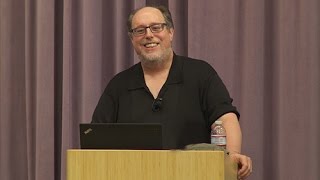
Steve Teig, founder of Tabula, argues that better execution is innovation. He discusses why FPGAs fall short and why we need programmable devices and computer architectures that move beyond the von Neumann model.
Chapters
My job at Cadence was to try to find a vision for the future of Cadence. How do we make Cadence a 10 times bigger company than it used to be? Now Cadence sells software for people to design chips with. But the kind of chips people design with Cadence software are special purpose chips for special purpose applications. A chip in your cell phone, a chip in a Cisco router, and so on. That's becoming so time consuming and so difficult, even the big companies are scared of it. And I started to worry that it might not be the best thing for Cadence's long term future to make such a. To be so dependent on people always jumping to the next technology and continuing to design at a rapid rate special purpose chips. I wondered, couldn't you have a programmable chip? Couldn't you have a more general purpose chip where you can use the same chip for many applications by having it change it, by changing its personality? And as it turns out, there were already two substantial companies doing exactly that who have a technology called FPGAs that are basically programmable chips where you can imbue them with a different personality after their manufacturer. And I thought, this is fantastic. FPGAs are going to be part of the future. As I looked into them in more detail, what I found was, yes, programmability is fantastic and kudos to the FPGA companies for creating it, but the overhead for providing that programmability is absolutely intolerable. It turns out that both then and now, the FPGA companies only provide about 5% of the market for special purpose chips. And the reason is that the overhead for programmability makes those programmable chips incredibly large, incredibly expensive, incredibly slow. So the idea is beautiful, the execution not so much. And it led me to wonder, all right, can we do better? Can I think of a way of building a better programmable chip than an fpga? And it turns out I came up with a way to do it and realized that the architecture that made it possible to build a better programmable device, one that's much denser, much faster, that provides the performance of a special purpose chip and not too much overhead for the programmability, while still preserving full programmability, that same architecture could be used for a computer and not just for a special purpose chip, that it provided the basis for a post von Neumann. I think a bunch of you are computer science people. A post von Neumann computer, something where you would have a million computing elements or 10 million computing elements running at gigahertz rates, where you can still program this in a software like way. So while I really wasn't going to do a fifth company, I just saw this opportunity. First of all, the $100 billion opportunity for chips, but also the chance to build a computer that went beyond the microprocessor. And I had to do it. So I left Cadence and I spent a few months in my living room trying to figure out how this was going to work and invented a series of technologies that we now call space, time and Inside and Everywhere and went off and founded Tabula, of which I'm currently the president and chief technology officer, that is building in fact a better programmable device that can compete not just with these FPGAs sort of classical programmable devices, but even with special purpose devices for a wide range of applications. But frankly, my real agenda, and please don't tell anyone, is to build a better computer and to use this technology over the next several years to try to build a framework to get out of the serial von Neumann mindset into a better computing environment.