Tim Kentley-Klay: Self-Driving Cars for Everyone [Entire Talk]
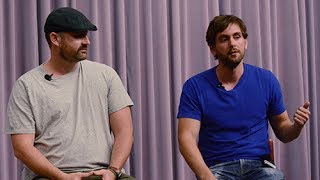
This content was created by GHION.AI . This content was uploaded by GHION.AI . This is a YouTube talk titled "Tim Kentley-Klay: Self-Driving Cars for Everyone [Entire Talk]" (recorded May 17, 2017). It is a moderated presentation/interview featuring Tim Kentley-Klay (Zoox co‑founder/CEO) and Jesse Levinson (co‑founder/CTO) with a moderator (Speaker A) and audience Q&A. The discussion covers Zoox's vision for full‑stack, purpose‑built autonomous urban mobility (a compact, bidirectional electric 4‑seater fleet), technical and product design choices (ground‑up vehicle architecture, sensors, LiDAR, compute), safety and cybersecurity, levels of autonomy, business and fleet models, fundraising and competitive landscape, regulatory and social impacts, and user testing approaches. The excerpt is a public talk with an interactive audience segment.
Chapters
So we have our CTO and our CEO of this company. Can you give us a little story of how you got here? Maybe each of you can give us a little bit of time to tell your story of how you ended up here, sitting here on this stage.
Sure. I think for me, my journey in robotics started around 2012. When I was watching from Melbourne, Australia, from one of my animation studios, what Google was doing with their self-driving car program. Sitting here today, looking back, they kind of, I think, lied to us. They made it look a little bit easier than what it actually is. But for me at the time, had the insight that AI and mobility, right, autonomy and mobility, is about much more than just incremental adaptation to the automobile. It's more than an autopilot feature for a freeway. This technology is going to reboot mobility as we know it. The previous mobility age before the automobile was, of course, the horse and carriage. And we're actually in that age for around 6,000 years. It was around 4,000 BC we domesticated the horse, put the axle on the wheel, and got coachbuilding. So what let us switch from one mobility age to the next? Arguably, it was the invention of the internal combustion engine, where we got to a technology level on this planet where we could mechanize the horse's biomechanical power. What was the right exploitation of that invention? Well, it wasn't to put it in the coach and keep the horse. People tried that, but it didn't work particularly well. The right exploitation was to get rid of the horse, change the architecture of the coach quite radically, to get through to something like the Model T Ford, right? And so the people that won weren't the coach builders. It was people who understood mechanical engineering, and then importantly, how to industrialize it. And the insight we have at Zoox is that AI mobility will take us from the age of the automobile into the next mobility age. And we think that's robotics. Because what we're really doing is bringing a narrow AI, sort of a horse-level intelligence, if you like. We created horsepower, now we're creating horse-level intelligence to the vehicle and taking the human out of the loop. And if that's true, Zoox was founded to ask the question, well, what would the full realization of AI mobility be? Can we imagine that? And if we can, can we build it not in 10 years, but today?
Great.
So everyone who works at Zoox likes to say it works 10 years in the future. And that's the journey we're on, is to be focused on what is the full realization of this technology. And let's see if we can make that today.
I love this idea of bringing the horse intelligence to the car. I'm going to look at my car differently. So Jesse, you've been thinking about this a long time. What brought you to this stage?
Yeah, so I got to spend a bunch of time at Stanford. I actually specifically came to Stanford in large part because Stanford started working on self-driving cars. And it seemed to me that of all the applications of computer science and AI, self-driving cars had by far the most potential to impact society in a whole variety of positive ways, economically, environmentally, and socially. So, it also was kind of cool and seemed like it'd be fun to work on. So, I started working on it with Sebastian Thrun, just in time to start working on the DARPA Urban Challenge, which was in 2007. And it was the first time that we'd sort of gotten some level of actual interaction between of autonomous vehicles and other dynamic objects in the world, which was really exciting. I got to work on a really small team and be part of that. And I kind of stayed in academia for a bit instead of going to Google or one of the car companies, because although I really—
Playing a little tennis.
A little bit of tennis, some photography. But I really wanted it to turn into a product, but I wasn't really convinced that the car companies sort of saw the future. Like, how is this technology really gonna actually make it to the market. And Google is doing super cool stuff. I have a lot of friends there, and they were doing amazing technology, but also just didn't seem like they quite knew what was the product going to be, right? And I didn't know either, so I was sort of like, well, I'll just keep working on this research. And I met Tim about 3 years ago, and he sort of came up with this idea for how would you actually come up with a whole new platform, a new business model, way more ambitious than anything I'd heard anybody else talking about. And so my first reaction was, well, this is probably nuts, right? Because it's so different. And I spent an hour with him, and I was like, well, actually, sounds pretty amazing. And it seemed like it probably was the future of transportation in cities. So we spent a few months getting to know each other, and I got really excited because I felt like I could take the work that some of my team and I had been doing at Stanford, and then actually start to apply it to what I thought would in fact be the full realization of that technology. So we got started, yeah, about almost 3 years ago now.
So, OK, paint a picture of what the future of autonomous vehicles are. So, OK, think about 5 years from now. I mean, hopefully you'll be launched by then. 10 years, maybe even 20 years. What's the vision that you guys have for the future?
Not to run out of money by then.
We have your investors in the room, so we hear them laughing.
Well, not to be making too much money by then, because we want to keep the blue sky, but hopefully customer adoption. I mean, I think, you know, I mean, Jesse and I, you know, we really started Zoox because we thought it was the best application of our time and talents. You know, we didn't do this because we want to flip the business. We did it because we wanted to found the future. And so I think for me, you know, what we're working to at Zoox, we're on a 5-year vehicle development program kicked off in 2015. When I say kicked off, I mean kicked off like 2 guys, 1 laptop. And we're aiming to conclude that in 2020 and be ready to scale a fully autonomous mobility service in cities. And so what I think we're both working for is, you know, being up at the Ferry Building, hopefully in San Francisco, eating at a burger joint and watching one of our ground-up robots going down Embarcadero, picking up a customer and taking them to where they want to be. You know, I think that's the reward that we're looking for, is to create that magical moment.
So Jesse, is this true? This is like you're looking at essentially mobile robots that are going to pick me up anywhere I want and take me where I want to go?
That's the idea. I mean, they're actually quite intelligent. They have a lot of computing power, a lot of sensors. And I actually hope that they'll be a little smarter than horses, somewhere in between horses and people.
OK, great. Maybe they'll be even smarter than some people. That would be great. Or maybe some drivers smarter than some people.
They'll certainly be a lot more attentive.
So what are the trade-offs that you're considering right now as you're developing this technology? The hope is to launch when? When are we going to see these on the road?
Well, I mean, we've already launched on our private test track actually in 2015. The first 7 months we actually created an on-demand point-to-point electric autonomous mobility service.
Wow.
A lot to say, isn't it? That from an app on my phone, you can push a button and the robot will come on that facility, find you, and take you where you want to go. And then we have a very detailed roadmap from now until 2020 where we roll out things. You know, Jesse, we already have, you know, Toyota Highlanders that we've hacked into and taken parasitic control of the ECU and put our own compute and sensors on. We have our license from the state of California. So they're out testing in the field, in Menlo Park, actually. And by 2020, we want to create the full thing.
So I want to paint a picture. I had a chance to chat with you at another time. And so I have this image in my mind of these vehicles that you're creating. And I understand that they're not like anything that we currently see on the road, right? Because if no one's ever, ever going to drive them, they don't need a steering wheel. They don't need a dashboard. They don't need windows. They don't need mirrors. How do you design a product like that from the ground up when you really are not comparing it to something that already exists?
Well, I mean, that's, that's half the fun, right? Is, is if you have a legacy product and you have a steering wheel in there, And you're trying to retrofit what I call roof racks. There's a lot of developers out there just putting sensors into the car architecture. I think you're taking a complex product and making it more complex. And then that structure of that vehicle is designed for human vision. So if you take that constraint out and say, well, the passenger never has to take physical control of this vehicle. Well, that's on us, right? It actually gives you more degrees of freedom to optimize for machine vision rather than a hybrid architecture. While actually removing complexity from the vehicle. By getting rid of the steering wheel, the instrument panel, side mirrors, windscreen wipers, you know it. We actually get rid of a lot of hardware out of the vehicle, which is really important for a startup to reduce the bill of materials and help us get to market faster.
Super interesting. So can you paint a picture of what this user experience will be when this thing comes up and picks me up at the Ferry Building?
No.
Okay. Now this is really important because you actually are in stealth mode. Mode, right? I'm going to guess it's not because you don't know, it's because you just don't want to tell us.
Yes.
Okay.
And why is it that you're in stealth mode? A lot of companies choose that decision for very important strategic reasons, and I think it's important to understand why are you choosing not to tell us what this experience is going to be like?
Yeah, I mean, that's a really good question. Sometimes there's a bit of media saying this super secretive startup called Zoox, right? And it's not that we're secretive at all. Like, within the company, we're very transparent with everyone about what we're doing. We don't compartmentalize too much, because we want everyone to understand what we're doing, because it's very holistic. You have to be able to see how everything works to solve this. For me, it's really just a question of focus. I mean, we've been on a lot. We've got a lot of work to do. And so for me, by being stealth mode, we can just focus on perfecting the fundamental art and science of what it means to create this technology without the distraction of, you know, going to too many— you know, this is the first one we've done, actually— going to, you know, too many conferences or having to have a rinky-dink website or anything like that. You know, to me, that stuff's just a distraction. We really want to focus as a company on what we're doing. And, um, we also have a point of view on what we're doing, you know. And so we— part of it is we don't want to say with a megaphone to our competitors, this is how we think this can work, because that's part of our competitive advantage. It might be so crazy that they wouldn't do it anyway.
Well, so this is really important, right?
A, your competitors aren't seeing it, but also your potential customers aren't seeing it and able to give feedback, right? So how do you get feedback and how do you set up the ability to pivot, right? To make some changes if you're going the wrong direction, if you're not actually out there sharing what you're doing with the world?
Yeah, so I mean, within the company, we do do user testing. We make interior models of the, we make models of the interior and we bring in people and we have UX researchers that come in and take notes without me there, so I can't influence it, right? All this kind of stuff. So we go through that diligence, but there's also some pretty good heuristics as well. Like, I think, you know, as over in Europe, where we've actually built a one-to-one version of the vehicle with the industrial design, and, you know, unsolicited, when people stand around it, look at it, you can tell from their reaction that we have something here. Whereas it's very clear when people don't like something, 'cause they're just not as interested, or they feel awkward about it. So we're super excited about what we're building. It's really fun, it's really different. The industrial design, by the way, is not what's on the internet from what I designed a couple of years ago. The DNA is the same in terms of the architecture we're building, but we're actually creating what we call a microbus at Zoox, which is a compact 4-seater for urban mobility.
So, Jesse, as the CTO and with all of this deep technical knowledge, how much are you actually having to build yourself versus buying off the shelf? Is this something that, okay, all the technology actually already exists, and it's just piecing it together in an interesting way, or are you actually reinventing the wheel?
Well—
Haha. Or inventing the wheel.
Well, it does have wheels, but they're not steering wheels.
Yeah, yeah, yeah.
It's a mixture, but I think one of the things that makes Duke challenging is that nobody has solved this type of problem before, right? There's a big gap between autonomous sort of features that you can get on a car today, and then true Level 5 mobility, which means you get in a vehicle and it takes you where you want to go, and you really don't have to do anything. And in fact, you can't even do anything other than say where you want to go, or, hey, I want to get out of the vehicle. You know, from a startup's perspective, one of the really exciting things is that we get to do the hardware and the software and the service jointly and holistically. And I think people sometimes don't appreciate how big of an advantage that is. If you look at, you know, what Apple did with the iPhone, they didn't just write a new operating system and put it on a Motorola Razr or a BlackBerry. And they also didn't make a new hardware device that was running Windows Mobile Phone from 2006. They could have done either of those things, but I don't think it would have made nearly the impact on the market that they were able to achieve with the iPhone. Now, I think with autonomous vehicles, especially fully autonomous vehicles, I think that integration between hardware and software and the user experience is even more important than it was with cell phones, right? And so one of the fun things that we get to do, but also the very difficult things, is we get to think holistically about where do we put sensors? What type of sensors do we need? How much computing power do we need? It's probably more sensors and more computers than you're gonna be able to buy on a car in the next couple years, because our business model is very different. We don't actually sell these vehicles to customers. We own and operate this fleet, and then you can use them the way you use Uber and Lyft to just hopefully be much better, and even cheaper to operate because you're not paying the driver. So we do need to develop our own software, our own AI, our own algorithms. We're not using Mobileye or anybody else's AI technology. It's completely developed in-house at Zoox. When it comes to computers and sensors, we, as much as possible, buy things off the shelf or work with technology partners to get access to their upcoming products. And then when it comes to the sort of physical mechatronic layer of the vehicle, It's also really powerful that we get to design a level of robustness and some amount of fail-operational into that design that cars today are not built for. Cars today are not built to drive 100,000 miles a year for 4 years. And they're also not designed to be necessarily safe when a whole bunch of components might fail. The good news is we don't have to reinvent, for example, the entire concept of an electric car the way Tesla had to do. What Tesla did 10 years ago from a vehicle engineering perspective It was quite amazing, very, very difficult. And, you know, there was really no supply chain for EV technology then. In the last decade, Tesla, and now a bunch of other companies, make electric cars at quite some scale. So if we're looking for batteries, you know, and motors, and steering columns, and these sort of things, you know, sometimes we might need to innovate a little bit with the supplier. But for the most part, it's about building a new architecture, but not reinventing every single hardware component in the vehicle.
So what do you guys see as the biggest risks? Are they technical risks? Are they market risks? Are there regulation risks? I mean, this is a really complicated product and experience and environment. What are the things that keep you up at night?
Well, I don't mean to be cute, but I think the biggest risk is actually unknown unknowns in the abstract, right? Because they're the things you don't see. That really hurt you looking back, right? And so one thing I've been learning, sort of leading with Jesse Zooks, is it's really important, the game almost in a way, when you're starting a business, is to bring into the company as fast as you can domain experts to expunge those unknown unknowns, right? That's really important work, 'cause it'll not only let you grow faster, it'll stop you from colliding into something you didn't see coming. So I think, for me, that's really important, is the culture of the company, who do we have around it? not just the board level, but advisors. We have tremendous advisors around Zoox. We have people like Carl Bass, who was recently the CEO of Autodesk. We have Gonzalo Rey, who's the CTO of Moog. We have Andrew Howard, who's a senior software engineer down at SpaceX. People that have shipped a lot of product in very advanced systems that are giving really good advice to what is a young team at Zoox. I mean, we have over 60 doctors, PhDs, postdocs from around the world working on the computer science aspects of what we're doing. So I think that's really important in the abstract, is to get rid of the unknown unknowns as fast as you can. And part of that has also been pragmatic. Rather than having a lot of conversation based on first principles, or that's rational and academic, it's like, well, let's just put something on the vehicle and go out and test it and get some data, and let the data speak to what's important and de-risk the business.
So even though you're not telling us what you did, you certainly have told investors, and they have given you a lot of money. you have been able to raise a tremendous amount for the vision that you've sold. How did you inspire people to get behind this very radical idea that really essentially jumped over a lot of things that people are now developing?
Yeah, I mean, it was pretty crazy raising our Series A. Jesse and I really had to go out to the market and ask for unusually large amount of money, because the complexity of what we're doing, we're creating a full-stack, next-generation autonomous mobility experience that's vertically integrated, is not cheap. All our competitors, their budgets are $1 billion plus in this marketplace. And yet, we're entering a market that is a $10 trillion market, right? And it is about to disrupt. And will it be incumbents, will it be a new entrant? And so, for the investment community, they get the size of the opportunity, And Zoox is in a very unique position because as far as we know, we're the only startup, and even compared to some tech giants and OEM giants, they're actually trying to do the whole thing under one roof, right? And so we're a big bet, but the outcome can also be a big reward as well. And so to find a group of investors that more or less 5 years out from a product, a customer with a lot of technical risk, a lot of regulatory risk, who would put in $250 million into our Series A, which is 1 to 2 orders of magnitude above what is normal, and for less than 20% of the business as well. That's a very special set of investors, and we were able to find them, we were able to have the right set of conversations with them, and I'm sure Jesse would agree, we have just brilliant investors around this company. DFJ, of course, have been early-stage seed investors through to our A round and helped lead that. Companies like Tencent, Lux Capital, Blackbird, really high-caliber venture capitalists that are not looking for a quick exit. They're looking to work with founders that want to create something big. And so we were able to find those people.
And this really is a moonshot. I mean, it's— if it works, it's gonna be amazing, and it's remarkable. Now, who do you see as your biggest competitors? Is it folks who are already working on autonomous vehicles, like Google? Or is it folks who are doing something totally radical that you might not even know about?
Yeah, that's an interesting question. I mean, it's actually a little hard to say at this point, right? Because nobody has Level 5 technology on the market, right?
Can you do us a favor and describe what that is, what Level 5 is?
Yeah, absolutely. So the SAE came up with this series of autonomy rankings. Level 1 is cruise control, basic stuff. Level 2 is you can do sort of adaptive cruise control and lane keeping, right? So sort of like the Tesla Autopilot system that you can get today. Level 3 means sort of a fully autonomous vehicle, but you still have to be sitting behind the steering wheel paying attention, because at any point in time it might decide it doesn't really know what it's doing and you have to take over. But other than that, it can get through intersections, do traffic lights, and sort of do almost everything. Level 4 means that the car is fully autonomous. You don't even have to pay attention. But it's only able to operate in a certain domain. So maybe it's fully autonomous, but only during the daytime, or fully autonomous, but only in this particular chunk of the city. And then level 5 means it's fully autonomous, and it can drive anywhere. And pretty much anything a human can drive, it could drive. So of course, that is the goal. That's what we're trying to get to at Zoox.
So I'm curious, though. It's really different if all the cars on the road are autonomous, and they all have the same rules and the same etiquette. But when you have a car, an autonomous vehicle on the road that is not being controlled at all by a person, and you also have human-controlled cars, there's got to be some mismatch. I heard the other day about the concept of bullying autonomous vehicles, right? That people who know that— well, they know the autonomous car is going to be very polite, so you can cut it off. Don't try that.
OK. Yeah, I mean, this really speaks to what we call social robotics. And at Zoox, we talk about the car becoming a character. Right? And this is why we think a car, if it was just autonomous, wouldn't actually work in the marketplace, because it actually doesn't have the lighting and sound actuation that we think you need to deal with social scenarios like that. You know, we actually have a personality for our vehicle. We call it friendly but fierce. So it can be nice, but it can also dial up certain attributes if you're being a pest. And then our vehicle, you know, it has some super cool features. So, you know, if you're driving through the Tenderloin, 2 AM, and someone comes out in front of the vehicle and is messing with it, Well, you know, most autonomous vehicles would just be stuck, either with no one in it, and so the customer's waiting, or someone's in it and they're freaking out. Well, our vehicle has special features. It's actually symmetrical. It's what we call bidirectional, with electric motors that can drive either way equally well. And we use active LED illumination to define dynamically what the front or the rear is. And so we have this neat little maneuver where if someone was standing in front of the vehicle messing with us, we could actually flip our lights and flop over to the other side of the road and drive away. I call it the French maneuver.
Does the car also signal whether it's being friendly or fierce? I mean, does it change color? Does it send out signals? Does it do something to say, hey, I'm going from my friendly mode to my fierce mode?
All of that.
All of that. OK. So it really does have a personality. OK. I'm not going to ask some rude questions about what it does when it gets mad. So what is the business model here? I mean, you alluded to the fact that this will be a fleet. That will be out there? Is this a fleet that you'll control? You said it would be like Uber. Would Uber buy these and use them? Is this something, or something that you're gonna be managing centrally?
Well, I mean, companies like Uber traditionally don't like CapEx on their balance sheet, so that's something for them to answer. But I think there's two ways to look at this. One is through technology, and one is through social. I think on a social level, there's clear trend lines in mega cities that young people, or people who live in cities, don't want to own a car. It's a pain. I don't want to have to park it, I don't have to deal with insurance, and what I really want is on-demand mobility where I push a button, it picks me up and takes me where I want to be, and that's it. And that's really the mission statement of our company, is connecting people and places, right? We love connection, and we want to have a physicality to how that is. And so I think people don't want to own the vehicle, they just want to pay for what they use, And we actually like that as a company because what's happening is with these advanced AI systems, they require continuous improvement by a large team of software engineers and a lot of computation happening in the cloud and a lot of data coming off them. And that costs money. And so if you have the automotive model, which is if you're a tier 1 like Bosch and you work on a rack and pinion steering system and you might spend 4 years writing some carefully coded firmware that goes on that system and you sell it once to an OEM who then sells it to a customer once, and they monetize once. I mean, if you need to continuously update that software, you've got no way to pay for it. Whereas these vehicles will have over-the-air updates going out to them, you know, at quite a high frequency. And so you actually need the subscription model of getting paid per mile to actually fund the updating of your robots, because they have almost like living code on them. And so it's good in that people don't want to own cars who live in cities. They want on-demand and pay-per-use. And it's great for us because that helps us make the product better.
They're just going to keep evolving.
And it's also a much better use of materials, right? Because we all know, well, you don't all know, but people who work in the industry know that, you know, cars are actually driven 4% of the day on average. So 96% of the time, all the resources put in that product sit idle. And so I love the idea that if you're not using this product, someone else is, right? And so again, this is why you do ground up, because you need to solve a product that's going to drive 16 hours of the day, 365 65 days of the year. As Jesse mentioned, that's 100,000, 130,000 miles. And so if you're thinking you're gonna get that just by retrofitting a car, good luck to you. You need to create a purpose-built architecture and product experience to solve for that.
And to add to that, this technology changes very quickly, right? I mean, people are used to buying a car and owning it for 10 years or so, right? The technology that people are putting into autonomous driving today in 10 years is gonna be pretty obsolete, right? If you look at the cell phone that you had 10 years ago, it certainly wasn't an iPhone, 'cause they actually didn't have iPhones 10 years ago. Although I'll only be able to say that for another month. But it's kind of crazy, this, the idea, you buy a car, and you buy a $50,000 car, a Tesla, $80,000, $100,000 car, right? And it has several thousand dollars of computers and sensors in it, and it's super cool, right? It's by far the best system on the market. But in 5 years, 10 years, it's not going to be very useful anymore. And so one of the things that we're excited about is that if we own and operate our fleets, we can continuously upgrade the technology as it changes every year or two, which would be very frustrating if you bought a car and then a couple of years later, you're like, ah, not so much.
Is this dependent upon any changes in the ambient infrastructure? I mean, changes in the roads or changes in communication networks that you're dependent upon?
Yes, when Zoox launches, we need to ban all cars from America. It would make our job a lot easier, because the problem is not really us, it's people hitting us, right? And so Jesse can speak to this, but the technology is designed to work in a mixed mode environment in cities. And we're not really looking to the local mayor to roll out the bank check to change the infrastructure of the city. That would be prohibitive. And so if your goal was to create a self-driving vehicle for like a car park, Disneyland, or a campus, you could really lightweight the vehicle. And in fact, Zoox built that in 2015. Our ambition is to create a ground-up vehicle that will have 5-star crash safety, it will have airbags in it, it will go from a surface street to a freeway, and it'll deal with harsh weather. So this is a full-stack hardware product that if we get right, can scale in the marketplace very quickly.
Interesting. In a few minutes, I'm going to open up for questions from the audience. So start thinking about the hardest questions you have for these guys.
Yeah. I'll just add one extra thought to that. Sometimes people say, wouldn't your problem be so much easier if you had vehicle-to-vehicle communication or vehicle-to-infrastructure? And what if cities were willing to spend hundreds of millions of dollars and add all these fancy features? And the reality is, well, first of all, that's just not happening in the next few years no matter what, even if we wanted it. And then second of all, it wouldn't make our lives as much easier as you might think. Because even if every other car on the road had V2V technology, and even if cities had all this fancy infrastructure, your vehicle still needs to see bicyclists, and pedestrians, and all these other dynamic entities in the world that definitely aren't going to have this type of technology on them. So, no matter what, you have to build a perception system that can see the world around you and make sense of it. So, you need the sensing, and the AI, and the understanding. And if you sort of need to understand that anyway, then understanding cars is just sort of one extra thing you need to understand.
Now we know that with all technology, there's a dark side, right? If we think about cars in general, it led to urban sprawl and air pollution. Are you thinking about the dark side, the downside, the consequences of this technology? And how are you, or are you doing anything to try to mitigate that? So what are the things you're concerned about? How are you thinking about that?
Yeah, I mean, I'm personally pretty optimistic about the technology. Otherwise I wouldn't be doing it. You know, it is true that the car was seen as clean and solving the problem of a lot of horse pollution that was happening in towns because there were so many horses. But this is one of the reasons some of our competitors, for example, are fielding vehicles that have internal combustion engines. I mean, we're pure EV. 'Cause for us, in our most dense urban areas, and the United Nations predicts that in 2050, 75% of the world's population, they're gonna live in dense urban areas. And so we want that to be safe, we want it to be clean, we want people to be able to jog and not be getting tailpipe emissions, right? And we want it to be access for the whole community, low cost, and we want it to be a wonderful product experience, which is something we're also very passionate about at Zoox as well. And so I think for us, there's a lot of positives I think some of the negatives are, as you said, there's always yin and yang to life, right? And so when you have a new technology, it is going to displace some other incumbent industries. And in Silicon Valley, I've been living here for 2 and a half years, it's called disruptive technologies, right? But I kind of react against that term, because I'm like, I'm not really creating a disruptive company, I'm creating a constructive company. You know, for a new business to get up in the marketplace, I think it has to be an order of magnitude at least better and ahead of the competition, right? And so you're actually making things better, but there's also loss in that. And so you might have some unemployment from professional drivers like taxis and this sort of thing, but you need to look at the entire system of a city, for example. If you're able to make that city drive more efficiently, be more safe, and a better service for a city of 4 million people, then that's a win. And by creating that technology, you create new stratas of jobs. And this is something that people often don't see, is they just see the jobs have been lost, but they don't see the jobs have been created. I mean, when was the personal computer invented? 1976, right? And we employ probably over 100 computer scientists. Those jobs didn't exist when that thing was invented. And so you also need to look at, there will be displacement, but there'll be new economies created. There'll be cottage industries of people cleaning these vehicles, recharging them, right? And even though they're more utilized, you're going to be making more of them. There's a lot more cars made today than horses and carriages were ever built. And it'll be the same with these robotic systems. They will increase the size of the market.
Do you anticipate this essentially obliterating the traditional car industries? Will people still have a car?
I think you'll see personal car ownership dropping. And it's actually been dropping for decades in any event. Because people who live in cities, you know, the big mega cities, they don't want to own a car. It's a pain, right? And so we're helping solve solve that problem. You know, I think on a time horizon of, you know, multiple decades, yeah, people won't be able to drive a car. It'll be considered too dangerous, you know, and people won't have those skills anymore. You know, just like how many people in this room— and this might be a bit biased because Woodside's not too far away— but how many people in this room actually know how to ride a horse? Okay, that's a lot. Next question.
Pogo stick, I don't know. But, okay, let's get some burning questions and I'm gonna focus on students first, okay? Great, back in the corner, back corner.
I have like 2 questions. First, I mean, when you're in the car, you kind of like have, if you have an accident or if you have somebody coming, you have the human, you just stop, you know, who has reactions. Your car has 2 modes. A human being has more than 2 modes when he drives. So how do you— if it's with a human being behind the wheel in your car, how do you stop the impact if there's an accident that can be created?
So is the question, how do you deal with an accident, or how do you prevent an accident?
How do you prevent it? Because when there's two human beings behind wheels, they have emotions, reaction. A robot has no emotion.
OK, so what do you do to prevent accidents?
Well, so the good news is that 96% of accidents are caused by human error, right? And—
I don't know if that's good news, but—
Well, the good news— well, I mean, it's good news for autonomous technology, right? And actually, to add on to the previous question, we talk about what is the dark side. I mean, the fact is 40,000 Americans are dying every year in car accidents. More than a million are getting injured, and then globally, you have over a million people dying. So when that's your starting point, right, there's a lot of ways to improve that technology. The self-driving vehicles have 360-degree sensing coverage. They're able to detect not only with cameras to see sort of visually what things are, but they also have depth sensing, right? So you might have radar, you might have LiDAR. These technologies can see where things are in 3D space. And so when you combine this 3D reconstruction that you can do with the semantic understanding that you get from your cameras, you actually do understand what's going on around you, and you can react to it much, much faster than a human can. So in those situations where somebody else is doing something strange, somebody's making a weird turn, or they're speeding, or a person's jumping out and they're not paying attention, this type of technology will be able to react significantly, significantly faster than a human would. And it also won't make stupid mistakes the same way people do, because it's not texting or drunk. So, right, so although there are very, very rare circumstances where some of this sort of emotional stuff might come into play, I think we can get rid of probably around 95% of accidents just by being attentive and not doing stupid things. And then for that last 5%, then you start looking at really advanced AI and do you understand people's gestures and emotions, and that's a bit farther out, but I think we can make at least an order of magnitude improvement before we get to that level of AI. Of AI.
Great. Back there. Yes.
Hi.
So the system that you're building from the vehicle to the sort of app platform is a lot of complicated pieces.
If there was one technology that you would most want to see mature, if you could just get like 10,000% better, what would you pick?
So the question is, this is a very large multidimensional problem. If there was one technology that you could put the gas on and really have a vast improvement, what would be your dream?
That's a good one. There's a whole bunch. Number one. Yeah, number one. I would say if somebody could make extremely good solid-state LiDAR that could sort of see out to 150 meters in all directions and be a couple hundred dollars, that'd be pretty great. There's a whole bunch of companies working on it. Nobody's figured it out yet. But that would be pretty cool.
For those who don't know what LiDAR is, what is it?
It's basically a laser. Shoots out the beam of light, and then it measures how long it takes to bounce back, and then you know the speed of light, so you can figure out how far away things are. And so what people have traditionally done today is they've used a technology called mechanical spinning LiDAR, and it's these little things that go like this, and they shoot a few million points per second into the environment and then measure how long they take to get back, and you get what's called a 3D point cloud. It's a really good way of knowing where things are in 3D space. The technology is still fairly expensive, and it's not automotive grade yet. So there are a whole bunch of people working on this, but it hasn't quite materialized yet. So that would be pretty cool. Great.
Lidar. Over there, back there.
Yes.
So if the car is going to be completely autonomous, we have to deal with the problem of security of the car. How will you deal with cybersecurity threats?
So how will you deal with cybersecurity threats?
Yeah, that's a really good question. So I think there's sort of two answers that are sort of technical, and then one that's social. And the social one is that, messing with these things is a pretty bad thing to do. And I think there will be a series of laws, I mean there already are laws, but I think there'll be even more laws that make it extremely undesirable to mess with this stuff. But from a technical perspective, there's sort of two things you can do. The obvious one is just to have extremely good encryption, right? And just have a top-tier security team as well as you can actually pay hackers to try to break into your system. and then they find vulnerabilities and you fix them. So that's the sort of obvious thing. I think the less obvious thing is the way you actually build the architecture, so that, you know, these vehicles will be on a network, you'll be able to do some communication, but you wanna make sure that it's actually physically impossible to command them to do dangerous things. So when we build the sort of network and communication infrastructure, we're making sure that even if somebody were to try to instruct the vehicle to do something really dumb, it would just simply refuse to do that. All the computation is actually happening locally on the vehicle. All the sensing, it's all happening locally. It's not like you're sending your sensor data over the network and then it's deciding what to do and it's sending that back. And so the vehicle is basically going to refuse to obey any type of a dangerous command, even if a hacker were to intercept it. So that would be how we would handle it. But it's really obviously an important topic, and it's one we take very seriously.
Great. Great.
I have a question about the autonomous driving startup ecosystem. So actually, I think there are quite a few autonomous driving startups being founded in the past 2 years. And actually, it's quite a complicated thing to do autonomous driving. It needs time, talent, and a lot of money and resources. So like, Zoox are quite lucky. You have experienced talent and you are well-funded. But what do you think about those other small startups that started, just started to do autonomous driving, what's their future or what's their chance or is it a good chance to do that anymore?
So the question is, there are a lot of other small companies that are popping up trying to tackle the same problem. What do you think about this ecosystem of other competitors?
Go for it. This is robotics, AI, mobility, safety, the environment, zero emission, I mean product architecture, experience. I mean, this is at the intersection of, I think, everything that's super compelling. These are companies that are on the vanguard of what's possible on this planet. And I think the more people that are looking at the problem and trying to understand it as an industry as a whole, pushing it forward is a great thing.
Yeah, I mean, it's literally now, every 2 weeks there's a new self-driving car startup, which is fun, right? I mean, obviously not everybody's gonna pull something off. I think one of the reasons there's a lot of excitement is that there's also a lot of acquisitions in the space. I think that's partly driving it. But if you take a step back, like Tim said, ground transportation is a $10 trillion market. So for all the money that VCs are putting into self-driving technology, and all the money that automakers are spending on it, it's a minuscule fraction of 1% of the overall market. So even if some of those things don't actually pan out, I think overall, if you look at the market in 10 years, you'll see that there was a pretty good return on investment there.
But it has changed. And I think when Jesse and I incorporated Zoox, it was just Google. And I think Uber reached out to Jesse like a month after, luckily I co-founded the business with him, because they were starting their program, right? And now there's been a proliferation post that. But if you look at what these startups are doing, I mean, they're trying to solve a slice of the pie. And I think what makes Zoox unique, you know, we're 240-odd people at the moment, you know, about to be over 2.5 years in, is that we are trying to do full-stack vertical integration, and under one roof we have product architecture and software and hardware integration. And so I think that makes us unique, not only in the startup community, but also, you know, like Waymo has decided not to build its own vehicle, you know. And so it's definitely ambitious. You know, Zoox is not for the faint of heart. And we have a real maker inventor culture at the company. And it's hard work, but, you know, it's crazy fun at the same time.
Do you think that some of the traditional automakers are gonna try to jump into this space?
Eventually.
Well, I mean, they are. I mean, this is a real black swan event, you know. Who knows who wins? I'm as interested as anyone else to see what happens.
We'll wait for the movie.
You know, there's various historical markers, like when we did go from the automobile, from the horse and carriage to the automobile. You know, it wasn't the coach builders that figured it out. And they were the titan industries, companies of their days, right? It was people like Ford or Porsche or Benz who understood mechanical engineering, not how to stable a horse and bend leather. And today, the problem really is a computer science problem. It's vision, and it's AI, and it's semantic scene understanding in a way that's robust and gives the vehicle the ability to drive through the environment with a degree of competency that the vehicle can actually build for its own time. And so if you can create that and wrap a vehicle around it, then you just might have something. And you could argue whether automakers, which are about vehicle dynamics and internal combustion engines and bending metal at high volume, whether they're well placed to look at the computer science AI challenges that are actually the key to unlocking this new era of mobility.
Cool.
Directly to that point about training the AI and getting to the level of reliability you need, it's been widely rumored that Zoox is using 3D reconstructions of the real world as video game simulations to train the AI.
Widely rumored?
Wow, I didn't know they were rumored.
So there were all these— Oh, good.
Thoughts on the strengths and limits of using simulation? I mean, it's something that Waymo says publicly on their website, that they use simulations to do training. It was reported by Bloomberg that Waymo and Ford and others are using simulation.
So the question is, are you using simulations to train these vehicles?
Yes, we are. It's actually really exciting, because there's two things you can get out of simulation that you don't get out of real life. and by the way, you still need a lot of real-life data, right? So we're collecting lots of real-life data. We have a remote team of 150 people just labeling data full-time using tools we built. So we've labeled a whole bunch of data. But there's only so many cars you can see before you kind of learn what a car is, right? If you've labeled 10 million examples of cars and images, it's pretty obvious what's a car and what's not a car, right? And so one of the reasons why companies like Waymo drive so many miles, or one of the One of the things that Tesla has going for it is they have these big fleets. They're getting lots of miles. It's not that they want to see 7 billion cars instead of 2 billion cars. It's they want to see what happens in these corner cases, right? What happens when something goes super, super wrong, and they want to get examples of that. The interesting thing is it's not a very efficient way to get corner cases, right? I think Waymo's driven a few million miles so far, and they've seen, I think they publicly mentioned a few dozen examples of really weird stuff that they've seen. But another way to get really weird sensor data is actually to simulate it. And so one of the things that we're investing really heavily in is this idea of sort of building the matrix for self-driving cars. And when we talk about simulation, we don't just mean sort of the planning-level simulation. I mean, we mean down to, as you were, I guess, it's been widely rumored apparently, right? Actually recreating sort of 3D models of dynamic models of cities where you can generate synthetic LiDAR data, synthetic camera data, synthetic radar data. and then you actually run your entire vehicle's AI driving software in that virtual world. And then you can see how all of the software interacts. Because usually when something goes wrong, it's not just one thing failing. It's usually there was some weird object and some sensor failed and this other thing happened. It's usually 2 or 3 things interacting that cause the problem. And so we can simulate a lot of those things happening at the same time, and then we can see how the vehicle would react, and then we can try to change the software and make it better. So we believe very heavily in simulation. Combined with lots and lots of real-world data. And I think putting those together, you can build something really safe.
It's also a really important at-market, at-scale tool. If you think about if you have 10,000 autonomous vehicles in the city and you want to update the code, it's not practical at that point in the technology's curve to go and manually drive a million miles or something like that. And even if you did, it might not even reveal something. And so you really need to have a very advanced simulator that's able to run a lot of regression testing, a lot of structured tests, a lot of virtual tests to give you the confidence that the change that you're making is performant to the system that you then roll out.
Back there. The two of you. One with the red sweater first and then the next one.
So, from what it sounds like you're saying, what Souk is planning to accomplish is have like a line, basically building a line of taxi vehicles, autonomous system. And for the current moment, like a full simulation, like almost kind of a full game engine that has like a full cityscape for which to test the vehicle, which is a very, very large undertaking for a small— or for a company of 200 or so. How do you think What do you think puts Zoox at an advantage to do this, especially as you mentioned the other companies are focusing more specific things? And yeah, how would you—
So the question is, this is a very complicated process. What makes you— what gives you an advantage in this very complicated problem?
Well, I mean, I think we've spoken that to a little bit. It is complex, but our— aggressive bet is that if we could keep that complexity under one roof, it gives us a competitive advantage. If you're like a Mobileye, a tier 1, like a supplier to an OEM, and you're developing a system, and then you have to go to an OEM and say, hey, we wanna talk about how to integrate that into your car, and then they have to go through all their procedures and manufacturing the car, and produce and put it on the marketplace, these large companies, it's very slow progress. Whereas if you set up very strong recursive frameworks in one entity, the ability to field a vehicle, get all the diagnostics and data off that vehicle, train on it, put it back in the vehicle, and that is happening in one entity, that becomes very powerful in our view. And so that's what we're really trying to do, is set up these recursive frameworks. Simulation is actually a recursive framework, a fractal framework, that gives us that performance.
I'm curious, maybe you could tell us the types of engineers you have working there, because, and that'll give us sort of a sense of the range of types of problems you're trying to solve.
Yeah, it's actually really fun. I mean, one of the things that makes me super excited to go to work every day is that there's such a diverse group of people, right? Even within engineering, but obviously broader than engineering. But within engineering, I mean, there's a lot of computer scientists, but even then, you have people from the gaming industry, you have people from motion planning, from computer vision, other types of machine learning. We have an amazing infrastructure team, right? We realized about a year ago, like, crap, we sort of need almost Google-level infrastructure if we want to do this stuff seriously. Now, we're not literally building Google-level infrastructure, but we're also building a lot more infrastructure than you typically see at a startup, right? So we're building a computing cluster with many, many hundreds of NVIDIA Pascal Titan X GPUs, right? Stuff like that. So we have a whole infrastructure team, people used to building that kind of stuff. We have mechanical engineers, we have optical engineers, all kinds of different types of electrical engineers. Pretty much, we're doing enough stuff that if there's a type of engineering, there's a good chance we have one of those or a few.
Great, super. Could you guys all stand up so we can hear you?
Could you talk about a defining moment that has shaped you to who you are today, whether it be professionally or temperamentally?
Great, I love that question. A defining moment in your career that shaped who you are today.
Oh gosh.
Well, I want to just say, so Tim, this is interesting, right? You came from a very, very, very different background.
It was probably when I was in grade 2 at school. Yeah, what happened? I was kept down a year because I spelt cat with a K.
That's because you have all these Ks in your name.
Yeah, that's part of it actually. But yeah, it was, you know, so my take-home message there was, well, Tim's just dumb, right? But maybe I am, maybe I'm not, we'll find out. But that was sort of, that sort of really got me thinking about how things work. On deeper levels, why did that happen.
And did you feel like you had to prove something, or did you come away thinking you were a creative thinker?
Yeah, definitely. I think through my younger years, you definitely have something to show and something to prove, I think, when that happens.
Great. Did you go back and talk to your second grade teacher?
I don't think she particularly wanted to talk to me. I was not the most well-disciplined child.
Uh-huh. OK. Well, we know a lot of those in this room too. Jesse, a defining moment.
That's a tough one. I think one that stands out for me was the night before the 2007 DARPA Urban Challenge. We were a very small team at Stanford. I think there were only 4 of us who actually wrote the code for our vehicle. And DARPA had told us that they weren't going to give us the digital map file until the morning of the race. But then they decided the night before they'd give everybody the map file, just to make sure there's no surprises, right? But we had frozen our code several days before, and we weren't touching anything. And they gave us the map file, and it turned out that it had about 20 times more of these sort of digital waypoints than we thought it would have. Because every file they'd given us previously, if there was a straight road, there'd just be one waypoint at the beginning and one at the end, and that was it. And all of a sudden, this file had every meter there was a waypoint. And so we tried to load it, and it was just too slow, and the entire thing didn't work. It was like, you know, 11 PM, and the race was the next morning. And we're like, well, this is not good. So it was actually just a really fun 3 hours because we had to come up with a whole new set of algorithms.
It was really fun.
It was super fun. We had to come up with a whole new algorithm to parse that file and search the road network. And then sort of test it and then sort of hope it would work the next morning. And it was actually fun because we had sort of all these sort of technical arguments like, well, should we do it this way or that way? And I sort of made my case. And Sebastian, my advisor, said, OK, I think yours makes sense. Let's go try it. I coded it up and it sort of seemed like it worked, and then we ran it the next day and it actually worked. And then we got to watch our robot car drive for 6 hours and not screw up at all and come back to the end. And to me, that was really exciting, because I think before that race, it was like, is any of this stuff even going to work, or is it just too hard? And then you see it do those 6 hours, and you see it come back, and you're like, that was the first time where I felt like, Obviously there was tons of work to do, but it was the first time where I felt like, hey, this is really possible and it's coming at some point in the future.
That's great. Well, so let's then talk about the business for a few minutes. You guys are co-founders. You come from really different backgrounds, different areas of expertise. How do you work together as co-founders, especially if you have different points of view about something? How does that work out?
Well, one sort of neat thing I learned from Jesse is he has this really cool way of communicating in that You know, we're discussing something, he'll go, "Yeah, I don't feel strongly about that." I'm like, "Cool." Or sometimes he'll say, "I feel quite strongly about that." We'll talk about it. And so sometimes I feel very strongly this is not the right thing to do. And so it's kind of nice that there's this sort of scale, right? And when we both feel very— and it's not often that we actually feel very strongly that this is the wrong thing to do with each other, you know. So the first thing I think you need is mutual respect so you can listen to the person. And then I think when you do get to that situation where you both feel very strongly about something, you really need to go back to first principles and decompose the problem and why it is. And fortunately for me, Jesse's one of the most rational people that I've ever met. And so that's a good way to process it. And sometimes the answer is, well, let's just go and explore that thing and see what happens. And if we're wrong, it's not the end of the world. Or let's go and get some data to see how that works.
So Jesse, that is a very mature thing, that idea of sort of making it clear what things are important and not important. Where did you learn that?
So that's a good question. I don't know, I think I've had pretty good role models, both of my parents. My mom's here, hi. You know, we're pretty good at encouraging me to be inquisitive. I think that's part of it comes from being inquisitive, and also part of it comes from just trying to be reasonable, right? And not saying, okay, I have to get my way all the time, right? And I think sort of my answer to that question, and I like your answer, but I think for me as well, it's about actually genuinely respecting each other. And respect doesn't mean that you always defer to the other person, or you assume they're always right. It doesn't mean that at all. And it doesn't mean that you're both equally skilled in all areas, but it means that I think, in our case, if we do disagree, we assume, I think, a couple things that are important. So first of all, that we're both being genuine, right? I never question Tim's intentions, or why is he saying something, or is he being misleading, right? Sometimes I'm like, hey, I don't agree with you on that, but I don't have to worry if there's some ulterior motive or any of that kind of crap, because I think if you have to deal with that level of uncertainty or distrust, I don't think you can make something like this work. And then the other is, Tim's a super smart guy, and it only took me about an hour of meeting him to realize that even though he didn't come from sort of the traditional engineering background, it doesn't really matter at the end of the day, right? A lot of what we're doing is about coming up with new architectures and coming up with creative solutions to technical problems. And if you can reason from first principles, which Tim is extremely good at, It doesn't necessarily matter if he can't code up something in C++, that's a little bit beside the point. So I think one of the reasons why we're able to work together is even in very technical areas we can have fun 3-hour conversation back and forth, and I think Tim is sometimes frustratingly good at keeping up. And he doesn't sort of take anybody's statement just verbatim, he's always thinking for himself, which again, And every once in a while that's frustrating, but it's actually an amazingly good quality in a CEO.
[Speaker:GHION_AI] One thing I'd add to that is it's okay for there to be conflict. It's how you process it, right? Like what Zoox is doing has never been done before. It's basically a group of people who don't know what they're doing, consequently, right? And so for me, when I see people locked in argument, I actually enjoy it, because I'm like, I love the passion. And you need that passion. If people aren't arguing, fiercely about how to do something that's never been done before, I mean, they know that you've got the wrong people. And so on a high level, it's actually quite a good signal, but you do want to balance that and keep it healthy.
We call that creative friction.
Yeah, I call it being comfortable with being uncomfortable.
Great. So I have 1,000 more questions, but I'm going to just ask one more because we just are going to run out of time. And I would love to know what really motivates each of you. This is a really big hard problem, something with a very long deadline, long sort of vision into the future. What is it that drives you in this very big endeavor?
You want to go first?
Sure.
Yeah, I mean, I think for me it's seeing people being able to use something that they don't necessarily understand, but they find to be amazing and they find to make their life better in some meaningful way. I love solving technological problems and coming up with creative solutions to them. Not for the sake of just writing a paper, I've done that, it's fun, I like going to conferences. But at the end of the day, when you can actually create something that somebody can use and they don't understand how it works, but they can tell that it's amazing, that's super rewarding for me. And that's actually why I wanted to work with Tim on Zoox, because I knew that at the end of the day, there will be other companies that figure out autonomous technology, right? We're not gonna be the only one that ever figures this stuff out, right? And at the end of the day, the customers getting in these vehicles are going to care a lot about the product and the experience and what is it like and how do they work. And of course it has to work and be safe, and I love obviously the technology element of that. But, you know, getting in a Zoox vehicle and thinking that it's kind of magical, like, I think that's really important. And, you know, Tim brings all of that and a lot more to the table, and that to me seemed like something worth working on.
Wonderful.
Well, you also have to make the vehicle work.
I'm trying.
And so, yeah, I mean, for me, it's that. It's connecting people and places. But for me, it's also, I have a background in animation. And what we're really doing here is animating matter. And we're animating in a way that it becomes independent from us. Silicon Valley was founded on computation. Silicon Valley, right? In a way, that computation now is being plugged into sensors and algorithms that can make sense semantically of what's happening around it. And that's going down to electric motors, electromechanical actuation, and that feedback loop can drive a device through the environment, and that's robotics. And so I find that fascinating as an animator and a creative person, is to figure out spatially and geometrically how to solve that product. And ultimately, I think that's important for cities today, but it's also important for expanding possible, of what's possible on this planet. It's like to say, we're gonna create autonomous mobility. And then explore the universe, because ultimately I think that's where intelligent robots go.
Wow. Thank you so much for animating us. Thank you.
More from GHION.AI


O processo de reconhecer limites, mesmo quando a vida parece exigir sempre mais.





Depois de tantas histórias, aprendizados e pausas necessárias, o @interior_iza está de volta



