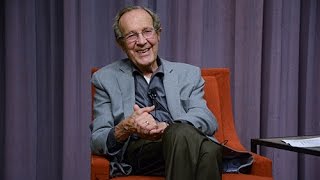
William Perry left his company in 1977 to work for the US government, tasked with offsetting Soviet military superiority through technological advancement. He was assigned this strategic challenge by the Secretary of Defense during a period of Cold War tension.
Now you were president of the successful company, was growing, and all of a sudden you get a call from the US government that says, we'd like you to leave Palo Alto and come to Washington dc. And you did it multiple times. It can't be the pay. What were you thinking?
Well, what I was thinking was, no, I don't want to do that. So I got a call from an old friend. Harold Brown was his name. He had been the president of Caltech, and then he'd gone back. He was invited by President Carter to become Secretary of Defense. He was a PhD in physics, so he had a technical background like myself. And he asked me if I'd come back to be his undersecretary for research and engineering. And I said no. I mean, I wanted to. Today we talk about entrepreneurs and serial entrepreneurs. People are proud to say they are serial entrepreneurs. I am proud to say I was not a serial entrepreneur. My plan was simple and plain. I wanted to take my company and build it into a great company. I had no idea of bouncing off with another idea to another company. Well, that was my plan. Since I was firm in that plan. The last thing I wanted to do is leave my company and go back to Washington. So I said no. And after two weeks of protracted discussion back and forth across the country, I yielded and said yes. Which is the right answer, by the way. But what persuaded me to say yes was this was 1977 now and January 1977. And the president and secretary carefully explained to me that we were in a very serious security issue in those days. I won't bore this class with the whole security issues of 1977, but they had some resemblance to security issues today. But When World War II ended, we ended up with almost a nuclear monopoly. But we disbanded. We had an army of 10 million men then. We disbanded the army. We disbanded our defense industry. The Soviet Union, on the other hand, observing what had happened in World War II, decided they would maintain a large army and that they would build up a defense entry. They wanted to emulate what the United States had done in World War II. They thought the reason the Allies had won World War II was because of America's industrial might. That's an oversimplification, but certainly was a major factor, America's industrial might. They said, next war we want to win with our industrial might. So they tried to emulate what we had done. They built up this huge defense industry and maintained quite a large Army. So in 1977, with all that background, they had an army about three times the size that not just we had, but which the NATO had at that time. Up until that point, we had said, so what? We have a great nuclear advantage. But by 1977, they'd caught up in nuclear weapons as well. Everybody was concerned. There was serious talk, I think greatly overstated talk, about a window of vulnerability to a surprise attack by the Soviet Union. There's a lot of concern to the point of hysteria, I would say. But in any event, the serious concern was we had to do something about that. And the President had decided very clearly he did not want to emulate the Soviet Union into tripling the size of the military, that huge cost. It would bankrupt our economy doing that, not to mention the fact it would have been very politically unpopular. So he said, we're not going to do that. We want to offset their superiority in numbers with a superiority in technology.
That's the magic word, offset.
Offset. He wanted to offset that. And he's seen what I'd done with the company. He said, what you did was introduce digital technology into your particular field. Was very successful. I want you now to introduce digital technology to all of our. The most important military weapons and use them then to make them so much superior to the Soviet weapons that we will offset their numerical superiority. So we. We went then in what came to be called offset strategy number two. The first offset strategy is we used our nuclear weapons to offset them. The second was to use our technology to offset them. So he gave me the job to offset, and that was a fascinating job. Had about $100 billion a year budget to do that. Kind of like a startup. You had to multiply that by 10 today to get the equivalent dollars. So it was a lot of money, a lot of resources, and he gave me full authority to do it. So that was just such a fascinating challenge. Aside from being an important problem, it was a fascinating technical challenge. I couldn't turn it down.