William Reilly: Negotiating a Life of Service to the World
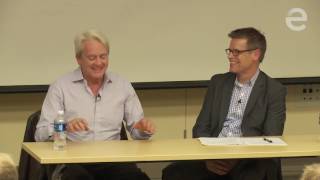
William K. Reilly, former EPA Administrator under George H.W. Bush, discusses negotiating the Clean Air Act, the Montreal Protocol on CFCs, and the Exxon Valdez response. He explains how he used external allies like Margaret Thatcher to work around internal opposition and shaped cap-and-trade policy for acid rain.
Chapters
I think of Bill as really a Renaissance man. If you look at any category, whether it's the public sector, the private sector, academic sector, the military, NGOs, he's had a senior position in all of those things. And so that can't be coincident. He's just a real high achiever and a great contributor in all those areas. Specifically, he was the administrator for the EPA under the first President Bush from 1989 to '93, I believe. And we're gonna talk quite a bit about that tonight. You know, Bill is currently a senior partner at Texas Pacific Group, a well-known private equity fund. He served on many presidential commissions. He was the president of the World Wildlife Fund, and so, We're unbelievably lucky, and I thank him in advance for his time.
Thank you, Stan.
Let's talk first, Bill, about—
Say something about framing first. Sure. I was fascinated by— I'd love to know what the facts that you all were circling around here. I'll send you a copy.
I'll send you a copy.
But I can only imagine. Henry Kissinger had a classic framing. He said it was his custom to— he said, I always tried to present three options. So it was unconditional surrender, nuclear war, or my option. The best of the worst. There's your Nixon. How many of you served Nixon?
That's fun. Well, let's start with your time at the EPA. You were serving President Bush. President Bush wasn't necessarily known— my memory would not think of him as a super progressive on the environment. President. So maybe tell us a little bit about how you approached both internally within the administration and then externally with some of the people you had to negotiate, some of the environmental disputes that came up during that time.
Well, President candidate Bush saw an opportunity in the '98 campaign. '98 was a very hot year. There were unprecedented numbers of ozone alerts. There was medical waste washing up on the beaches of New Jersey and Long Island. And he saw an opening and exploited it brilliantly. This partly reflected the fact that he thought in his heart that Reagan had not been sufficiently sensitive to the environment. But he was Reagan's vice president, so he'd never spoken up on the issue, and it was hard to draw him out, I was told, when he was vice president. The only indication he ever gave to his chief pollster who pressed him very hard, "Are we gonna have— what's gonna be different?" He said, "I'd like to be more forward-leaning on the environment." So he charged into Boston and had a very famous trip in a boat and went out and publicized how really polluted Boston Harbor was. And he charged that to the governor, Michael Dukakis, who was claiming the Massachusetts Miracle. It worked really, really well, partly because Dukakis reacted so defensively. He committed to be the environmental president, and I was the bona fides on that commitment. He got the president of World Wildlife Fund as his EPA administrator. However, his vice president, his chief of staff, and his budget director never understood why he'd made that commitment, nor did they sympathize with the priority. Basically, the budget director's view was, "Whatever worked to get us elected, fine, but now, you know, we're in a different mode." So I did a lot of negotiating, and I can think of so many times when I went around the system to negotiate with other parties than those who were creating the issues or creating the obstacles. In public service, there are multiple constituencies. It's one reason why often you get corporate CEOs who do not do well in public life, because they first of all assume that the White House appointed them is going to be on their side. Not always. And they've got congressional, they've got popular, they've got sectoral economic interests on any given issue. And I can recall one where I wanted to use the Clean Air Act to improve the air, the visibility in the Grand Canyon. And this would have been the first time that the Clean Air Act was used for that purpose. So I was able to negotiate a position that got a 70% reduction in sulfur dioxide and the pollutants of concern. We'd already tagged the pollutants and everything. We knew exactly where the stuff was coming from. It was coming from Arizona Public Power. I got a 70% cleanup. And I remember getting a tour by a young female park ranger out in the Everglades. And I was quite proud of this place. Plan that I had. And I said, "So what'd you think of that?" And she said, "You think it's enough?" Huh. And actually had quite an impact. So I went back, and there was no getting anything further for cost reasons out of the office management budget. Basically, we were gonna require, I think, 2 scrubbers, $100 million each, of Arizona Power on 2 of the 3 plants. I went to the CEO of Arizona Power. I said, "Is time worth anything to you? Suppose you didn't have to do anything for, well, 1, 2, and 3 years." He said, "Time's worth a lot to me." I said, "So let's go to 90%." He said, "Deal." And we got it. OMB was amazed, but the annual report of Arizona Power so proudly trumpeted this achievement for the environment in Arizona, and the CEO was very proud himself. He cared about the environment. Well, that is an example, and I often think that how you go into these things, you mentioned some cultures are less transactional, and that's really true. And I notice people in public life who are very disciplined, very focused, very intense, and very earnest often cannot do it. It takes too much out of them. They are too focused on a very particular finite but ideal solution. And I think of the former head of the National Endowment for the Arts, whose advisory council approved grants to someone who did a painting called Piss Christ. It was a crucifix standing in a big vat of urine. Well, needless to say, this was distressing to a lot of people. And I remember I was asked by Senator Simpson of Wyoming, who told him he should meet with— who told this individual, Frohnmayer his name was, he should meet with me. He said, "See, Riley has the toughest hide in town. He just comes up here and smiles and gets away, slips away." Actually, I was surprised that was my reputation, but if you're EPA Administrator, you do take a lot of hits. And the truth is, it didn't really bother me that much. Anyway, I met with Frohnmayer and said, "Your choices are straightforward." I said, "You ought to advertise what you do for the culture of the country, the arts companies, museums, the ballet companies, the symphonies, all of these things." "Well," he said, "I've been told I can't do it. The chief of staff doesn't want me on the road." And I said, "So what are you disposed to do?" "I have to defend my arts council." I said, "It'll cost you your job, and it'll probably risk your whole agency." "Mail is running 9 to 1 against you in the White House. You can't do this in American culture. You can't use federal money to denigrate a religion." And anyway, it did finally cost him his job. I tried to humor him a little bit, and I said, "You know, you could take an alternative approach. You could say that your agency is providing something that by every measure the public really loves and wants more of, and nobody has recognized that." And he said, what's that? I said, pornography. And he looked at me, and I said, just kidding. Anyway, he later did me the disservice of writing up my advice about how to manage the Chief of Staff at the White House in a book, an autobiography he wrote before we left office. But those kinds of experiences— and the Secretary of the Smithsonian had a similar one when he put up an exhibit or was planning an exhibit, and I'm not sure how far along it got, and it was on the Enola Gay and the decision to drop the atomic bomb on Hiroshima and Nagasaki. Well, conservative elements in the Congress just were crazy at the idea of even implying that there's some moral question about that decision. And I remember meeting with him, and we talked about the alternatives he had, and he concluded to hold his appropriation it was something that he probably shouldn't do. And I don't think they ever mounted that exhibit, but, or certainly not in the way that had been intended that would raise those kinds of questions. And I said, give all your information and your research to a foundation and an art gallery, the Whitney or somebody, and they can mount the exhibit. But again, it's all public money and it seems to me that has a lot of implications. But the negotiating imperative is often something that in government, agency heads move too quickly into a defensive posture and assume that they're responsible for what happened. And I saw this happen in the Exxon Valdez, where I went up with the Secretary of Transportation, the Commandant of the Coast Guard, and the Secretary of Transportation was asked, by his press guy whether he was ready for the press conference. He said, "5 minutes." And I said, "What are you gonna say?" He said, "I'm gonna say everything's under control. Coast Guard's got this under control." He said, "What are you gonna say?" And I said, "Not that." And he said, "You cannot come up here. I have the jurisdiction and differ with me." I said, "I don't propose to differ with you, Sam. I just don't propose to tell people—" You got 1,400 press out there and about 200 cameras, tell people what is going to be manifestly disproved within about 3 days as this stuff starts washing up on the beaches in the south. And so the commandant, no, yeah, I guess the commandant said, what are you concerned about? And I said, well, nothing we've been told is true here. We overflew the site. We were told there were 12 skimmers. They were all working. We saw 2 and they were dead in the water. 3-star admiral who was holding the door to a women's room where we were meeting. It's the only place we could find closed. Said there were 60-mile-an-hour winds here last night. And I said, we're also told that all the fish hatcheries had been boomed and they're all broken. Even the boom around the ship was still leaking. He said, well, sir, the same winds and waves. I said, Admiral, I'm not blaming you. It's not your problem. I mean, it is your problem. It's not your fault. And finally we agreed. Skinner said, "What would you say?" I said, "I'd say we're talking to everybody. We've talked to the governor. We're going to meet with the mayors, the tribes, the fishing cooperatives, and go back and report to the president. And he's going to report to the country." So that's what we finally did. My name was mud on the flight back, I must say. But it seemed to me that instinct, and I saw it over and over again, when something happened in the jurisdiction of an agent, agency to immediately assume some responsibility for its having happened, but some implication that they should embrace it. When in fact, they should go outside the box and look at it more clearly and see the data. And I myself, I once moved to ban $500 million worth of wine in Europe because it contained an unlicensed, unregistered pesticide. And needless to say, the French and the Italians were very upset. And they responded in a way that culturally I thought was really quite marvelous. I know both those cultures. I went to school in France and I spent a lot of time in Italy. And a Frenchman came in and he said, you're quoted on the front page of the Wall Street Journal as saying you're continuing to drink French wine. I said, I am. He said, well, why make such a big deal of this? I said, well, I have something It's called a law. And if it doesn't have a tolerance and it's in a food, you know, can't be permitted. So he said, well, how about you let us do the testing? And I said, well, we proposed that last year to have laboratory testing protocols, but don't you think it'd be the wrong time? And he finally said, well, don't test so much. Then the Italian came to see me and he said, what if I may ask you si problem? And I said, well, the problem is in high doses, this stuff, procimidone, causes cancer of the testicles in rats and mice. He said, the testicles? Italian wine. Nothing could be worse. It wasn't the cancer. Anyway, it was hard not to laugh. But this all came on so fast, and the stuff had all been ready for transshipment, that I then I didn't get enough information right away. We sat down, I finally sat down with all of my scientists and so forth and asked a number of questions about the stuff and how much we knew about it, how much the Europeans knew about it. They permitted, why don't we? Would we? Nobody's ever applied for a tolerance. Doesn't that tell you something? Yeah, it probably does. It must be something. It must be what we fear. At any rate, I finally said, what's the exposure assumption? And they said, "2 liters a day for 40 years." I said, "No, nobody drinks 2 liters of wine a day, for God's sake." And this young woman said, "Yes, they do, sir. My father does." And I said, "Well, with all due respect, it won't be the wine that causes him health problems. I mean, it won't be the persimmon." Anyway, I said, "Look, it's in 20% of French wine, so You've got to assume that the individuals are only drinking that 20%. I said, what happens if you drop the exposure assumption to half a liter? The problem goes away. It's below the level of regulatory concern. I said, okay, do it and make it clear all future wine from any other vintages than this one are prohibited without a tolerance being applied for and granted. Those kinds of things, I often think someone said here, maybe it was you, there's a tendency to enter negotiations without enough information, not to prepare adequately. That was the case. Yeah. And it's easy to say that, but in the heat of a crisis, to sit down with everybody beating on you, and by the way, the French were threatening American trade, our exports, and I also had to get involved with that. And send my assistant administrator to explain it in France and Italy and to call the U.S. ambassador to France and tell him to tell your château-owning friends the EPA administrator is trying to solve this problem. He has never said what he could say: French wine could cause cancer. So that quieted them down for a while, and I didn't get the Legion of Honor, though. I was disappointed.
Well, tell us, you know, going back, you said Bush ran on the environment. He's going to overcome the Reagan deficit there. You mentioned that several people in the cabinet weren't for that in implementation. Talk about how you either negotiated with Bush to try to accomplish that objective or some of the hurdles and how you tried to overcome those, either internally with the president or with his cabinet.
One of the really big objectives that we had was to develop a new Clean Air Act. There had not been a revisited Clean Air Act for 12 years. It was obsolete in many respects. It didn't address acid rain in the slightest, and acid rain was an extremely serious problem, both for the Northeast of the United States and even more for Canada. It was a very divisive issue with Canada. The Prime Minister Mulroney had said, "It's the single largest difference that we have with the United States. It affects our relationship very negatively." And I had been told by somebody close to Bush that when you develop your objective and you're alone with the president, not if you've got the rest of these guys around, play the Canadian card. Remind him that Reagan promised to deal with acid rain when he appointed Ruckelshaus administrator in '83 and never did, never produced anything. Bush feels badly about that. He's sympathetic with Mulroney, who supported us on a free trade agreement with Canada. And took heat for it. So play that card. Well, I did. And, uh, I wanted a 10 million ton reduction of, uh, sulfur dioxides. And, um, the difficulty with that was it was twice as expensive, according to our calculation, as an 8 million ton reduction. So the extra 2 million tons would have to be, to some degree, symbolic. But I made the case to Bush, you want to be the environmental president, The environmentalist objective is 12 million tons. Canada's is 10 million tons. And I talked to— developed a relationship with the ambassador to the United States from Canada and also with the prime minister personally. And Bush chose the 10 million tons. That astonished everybody. We created a market-based system for cap and trade. It's the original cap and trade on which the Kyoto Protocol was based and we have in California now, a cap-and-trade program. It was constantly challenged. It was constantly threatened. And I learned just before the bill, which became more expensive in the Congress than we had originally hoped, was going to be— there was going to be a recommendation of veto on the part of the vice president. And he has claimed that in his book. He actually threatened or told Bush that he should actually veto the statute. That one was a real stunner to me. And here's a negotiation. I called up the Prime— the Ambassador to Canada and I said, when this bill is gavelled down by the Conference Committee and we have a law proposal coming out of the Congress, I would like the Prime Minister of Canada to call President Bush and tell him that he's going to go down in history as one of the great statesmen friends of Canada, the best they've ever had. Well, Prime Minister Mulroney did that, and the chances of the Vice President then getting a veto were nil. And I remember thinking, it's an interesting cross-negotiation there to go outside the system. But to do it within the system would have been— well, there wasn't much I could do about the Vice President. He was simply not on the case.
Interesting. And we talk in the course about sometimes changing the other side's alternatives. And that's a great example of that. You told me a story, I think we were at a Council on Foreign Relations meeting and it was, I think my memory is it was around ozone depletion and kind of an end-around strategy. Do you think that would be a good story to tell here?
Well, all my secrets. Yeah, I negotiated a, the original Montreal Protocol, to eliminate ozone, upper atmospheric ozone depleters. Everybody know what that is, they are? They're chlorofluorocarbons, a chemical that was an $800 million revenue item for DuPont, turned out to be causing a depletion of upper atmospheric ozone. And it was pretty much the two chemists who proved it got the Nobel for it. And so it was a decision in the late Reagan administration to support— George Shultz takes a lot of credit for this— to support a phase-out of 50% of these chlorofluorocarbons for the developed world within 5 years. I proposed to take that up to full elimination. And I think it was full— 5%— 50% in— it might have been 50% in 10 years. I'm a little hazy on that. But we wanted to take it further. We had EPA. And there was no way— they had a two-track system, much as Kyoto did. For the developing countries, they were allowed much longer to get out of the chlorofluorocarbons. And I remember the Chinese ambassador— I showed a movie of depletion that NASA had done at a conference Mrs. Thatcher had, Prime Minister Thatcher, in England. And I asked the the Chinese minister, ambassador, minister, "Do you reject the science here? You disclaim it?" And he said, "No, we don't necessarily, but we find it awfully convenient that something that is very useful, very functional in our economy, now you have to eliminate, and you just happen to have the companies that have manufactured the substitutes." So he said, "We'll have to have the Chinese National Academy look at it. But there was no way the developing countries were going to get out of those ozone depleters without money. And so part of the plan was to have a $500 million fund to assist them. I remember went back and there was a very peculiar mood in the White House at that point, and it was partly directed at me and the fact that I'd been getting a lot of press. And so the Chief of Staff, the Treasury Secretary, and the Director of Management and Budget all agreed that we weren't going to give them anything. That it was in their interest. They were going to get sunburned too and suffer a lot of other negative consequences. And it was tough. I remember the budget director said, yeah, he said, we, we don't bring the ball, there's no game. And I remember coming out of that meeting thinking, this is a tough crowd of three to try to get overruled by the president. And so I remembered the conversations that I had had with Mrs. Thatcher, who was a chemist at Cambridge. Really understood the issue. And I went out and here's another three-way negotiation, called Mrs. Thatcher. The decision was made by Bush to put the full $500 million the next day. And I'm sure the three parties to the conversation I had must have wondered what happened. But that's what happened. And that's really the nature of government is you go where you need to and you look for the constituencies that you can deal with. And frankly, I've told you about some of the victories. You also lose a lot.
Let me just ask a clarifying question there. So you went to Thatcher and did really an end around, and then Thatcher went to Bush. Exactly right. So Bush couldn't hear it from you, but he could hear it from Thatcher, right?
I never even talked to Bush about it finally because it wasn't necessary. Oh, that's brilliant. Yeah. Well done. So, well, we had somebody there that he respected and that actually knew and cared about the issue, which was It's also great.
But you had these guys against you. I mean, the budget director, I think it was Dick Darman at that time, not a big environmentalist. No, boy, no. You also told me a story about him wanting your travel receipts and really kind of going after you.
Yeah, this is an interesting story. Didn't realize that they played that hardball so early, but they did. And you use all your resources in a position like that. You go in thinking— I remember my wife said to me, she said, you know, I asked you what this job was going to be about and you said it was balancing 'economics and environment and science and health and putting them all together and making policy.' But she says, 'Seems to me all you do is fight.' What I'm describing here is the politics of the environment in a divided government where the president believed one thing and cared about the issues, but it was mostly focused, as you might imagine, on international problems and foreign affairs that were where his head was in his history and most interest. And the budget director could get away in front of the chief of staff and others with saying, as he once did, he said, "The problem is we've got an environmentalist running EPA." But then he said, "The real problem, the real problem is we got an environmentalist sitting in there," and he pointed to the Oval Office. And I remember thinking, "Is that permissible? Is that legit? Can you say that?" Attack the boss.
But he did. Well, I remember one thing that Bush did was he announced, and remind me of the details here, a ban on drilling, and you had a negotiation, I think the Sierra Club was involved and some other folks, do you wanna tell that story?
Yeah, it wasn't actually, I don't think, with the Sierra Club, I don't think we negotiated with them very successfully ever, but the president, asked my opinion on whether or not to ban drilling along the West Coast and also, as it turned out, the Atlantic Coast. And I said, I think it's an easy choice. And I said that with some trepidation. This was an oil man after all. I said, Dukmejian tried to do it, tried to drill. Reagan tried to drill. Watt, Secretary under Reagan, tried to open it up. Nobody succeeded. I said, "Simply ban it and take credit for it. You can't do it anyway." And he said to me, "Do you think that if I do this—" He first of all said, "Look, the drilling's gotten much more safe and reliable than it ever was in the days when we had the big blowout off Southern California." He said, "Do you think if I do this, environmentalists are gonna say it's another wimpish half measure? 'Cause I'm only gonna do it for 10 years. I'm not gonna do it—" permanently. I don't know enough about the future of the economy and our needs. And I said, these are sophisticated people, Mr. President. They're gonna understand that it's your watch and probably your successors, and that's quite a lot. Well, and the decision was made and the Sierra Club said, this is another wimpish half-measure by an anti-environment president. And it went on like that. So at the next cabinet meeting, as he was leaving, he said, you see what the Sierra Club What can I say? Almost using his words even. And he said, you know, I don't give environmentalists everything they want, but they treat me like I was Reagan. And I remember thinking, losing him.
Yeah, it's interesting. You know, my work, I've done quite a bit of work with environmentalists, and the problem with many of them in my experience is they're just always against things and they're not really for things. You told me a story as we were walking before class about a current project you're working on to— was it shut down a couple of coal plants and what's going on in Texas? I think that this is a really interesting story about how to frame something and give the other side credit.
The environmentalists, and there are serious exceptions to it, the Environmental Defense Fund and Fred Krupp, I did a deal with whereby he would support our Clean Air Act, at least the acid rain provision. And we would make the cap permanent and he would provide full support. He was as good as his word, he did. And 10 years ago I negotiated the environmental commitments for the largest private equity deal in history, a $45 billion deal in Texas to buy Texas Utilities and for TPG, Goldman Sachs, and KKR. And as it turns out, we went in at $8.50, gas price, which determines the price of electrical energy in Texas. It's now around $2, and the company's in bankruptcy. As we are going out the door, one of the commitments I made was to cancel 8, the construction of 8 coal-fired power plants, and that made history at the time. It was the first time that the financial community had ever taken the environment so seriously. And we averted 55 million tons a year of of carbon dioxide. So we now have 3 coal-fired power plants, which are responsible for 3,500 megawatts and 33 million tons per year of carbon dioxide. And in return for allowing a couple of them to go out of business, one this year, one in 2 years, and one in 5 or 6 years, we're proposing to make a commitment to permanently shut them down. This is a negotiation that's ongoing. It's by no means finished or approved. But the decision that Texas has been briefed on is extremely concerning to Texas. Texans like coal-fired power, at least they ideologically like it, even though they have more wind power than California, more wind power than any state. That started under George W. Bush. They really don't like EPA, and on the Clean Power Rule, which is gonna reduce carbon dioxide, they have refused to write their own state implementation plan, forcing EPA to write it, the federal implementation plan. So in that frame of mind, they get wind of this conversation, and they're really upset, and we're told that they think that we're trying to do one favor as the Obama administration goes out the door. And so our— the head of our generation company goes down to talk to the governor and talk to the environmental officials there and explain that the upgrades required by current air law would be about $700 million for these 3 plants. And given their value and the fact that we've just acquired 3,000 megawatts of gas-fired power and another— we're building solar power. We can— and Texas can do without it. So we're trying to bring them around. And one of the difficulties is what does Texas say if EPA and we sweep in and make this decision and it looks like they've been undercut? Well, it's occurred to us that what they say is, we, Texas, solved the problem that the Clean Power Plan was designed for. We're not even gonna be subject to it. We're going to, under the Clean Power Plan, 51 million tons of carbon dioxide have to be cut from the annual output in Texas. We're gonna provide 33 of them. Problem solved. So the governor can say, we dealt with the problem ourselves. You can even say we dealt with it without the Clean Power Rule, without EPA, and we've put Texas on a cleaner path, but we had, you know, it wasn't the federal government. That's the story, or it could be a story. And very often, if you're dealing with decisions that have these very substantial financial consequences, you really need to think about the other side and their political posture and all of the things they may have said. In the past and how they'll look like they're reversing to make it easy for them and let them win. Interesting. Something that EPA fully understands and they're quite happy with. They know how they're regarded in Texas. That's not news to them.
I bet. So it's really an example of giving them a graceful exit and essentially letting them have your way.
Mm-hmm. I wouldn't want to put that quite that way.
I said that, you didn't say that. Yeah. Well, good. Let's shift to multi-party talks. I know when you were EPA administrator, you dealt with the Rio talks. There have been the Copenhagen talks. There's recently the Paris talks. These are multi-party, complex, multi-stakeholder processes. Maybe can you comment on any of those, or experiences with those, or lessons learned, or are those the right way to get climate deals done?
You know, historically, the international conferences on climate have foundered because of a very strict demand for targets and timetables. We're going to reduce carbon dioxide by X amount in Y number of years. Turns out not a lot of governments are willing to play by that rule. They did purportedly in Kyoto, but even governments that were very moralizing at the time about the failure of the United States to ratify such a deal like Canada and the Netherlands. Canada was 35% over what it committed in Kyoto. Everybody said it's a legally binding treaty. Well, it wasn't very binding, it turned out. Netherlands, 11% over. So that did not work, and the decision essentially was reached, and there was a very widespread consensus that this was the appropriate way to go, to have a conference with commitments that are open-ended, that would embrace whatever a country brought as its own proposal on how much reduction it will get and by when. That's what happened, and we all declared it a success. It was important that we have a success after Copenhagen was not a success, and it reverberated to the discredit of the whole issue in the minds of a lot of people, including a lot of foundation people who thought that there were opportunity costs of staying in this game, and we had lost Waxman-Markey, which is the climate bill. And then we lost Copenhagen. So I am terrifically supportive of the fact that we got a deal that everybody thinks is a great success. However, you can't really take it to the bank. I mean, we've not got common baselines, we've not got common sets of objectives, we've not got sectoral agreements on where these reductions are coming from. Even the United States, a third of the emissions that we promised to get, we have not specified how we're gonna get. So the treaty is really the best that could be done. And I look back at Rio, where the United States was very criticized for not committing to specific targets and timetables, and just realizing the culture, the times, the expectations had changed. And there's much greater sense of realism now when you look at countries like China and India, Mexico, Argentina, others, that to get the kind of solutions that we need will cost a lot of money. For example, the amount of, a huge amount of wind and solar power that have been committed by the various countries, mostly by developing countries, really big numbers, will cost $2 trillion, trillion with a T. The countries, some of them have made it completely clear, that money either will come from the international aid and lending institutions or it will come from private finance, but they won't be able to come up with it. So the negotiations on finance are going to be really critical. The leadership of the next president on the issue, one has to hope he believes in the issue, she believes in the issue. One of the candidates does not, famously. Look back at Rio and we worked very closely with the president of Brazil who hosted that conference. In fact, I went to meet with him. Prince Charles had a yacht trip up the Amazon that he invited me to go on with him. And he had the president of Brazil and the 3 key cabinet ministers. And so I went and said that I would not recommend the president come to the conference— this is 4 months or so before— unless they straightened out their act. And each of the cabinet officers told us the same things. And I said, look, the president's going to be in a an election campaign in June of '92, and the prospect for embarrassing him is just not one that anybody's gonna wanna accept, and you guys are not very organized. The president of Brazil said, I will promise you, I will not, we will not allow the president to be embarrassed. He said, it's worth, I think he said 65 heads of state are waiting to see if the president of the United States is coming. So it's vital to Brazilian-US relations. Well, there was a big debate within the administration about whether the president should go, and he decided to go. But a key decision had been made not to support the biodiversity convention. I had to defend that as head of delegation down there. But I also developed a draft that would have allowed us to endorse it, I thought. And later, the National Security Advisor Brent Scowcroft said, We could have supported that if it hadn't become public and so embarrassingly so. Anyway, the secret memorandum I sent to the president was leaked the next morning and front page of all the newspapers. And it embarrassed the Brazilian president. He used the word fix. I said that the Brazilians are prepared to help us fix the treaty. Well, fix has the ambiguous meaning it has in English too. And so the press in Brazil had a good time embarrassing the administration. I often look back at all of that and wondered if that could have been dealt with. But what really happened there was one more example of a divided administration. The person who leaked the memo was in the Vice President's office. And without much regard for how it would affect his boss, he sent it to the New York Times where it was front page news. And then in the opening paragraph it said, someone hostile to Mr. Riley's position leaked the memorandum. That's not something you can really guard against very well if you've got that kind of administration and you've got people who really aren't on the environmental team.
Well, you bring up the current politics and it's hard not to want to go there and get your perspective. You've got a very divided a huge divide between Republicans and Democrats, Congress hasn't been very effective. I was once interviewing Justice Sandra Day O'Connor and she had an interesting perspective on the dysfunction of Washington. She said when she first became a Supreme Court Justice, all the Congressmen and women would go home, you know, infrequently, but they lived in Washington and their kids were in school together and they had cocktails together and there's a lot of relationship even though they had divides of ideology. But now with the pressure of fundraising, you kind of had to be in maybe an apartment in Washington. But if you're from Arizona, you really live in Arizona. And those relationships weren't formed. So I'd be curious as to your perspective. You've done work through a lot of different presidential administrations. How has it come to this? Is there a solution? How can that be negotiated?
Well, there's no simple solution. But that is very true. I was co-chair of the President's Oil Spill Commission after Macondo. And the executive director that we chose— Senator Bob Graham of Florida was the co-chair— was Richard Lazarus, who's now a professor. Then a professor at Georgetown, now a professor at Harvard. His best friend is Chief Justice Roberts. Lazarus is a classic liberal. A professor and with the views that are consistent with that. And he was a roommate of Justice Roberts. They teach a— co-teach a course every summer and they've taught in Australia, I think in Malta and some other places. And I look at that relationship and that's the way things used to be. Teddy Kennedy was close to Orrin Hatch. Go figure. But it worked. Those relationships— a lot was relationships in those days. And the attitude in the Senate, you would never use the kind of language that some of them use now for each other. And if you talk to people, I've talked to some people who— Senator Boren in Oklahoma and some others who left the Senate, Senator Bradley, Senator Simpson. One of those three said, you know, they'd want to impeach us if they knew how we spent our time. Basically, it's hours a day on the phone in the offices away from the Capitol because you can't raise money in the Capitol, talking to donors and eliciting funds. And I said, but you have a 6-year term. How bad could it be? Well, you have to raise money early to scare off primary opponents. And then there's the ideological issue that they're probably, as I've been told authoritatively by, by more than one Congressperson in the House, more than 100 Republicans who totally get climate change, totally understand the science and what it all means, but are precluded by concerns in their district for being outflanked on the right, lest they get on the wrong side of that issue, lest they support— well, in the case of Waxman-Markey, say. And one congressman told me that he would have been advised in his district not even to stand again in his primary. I asked him in his case, I said, who cares that much in your district? He said, evangelicals in our district. And you've got the image that Senator Sheldon Whitehouse, a Democrat from Rhode Island, has this marvelous image. He says, the thing is, the way we have to think of the Congress as a prison, or at least that part of it that has the Republicans. And he says, and We need a prison break, but they all have to go together when they go. They have to climb the wall and run because otherwise they get picked off one by one. Well, there have been 14 Republican senators who've acknowledged the climate issue, and I forget some percentage of those acknowledge we ought to do something about it. I think that's only a matter of time, honestly. We had a letter from a number of mayors, quite a number of them from Florida, recently to the debate questioners asking that the question be posed about climate change. It never even came up in the 4 years ago, any of the debates. And it hadn't come up this year until I think they've had one question and people were allowed to slide away and not really address it after saying, you know, they really didn't— I guess Trump said he didn't really pay much attention to it or think there was much to it. He's also said, I understand that he's going to eliminate EPA. And I think— isn't he on record as saying he's going to eliminate the IRS? I think he has said that. Cruz was of that opinion.
Well, let's say— final question, then I want to open up to the students.
Just to complete the thought, I think that we're going to see, as we have seen historically in a democracy— we saw it in the summer of '88— a substantial change in political opinion, and all of a sudden we will begin to embrace the issue and address it. And it will largely be the consequence of things like Miami having to install large pumps after every rainfall to deal with flooding the streets and equivalent things related to sea level rise. Okay.
So my final question is, let's assume that Donald Trump is not the next president and that Hillary Clinton wins and the new administrator of the EPA calls you up and says, Bill, I've got a lot of experience, I want to get a lot of stuff done, I want to have an environmental agenda. Clinton is generally on record as being an environmentalist. What's the advice to that person?
Well, you've got two pillars, really marvelous pillars, to the carbon dioxide reductions the country has to get. One is the automobile fuel efficiency standard, which the administration negotiated with the auto industry, and it's really amazing. It's 54.5 miles per gallon, I think, by 2025. That will reduce by more than 2 million barrels a day the energy oil use by the United States. Now, there's a negotiation I would have liked to have done. I mean, we had a little bit of an advantage in that at the time we negotiated, we actually owned a couple of the oil companies, we the government, but— and that won't happen again, one hopes. But that is really important. The second one is the Clean Power Rule, which will reduce CO2 substantially and also have the effect of furthering the movement. I was asked by the minister negotiator from China just before Paris, to what degree can I depend on, can China depend on a continuation of the policies that the Obama administration has espoused? And I said, well, I think you can take a lot of consolation from the fact that the United States is decarbonizing. We're going to meet the goals that were set in Kyoto by President Obama by 2020, I think it is. We're gonna meet them largely as a thanks to the oil and gas industry. It's fracking and cheap natural gas which has allowed the displacement of coal, and coal, of course, is twice as productive of carbon dioxide as gas. The third set of decisions It's gonna be very tricky for the new president. I think if we have a Congress similar to the one we have right now, we can't expect necessarily a big uptick in responsiveness. But what really has been significant in our country is the responses of the cities. The Chicago Climate Action Plan, and they're hugely inventive responses. They've invented permeable paving, and they're replacing all of their paving gradually in the city to deal with the fact that they're gonna get their water about the way we get ours, and there'll be long periods of no water at all from April to November, December. They have green roofs that have been incentivized. They're increasing the— tripling the size of their emergency rooms because they expect days above 95 degrees to go up very substantially. In the next, in this century, way over where it was last time, last century. And a whole range of things, tree planting is different. They're planting all different species, by the way. They're no longer planting Norway spruce or maple or ash. Ash is the Illinois state tree. They're planting Alabama sweetgum. They're in a new plant zone. I think that kind of information down at the grassroots level, and who did that? It was a mayor who's not known for being a tree hugger or ideologue. It was Mayor Daley. He oversaw it, brought in the best people from the universities in Chicago, and they've got some good ones. And the result was what they— they set out a scenario of likely effects of climate change, to which then the people responded. And they've got a first-class plan, very strong incentives for insulation as well. New York under Bloomberg did something very similar, and there are a number of other cities around the country. I think the combination of what they can do on adaptation, where it's going to be incontestable that changes will require responses, and mayors tend to be rational, prudential-minded people. They really deal with problems non-ideologically at their best. That, I think, is going to give us and new president a lot of help in developing sets of policies that start with adaptation because most of the members of Congress who don't want to concede that humans are causing climate change do accept that the sea level is rising and that temperature, mean temperature, is rising. So if you have that, you have a basis for getting some agreement on adaptation. And I think that finally, as we move toward more and more adaptation, People will look and see that, well, is there nothing we can do about this problem? And finally, we will see the American political process respond. Okay, excellent.
Let's throw it open. Will's got his hand up first.
Thanks again for coming in and sharing your stories. I was just thinking as you were talking, you really moved from where you were nonprofits where you could probably more directly negotiate for the environment as a voice for the environment in government where you're really having to negotiate for the interests of the American people in the environment in this case. And then also you've done stuff in investment where, yeah, there's some interest in the environment, but also you're— you're choosing to negotiate for financial interests of people making those investments. I'm just wondering, as you've done that, how you've had to change your negotiation style between those things and at the same time keep your interests or your values there?
Okay, so just quickly repeat that, you've worn a number of different hats in different sectors, government, for-profit, nonprofit, presumably your values have remained fairly consistent, have you had to change your approach in those different environments to negotiation?
I've certainly had to function in an environment for much of the time in private equity where there was not a serious priority given to the environment. It's only within the past, I think, 3 to 5 years that it has become popular, and not just popular, but even required on the part of some major investment organizations, CalSTRS, CalPERS, which are huge investors in the economy and in private equity. And the Europeans probably got there first, European investors, the Norwegian hedge fund, some of the sovereign wealth funds of the developed countries. That's really taken hold. And now you have the best situation in that the investors themselves want to see green policies. They don't want to be embarrassed. A lot of them are saying, are looking very closely at coal. There was a very important letter that was issued by David Swensen of Yale, who is the gold standard of investors. Investment. And he didn't, he didn't say that Yale would not invest in coal. What he did say was that all of his portfolio managers were to take very seriously the risks associated with climate and determine with respect to each investment how they would deal with those risks, whether the risks were worth taking, how large they were, and the rest. Very compelling letter. It had a very substantial impact. And it was something that I really welcomed. I would say that in terms of a lot of the things I've done in the private sector, I'm on the board of Royal Caribbean Cruise Lines. I was brought in there to fix them. They got indicted for having disconnected oily water separators on 11 ships. They got fined $20 million and went on probation. And I was brought in to develop a new probation agreement. And a settlement and make sure they did settle rather than fight those charges, because it was a conspiracy or looked like a conspiracy. And so in those cases, and there have been some others like that where I've gotten involved with agribusiness that was an organic business. And now I'm on the board of a pellet company that makes pellets from the detritus, the leavings of woodlots largely in the South. East and makes them into pellets that substitute for coal, reduce the amount of coal used in European coal-fired power. So the kinds of investments I've tended to be involved with are largely environmental enhancements. And so I haven't had to make any really difficult choices. And of course, in the Texas Utilities investment, it became Energy Future Holdings. The environmental commitments we're very proud of. Promised 1,500 megawatts of wind. We promised to extend the grid in Texas, spent more than $2 billion to do it, one company. And so you can get the wind from the Panhandle where the winds are to the Dallas and Fort Worth where the people are. And there are those prospects in finance and they come up all the time, especially in the energy sphere.
Okay, other questions, Joey?
Um, so we, we, uh, talked a lot about in this class, uh, for trying to establish certain types of objective criteria. It seems like, I guess, especially in the environment, a lot of times you go into a negotiation with another party who— and both parties have a fundamental disagreement about some of that. Like, for instance, you, uh, might believe in climate change and the other organization doesn't believe that green greenhouse gases contribute to climate change. So how do you adjust your negotiation strategy to try to find some common ground when it appears that there's such a big fundamental disagreement about the causal relationship?
[Speaker:JOHN KERRY] OK, let me just repeat that quickly. So you get ideological divides, something as simple as warming, humans causing warming, and not. How do you negotiate with another party who fundamentally, from a values perspective, and even ideologically sees things differently?
Well, in the case of Texas, looking at coal-fired power that one might want to eliminate and a concern on the part of Texas political establishment that they don't want to give any quarter to EPA, what you do and what we have done is make very clear that the economic cost of retaining those plants as you upgrade to accommodate sulfur dioxide rules, mercury rules, all the rest of them, are such that you can arrive at another explanation or reason that has nothing to do with carbon dioxide reduction to make those decisions to shut down those coal-fired power plants. That's, I think, the first thing. Second thing I would say is it is often true of environmentalists who tend to have their heart in it in a big way, and certainly my agency, EPA, did. We had more people who were veterans of the Peace Corps than any other department, agency, in Washington. And I thought that spoke well of people's idealism and their general outlook. But it sometimes has a disadvantage of causing people not to be open to compromise and to define a position as the morally correct position in such a way that it's very hard to negotiate. You can't negotiate with someone if you characterize their position as pure evil and you can't really concede much to it. I remember once the Interior Secretary said to me, you know, he said, I love my parts of the Interior Department like the Bureau of Mines or Water. I give them an order and they say, yes, sir, they salute. He said, give an order to the Park Service or the Fish and Wildlife Service, they want to check with God first. Then he said to me, I forgot who I was talking to. That's all you've got, people who check with God. Well, that's true. And it's a hugely positive thing that we did and do. Nevertheless, you have to be sensitive to the fact that there are a lot of perspectives that are brought on major public policy decisions. One of the things that the president has to do is reconcile those in some sufficient, adequate, and sustainable way. And if you're negotiating for the environment, it's hugely helpful to go into a negotiation without believing that your adversary is really the enemy.
Good. Indigo?
So you talked a lot about these sort of like tense professional relationships with people, but I'm just curious how you managed to navigate your personal relationships with these same people that were like putting slander in the newspaper.
So when you, you mentioned several stories about within the Bush administration, people sabotaging through the media, leaking. And you had to go on working with them for those 4 years, and so how do you maintain the relationships?
I think that we both, in the case of the Chief of Staff, knew that we had to get along with the other one. I mean, I knew that he had the President's ear 24 hours a day and I didn't. I saw the President when I needed to, saw quite a lot of him, but, and he knew that apparently he had, after the Exxon Valdez, the President had been very positive about my performance. And the fact that I was there. So we were delicate with one another, I guess. But I— he was very gruff. And people used to think that he would curse them out and get very angry on the phone and give all sorts of jeremiads. I didn't have that relationship with him. I mean, the way he generally dealt with me, he would call me up in the morning. He'd get into his car, White House car, at 6:00 or 6:30, and he would already have the newspapers. I would be just waking up. He'd call me up and he'd say, "Bill, what are your guys doing in Los Angeles? I mean, how can you— they can't do that." And I wouldn't know what he was talking about, which— that was the idea, a little Chinese water torture. Um, I kept a good relationship, and I can remember the kinds of things I did not very many people did. In fact, I don't recall it. Once we were riding up to the Congress, and the president's congressional aide was sitting in the middle, chief of staff on the right, I was on the left. And in the front row was— front seat shotgun was the deputy chief of staff. And he leaned forward, and chief of staff said to him, "You tell Sullivan to cut it out on tobacco. He's had entirely enough on tobacco." And I said in a falsetto voice, "Ooh, no, cut it out. You're going to get a call from Sununu." And poor chief— deputy chief of staff almost disappeared in his seat. And the chief of staff didn't say anything. And he said, I've been having trouble sleeping lately. I got a good night's sleep for the first time in a long while last night. And I said, you know why that was? He said, no. I said, it was because of that little love talk you and I had before you went to bed. And we had had one of our more serious disagreements. And he smiled and he said, I had 3 of those calls last night. I was thinking one was enough for a career. But basically, I don't use humor. And it turned out that was effective. Also with the budget director, who whenever he saw me coming into the White House mess telling a joke or laughing, looked very concerned about what I might find so funny that day. I mean— and of course, as soon as I found that out, that's what I always did. I found it possible to do that. I don't have the kind of temperament where that's difficult, but when I was talking about the arts director and some of the others that I've dealt with, it really is true that— and I'm not sure it's entirely temperament. I think you can simply decide that you're going to be a certain way. You're going to keep your emotions under control. You're going to keep your eye on the ball, realize that if you lose today, you're going to want to win tomorrow, and you might be able to, but not if you walk away mad every time. Good perspective.
Other questions? Yeah, Tali. In a lot of the situations, financial, you always have the alternative to walk away from the table and say, I have a better deal with someone else.
In the environmental aspect, especially if you think about the international negotiations with the latter party, you don't have that alternative. —this alternative that gives you leverage. Do you find a different alternative or different solution that fulfills this— that can supplement this method?
So in financial negotiations, there's always an alternative. You can walk away. Sometimes in complex environmental disputes, there isn't an easy walk-away alternative.
I had a terrific mentor, Russell Train, who was former president of World Wildlife Fund for me. Had been the second administrator of EPA under Nixon and then Ford. Very close friend, and he was my chairman of the board when I was president of World Wildlife Fund. When I was appointed, he said, "You're going into an administration without any friends." He said, "I actually know several of these people," and he mentioned some of the ones we've been discussing. He said, "They're gonna look at you and wonder, you weren't involved in the campaign, you didn't contribute to the success here, what are you doing with that job?" And he said, "I have two pieces of advice." He said, "You're going to have two advantages. One, you're Bush's kind of guy. He's going to like you." And I remember Lee Atwater, who was the president's campaign director, head of the Republican Party, said to me once, he said, "Bush is in politics for guys like you, not me." He said, "I accept that. It doesn't bother me." But he said, "He doesn't like politics. He really likes policy." And he said, "If it works with Bush," he said, "it will." He will like you. And we got along great. And we were invited to 5 state dinners and I would always be positioned to cut in on him at the dance floor so that he could dance with my wife, really. And they were very nice to her and they seated her next to Prince Philip at the dinner for the Queen and next to Václav Havel at the dinner for him. So we got along very well personally with the Bushes. And they were great. And the second advantage, Train said, is the press. He said, you should play for the press. He said, if after a year that works, he said, and it will work for you, he said, the White House will fear you. And that is where you want them. I thought, isn't that interesting? And I remember Jim Baker, who'd been Chief of Staff to President Reagan, Spent about 30% of his time, it was said, a couple of hours at any rate, in the morning open to the networks and 3 newspapers. And when Don Regan succeeded him, former head of, I think, Merrill Lynch succeeded him, he was contemptuous of the amount of time that Baker had spent with the press. Well, Regan didn't last very long. Baker knew what he was doing. And I did exactly that. I talked to the press. I was on the Today Show very regularly. I did get told not to do it so much. There were people who were thinking that I was overdoing my issues and other people needed to get more attention. And I also was criticized by White House staff for revealing too much. And I remember Atwater said of me— I was quoted on the record as saying, it isn't that he's telling secrets. He's confirming what everybody knows but what nobody will admit. And that's what I was doing. And so it made me very popular with the press. But the press, particularly if you're the EPA administrator, you report to 78 committees of the Congress and subcommittees. Really, that many. You have statutes and requirements, really virtually every week you're supposed to issue a new report on some problem that somebody got Congress to agree to have you do, you are pulled in so many directions and distracted so significantly that you need to take the issues yourself and define them and define them again and again and again, creatively, persuasively. And pretty soon people will start discussing the debate in your terms. And you said what really is important. You actually have the whole agency behind you. You can certainly get all the data and the research that supports positions that you take. That's what the country really needs. It's to a very large degree, it's a communications responsibility that even an administrator has, especially an administrator of EPA. The environment matters hugely to people, but they need to know not just positive things that we should do, but things that they shouldn't worry so much about, like hazardous waste. Which has just been way exaggerated in terms of its morbidity and mortality consequences. That is a key responsibility of somebody in high office and particularly at running EPA.
Well, we could talk all night, but unfortunately we're out of time. Let's give Bill a hand.
Thank you so much.
More from GHION.AI


O processo de reconhecer limites, mesmo quando a vida parece exigir sempre mais.





Depois de tantas histórias, aprendizados e pausas necessárias, o @interior_iza está de volta



