In this demo‑day presentation, the founders of UnumID explain how their mobile‑first identity platform creates a tamper‑resistant, shared verified identity by binding a person, their smartphone, and their online persona through biometrics, behavioral authentication, and cryptography anchored in the device’s secure hardware element. They argue that storing encrypted personal data on the edge (the user’s phone) makes large‑scale data breaches virtually impossible, as each account would require compromising an individual device. The solution enables passwordless, push‑or‑QR‑code multi‑factor authentication and, crucially, a shared KYC mechanism that lets users instantly onboard to new financial services by consenting to share previously verified identity data, reducing onboarding time from minutes to seconds. Their white‑label SDK turns any app into a branded identity wallet, eliminating phishing, SIM‑swap attacks, and other social‑engineering threats. The founders trace the technology back to a 2016 Stanford project aimed at preventing foreign influence in politics, note that they have raised capital from Samsung and Draper Associates, received TechCrunch privacy‑security accolades, and piloted the product across 48 U.S. states. They conclude with a call to financial institutions to adopt the platform as the future of mobile‑centric finance.
Chapters
UnumID helps financial services instantly know who's who in the online world. We tie a single human to their mobile device using biometrics and behavioral authentication, and we tie that device to their online identity using cryptography and specifically leveraging the secure element of that device, not accessible even to the hardware manufacturer. In doing so, we create a single tamper-resistant source of truth across all business units and even across companies. Crucially, all the sensitive data is pushed to the edge, encrypted on each user's mobile device, making a data breach nearly impossible. To hack a million users' accounts and personal data, you'd have to hack a million independent devices. Not just one database. We call this Sharified Identity or Shared Verified Identity, and it's the future of finance.
The original idea for UnumID came to us back in 2016 when we were students at Stanford. We were trying to solve an urgent national security problem, preventing foreign influence in our politics. We built state-of-the-art identity technology to prevent bots from influencing political systems, which we achieved by establishing a one-to-one connection between a person in the offline world and an identity in the online world. But we quickly realized that this was an unsolved problem everywhere: in healthcare, e-commerce, shared economy, government, and perhaps most notably in financial services, which have the huge burden of know-your-customer regulations. Identity is fundamental to every interaction we have online, but current systems are outdated and insecure.
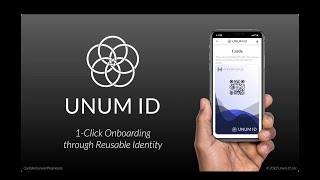
Since our first funding in 2018, we've raised capital from Samsung and Draper Associates. We've been named a TechCrunch top pick in privacy and security, and we launched in an initial pilot in 48 states across the country. Why all the buzz? Because UnumID transforms each user's mobile device into a secure, reusable virtual ID card. We can create two transformative user experiences. Passwordless authentication, and instant onboarding through shared KYC.
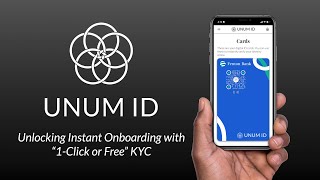
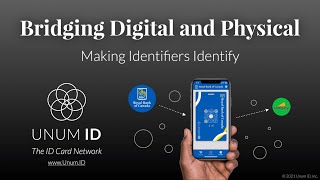
Our white label software embeds in your app, transforming it into an identity wallet that stores each user's personal data on their own device. It's all protected by biometrics and cryptography tied to the secure hardware element of that device. Multi-factor authentication is then as seamless and easy as tapping a push notification or scanning a QR code. With your app under your branding. No passwords involved. Phishing is nearly impossible because the authentication goes both directions, so the user also authenticates that you're the right company. They literally cannot share data with the wrong entity. And social engineering attacks like SIM swapping are eliminated because the user's identity is tied to their physical phone rather than their phone number. People are easily fooled, but cryptography isn't. Most importantly, UnimyID allows you to share KYC verifications with other financial services securely and in full compliance with privacy regulations because user consent is foundational to the system. This enables, for example, instant onboarding where a user simply agrees to share identity information that they've already verified with another company. This means you can onboard a new user in 5 seconds rather than the average time of 10 minutes up to several days.
Long gone are the days of in-person banking and paper documents. As our generation will tell you, the future is mobile. Phones are the ID cards of tomorrow. Even today, more Americans have a mobile device than have a driver's license. Now is the time for your institution to get ahead of the curve. The world is changing quickly, but with UnumID, you can pave the way to the future of finance. Let's work together to build the next generation of customer experiences.