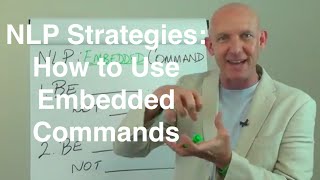
Kevin Ward (YES Masters) explains what embedded commands are — short commands embedded inside questions or statements as an NLP technique — and how real estate agents can use them ethically to get more “yeses.” He defines embedded commands, gives examples (e.g., “Do you want to come over to my house for dinner?” → embedded: “come over to my house”), warns against manipulative use, and emphasizes two keys to effectiveness: be inviting (not threatening) and be confident (not desperate). He also gives a pre-qualifying script that contains three embedded commands: “feel confident,” “sell your property,” and “hire me.”
Chapters
Hi there, this is Kevin Ord with YES Masters Real estate success training, helping you get more yeses and more successes in your business and in your life. And let's talk about embedded commands. Now an embedded command is a neuro linguistic programming strategy, NLP for short. And that's which is a communication strategy that is extremely powerful when it comes to inspiring people to say yes to you. Getting people to say yes, yes to you. Now what an embedded command is is very simply, it is a command that is embedded, right, embedded inside of a question or statement that subconsciously gives a command to the brain to do a certain thing or to think a certain thing. So just as a simple example, an embedded command would be, for example, I could say, do you want to come over to my house for dinner? Now it's a simple question, do you want to come over to my house for dinner? The embedded command is come over to my house. So do you want to come over to my house for dinner? So that would be an embedded command. It is again, it is a command that is subconsciously embedded inside of a statement or question that is intended to give a command to the brain. Now understand, this is very important to understand up front because a lot of people are like neuro linguistic, it sounds manipulative, it sounds sneaky, it sounds underhanded and so forth. Well understand that nlp, Neuro linguistic programming and the tools in it embedded command and so forth is simply that it is a tool and it's like a knife. A knife can is not good or evil. A knife is a tool and it can be used to do good or it can be used to do evil. So if you use an embedded command to manipulate someone selfishly for your own gain or for unethical reasons, that's what makes you a con artist. In other words, that's deceptive, that's evil. On the other hand, if you use an embedded command as a tool to help somebody make a decision that's good for them and you're using that to influence them or to lead them in a way that can add value to them and help them make a good decision, then that's another way to use a tool that uses it in a good way that adds value people. So it makes you one makes you a con artist and one makes you a problem solver. And it depends on your motivation. So understand what I'm teaching you is a tool. And when I teach agents how to use embedded commands and how to use NLP techniques and strategies, my presupposition is that your heart is in this business to add value to people, not just to serve your own selfish gain. There you go. So this is the tool, an embedded command. Do you want to come over to my house for dinner? And that would be an embedded command. Now let's talk about what is it that makes an embedded command powerful and effective when it comes to getting yeses, getting people to say yes to you? Well, there's a couple of really important keys about how you use an embedded command. And the first one is that you want to use an embedded command in a way that is inviting. So be inviting, not insisting. Be inviting, not insisting. Or another way to say it is be inviting, not threatening. So I used, I gave you an example of an embedded command a minute ago. Come over to my house. So would you like to come over to my house for dinner? Now here would be a way to use an NLP embedded command in a way that is threatening or insisting. Do you want to come over to my house for dinner? That would be a insistent command. That would be a threatening command. So if you just took it out of the embedded and you just put it in into a statement as a straight up command, I could say to somebody that I'm mad at, they're late, they're supposed to be at my house an hour ago, and I could say, come over to my house like right now, get your butt over here. And it's threatening, right? It's insistent, it's demanding. Or I could say, come over to my house now. It's still a command, but it's an inviting command, not a forceful, demanding command. And when you're talking to a seller or a prospect or a lead or a buyer, whatever it is, when you're talking to somebody and you're trying to inspire them to say yes to you, a threatening tonality, a threatening embedded command creates resistance. And so what you want to do is when you use an embedded command, you want to be inviting, not threatening. And then the second key to really being powerful with embedded commands is to be confident. Confident, not desperate. Alright? Or another way to say it, and I think that's how you spell desperate is, is to be confident, not desperate. Or another way to say it is to be confident, not begging. So I don't want to say come over to my house, please. Come over, would you come over to my house, please? Go over to my house for dinner. Would you come over to my house for dinner, please? So when you're, when that would still be an embedded command. Come over to my house. In a way, but it's begging, it's desperate, it doesn't sound confident. And the key to making an embedded command a powerful command is it by making it sound confident. So you've got to be. You don't want to be demanding, you don't want to be forceful. You don't want to be the jackhammer, you want to be the magnet. You want to be confident and compelling rather than demanding and repelling you See, what happens is if I'm insistent, if I'm forceful, if I'm threatening, I literally create resistance. See, because anytime you meet, anytime you feel forced, you feel pushed, you naturally resist, right? If somebody comes and pushes you, then you're going to resist, you're going to push back. You have to do that to maintain your equilibrium or balance. Because nobody likes to feel pressure. But what they do love to feel is everybody loves to feel attraction. In other words, I want to do something that I want to do. So I talk about in terms of how you want to lead people to a decision is you want to inspire them to hire you rather than try to intimidate them or threaten them or break them down and overrun their objections until finally they just give in and relent and hire you. Because what happens is when they give in on those terms, then later they're going to have remorse, they're going to be more resistant, they're going to be. They're not going to be your raving fans after it's all over. So you want to be clear that I want to be confident, I want to be strong. I want to use a downswing, not an upswing, which I'll teach you about in another video. And that is you don't want to go, come over to my house, which sounds uncertain. That's an upswing. Come over to my house. Come over to my house. So do you want to come over to my house for dinner? And the command is, that's embedded, is come over to my house. But it's not come over to my house right now. Get over here. You see, that would be threatening and forceful. So let me just give you an example in one of my scripts. That would be a pre qualifying script. So let me ask you this. When we get together, if everything looks good and you feel confident that I'm the right agent to sell your property, are you planning to hire me when we meet? Now, in that question, there are literally three embedded commands. The first one is feel confident. The second one is sell your property. And the third one is hire me. Now. There's an inviting way. And A confident way to say that, and then there would be a threatening way, commanding, a demanding way to do it that would be intimidating. So when we get together, if everything looks good and you feel confident that I'm the right agent to sell your property, are you planning to hire me when we meet? Now, the reason I kind of do that a little jokingly, a little bit over the edge, is because a lot of the NLP training that I have seen in the real estate industry and in the, in the language of sales, or teaching sales how to have, how to talk salesy, is that the embedded commands are taught in a way that's mechanically correct and yet persuasively, totally ineffective. So technically correct would be feel confident. So. And if you feel confident that I'm the right agent to sell your property, that would be technically correct. According to the NLP strategy. It is a command that's embedded in a question, but in terms of being persuasive, not so much, because it's going to create resistance. And so you want to come across in a way that's inviting, not demanding. At the same time, you don't want to come across as unconfident, saying, you know, if everything looks good and you feel confident that I'm the right agent to sell your property, are you planning to hire me when we meet? And that would be desperate. It comes across as uncertain, it comes across as tentative, it comes across as weak. See, the whole point of this thing is the reason and the way you use an embedded command effectively is to cause people to want to work with you, to cause them to want to say yes to you. They lower the resistance because you're not being demanding or threatening. You're being inspiring, not insisting. You're being inviting, not intimidating. And you're being attractive, not abrasive. And when that happens, people listen to you. They like what they hear, they like you, and they want to say yes to you.